Introduction: Issues of Simplicity and Complexity
Jonathan Shapiro, better known as Zapiro, is South Africa's most influential and widely published political cartoonist. His work is featured in several national daily and weekly newspapers. His cartoons have also appeared in international publications and he or his work has been featured in everything from highbrow newspapers to the front page of real estate advertisement magazines. A member of the anti-apartheid movement in the 1980s, he exhibits a bias toward a progressive, Left-liberal conception of what political life ought to be that sits uncomfortably with the increasingly Africanist tonality pulsating through the veins of South African political life. His work touches upon the history of oppression, the reactions of those in and now out of power, and, in more recent years, on the issues that arise from the “underbelly” of the liberation movement. He has brutally caricatured the foibles of liberation movements leaders, be it their AIDS denial, individuals' cases of corruption, or the hypocrisy of ethnic or racial mobilization in the context of the new, non-racial dispensation. His particular wrath is reserved for African National Congress (ANC) figures who have, in his view, defiled the principles of the liberation movement. In the last two years, Zapiro has busied himself with a series of cartoons about the trials and tribulations of the former deputy president and leader of the ANC, Jacob Zuma.
Zuma's Trials: Rape, Corruption and Contestation in the ANC
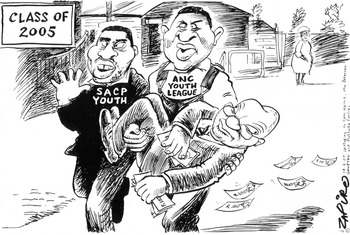
During the late 1990s, the South African government engaged in a large-scale set of negotiations to upgrade its military forces. The “arms deal,” as it became known in the media, provided a great deal of controversy as charges of corruption and influence peddling soon hit the front pages of the newspapers (see Figure 1 for Zapiro's take on the scandal). A special investigative unit that had been called into existence to probe organized crime and corruption, the Scorpions, was eventually called upon to investigate these claims, and soon the first culprit was brought to book. Tony Yengeni, the ANC's parliamentary whip, had obtained a large discount for a Mercedes Benz 4x4 in return for providing information to Daimler-Chrysler. The investigation turned its focus on several other involved individuals and soon the name of Shabir Shaik emerged as a prime suspect. Shaik, friend, confidant, and banker to Zuma, stood accused of having used his influence with the then-vice president to solicit bribes with which the ANC was able to fund a campaign of “weaning chiefs off the IFP”—the Inkatha Freedom Party, the ANC's political rival—in KwaZulu-Natal as well as help Zuma build a luxurious private residence in his birthplace, Nkandla. After much obfuscation and resistance, the state eventually prosecuted Shaik on corruption charges and, in his verdict, the presiding judge held not only that Shaik was guilty on several counts of corruption, but that a “generally corrupt” relationship existed between Shaik and Vice President Zuma.1
While Yengeni finally began serving his jail sentence in September 2006, years after his conviction and several appeals later, Shaik is still appealing his conviction.

The Class of 2005. This cartoon reflects on the change that has taken place within the liberation movement where the “youth” of 1976 paid a high price for their opposition to apartheid. In 2005, Jacob Zuma, depicted here as Hector Peterson, the first victim of the 1976 Soweto Uprising, is being helped by his ANC Youth League comrades, money pouring from his hands. © Zapiro, Sowetan.
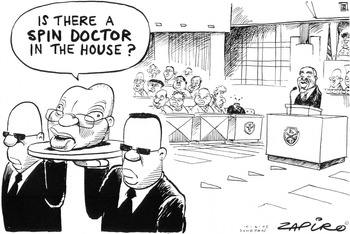
Following this verdict, the Scorpions felt that they had the legal ammunition to proceed with their case against the vice president. Zuma's defenders argued that a high-level conspiracy was in place to prevent him from becoming the next president of South Africa. The conspiracy theory was strengthened by President Thabo Mbeki's decision to relieve Vice President Zuma of his duties after the charges of corruption were laid against him in court (see Figure 2). Mbeki's decision to fire his vice president set off a round of furious intra-party contestation and marked the beginning of the struggle over the future leadership of the party. Above all, the union movement, the South African Communist Party, the ANC's Youth League, and, initially, the Women's League rallied around their champion, who began to conduct his campaign against Mbeki from his position as leader of the party. Mbeki, in turn, voiced his position by promoting Phumzile Mlambo-Ngcuka, then minister for minerals and energy and the wife of the chief of the National Prosecution Agency, Bulelani Ngcuka (Zuma's prosecutor), to the now vacant vice-president position. Mbeki also announced that he thought a woman should be the next president, indicating his wish that Mlambo-Ngcuka and not Zuma should succeed him. Zumawaged a defensive campaign from within the party until his political woes worsened considerably. He was accused of having raped a family friend, a HIV-positive woman, in his house in Johannesburg in late 2005.

Is there a Spin Doctor in the House? This cartoon reflects on the “axing” of the deputy vice president in the wake of corruption allegations against Jacob Zuma for involvement in the so-called arms deal scandal. © Zapiro, Sowetan.
At first, Zuma vehemently denied sexual contact with the plaintiff, claiming that these charges were part of the conspiracy against him. But once arrested and charged for the crime, he admitted to having sex with the woman but on a consensual basis. While his corruption trial was scheduled for July 2006, the serious nature of the rape charges against him necessitated an earlier trial.2
The corruption case against Zuma was dismissed in September 2006, by the presiding judge on a matter of several technicalities. This does not mean, however, that the state has abandoned its case against Zuma. Currently, Shaik's appeal is in motion and the prosecuting authority is awaiting the outcome before it decides to proceed against Zuma for a second time.
Gender activists were particularly incensed by the fact that the presiding judge allowed the defense to bear testimony designed to demonstrate that the plaintiff had a history of rape accusations. Zuma testified in his defense arguing that the woman had come to his house, wore “suggestive clothing,” and, once in bed, wore “only a kanga without underpants,” thereby re-enforcing the suggestion that she was sexually available. It needs to be noted that the kanga is worn throughout Africa and “is a hallmark of female modesty and respectability” (as one journalist noted) and not, as the accused would have it, a “revealing piece of clothing.” The mundane kanga was successfully sexualized and transformed into an object of seduction, much like the cigar in the Clinton-Lewinsky affair. Meanwhile, Zuma angered AIDS activists by testifying that he had sex with the HIV-positive woman without a condom, as he calculated that the risk of infection was low and, after showering, he would be able to minimize his risks even further. This appalling lack of insight was particularly striking as Zuma had been the chairperson of the AIDS Council of South Africa and, as UN envoy Stephen Lewis commented, should have known much better.
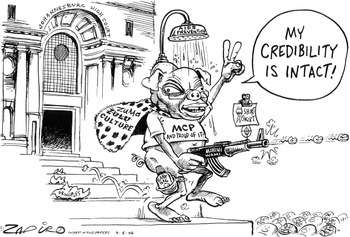
Throughout the trial, Zuma portrayed himself as the embodiment of Zuluness—he spoke only in Zulu and maintained that the sexual encounter was defined by the proper Zulu etiquette and that he had only done what any “proper Zulu” male would. Arguing that he was a successful lover—i.e., not in need of raping to get sexual satisfaction—he stated that he considered it culturally inappropriate to leave the woman in a “state of sexual desire” and therefore had to engage in sex with her as she would, according to Zulu tradition, then have been able to claim that he had raped her. Again, foregrounding his Zuluness, Zuma argued that he was prepared to pay lobola—bride money paid in cows—for the woman if she and her family so wished. Lobola, and patriarchal conceptions of women and sexuality, became the site upon which Zuma's claim to Zulu authenticity was played out. Some commentators, including many Zulus, suggest that Zuma's arguments have little to do with Zulu culture but are instead the product of Zuma's cultural imagination (i.e., Zuma Culture). His courtroom statements and behavior only fueled the fires of his support movement outside the court, which demanded his freedom, exoneration, and venerated their champion and his views on sexual consent and conspiracy. It came as only a mild surprise when, on May 8, the judge pronounced a guarded “not guilty” verdict in which the sexual personae of the accuser held overwhelming importance; this result has led many anti-rape activists to believe that the cause for rape victims in the country has been heavily damaged by the trial. Zapiro's reaction to the verdict and Zuma's post-verdict behavior prompted him to draw the highly unflattering cartoon shown here as Figure 3.3
Published in the Cape Times on May 9, 2006, this cartoon captures the anger felt by many that Zuma got off very lightly in this case and that he had destroyed his own reputation through his testimony rather than any court action taken against him. The machine gun alludes to Zuma having sung a liberation song (Umshini Wami) about “his machine gun” to his supporters and how he would like to use the gun to dispatch his opponents. The gun fires sperm bullets and is aimed at short skirts; the baby oil is ready for massaging any willing female; the showerhead refers to his having reduced the risk of contracting HIV through taking a shower after having had unprotected sex. All this is cloaked in “Zuma Culture” and membership in the Communist Party.

My Integrity is Intact. The cartoon reflects upon Zuma's exit from the High Court after having been held “not guilty” on rape charges. For more, see Note 3. © Zapiro, Independent Newspapers.
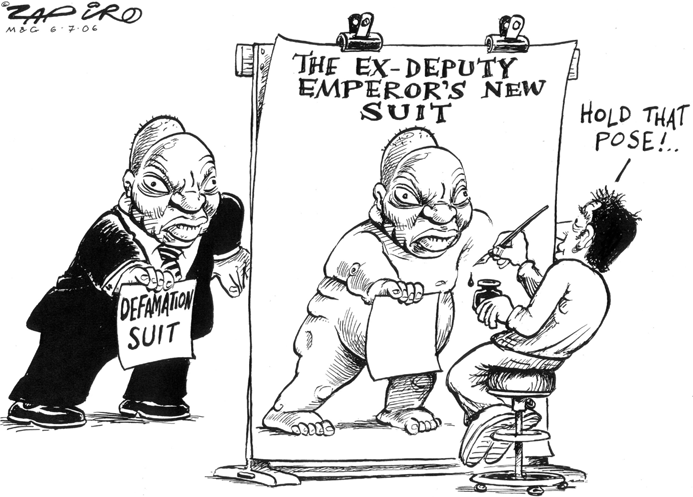
Zuma, upon receiving the not guilty verdict, came out of court vowing to take his revenge on what he perceived as a biased press. Within a few weeks of his release, lawyers acting on his behalf began legal proceedings against several major newspapers and against Zapiro personally (see Figure 4), claiming monetary compensation for having defamed Zuma and hurt his integrity. His lawsuit has drawn condemnation by a variety of local and international organizations concerned with press freedom, particularly Reporters without Borders.

The Emperor's Clothes. This cartoon was published in the Mail and Guardian, June 6, 2006, after Jacob Zuma threatened the cartoonist with legal action. Since then he has proceeded with the lawsuit. © Zapiro, Mail and Guardian.
Interview with Zapiro
Question-Robins and Koelble: Jonathan, you state in several of your cartoons that Jacob Zuma has become almost an “obsession” to you. You have certainly portrayed him in the most unflattering manner. Are you not concerned that your cartoons have gone “overboard”? After all, Zuma was pronounced not guilty of rape and he may get off on the corruption charges as well. What is your view on such a negative characterization and do you think it plays well with the wider public?
Answer-Zapiro: To a huge extent, politics is about image. The image a person has of her- or himself is different than the image presented to the public by utterances and actions. My unflattering portrayal of Jacob Zuma is entirely based on actual quotations of his where he has said outlandish, chauvinistic, and ignorant things about AIDS, women, and the rule of law, amongst other things. I was once an admirer of Jacob Zuma. I admired his commitment during the apartheid era, his pleasant personality, and his ability to establish rapport with people. I'm afraid that those qualities have been overshadowed by his recently displayed attitudes, his inability to control his own finances (let alone potentially the finances of the nation), and also the huge issue of his corrupt relationship with Schabir Shaik. As a cartoonist and therefore a commentator, I don't have to hold back if I feel these things strongly, which I do. I think negative characterization is justified.
Q-SR and TK: Are you not afraid of negative repercussions to your work? After all, you are creating caricatures of individuals that are rather simplistic but we all know that these are highly complex and sensitive situations. How do you deal with the issue of complexity? And what about the charge that you and the media in general play to the “chattering class” but are irrelevant to the broad mass of South African citizens?
A-Z: I'm not afraid of negative repercussions to my work. It goes with the territory. As to whether the caricatures I create are too simplistic, that's something that does concern me on occasion. It probably is a justifiable criticism of most cartoonists including me, but on the other hand it has been pointed out about my work by Jeremy Cronin [executive member of the South African Communist Party and one of the most influential poets in South Africa—editors] amongst others that I am greatly concerned with an investigation of the nuances and difficulties of being in government as opposed to the simplicity of being in struggle or revolution. This sort of cartoon often shows empathy with the protagonist rather than all-out character assassination. Where a character does occasionally become perhaps a bit stereotypically one-dimensional (which has perhaps happened with my recent portrayal of Jacob Zuma), a way of partially dealing with this is that I'm able to say different things about a character in different cartoons. I think people see the space I have in newspapers as a continuum of commentary.
As to who my cartoons play to (and I can only answer for my own commentary as opposed to that of the media as a whole), the first group would be the readership of a particular newspaper in which the cartoon appears. Because South Africa has such a high rate of illiteracy, that already defines my target group as being slightly out of the broad mass of South Africans. The five or six years I spent as an activist in the United Democratic Front [the domestic anti-apartheid movement of the 1980s—editors] in the 1980s defined my politics. Non-racialism, accountability, community oriented, gender-sensitive politics was the order of the day and I've tried to maintain a progressive approach which is still oriented towards these attitudes. In some ways I don't always care exactly who is going to be reading my cartoons when I draw them. I'm more concerned with the message I am putting out. I'm also lucky that because I am in the biggest weekly (Sunday Times), another very literate weekly (Mail and Guardian), and four large newspapers in four different cities during the week (Cape Times, Star, Mercury, Pretoria News), I know that the cartoons are seen by a lot of people. I know too that they get cut out by people working in organizations and posted on notice boards, so they are often seen by members of the public who are not necessarily newspaper readers.
Q-SR and TK: How do you see your role in the new South Africa? Do you see your work as a kind of moral mirror or lens or just as a way of making fun of the powerful? And what do you see as the future of the political cartoon in this country?
A-Z: I've always felt my role is both as a moral mirror and as a way of poking fun at the powerful. In fact I've used the metaphor of the mirror when I've spoken in public, calling it a warping mirror which provides a grotesque and altered reflection of events and personalities in order to make sharp and funny points. I've also often spoken of the role of the cartoonist as the court jester. In olden times the court jester was given more latitude than others to criticize the king, and I think the convention established in the newspapers gives the cartoonist latitude to use hyperbole and to be rude if necessary. Knocking the powerful off their pedestal and skewering sacred cows is an important thing in itself, as a kind of pressure valve for society.
I feel there is an important role for cartooning in South Africa at the moment. We as cartoonists are being taken more seriously than ever, as evidenced by Zuma's suing me and also by the recognition of cartooning in journalism circles. Cartoons are moving off the pages of the newspapers and into radio and television debates. The domination of Whites in cartooning is changing and young Black cartoonists are finding their way into major newspapers.