Perhaps no phenomenon in China’s jurisprudence has attracted more attention than judicial mediation. Over several decades, scholars have examined its function of governance and the effects on individual litigants (Cohen Reference Cohen1966; Lubman Reference Lubman1967, Reference Lubman1997; Clarke Reference Clarke1991; Peerenboom Reference Peerenboom2002, 288; Palmer Reference Palmer, Harding and Nicholson2009). Some have often touted judicial mediation as an extension of China’s nonconfrontational cultural tradition. Others have argued that judicial mediation helps maintain social relationships and reduces judicial costs (Wang Reference Wang2009; Xiong Reference Xiong2015). Allegedly, it contributes to social harmony and stability, paramount goals that are now pursued by the ruling Communist Party. Indeed, the high rate of mediation is often cited as proof of its success. Some recent studies, on the other hand, have criticized judges’ conflicting roles as both adjudicators and mediators in judicial mediation. Echoing earlier studies that have argued that judicial mediation in China is nonvoluntary, coercive, and manipulative (Cloke Reference Cloke1987; Huang Reference Huang2010), scholars have lambasted involuntary impositions of settlement (Chen Reference Chen2015, 106–25; Xian Reference Xian2015, 126–41).
But few have systematically explored the tactics of judges in the settlement. Some techniques are mentioned in passing (Su Reference Su2000; Ng and He Reference Ng and Xin2014; Xiong Reference Xiong2015). The official media often promote the mediating skills of model judges (see, for example, Peaceful Zhejiang 2012). But they focus on the timing, setting, patience, emotion, manner, and device. Examples include thinking in others’ shoes, playing the emotional card, mediating in a harmonious environment, “striking when the iron is hot,” and back-to-back negotiating (Xin Reference Xin2014, 190–92). Again, few of these sources have examined operational techniques. Moreover, due to the nature of political propaganda, these reports also intentionally omit anything inconsistent with the official position. For example, none of them mention repression, which is a major tactic in coercing litigants.
Primarily drawing on ethnographic observations of a civil judge from a basic-level court in a suburban area in hinterland China, complemented with secondary sources, I detail Chinese judges’ tactics at the micro level. By official accounts, judicial mediation resolves many cases in a way that seems satisfactory to the litigants.Footnote 1 How does it do so? What are the on-the-ground strategies and mechanisms through which confrontational litigants are led to agree on an outcome? How is the power marshaled and exercised? Following a long tradition in law and society scholarship of dispute transformation (Felstiner, Abel, and Sarat Reference Felstiner, Abel and Austin1980–81; Mather and Yngvession Reference Mather and Barbara1980–81; Merry Reference Merry1990, Reference Merry1994; O’Barr Reference O’Barr, Kramarae, Schulz and O’Barr1984), I focus on how judges negotiate litigants’ claims in judicial mediation. I find that the Chinese judge expands and narrows claims (Mather and Yngvesson Reference Mather and Barbara1980–81, 778). Yet, in addition, a judge has in her repertoire “repression,” “conversion,” and “facilitation.” The judges not only badger plaintiffs to drop their claims (Li, Kocken, and van Rooij Reference Li, Kocken and van Rooij2018), but they also convert or facilitate the claims. These tactics suggest a novel model of judicial mediation. The conventional wisdom is that, in judicial mediation, the judge serves a relatively non-interventionist role. He only supervises the negotiations, and he may not impose solutions. But, as will be shown, it is a three-way negotiation as the judge is also negotiating. Like the parties, he has things to gain and to lose; he is a stakeholder. More dominant than the parties, he is also an agenda setter.
In addition, I explore the inequitable consequences of the judge’s apparent success in disposing cases. In negotiating the claims, she convinces or coerces litigants who are economically vulnerable, inexperienced in the courtroom, legally bewildered, or timid in confronting a judge’s authority into the settlement. But the judge also encounters actual or perceived political resistance. She favors those litigants who can mount credible political threats to protest against the court. As a result, the interests of those who are vulnerable in one way or another, but not in a position to initiate political threats, are often dispensed. Inequalities are thus generated, reproduced, and reinforced.
THE JUDGE AS A NEGOTIATOR
According to the law on the books, negotiation and litigation in judicial mediation are often regarded as two distinct processes (Otis and Reiter Reference Otis and Reiter2006, 369; Robert Reference Robert2006).Footnote 2 In the United States, the pre-trial mediation meeting is to stop a formal trial (Resnik Reference Resnik1995). But, in reality, across the full range of contemporary and historical jurisdictions, they are linked. Speaking of a negotiated settlement in court, Marc Galanter (Reference Galanter1985, 1; emphasis in original) even suggests that “it is only a slight exaggeration to say that it is litigation.” It is “a single process of disputing in the vicinity of official tribunals that might be fancifully called LITIGOTIATION.” Only a tiny proportion of cases, at both the federal and state levels, are tried (Galanter Reference Galanter1986, Reference Galanter2004). The American judge is “a settlement judge instead of a trial judge.” Bargaining in the shadow of law is universal (Mnoonkin and Kornhauser Reference Mnoonkin and Lewis1979). As Martin Shapiro (Reference Shapiro1981, 9) asserts, “[m]ost judicial systems retain strong elements of mediation.” He then lists imperial China, Communist China, England, and several Islamic states as proof. The archival or ethnographic evidence also suggests that, in East Germany (Markovits Reference Markovits2002), Japan (Henderson Reference Henderson1965; Bryant Reference Bryant1984), and Taiwan (Moser Reference Moser1982), judicial conciliation and adjudication are intimately combined. The judges negotiated with their litigants with parental conviction (Markovits Reference Markovits2002), political ideologies (Fu and Palmer Reference Fu and Michael2015, 8), and moral values (Moser Reference Moser1982).
Given that the prevalent link between judicial mediation and adjudication is well documented, a three-way model of negotiation better captures the dynamics between the players. Judicial mediation is not just a two-way negotiation; the judge goes beyond the role of a go-between and is not a detached, neutral, and independent arbitrator. He has his own agenda and stakes. In this process, the interaction between the judge and the litigating parties is no less crucial. Partly due to the lack of this three-way model, the exiting literature barely pays attention to the negotiating tactics of the judge at the micro level. Galanter (Reference Galanter1985, 4–8) does provide some of the techniques of judicial participation, but he mainly focuses on devices facilitating mediation such as conferences and summary trials. The work of some anthropologists focusing on court clerks might be the only exception (Mather and Yngvesson Reference Mather and Barbara1980–81; Yngvesson Reference Yngvesson1988; Merry Reference Merry1990). Without knowing more about these tactics, one cannot understand exactly how the negotiation operates between the judge and the litigating parties. More importantly, such micro-level tactics, like the blood in the capillaries, illustrate how the judge’s power is operated and resisted. It also spells out the micro mechanisms that help to explain one of the most important consequences of such practice: does judicial mediation lead to inequalities?
The inequality question has long been debated. In his celebrated article “Against Settlement,” Owen Fiss (Reference Fiss1984, 1073) points out that resource disparities between parties can influence settlements. In particular, the poorer party is less capable of obtaining information about the litigation and the outcome and, thus, is disadvantaged in the bargaining process. But Fiss provides little empirical evidence to substantiate his speculations. After all, he never addresses the judge as a party in this negotiation process. In Galanter’s (Reference Galanter1974) classic capability thesis, he argues that the more resourceful “haves” come out ahead in litigation. But how his insights on litigation can be applied to alternative forms of dispute resolution, including judicial mediation, is far from conclusive (Galanter Reference Galanter1985; Menkel-Meadow Reference Menkel-Meadow1999). Barbara Yngvesson (Reference Yngvesson1988, 409) argues that this interactive and fluctuating process both “reproduces and transforms systemic inequalities.” Specifically, inexperienced complainants are subject to the influence of clerks and attorneys (426). She further asserts that complainants’ class, experience, power, and ethnicity each contribute to inequalities. But her works are based on court clerks instead of judges. The tactics of the gatekeepers are of course important, but they will be different from the judges who make the final decision.
STUDYING JUDICIAL MEDIATION IN WESTERN CHINA
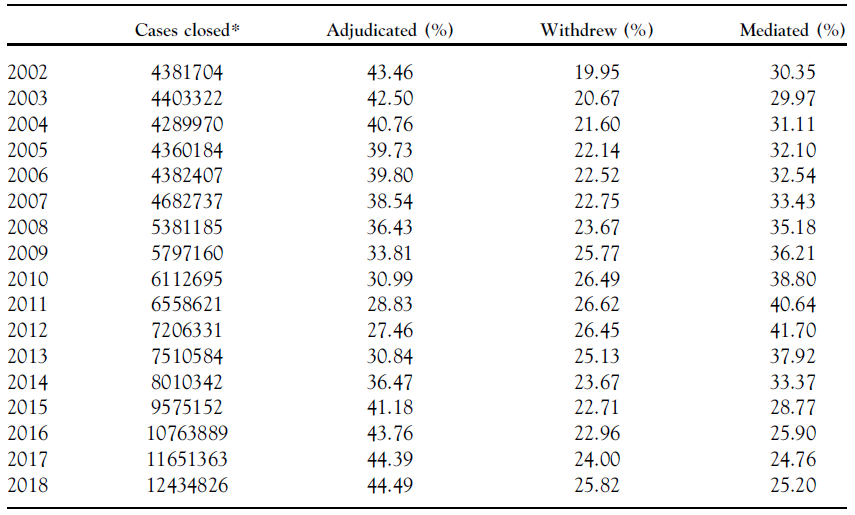
One of the most striking phenomena in China’s legal landscape is the stubborn plateau of judicial mediation. As shown in Table 1, combined withdrawal and mediation rates have remained between 50 and 60 percent throughout most of the Reform period. During various periods, depending on the political wind, mediation has been either stressed as one of the criteria to assess the performance of courts and judges (Minzner Reference Minzner2011; Li, Kocken, and van Rooij Reference Li, Kocken and van Rooij2018) or a backward trend to judicial professionalism (Fu and Cullen Reference Fu and Richard2011). Nonetheless, mediation has always been a signature production of China’s civil justice.
How civil cases are resolved in the Chinese courts (2002–18)

Note: * The number of cases closed from 2002 to 2010 excludes intellectual property and maritime cases, while these are included from 2011 to 2018.
Source: China Law Yearbooks (Beijing: China Law Yearbooks Press, 2003–19).
As far as the mediation rate is concerned, the court in the present study demonstrates a similar trend. Located in Southern Shaanxi Province, in Western China, its mediation rate has always been relatively high. With respect to its population, about a third of its 430,000 residents live in the countryside. The region’s economy grew steadily during the Reform period; by 2018, the gross domestic product per capita had reached 48,900 yuan (one yuan = US $0.14 as of this writing), or three-quarters of the national average. Located thirty miles from the provincial capital, it is a typical suburban area that has experienced dynamic economic and cultural transformation over the last two decades. Population mobility has soared, and, along with the process of urbanization, land requisition has been common. Since 2016, the court has heard more than six thousand cases annually, most of which have been civil, criminal, and enforcement cases. Overall, the court’s jurisdiction is of medium scope within China’s lower-level courts.
Following the recent judge’s quota reform, the number of judges has declined (He Reference He2021b). At the same time, caseloads have increased due to the case registration system, under which all cases are accepted without review and filtering (Xia Reference Xia2018), and the emphasis on enforcement and socioeconomic development. The total increase in caseloads has been roughly 40 percent. As a result, caseloads per judge have doubled from eighty in 2015 to 170 in 2018 in this court. As a result, these judges have been under pressure to handle cases efficiently. The thrust of the recent reforms has been to “let the adjudicator judge, but hold those who judge responsible.” While judges can make most of their decisions free of their supervisors’ approval, they are held responsible for their decisions for life. With the heavy caseload, mistakes are common, especially when the definition of “mistake” is vague. It may be discovered by a litigant’s petition, an investigation in another case, or an inspection by the appellate court.
On the other hand, concerns about personal safety loom large—judges often face threats, or even physical attacks, from resentful litigants, especially after making controversial judicial decisions (He Reference He2017; Zheng, Ai, and Liu Reference Zheng, Ai and Liu2017). They also need to bear insults from troublesome litigants and the subsequent investigations. Judicial transparency only aggravates the situation (Ahl and Sprick Reference Ahl and Sprick2018; Harvard Law Review 2020). Massive investment has allowed the hearings to be livestreamed (Finder Reference Finder2016), and most of the adjudication documents end up online. This allows big-data analysis of every judge’s propensities, traits, and stripes. Even a typo could turn catastrophic (Xinhua Net 2017). Under a regime that prioritizes social stability, and in which populist ideology has been reinvigorated, judges’ insecurities are intensified (Trevaskes et al. Reference Trevaskes, Sapio, Biddulph and Nesossi2017; Lin and Trevaskes Reference Lin and Susan2019).
Under this institutional environment, many judges prefer to get cases mediated, even though the mediation rate has ceased to be a criterion in assessing the judge’s or the court’s performance. There are many benefits to settling a case: the decision is reached by the consensus of the parties so that they will not appeal or complain. It also will not result in a wrongfully decided case. Thus, they are exempted from lifelong responsibility. If the cases are withdrawn before their hearing, it will even save the judge from the hassle of hearing and writing the judgments. Under China’s civil procedure, the distinction between mediation and adjudication is blurred. Unlike the stereotype of mediation, Chinese judges in judicial mediation are both the mediator and the adjudicator. They have the power to render a binding judgment should the litigating parties fail to settle. Due to their own concerns listed above, they are not merely neutral facilitators. The civil procedure also leaves individual judges massive leeway in mediation. They can conduct mediation across all stages of the case process: before the case filing, during the hearing, and even at the enforcement stage after a decision has been decreed. It can be conducted either with or without the presence of the lawyer, if indeed there is a lawyer on the case.
In the past, most judges and court staff were locals. This changed with the recent judicial reforms, after which new blood was recruited from across the country. In the meantime, about one-third of the judges are non-locals, usually with formal legal training. The judge on whom I focused was born and raised locally, as were the majority of her colleagues. She was recruited to the court in 1988, right after high school. Over three decades, she has worked as a clerk, assistant judge, and judge. She has rotated through the civil and criminal divisions and has been promoted to the deputy head of the political department. In the wake of the judge’s quota reform, she gave up her administrative position and has since become a quota judge in the civil division. Decades of experience in the court, and familiarity with local affairs, provide her with thorough understanding of the law, court operations, political sensibilities, as well as the local culture. Unlike judges who have recently graduated from law school, and who rely on legal technicalities to control proceedings, this judge uses her knowledge of local communities to detect the litigants’ utmost concerns and weaknesses. Through skillfully timed questions, she controls the range and pace of the information presented. Rather than focus on legal problems, she seeks workable solutions. Her pragmatic approach to the root of the disputes allows her to cut through the complexities of relationships and emotions that the legal proceedings may evoke. Never hesitant to interrupt hearings, she is particularly skilled at striking a balance between the two litigating parties.
In the hearing in which a disabled team leader of migrant workers (工头) sued a labor company over unsettled wages (the Disabled Team Leader case), the labor company’s legal representative not only denied the man’s claims but also claimed that “the man’s work has caused damages of tens of thousands of yuan to the company.”Footnote 3 The judge almost lost her cool: “The plaintiff has provided service for you; you not only refuse to pay, but suggest that he has caused damages! Are you making counterclaims? If so, pay the corresponding litigation fee first!” The labor company’s legal representative, taken aback by the judge’s outburst, was subdued enough to withdraw the claims. In the Man Who Married into the Wife’s Family case (倒插门), the female was aggressive, demanding not just divorce but also that the man, who was from a remote area, pay “the vacant bed fee” (空床费), because he had moved out of the matrimonial home after their fights. During the mediation session, the judge scolded the wife for the request. She refuted the wife’s claim as ridiculous because she had ignored that the man’s family had paid a high bride price for the marriage. The wife’s aggressive position was repressed. Eventually, both cases were settled.
For various reasons, getting a case settled or withdrawn has become more difficult (Fu and Cullen Reference Fu and Richard2011). This judge’s mediation and withdraw rates were 33 percent lower than the court average, which had been 44 percent in 2019.Footnote 4 Apparently, she had been pleased to get cases mediated. If one case was mediated, the judge explained in her own words, “[i]t was really my day.” I have known this judge from other projects for a decade. With mutual trust, I was allowed to sit in the courtroom throughout the trial process, including the mediation. I visited the court in the summers of 2017 and 2018, each for about a month. I have observed more than fifty trials, and these observations constitute the bulk of my data. As an observer, I was also present in the private caucus of a mediation session when the litigants threatened the judge. I saw how the intended goals of the law are twisted and slighted, how the meaning of the law is constructed and contested, and how the ideologies of the judge and the litigants both clash and compromise. Raw and unfiltered tales unfold behind the curtain of China’s judicial mediation. They allow a rare peek behind closed doors and are particularly invaluable because the mediation process barely leaves any paper trail. As will be shown, my thick descriptions and analysis, by providing the nuanced dynamics between the judges and litigants as well as the psychological and behavioral reactions of the litigants, offer a fresh perspective to the study of judicial mediation in China.
Audio and video recording of court proceedings is prohibited in China. Thus, during my fieldwork, I relied mostly on written notes. While my notes are comprehensive, they are not detailed enough to allow minute attention to micro features such as lapses, overlaps, silences, or paralinguistic features such as stress and intonation. That said, I consider the notes to be sufficient for the purposes of this analysis. Despite its limitations, the data is valuable considering the limited amount of socio-legal research on Chinese courtrooms. Names and other identifiers have been changed to protect the identities of the litigants and counsels involved.
CLAIMS NEGOTIATING
Due to the heavy caseload, it is almost impossible for the judge to carefully review case files, conduct field investigations, and schedule mediation sessions before hearings, as was done at the beginning of the Reform (Huang Reference Huang2010). This time pressure makes settling cases a challenge. Sometimes, the judge takes advantages of the litigants’ early arrival to hold impromptu mediation sessions. Some mediations are conducted right after the respective court hearing. Most cases are hotly contested or else they would not have progressed into litigation. Despite the difference in the nature of the cases, the judge develops a repertoire of strategies to negotiate the claims raised by the litigants as well as by the plaintiffs, in particular. These tactics fall into five principal categories: repressing, narrowing, converting, expanding, and facilitating the claims. Some of the tactics are used in tandem, and when one tactic does not work, she switches to another.
Repression
The first strategy is to repress the claims. Repression differs from rejection, in which the claims lack proper legal basis. In this case, a judge can simply reject claims based on the civil procedural law. Repression, however, occurs when the claims are legally sound. The judge simply convinces the litigant to drop the claims. The claims are thus repressed. In the Singapore Laborer case, the wife sued her husband, a migrant worker based in Singapore, for divorce. She could not provide a valid address for her husband so she sought the judge’s help. For the judge, this constituted a natural opportunity for mediation. In their conversation, the wife detailed the beating that had occurred during the Spring Festival when her husband had returned from Singapore. According to the wife, the underlying reason for the beating was that she had not given birth to a boy. The judge was not interested in the causes. Nor did she pursue the death threat that the husband had uttered (“I will kill you all”) or investigate the swollen face or bruised eyes the woman had claimed. Her subsequent question was straightforward: “Are you able to afford to raise the two girls yourself after the divorce?” After sobbing and deliberation, the woman, who only worked part-time as a supermarket cashier, decided to withdraw the case.
The judge had been skillful. She had guided the woman to consider her vulnerable economic position, assuming that, upon being divorced, she would have to support herself and the two children alone. What the judge had not mentioned was that the court could have, according to the law, adjudicated a divorce for her. At the same time, it could have required the husband, who had a respectable income in Singapore, to provide child support. Had the woman been informed of this option, she might not have withdrawn the case. However, that suggestion would have meant that, for the judge, instead of eliminating a case, she would have created a new one.
In the Shanghai Migrant Worker case, the wife sued for divorce because her incompetent husband had harmed her genitals to the extent that she was unable to walk. He had done this, allegedly, in order to release his own sexual anxiety. She had fled to Shanghai as a migrant worker, and the two had been separated over a year. However, the judge cited social stability and a paramount concern for China’s political regime to repress the divorce claim. The husband’s family background had been dismal. He was the only one who was employed but with a low income. His brother was unemployed, and, more importantly, his mother was mentally ill. A divorce decision may have agitated the husband, who apparently could not find another wife. It also could have agitated his family members. They may have committed suicide or become homicidal; they may have filed petitions to the upper-level government, accusing the judge or the court of a wrongful decision. The judge utilized this possibility to repress the wife’s claim. Even though she admitted to her lawyer “no way will this marriage persist,” and “his request has little legal basis,” the judge framed her statements in political discourse: “We cannot wipe out the hopes of his whole family.”
Indeed, repressing claims is common in divorce cases. As shown by numerous studies, the claims for divorce and domestic violence compensations are frequently repressed (He Reference He2009; He and Ng Reference He and Kwai2013a; Li Reference Li2015; Michelson Reference Michelson2019; He Reference He2021a). As far as the law is concerned, the issues of divorce, property division, and child custody are independent of one another. Each issue has its own governing principles and rules. Divorce is determined by whether or not mutual affection has broken down. Child custody is determined by the child’s best interest. According to the law, the decision on one issue should not affect the other. However, these three issues are interwoven, especially in mediation. The judge has to weigh all of these elements in mediation. Whether one agrees to be divorced, for example, may depend on how the other two issues are negotiated. For a judge, these are the three bargaining chips for mediation. When the issue of divorce is contested, the other two bargaining chips become useful. If one party is steadfast on child custody, for instance, the claims for divorce or property rights have to be repressed (He Reference He2021a, 196).
Narrowing
The second tactic is to narrow the claims. It means that the judge truncates parts of the broad claims originally initiated by the litigants. The claims are thus easier to be focused on and settled. While judges in other jurisdictions may also narrow the claims for other purposes (Mather and Yngvesson Reference Mather and Barbara1980–81; Yngvesson Reference Yngvesson1988; Merry Reference Merry1990), Chinese judges are to “dispose of the cases” (compare O’Barr Reference O’Barr1994, 371). Unlike repression, which forces the withdrawal of the claims, narrowing only refines them. When a direct settlement cannot be struck, narrowing paves the way for the final decision to be accepted. Such a strategy has been documented by Kwai Hang Ng and Xin He (2014), based on our study of a court in the coastal region. A young, professional judge skillfully narrowed the claims for child support to one hundred yuan and successfully struck a settlement.
In the Farther-in-Law case, both the defendant and the judge’s clerk were late for the scheduled hearing. The judge then initiated an informal mediation with the plaintiff. Only at this moment did she discover that the plaintiff was the defendant’s father-in-law. He had been hit by the defendant who had gone to his home to request his wife’s (the plaintiff’s daughter’s) return. The claims had totaled thirty-five thousand yuan, including medical expenses, lost wages, broken locks, and “spiritual damage.” The defendant had already been detained by police for ten days and had been fined two hundred yuan. The judge’s first attempt was to repress the claims: “Technically you are the defendant’s father-in-law. Is it really worth a fight in court? Why don’t you just settle?” Instead of engaging legal claims, the judge focused on the common ground: the young couple was still married, and they may still have had a future together. This strategy echoes Susan Silbey and Sally Merry’s (1986, 16) “selecting issues.” Yet the father-in-law was determined to go through with the court proceedings: “No way! I am not settling. I do not care how much the court asks him to pay. But he has to pay. He beat me and he said he would not pay a cent.”
The plaintiff seemed agitated from being hit by his son-in-law, and he resisted settlement. Realizing the emotional component of the claims, or the cultural dimension (Merry and Silbey Reference Merry and Silbey1984), the judge changed her strategy. She scanned the file page by page and said: “You also asked for lost wages, transportation fees, personal care fees, medical fees, and lock repair fees. Where is the evidence?” After the plaintiff shook his head, the judge continued: “A lawsuit is all about evidence. You only have evidence of medical expenses. Without other evidence, how can I believe that you suffered those loses? How do I know you are a taxi driver or how much your income is? Does the medical record state you missed work for 50 days?” She challenged his job status, his income, and other claims. In other words, the original claims were narrowed to the medical expenses only. This strategy, once again, served to suggest that it was not worthwhile to go through the hearing with a small stake; the plaintiff had better settle.
When the father-in law still refused to settle, the judge further narrowed his claims: “Usually we only recognize lost wages for the period of hospitalization. And you asked for ten thousand yuan for spiritual damage. But the spiritual damage is only granted for serious injuries.” To make sure that the narrowing strategy worked, the judge confronted the emotional issue: “I know that you just want to save face by taking your son-in-law to court, because he hit you. But in the hearing, I need you to show evidence for every item. If you cannot produce it, I will blame you for unpreparedness. Your son-in-law might laugh at you and you would lose face instead.” She stated that the court would only recognize the hospitalized period for lost wages. She also hinted that the spiritual damage would not be upheld. To this point, the claims had been narrowed from thirty-five thousand yuan to 2,535 yuan for the medical expenses. Understanding that the plaintiff was suing primarily to vent his grievances, the judge suggested that the plaintiff would lose face precisely because he could not produce evidence. Emotional issues should not cloud the legal issues. His goal of venting grievances would not be successful. Without evidence, the emotional claims would have to be truncated as well.
When the defendant showed up, the judge asked him to wait in the small courtroom across the corridor. After talking with the plaintiff, she approached the defendant: “You beat him so hard, causing two broken bones. You have to pay the damages.” Stoically, the defendant said, “I have no money. What can he do to me?” The judge said: “Should your father-in-law seek judicial appraisal, the injuries would definitely constitute light injury in the criminal sense, and you would have to do time. Given how angry he has been, he would surely send you to jail. You’d better just pay, whether or not you have money. Otherwise, the police and the prosecutor will handle this case.” Apparently, the judge had already noticed the broken bones when she was reviewing the files. Given her background as a criminal judge, she knew that it would constitute “light injury.” As mentioned, her strategy was to narrow the claims, not to instigate new claims. She had no obligation to inform the father-in-law of this information. Later, she told me: “I am not his lawyer. My job is to dispose of the case.” She had saved this point for the defendant because it was a powerful bargaining chip for coercing him to settle.
Due to the father-in-law’s stubbornness, the case was not settled; the hearing went on. What transpired in the court hearing, however, was surprising: when the plaintiff stated his requests, the original requests for thirty-five thousand yuan became only 5,885 yuan. The defendant’s response was no less surprising: “I am willing to pay off the requested money.” His original defensive position had melted. Although he had no money to pay on the spot, he was willing to pay later. Both parties were pleased with how the case had ended, which resulted in the same outcome as mediation.
Converting
When it is difficult to reach a solution within one dispute paradigm, switching to another paradigm may mitigate the confrontation (Comaroff and Roberts Reference Comaroff and Roberts1981). Converting means turning the original claim into another one. These tactics often occur in contentious cases, in which neither party is willing to make a concession, and repressing or narrowing will not work. The judge then switches to another dispute paradigm or applies a new rule. In Barotseland, the judge converted a dispute between a headman and his kin over the use of dams to one over the headman’s fitness to rule (Gluckman Reference Gluckman1955, 189). In litigation-related petitions, a common strategy of Chinese judges is to convert substantive claims to procedural ones (He and Feng 2016). In a Chinese case known as the Irate Husband, the court converted an injunction against a threat into a counter-claim for compensation and imprisonment (Su Reference Su2000; for a translation, see also Upham Reference Upham2005). In this case, the plaintiff, having had an affair with his neighbor’s wife, filed for an injunction against his neighbor’s threats. The neighbor, allegedly harmed by the adultery, had threatened to kill the plaintiff and his child unless he was compensated ten thousand yuan. “After much cajoling and threatening of both sides,” the court broke a deal by which the plaintiff, after spending thirteen days of “protective custody” in jail, paid the neighbor eight thousand yuan (Upham Reference Upham2005, 1690). Thus, the plaintiff’s claim for protection for personal safety was converted into imprisonment plus a fine. This conversion of claims occurred despite adultery not being a crime and the neighbor’s persistent threats of harm. Everyone was satisfied with the result, and the case was disposed.
In the Old House case, six married sisters, along with the daughter of the younger brother who had died in a traffic accident thirty years before, sued their elder brother’s family for the old house left by their parents, who had passed away ten years before. The plaintiffs’ intent was to allow the younger brother’s daughter to inherit the house so that she would have a place to stay when she pays respect to her parents and grandparents. When her father died, she had been only two years old. Under her grandparents’ arrangements, she had been raised by her eldest aunt—the eldest sister of the six, who was married in Xinjiang, thousands of miles from Shaanxi. Each of these six sisters believed that the daughter had every right to inherit the house on behalf of her father. They also signed a written document transferring their rights to her.
The petition, however, was fiercely resisted by the elder brother’s family. They believed that each of these married sisters had been “water splashed,” and, thus, they had no right to the parents’ house. Nor did the daughter. She had also been away from home for thirty years and had been adopted by the eldest sister. The elder brother’s wife threatened that if the sisters kept suing for the old house, she would flatten their parents’ graves, which were located on her farmland! The judge paid a visit to the old house. Empty and dilapidated, the only item of value was an old sycamore tree in the courtyard. When the judge visited the elder brother’s home, she was beleaguered. The family members shouted “money” throughout the process; it seemed money was the only way they would give up the house. When the judge met one of the six sisters, she first repressed and narrowed the claims: “The daughter of your younger brother has formally been adopted by your elder sister; the adoption was notarized. Legally speaking, she was not the daughter of your younger brother anymore. Therefore she cannot inherit the legacy of your parents on behalf of your younger brother through ‘vicarious succession.’ In reality, the lawsuit is all about you who want to partition your parents’ property.”
By stating that “the lawsuit is all about you who want to partition your parents’ property,” the judge converted the younger brother’s daughter’s claim over the legacy to a claim from the six sisters over the legacy. In most areas of rural China, the local custom holds that females have no right of inheritance (compare Merry and Stern 2005). In other words, it was acceptable for the daughter to sue for the legacy because she had acted on behalf of her father—the younger brother—but it would have violated the local custom for the six sisters, who had each married, to sue for this legacy. Citing the local custom, the judge pushed for a settlement:
Your elder brother’s family hates all your sisters to the core. The villagers also believe that you guys are making a fuss: it is unheard of for daughters married out for decades to fight for the legacy of the matrimonial family! And for such a dilapidated house. At the end of the day, you damage the relationship with your matrimonial family, having no place to stay when worshiping your parents. You might not even be able to keep their graves should your sister-in-law remove them!
Despite the state law endowing equal inheritance status among males and females, the judge had invoked a local custom to construct the dispute. To fight for the matrimonial family’s legacy was culturally inappropriate and, thus, would have encountered much resistance from not only the elder’s sister’s family but also from the villagers. Moreover, the lawsuit might backfire: their parents’ graves might be removed. The suit was not worth fighting: the value of the house was too little for all the effort and damages! The local custom, social norms, and practical difficulties had prevailed over the law. The judge then proposed a settlement: “If you really want the house, maybe you guys could pay the elder sister’s family some money. That is all they want. You can still keep a good relationship with them. Then they would not prevent you guys from renovating the house and passing it to your younger brother’s daughter. Sound ok?” The judge finished by converting the claims. A lawsuit originally based on the right to inheritance was converted to a bid to buy the house from the elder brother: “Maybe you guys can pay the elder sister’s family some money. That is all they want.” In such a settlement, rights are forgotten, and local culture replaces state law. In short, what Carol Gilligan (Reference Gilligan, Heller, Sosna and Wellbery1986, 242) terms “inclusiveness” has trumped “fairness.”
By the time I finished my fieldwork, a settlement had yet to be reached. The judge vented her frustration to me over these “garbage” cases: little value, but fierce confrontation. She had nearly been threatened by the litigating party! Tremendous effort was necessary to reach a settlement, but neither party seemed satisfied. Unanticipated resistance may ruin the chances for a possible settlement, and the judge’s authority and power were contested (Lazarus-Black and Hirsch Reference Lazarus-Black and Hirsch1994). One matter is clear though: without the tactics of conversion, there would be more resistance from both parties.
Expanding
Lynn Mather and Barbara Yngvesson (Reference Mather and Barbara1980–81, 778–79) argue that disputes may also be expanded in terms of a new framework outside the existing categories for events and relationships. Expanding occurs when new issues may be added, the arena of discussion may be enlarged, and the number and variety of participants may increase. Silbey and Merry (Reference Silbey and Merry1986, 16) also find that mediators often broaden issues and identify common ground for both parties to exchange. Chinese judges occasionally expand claims to facilitate exchanges between the parties in order to reach a final settlement. As Hao Xiong (Reference Xiong2015) documents, the judges in Yunan province in the southwestern region of China expanded the monetary claim to emotional and psychological claims in judicial mediation.
In the Man Who Married into the Wife’s Family case, the wife filed for divorce for a second time within the first year of their marriage. In the pre-trial mediation, the judge spoke to the man first. Tall, good-looking, but shy, the man was from a remote area. Apparently, his humble family background had been why he had been willing to marry into the wife’s family. Under China’s patrilineal culture, men who marry into their wife’s family are to pass their bloodline on to the wife’s lineage, which would be less desirable for men of an equal social status (Stacey Reference Stacey1983). When the judge asked him in private if he was willing to accept divorce this time, the man was hesitant: “I would rather not, if possible.” He was accompanied by his cousin who added: “It is not easy for a young man to get a wife these days. His family spent a lot on this marriage and are still paying a high-yield loan.” Then the man said: “If the divorce is inevitable, can I have the twenty-five thousand yuan back, that is, half of the bride price?”
From the conversations, the judge understood the man’s position: the man had been overwhelmed by financial concerns because of his family’s monetary investment in the marriage. Yet he was willing to be divorced as long as the compensation was reasonable. Then the judge talked to the wife’s side in private. As mentioned, the wife was aggressive, demanding the so-called “vacant bed” compensation from the man. The judge first ridiculed this legally baseless claim (repressing), then requested that she return the bride price in exchange for a divorce. She bombasted her with five rhetorical questions:
Did they just pay you the bride price? The man’s parents spent tens of thousands of yuan for this marriage. Didn’t they invite your relatives to the celebration banquets? Didn’t they buy your clothes, jewelry, furniture, electronics, and other valuables? You have been married only a little over half a year. What business would allow you to earn so much? Isn’t it fair for you to return the bride price?
In addition to these rhetorical questions, the judge compared the wife’s take on the marriage to a business. She asked: “What business would allow you to earn so much?” A marriage, of course, is not a business, nor is its purpose pecuniary. This comparison stigmatized the wife’s position and thus provided extra moral force to coerce her.
If the judge’s “little sermons” had little impact on the wife’s position, they surely affected the wife’s mother, who accompanied her to the mediation session (compare Yngvesson Reference Yngvesson1988, 426). Slightly embarrassed by her daughter’s position, she apologized to the judge for the young woman’s immaturity. Then she murmured to the wife something about the divorce and land requisition. The judge, given her familiarity with the plaintiff’s location and the local affairs, realized that the wife’s house might be subject to eminent domain, and an earlier divorce would be essential for the wife’s land compensation, and she explained:
Upon divorce, the man’s family lost both the person and the money (人财两空). How could they swallow the grievance? Should the court award a divorce for you, can your personal safety be assured? So you should return at least thirty thousand yuan of the bride price, along with the jewelry. Thirty thousand yuan is just off the top of my head; I don’t know if the man will agree with it or not. If you disagree, then the divorce has to be put off.
Her statement “then the divorce has to be put off” was powerful. The judge’s shrewdness with respect to the concerns of the parties, and her familiarity with the community, were crucial to forging a consensus: the man was willing to be divorced as long as there was reasonable compensation; the wife was eager to get a divorce so as not to dilute her land compensation. In balance, the wife, though she had an aggressive personality and position, would have had more to lose if the divorce had once again been put off. The man, as the judge said to the wife, had lost both his wife and a great deal of money and may have found himself in a desperate position. The likelihood that he would have protested the divorce decision would have been higher than that of the wife protesting the delay. Thus, the judge kept expanding the claims for the man, ensuring that he was content with the outcome.
Eventually, the judge not only talked the wife into a settlement but also expanded the man’s requests: thirty thousand yuan of the bride price was to be returned. This was higher than the man’s original request; the nuptial jewelry was to be returned as well. Strictly speaking, the legal rules did not justify the return of the nuptial jewelry because they had been married over half a year.Footnote 5 Nonetheless, the judge pushed for it. In return, in a settlement agreement, the judge ensured that the man had revoked his household registration in the wife’s village, so that her share of the land compensation would not be diluted. The expanded issues, including more monetary compensation for the bride price, the cancellation of the household registration, and the return of the jewelry, provided more room for both litigating parties to settle.
Facilitating
Unlike repressing and narrowing, in which claims are truncated and muddled, facilitating strengthens the claims. It places one party in a legally advantageous position so as to settle the case. Unlike expanding, facilitating does not add new claims, nor does it encroach on new areas. Rather, it reinforces the existing claims. As argued by Robert Mnoonkin and Lewis Kornhauser (Reference Mnoonkin and Lewis1979), when a court decision can be predicted, bargaining outside the courtroom transpires. In China’s judicial mediation, the judge often facilitates one party’s claim. A pragmatic judge depicted by He and Ng (Reference He and Kwai2013b) facilitated the claims of the husband for divorce. She urged the wife to accept a divorce settlement earlier; otherwise, the wife would further jeopardize her financial situation. In another study, the claims of the husband in resisting divorce were facilitated by the appeal-level judge in the judicial mediation, who cited that their mutual affection had not truly broken down (He Reference He2021a, 131). In mediating labor disputes, such a strategy is often employed by Chinese judges in Guangdong province (Chen and Xu Reference Chen and Xin2012).
In the Business Man case, a businessman sued a female doctor, who owned a mid-sized hospital that could accommodate two hundred patients, for a one personal debt of hundred thousand yuan. Due to her clerk’s negligence, the judge was not notified about the case until twenty days before the closure deadline (three months under the simplified procedure). She then rushed to process the case. However, when the petition, the subpoenas, and other relevant documents were mailed to the defendant, the package was returned because “the addressee does not exist” and nobody answered the phone. Due to the approaching deadline, the judge asked if the plaintiff could withdraw the case first and then file again after the new year, a common maneuver to improve the case closure rate. The plaintiff rejected the request. The judge then threatened to reject the claim on the grounds that the plaintiff could not provide a valid address for the defendant. The plaintiff said:
When I filed the lawsuit, the defendant was right at her hospital. Now she has disappeared because of the court’s delay. About the same time I had another case filed in the neighboring court, which has already granted me the judgment. If you cannot offer me a reasonable explanation for this delay, I will have two mud diggers in front of the courthouse, blocking your entrance!
Apparently, the plaintiff was a difficult character. Shrewd and cunning, he seemed to be a master of court operations. To block the courthouse entrance with two mud diggers was the last thing the judge wanted. From her interaction with him and his thuggish background, she felt that his threats were realistic. If mud diggers actually blocked the court’s entrance, the court leaders would not be able to remove them because of illegal parking. Instead, they would first question if the judge had taken any bribes or other unlawful transactions. Then they would go through the case files to examine any inappropriate procedure (Finder Reference Finder, Devlin and Wilderman2021). In addition, the media’s reaction to such a picture would be that “the court and the judge must have done something egregious that the litigating parties have to protest in this way!” (compare Xinhua Net 2017). The court leaders or the party’s disciplinary division would not take into account the fact that the judge had been overburdened by heavy caseloads. Instead, they would punish the judge for any issues so as to make sure that the incident was under control.
Fearing such an outcome, and also because the way in which the case had been handled was not impeccable—the subpoena had not been served in time, even though it was still within the time limit—the judge took the initiative to look for the defendant. With a luxury car provided by the plaintiff, they went to the defendant’s hospital. During the journey, the judge learned that the plaintiff and the defendant had had numerous loan transactions. The plaintiff had also boasted that they had had a sexual relationship. While they did not find the doctor at the hospital, the judge and the plaintiff served the doctor an absentee notice, which was deemed to have been delivered legally. While examining the evidence, the judge found another discrepancy: while the evidence of payment was signed by the defendant, the money had been transferred from the plaintiff’s wife to another unrelated third party. Since it was hard to get witnesses to appear at the court hearing (He and Ng Reference He and Kwai2013c), the judge took another trip with the plaintiff to find the third party, who verified the transaction. With all the evidence collected, the hearing was merely a show. The defendant did not appear, but her legal representative accepted all of the claims. Her representative simply asked for more time to pay, which the plaintiff granted.
In this case, the judge could have repressed the claims. Under the simplified procedure, the judge and the court are under no obligation to serve a notice. The rules are that the plaintiff must provide an accurate address. Otherwise, the court can dismiss the claims after it has been verified that an unsuccessful attempt has been made to serve the notice.Footnote 6 At the very least, the judge was not supposed to take trips with the plaintiff to locate the witness because whoever makes the claims must bear the burden of proof. As a result of her heavy caseload and the strict deadlines to close cases, there was no way the judge could have made such efforts for all of her cases. Moreover, the plaintiff had had sexual a relationship with the defendant, which would have blurred the line between a loan and a gift. Indeed, when the plaintiff boasted of his sexual relationship with another woman, he confessed that he could not recoup his loan because of the relationship. The judge could have pressured the plaintiff to forgive the debt, given her shrewdness on social norms. Nonetheless, she did not take this route. Instead, she chose to facilitate the claims by making herself available for the investigation and for serving the notice. Thus, she ensured that all of the evidence was secured for an inevitable settlement.
INFORMATION ASYMMETRY
The process of China’s judicial mediation is far from the prototype of “an independent judge applying legal rules to achieve an all-or-nothing outcome,” as perceived in litigation in common law jurisdictions (Shapiro Reference Shapiro1981, 1). Rather, it is constantly negotiated, twisted, or manipulated. How can the judge have such a powerful impact on the claims? I argue that it is through her knowledge of the law that the judge legitimates and amplifies her power. Behind the litigants’ claims is their legal consciousness: how they view disputes and understand and interpret how the law determines what claims they put forward (Merry Reference Merry1990; Ewick and Silbey Reference Ewick and Silbey1998). However, legal consciousness is processual and affected by the individuals’ experiences, especially by those around them (Silbey Reference Silbey2005; Young Reference Young2014). In the setting of China’s judicial mediation, nobody would have been more influential than the judge. The judge controls not only the actions of those they dominate but also the language through which individuals are subjected to their domination (Bourdieu Reference Bourdieu1987). Misunderstanding is induced. Thus, the mediation subtly blends consensus with coercion, merging imperceptibly into the “gentle, invisible form of violence which is never recognized as such” (Bourdieu Reference Bourdieu1977, 191–92). In several ways, the judge enjoys enormous inherent advantage and takes advantage of her structural position to maximize this effect.
First, the judge is far more knowledgeable than the litigants on the law, the procedural rules, and court operations. The knowledge gaps help the judge establish her authority, which is crucial for settlement (Abel Reference Abel1982; He and Su Reference He and Yang2019). When the litigants come to the court, many are first-timers; most are inexperienced. They face a judge who has been in the post for three decades. Moreover, few litigants at this level are represented by lawyers, and some of the lawyers who do represent them are of substandard quality and unable to articulate the key claims and evidence. Others merely push their clients to accept a proposed settlement. Some have to maintain a symbiotic relationship with the judges or exchange information and resources in order to make a living (S. Liu Reference Liu2011).
An episode involving the interaction between the judge and the litigant in the Father-in-Law case illustrates this contrast. The judge, in a scolding tone mixed with impatience, asked the father-in-law for evidence of his claims. The father-in-law produced an envelope, from which he took out several medical receipts:
Judge: Why don’t you paste them on a piece of paper? In the current way, they are easy to lose and I cannot keep them in the file. Where is the evidence for the other claims?”
Father-in-Law: I don’t, don’t … have any other. That is all. I do not really know all this. This is my first time in court.
In this conversation, the judge’s impact was palpable. Challenged by the judge, the father-in-law faltered: “I don’t, don’t … have any other.” As a taxi driver, he had little education or court experience; he had no idea what evidence should be presented or how it should be presented. He was out of place. From his perspective, being beaten by his own son-in-law had been a grave humiliation. He could not vent his hatred unless the son-in-law was forced to go through the court proceedings, which was all he was asking for. However, he had neither the expertise to navigate the court process nor anyone to help him with this process. Facing the judge’s challenge, he excused himself apologetically: “I do not really know all this. This is my first time in court.” Apparently, he did not understand the consequences of improperly presenting evidence, and he thought that such an oversight was a serious failing. His confidence was shattered. As the judge frowned, the plaintiff kept silent, bowing his head. Apparently, the conversation resulted in him drastically truncating his claims in the ensuing hearing.
There were similar effects on the defendant. When the judge said that he had caused “light” injuries to the plaintiff and, as a result, that he might be sent to jail, the defendant retorted: “I already served ten days in jail.” The judge responded: “That was administrative punishment. This would be a criminal penalty! You’d better behave yourself and show your contrition. Even if you don’t have the money now, you should promise to pay later. Your wife still lives in his house. If you adopt a cooperative attitude and be nice, it is possible that his daughter will go home with you.” The defendant, an unemployed young man, might have had some experience with the police, yet he knew little about the difference between administrative punishment and criminal penalty. The judge notified him that his father-in-law was considering charging him criminally (if the injuries were to be medically appraised). Yet he had no idea that this was a ruse: the judge had no incentive to reveal the information to the father-in-law. Her goal was to dispose of the case, and she simply made the idea of a settlement sound like natural option for him!
Because these litigants lack legal knowledge and experience, they are easily influenced or misguided by the judge. She dictates the rules: whether spiritual compensation was available, what evidence was needed, and the difference between the administrative punishment and the criminal punishment. This is exactly why, in the Irate Husband case, the court had imprisoned the plaintiff and ordered him to compensate his neighbor eight thousand yuan for committing adultery, despite there being no legal basis for this outcome. Ironically, the plaintiff thankfully said: “The court detention is to help me!” (Su Reference Su2000, 247). He had no idea that the judge had imposed a settlement that had elements beyond the law. The baffled peasant was simply cajoled into settlement.
When the litigant is experienced, this gap is diminished, but not eliminated. In the Man Who Married into the Wife’s Family case, the aggressive wife argued that she should be granted a divorce this time because “this is my second petition for divorce.” The judge retorted: “Which legal statute guarantees divorce on the second petition?” Apparently, the wife had been informed by her lawyer, or somebody else, that the court usually grants a divorce on the second petition (He Reference He2009, Reference He2021a). However, the judge was also right in that no law would guarantee a divorce decision on the second petition. The knowledge gap was evident.
Even when a lawyer is present, the judge’s dominance persists. In the Disabled Team Leader case, the plaintiff, a disabled team leader of migrant workers, sued a labor company for unsettled wages. According to the contract, the unsettled wages were about fifteen thousand yuan. However, the plaintiff claimed that, with the contract price, he would have been unable to recruit workers for the job, a point admitted by the defendant. When the defendant resisted the judge’s pressure for more compensation, citing his lawyer’s interpretation of the contract, the judge said:
The court of course follows the law, but it also follows li (理the reason) [compare Q. Liu Reference Liu2018]. A disabled man, relying on neither government nor society, was supporting himself with his woodcraft. However, the job your company offered only made him worse off. Is the contract fair? Our judgment should materialize not only legal effects, but also social effects. I have to make sure the plaintiff will not petition to the district party chief, nor will he be waiting to see the court president. He will not intercept me in street and I could walk past him comfortably. We are to resolve the dispute, not add another dispute or petition. One of our responsibilities is to maintain social stability.
In this mediation, the judge invoked li and political considerations to justify her decision. Challenged by the defendant’s lawyer, she stressed that it was not the law that dictated the decision; li, or the reason, also had a role. Under li, the contract offered to the disabled man had been unfair. Furthermore, she stressed that the maintenance of stability was the responsibility of the judge. She would not have made a decision that would elicit petition, complaint, or even threats to the judge (Liebman Reference Liebman2011; He Reference He2017). Put differently, whether she followed the law or li, or social effects, was subject to the varying context of individual cases—in this case, the fact that the plaintiff was disabled made the difference. The contract that should have prevailed under the law had to make way for li—that is, political considerations. The defendant, with a lawyer behind him, thought that the law was with him. However, the judge suggested another set of rules on which she had based her decision.
However, such tactics were less influential in the Business Man case, in which Boss Wang exploited the judge’s Achilles heel. In his conversation with the judge, he first mentioned that his concurrent lawsuit filed in the neighboring court had already been closed, but this court had yet to find the defendant. It was assumed that this issue must have been the court’s fault, which was indeed correct; the delay had been caused by the negligence of the judge’s clerk. He further stated that he would block the courthouse entrance with two mud diggers, which would have staged a public show and rattled the court officials—a judge’s nightmare. As a result of such circumstances, when the judge asked why Boss Wang had not hired a lawyer, he responded: “I have a winning case. What do I need a lawyer for?” With this response, he demonstrated confidence. He had simply dragged the judge with him to deliver the subpoena and conduct investigations. The judge had no choice but to cooperate, as if she had been his lawyer. The normal power dynamics between the judge and other litigants had been reversed. She dared not repress his claims, even though she was aware of his sexual affair with the defendant. Instead, she only facilitated his claims, forcing the other party to make concessions.
Second, in conducting mediation, the judge usually excludes lawyers whenever possible. This is because lawyers often know more about the law, the procedures, and the court. Their presence invariably makes any misunderstanding more difficult to induce. When lawyers are present, the judge may even feel annoyed (Ng and He 2014). Indeed, similar to what Merry (Reference Merry1990) has found, the judge often discredited the lawyers’ ability in order to uphold her authority in front of litigants. In the Disabled Team Leader case, in which a disabled team leader of migrant workers sued a labor company for unsettled wages, when the judge was responding to the project manager who said that his lawyer’s point seemed sensible, the judge stated: “The roles of the lawyer and the judge are different. You paid your lawyer and he should fight for your interests, but the judge has our unique political standing and perspective. Our judgments are publicly accessible; we must consider their social effects. Your lawyer does not have to take this into account. Dispute resolution is our predominant concern.”
In this response, the judge discredited the lawyer by saying that the lawyer worked for the client. She elaborated her responsibilities as a judge. She reshaped how a litigant is supposed to behave: a litigant should understand the judge’s position. This tactic echoes Austin Sarat and William Felstiner’s (Reference Sarat and Felstiner1997) study of divorce lawyers and their clients: lawyers first destroy the law’s conventional picture and reinterpret it; they then stress their connections with the courts and construct the client as a capable participant in the legal process. This is exactly what the judge had been doing: she had reinterpreted the law and the court’s position, while, at the same time, discrediting the lawyers as biased. In this way, she maintained her authority and legitimatized her position, rendering the process of induced misunderstanding invisible, natural, and legitimate.
Finally, the judge would conduct mediation in private caucus, and only in rare exceptions did she invite both sides to face-to-face mediation (compare Chen Reference Chen2015, 112). Silbey and Merry (Reference Silbey and Merry1986, 10, 14) have found that the private caucus can help reveal the disputants’ underlying issues and bottom lines, in addition to controlling the process. Similarly, the judge needs to understand the litigant’s desires and what outcomes he or she would accept. Deborah Kolb and Kenneth Kressel (Reference Kolb and Kressel1994, 471) call this process “interrogation”—namely, allowing the mediator to develop a sense of how to deal with the issues presented or to solve the particular problem, include learning about the litigants’ personalities, dispositions, and tempers. Are they stubborn or flexible? Is their temper mild or explosive? To what extent can they accept an unfavorable decision? Are their death threats realistic? The private caucus allows the judge to detect any cracks in the litigants’ defense. Moreover, the private caucus helps control the information flow, maximizing the effect of the information asymmetry between judge and litigants. In this step, the judge can conceal key information that would subvert the settlement if it were to be revealed to the other party.
In the Man Who Married into the Wife’s Family case, the judge found in private caucus that a delayed divorce would dilute the wife’s share in land compensation, and she used this fact to force the wife to settle. However, she never revealed this bit of information to the man. In the Father-in-Law case, the judge found that the injuries inflicted on the father-in-law were serious. Yet she did not mention this to the father; instead, she informed the son-in-law in private that he would go to jail if he did not cooperate with the court and pay the money as requested. Should the extent of injury been known to the father-in-law, he likely would have charged the son-in-law with a criminal misdemeanor, which would have derailed the judge’s effort to settle the case. Similarly, in the Disabled Team Leader case, the judge reinterpreted the law and the position to the defendant, stressing the court’s political function. In particular, she said that she would not allow the plaintiff to complain about the case to the court president or government leaders. This information could have been said to the defendant only in a private caucus. Had the plaintiff been aware of that, he would have pushed for more money or simply waged the resistance suggested by the judge.
INEQUALITIES
While the tactics in claims negotiating can be used toward all litigants in the spectrum at random, under what circumstances are specific tactics deployed? With the superior position in the process and the information gathered, the judge usually starts from the most vulnerable aspect of a litigant’s defense line. Economic and gender vulnerability are obvious in the Singapore Laborer case. The plaintiff was a temporary cashier, relying on her husband for financial support. Even though she had suffered severe domestic violence, the judge did not mention any compensation for this violence. Instead, she directly repressed her divorce claim: “Are you able to afford to raise the two girls yourself after the divorce?” If her statement “to afford to raise the two girls” is about the woman’s economic vulnerability, “yourself” is more about her gender vulnerability. Invoking the tough challenge of raising children as a single mother, without the support from either her husband or his family, the judge took advantage of this issue in order to successfully repress the plaintiff’s claim. Other studies on divorce mediation also suggest that it may disadvantage women. In striking a settlement, the compensation from domestic violence is “erased” (He Reference He2021a, 118). Indeed, the fact that the courts rarely grant divorce for first-time petitions, thus encouraging withdrawal or settlement, undermines the interests of women who constitute about 70 percent of divorce plaintiffs (Li Reference Li2015).
Cultural vulnerability appears in the Old House case. The elder brother’s family had the cultural advantage. According to the law, the sisters had every right to pass their shares on to their younger brother’s daughter. Why did not they have to pay extra money for the old house? The local custom is invoked to trump the law. The elder brother’s family, together with the villagers, firmly believed that the sisters had no right. With such belief, they mounted a powerful resistance to the law’s intervention. Living in the village, they were in a better position to physically control the house. They replaced the lock, preventing the sisters from accessing it. The parents’ graves were situated on their farmland. They could have flattened them. As the saying goes, possession is nine-tenths of the law! Realizing the cultural vulnerability of the sisters, the judge cited the local custom to justify her settlement proposal. She downplayed the sisters’ legal rights to partition the matrimonial property. Should the judge have not desired a settlement, she could just wait for both parties to present evidence and adjudicate. Then she may have sided with the six sisters’ legal rights. However, in judicial mediation, the culturally vulnerable party is easier to take advantage of.
Legal vulnerability also emerged in the Father-in-Law case. The father-in-law’s lack of legal knowledge on how to frame his claims had them truncated. Likewise, the son-in-law, without knowing the difference between administrative penalties and criminal punishment, was coaxed into a settlement. In the Man Who Married into the Wife’s Family case, the wife, though she knew more about the law and the legal process, was repressed by the judge’s statement: “Which legal statute guarantees divorce on the second petition?” Her incomplete understanding of the law and her concern over land compensation led to her disadvantage. Despite her strong will and aggressive position at the outset, she had to compromise.
Economic, cultural, and legal vulnerabilities, however, are not always determinative. On the other side of the balance is political resistance: to what extent can the litigating party erect credible protest against the court? In the Business Man case, the judge dared not repress Boss Wang’s claims, despite his sexual relationship with the defendant, which was an obvious crack. Why did she not take advantage of the social norms or cultural vulnerability? Why do the law, procedures, and evidence become prominent? Why is she willing to spend her precious time delivering and collecting evidence? The key is that Boss Wang was able to threaten the judge: blocking the courthouse with his mud diggers. In this struggle, the resourceful and knowledgeable court regulars reverse the game. He takes advantage of the judge’s political concerns to accomplish his goals.
Similarly, in the Shanghai Migrant Worker case, the husband and his family were in a pathetic situation, socially and economically. But exactly because of this situation, the likelihood was high that they would protest a divorce decision or cause trouble for the judge. They were in a good position to initiate a political protest. As a result, the judge deployed political considerations to repress the wife’s divorce claim, which was also why, in the Man Who Married into the Wife’s Family case, the judge pressed the aggressive wife to trade her bride price for a divorce compromise: the husband from humble origin’s was likely to be a threatening party. Likewise, the judge facilitated the claims of the disabled team leader. The same rationale persisted in the Irate Husband case. The husband declared that he had been so hurt by the adulterous relationship between his wife and the plaintiff that he would physically harm the plaintiff and his family. A key consideration for the court to imprison the plaintiff and order him to pay compensation was the neighbor’s threats. Indeed, women’s incapability of imposing such threats has become a major reason why they are disadvantaged in divorce mediation (The Economist 2021). The judge’s ultimate concern was to resolve disputes, addressing both efficiency and stability concerns (He Reference He2021a).
On the one hand, the judge focused on how claims are framed, what discourses are employed, and what evidence is needed. She would select a layer of pluralized laws (Merry Reference Merry1988)—be it state law, local customs, political considerations, or economic consequences—in order to facilitate a settlement. She silenced some interpretations while privileging others, constructing the official definition of social justice in the specific context. On the other hand, her interpretations were often countered by the litigants with varying degrees of legal, political, and social sophistication. Actual or perceived political resistance served as her biggest constraint. The presence of this sort of tendency determined which way she would favor. Those who were not in a position to initiate credible threats were often repressed.
EXPLAINING THE CHINESE WAY
Why did the judge operate in this way? The first reason is the goal of judicial mediation. American judges also want to dispose of cases (Galanter Reference Galanter2004). But their major concerns are costs and time: going through litigation in the United States is more time consuming and costly (Galanter Reference Galanter1985; Resnik Reference Resnik1995; Robinson Reference Robinson2006). For Chinese judges under heavy caseloads, one of their greatest goals is to get rid of cases as soon as possible. But they also have political concerns. They want to make sure that the cases that are settled do not have any lingering effects—no malicious incidents—nor are their decisions appealed or petitioned against (He Reference He2021a). The main goal is dispute resolution instead of rule setting. What they want is “the combination of legal and social effects” (Su Reference Su2000). They do not just resolve disputes; they have to maintain social stability as well.
Judges thus try to prevent any appeals or petitions from threatening social stability. The court leaders are less interested in the merit of the complaints than in preventing trouble making. Judges get little protection from their supervisors. Thus, they have to take those who may initiate such threats more seriously and favor them. As the saying goes, the squeaky wheel gets the grease. The judge will first satisfy the needs of those who are prone to complain about their court decisions. The political goal of stability maintenance thus adds one more twist to how power and inequality are linked. Conventional wisdom suggests that power is unequally exercised along certain forms of gender, class, or social status (Yngvesson Reference Yngvesson1988). But, as shown in this article, the judge dismissed a distressed woman who was attempting to get a divorce in one case, yet fought to have the bride price returned to a man in another case. She was a socialist for a disabled worker in one case (compare Markovits Reference Markovits2002) and then became a coward when facing a nasty businessman. Walking on a tightrope, she has to do a great deal of balancing. Due to various political concerns, power is not necessarily based on gender or on class or status. Somehow formless and baseless, however, it is related to the concern for social stability (Ng and He Reference He2017, ch. 5). The connection between power and the judge’s proposed settlements can only make sense in light of the underlying political goal. Only a judge versed in the system can master the judicial craft.
The second reason can be found at the institutional level. In most common law jurisdictions, institutional arrangements are set up to prevent some forms of inequalities from being perpetuated in judicial mediation. Both parties are represented by lawyers throughout the process. In an open hearing, those parties’ positions may be competitively argued by their lawyers. However, in China’s judicial mediation, where lawyers are often excluded and where cooperation is the highest normative value, they are particularly vulnerable (Hughes Reference Hughes1995). Perhaps this is why, in pre-trial mediation in common law jurisdictions, a lawyer’s presence is often required. Moreover, most judges in the United States play a less involved role in mediation than their Chinese counterparts. According to a comprehensive survey of US trial judges reported by Galanter (Reference Galanter1985), the majority of the respondents surveyed believed that they made themselves available for conferences with counsel or gave suggestions when asked. These results reduce the likelihood that judges use their legal knowledge to legitimize power. Moreover, judges cannot be the adjudicator and the mediator at the same time. They cannot use their adjudicatory power to coerce the litigating parties to settle. In the mediation session, private caucusing occurs, but it is always done in the presence of a lawyer, which is why, when inequalities are documented, they often occur in places where the claimants are often not represented by a lawyer as well as when the procedures between mediation and adjudication are separated. Notable examples include courts in Tokugawa Japan (Henderson Reference Henderson1965, 178), mediation centers in New England (Silbey and Merry Reference Silbey and Merry1986), or when clerks screen the initial filings in a Massachusetts court (Yngvesson Reference Yngvesson1988).
In China’s case, there are no such institutional firewalls. Judges are both the mediator and the adjudicator. They can credibly threaten a party with severe consequences if the party does not go along with the proposed settlements. In addition, judges have tremendous power in the hearing processes. They can prevent lawyers from participating in the mediation sessions. They can repress the lawyers’ presentation in the hearings (Ng and He 2014). This may be why repression is frequently employed in divorce cases, in which most of the plaintiffs lack legal knowledge. To make matters worse, in many civil cases, as documented in this article, litigants are not legally represented, let alone represented by lawyers! The institutional arrangements thus allow judges massive leeway in imposing their preferences in the settlements, which is why inequalities are systemic and inherent.
CONCLUSIONS AND IMPLICATIONS
This article details a Chinese judge’s settlement tactics at the micro level. By repressing, narrowing, converting, expanding, and facilitating claims, judges dispose many of their cases in the name of settlement. When claims are made, the judge’s responses are interactive, with constant revision and negotiation. It has thus been demonstrated that the judge is not merely a supervisor of two parties. She herself is an important negotiator. She also sets the agenda for the parties’ interaction by drawing on resources of power. While earlier treatments of judicial mediation have implied such a negotiating role for judges (Henderson Reference Henderson1965; Shapiro Reference Shapiro1981; Moser Reference Moser1982; Galanter Reference Galanter1985; Markovits Reference Markovits2002), this article explicitly suggests a three-way model of negotiation.
Moreover, such a negotiation process is not neutral: depending on a litigant’s political leverage, economic capabilities, legal knowledge, and gender and social identities, judges employ varying negotiating strategies. Within China’s unique political and legal environments, inequalities are reproduced and reinforced. In litigation, if the haves have already come out ahead by a large margin in China (He and Su Reference He and Yang2013), mediation is not much better. Ke Li (forthcoming) reports that “the more powerful (or resourceful) party in marriage—oftentimes, the husband—can recruit allies outside the court system and subsequently channel their influences into mediation, thus further enhancing his bargaining power in divorce settlements.” The forces for the have-nots are not strong enough to counteract against them. The mediation process occurs behind closed doors. It leaves no trace on paper, and, thus, judges are almost exempt from any life-long liability for wrongfully deciding cases (Li, forthcoming). Under the tag of voluntarism, the party who is vulnerable in one way or another, but cannot impose credible political threats, is susceptible to losing out to a party with more influence, given the hierarchical relationship between the judge and the litigating parties. Since the goal of a judge is settlement and the maintenance of stability, she is unlikely to prioritize fairness over the settlement’s eventual success. Instead of acting with ethical constraint for the legally, economically, or culturally weak party (Mayer Reference Mayer1987), she exploits them, thus reinforcing inequalities.
Of course, not all judges are handling cases in this way. For many judges, mediation is more time consuming; for the younger generation of judges who are equipped with legal training, adjudication may be more efficient (Fu and Cullen Reference Fu and Richard2011). More litigants, influenced by legal rhetoric and discourse, are reluctant to accept a settlement in which rights and obligations are blurred. Admittedly, in more developed areas where the litigants know more about the law or legal representations are more common, such inequalities may be less visible than they were in my fieldwork. This article does not claim that this pattern of negotiated claims can be generalized to most judges. Several of the judge’s personal characteristics made a difference: the judge’s knowledge of the law and the court, her grasp of local culture and political considerations, and her savvy with the litigants’ psychological and emotional evolution.
But the tactics documented in this article are by no means unique to judges in an obscure region. Her approach is commonly seen in judges who are experienced, who have a fundamental grasp of law and politics, and who are capable of deploying all sorts of arsenals in their dismissal of cases. As shown, similar approaches have been sporadically detected in Guangdong (Chen and Xu Reference Chen and Xin2012; Ng and He Reference Ng and Xin2014; Li, Kocken, and van Rooij Reference Li, Kocken and van Rooij2018; He Reference He2021a), Henan and Zhejiang (Michelson Reference Michelson2019), Hubei (Su Reference Su2000), Sichuan (Li Reference Li2015, forthcoming), and Yunan (Xiong Reference Xiong2015) provinces. Some are even found in appellate courts (He Reference He2021a, 131–32). Cases that are withdrawn remain a major outcome in China’s judicial mediation (Table 1), and many of them are a result of “repression.” It is true that after the recent judicial reforms, judges have become more legally trained and more professional. It is also true that novice judges may have difficulty in mediating cases (He, Li, and Feng Reference He, Li and Feng2017). Given the institutional and political incentives, however, these legally well-trained judges have little difficulty acquiring and deploying such tactics, as already demonstrated in studies from the coastal area.
This negotiation model is groundbreaking for research on Chinese law and politics. Since the Chinese judiciary is a subset of the party-state bureaucracy, the mediating tactics of judges may be observed in other types of mediation—inside and outside the courts—such as administrative mediation, mediation conducted by the people’s mediation committee in a village or neighborhood, grand mediation that involves all sorts of government branches, and even criminal reconciliation. Are the tactics employed by these various agencies on varying disputes different, and to what extent and in which way do they perpetuate inequality? The model thus presents a new perspective for understanding China’s dispute resolution and social control. All states strive for social control, but their ability to achieve it depends on the agent’s functioning. Since courts are also crucial sites of social control, the state relies on the judge to govern society and resolve disputes (Shapiro Reference Shapiro1981). As the state’s agent, she needs to address the state’s political concerns for social stability and governance. But, as a judge, she is also tasked with enforcing the laws. Between the two, the primary task of the judge is to promote social stability as the state, or her superiors, define it—there can be no troublemaking. Often, a judge’s superiors are indifferent to how troublemakers are repressed. They just want to keep the lid on things. These cases may be of little importance to the courts, but they are dangerous to the social order if mishandled (compare Hofrichter Reference Hofrichter1982, 215). Striking a balance between the litigating parties often turns out to be beneficial, and, consequently, rights and equalities are sacrificed.
This three-way model also sets a new agenda for examining the dynamics between judges and litigants beyond China: what are the legal, political, and institutional constraints faced by the judge as a negotiator in the United States, Japan, Taiwan, Germany, and Russia? What are the micro-level tactics in a specific jurisdiction? What are the sources of authority? How do these citizens resist? Across all of these jurisdictions, what characteristics and tactics are shared? If the business of judging appears similar across jurisdictions with different political systems, how do we explain the commonalities? By answering all of these questions, we will be one step further in the comparative and political analysis of courts.
APPENDIX 1. The details of the cases analyzed