Introduction
Faba bean is an excellent source of protein for human food and animal feed, and it is suitable for environmentally sustainable agriculture due to its generous ecological services. Nevertheless, faba bean is reputed to be relatively sensitive to drought (McDonald and Paulsen, Reference McDonald and Paulsen1997; Daryanto et al., Reference Daryanto, Wang and Jacinthe2015). Various morpho-physiological and biochemical characters confer drought adaptation in plants. Several studies have demonstrated faba bean drought-related morpho-physiological traits in above-ground (e.g. Darwish and Fahmy, Reference Darwish and Fahmy1997; Khan et al., Reference Khan, Paull, Siddique and Stoddard2010) and below-ground characteristics (e.g. Belachew et al., Reference Belachew, Nagel, Fiorani and Stoddard2018). The waxes on plant cuticles form a protective cover against biotic and abiotic stresses (Jenks and Ashworth, Reference Jenks, Ashworth and Janick1999; Xue et al., Reference Xue, Zhang, Lu, Chen and Chen2017). The effectiveness of stomatal control over transpiration efficiency increases if non-stomatal transpiration pathways are restricted. An important non-stomatal water vapour pathway is the leaf cuticle.
Accumulation of epicuticular wax (ECW) is considered an important drought avoidance strategy in many plant species. In pea (Pisum sativum L.), a greater amount of ECW was correlated with a higher harvest index under drought conditions (Sánchez et al., Reference Sánchez, Manzanares, de Andrés, Tenorio and Ayerbe2001). Drought stress enhanced the deposition of cuticular waxes and subsequently improved drought adaptation in alfalfa (Medicago sativa L., Zhang et al., Reference Zhang, Broeckling, Blancaflor, Sledge, Sumner and Wang2005) and soybean (Glycine max (L.) Merr., Kim et al., Reference Kim, Park, Kim and Jenks2007). Variation in the wax quantity has been demonstrated in several crop species (reviewed in Sharma et al., Reference Sharma, Kothari, Rathore and Gour2018) but not yet in faba bean. Thus, this study aimed to explore variation in leaf ECW concentration as a drought adaptation character in a relatively large faba bean germplasm collection.
Experimental
A set of 197 faba bean accessions from the ICARDA (International Center for Agriculture Research in the Dry Areas) collection was used in this study (online Supplementary Table S1).
Faba bean germplasm was grown in 2 l plastic pots containing a mixture of sand and peat (3:1 v/v) in a climate-controlled glasshouse at the Department of Agricultural Sciences, University of Helsinki, as reported previously (Khazaei et al., Reference Khazaei, Street, Bari, Santanen and Stoddard2013). The experimental design was a randomized complete block with four replicates. Throughout the experiment, soil moisture level was maintained at field capacity. Photoperiod was adjusted to 14 h/10 h (light/dark), and the temperature was maintained at 21°C day/15°C night. Minimum day-time PPFD (photosynthetic photon flux density) was set to 300 µmol/m2/s at the canopy level. Relative humidity was kept at 60%.
Eight weeks after sowing, the following measurements were taken on the youngest, fully expanded leaves. Leaflet area was measured using a LI-6200 leaf area meter (LI-COR Inc., Lincoln, NE). Stomatal density and area were measured following the impression method (Wang and Clarke, Reference Wang and Clarke1993). Gas exchange traits were measured using a LI-6400 portable photosynthesis system. Canopy temperature was measured using a FLUKE® 574 infrared thermometer gun (Fluke Corp., Everett, WA). Leaf relative water content was measured as described by Barrs and Weatherley (Reference Barrs and Weatherley1962).
The amount of ECW was determined by a colorimetric wax quantification method developed by Ebercon et al. (Reference Ebercon, Blum and Jordan1977), based on the colour change produced by the reaction of ECW with K2Cr2O7. The reagent was prepared by mixing 20 g of powdered potassium bichromate with 40 ml of deionized water. The slurry was mixed with 1 l of concentrated sulfuric acid and heated at 80°C until a clear solution was obtained. To extract wax, 10 fresh leaf discs having a total area of 40 cm2 (both surfaces) were punched from the leaves. Samples were immersed in 17 ml of chloroform for 15 s. The chloroform-ECW solution was filtered through a fine filter paper, then evaporated on a boiling water bath (85°C) until the odour of chloroform was gone. Next, 5 ml of K2Cr2O7 reagent was added into glass test tubes and heated at 100°C in a water bath for 30 min (loosely capped with aluminum foil). After cooling, 12 ml of deionized water was added, and the colour was allowed to develop for at least 3 h. The optical densities of the samples (two readings per replicate) were measured at 590 nm with a PharmaSpec UV-1700 UV–Visible Spectrophotometer (PharmaSpec, Shimadzu, Germany).
For reference purposes, faba bean wax was extracted from a large amount of field-grown leaves using chloroform. A standard curve was prepared by following a serial dilution method from ECW extracted from PEG-3000 (polyethylene glycol), Carnauba wax, and faba bean wax. The linear standard curve equation was used to determine the wax concentration of samples.
The R statistical package (R Development Core Team, 2016) was used for all data analysis. The means of studied traits are given in online Supplementary Tables S2 and S3.
Results and discussion
The standard curves for all three tested waxes were linear throughout the concentrations (online Supplementary Fig. S1). PEG-3000 was curved slightly downward and Carnauba slightly upward while faba bean wax was straight. The faba bean wax was used as the standard for ECW measurements.
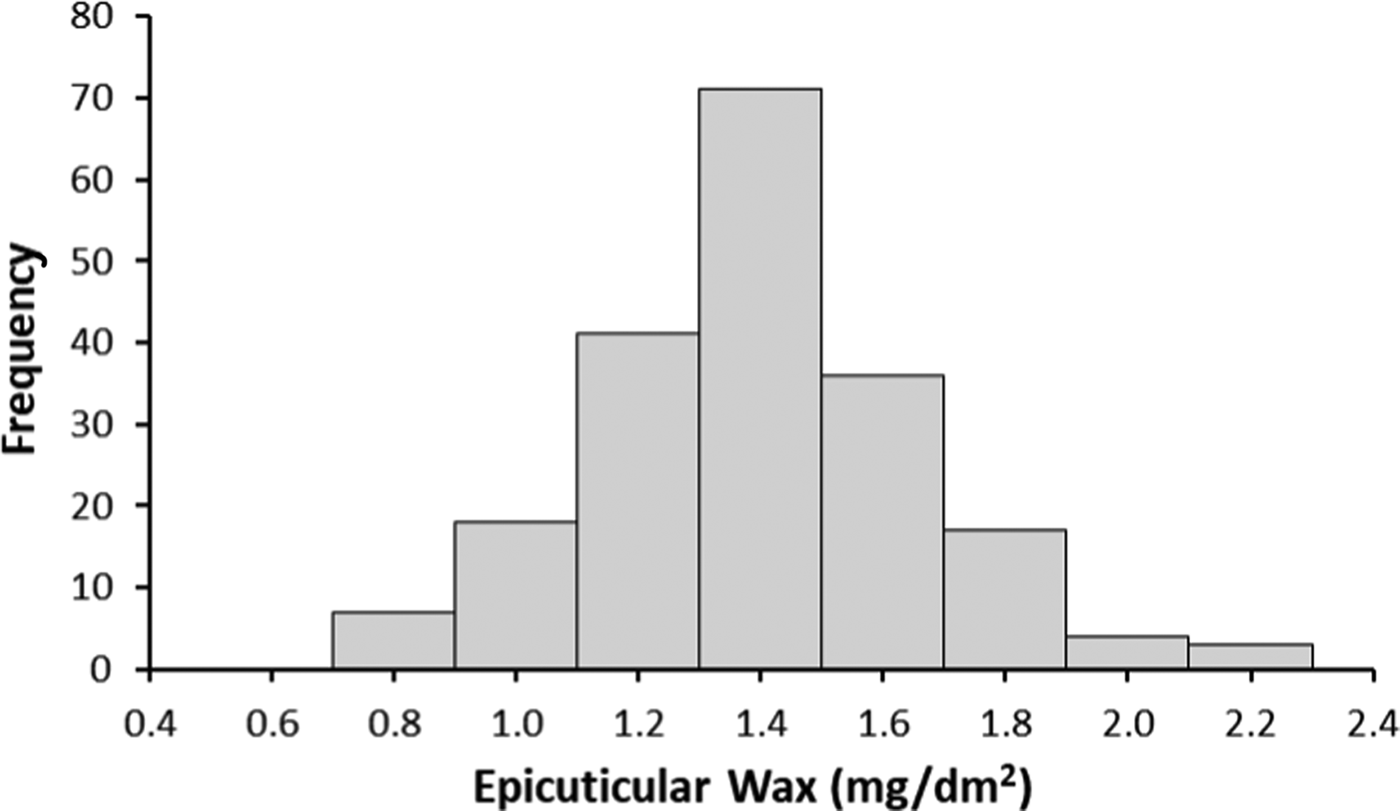
The 197 accessions differed for ECW (P < 0.001). ECW ranged from 0.680 to 2.104 mg/dm2 (Fig. 1; online Supplementary Table S2), with a mean ± SD of 1.288 ± 0.263 mg/dm2. ECW showed no significant correlations with stomatal morphology, gas exchange traits and relative water content, and only a weak positive association with leaflet area (P < 0.090) (Table 1). The lack of associations between ECW and other leaf traits related to drought adaptation, particularly stomatal characteristics under non-stress conditions indicates that faba bean might use a rapid stomatal closure for immediate and increased wax accumulation for long-term adaptation to water deficit. In stress conditions, however, ECW was associated with the gas exchange traits in Jatropha (Figueiredo et al., Reference Figueiredo, Oliveira, Oliveira, Silva and Santos2012) and wheat (Huggins et al., Reference Huggins, Mohammed, Sengodon, Ibrahim, Tilley and Hays2018). It should be noted that leaf mesophyll conductance, chloroplast density, and cell wall thickness also regulate water balance in plants (Ouyang et al., Reference Ouyang, Struik, Yin and Yang2017).
Frequency distribution of leaf epicuticular wax concentration in 197 faba bean accessions (Skewness = 0.316, Kurtosis = 0.474). LSD0.05 (least significant differences) = 0.059.

Pearson correlation coefficients of epicuticular wax content (ECW) with morpho-physiological traits among 197 faba bean accessions

LA, leaflet area; SD, stomatal density; SA, stomatal area; gs, stomatal conductance; E, transpiration rate; TE, transpiration efficiency; CT, canopy temperature; RWC, relative water content.
a Stomatal length × stomatal width.
b Transpiration efficiency was calculated as photosynthetic rate divided by the stomatal conductance.
Here we employed a high-throughput screening colorimetric method for screening a large number of faba bean accessions for ECW. To our knowledge, no previous study has shown the variability in ECW in faba bean. Accessions IG 12132 (ILB 938, Khazaei et al., Reference Khazaei, Link, Street and Stoddard2018), IG 12260, IG 11989, IG 137686, IG 72375, IG 112096 and IG 74554 had the highest ECW concentrations among accessions. These accessions might be used in the genetic improvement of ECW as a component of drought adaptation in faba bean breeding programmes.
Supplementary material
The supplementary material for this article can be found at https://doi.org/10.1017/S1479262118000461.
Acknowledgements
H.K. expresses his gratitude to CIMO (Centre for International Mobility) and the Emil Aaltonen Foundation for their financial support during the experiments.