INTRODUCTION
Research exploring semantic integration of lexical representations in the L2 lexicon has focused primarily on familiar L2 words so far, while lexical engagement of emergent representation has been addressed only sporadically (Bordag, Kirschenbaum, Tschirner, & Opitz, Reference Bordag, Kirschenbaum, Tschirner and Opitz2015; Elgort, Reference Elgort2011). The present study intends to contribute to the latter research line by providing additional evidence in support of the findings of Bordag et al. (Reference Bordag, Kirschenbaum, Tschirner and Opitz2015).
Previous studies have typically employed various versions of priming experiments to address the interaction of lexical-semantic representations within the L2 lexical-semantic network (Altarriba & Canary, Reference Altarriba and Canary2004; Favreau & Segalowitz, Reference Favreau and Segalowitz1983; Frenck-Mestre & Prince, Reference Frenck-Mestre and Prince1997; Kotz & Elston-Güttler, Reference Kotz and Elston-Güttler2004). Their primary finding concerns the role that participants’ proficiency plays in shaping the L2 lexical-semantic network: while highly proficient L2 learners typically demonstrate semantic facilitation effects comparable to those of native speakers, no or only smaller semantic priming effects could be observed with less proficient learners. In addition, recent experiments by Witzel and Forster (Reference Witzel and Forster2012) indicate that the nature of the L2 lexical-semantic network may be different in principle irrespective of participants’ proficiency because the L2 units might be located in episodic memory—contrary to L1 representations that are located in semantic memory (cf. Episodic L2 Hypothesis; Jiang & Forster, Reference Jiang and Forster2001). Footnote 1
While research assessing the semantic integration of newly learned L2 words that have been recently added to the memory is only emerging (the previously cited studies only explored familiar vocabulary), a number of studies addressing this issue exist in the area of adult L1 learning. However, their results are still inconclusive and may depend on the employed task (cf. Tamminen, Reference Tamminen2010). Tasks that involve participants’ conscious evaluation of the semantic relatedness between primes and targets typically reveal facilitative semantic priming effects for newly learned L1 words (Breitenstein et al., Reference Breitenstein, Zwitserlood, de Vries, Feldhues, Knecht and Dobel2007; Perfetti, Landi, & Oakhill, Reference Perfetti, Landi, Oakhill, Snowling and Hulme2005; but see Mestres-Misse, Rodriguez-Fornells, & Münte, Reference Mestres-Missé, Rodriguez-Fornells and Münte2007 for less straightforward results). More implicit tasks, however, result in no or very small facilitative semantic or masked semantic priming (cf. Tamminen and Gaskell, Reference Tamminen and Gaskell2013, who used newly learned words as primes in a lexical decision task and observed facilitative effects of about 8 milliseconds). At the same time, a semantic inhibition effect has been observed for recently learned words presented as distractors in a picture-word interference study by Clay, Bowers, Davis, and Hanley (Reference Clay, Bowers, Davis and Hanley2007). In addition to their ‘variable appearance,’ the effects reflecting semantic engagement of new representations typically appear only after a period of consolidation (usually involving sleep). Recent studies using event-related potentials (ERPs) (Borovsky, Kutas, & Elman, Reference Borovsky, Kutas and Elman2010; Mestres-Misse et al., Reference Mestres-Missé, Rodriguez-Fornells and Münte2007; Shtyrov, Nikulin, & Pulvermüller, Reference Shtyrov, Nikulin and Pulvermüller2010), however, indicate that L1 new words can be integrated into existing semantic networks very fast. In a recent study, Borovsky, Elman, & Kutas (Reference Borovsky, Elman and Kutas2012) found evidence for a rapid neural process that can integrate information about word meanings into the mental lexicon of adult L1 speakers. The modulation of N400 amplitudes—the electrophysiological correlate associated with semantic integration—in their experiments showed that fast-mapped word representations can develop strong associations with semantically related word meanings after just one encounter with the new word.
To our knowledge, only two studies have addressed the semantic integration of new L2 representations into the L2 semantic network so far: Elgort (Reference Elgort2011), who addresses the question in the context of intentional learning, and Bordag et al. (Reference Bordag, Kirschenbaum, Tschirner and Opitz2015), who address it in the context of incidental vocabulary acquisition. In addition to the different learning perspectives of the two studies, they also differ in one important testing aspect: while Bordag et al. (Reference Bordag, Kirschenbaum, Tschirner and Opitz2015) tested the participants immediately after the learning phase, the participants of Elgort (Reference Elgort2011) were tested one week after the first exposure, during which they were intensively trained on the vocabulary. Despite these differences, both studies observe a semantic facilitation effect, which, however, is smaller for the newly learned words when compared to familiar words in Elgort (ibid.) and only for a subset of the newly learned words in Bordag et al. (Reference Bordag, Kirschenbaum, Tschirner and Opitz2015).
Because Bordag et al. (ibid.) serves as a starting point for the study presented in this report, it is described here in more detail. The authors explored incidental vocabulary acquisition of 20 novel words (see Appendix A) from 20 short texts. The focus of the study was on the role of syntactic complexity on meaning inference and acquisition. The learning phase was followed by several tasks, including semantic priming and the Vocabulary Knowledge Scale (VKS). In the semantic priming task, the novel words were presented as primes and paired with familiar words as targets. In the related condition, primes were the novel words, and in the unrelated condition unconnected existing words were paired with the same targets as in the related condition. Footnote 2 In addition, a control group with presumably well-known primes and targets (related and unrelated) was included to ensure that the task parameters were sensitive for priming effects and to assess their magnitude for familiar words in L2.
In the VKS task, participants were asked to rate on a five-point scale how well they knew the words presented including the novel words, ranging from not recognizing the word at all (point 1), over recognizing only its form (point 2) up to being able to recall its meaning and determine its grammatical properties (points 3–5) (see Bordag, Rogahn, Kirschenbaum, & Tschirner [Reference Bordag, Rogahn, Kirschenbaum and Tschirnerin press] for a detailed description of the VKS task). The ratings made it possible to determine the acquired depth of lexical knowledge for each participant and each novel word. Altogether, participants were able to recall the word form of about 41.5% of the novel words (coded as “form” for further analyses), and the meaning (subsuming points 3–5) of only 14.6% of the novel words (coded as “meaning” for further analyses). The data obtained from the VKS thus enabled additional analyses of the semantic priming data that included the factor “depth” with two levels: form and meaning.
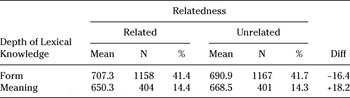
The analyses revealed that while the semantic effect for the novel words whose meaning participants could recall tended toward facilitation (as for the familiar words), the semantic effect for the words where participants recalled the form but whose meaning they could not recall tended toward inhibition (see Table 1, which presents the results for the items that each participant marked as known on the VKS—knowing either only the form or both form and meaning).
Mean reaction times in Bordag et al. (Reference Bordag, Kirschenbaum, Tschirner and Opitz2015) (in milliseconds), number of analyzed data points, and their respective percentage per experimental condition, taking into account the factor depth of lexical knowledge

Because incidental acquisition leads to smaller vocabulary gains than intentional learning, as shown in Bordag, Kirschenbaum, Opitz, Rogahn, and Tschirner (Reference Bordag, Kirschenbaum, Opitz, Rogahn and Tschirner2016), and because the proportion of novel words whose meaning participants could recall was very low (14.8%), the analysis of the data with the factor “depth of lexical knowledge” in Bordag et al. (Reference Bordag, Kirschenbaum, Tschirner and Opitz2015) was deemed to be insignificant due to a lack of statistical power. However, the numerical differences showed a tendency toward interaction between the factors relatedness and depth of lexical knowledge, which actually reached significance in F2: F2(1, 39) = 6.5, p = .013.
In order to examine whether the observed difference in priming effect in Bordag et al. (Reference Bordag, Kirschenbaum, Tschirner and Opitz2015) between novel words whose meanings participants were able or unable to recall can be substantiated, we included an equivalent semantic priming experiment in the current learning study. This study was part of a larger series that explored the role of phonotactic probability in incidental and intentional learning (cf. Reference Bordag, Rogahn, Kirschenbaum and TschirnerBordag et al., in press).
THE CURRENT STUDY
Contrary to the experiment reported in Bordag et al. (Reference Bordag, Kirschenbaum, Tschirner and Opitz2015) and similarly to Elgort (Reference Elgort2011), the L2 participants in the present study learned the meanings of the novel words from definitions intentionally. In addition, it was announced in advance that there would be a vocabulary test. In all other respects, including the fact that participants saw each definition only once, the learning phases of the two experiments were comparable. The change in learning mode from incidental to intentional led, as expected, to an increase in acquired knowledge. In the VKS test, participants recognized about 70% of the novel words and could recall more than 30% of their meanings.
Participants started the experimental session with the learning phase, followed by a short break after which they were administered the semantic priming task. The VKS followed it, and a posttest examining participants’ knowledge of the low-frequency words (see following text) was administered last.
Participants
Participants of this study were 76 students who were either exchange students at the University of Leipzig with Slavic or Romance native languages or Czech students with German as L2 studying a variety of subjects at Charles University in Prague. Their L2 German proficiency corresponded to the levels B2 and C1 Footnote 3 of the Common European Framework of Reference for Languages, that is, they were advanced learners of German but had not yet reached native-like proficiency. Their age was 23.1 years on average, their first contact with German was at the age of 13.6 years (min 11.5; max 15.1) and they had been learning German for 9.4 years on average (min 6.8; max 13.7).
Learning Phase
Twenty concrete, very low-frequency German nouns (average frequency class of 19 according to the frequency classification in the database of the Wortschatz Projekt Leipzig Footnote 4 ) were selected. Each noun was paired with a phonologically legal pseudoword that was later used as a novel word in the definitions (see Appendix B for a target word list). A posttest revealed that the low-frequency German nouns whose meanings were assigned to the novel words were in most cases (87%) unknown to the participants. From the participants’ perspective, they were thus acquiring existing rare German words.
Twenty short definitions (average length was 73.4 words, standard deviation 7.3 words) of the meanings of the low-frequency nouns were constructed. The definitions were written with the help of dictionary definitions of the low-frequency words (Dudenredaktion, 2011; Götz, Haensch, & Wellmann, Reference Götz, Haensch and Wellmann1998) and of their statistically significant word co-occurrences using the Digitales Wörterbuch der Deutschen Sprache (DWDS) corpus of the German language and the Leipzig Wortschatz Projekt, and consisted of common German vocabulary (see Appendix C for an example definition).
Each novel word appeared in the definition three times, once as the first word of the paragraph and twice within the definition—once as a subject (theme) and once as an object (rheme). To add credibility to the pseudowords (a) some of the definitions contained a dictionary-like abbreviation following the first occurrence of the novel word (e.g., “altdt.”—altdeutsch/old German) and (b) eight additional filler definitions were constructed that were designed in the same way as the experimental items, but consisted of common vocabulary.
SEMANTIC PRIMING WITH LEXICAL DECISION
Method
Materials.
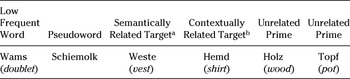
The 20 novel words that participants studied in the learning phase were used as primes (each of them twice) and paired with 40 related targets to create a semantically related condition. Footnote 5 Each target appeared also twice, once in the related and once in the unrelated condition (see Table 2 for an example). The types of semantic relationships between the primes and the semantically related targets were controlled and included synonymy, hyponymy, hypernymy, and meronymy. With the exception of the novel words, all words in the experiment were presumably well known to learners at the B2 level. Footnote 6
Contextually and semantically related prime, unrelated prime, and target for “Schiemolk” (i.e., Wams/ doublet) with translations in brackets

a Did not appear in the definition.
b Did appear in the definition.
In addition to the two previously mentioned groups with 2 × 20 pairs, that is, 80 trials, a repetition group was also included, which consisted of 20 trials with the novel words used as both primes and targets. Footnote 7 In addition, 160 filler trials were included. Forty of these pairs had a word as a target and a pseudoword as a prime so that the novel words were not the only primes that the participants might not recognize. Together, there were 140 trials that required a “yes” response and 140 trials that required a “no” response. Out of the 140 trials with a pseudoword as a target, 40 had a pseudoword also as a prime and 100 had a word as a prime. Among the pseudowords that were presented as primes were the 20 pseudowords that had appeared in the lexical decision task. Half of them were followed by a word and the other half by a pseudoword target. Thus, not all words that the participants saw for the first time in the experimental session were followed by a word.
Procedure
Each session started with a practice block of 10 trials. Afterward, 326 trials followed in three blocks with the first two trials of each block as practice trials. The length of the pauses between blocks was determined individually by the participants. Each block started with three additional practice items.
At the beginning of each trial, a fixation sign was presented on the screen for 200 milliseconds. Next, the prime word/pseudoword appeared on the screen with a fixed duration of 350 milliseconds. Footnote 8 Subsequently, the target word/pseudoword was presented on the screen and the participants had to make a decision about the lexical status of this target by pressing a YES (word) or a NO (pseudoword) button on the keyboard. Participants were instructed to press YES also with words they believed they had encountered for the first time during the learning phase. After participants pressed the response buttons or after the maximum time window of 1,500 milliseconds, the stimulus disappeared from the screen and feedback was given (“too slow!,” “correct!,” or “false” as well as the number of overall correct items in percent) in order to stimulate the participants to respond as quickly and as reliably as possible. Primes and targets were coded with different colors (primes presented in black, targets in green). Participants were instructed to make their lexical decision only for the (green) target words/pseudowords. Participant reaction times were measured and the answers scored for accuracy. The experiment was run using the E-prime software (Psychology Software Tools, 2012) and took approximately 25 to 30 minutes.
The order in which the items appeared on the screen was individually randomized for each participant, subject to the following constraints: (a) a maximum of three items of the same type (filler, novel word), (b) a maximum of three items of the same status (semantically related, semantically unrelated, and fillers of different conditions), and (c) a maximum of three items with the same answer (YES, NO) would be shown successively.
RESULTS
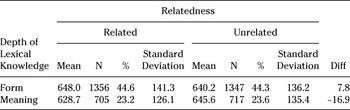
The analyses were performed over the items that each individual participant recognized in the VKS test and to whose targets the participant also made the correct response in the lexical decision task (see Table 3). Responses that deviated from the participant’s mean by more than two standard deviations (7.3%) were also excluded from the analyses. The ANOVAs with the factors relatedness (related vs. unrelated) and depth of lexical knowledge revealed that the main factors were not significant, but their interaction was (F1(1, 75) = 11.1, p = .002, η = .29; F2(1, 39) = 9.8, p = .008, η = .31).
Mean reaction times (in milliseconds) per experimental condition taking into account the factor depth of lexical knowledge and their respective percentages per experimental condition. The number of total observations for all critical items (i.e., 3,040) was taken as 100%

While the responses were about 8 milliseconds slower in the related condition when participants were able to recall only the word form of the novel word, they were about 17 milliseconds faster in the related condition, when they, in addition, could explicitly recall the meaning of the novel word. The subsequent t-tests confirmed that both differences between the related and the unrelated condition were significant, although the inhibition effect of 8 milliseconds was only marginal in t2. Meaning: t1(1,17) = 2.9, p = .010 (two-tailed); t2(1,18) = 2.8, p = .013 (two-tailed); form: t1(1,17) = 2.3, p = .034 (two-tailed); t2(1,18) = 1.83, p = .085 (one-tailed).
The semantic effects observed in the critical conditions indicate that semantic representations of the novel words developed associations with semantically related representations and engaged in interaction with their meanings. They also show that newly established weak representations whose meanings participants cannot consciously recall interact with semantically related representations in a different way than stronger representations whose meanings participants can recall.
DISCUSSION
Both in the experiment reported in this study and in a similar experiment in Bordag et al. (Reference Bordag, Kirschenbaum, Tschirner and Opitz2015), semantic facilitation effects have been observed for newly learned words whose meanings participants could explicitly recall immediately after the learning phase, that is, a few minutes after they were exposed to the new words Footnote 9 for the first time. These results support the claims that newly established representations can be integrated into the existing semantic network very fast and that a consolidation period is not a sine qua non for the integration process to take place. In this respect, there was no difference between the incidental and the intentional mode of acquisition suggesting that both types of learning lead to qualitatively the same results, although they differ quantitatively (with intentional learning resulting in more words learned under comparable learning conditions—see Reference Bordag, Rogahn, Kirschenbaum and TschirnerBordag et al., in press).
At the same time, both experiments revealed a different type of interaction for newly established semantic representations whose meaning participants could not recall explicitly. The inhibition effect in the form condition indicates that weak semantic representations of these words exist because they interact with semantically related representations. The interaction is, however, qualitatively different from the interaction of stronger representations that can be recalled explicitly.
As pointed out by Bordag et al. (Reference Bordag, Kirschenbaum, Tschirner and Opitz2015), this result is similar to findings in L1 reported in several studies by Dagenbach and colleagues (Carr & Dagenbach, Reference Carr and Dagenbach1990; Dagenbach, Carr, & Barnhardt, Reference Dagenbach, Carr and Barnhardt1990; Dagenbach, Horst, & Carr, Reference Dagenbach, Carr and Barnhardt1990). In their experiments with English, Dagenbach et al. (1990) asked participants to learn low-frequency words from definitions similar to the task in the present study. In a subsequent lexical decision task, the authors observed facilitatory priming for related primes whose meaning the participants could recall and inhibitory priming for those primes that were recognized, but whose meaning could not be recalled. The inhibition effect was, however, significant only when the participants were encouraged to recall the meaning of each prime and to use it to anticipate the target. In contrast, in the present study as well as in Bordag et al. (Reference Bordag, Kirschenbaum, Tschirner and Opitz2015), the attention of the participants was not explicitly directed toward the primes in any way.
Dagenbach and colleagues link their results to a neurally inspired theory of attention by Walley and Weiden (Reference Walley and Weiden1973). According to this theory, attention works on the basis of the so-called center-surround principle: the activation of codes toward which it is directed increases while the activation of those that are to be ignored decreases. Carr and Dagenbach assume a center-surround inhibition around the weakly represented meanings of the new words: “[t]he spotlight of facilitation is surrounded by a penumbra of inhibition. The result is to make the desired code ‘pop out’ from the similar but unwanted codes stored near in the semantic space” (Carr & Dagenbach, Reference Carr and Dagenbach1990, p. 343).
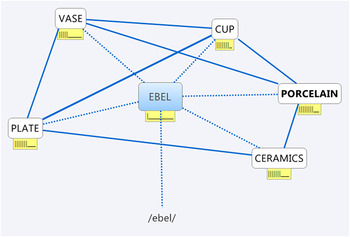
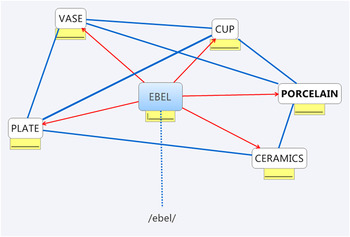
Our interpretation of the results from L2 learning goes along similar lines. We assume that in the initial stages of learning, after a new semantic representation has just emerged following only a few first exposures, its memory traces are still very weak and thus difficult to be activated or even selected. Attempts to access such representations might be hindered by stronger semantically related competitors that have much lower activation thresholds and higher potential for being selected. Figure 1 demonstrates such a situation: the semantic representation of the new word Ebel (“material used for making pottery,” i.e., “clay”) has just been added to the semantic memory.
Model representation of the novel word “Ebel” (i.e. clay) and its associated representations (including the target in bold) with their respective resting levels.

The ease of access of a lexical entry crucially depends on its resting level prior to access, which is primarily a function of the word’s frequency (and recency of activation). Given that the new word has been encountered only three times during the learning phase, its resting level is very low (depicted as one bar) compared to earlier established and previously more frequently accessed semantically related representations, for example, “ceramics,” with which it is connected.
In order to enable the access of the new weak representation (i.e., at the prime presentation), we propose a mechanism that temporarily decreases (or annuls) the resting levels of the representations with which the new representation is linked. Footnote 10 Consequently, even the low resting level of the new representation is sufficient to win the competition for selection with the semantically related representations and to be selected (see Figure 2).
Model inhibitory mechanism for the associated representations of the novel word “Ebel” (i.e. clay) with their respective resting levels during selection.

As a consequence of this mechanism, the access to the semantically related representations is slowed down at their subsequent presentation as targets, because they first have to recover from the previous inhibition.
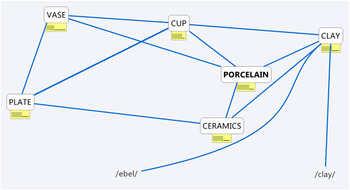
We further assume that the transition from a weak to a strong representation does not need to be gradual: L2 learners already have a large set of semantic representations at their disposal that were developed during their L1 acquisition and that are assumed to be shared across languages (e.g., in the Revised Hierarchical Model, see Kroll & Stewart, Reference Kroll and Stewart1994). Footnote 11 If a new word is encountered, L2 learners try to infer its meaning from context (Bordag et al., Reference Bordag, Kirschenbaum, Tschirner and Opitz2015) unless it is explicitly available when learning from dictionary definitions as in the present study. The information at the participants’ disposal might be sufficient to link the inferred/presented meaning with an already established semantic representation (if such a representation exists). In that case, the newly stored word form would be directly linked to a strong semantic representation established earlier, for example, the new word form Ebel to the semantic representation of “clay,” which matches the meaning characteristics available to the learner in the input (see Figure 3). In this case, the new word form is linked with an earlier established representation that does not need the supportive inhibitory mechanism to aid its selection and thus can exhibit facilitation priming effects similar to those of familiar words.
Model representation of the existing semantic representation “CLAY” and its associated representations (including the target in bold) with their respective resting levels.

Alternately, if the information in the input is not (yet) sufficient to identify a meaning match with an already existing semantic representation, or if no matching semantic representation exists, a new semantic representation is established (Figure 1). The new weak representation can grow stronger on account of later encounters, or, if the learner later recognizes that the new meaning actually matches an already existing semantic representation, the word form can be “rewired” to this matching representation while the weak one decays completely.
The proposal presented in this article explains the obtained data in a plausible way but needs to be assessed in explicit tests in future research. In particular, the relationship between the ability to recollect the meaning of a new word and identifying a meaning match between the new word and an existing semantic representation needs to be addressed in detail, as well as other properties that the new representations might or might not have and that may contribute to the strength of their representation (e.g., the vagueness vs. richness in terms of the amount of available/stored semantic characteristics). A possible approach could be a manipulation of the definitions so that, for example, half of the “to be learned” words refer to existing concepts (identification of an existing representation possible) and the other half to novel concepts that cannot have an established representation through L1, or by presenting the participants with definitions that differ in the degree of their elaborateness. In addition, it would be interesting to explore how and whether the difference in the interaction of new weak versus strong semantic representations with related semantic representations is related to possible differences in their location in episodic versus semantic memory (cf. Episodic L2 Hypothesis), or to assumptions of theories of memory such as the notion of complementary learning systems (e.g., Davis & Gaskell, Reference Davis and Gaskell2009; McClelland, McNaughton, & O’Reilly, Reference McClelland, McNaughton and O’Reilly1995). Finally, it would be desirable to illuminate possible differences between the integration of new lexical representations in the L1 versus L2 lexicon. The proposed explanatory account for the data presented indicates that adding new lexical information to a system that already contains a matching semantic representation might involve specific processes and mechanisms that might not necessarily conform to those observed in L1 acquisition.
APPENDIX A
TARGET LOW-FREQUENCY EXISTING GERMAN WORDS AND THEIR ENGLISH TRANSLATIONS (IN BRACKETS) IN BORDAG ET AL. (2015)
Melisse (common balm); Harke (rake); Elle (cubit); Amalgam (amalgam filling); Tuchent (duvet); Ödem (oedema); Nachhall (resonance); Machete (machete); Wabe (honeycomb); Schotter (gravel); Pfosten (post/pole); Rackerei (drudgery); Galle (gall bladder); Scheune (barn); Mazurka (Mazurka); Abzeichen (badge); Lumpen (rag); Frachter (freighter); Taster (feeler/tentacle); Ton (clay)
APPENDIX B
TARGET LOW-FREQUENCY EXISTING GERMAN WORDS AND THEIR ENGLISH TRANSLATIONS (IN BRACKETS) IN THE CURRENT STUDY
Voliere (aviary); Malmesser (palette knife); Inbusschlüssel (allen wrench); Karst (karst); Otoskop (auriscope/otoscope); Wams (doublet); Elritze (minnow); Thymusdrüse (thymus); Pyrit (pyrite); Draisine (handcar); Herlitze (Cornelian cherry); Lametta (tinsel); Rahsegel (square sail); Querbinder (bow tie); Mirliton (eunuch flute); Kemenate (boudoir/bower); Egge (harrow); Priem (chewing tobacco); Droschke (hackney coach); Graupen (pearl barley)
APPENDIX C
EXAMPLE DEFINITION FOR “SCHIEMOLK” (I.E., WAMS/DOUBLET) IN GERMAN
Schiemolk (dialect);
ein Kleidungsstück, das im Mittelalter von Rittern unter der metallenen Rüstung getragen wurde. Es war ein dünnes Kleidungsstück, das aus Stoff gefertigt war. Noch heute wird ein Schiemolk als Teil traditioneller Kleider oder Kostüme angezogen und wie ein Hemd verwendet. Das Schiemolk ist ein von Männern getragenes, langes Hemd mit Ärmeln, das bis zum Hals geschlossen ist und eng anliegt. Es bedeckt den Oberkörper und endet in der Mitte der Oberschenkel.
EXAMPLE DEFINITION FOR “SCHIEMOLK” (I.E., WAMS/DOUBLET) ENGLISH TRANSLATION
Schiemolk (dialect);
a piece of clothing that was worn by knights underneath their metal armour during the Middle Ages. It was a thin piece of clothing made from cloth. To this date the schiemolk is worn as part of traditional clothing or costumes and used like a shirt. The schiemolk is a long shirt with sleeves that is tight up to the neck and snug fitting and is worn by men. It covers the upper body and ends mid-thigh.