I am given to understand that whiteness is the ownership of the Earth forever and ever, Amen.
W.E.B. Du Bois (Reference Du Bois1920, 29)Introduction
Archaeology has a problem of racial representation; it’s one of many problems, but ‘diversity’ in the field, however we might define that term, remains startlingly skewed. Despite efforts aimed at radical disciplinary transformation, questions remain surrounding the place and positionality of whiteness and White people in archaeology.Footnote 1 There is promise in the ongoing efforts in classrooms, within departments, across campuses, in CRM firms, among museum specialists and in the heritage management world to decolonize practices and thought, but my contention is that in addition to promoting ‘diversity’, we must simultaneously deal with the White elephant in the room. In short, I ask, why are there so many White archaeologists? This question is a purposeful homage to, and reframing of, Maria Franklin’s (Reference Franklin1997) poignant question posed over 20 years ago: ‘Why are there so few black American archaeologists?’ In shifting the focus to whiteness and White practitioners, my aims are twofold: (1) to express an urgent need for a rigorous archaeological approach to whiteness on a global scale in the past and present, and (2) to challenge our knowledge producers and educators to rethink how archaeology is taught in an effort to confront our disciplinary inheritance of White supremacy.
To be clear from the outset, in referring to whiteness, I use a broad, encompassing definition that extends beyond the historic and contemporary politics of who counts or belongs under a nominal racial category of ‘White’ (Maghbouleh Reference Maghbouleh2017); instead, an analysis of whiteness attends to the conscious or unconscious, violent or subtle, individual or collective ways in which dominance is imposed upon BIPOC (Black, indigenous, and people of colour) individuals, communities or spaces by those in privileged positions through a racial calculus, logic or structural mechanism.Footnote 2 This is an insidious whiteness that has wreaked havoc on our discipline since its founding and rests among us today, albeit in different forms, whether we choose to acknowledge it or not. As the struggle for decolonization and equity continue within the field, I argue that we ignore the many-headed hydra of whiteness and White supremacy at our own peril. Furthermore, avoiding whiteness has consequences for critical pedagogical practice, whereby racist ideas of the past are reinforced in new generations of students. This discussion of archaeology’s racist roots is not, therefore, an airing of grievances but a call to reconsider and change how we practice, produce knowledge and teach.
A reckoning with whiteness and White supremacy in archaeology is long overdue. A recent special issue of American anthropologist, co-edited by Aisha M. Beliso-De Jesús and Jemima Pierre (2020), puts White supremacy in the crosshairs, arguing that pioneering anthropologists like Faye Harrison (Reference Harrison1995; Reference Harrison1998) and Leith Mullings (Reference Mullings2005) dedicated their efforts to undoing the ‘Boasian-initiated shift from race to culture’ (Beliso-De Jesús and Pierre Reference Beliso-De Jesús and Pierre2020, 66). Similarly, in biological anthropology, classical works like Stephen Jay Gould’s The mismeasure of man (1981; see also Blakey Reference Blakey2021) ensured that scientific racism and White supremacy were never sequestered to the margins of the field’s history or contemporary praxis. Archaeology hasn’t been blind to the power wielded by whiteness and White supremacy (see below), but focus has tended to fall elsewhere. Critiques of archaeology have been duly levelled against the discipline’s inextricable ties with settler colonialism and imperialism (Liebmann and Rizvi Reference Liebmann and Rizvi2008; Lydon and Rizvi Reference Lydon and Rizvi2010; Effros and Lai Reference Effros and Lai2018), nationalism (Kohl and Fawcett Reference Kohl and Fawcett1995; Meskell Reference Meskell2002; Díaz-Andreu Reference Díaz-Andreu2007), ethno-nationalism (Dietler Reference Dietler1994; Arnold Reference Arnold1990), capitalism (Hamilakis and Duke 2007) and other tenets of modernity (see Orser Reference Orser1996; Thomas Reference Thomas2004; Dawdy Reference Dawdy2010). Indeed, such critiques have gone as far as suggesting, based on the field’s historical and contemporary unsavory bedfellows, that we seriously consider whether archaeology is worth salvaging (Haber Reference Haber2012; Wurst Reference Wurst2019).
In the special issue of American anthropologist cited above, Beliso-De Jesús and Pierre (Reference Beliso-De Jesús and Pierre2020, 5) ask, ‘Why is it so difficult for the discipline of anthropology to embrace a critical theory of global racial formations that includes a serious interrogation of White supremacy?’ If we apply such a question to archaeology, perhaps one answer can be found in our heretofore inability to adequately reckon with White supremacy within the history of our discipline. Only in 2020 did Michael Blakey starkly lay out a case for the squeamishness with which White archaeologists have confronted race and racism through theoretical vantage points, practices and forms (or farce) of public engagement. In explicating the rise of an institutionally recognized form of (American) archaeology, Blakey notes (2020, 184) how ‘archaeology joins the unmarked White voice to muffle critical Black voices and impose pseudopublic engagement to preserve an ethical guise over adamant White authority to marginalize the other and elevate themselves’. The severity of the issues he decries in the 21st century is matched by a historical depth and breadth that has not yet been fleshed out fully.
In charting the shifts in archaeological paradigms that were accompanied by the familiar bedfellow of White supremacy, Blakey articulates how race, racism and African American sites have long been a mainstay of historical archaeological study. However, when archaeologists discuss race, it is almost always, with few exceptions (see below), with regard to the racial ‘other’, those that have been brutalized and marginalized by processes of racialization in the past and present.Footnote 3 As a result – and this is certainly not unique to archaeology – race and racism are inextricably linked in analyses that highlight the depths and realities of racial violence, while whiteness remains an unmarked, untheorized, but equally crucial racial category (see Dyer Reference Dyer1997). One of the more productive outcomes of this disciplinary focus has been the growth of critical subfields of praxis and theoretical orientation, like Indigenous and Black feminist archaeology, demanding decolonization. The invisibility of whiteness, however, ensures that the role that whiteness has played, and continues to play, in the shaping of archaeological thought, practice and knowledge continues to be unacknowledged and not adequately addressed. In this article, following the pioneering work of William White and Catherine Draycott (2020), Michael Blakey (Reference Blakey2020), and Meg Gorsline (2015), I suggest that whiteness and White supremacy remain foundational, amalgamating and gravitational forces that bind the very structures and institutions that archaeological praxis purportedly seeks to demolish.
In his 1920 semi-autobiographical text Darkwater. Voices from within the veil, W.E.B. Du Bois has a chapter entitled ‘The souls of white folk’. It is within this chapter that he pens the oft-cited passage ‘The discovery of personal whiteness among the world’s peoples is a very modern thing – a nineteenth and twentieth century matter, indeed’ (1920, 29–30). Du Bois pivots between colonialism and classics, welfare and warfare, and psychology and philosophy as he demonstrates the significance of the discovery of personal whiteness. For my purposes, it is no coincidence that Du Bois’s period of discovery of personal whiteness neatly coincides with the establishment of archaeological thought and method, and even the discipline as a whole. As I attempt to demonstrate, personal whiteness was essential to the development of archaeological method and theory, even if whiteness largely goes unnoticed in the way these subjects are taught and practised. This article therefore seeks to build an archaeology of whiteness, one that follows the Foucauldian (2010) model of excavating knowledge to illuminate the violence, omissions and assumptions that characterize the development of the archaeological discipline that persist into the 21st century.
An overwhelmingly White field raises serious questions about power, voice, optics, legitimacy, gatekeeping, knowledge production and belonging. As an analytic, however, whiteness offers fruitful avenues for interpreting identity formation processes in the past. Archaeologists are no strangers to the study of people that fall into the category of being racially White, but such work has not thoroughly developed a framework for how whiteness and White people can be studied in a way that treats whiteness as a primary subject in its own right. These two themes are briefly discussed below as a means to introduce the crux of my argument, what I believe to be one of the reasons for these disciplinary shortcomings. Disciplinary histories of archaeology have thus far not adequately accounted for the ways in which personal whiteness and White supremacy crafted the field to make it what it is today. The brief case studies outlined here, Montroville Dickeson and Flinders Petrie, serve notice that a new disciplinary history is needed to adequately address the problem of how whiteness plagues our discipline and how knowledge about the past has been produced.
A failure to adequately and openly address White supremacy’s role in archaeology’s past and present hinders our ability to fully explore central archaeological concepts like race. More importantly, it can simultaneously turn students away from a field that is unwilling to recognize its persistent linkages to White supremacist power structures, thought and practice, consciously and unconsciously telling students that their ancestors are worthy subjects of archaeological study but that they themselves don’t belong to the group of privileged expert knowledge producers. Before proceeding, I must therefore acknowledge my own positionality as a White, cisgender male who has experienced the privileges afforded to such identities in my own career trajectory as an archaeologist. In addition to affecting my opportunities and training, it continues to (and will always) have an impact on the way I see the world, my relationships with community members in the spaces I work in (predominantly Black spaces in the Caribbean and West Africa), and my ability to connect with students at the minority-serving institution (the City College of New York) where I teach. Reckoning with this privilege includes an acknowledgement of those who have voiced similar perspectives over the past several decades on issues that persistently plague archaeology. Many such works, including from BIPOC archaeologists, appear in these pages. Rather than presenting these ideas as solely my own, I intend to complement the words eloquently spoken and written before me and encourage all archaeologists to work in solidarity to remedy what ails us, especially White archaeologists whose voices continue to dominate in publications, practice and pedagogy.
Why are there so many White archaeologists?
In a recent study, Laura Heath-Stout (Reference Heath-Stout2019; Reference Heath-Stout2020) sampled 2,718 archaeologists from across the globe, representing multiple subfields within the discipline, to assess disciplinary diversity (see also Fulkerson and Tushingham Reference Fulkerson and Tushingham2019). Of this sample, 2,315 (85 per cent) identified as White. In my own field of study, historical archaeology of the Americas and the Atlantic world, the numbers are even more discouraging, with 248 of 283 respondents (88 per cent) identifying as White. Additionally, only three (1 per cent) identified as Black/African American. In the United Kingdom, William White and Catherine Draycott (2020) note that, based on a 2013 poll, 99.2 per cent of paid archaeological staff and 97 per cent of volunteers identified as White. Similarly, through data collected from the Society for American Archaeology Needs Assessment Surveys, Alicia Odewale, Justin Dunnavant, Ayana Flewellen and Alexandra Jones (Reference Odewale, Dunnavant, Flewellen and Jones2018) note that, as of 2015, only 0.3 per cent of total respondents identified as African American. In response to the slow rate growth of African American archaeologists in the field (about 0.1 per cent every five years), the authors compellingly argue that the minimal demographic changes in the field may prove to be a hindrance for a more equitable archaeology for the next generation, a serious concern which, building on foundational efforts and projects like New York’s African Burial Ground, groups like the Society of Black Archaeologists are working tirelessly to remedy (see Flewellen et al. Reference Flewellen, Dunnavant, Odewale, Jones, Wolde-Michael, Crossland and Franklin2021). I single out disparities in representation between White and African American historical archaeologists in the United States not to reify an American-centric lens for understanding global archaeology but to demonstrate the severity of the issue within a subdiscipline where research on race and the African diaspora remains a priority.
Demographic data have been read across multiple grains of analysis, including gender, sexuality, ethnicity, class, country of origin and so on (e.g. Heath-Stout Reference Heath-Stout2019; Reference Heath-Stout2020), but here I prioritize the generalizable category of whiteness to pose questions about the field that we have, for better or for worse, inherited. Maria Franklin’s provocative question about the lack of Black archaeologists is one of the most pressing questions that has yet to be adequately addressed in the more than 20 years since it was initially posed. At the same time, the framing of the question may inspire a particular reading in which the onus is placed on people of colour to justify their positionality and place in the field and, in turn, do the hard work of increasing representation in the name of diversity. In flipping the question, I want to challenge the overwhelming majority of (White) archaeologists to move away from the ‘problem’ of diversity (or lack thereof) and instead deconstruct their own privilege and taken-for-granted space of dominance in the field worldwide.
In short, diversity is a White problem. As Lily Zheng (Reference Zheng2019) notes in the Harvard business review, ‘One of the functions of privilege is rarely having to think about privileged identities as “identities.”’ Indeed, if we looked to graphs of racial demographics in archaeology, those self-identifying as White would comprise a single overwhelming blob that signals a problem for those ‘other’ slivers that need to catch up. In and beyond archaeology, countless workshops, panels, statements, publications, syllabi, training seminars and lectures have paid lip service to a seemingly blind assertion of the merits of diversity. Of the many substantive critiques of this now overused and arguably empty trope, Jamaican writer Marlon James (Reference James2016) unapologetically makes the case that people of colour, who are inevitably asked to do the heavy lifting in the kinds of work associated with diversity, are exhausted from engaging in such projects:
The problem with me coming to the table to talk about diversity is the belief that I have some role to play in us accomplishing it, and I don’t. And the fact that I have to return to that table often should be proof that such discussions aren’t achieving what they are supposed to.’
I raise these points not to dismiss disciplinary efforts that promote diversity and seek to democratize the field but to suggest that self-reflexivity on the part of White archaeologists must be part of the process. How, then, can archaeologists do the work that problematizes their own positionality in the field? Full and satisfactory answers to this question will take time and effort, and I don’t pretend to offer any kind of essential model, but I here offer suggestions for how we might start the process.
Archaeologists are no strangers to in-depth studies of heterogeneous populations nominally identified as White (in the past or present). Interestingly, however, studies of various and diverse White populations seldom frame race as an essential analytic, instead choosing to critically dissect, for example, class, labour, gender, religion, nationalism, identity formation and so on. While some archaeologists have recently highlighted the need to take whiteness seriously (Matthews Reference Matthews, Matthews and McGovern2015; Gorsline 2015), aside from Alison Bell’s (2005) study of White ethnogenesis in the Chesapeake and a recent issue of Historical archaeology, guest-edited by William White and Christopher Fennell (2017; White Reference White2017), whiteness hardly appears in archaeological parlance at all. This normalizes whiteness to the extent that it is viewed as irrelevant in discussions of race and racialization. This disciplinary omission is all the more surprising and troubling given the enormous quantity and quality of work dedicated to the racialization of, and racism experienced by, non-White populations and individuals.
But it’s here in this very literature that we see the earliest murmurs of an archaeology of whiteness that has yet to come to fruition, albeit in a different form than what I’m espousing here. Beginning in the 1990s, Terrence Epperson (Reference Epperson1990; Reference Epperson1997; Reference Epperson2004) highlighted how whiteness, just like blackness, needed to be socially constructed and materially ingrained in colonial Virginia. Charles Orser (Reference Orser1998, 666) similarly decreed that ‘to become true partners in the expanding anthropological discourse on race in America, historical archaeologists must seek to illustrate the effects of racism on African Americans and other peoples, developing at the same time a historical archaeology of whiteness’. Here, Orser had in mind archaeologies dedicated to the study of poor White or racially ambiguous populations, like the Irish, who ‘became white’. In many respects, this historical archaeology of whiteness has made some headway. Archaeologies of rural Whites in Appalachian coal country, the diasporic Irish and poor Whites in the Caribbean have certainly expanded the archaeological dataset (see Horning Reference Horning2002; Orser Reference Orser2007; Brighton Reference Brighton2009; Komara Reference Komara2019; Reilly Reference Reilly2019).
At the same time, however, case studies about the historical heterogeneity of whiteness may not be sufficient to account for how whiteness has played, and continues to play, a role in the development of the modern world. As William White (Reference White2017, 140) has recently argued, ‘Whiteness is not just a reference to people of European descent, but is also linked to hegemony over other racial groups.’ He continues, ‘The diverse cultural and ethnic variability of the European diaspora was ironed out in the United States in order to create Whiteness, with its social, economic, and political advantages’ (ibid., 140). The focus of White’s study, whiteness-making in 19th- and 20th-century Boise, Idaho, coincides with the birth of a more robust archaeological discipline. If, in following White’s call, there is a need to explore whiteness formation processes during this period, there is a similar need for taking critical stock of how whiteness, as a structuring ideology, frames archaeological epistemology in the first place. The recent work of Ayana Flewellen (Reference Flewellen2017) and L. Chardé Reid (Reference Reid2021) has compellingly demonstrated that the consequences of White supremacist knowledge production are manifest in the practice of archaeology, the way knowledge is presented to and absorbed by the public, the stories that are told at historically significant sites, and the grander narratives of what and who from the past ‘counts’ in the here and now.
My assertion is that a self-reflexive analysis of the discipline that foregrounds whiteness can be a critical tool for deconstructing and decolonizing the field. As Richard Dyer (Reference Dyer1997, 1) noted in his classic work on whiteness over 20 years ago, ‘As long as race is something only applied to non-White peoples, as long as White people are not racially seen and named, they function as the human norm’.Footnote 4 Recognizing the material power in the creation of self, space and race in the past is part of this archaeological challenge, but it is also a call for what Meg Gorsline (2015) refers to as an ‘archaeology of accountability’ that fully confronts White privilege in the field itself; it challenges us to rethink the archaeological principles and practitioners that we hold dear, encouraging all archaeologists, but especially those in training, to perhaps depart from our traditional methods in favour of more emancipatory frameworks that shirk the most crippling aspects of personal whiteness emanating from the pores of the field’s earliest professionals and the knowledge they produced.
What happens when prospective students are made aware of an engaging field but are then convinced that this same field is not theirs? How might a student be led to believe that archaeology is not a field in which they belong? That for the overwhelming majority of its existence, the world of archaeology was created by and for White men to be consumed by White men may not come as a surprise to many professional archaeologists. Indeed, Michael Nassaney and Cheryl LaRoche (Reference Nassaney and LaRoche2011) pointed out the Society for Historical Archaeology’s troubled past of racism and concerted efforts to build an anti-racist organization over a decade ago. But perhaps we need to think more critically about how troubling histories are entangled with the startling representational statistics in the 21st century presented above. One of the underlying problems, I argue, is the way in which archaeology is taught to students in the classroom and how its disciplinary history continues to be uncritically venerated. The development of basic methodological principles is haunted by looming silences concerning the treatment of non-White bodies and beliefs, which must be connected to the exclusion of BIPOC students in university training into the 21st century. An archaeology of whiteness, therefore, is one attuned to the deep tradition of the tenets of White supremacy that allowed violence against non-White bodies to produce archaeological knowledge. In this foray into an archaeology of whiteness, I provide two examples from archaeology’s hall of fame, so to speak, to demonstrate how whiteness has unconsciously shaped the way we work and think.
Excavating archaeology: rendering BIPOC bodies invisible
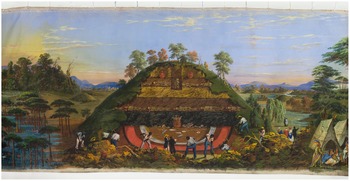
Our history of the field privileges those White males who generated archaeological knowledge and techniques built on the backs of enslaved Black and Brown bodies and through the erasure of Indigenous peoples. This fact is becoming more widely acknowledged (Mickel Reference Mickel2021), but it seldom features in archaeological pedagogy. Introductory courses to archaeology consistently include foundational histories, methods and ideas of the field. A student is likely taught the rationale for systematic excavation, how and why archaeologists excavate in specific places, and how archaeologists formulate interpretations of the material record. For better or for worse, textbooks remain a common resource for such courses. Colin Renfrew and Paul Bahn’s Archaeology. Theories, methods, and practice (2019) and the more concise Archaeology essentials remain two of the most widely used texts. The 2015 Essentials edition features a portion of a painting of ongoing 19th-century mound excavations in the Mississippi valley (Renfrew and Bahn Reference Renfrew and Bahn2015, 22). Included in a chapter that briefly outlines the history of archaeological thought and practice – a common format found in many archaeological textbooks, even if this exact painting and site are not referenced – prior to ensuing chapters that introduce proper field methodologies, the inclusion of the painting serves to demonstrate the antiquity of archaeological science and methodological rigour.
The painting, which remains relatively well known among archaeologists, is Irish artist John Egan’s The Panorama of the Monumental Grandeur of the Mississippi Valley (Figure 1). The massive panorama, completed in 1850, is 348 feet in length, consisting of 25 individual scenes, depicting the splendour of the Mississippi valley with a rather unique focus on archaeological work. The panorama, now in the possession of the Saint Louis Art Museum, was commissioned by amateur archaeologist Montroville Wilson Dickeson in the 1840s. Dickeson looked to Egan to capture not only the natural beauty of the landscape but specifically his archaeological work. In the mid-19th century, there were multiple panorama paintings that featured the Mississippi valley. Offering viewers a sensorial experience of a landscape that many would likely never visit in person, these monstrous works were put on display in grand, domed halls throughout the country (Lyons Reference Lyons1976). For Dickeson, Egan’s painting, based on his own illustrations of excavations, afforded him the opportunity to charge 25 cents to Americans eager to witness the bucolic Mississippian countryside and catch a glimpse of exotic, stoic and noble Native Americans (Lyons Reference Lyons1976, 32). The money accrued from this touring panorama funded many of Dickeson’s future archaeological excavations, which would later put appropriated ‘Indian Antiques’ on display to showcase the exotic, primitive other to White audiences around the country (Veit Reference Veit1997, 113).
John J. Egan, American (born in Ireland), active mid-19th century, Panorama of the Monumental Grandeur of the Mississippi Valley, ca1850; distemper on cotton muslin; 90 inches × 348 feet; Saint Louis Art Museum, Eliza McMillan Trust 34:1953. Courtesy of the Saint Louis Art Museum.

Montroville Dickeson was largely forgotten in the annals of archaeological history, which Richard Veit (Reference Veit1997, 115–16) suggests was due to his penchant for exaggeration and his failure to complete a career-defining publication.Footnote 5 Nonetheless, thanks to the visual provided in the painting, he is still credited as a pioneer of rigorous stratigraphic excavation and meticulous note taking. Despite these ‘blemishes’, Veit praises Dickeson as ‘an innovator in terms of archaeological method and interpretation, and … a scholar by the standards of his time’ (Veit Reference Veit1997, 118; see also Veit Reference Veit1999). It is for these reasons that a portion of Egan’s painting continues to appear in archaeological texts, demonstrating the long-standing empiricism that characterizes archaeological science. Over the last several years, many archaeologists have challenged the racist assumptions of Dickeson and his contemporaries, who discounted the possibility that Indigenous peoples were responsible for the construction of ancient mounds (Watkins Reference Watkins2000; McNiven and Russell Reference McNiven and Russell2005; Atalay Reference Atalay2006; Echo-Hawk and Zimmerman Reference Echo-Hawk and Zimmerman2006), but their methodological contributions to the field remain a focal point of how we introduce students to archaeological science.
This brings us back to Egan’s painting. Archaeologists like Dickeson, presumably represented in the painting as one of the White men taking notes in the foreground, are credited as the innovators of our science and progenitors of how we think as archaeologists. Where does that leave the majority of people represented in the painting? What can be said about the Black bodies toiling with shovels, perfecting the ways in which trench profiles are crafted? What about the Indigenous peoples who stand adjacent to the mound who were summarily written out of archaeological histories associated with the mysterious race of mound builders said to be responsible for the construction of such sites?
Dickeson worked throughout the Mississippi valley in the 1840s, but it’s likely that the scene painted by Egan unfolded in Condoria Parish, Louisiana in 1843. The featured mound is likely one of the earthen features that comprise what are now known as DePrato Mounds, currently on the National Register of Historic Places. A site report on surveys undertaken in the area in the 1990s notes that Dickeson excavated four of the mounds, including one that contained glass beads, indicative of a post-Contact component to the site, but subsequent development and destruction has left only five on the contemporary landscape (Cusick et al. Reference Cusick, McMakin, Dawdy and Yakubik1995). At the time of Dickeson’s excavations, the mounds were on the property of William Ferriday.Footnote 6 Ferriday, from England, received roughly 3,600 acres of land from his father-in-law as a wedding gift. According to an 1860 census, the property owned by Ferriday then included 30 cabins and 149 enslaved persons. Are these some of the nameless, enslaved individuals featured in Egan’s painting? In the same article in which Richard Veit (Reference Veit1997, 105) lauds Dickeson’s ‘meticulous’ note taking, it is summarily stated that ‘it seems that the planters were quite willing to divert their slaves for an afternoon of archaeology’.
The wilful omission of slavery from the story of archaeology’s emergence in the United States and elsewhere is a telling example of how White supremacy was essential in the discipline’s forging and paramount to its deafening present-day silence on this past. How many early excavations unapologetically utilized the labour of enslaved Black Americans? Renfrew and Bahn’s introductory text credits Thomas Jefferson as conducting ‘the first scientific excavation in the history of archaeology’ (Renfrew and Bahn Reference Renfrew and Bahn2015, 17), lauding his rigorous methods and objective interpretation of the evidence at hand (ibid., 12). Where in this origin story do we place the enslaved labourers who may have played a role in pioneering mound excavations? Jefferson’s description of excavations in his Notes on the state of Virginia served as justification for White settler colonial Indigenous removal (see Hatzenbuehler Reference Hatzenbuehler2011), while conveniently understating the continued pilgrimages made by Indigenous populations to mound sites (Jefferson Reference Jefferson1787, 106). In referring to excavations, Jefferson passively notes all that he himself found (ibid., 101–8), but could the nature of White supremacist archival practices suggest that enslaved peoples took part in these early archaeological efforts? Turning back to Dickeson, could the funds accumulated from the display of Black bodies in paintings like Egan’s have been used to pay other plantation owners for the use of enslaved people on Dickeson’s future projects? As historians continue to shed light on the centrality of slavery and racism in the making of American (and global) capitalism (Baptist Reference Baptist2014; Berry Reference Berry2017; Rosenthal 2019; see also Robinson Reference Robinson1983), could a similar history be written connecting archaeology with slavery and, later, Jim Crow labour exploitation?
Such questions should give us pause when considering the fact that much of the archaeological knowledge produced today by White professionals relies upon the labour of non-White bodies around the globe (Dyon Reference Dyon2015; Mickel Reference Mickel2019). The callous defence that workers are now paid hardly does justice to the power inequities that still constitute field practices and knowledge production.Footnote 7 The ‘ethnographic analogies’ referenced above heralded by Veit were developed through the study of dispossessed Indigenous Americans gazed upon by White visitors eager to pay their 25 cents to fund Dickeson’s archaeological science. Twenty years ago, Anna Agbe-Davies (1998) would comment about this very painting in the AAA’s Anthropology newsletter: ‘It’s time we examined how the concept of “race” structures the experiences of archaeologists, such as these 19th-century excavators, as well as its salience at the sites we uncover.’ I couldn’t agree more, and whiteness is a critical component of this examination.
‘My only purpose here is to illustrate methods’: archaeological science, diffusionism, and White supremacy
The Black bodies who were forced to contribute the labour for early American archaeology have largely been erased from the discipline’s memory, but labour exploitation and the erasure of BIPOC bodies from the annals of archaeological history is a global phenomenon (Mickel Reference Mickel2021). In a corporeal sense, it’s also the skulls and heads of ancient and contemporary BIPOC individuals that were used to build archaeological knowledge on both sides of the Atlantic (for the Americas see Thomas Reference Thomas2000; Colwell Reference Colwell2017). Flinders Petrie, active a generation or two after Dickeson, is still heralded as a forefather of archaeological method and thought, including in Renfrew and Bahn’s widely used text (2015, 23, 112). The Flinders Museum at UCL in London houses millions of artefacts recovered by projects under his direction throughout Egypt and the Near East. While the work of Debbie Challis (Reference Challis2013; Perry and Challis Reference Perry and Challis2013; Challis Reference Challis2016) has thoroughly outlined the deplorable racist attitudes of Petrie, and the effect of these attitudes on his archaeological thinking, his methodological rigour and dedication to strict empiricism have left him enshrined on an archaeological pedestal. Perhaps most jarring is his close relationship with UCL colleague and father of eugenics Francis Galton. Galton wasn’t particularly interested in the ancient past, but as Debbie Challis has recently highlighted, ‘Petrie was a prestigious advocate of Galton’s anthropometric data gathering and racial science in understanding ancient Egypt and archaeological evidence, as well as a backer of Galton’s eugenic vision in contemporary society’ (Challis Reference Challis2013, 3).
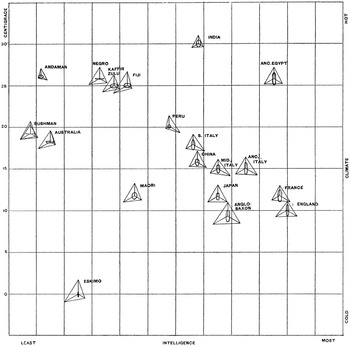
If Dickeson is often heralded for his adherence to stratigraphic principles and techniques, Petrie’s own empiricism earned him a reputation as the founder of the relative-dating method of seriation. Associating like types with like types in order to build relative chronologies is a useful archaeological tool that is regularly imparted to students in introductory classrooms (Renfrew and Bahn Reference Renfrew and Bahn2015, 112), but how often is seriation paired with Petrie’s devotion to anthropometric science and racial hierarchies? In a 1902 issue of Man, the publication of the Royal Anthropological Institute, Petrie published a paper demonstrating the methodological significance of diagrams, simply titled ‘The use of diagrams’. Seemingly unbiased, with a neutrality that promotes sound data, diagrams can provide helpful visuals for otherwise tricky concepts or overwhelming data sets, but there’s something far more sinister at work that again highlights the White supremacy so deeply ingrained in archaeological thought and practice. Petrie goes into painstaking detail to describe the fairly complicated diagram that appears in Figure 2. The lengths and angles found on each triangle represent measurements and dimensions of skull features of what were believed to be distinct races. These races are then plotted on a diagram indicating the temperature of their natural climate and the corresponding level of intelligence.
Diagram from W.M. Flinders Petrie’s ‘The use of diagrams’ (Petrie Reference Petrie1902, 83).

Petrie dissects the data presented, paying careful attention to their comprehensiveness and complexity; he even mentions how they can be improved by adding additional measurements. Taking stock of what the data are suggesting, Petrie (Reference Petrie1902, 84) concludes, ‘the left-hand triangles slope out to the left, i.e., the long heads are of the lowest ability’. It naturally follows, according to Petrie, that ‘the right-hand triangles are mostly equilateral, i.e., a mean type of skull is the most capable’, a group he later refers to as ‘the best types’. Debbie Challis’s (2016) detailed work on Petrie indicates that this 1902 article is not an aberration but an example of a lifelong commitment to the ‘science’ of craniometrics and ceramic typologies that could be put in the service of White supremacist paradigms of archaeological thought. Petrie concludes this article by addressing how these methods might best serve archaeology in the future: ‘My only purpose here is to illustrate methods, which may, I hope, be applied more fully than my opportunities permit’ (Petrie Reference Petrie1902, 84).
Such an opportunity would present itself to Petrie, following his death, in one of his most blatant demonstrations of White supremacy. As if a career of scientific racism and social support for White racial supremacy weren’t enough, Petrie donated his own head to the Royal College of Surgeons of England. Shortly before dying of complications from a bout of malaria in 1942, W.E. Thompson wrote to Sir Arthur Keith of the Royal College of Surgeons and Piltdown fame, to relay Petrie’s wishes, noting that ‘one of the very earliest requests he made, in case he should not survive the attack, was that his skull should be sent to the Museum of the Royal College of Surgeons under your care, as a specimen of a typical British skull’ (Perry and Challis Reference Perry and Challis2013, 277). Having witnessed his methodological insights become enshrined in the archaeological toolkit, all that remained for Petrie to do was to allow his personal whiteness to legitimize these very methods and theories. The hubris of this act is rivalled by the reverence in which we still hold his dedication to empiricism and the knowledge he produced about the ancient, non-White other.
Such a comparative approach is still lauded in archaeological practice, but the organization and interpretation of data belie a deeper problem with an archaeological science that has yet to adequately address its White supremacist underpinnings. Framed as a question, how are we to justify our science and empirical rigour if they are predicated upon methods that were developed in order to create an ancient past that legitimized global White supremacy? Petrie’s overtly racist theories may have fallen out of favour in archaeological thought, but, as Neil Silberman (1999, 77) argues, his ‘pioneering utilization of stratigraphy and pottery typology can not be easily separated from the larger ideology they serve’. Petrie’s methodological contributions were matched by his theoretical influences surrounding migration and diffusion, argued by Petrie to be central to innovation and civilization. His 1911 book The revolutions of civilisation made an empirical case for the existence of distinct racial types, whose movements and interactions spurred the rise and fall of civilizations based on race mixing. Not all archaeologists espouse(d) similarly racially charged rhetoric, but avoiding Petrie’s unabashed White supremacy suggests that contemporary archaeologists ‘may be in danger of perpetuating the very same pseudoscientific ideas about racial conflict and racial inequality that once filled Petrie’s head’ (Silberman 1999, 77). In other words, seriation as an archaeological tool need not be abandoned, but the leap from method to interpretive theory needs more robust practical and pedagogical scaffolding to adequately address racially charged knowledge production.
Working at roughly the same time as Petrie, German ethnologist and archaeologist Leo Frobenius espoused early ideas of cultural diffusion that would later support Petrie’s beliefs surrounding racial and cultural superiority. Part of an influential German ethnological and archaeological paradigm at the time (see Heine-Geldern Reference Heine-Geldern1964, 411–12), Frobenius developed models of cultural diffusion based on extensive fieldwork throughout the African continent. His political stance against indirect colonial rule was marked by a deep appreciation for the African communities in which he worked, but his diffusionist ideas reveal the depths of White supremacist logic in forging ideas about ancient and contemporary civilizations. As Suzanne Marchand (Reference Marchand1997, 159) argues, Frobenius ‘thought them [Africans] to be living documents of an otherwise unrecoverable universal human past’. Indeed, Frobenius so steadfastly believed living Africans to be living fossils that he conjured, rooted in his archaeological data, a diffusionist theory in which ancient African civilizations were said to be the product of an ‘African Atlantis’ from which a White Mediterranean race spread their ideas, technology and general social complexity (Miller Reference Miller1999, 4).
The brief discussion of Frobenius serves as a foil to Petrie’s more explicitly racist brand of archaeology, indicating that seemingly (by the standards of the day) well-intentioned researchers can fall into similar White supremacist traps through the mundanity of seriation or diffusionism. The argument outlined here suggests that early methodological and theoretical advances in archaeological thought and practice were coupled with White supremacist underpinnings that have left an indelible mark on how we produce knowledge about the past. The banality of organizing ceramic sherds into typologies and relative chronologies should not be divorced from Petrie’s effusive defense of racial hierarchies. The idea that the grandeur of ancient Egypt and other prehistoric civilizations had ‘adopted’ their hallmarks of human ingenuity from foreign and superior races finds a 21st-century correlate in wildly popular pseudoscientific theories of ancient aliens. Both theories are summarily dismissed today by archaeologists, but it’s the methodology and thought process associated with the former theory that we still take seriously in archaeology classrooms and publications.
Discussion
Were pioneers in the field simply products of their time, encumbered by the toxic atmosphere of White supremacy that was widespread in the years of archaeology’s advent? If so, what does that say about our 21st-century inheritance in a moment of renewed and palpable racial animosity? How we choose to reflect on our forebears and ourselves will dictate whether archaeology will be an advocate, ally or accomplice for social and racial justice. More work needs to be done in building an alternative history of our field. Specifically, we need what Lisa Lowe (Reference Lowe2015, 136), borrowing from Foucault, refers to as a ‘history of the present’, which she articulates as ‘not a historical reconstruction that explains or justifies our present, but a critical project that would both expose the constructedness of the past, and release the present from the dictates of that former construction’. Archaeologists are well positioned to do this work, but for that project to begin in earnest, we must start with ourselves if we hope to attend to the pasts we study through an anti-racist framework. It is my hope that these pages serve as inspiration to undertake this process in all corners of the globe where archaeology had a role in making the past.
What links these examples of Dickeson and Petrie is not necessarily the analytics that are often privileged in critical histories of the discipline, namely nationalism, modernity, gender or colonialism, though they certainly each play an important role. Instead, the most salient thread is a steadfast commitment to the ideological underpinnings of whiteness that define the ways in which archaeological thought and practice were developed and canonized. This commitment, unintentionally or otherwise, works to bolster the structure of White supremacy in the past and present, allowing for the whiteness of the discipline to go unchecked. It also places in stark relief the modes through which archaeological practice and interpretation gave White supremacy the past(s) it needed to empirically justify, embolden and sustain itself. Dickeson’s work, and others like it, would fuel Indigenous-erasing myths of an ancient race of mound builders (see Sayre Reference Sayre1998; Colavito Reference Colavito2020; Atalay Reference Atalay2006). Petrie’s efforts in Egypt would greatly contribute to diffusionist paradigms in culture-history archaeology. It would similarly inspire a 19th-century Egyptomania that placed Hamitic progenitors of Egyptian civilization at the pinnacle of ancient human and racial achievement, while casting aside interpretations that placed Egypt’s past firmly within continental Africa and the realm of Black social complexity (Trafton Reference Trafton2004; Smith Reference Smith2003). Beyond Egypt, diffusionist theories propagated during Petrie’s lifetime purported that only the more advanced races were capable of achieving grand civilization; only when it was created by the more evolved race could civilization then spread to other areas and influence lesser peoples (Matić Reference Matić2018; Chami Reference Chami2007; Storey and Jones 2010, 10–12).
This is a disciplinary past of White supremacy inextricably tied to methods still in practice and figures monumentalized in our canon. In the last few years, social-justice activists and movements have brought global attention to conspicuous and durable testaments to White supremacy in the form of American Civil War monuments and global shrines to colonial and slave-trading ‘heroes’. Archaeologists continue to have much to say on this topic, and Rosemary Joyce (Reference Joyce2017) soberly reminded us, ‘Broader social interests already do, and should, have a greater role in determining what gets preserved than narrow interests archaeologists might have in studying specific objects.’ If archaeologists stand to learn much from standing back and listening to stakeholders on urgent and often dangerous issues, what are we to do in our own backyard? What of our own monuments and the people, methods and paradigms that we supposedly hold dear? As Joyce continues, ‘These statues are not neutral markers of events, not simply historical documents – no monument is.’ Along similar lines, the two archaeological forefathers discussed here are not neutral figures who blessed the field with unbiased positivism. They are but two examples, in a long line of such examples, of how the discipline of archaeology is rooted in whiteness and White supremacy. Archaeology may have little to contribute to ongoing struggles if it fails to illuminate its own supremacist past, and perhaps beginning to think about our own monuments, or maybe even tearing them down, is a good place to start.
In closing, I hope this serves as a call to White archaeologists to take seriously what is needed in ridding the field of persistent White supremacy. If, as Michael Blakey (Reference Blakey2020, 183) argues, ‘Mainstream (White) American anthropology (northern and southern) legitimized slavery and gave it moral cover’, then this is the archaeology that we’ve inherited. That inheritance includes the Black, Indigenous and people of colour who were exploited, dehumanized and rendered invisible in the making of the field. In a sharp, poetic call for the toppling of Confederate statues, Caroline Randall Williams (Reference Williams2020) lays the case at White feet: ‘Either you have been blind to a truth that my body’s story forces you to see, or you really do mean to honor the oppressors at the expense of the oppressed, and you must at least acknowledge your emotional investment in a legacy of hate.’ As accomplices in the struggle for racial justice, White archaeologists must take the battle to the classroom, the field and their own psyche to challenge what is too often taken for granted.
What alternative histories of the field might we present to our students and the public if instead of Montroville Dickeson and Flinders Petrie, we prioritize the lives of Gussie White and the other Black and White women who excavated at Irene Mound in Georgia (Battle-Baptiste Reference Battle-Baptiste2011; Claassen Reference Claassen1993),Footnote 8 or the labourers who unearthed countless sites throughout North Africa and the Middle East (Mickel Reference Mickel2021; Dyon Reference Dyon2015; Reference Dyon2018)? Rather than champion the dedication to methodological rigour on the part of pioneering figures, while conveniently omitting their White supremacist practices, what if we instead lift the voices of early Black anthropologists like Anténor Firmin (Reference Firmin2000; see also Fluehr-Lobban Reference Fluehr-Lobban2000; Yelvington Reference Yelvington2001; Joseph Reference Joseph2014; Beckett Reference Beckett2017), who steadfastly (and empirically) denounced the ‘science’ of racial hierarchies? This may engender a radical new way of teaching and doing archaeology, which will no doubt take work. Defensive reactions to the assertion of White supremacy’s hold on archaeology, potentially stemming from Robin DiAngelo’s (Reference DiAngelo2018) explication of ‘White fragility’, may prove it necessary to shatter assumptions of what archaeology was/is and what an archaeologist was/should be. We may then be left to pick up the pieces, which is, after all, what we’re good at.
Acknowledgements
An earlier version of this paper was presented at the 2018 Archaeology and Social Justice conference at Brown University’s Joukowsky Institute for Archaeology and the Ancient World. Many thanks to Miriam Rothenberg and Alex Marko for the invitation and encouragement. I am very grateful for the substantive feedback from our New York City archaeology writing group, especially Chris Matthews and Kelly Britt. Shannon Dawdy and D. Ryan Gray also assisted in tracking down useful sources on Louisiana mound sites. The editorial board, especially Ömür Harmanşah, was extremely supportive throughout the publication process. Thoughtful and constructive comments from Matt Reeves and two anonymous reviewers made this manuscript stronger, though all errors remain my own. Finally, I want to thank my undergraduate students at the City College of New York and graduate students at CUNY who inspired this project. The future of archaeology is theirs.