Introduction
The utilization of wild plant species as valuable resources requires a comprehensive understanding of their genetic and biochemical potential. In particular, crop wild relatives – wild taxa genetically related to domesticated crops – are recognized as crucial sources of novel traits for breeding programmes, especially in the face of climate change and emerging diseases (Maxted et al., Reference Maxted, Kell, Ford-Lloyd, Maxted, Ford-Lloyd, Kell, Iriondo, Dulloo and Turok2007; Kapazoglou et al., Reference Kapazoglou, Gerakari, Lazaridi, Kleftogianni, Sarri, Tani and Bebeli2023). Despite their significance in enhancing crop resilience and supporting ecosystem services, these resources remain underutilized and insufficiently conserved (Naidoo et al., Reference Naidoo, Balmford, Costanza, Fisher, Green, Lehner, Malcolm and Ricketts2008). Evaluating their economic and medicinal potential, particularly in agriculture, pharmaceuticals and biotechnology, is essential for identifying species with high-value phytochemicals and bioactive compounds (Halder and Jha, Reference Halder, Jha, Jha and Halder2023; Salem et al., Reference Salem, Szwajkowska-Michałek, Przybylska-Balcerek, Szablewski, Cegielska-Radziejewska, Świerk and Stuper-Szablewska2023), thereby supporting both conservation and sustainable utilization.
The genus Boehmeria in the family Urticaceae includes several species. Among them, cultivated ramie (B. nivea (L.) Gaudich.) has been historically used in fibre production and has edible and medicinal properties (Kim et al., Reference Kim, Shin, Song, Kim and Yoon2006; Chung et al., Reference Chung, Kim, Choi and Hwang2016). A morphologically distinct variant, wild ramie (B. nivea var. tenacissima (Roxb.) Miq.), is naturally distributed in coastal and island regions of Korea and remains underutilized (Jung et al., Reference Jung, Lee, Yang, Moon, Song and Kim2020). Wild ramie is rich in vitamins, minerals, flavonoids, carotenoids and rutin. Traditional Korean medicine highlights its phenolic compounds, triterpenoids and chlorogenic acids for their various physiological activities (Lee et al., Reference Lee, Kim, Park and Choi2018; Sancheti et al., Reference Sancheti and Seo2010). The leaves, in particular, contain high levels of dietary fibre, amino acids, vitamin C, calcium, potassium, magnesium, polyphenols and flavonoids, contributing to its strong antioxidant properties (Jang and Yoon, Reference Jang and Yoon2006; Cho et al., Reference Cho, Lee, Kim, Jung, Kim, Cho and Lee2017). Research has identified valuable traits in wild populations – such as antioxidant activity and adaptability to harsh conditions – that make them promising candidates for breeding programmes. Ramie primarily propagates vegetatively but exhibits both self-pollination and outcrossing, depending on the environment (He et al., Reference Jang and Yoon2014; PROTA4U, 2011; Plants For A Future (PFAF), 2022).
In Korea, ramie (B. nivea L.), locally known as ‘mosi’, is primarily cultivated in regions like Hansan-myeon of Seocheon County, South Chungcheong Province. This area is renowned for producing Hansan mosi, a fine ramie fabric that has been inscribed in the UNESCO Intangible Cultural Heritage list since 2011, highlighting its cultural significance (Kim and Cho, Reference Kim and Cho2000; UNESCO, 2011). While traditional uses of ramie focus on textile production, particularly for summer clothing due to its lightweight fibre, recent studies have explored its potential in functional foods and pharmaceuticals due to its rich content of polyphenols and flavonoids (Lee et al., Reference Lee, Nho, Hwang, Kim, Lee and Jeong2009; Lee et al., Reference Lee, Seo, Lee, Kim and Kim2023). As of 2023, the total cultivation area of ramie in Korea was approximately 20 hectares, with a production volume of 87 metric tons (Korean Statistical Information Service (KOSIS), 2023). Despite its cultural and functional significance, systematic breeding programmes for ramie in Korea are limited, and most cultivation is maintained through traditional practices (Lee, Reference Lee2019).
Genotyping-by-sequencing (GBS) is an advanced tool for assessing genetic diversity and population structure in crop breeding. This next-generation sequencing technology is high-throughput and cost-effective, enabling the comprehensive analysis of diverse plant species, including those with large genomes (Elshire et al., Reference Elshire, Glaubitz, Sun, Poland, Kawamoto, Buckler and Mitchell2011a; Poland et al., Reference Poland, Brown, Sorrells and Jannink2012b). GBS facilitates the simultaneous discovery and genotyping of markers by reducing the genome complexity through restriction enzyme digestion, making it ideal for breeding programmes (Poland et al., Reference Poland, Brown, Sorrells and Jannink2012; He et al., Reference He, Zhao, Laroche, Lu, Liu and Li2014). GBS technology has been widely used to assess genetic diversity and population structure in various plant species, including crop breeding. Studies have successfully employed GBS to identify valuable genetic markers and analyse environmental influences on plant populations, such as in breeding programmes for different crops (Edae et al., Reference Edae, Byrne, Haley, Lopes and Reynolds2014; Poland and Rife, Reference Poland and Rife2012).
The biosynthesis of phytochemicals in plants is primarily driven by their genetic makeup; however, the concentration of oxidative phytochemicals, such as polyphenols and flavonoids, is also notably influenced by environmental and agricultural factors. These include farming practices, seasonal variations, geographical location, plant maturity, soil type and postharvest processing. Developing plant varieties with high phytochemical concentrations and strong antioxidant properties requires the optimization of genetic potential and environmental conditions (Tsao et al., Reference Tsao, Khanizadeh and Dale2006).
Therefore, the present study investigated the genetic variability and phytochemical content of wild ramie from various regions. This study used GBS technology to evaluate genetic diversity and examine environmental influences on Total phenolic content (TPC) and total flavonoid content (TFC) over multiple years. We hypothesized that wild ramie populations would exhibit significant genetic and phytochemical variation associated with regional environmental differences. The primary objective of this study was to identify germplasm resources with valuable traits to support breeding and conservation efforts. This enhances the overall agricultural and industrial value of this plant, particularly in terms of its potential use in various functional applications.
Materials and methods
Plant materials
To analyse genetic diversity and phytochemical content, 150 samples of wild ramie were collected from six regions: Goheung (GH), Heuksando (HS), Jindo (JD), Mokpo (MP), Ulleungdo (UR) and Yeosu (YS) in July 2021 (Table 1 and Fig. 1). In July 2022, wild ramie was randomly collected from the same regions and populations, with 10 individuals sampled from each location to analyse changes in phytochemical content owing to annual variations. The collected wild ramie leaves were freeze-dried using a freeze dryer (MCFD8518, ilShinBioBase, Korea) and ground using a sample grinder (Tisselyser II; Qiagen, Germany). The ground samples were stored at 4°C until further use. Voucher specimens were deposited at the Honam National Institute of Biological Resources.
(A) Sampling locations of wild ramie (Boehmeria nivea (L.) Gaudich. var. tenacissima (Roxb.) Miq.) collected from six regions across Korea. Insets provide enlarged views of clustered sites and Ulleungdo (UR). GH, Goheung; HS, Heuksando; JD, Jindo; MP, Mokpo; UR, Ulleungdo; YS, Yeosu. (B) A representative individual from the YS population, showing key leaf morphological features including serrated margins and prominent venation.

Six regions where 150 Boehmeria nivea (L.) Gaudich. var. tenacissima (Roxb.) Miq. samples were collected

GH, Goheung; HS, Heuksando; JD, Jindo; MP, Mokpo; UR, Ulleungdo; YS, Yeosu.
DNA extraction
DNA was extracted from 30 mg of freeze-dried leaf tissue from each genotype using the DNeasy Plant Mini Kit (Qiagen), following the manufacturer’s instructions. The DNA quality and quantity of each sample were determined by electrophoresis in 1% (w/v) agarose gels and spectrophotometry.
GBS analysis
The GBS analysis was conducted by Seeders, Inc. (Daejeon, Republic of Korea) and generated using a standard analysis method (Elshire et al., Reference Elshire, Glaubitz, Sun, Poland, Kawamoto, Buckler and Mitchell2011b) and sequenced using the Illumina HiSeq X Ten platform (Illumina, San Diego, CA, USA) with 150-nt paired-end reads. Sequence preprocessing and single-nucleotide polymorphism (SNP) detection were performed as described by Ma et al. (Reference Ma, Yang, Jo, Kang and Nam2021).
Population structure and genetic diversity
Six population genetic statistics describing genetic variations in the species were estimated using the R packages adegenet and hierfstat (Goudet, Reference Goudet2005; Jombart, Reference Jombart2008). Analysis of molecular variance (AMOVA) was performed to compare the six populations using Poppr (Kamvar et al., Reference Kamvar, Tabima and Grünwald2014). Population structure was analysed by discriminant analysis of principal components (DAPC) using the adegenet package. The genetic and geographic distances among the six populations were compared using the hierfstat package to calculate the pairwise Weir and Cockerham Fst, and the geodist (v0.0.7) package was used to measure the geographic distances (km), resulting in a plot of geographic distance against Fst/(1 − Fst), which could support subsequent investigations of outliers (Padgham and Sumner, Reference Padgham and Sumner2021).
Analysis of phytochemical content
The ground sample (100 mg) was added to 1 mL of 75% EtOH and sonicated for 1 h. The mixture was centrifuged at 16,873 × g for 10 min. The clear supernatant was collected in a new tube and used to determine the TPC and TFC.
TPC was measured using the method by Lee et al. (Reference Lee, Ma, Cho, Lee, Chung and Lee2017). Folin–Ciocalteu reagent (100 µL) was added to 100 µL of sample solution and reacted at room temperature for 3 min. After adding 100 µL of 2% sodium carbonate, the mixture was incubated at room temperature for 30 min. Absorbance was measured at 750 nm using an enzyme-linked immunosorbent assay reader, with distilled water as a blank. The TPC was reported as milligrams of gallic acid equivalents (GAE) per gram of dry weight of the sample (mg GAE/g dry leaf).
TFC was measured using an aluminium chloride colorimetric assay using the method by Lee et al. (Reference Lee, Ma, Cho, Lee, Chung and Lee2017). A 100 µL of 2% solution of AlCl3 · 6H2O in methanol was added to 100 µL of the sample. Absorbance was measured after 10 min in methanol at 430 nm. The flavonoid concentration was expressed as milligrams of quercetin equivalents (QE) per gram of dry weight of the sample (mg QE/g dry leaf).
Statistical analysis
All data are expressed as mean ± standard deviation. Duncan’s multiple range test was used to detect statistically significant differences. Analysis of variance was performed using R software.
Results
SNP discovery, genotype and genetic diversity of 150 wild ramie samples from six sites
SNP discovery, genotyping and an assessment of population genetic diversity were conducted using 150 wild ramie samples. Sequencing was performed using an Illumina HiSeq X PE150 platform. Following the primary quality filtering step, 1,553,285,582 reads were generated, resulting in 1,214,698,938 clean reads with an average of 6,326,557 reads per accession. After applying a minimal set of initial quality filters, 971,528 SNPs were identified. Rigorous screening, with criteria of missing data < 0.3, minor allele frequency ≥ 0.05 and read depth > 5, resulted in a final dataset of 13,563 SNPs for genotyping. Subsequently, various measures of genetic diversity were identified.
For all 150 samples, the observed heterozygosity (Ho) ranged from 0.297 (YS) to 0.422 (JD), with an average of 0.359 for Ho, and the expected heterozygosity (He) varied from 0.253 (UR) to 0.322 (GH), averaging 0.288 for He (Table 2). Allele richness (Ar) ranged from 1.256 (UR) to 1.323 (GH), with an average of 1.290. The Shannon–Wiener index (H) ranged from 2.565 (HS) to 3.807 (GH), whereas the Simpson’s index (λ) ranged from 0.923 (HS) to 0.978 (GH).
Genetic diversity statistics for Boehmeria nivea (L.) Gaudich. var. tenacissima (Roxb.) Miq. of collection site and DAPC clusters

N, number of individuals; Ho, observed heterozygosity; He, expected heterozygosity; Ar, allele richness; PA, number of private alleles; H, Shannon–Wiener index; λ, Simpson’s index; YS, Yeosu; UR, Ulleung-do; HS, Heuksando; JD, Jindo; MP, Mokpo; GH, Goheung; DAPC, discriminant analysis of principal components.
The AMOVA conducted on wild ramie samples from six collection areas indicated that most of the genetic variation (56.2%) was within populations, whereas a smaller portion (43.8%) was observed among populations (Supplementary Table 1). The calculated Fst value, which is a measure of genetic differentiation, was 0.438, suggesting a high level of genetic differentiation among the studied populations. This difference was statistically significant (p < 0.001) (Fig. 4).
The Mantel test, which examined the correlation between genetic and geographic distances, revealed no significant genetic isolation among the six populations of 150 wild ramie samples based on geographical distance (r = 0.14, p = 0.55) (Supplementary Fig. 1). The correlation coefficient (r) of 0.14 indicates a weak positive correlation; however, the non-statistically significant p-value of 0.55 indicates that this correlation is not conclusive.
Population structure and genetic relationship of 150 wild ramie samples from six sites
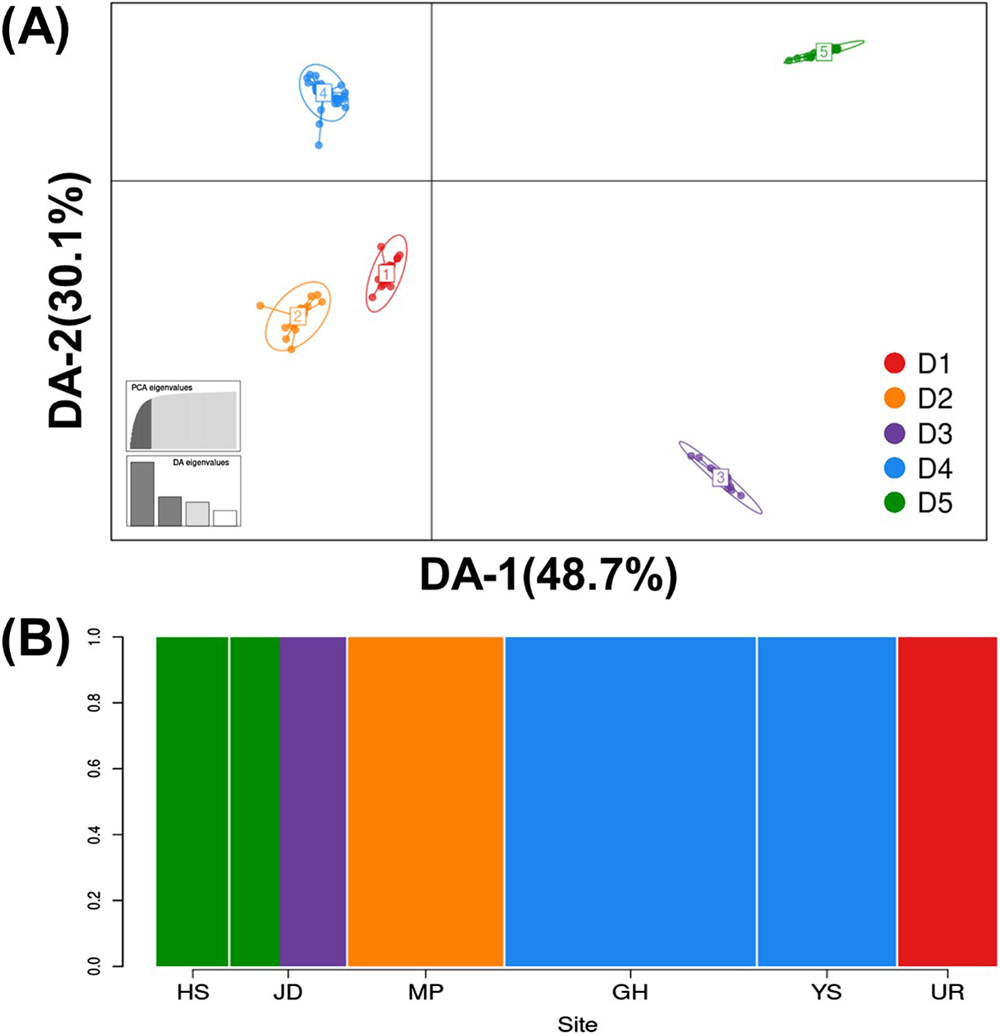
DAPC was conducted using 13,563 SNPs to understand the pattern of genetic structure. A scatter plot was generated based on the five clusters obtained through BIC, 20 PCAs obtained via xvalDapc and the two main axes of the discriminant analysis (Fig. 2A). The clusters comprised 18 (D1), 28 (D2), 12 (D3), 22 (D4) and 70 (D5) samples. Clusters 1, 2 and 3 represented the populations collected from UR, MP and JD, respectively (Fig. 2B). Cluster 4 comprised populations from HS and JD, whereas Cluster 5 included populations from GH and YS.
(A) Discriminant analysis of principal components (DAPC) of 150 Boehmeria nivea (L.) Gaudich. var. tenacissima (Roxb.) Miq. samples collected from six regions. The axes represent the first two discriminant axes (DA-1 and DA-2), explaining 48.7% and 30.1% of the variation, respectively. Each point represents an individual, and colored ellipses represent 95% confidence intervals for each genetic cluster. Numbers indicate subpopulation designations inferred by DAPC. (B) Composite stacked bar plot showing the assignment probability of individuals from each site to the five inferred clusters. The vertical axis represents the membership probability for each individual.

The observed (Ho) and expected (He) heterozygosity of the five clusters (Maxted Reference Maxted, Kell, Ford-Lloyd, Maxted, Ford-Lloyd, Kell, Iriondo, Dulloo and Turok2007) varied as follows: Ho ranged from 0.325 (D2) to 0.408 (D4), and He ranged from 0.253 (D1) to 0.329 (D4) (Table 2). Additionally, allele richness (Ar) ranged from 1.256 (D1) to 1.331 (D4), and the number of private alleles (PA) ranged from 0 (D3) to 3069 (D5). Furthermore, the Shannon–Wiener index (H) ranged from 2.485 (D3) to 4.248 (D5), whereas the Simpson’s index (λ) varied between 0.917 (D3) and 0.986 (D5).
The AMOVA conducted on 150 wild ramie samples from five clusters of DAPC indicated that most of the genetic variation (59.8%) was within clusters, whereas a smaller portion (40.2%) was observed among populations (Supplementary Table 1). The calculated Fst value, which is a measure of genetic differentiation, was 0.402, suggesting a moderate level of genetic differentiation among the studied populations. This differentiation was statistically significant (p < 0.001). The pairwise Fst values among the DAPC clusters ranged from 0.167 (D2–D4) to 0.322 (D1–D3) (Fig. 3).
Pairwise Fst values between six Boehmeria nivea (L.) Gaudich. var. tenacissima (Roxb.) Miq. populations. GH, Goheung; HS, Heuksando; JD, Jindo; MP, Mokpo; UR, Ulleungdo; YS, Yeosu.

Phytochemical analysis of wild ramie samples on six collection sites during 2021 and 2022
Phytochemical analysis of wild ramie samples from the six collection sites in 2021 and 2022 revealed significant differences among areas (A) and between the two experimental years (Y) (Supplementary Table 2). Furthermore, the TPC showed significant results for both factors A (p < 0.001) and the interaction of A with Y (p < 0.001). In contrast, the TFC exhibited significant results only for factor Y (p < 0.001), with non-significant results for factor A and its interactions.
The TPC of wild ramie samples from the six collection areas ranged from 2.2 (HS) to 30.3 (UR) mgGAE/g in 2021, with an average of 8.52 ± 4.32 mgGAE/g (Fig. 4 and Supplementary Table 3). In 2022, the range was from 3.2 (GH) to 19.6 (JD) mg GAE/g, with an average of 9.22 ± 3.79 mgGAE/g. Similarly, the TFC ranged from 1.2 (HS) to 17.5 (UR) mgQE/g in 2021, averaging 5.10 ± 2.50 mgQE/g. In 2022, the range was from 1.0 (GH) to 6.1 (GH) mgQE/g, with an average of 2.78 ± 0.86 mgQE/g. In 2021, the UR population exhibited the highest variation in TPC, with a coefficient of variation (CV) of 67.7%. The HS population showed the greatest variation (82.5%) in TFC. In 2022, the GH population showed the highest variation in TPC (CV of 37.1%) and TFC (CV of 33.2%) among all the collected wild ramie samples.
Total phenolic content (TPC, panel A) and total flavonoid content (TFC, panel B) of Boehmeria nivea (L.) Gaudich. var. tenacissima (Roxb.) Miq. collected from six regions in Korea in 2021 and 2022. Different letters above the bars indicate significant differences among collection areas within each year based on Duncan’s multiple range test (p <0.05).

Discussion
This study revealed substantial genetic diversity and significant population differentiation among wild B. nivea populations collected from six coastal and island regions in Korea, with a notably high Fst value of 0.438 (Supplementary Table 1). According to the classification proposed by Hall (Reference Hall2022), this indicates very strong genetic structuring. These findings are particularly meaningful given the limited genomic studies on ramie in Korea, where research has largely focused on industrial applications such as food additives and functionality, with only one study related to simple sequence repeat marker development for diversity evaluation (Kim et al., Reference Kim, Uhm, Kim, Lim, Kim, Jung, Roh, Jang, Lee and Um2016). Currently, 108 ramie accessions – including 53 wild types and 55 landraces – are preserved at the National Agrobiodiversity Center of the Rural Development Administration (NAC, 2024), but their genetic potential remains largely unexplored. Genetic diversity plays a pivotal role in ensuring crop resilience to climate change and other unpredictable stresses, serving as a reservoir of novel traits for breeding (Bhandari et al., Reference Bhandari, Bhanu, Srivastava and Shreya2017). Recent breeding programmes increasingly rely on wild species and relatives due to their higher genetic variation compared to domesticated populations (Tirnaz et al., Reference Tirnaz, Zandberg, Thomas, Marsh, Edwards and Batley2022). Our integrative approach, combining population genomics and phytochemical analysis, offers foundational data for utilizing wild ramie in future breeding and conservation strategies, particularly in the face of global challenges such as climate change, food insecurity and sustainability (Swarup et al., Reference Swarup, Cargill, Crosby, Flagel, Kniskern and Glenn2021).
Two main theories explain the origin of Korean ramie (B. nivea var. tenacissima): one suggests it was introduced from China, while the other proposes it is indigenous to Korea. Wu et al. (2024) reported that Korean and Japanese ramie accessions cluster with feral populations from Zhejiang, Anhui and northern Jiangxi in China, implying historical introductions likely driven by human migration and maritime trade. Archaeological evidence shows that ramie was used in China as early as 2700 BCE, and in Korea, its cultivation is believed to date back to the Baekje dynasty (18–660 BCE), where it was used to produce woven fabrics (Kim and Cho, Reference Kim and Cho2000). Although the exact origin remains unclear, the high genetic diversity observed in Korean wild ramie suggests long-standing naturalization, possibly reinforced by the introduction of Chinese cultivars during the Yuan and Joseon dynasties, when ramie was a valued trade item used for royal garments. These introduced varieties likely hybridized with local wild populations or landraces, contributing to the broad genetic base observed today (Kim and Cho, Reference Kim and Cho2000; Wu et al., Reference Wu, Chapman, Liu, Milne, Zhao, Luo, Zhu, Cadotte, Luan, Fan, Monro, Li, Corlett and Li2024).
The isolation-by-distance patterns shown in Fig. 2 were not statistically significant (p = 0.55). The HS population, which is located furthest west, has relatively lower pairwise Fst values with the other regions, compared to the UR population, which is located furthest east, (Fig. 4). As previously mentioned, conclusive evidence regarding the phenomenon is lacking. However, it is known to have originated in Korea, particularly in the Jeolla-do region (MP, JD, GH and YS) and UR, which are relatively close. One possibility relates to historical records from the Joseon dynasty. According to these records, the Joseon dynasty implemented the policy of depopulating UR to prevent invasions by Japanese pirates. Officials were dispatched every 2–3 years to search for inhabitants and expel any Japanese found on the island. In 1882, Yi Gyu-won, who was sent as an inspector to UR, reported that 140 Koreans and 78 Japanese people lived there. Among the Koreans, 115 were from Jeolla Province, mostly from the areas around YS, Geomundo and GH. These individuals were skilled sailors with extensive navigation experience (Lee, Reference Lee2019; Rii, Reference Rii2013). As people from Jeolla Province moved to UR, they likely attempted to cultivate various crops, introducing their agricultural techniques and crops. During this migration, they likely transported ramie, a key summer fabric (Kim, Reference Kim2012). Transplanted ramie plants likely developed into genetically distinct groups through naturalization.
In this study, we indirectly assessed environmental impact by analysing annual variation in phytochemical content – TPC and TFC – over 2 years, along with regional genotypes (Supplementary Tables 4 and 5). For TPC, significant differences were observed in genotype (area, A), environment (year, Y) and their interaction (A × Y), indicating a strong GE interaction. In contrast, TFC showed significant differences only for the year, suggesting that environmental factors had a more direct effect on TFC without significant genotype interactions. These findings underscore the relevance of genotype-by-environment (GE) interactions, which reflect how different genotypes respond to varying environmental conditions. GE interactions are shaped by underlying genetic variation (Chalvin et al., Reference Chalvin, Drevensek, Chollet, Gilard, Šolić, Dron, Bendahmane, Boualem and Cornille2021), regional population differentiation (Flint-Garcia, Reference Flint-Garcia2013) and environmental stimuli such as temperature, humidity and other abiotic factors (Cipollin and Redman, Reference Cipollin and Redman1999; Wang and Zheng, Reference Wang and Zheng2001; Boo et al., Reference Boo, Heo, Gorinstein and Chon2011; Samec et al., Reference Samec, Ljubej, Radojcic Redovnikovic, Fistanić and Salopek-Sondi2022), ultimately influencing phenotypic traits such as phytochemical content.
Many studies have examined the effect of environmental factors on phytochemical content in various plant species such as Aloe vera (L.) Burm.f., Brassica oleracea var. acephala, Sorghum bicolor (L.) Moench and Fragaria × ananassa Duch. (Wang and Zheng, Reference Wang and Zheng2001; Choi et al., Reference Choi, Kim, Song, Park, Kim and Kim2017; Kumar et al., Reference Kumar, Yadav, Yadav and Yadav2017; Samec et al., Reference Samec, Ljubej, Radojcic Redovnikovic, Fistanić and Salopek-Sondi2022). Jung et al. (Reference Jung, Lee, Yang, Moon, Song and Kim2020) analysed TPC and TFC in wild ramie, but their study did not evaluate environmental influences. Therefore, our study is the first to investigate genotype–environment interactions affecting phytochemical variation in wild ramie. For instance, Wang and Zheng (Reference Wang and Zheng2001) found that increased diurnal temperature variation increased polyphenol levels in strawberries. Cipollin and Redman (Reference Cipollin and Redman1999) reported that wind speed and humidity negatively correlated with total phenols in onions. Additionally, lower temperatures during the early growth stages increased the flavonoid content in lettuce and kale by influencing flavonoid biosynthesis (Boo et al., Reference Boo, Heo, Gorinstein and Chon2011; Samec et al., Reference Samec, Ljubej, Radojcic Redovnikovic, Fistanić and Salopek-Sondi2022).
In conclusion, this study demonstrated substantial genetic diversity and significant variation in TPC and TFC among wild ramie populations collected from six regions in Korea. The identification of five genetic clusters and the observation of genotype–environment interactions affecting phytochemical accumulation suggest that both genetic background and environmental conditions contribute to the observed diversity. These results underscore the potential of wild ramie as a valuable resource for developing improved cultivars with enhanced functional and agronomic traits. To build on these findings, future studies should investigate specific environmental variables – such as temperature, humidity and soil properties – that influence phytochemical biosynthesis, and explore genetic loci associated with these traits using GWAS or QTL mapping approaches.
Supplementary material
The supplementary material for this article can be found at https://doi.org/10.1017/S1479262125100117.
Funding statement
This work was supported by a grant from the Honam National Institute of Biological Resources (HNIBR), funded by the Ministry of Environment of the Republic of Korea (HNIBR202101115).
Competing interests
The authors declare no conflicts of interest.