In NAKA Dance Theater's BUSCARTE: Duet (Searching for You), Debby Kajiyama drags a tape recorder across the floor, making a loud scraping sound.Footnote 1 Then she listens to the tape, clasping her hand and looking at the recorder where a voice says, ‘No, no. I don't think it's a haunting. He did not have a face. I mean … they removed the face. The reason I have a clean conscience is because I know I did my job.’ Clearly, someone is answering questions: testifying. The interviewee's identity is unclear, but so is the interrogator's. Kajiyama grabs the tape recorder and begins to interrogate the speaker by asking, ‘Are you sorry?’ The interviewee responds! Says, ‘No.’ Kajiyama wonders, ‘Is there anything you could have done differently?’ Slowly, we realize this is Kajiyama, interviewing herself on the recorder. But the distinction between interviewer and interviewee is unstable: the roles frequently reverse.
According to NAKA Dance Theater's website, BUSCARTE: Duet is a ‘multi-disciplinary duet performance that contemplates the forensic anthropology in the case of forty-three students from Ayotzinapa Rural Teachers’ College, forcibly disappeared in Iguala, Guerrero [Mexico], in 2014’. What are these forensic concerns from the legal and scientific art of searching for human remains and testimonies doing in a theatrical performance? BUSCARTE: Duet is one of several projects that fit under what I observe is the growing umbrella of artists concerned with forensic aesthetics. For example, Mexican artist Rafael Lozano Hemmer places forensic practices at the centre of artistic expression. Hemmer's Level of Confidence is a portable, interactive and digital installation that uses face recognition technology to enable museum visitors to scan their faces and try to match them with one of the forty-three missing students from the city of Iguala. Of course, the algorithm does not find exact matches: the students are still missing. I will discuss how artists – NAKA Dance Theater and others – offer us performance practices to revive the victims of state repression. These artists advance a commitment to what I call forensic performances, and their investigative practices revitalize theatrical experience in debilitated democracies. They use the literature and techniques of forensics to stake a claim for justice in opposition to putative democratic processes that serve a violent form of democracy and a theatre of representative politics that gives the illusion of justice.
A performance group based in Mexico City, Mexico and Oakland, California, NAKA Dance Theater is at the centre of this intersection of art and forensics. Founded in 2001 by José Navarrete and Debby Kajiyama, NAKA Dance Theater is committed to contemporary performance and social justice, prioritizing working with communities directly and indirectly impacted by state violence. BUSCARTE: Duet began in 2015 and culminated in 2020. In the performance, Navarrete and Kajiyama create theatrical events where biometric details, discovery of human remains, testimonies and crime scene investigations are artfully interpreted to configure a claim for social justice where the official legal–scientific terrain has failed to protect victims of state repression. This performance has been presented in Oakland, California and the Iwate Prefecture in Japan, where the performance was translated into Japanese. In May 2020, NAKA Dance Theater produced an online showing of the performance and followed the event with a conversation between the artists and one of the surviving youth from the incident in Iguala, Guerrero.Footnote 2
This article continues with an overview of the case of Ayotzinapa that helps me subsequently establish an analysis of forensic performances. Understanding forensics is central to systemic change. Forensics relates anthropology, rhetoric and democracy to individuals. Performance art connects the living with the dead. Forensic performance art carries out some of the work of investigative journalism, without its dangers. Forensic performances attend to the shared collective imaginations and visuality of state crimes and the retracing of steps of persons forcibly disappeared – uncovering the choreography of state violence as a forensic accounting for injustice. Visual (theatrical) and movement (dance) literacies are needed together to assess how the state enacts and maintains power when the courtroom is no longer the determined site for securing a collective shared experience. Theatrical and movement literacies help us understand how repressive states contort their power when they are being held accountable on the public stage of justice. Theatre opens up a space to do a forensics that is orthogonal to a state forensics claiming a certain kind of reality and truth that is dangerous for democratic politics.
The case of Ayotzinapa: theatrics of state violence
Artists Debby Kajiyama and José Navarrete created BUSCARTE: Duet to contemplate the contested case of the missing student teachers from Ayotzinapa, Mexico. On 26 September 2014, federal, state and municipal police attacked the educators-to-be from the Escuela Normal Rural Raúl Isidro Burgos de Ayotzinapa outside Iguala, Guerrero. The indigenous and mestizo students were preparing for a trip to Mexico City to participate in the commemorative demonstrations honouring the students killed in Tlatelolco in 1968. The student teachers from Ayotzinapa were headed to intercept charter buses that they planned to use at a later date to travel from Ayotzinapa to Mexico City – as they did every year. The accounts of the attack remain contested, but what is certain is that eight were killed, twelve injured and forty-three abducted. According to the official report filed in November 2014 by then Attorney General Jesús Murillo Karam, local Iguala authorities passed the forty-three apprehended students to the criminal organization Guerreros Unidos, which abducted them, burned their bodies and dumped the charred remains in a landfill thirteen miles away from Iguala in Cocula. Parents of the missing students continue to dispute these claims, which erase the involvement of the state. According to José Reveles, the students inadvertently abducted buses that were carrying heroin. A coordinated fleet of municipal and federal police with military forces, along with drug cartel militias, attacked the students to keep the millions’ worth of heroin from accidentally disappearing.Footnote 3 The Inter-American Commission on Human Rights in collaboration with victim representatives and the Mexican state created the Grupo Interdisciplinario de Expertos Independientes (GIEI) on 18 November 2014, to provide technical assistance to the parents and family members of victims from Iguala. GIEI has strong evidence suggesting that thirty-four of the perpetrators accused of the crime were tortured to get a confession, in some cases by agents of the Policía Federal Ministerial (Suárez-Enriquez). In September 2018, then president Enrique Peña Nieto maintained that the investigation in Ayotzinapa was transparent (‘Crearán comisión de la verdad por caso Ayotzinapa en México’). The Inter-American Commission of Human Rights maintains that irregularities were present in the investigation (‘Informe de Balance’). In January 2019, Mexican president Andrés Manuel López Obrador created a truth commission to investigate the case.Footnote 4Footnote 5
In a public showing of BUSCARTE: Duet, Kajiyama and Navarrete express horror that, when authorities and independent investigators searched for the missing students, they found other mass graves nearby.Footnote 6 A programme note from 11 March 2018 states that the artists are on a ‘quest to make visible that which cannot be looked at directly’.Footnote 7 They seek to visibilize the countless bodies found in mass graves and the estimated 25,000 bodies that remain uncounted.Footnote 8 Forced disappearances are sometimes carried out through what performance studies scholar Diana Taylor identifies as a ‘theater of operations’ orchestrated by repressive governments.Footnote 9 People are also likely to be executed by non-government agents, such as criminals who run drug cartels with impunity. In other cases, women are forced to disappear or are murdered by their partners. Disposed of in mass graves, they are often accused of being affiliated with drug traffickers, their death labelled a homicide rather than a femicide, a crime involving the intentional murder of women simply because they are women.Footnote 10 The theatre of operations is maintained by anyone, anywhere, almost always a man, who wants to execute power, while the government looks away. Residents, meanwhile, wait for loved ones beyond the reach of visibility for legal systems to hold culprits accountable.
BUSCARTE: Duet is a theatrical expression of dispersed violence and the embodied vestige of the checks and balances needed in a democracy. In the performance, Navarrete sticks his head out from behind a translucent white sheet, wearing an eagle's head. He grabs the sheet from the bottom and shakes it, creating the illusion of flying. Then he laughs menacingly, stops and faces back. His sharp beak is silhouetted and resembles a large knife. The eagle rests on its back and grabs the plastic cover again. Shaking it aggressively, he creates concentric circles, waves that reverberate as if a rock were thrown forcefully into water, producing a mesmerizing tableau with each undulation rippling a hypnotic arch. Then, half-bird, half-man, Navarrete meanders through thoughts about his love of flight, appetite for squirrels, desire for entertainment, and attraction to breaking hearts. Throughout the entire story, a voice modulator distorts his words. Utterances are elongated, each word lagging behind the other. Stopping mid-sentence, he proceeds to interrogate the audience with the confrontational phrase ‘Are you satisfied?’ Then he challenges the audience to preserve the official version of Ayotzinapa, retelling the official account presented in 2014 by then Attorney General Jesús Murillo Karam as if the artist were a defendant in a court case. He concludes the story saying, ‘This is your democracy now.’
In Mexico, democracy is a social–political condition where state agents are constantly experimenting with governance and development. Mexican democracy was unable to establish robust institutions and dynamics to access power and channel public demands.Footnote 11 Student movements of the 1960s and 1970s pushed the country towards a multi-party system, but the judicial branch failed to prosecute and convict political criminals and criminal politicians. The government did not suppress violence, and it failed to reform and consolidate civil, military and intelligence agencies. In the 1980s and 1990s, the democratic reforms and defeat of the single-party monopoly that had been in office for most of the twentieth century coincided with neo-liberal imperatives that foreclosed the possibility of a democracy concerned with people's rights. Public security, protection of substantive rights and violence were, and continue to be, deliberated across party affiliations.
In BUSCARTE: Duet, the eagle-man played by Navarrete expresses a concern with a debilitated democracy. The creature is illogical and motivated by destruction. Democracy is represented as violent and spectacular, to expose a grandiose, debilitated system underneath the story of the missing students from Ayotzinapa. Instead of guaranteeing residents’ protections, the government pacifies critiques and dismisses them in the name of efficiency. This attitude is best expressed in the performance when the creature tells the audience the government did its job in investigating the story. After recounting the story told by the Attorney General, the creature says, ‘Finito’, clapping his hands. This type of democracy – which uses the theatre of operations to pacify claims of injustice – uses existing institutional apparatus, such as judicial and legal systems, to persuade its citizens that a job was performed in the name of civic justice. Democracy, in this instance, is a violent system able to furnish a truth that is fluid and free of troubles for the government.
In light of a democratic government's impunity, performance is key to transmitting traumatic memory and its connection to structural and symbolic violence. According to Diana Taylor, artists and citizens alike across the Americas use embodied performance strategies and visual materials as recognizable vital acts passed on from one generation to the next to express trauma, trace the connections across political moments, and publicly decry a state's repressive regimes.Footnote 12 Taylor has identified these as the DNA of performance, which connects biological and aesthetic codes in performance protests associated with the disappeared, such as the use of black-and-white photographic IDs. Embodied performance practice is a critical form of proof alongside scientific strategies used in identifying disappeared persons, and it is necessary for recognizing injustices perpetrated by the state.
Kajiyama and Navarrete do not make claims to direct biological links with the victims and they do not use traumatic meme practices associated with disappeared persons – such as black-and-white photographic placards of missing persons – to remind their audience of the state's criminal history.Footnote 13 They use less recognizable visual aesthetics. Kajiyama walks around a black stage adorned with long thin white straight lines criss-crossing the floor and diagonally to the high corners of the walls. A simple geometric scenery creates angular tableaus highlighting Kajiyama's body in simple black long-sleeve pants and shirt, as well as the recorder she holds in her hand. There are no photographic IDs of the missing student teachers of Ayotzinapa, nor of the parents who continue to search for them. Instead, we hear an interrogation of the supposed perpetrators – and even this fact is not established. The names of the interviewee and the interviewer are never clear. Perpetrators claim they were obeying orders from their supervisors. They were doing their job. Then the roles switch and the interrogator becomes the suspect. When Kajiyama interviews the recorder, she asks about the crime she committed and the response is about employment.
Deploying these less common traumatic meme practices uncovers what appears insensible in light of gore capitalism. Political philosopher Sayak Valencia identifies gore capitalism as the extreme neo-liberal epistemologies created by subjects who use decorative displays of extreme violence, narco-trafficking and necropower to keep up with the economic and social demands of capitalism in the United States. ‘Decorative’ displays of violence include the hanging of mutilated bodies in public squares, executions in broad daylight and the dismemberment of bodies to be left strewn in public. The desire for this creates a necro-state, or a sociopolitical dependence on death at all levels of society.Footnote 14
Where mass graves and forced disappearances are logical, and where political violence makes it difficult to find the responsible assailants because of a debilitated democracy, BUSCARTE: Duet offers an opportunity to reckon with this reality of dispersed violence. The question and response in this scenario connect the case of Ayotzinapa to impunity across the country – visibilizing the common net of trauma connecting forced disappearances with what Alicia Schmidt Camacho says is Mexico's inability to guarantee rights to its citizens because it participates in a neo-liberal economy that depends on the constant creation of exploitable populations.Footnote 15 Even when suspects are identified, victims’ identities are known, and it is clear that the theatre of operations of the state has been deployed, as in Ayotzinapa, law enforcement has impunity. BUSCARTE: Duet animates the difficulty of finding who is at fault and who is the victim in the case even when we have an abundance of details and no substantive actions. That we find it difficult to identify the perpetrator and the victim in the performance is crucial. When the victims of economic dispossession become perpetrators of spectacular public violence there is no clear distinction between victim and perpetrator, lawfulness and lawlessness. All that residents have is audio and visual recordings, pictures, visual representations of crime scenes, television footage, stories, a felt sense of injustice and symbolic images to search for justice – the residue of the theatrics of state violence.
Kajiyama and Navarrete theatricalize democracy throughout BUSCARTE: Duet, suggesting a large role for performances in democratic processes. It demonstrates performance's capacity to offer an alternative approach to realism in a violent democratic context. According to González González, ‘Journalism has become a high-risk profession, and the exercise of freedom of expression, a precondition of democracy, is probably a death sentence.’Footnote 16 Journalism in Mexico is a very risky practice. Investigative journalists in Mexico assume such serious risks in their work because they pose a threat to mayors and state officials and often receive death threats.Footnote 17 In such a context, performances like BUSCARTE: Duet carry out the work of journalism, investigating the verifiable truth of events and honouring freedom of expression in dangerous conditions. Kajiyama and Navarrete have reviewed declassified police reports and interviewed surviving youth and the parents. Navarrete's and Kajiyama's preoccupations with investigative methods underline the artists’ search for a democracy other than one that continues to be unaccountable because it has yet to secure the full protection of an independent press. By asking audiences if they are satisfied, the artists really ask if the audience is happy with the story as it was represented and with degraded democracy. When people gather in the theatre to recall state crimes and ask if we are satisfied with our reality and the institutions set up to protect that reality, there is some hope of doing things differently and surviving gore capitalism. This is the work of forensic performances, which I address in the following section.
Forensic performances
A necro-democratic state makes particular demands of its citizens and it alters the DNA of performance. Theatrical events that no longer possess easily recognizable traumatic memes in order to attend to forced disappearances are forensic performances, contributing to the enactment and maintenance of real cases that extend beyond the courtroom and are principally concerned with making the audience present at the scene of a crime. Although forensic science started in the early 1970s as a set of disciplinary practices to find medical–legal evidence for courtroom use, the anthropological branch of the field assesses the social conditions of a crime to create social truths: verifiable collective answers and processes that become more transparent.Footnote 18 Non-specialists, such as social workers, cooks, security guards, farm workers and database technicians, may collaborate with families of the missing and together create a ‘crucial expertise, without which the forensic process in their country would lack the credibility and humanity it needs to move forward’.Footnote 19 Although artists such as NAKA Dance Theater do not use forensic methods to traverse crime scenes or identify mass graves or enter courtrooms to testify before judge and jury, NAKA Dance Theater makes evident the theatricality of these practices and uses excerpts from actual forensic reports and interviews with family members to offer credible accounts of the Ayotzinapa case. I see in their work a new strain of performance that resembles forensic oratory practices in legal proceedings, but with marked theatrical mutations in a necro-political state. At the centre of BUSCARTE: Duet is the conflict between the public's claims and official narrative in the case of Ayotzinapa. The performance concerns evidence from all of it as the artists re-enact and transmit partial accounts of the historical record of the events, play out the debate, and use the theatre as a site to dispute the official version of the past.
By re-enacting competing aspects of the case, the artists enact a sense of forensics that is close to its etymology. Forensics comes from Latin noun forensis, meaning forum or public square.Footnote 20 Forum connects to the term foras, meaning outside.Footnote 21 Thus forensic science as we understand it is the use of medico-legal techniques for the purpose of serving the public square, i.e. the courtroom. Yet there is more than a medico-legal inflection in observing forensic concerns. In rhetoric, forensic oratory is about describing past events for the sake of accusing or defending.Footnote 22 An important element is the vividness of language – which was the hallmark of fifth- and fourth-century BCE persuasive forensic speeches by litigants and defendants before hundreds of Athenian jurors.Footnote 23 Long before photography and animation in legal proceedings, litigants gave forensic speeches to make present somebody who was absent. Litigants exploited the gap existing between real sight (what one sees in the courtroom) and imaginary sight (the scenes one creates in the mind based on what one is told). Words were key to creating representations of reality for jurors to be present at a crime.
In the case of BUSCARTE: Duet, it too is about making present someone who was absent. Where the traumatic meme that Diana Taylor describes makes people who were disappeared present, the forensic performance makes the audience, who was absent from the scene or scenes of the crime, present. Kajiyama and Navarrete are examples of forensic-specialist artists who mirror the necro-state and use the vividness of theatre to present the Ayotzinapa case to their audiences. To develop their ongoing piece (2015–20), they travelled to Mexico to support Ayotzinapa demonstrations and gather testimony from parents who had travelled to Guerrero to conduct their own investigations after federal authorities closed theirs.Footnote 24 From 17 to 29 September 2017, Navarrete and Kajiyama visited Mexico City to meet with parents and participate in public demonstrations commemorating the third anniversary of the incident. On 29 May 2020, the artists hosted a virtual conversation with Oakland, California community leader Arnoldo Colibrí and Omar García, a survivor of events in Iguala.Footnote 25 During this discussion, García commented on the unique function of art and performance. He said, ‘Art makes people feel … It creates, reinforces, and internalizes historical memory. These forms of expression should accompany social movements and, in return, social movements need to support artistic expressions.’Footnote 26 For García, theatre helps people who are not from Guerrero become aware of the student teachers’ case and it amplifies causes beyond their confines.
I observe forensic performances to be part of the long history of artists who use theatre as a forum to provide alternative expressions of reality. In the face of corruption, a sensational press and unreliable politics, the ‘Theater of the Real’ is a discourse of truth telling that offers sources of information outside the Catholic Church, yellow press and family-written narratives.Footnote 27 Unlike performances in the Theater of the Real, BUSCARTE: Duet was produced in parallel to real events and is not autobiographical. Navarrete and Kajiyama do not represent characters based on specific people and they do not claim ties to disappeared persons. Because the Ayotzinapa incident is unresolved, BUSCARTE: Duet relays information from outside events about the case in real time. It transmits stories, data and official reports across different public spheres – witnessing events as they unfold. Forensic performances move away from the biological and autobiographical accounting of generational trauma and instead trace a social connection that is still very much aesthetic and theatrical as it evidences traumatic memory, but in which one does not have to be biologically connected. When we talk about social trauma connected to forced disappearances, it can be, as Taylor describes, a biological lineage and, as forensic performances uncover, it can also be a chosen connection appended through creative practice to guard truth telling.
Thinking about forensic performances as an account of traumatic memory through theatre augments Ileana Diéguez's examination of how performance, as liminal aesthetic practice and/or quotidian activity, serves political activism.Footnote 28 Liminal scenarios are important social condensations where lived experiences, aesthetics and politics cohere for a temporary moment, are contested and then dissolve. They are inherent to structured unequal societies, happen in moments of crisis, and provide an opportunity for hierarchies to be undone. Liminal scenarios make a communitas possible – relationships unmoored from the restraints of class structures. Forensic performances, like BUSCARTE: Duet, benefit from their sheltered confines to create liminal scenarios that connect legal, scientific and performance spaces. Like the liminal scenarios that Diéguez identifies, forensic performances do the double work of signalling two overlapping spaces: that of the theatricality of legal procedures and that of performance's ability to make evident that theatricality of life.
Yet the forensic performance does not turn the public space of the street into the site on which to conjure trauma and a collective imaginary to comment on that theatricality. Instead, it condenses a collective imaginary from the public space into the private sphere of the theatre, or as close as possible to it, to reinvent quotidian life from within. The objective is to transmit information through the performance or in post-performance talks alongside the performance – creative act plus context. As mentioned above, Kajiyama and Navarrete organize public showings of BUSCARTE: Duet alongside discussions with some of the surviving student teachers from Ayotzinapa. The performance is akin to investigative journalism.Footnote 29 The performances do not carry out the work of journalism; if they did, they would be targets of retribution. Forensic performances hold up a mirror to cases of public concern to illustrate how social truths are contested. They demonstrate a theatrical performance's ability to be spatially and temporally bounded, to circulate under the radar, and involve smaller micro-convivial audiences that give it power. In spaces where retribution is a common tactic, performances lack the capacity to circulate as quickly as print and digital media. But, while lacking that, they hold the power to get information out. Forensic performances operate across iterative networks where exposing information happens in smaller settings and at a slower, more deliberate pace.
This deliberate pace is present in Lukas Avendaño's Buscando a Bruno (Searching for Bruno), a piece equally concerned with forensic aesthetics. Muxe artist and anthropologist Avendaño invites audiences to sit on a chair next to him and wait for Bruno, his missing brother, forcibly disappeared on 10 May 2018.Footnote 30 Avendaño perches on a chair dressed in colourful Oaxacan garb, and holds a small bright-coloured headshot picture of Bruno with the caption, ‘Dónde está Bruno?’ (‘Where is Bruno?’). Dozens of forensic workers in hazmat suits hand out QR (quick-response) codes that lead to a website about Bruno.Footnote 31 Eventually, these white-suited workers surround Avendaño – and they make the muxe artist ‘disappear’.
The artist adorns their body with Oaxacan garb to represent the horrible atrocities of forced disappearances, but this traumatic meme highlights a tactile (touch) rather than visual (photographic) focus. The artist's radiating bright beautiful colours contrast with the white hazmat suits encircling Avendaño like a mob waiting to strike. Two different approaches manifest here to the adorning of the body and what this uncovers about the social orientation of forensics.Footnote 32 Hazmat suits foreground the scientification of searches and its manifestation through the aesthetic of distance. They are a container of the body, separating it from past events or the scene of the crime in order not to contaminate the investigator or sense of time. By contrast, Avendaño invites participants to sit next to the artist and hold their hand while they are waiting for the artist's brother to return. In this way, Avendaño welcomes a forensic accounting through physical contact for persons absent from the event. But the persons absent are not who we think: the brother. It is in fact the audience. This forensic accounting is not about creating a barrier between the person doing the search and those needing to be found. It invites a forensic sociality of the disappeared through an understanding that there must be touch – with the possibility of contamination. Buscando a Bruno makes the audience, who was absent from the crime scene(s), present.
Appending ‘forensic’ to performance emphasizes that these scenarios are not just representations and aesthetic treatments distanced from a series of past or current events; they are Taylorian repertoires with legal concerns. The word ‘forensic’ highlights the investigative concerns in the performances determined to highlight the embodied accounting of injustice. They foreground temporal shifts and investigative and tactile concerns behind these activities. The artists have the pliability to move across different spheres for gathering information, working with the parents and examining police reports. The forensic emphasizes what a forensic specialist would do. They gather information and stage vivid scenarios of past events to deploy what Jersy Limon says is unique to theatre: its time-travelling ability.Footnote 33 They are wholly invested in focusing on past events to stake a claim for justice and involving the audience (in some cases with direct touch) in the search. Connecting ‘forensic’ to ‘performance’ points to an ethical calculus oriented away from the theatrics of state violence and towards impunity and oppression while perpetuating the repertoires of injustice through existing legal structures.
The choreography of state violence
Since 2014, most artistic and communal expressions in support of the missing students from Ayotzinapa have manifested as visual expressions. For example, the international project Forensic Architecture used evidence, testimonies, videos and phone records from the crime scene associated with the case to reconstruct an interactive digital platform and museum exhibition. Forensic Architecture focused on retracing the steps taken by the police officers, drug cartels and students in order to create a mural of intersecting data points that reveal the incongruence of the official report. Despite the emphasis on the movement of bodies (the disappeared and state agents) to create these interactive and visual representations, less critical attention has been given to the choreographic elements in the case, and what this means for our understanding of the role of performance in the face of repressive regimes.Footnote 34 The competing efforts on behalf of the authorities, the independent investigators and the parents all attempt to retrace the students’ literal steps leading to their disappearance. Behind these debates exists a choreographic concern. A choreographic analytic reveals the manner in which the state redirects and conjures new steps that may never have been taken by the students in order for their version of the story to cohere to the general public. Step taking and step creation (whether fictional or factual) is central to the theatrics of state violence. Forensic performances such as BUSCARTE: Duet foreground these choreographic significances – uncovering the aesthetic literacies needed to hold governments accountable for violating our shared collective experience. The performance connects the theatricalized (visual) nature of state violence with the choreography of state violence (movement of bodies).
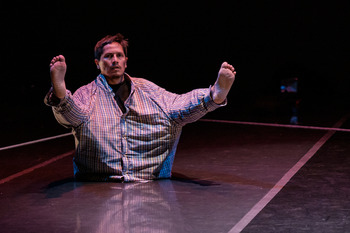
The final moments in BUSCARTE: Duet make these choreographic matters clear. Navarrete, who wears an oversized plaid shirt, bounces his knees and bops his head to a rhythmic cumbia beat. He buckles his right knee and his neck breaks back; both appear to snap but then recoil. This broken motion intensifies; his limbs convulse. Then his body resets before it discombobulates again. He repeats this sharp sequence as if receiving continuous blows to his stomach. Kajiyama joins him and they begin a syncopated march where they parade their bodies, alternating between grimaces and sad faces. Rhythmic beats are suddenly mixed with the interrogation voice from the recorder. The interrogation is overlaid on the cumbia, its text taken from headlines of real cases. The overlay makes the otherwise rhythmic cumbia sharp and jarring. Kajiyama lunges at Navarrete and the unison sequence ends. They tussle, grab each other desperately, and rearrange each other on the floor. When their skirmish ends they separate again. The recording transitions from testimony to a monologue of being uncomfortable with a contortionist in a circus. Kajiyama says, ‘Each time he is brought out to the table, a chopping block. The music is grandiose … He folds himself flat … I cannot watch … The audience goes wild … I bite the drawstring from my hoodie to keep from cursing at the audience.’Footnote 35 While the narrator trembles these words, Kajiyama and Navarrete buckle at the hips again and collapse to the ground, wrapping themselves inside the oversized plaid shirts and contorting their bodies into odd shapes. Feet come out of sleeves where hands are supposed to be located (see Fig. 1).
José Navarrete in NAKA Dance Theater's BUSCARTE: Duet. Navarrete's feet come out of the shirt's sleeves. Photograph credit: Scott Tsuchitani. Courtesy: the artists.

The contorted embodiment expressed in BUSCARTE: Duet complicates the picture for political and memory studies concerned with forced disappearances, where the photographic ID has been heretofore identified as the primary traumatic meme which accounts for disappeared persons.Footnote 36 Embodiment or expressive behaviours like dance muddle that line about how people are coming in and out of presence. In BUSCARTE: Duet, the artists do not use the photograph as the traumatic meme to bring disappeared persons into presence. BUSCARTE: Duet is doing something else in the way in which dance traffics modes of presence-ing. The cumbia steps become an avenue for political practices that offer less oppressive conditions by what dance studies scholar Victoria Fortuna calls ‘moving otherwise’. That is, the dancers offer ‘alternatives to, and sometimes directly [critique] the patterns of movement and bodily comportment that [shape] everyday life in periods marked by violence’.Footnote 37 The dance music cumbia used in this section indexes dispersal as the sonic rhythm extends its hemispheric tentacles and creates the tempo to everyday working-class life. Cumbia sonidera is a low-tempo mixture of Afro-Colombian beats and rhythms with pianos that began in the mid-twentieth century in the high-crime neighbourhood of Tepito in Mexico City, a place that has been a centuries-long site of legal and social battles. Throughout Mexico, cumbia sonidera, both the music and the dance style, blast from trucks, taquerias and dance halls – a reminder of a working-class disposition.
The cumbia steps executed by Navarrete and Kajiyama before they contort their bodies are rough and jerky. Their knees buckle and their necks seem to break as they appear to receive blows to their bodies. Collapse. Recoil. Convulse. These gestures intensify. By the time they are in unison, the dancers’ bodies are exhausted, sloshing around and dragging their feet as if they were puppets being dragged across the stage by an invisible and malevolent hand. In the middle of those drags, they persist to the cumbia beat and step. They transfer weight from the balls of their feet to their knees and lean into their hips. The artists step forward, undercut their own feet, lunge and rebound with other steps toward the front. It is as if an invisible force, which dance studies scholar André Lepecki describes as choreopolicing, gets in the way of their step and tries to redirect their movement towards conformity.Footnote 38 They stumble momentarily, adjust, and then resume, devoted with a will to act – towards the choreopolitical, opposite of choreopolicing. The artists flinch and then recoil to progress forward as they listen to the cumbia.
If the vividness of language is what creates the world through forensic oratory performances in the courtroom, then action and movement are what sustains it in a necro-political state where that courtroom is suspect. I see in this cumbia moment a crucial contribution to the discussion of Ayotzinapa and the wider discourses about state violence and forced disappearances. To the beat of cumbia music, Kajiyama and Navarrete persevere in the face of a legal consciousness that runs parallel to the performance. The performers make evident the social and somatic impact of state violence. Meaning that cumbia steps reveal the social construction of the legal terrain and its consequence for how those representations and enactments of justice manifest at the embodied level in quotidian life. Legal conditions shape, without dictating, what we think is possible as we dance and move through public and private spaces. Laws direct how legs move. In turn, when the audience watch this cumbia, they become witnesses in the sense that dance studies scholar Ann Cooper Albright would have us understand witnessing.Footnote 39 The audience watch the dancers actively challenge and negotiate political and social ideologies – legs lashing out at unjust laws through performance – even as the artists underscore the profound impact of these ideas on everyday embodied experiences that might appear inconsequential. In a necro-state, the feet have come to replace the hand and mouth. Where forensic orators use their voice to speak claims to justice, the dancer–actor on the stage depends on their feet to speak truth to justice and chart alternative paths to the choreography of state violence.
Kajiyama's and Navarrete's effort to tussle in their own bodies after the cumbia music ends accentuates an embodied perseverance in the face of the state: as violent conditions expand into other public squares outside the courtroom, people under duress change their bodies as a practice of resisting the official narrative. They do not leave the chopping block. Instead, they stay within it to make visible what is slowly disappearing. As the voice-over says, ‘He contorts himself.’ Using one's body and caring for oneself, the author of the plan, is the necessary political affirmation.Footnote 40 Thus devotion to the body of the author and the impersonal devotion to the collective plan create a new event: we hear the interrogation of a presumptive criminal and then witness Navarrete and Kajiyama devoting their time to resisting and maintaining a commitment to their steps, upholding their agencies in gore capitalistic conditions where spectators are engrossed with the spectacle of violence. The contortionist that the performance recording references devotes herself to changing her body yet preserving a social truth that is being pressured to change in the face of increasing force from the legal field that alters the steps of victims of state violence after they have died or disappeared. Kajiyama commits to the story of Ayotzinapa as told by the parents and others who remember it. Together, they keep the story alive about how the students moved and walked. They keep the rhythm of justice on their feet. When their feet are chopped off, literally, metaphorically or discursively, other body parts become devoted performers. And the artists ask the audience to consider what type of audience they want to be: spectators engrossed by the violence or witnesses willing to choreograph less violent practices.
A forensic accounting of justice that values dance and choreographic practices offers persuasive analytical modes necessary for legal discourse to create credible shared collective experiences. In forensics, the practice emphasizes that what creates the credible connection between the artefact and the event is the standardization of protocols of discovery – then in fact there is some underlying belief about the stable connection between the artefact and the event. The artefact bears some trace of the original event. In order for something to be forensic you have to repeat the practices across different scenarios to produce validity and certainty from uncertainty. The conditions of validity are the by-product of standardization and persuasion. Forensics in a dance context suggest standardization too. The cumbia dance in this performance highlights a quotidian working-class life. The standardization that it evidences is not one of medical, biological or individual processes associated with the common understanding of forensics, but one of the codification that happens in everyday life on dance floors. Dance becomes a credible marker for the validity of community. Dance is the artefact and the event. It congeals codified ways of moving across time, exhibiting its characteristics, and this can be inflected at critical times to account for social traumas – contrasting a state's choreography that marshals narratives about what expendable persons such as the indigenous and mestizo students from Ayotzinapa did and where they went to warrant such violent reactions to their movements. These narratives depend on an oppressive state literally conjuring the bodies and steps of supposed (expendable) criminal residents and torturing them for confessions – all to fit their narratives to wash their hands clean of any involvement.
In contrast to the state's choreography, the cumbia steps, its music, Iguala and the overlaid interrogation voices become one sonic and incorporated space where the artists negotiate how the interview is used in public. The theatres where BUSCARTE: Duet is performed, including its audience, become a contested public forum, or the performative commons – as described by performance studies scholar Elizabeth Dillon Maddock, where a new public is created.Footnote 41 In the case of BUSCARTE: Duet, a performative commons extends between juridical spaces (where interview recordings were made), theatre venues (where NAKA Dance Theater shares its work with others) and dance floors to create a new public. This new public enacts and maintains a shared, but negotiated, sense of space where choreographic and theatrical encounters are central to legal concerns.
Devotion to choreography and theatrics in cases of forced disappearances enacts a forensics from below where attention to feet and their movement is paramount to identifying the state's violent choreographies.Footnote 42 Unlike a forensics from above, which the state deploys in its theatre of operations to assure the public it has done its job, forensics from below maintains contested collective truths in the open by valuing where people move and how they speak. Thus the DNA of performance that has been altered in gore capitalism is transmitted in public demonstrations, and it also manifests on the dance floor where feet swivel right and left, responding to the literal choreographic threat of state violence. Forensic performances, which are central to forensics from below, do just this: they become spaces for using embodied and visual methods to challenge the official narratives about where bodies, both physical and social, are pulled up to the chopping block and made to disappear.
Searching for the ending
After assessing the theatrical expressions of the forcibly disappeared and their role in debilitated democracies, we can assess performances with subtler forensic aesthetic expressions whose concerns with democracy, however, are equally pronounced. Take, for example, Mexican artist Violeta Luna's 2017 performance Réquiem: fosas. In the stage performance, Luna sits wearing a long black skirt, surrounded by a pile of bones, and her body is painted like Tlaltecuhtli, the Mexica mother of all things, human beings alive and dead. A video projection behind her shows what appears to be a crime scene. A left hand reaches for a white brush while the other hand digs into the dirt to grab an indistinguishable object. The person's face is outside the visual frame and we cannot make out her role, name or designation. Next to her hand is a tag with the alphanumeric identifier ‘C7’. The objects and the scene indicate that it is an investigation scenario, but we cannot say under what circumstances. There is no recognizable weapon or body. Neither do we know any details about the person outside the frame. Yet the scene's marker ‘C7’ and the digging gesture are distinguishable with what we call forensic practices.
A forensic scenario looping behind her, Luna sits with black bones at her feet, looks at them, stares at them, and then opens her mouth to scream, silently – the painful conditions of gore capitalism. After Luna screams, she exposes her legs and a cranial figure comes out between her legs. It slithers right, then left, advancing toward the audience. It controls Luna's body and searches, or busca. Re-enacting the process of giving birth to death, Luna, as Tlaltecuhtli, is not dressed up as a pre-Hispanic deity to blame the violence on indigenous people or to accept the deadly conditions as part of a culture that accepts death on all terms. Luna is not symbolizing death as a passive condition.
Luna's critique of democracy is less explicit here. We do not see any obvious symbols of democratic institutions like eagles. Nor do we hear her bellow diatribes about the failures of democracy. Instead, we only see Luna dressed as Tlaltecuhtli, the forensic scenario and the pile of bones. Luna reminds us that every day is the day of the dead, but it is the search for those who were, are and will be forcibly disappeared in the wake of state repression and impunity that makes us shout in agony. Through this forensic performance, she gives life to a devotion of investigative gestures so profound that, even in her own death, her decaying body's scents, bones and hair rise from clandestine mass graves as evidence of the dead searching for justice among the living.