Introduction
Bird flu, or avian influenza (AI), is caused by Orthomyxovirus type A (Swayne, Reference SWAYNE2000), which, due to its pathogenicity, results in an extremely high mortality rate in a variety of wild and domestic bird species. H5N1 avian influenza has caused drastic losses to poultry farming throughout the world, including Thailand. The first report of bird flu incidence in Thailand was located in the central part, the Suphanburi province, on 23 January 2004 (OIE/FAO, 2005). There were three periods of outbreaks, which ultimately covered 51 provinces in all areas of the country, except the South. In an effort to curb the spread of the virus, as of 2009 65 million chickens have been slaughtered (IRD, 2009). Furthermore, H5N1 infections in other species have also been reported, e.g. cats and humans. The cumulative number of human cases caused by avian influenza (A/H5N1) from 2004 until 18 March 2008 amounted to 25 cases, 17 of whom died (WHO, 2008). The sharp decline in the numbers of commercial chickens, both broilers and layers, has caused massive economic losses.
The destruction of birds suspected to have the virus, as well as all chickens within a 5 km radius of an H5N1 infected-chicken, was a strict government policy. Thailand has endured three major waves of the H5N1 pandemic. During this period, approximately 37 million birds were destroyed (Puthavathana et al., Reference PUTHAVATHANA, AUEWARAKUL, BURANATHAI, AUNGTRAGOOLSUK, KITPHATI and CHOTPITHAYASUNONDH2007). The government policy to eradicate the virus not only devastated commercial chickens, but also wiped out indigenous chickens throughout Thailand.
Bird flu does not directly evolve into its highly pathogenic form in backyard poultry operations, where low-density raising and high genetic diversity keep the viral load at low levels. However, in industrial poultry operations, where chickens are crowded together and closely confined, the virus rapidly evolves and amplifies towards a more pathogenic and highly transmissible form, capable of jumping species and spreading into wild birds and backyard chickens (Suarez et al., Reference SUAREZ, SENNE, BANKS, BROWN, ESSEN, LEE, MANVELL, MATHIEU-BENSON, MORENO, PEDERSEN, PANIGRAHY, ROJAS, SPACKMAN and ALEXANDER2004). In this sense, H5N1 is a poultry virus that kills wild birds and indigenous chicken, not the other way around. Instead of placing the blame for the spread of avian flu on backyard poultry-keepers and migratory birds, international agencies should urgently recognise that diverse small-scale poultry farming is part of the solution, not the problem (GRAIN, 2006).
Therefore, aspects of the loss of genetic diversity after the AI pandemics in Thailand are an important issue. No comprehensive information has been reported about the impact on genetic diversity and genetic resources. Therefore, the impact of the AI outbreak on Thai indigenous chicken genetic resources and genetic diversity is the main objective of this study.
Site selection and data collection
Surveys at three sites in four provinces – Phitsanulok, Nakhon Phanom, and Suphan Buri–Nakhon Pathom, representing the North, Northeast and central areas of Thailand – were conducted during March to April 2009. The questionnaires were developed by the research team to collect village and household information. Only households from the outbreak districts (in the past five years) in those provinces were investigated. A total of 486 households from 27 villages in seven sub districts were interviewed.
Village leaders were interviewed to gather general information about each village, and the impact of the AI outbreak in terms of the entire community. Household heads or native chicken raisers were interviewed to gather details about the impact of the AI outbreak at the household level on chicken-raising procedures, varieties and numbers. The interview covered several areas: management, housing, diversity, health, mortality, decisions about restocking/non-restocking, variety selection and related topics, with respect to strategies for protection from the disease after chicken deaths or culling. A total of 679 mature and 387 young roosters were photographed and classified by feather colour, shank colour, and comb types.
Identical questionnaires and data-collection methods were used at all three sites. Questionnaire training and data-gathering methods were first discussed among members of the research team; then sub-survey teams at each site were extensively trained before putting the survey into practice. Preliminary surveys were then performed. Any modifications or adjustments of the questionnaire to fit a particular locality had to be approved by the research team.
Reasons for raising Thai indigenous chickens
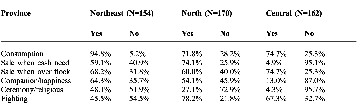
The results from interviews of 486 households in three regions of Thailand showed that Thai indigenous chickens were raised for several purposes. The main reasons in most areas were: for household or local consumption; for sale, when cash was needed or when overstocked; and for use as fighting cocks. Slightly different motivations for raising chickens were found in different regions. Fighting was a more popular purpose in the North and central regions compared to the Northeast (Table 1). Companionship or ‘purpose of happiness’ was one of the reasons for farmers in the Northeast, while this was less important in communities in other regions. This study also showed that Thai indigenous chickens were more closely involved in Thai religious and traditional ceremonies in the Northeast than in other parts of Thailand. Most households kept their indigenous chickens in the backyard during the day to allow them to freely scavenge, and then they were penned at night – similar to the findings in previous reports (Choprakarn et al., Reference CHOPRAKARN, WATTANAKUL, WONGPICHET and SURIYACHANTRATONG1998; Laopaiboon and Jitpraneechai, Reference LAOPAIBOON and JITPRANEECHAI1999; Klinhom et al., Reference KLINHOM, WONGSAMAN, KANHAREING, TREEMANEE, SUEKAEW, UTARASK and PIMDEE2005). This practice was satisfactory for the farmers involved.
Reasons to raise Thai indigenous chickens in three regions of Thailand.
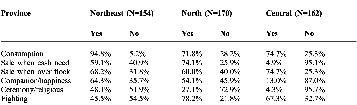
Survey participants were asked about their first priority for raising Thai indigenous chickens, if options could be chosen freely; the results are shown in Table 1. However, if only one option could be chosen, the first priority was for consumption (37%), followed closely by fighting (34%) (data not shown in table). Notably, the priority was different in each region of Thailand. This study revealed that the major priorities for raising Thai indigenous chickens were consumption, fighting and income in the Northeast, North and central regions, respectively. The main purposes of raising indigenous chickens in Thailand found in this study are similar to previous reports on Thailand (Heft-Neal et al., Reference HEFT-NEAL, KAHRL, OTTE and ROLAND-HOLST2009), Lao PDR (Bouahom et al., Reference BOUAHOM, KEONOUCHANH and KHAMPHAVONG2007) and the Solomon Islands (Jansen et al., Reference JANSEN, GLATZ and MIAO2009), where meat and eggs are primarily for home consumption and are sold when cash is needed. In the Niger River delta, chickens are also used in traditional ‘caring’ rituals, act as a natural alarm clock, and are offered as gifts for cementing marriages and for friendship (Kperegbeyi et al., Reference KPEREGBEYI, MEYE and OGBOI2009). In Jordan, chickens are raised mainly for egg consumption and sales (Abdelqader et al., Reference ABDELQADER, WOLLNY and GAULY2007). In Myanmar, fish is more commonly consumed; therefore chicken-raising is done for extra income (Henning et al., Reference HENNING, KHIN, HLA and MEERS2006). The use of indigenous chickens in religious rites also occurs in Ethiopia (Dessie and Ogle, Reference DESSIE and OGLE2001), where local chickens are used in religious ceremonies (sacrifice) in the central highlands. The use of indigenous chickens in several types of ceremonies and wedding celebrations has been reported in various parts of Southeast Asia (Aini, Reference AINI1990) and Africa (Tadelle, Reference TADELLE2003). The overall social impact of Thai indigenous chicken-raising was reported by Simarak et al. (Reference SIMARAK, KERDSUK, KERDSUK and KREKSAKUL2007).
Chicken rearing and parental restocking after AI outbreak
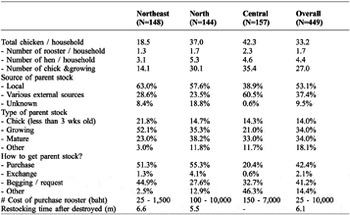
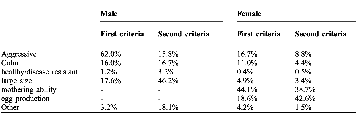
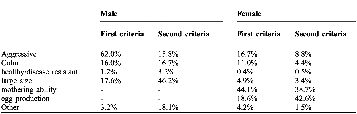
The average number of Thai indigenous chickens per household was 18.5, 37.0 and 42.3 in the Northeast, North and central regions, respectively. It has been reported that the average flock sizes of backyard chickens in Jordan (Abdelqader et al., Reference ABDELQADER, WOLLNY and GAULY2007) and Pakistan (Farooq et al., Reference FAROOQ, SHAKIR, MIAN, MUSSAWAR, DURRANI and CHEEMA2004) were 41.6 and 23.1 chickens per household, respectively. In this study, more than 80% of chickens raised were young and growing chickens. Typically, each household had a total of one to five roosters and hens. After the AI outbreak, most parental restocking of indigenous chickens in Northeast and Northern Thailand was carried out by obtaining them from local or home-grown areas, while restocking in the central region was likely to occur via transfer from various external sources. Most commonly, chickens obtained for parental restocking were growing or mature age chickens (68%). Some farmers preferred to restock younger age chickens (10-20%). Generally, parental chicken restocking was achieved either by purchasing or by begging from neighbours and relatives. The cost of Thai indigenous roosters can be high, varying from 25 to 10,000 baht each (approximately US$1 to $300). In most cases, the highest-priced roosters were the fighting type. The cost varied according to the degree of aggressiveness and fighting characteristics. The average restocking time was six months after chicken destruction caused by the AI outbreak (Table 2). The main criteria for selecting parents for restocking were aggressiveness and large body size for males, and mothering ability and egg production in females (Table 3). Large body size and mothering ability are generally the main criteria for breeding stocks of native chickens in several countries, such as Zimbabwe (Muchadeyi et al., Reference MUCHADEYI, WOLLNY, EDING, WEIGEND and SIMIANER2009). Selection for low aggressiveness is usually performed for commercial chickens (Tablante et al., Reference TABLANTE, VAILLANCOURT, MARTIN, SHOUKRI and ESTEVEZ2000; Dennis et al., Reference DENNIS, CHEN and CHENG2008) to avoid social stress and cannibalism. However, improving the competitive effect in breeding programs has been suggested, to enhance traits related to survivability and production (Muir and Schinckel, Reference MUIR and SCHINCKEL2002). Aggressiveness is one of the preferred selection criteria for parent stocks in Thailand, in order to exploit them as sporting birds for cockfighting. Development of fighting cock breeds is not only important for their use as gaming fowl, but also in terms of genetic conservation. Most fighting cocks were developed from indigenous chickens. Fighting cocks are common throughout much of Southeast Asia (Thailand, Vietnam, Philippines, Indonesia), South Asia (India, Pakistan), the Pacific Islands, Latin America (Mexico, Peru, Brazil), Europe (Spain, UK, France) and North America (US) (Wikipedia, Reference WIKIPEDIA2010). The Thai indigenous fighting cock is one of several favourite strains in Brazil (Rodrigues et al., Reference RODRIGUES, QUEIROZ and DUARTE2006), Japan, Taiwan, Southeast Asia, etc. It is noteworthy that selection for mothering ability was preferable to fertility (egg production) in this study. This indicates that indigenous chicken-raising in Thailand is generally more concerned with chick survival than the number of eggs hatched. This result was similar to a study on village chicken production by Kusina et al. (Reference KUSINA, KUSINA and MHLANGA2001), who reported that low mortality through predation, climatic stress and poor nutrition are the main constraints for village chicken production.
Characteristics of Thai indigenous chicken rearing information in Thailand.

Main criteria for selecting parent stock.
Diversity of Thai indigenous strains before and after the AI outbreak
Thai indigenous chicken strains are traditionally classified by feather colour in males: black, yellow, red, grey, striped, green, straw, bronze, and white (Nilpueng, Reference NILPUENG1999; Department of Livestock Development, 2003). Mature and young roosters are also classified by mating history and age. The classification is usually applied to roosters because: 1) the colour classification is clearer in males than in females; 2) males are basically related to genetic forces in nature, such as selection, migration, and genetic drift.
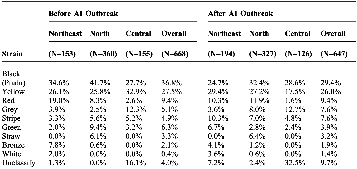
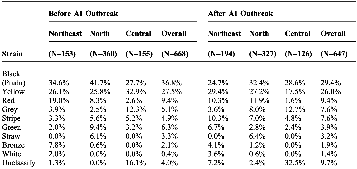
Table 4 shows the proportion of rooster strains that the interviewees possessed before and after the AI outbreak. Noticeably, the most prevalent Thai indigenous rooster strains in all regions of Thailand were black and yellow types, both before and after the outbreak. This is still the case today, while red, green, striped, and straw-coloured strains are found to a moderate extent. In this study, black, yellow and straw colours were commonly found in young roosters, whilst the white colour was rarely found either in mature or young roosters. This study disclosed that the numbers of the black, or Pradu, strain had begun to decline, while the proportions of other strains were only slightly changed. However, unclassified or mixed strains started to increase. The diversification of plumage colours is due to strain diversity and crossbreeding among Thai indigenous chickens, or between Thai and exotic strains (mostly from Vietnam and Burma). The black-feathered indigenous chicken is also the strain most commonly found in West Africa (Youssao et al., Reference YOUSSAO, TOBADA, KOUTINHOUIN, DAHOUDA, IDRISSOU, BONOU, TOUGAN, AHOUNOU, YAPI-GNAORÉ, KAYANG, ROGNON and TIXIER-BOICHARD2010). In China, the common indigenous strains are related to geographic location; for example, yellow chickens (yellow feathers, skin and shank) are popular in the south, while ‘black-bone’ chickens are commonly found in Sichuan (Lujiang et al., Reference LUJIANG, XIANYAO, GUIFANG, KUANWEI, HONGJIE, LONGCHAO, GUIQIN, ZHUOCHENG, GUIYUN and NING2006).
Diversity of Thai indigenous chicken rooster strain before and after AI outbreak.
A molecular study has been conducted on the classification of Thai indigenous chickens. High heterozygosity within strains revealed a high genetic diversity among genes in individuals, and a slight increase of genetic subdivision between strains (Akabut et al., Reference AKABUT, DUANGJINDA, LAUPAIBOON and GUNHARENG2006). However, there was no variation in meat quality between strains (Mekchay, Reference MEKCHAY2003; Teltathum et al., 2003). Muir et al. (Reference MUIR, WONG, ZHANG, WANG, GROENEN, CROOIJMANS, MEGENS, ZHANG, OKIMOTO, VEREIJKEN, JUNGERIUS, ALBERS, LAWLEY, DELANY, MACEACHERN and CHENG2008) reported that more than half of the genetic diversity had been lost in commercial chickens, and revealed that the lack of genetic diversity in these chickens could worsen future bird flu outbreaks and other disease threats. Therefore, they suggested that crossbreeding between commercial lines and indigenous types is an appropriate way to recover the genetic diversity in commercial chickens. Consequently, this report encourages the importance of indigenous chickens as a genetic resource for the future. In Thailand, crossbreeding between local indigenous strains is commonly found in backyard and family production, while crossing between exotic indigenous strains (e.g. Myanmar and Vietnamese indigenous chickens) is found in some households to search for better fighting types. In addition, crossbreeding between indigenous chickens and commercial lines (broilers and layers) is scarcely found in villages due to the restrictions of the closed commercial production system. A performance study of such crossbreeding has been reviewed (Choprakarn et al., Reference CHOPRAKARN, WATTANAKUL, WONGPICHET and SURIYACHANTRATONG1998).
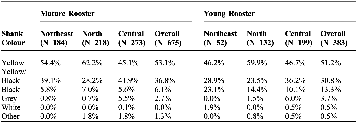
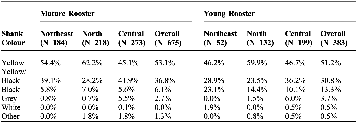
In terms of the variety of Thai indigenous chicken shank colours found in this study, Table 5 shows that yellow shanks and yellow with black spots (yellow/black) are the most commonly found (>80%). Similarly, yellow-coloured shanks are the most common among indigenous chickens in Kashmir (Iqbal and Pampori, Reference IQBAL and PAMPORI2008), China (Lujiang et al., Reference LUJIANG, XIANYAO, GUIFANG, KUANWEI, HONGJIE, LONGCHAO, GUIQIN, ZHUOCHENG, GUIYUN and NING2006) and Ethiopia (Mogesse, Reference MOGESSE2007). Clean or totally black shanks are found only in the pure black strain (Pradu); therefore only 6-13% of the total of mature and young roosters, respectively, had this characteristic. Moreover, clean white shanks are found only in the very rare pure white strain (Chee chickens), and therefore accounted for less than 1% of the total. Black-coloured shanks are a normal characteristic in black-bone chickens, which are widespread in China (Lujiang et al., Reference LUJIANG, XIANYAO, GUIFANG, KUANWEI, HONGJIE, LONGCHAO, GUIQIN, ZHUOCHENG, GUIYUN and NING2006).
Current diversity of shank colour in Thai indigenous chickens.
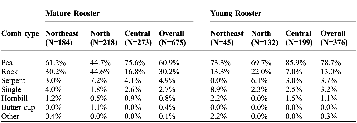
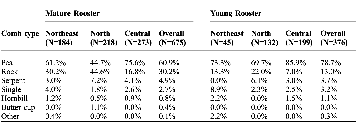
There were six major comb types found in this study (Table 6). The most common comb type found was the pea comb (61% in mature roosters and 79% in young roosters). The pea comb is found in similar proportions in Ethiopian indigenous chickens (Mogesse, Reference MOGESSE2007). However, single pea comb indigenous chickens could be found in some regions, such as in Kashmir (Iqbal and Pampori, Reference IQBAL and PAMPORI2008). The rock comb was another common comb type in Thai indigenous chickens. This comb type has not been identified in any commercial chickens or layers.
Current diversity of comb type in Thai indigenous chickens.
Several countries have established poultry conservation programs (in situ and ex situ) either for local or national populations (Hoffman, Reference HOFFMAN2009). In Thailand, the national program for the conservation of chicken genetic resources succeeded after the advent of the AI outbreak, during which drastic culling programs caused extremely high mortality. Up to now, the global plan of action for conservation of indigenous chicken genetic resources has been to monitor population status, geographical distribution, and risk status, and to establish a warning system. Tixier-Boichard et al. (Reference TIXIER-BOICHARD, BORDAS and ROGNON2009) suggested that data on production systems need to be integrated with genetics for better describing the diversity. They also concluded that maintaining genetic diversity is a key for sustainable poultry production and for monitoring poultry genetic resources.
Conclusions
The AI outbreak had a major impact on the genetic resources of Thai indigenous chickens. From this study, the numbers of the black (Pradu) strain started to decline, while the proportions of other strains were slightly changed. Additionally, mixed colour due to strain crossing increased considerably. The most common shank colours found were yellow or yellow with black spots. There were six major comb types found, the most common being pea and rock. Since the AI outbreak, pure Thai indigenous strains have declined as a percentage of the total genetic population, while mixed strains have continually increased. The genetic conservation of untainted strains of Thai indigenous chickens is our recommendation.
Acknowledgements
The work was supported by the Food and Agriculture Organization of the United Nations (FAO) under the ‘Future prospects for the contribution of village poultry production to food security in developing Asian economies’ project that was funded by the ‘Deutsche Gesellschaft für Internationale Zusammenarbeit (GIZ)’. We are grateful to Associate Professor Banyat Laopaiboon for valuable suggestions in characterization of the indigenous strains and Professor Christopher Salisbury for English editing. We also thank the Research and Development Network Center for Animal Breeding (Native Chicken) KKU-TRF for useful information relevant to the study.