Introduction
Few grand strategies puzzle International Relations scholars more than appeasement. Scholars have debated why states put their hopes in seemingly risky attempts to ‘buy off’ foreign challengers ever since Neville Chamberlain unsuccessfully sought to mollify Adolf Hitler in the 1930s.Footnote 1 Today, few analysts subscribe to the once-popular ‘guilty men’ theory, which attributes appeasement to leaders' personal failings.Footnote 2 Instead, two general approaches delineate the contemporary study of appeasement. One suggests that states are most apt to appease a foreign challenger when facing multiple external threats.Footnote 3 States, they argue, will sometimes attempt to mollify one foe in an effort to concentrate scarce resources against a more dangerous enemy; appeasement is the product of a logic of triage.Footnote 4 The other stresses internal, rather than external pressures. In these domestic politics accounts, powerful financial and export-oriented interests worried about the economic and social costs of war pressure national leaders to make diplomatic concessions in hopes of avoiding conflict.Footnote 5 For these scholars, appeasement is less about prioritising foreign threats than it is about placating kingmakers at home.
In this article, we offer an alternative explanation for why states appease. We argue that the answer lies at the microfoundational level of individual leaders, where the twin pressures of statecraft and political leadership intersect. Governments are most likely to adopt a strategy of appeasement when their top leaders are severely cross-pressured: when demands for international security conflict sharply with domestic political priorities. Appeasers invariably hold power at times when national security is scarce; they cannot safely discount the risk of foreign aggression. Yet leaders who appease foreign aggressors are also constrained domestically. Economic resources are limited, and leaders run high risks with the electorate (selectorate) if they fail to invest those resources at home. In the context of this specific political configuration, cross-pressured leaders will seek security on the cheap, with appeasement being one way out of this classic dilemma of statecraft – that is, a strategy to obtain an acceptable level of external security while at the same time catering to domestic exigencies.
We test our argument about the salience of international threat and domestic politics against a detailed analysis of British appeasement in the 1930s. While Winston Churchill's admonition at Fulton, Missouri that ‘there never was a war in history easier to prevent by timely action than the one which has just desolated such great areas of the globe’ may be overstating the case,Footnote 6 it is true that many scholars believe World War II could have been averted had Chamberlain acted decisively to contain German revanchism. As such, there is an intrinsic value in understanding Chamberlain's calculus. Yet the Chamberlain case also offers a ‘hard test’ for our argument that appeasers are leaders who face incentives to invest resources on the home front. As head of the right-of-center Conservative party and a staunch opponent of socialism, it defies conventional wisdom to suggest that Chamberlain faced intractable pressures to invest in butter over guns. Indeed, Chamberlain while Chancellor of the Exchequer had advocated that the Conservatives fight the 1935 general election on the issue of national security, gaining for himself a reputation as something of a hawk on foreign policy.Footnote 7 Once Chamberlain became prime minister in May 1937 at the head of a Conservative-dominated National Government with a huge parliamentary majority, why did he not beat a militarist path? We show that weighty domestic imperatives combined with geopolitical factors to shape Chamberlain's decision to appease.
The article is organised into four sections. In the first section, we describe the general conditions under which politically self-interested leaders are most apt to appease a potential aggressor. The next section applies the model to the British case. We explain why Chamberlain saw political advantage in appeasement and why Chamberlain found it difficult to adopt a tougher stance toward Germany, while also taking care to highlight facets of the case that do not fit our model. In the third section, we briefly consider what would have been necessary for Chamberlain to abandon appeasement in favour of a more assertive balancing strategy, drawing on the comparative case of Franklin Delano Roosevelt (FDR) to consider the counterfactual argument. Finally, we conclude by discussing implications for theorising about appeasement and about how leaders make grand strategy more generally.
The political logic of appeasement
Appeasement occurs far more frequently in international politics than balance-of-power logic predicts.Footnote 8 Most efforts to explain this ‘anomaly’ have given pride of place to either the international or the domestic level of analysis. Few scholars have taken the analysis to the level of individual leaders.Footnote 9 To some extent, this reflects a view widely held among contemporary International Relations scholars that although individuals do matter from time to time, it is not possible to generalise about their behavior.Footnote 10
We believe that this view is mistaken, and that our understanding of why states sometimes opt to appease their foes can be enhanced by starting from the level of individual statesmen, by viewing leaders as strategic actors who choose their policies (strategies) on the basis of political self-interest. By going to the microfoundational level, it is possible to take into account Realpolitik's concern with international power and security and Innenpolitik's emphasis on domestic interests and coalitions. Specifically, we model the ‘inputs’ of a leader's political calculus as deriving from both the international and the domestic spheres, turning core realist and domestic politics insights about the structural determinants of appeasement into a parsimonious – and generalisable – explanatory model.Footnote 11 In contrast to extant approaches, then, which tend to privilege a single level of analysis when modeling strategic choice, our approach posits geopolitical and internal forces as twin engines of statecraft, joint drivers of leaders' strategic choices. In short, self-interested political leaders must, by virtue of their positions, respond to both international and domestic stimuli in relatively equal measure.Footnote 12
Geopolitical slack
Leaders take geopolitics seriously for a simple reason: to do otherwise is to risk their reputations and their hold on political power. As Niccolo Machiavelli warned, ‘princes’ who misjudge their state's surroundings and capabilities jeopardise their hold on power. The unanticipated rise of a foreign challenger or the failure to take an old or new foe seriously can severely damage a leader's reputation and credibility, at home as well as abroad. Failure or defeat in international affairs throws open the door to domestic opponents and would-be challengers to the throne. In short, demonstrating foreign policy competence matters.
How pressing is this performance constraint? It depends, we argue, on how much slack there is in the external environment. The term ‘slack’ refers to a country's room for manoeuver in an international system in which power is distributed unevenly; it is measured by the intensity of the threat(s) that a country faces from foreign challengers.Footnote 13 Leaders have greater geopolitical slack when their country faces no immediate threat to its physical security, and when the possibility of a rapid and adverse shift in the distribution of power is relatively low. Under such circumstances, decision-makers can treat the international environment as relatively benign, something that bears opportunity rather than portending risk. Leaders have little geopolitical slack when security is scarce and their state is exposed and vulnerable to foreign intimidation and aggression. In this situation, leaders are much more likely to find themselves compelled by their surroundings. In particular, they have strong incentives to move proactively to check challengers and avoid adverse shifts in their geopolitical position that their publics might blame them for, and that both their domestic and foreign adversaries might exploit.Footnote 14
Statesmen thus have self-interested reasons for thinking in geopolitical terms,Footnote 15 especially when international conditions are unfavourable and the risk of strategic failure and domestic blame is great. Almost invariably, leaders will look for ways to minimise their political exposure to hazardous international environments. How? Balancing is one possible response.Footnote 16 It is a defensive strategy that involves efforts to prevent another state from exploiting the status quo. One form of balancing involves a leader's efforts to build up his or her state's military capabilities (‘internal balancing’). Alternatively, a leader can try to diffuse the threat by pooling resources with other states through forming alliances (‘external balancing’).
However, balancing is a comparatively expensive type of response, especially the internal variety. Wealth must be taxed, requisitioned, or expropriated, and resources can be hard to extract from a resistant populace or legislature. In this regard, balancing strategies differ sharply from other status quo strategies such as appeasement or buckpassing whereby leaders rely on some other state to check potential aggressors.Footnote 17 Appeasement and buckpassing require little in the way of taxation or conscription because they lean disproportionately on diplomatic means. This is perhaps most obvious in the case of appeasement, but buckpassing is similar in that it seeks to ‘shirk’ the costs of deterring (and possibly defeating) the potential aggressor.Footnote 18
Which of these grand strategies, then, will leaders adopt at any given moment? Realists have tended to focus on external considerations: Is the threat urgent? Are suitable allies available? Is another state willing to catch the buck? However, explanations that give pride of place to international circumstances are unhelpful for understanding why leaders sometimes prefer appeasement or buckpassing to internal balancing – that is, why leaders sometimes act contrary to balance-of-power logic. Knowing how much geopolitical slack a leader has tells us something general about how he or she will act, but whether a leader will balance against or appease an external threat depends upon domestic as well as international circumstances.
Guns versus butter
Leaders are not only statesmen; they also head up domestic coalitions or parties, the continued support of which depends in part on the leader's ability to deliver valued goods to their constituents. Modern leaders do many things to gain domestic backing. They set national priorities, work for policies that create jobs, distribute contracts, provide subsidies, and channel investments into projects that will benefit their supporters and strengthen their party's claim to power.
One implication is that a leader's ambition to pursue expensive balancing strategies depends in part upon whether the domestic constituencies whose support is essential to his or her hold on power have a sizeable stake in investing in military strength, as opposed to domestic welfare. If so, expansive (and expensive) strategies for dealing with external threats are much easier to develop and implement. Frequently this is the case, but sometimes a leader's party prefers butter to guns, even in the face of worsening international circumstances. In these instances, when supporters are reluctant to prioritise foreign policies that put a premium on military power, leaders can be expected to favour strategies that place less of a burden on domestic resources. To emphasise, this is not to say that leaders ever can disregard the risks posed by external threats, just that some leaders (those who head butter-oriented coalitions) are wont to favour grand strategies that place less of a financial burden on society than their counterparts who head guns-oriented blocs.Footnote 19
Beyond the distributional consequences of grand strategy, leaders are also mindful of how foreign policy decisions will play among the public at large. Especially in democracies, leaders must secure the political backing of not only partisans but also a decisive slice of the national electorate.Footnote 20 Popular attitudes about taxes and nontax opportunity costs are thus important indicators of how much domestic latitude leaders have in making grand strategy.Footnote 21 The more resistant the public is to new taxes and conscription, the higher the domestic political hurdles to mobilising military power, and the more restrained leaders are likely to be in setting grand strategy. This means that foreign policies rarely are judged solely on their own merits. Rather, leaders must also consider whether and how foreign policies will affect what they are trying to achieve domestically, something that is especially pertinent when it comes to foreign policies that threaten to expend sizeable quantities of national resources.
Generations of political economists have described this trade-off in stylised terms as the choice between guns and butter. Leaders must decide whether to invest the state's resources in military build-up (guns) or to invest in domestically oriented policies and programmes (butter).Footnote 22 As a practical matter, the trade-off is rarely as unbending as modern economic texts portray it to be. Leaders can and often do invest in both guns and butter, relying on increased taxes or large budget deficits to reduce the severity of the trade-off. Still, the guns-versus-butter distinction is a useful reminder that leaders do not make grand strategy in a fiscal vacuum. As the famous American strategist Bernard Brodie put it, ‘[s]trategy wears a dollar sign.’Footnote 23
How acute this guns-versus-butter trade-off is depends on many things: economic growth, administrative capacity, and domestic support for or opposition to the extractive policies that finance military spending.Footnote 24 In times of plenty, conflicts over national priorities and budget outlays ease, and domestic politics becomes less zero-sum. Leaders who hold power at a time of economic crisis, by contrast, have fewer resources at their disposal and are thus more constrained. Diversionary war theory predicts that it is precisely under these conditions that leaders are most likely to resort to coercive diplomacy or war.Footnote 25 Sometimes this prediction holds up. Yet leaders faced with economic crises and tight resource constraints often do the reverse: they look for ways to mollify foreign rivals (appeasement), ‘outsource’ the demands of security to other nations (buckpassing), or scale back foreign commitments and military expenditures (retrenchment).
Just as leaders have self-interested reasons to think in geopolitical terms, then, political self-interest explains why leaders think about grand strategy in domestic terms, too.Footnote 26 When powerful elements within their party see little advantage in militarism, when playing the ‘security card’ offers little electoral advantage and when fiscal constraints are tight, leaders face political hurdles to the mobilisation of resources for investment in the military. While such leaders are just as sensitive to international threats as their militarist-minded counterparts, they have strong political incentives to find credible and effective strategies for achieving security that avoid placing a heavy burden on domestic resources.
Appeasement as statecraft
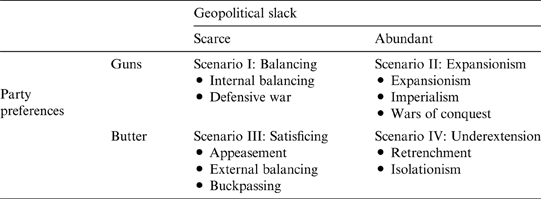
We now have the pieces in place to predict when leaders will find it politically advantageous to adopt cost-minimising strategies like appeasement (see Table 1).Footnote 27 For these leaders security is scarce. They cannot afford to discount the risk of strategic failure and so must find ways to reduce the nation's vulnerability to potential military attack, economic coercion, and political intimidation. For these same leaders, however, the high cost of investing in military power is an issue. Their party or coalition prefers butter to guns; key constituencies and voters are reluctant to prioritise foreign policies that threaten domestic consumption or require increased taxes. Whereas the leaders of other parties might be able to implement strategies of internal balancing, appeasers fall into the category (scenario III in Table 1) of leaders who cannot; they are leaders under great pressure to invest at home. Under such circumstances, there is a pressing need to find strategies that promise satisfactory levels of external security but which will not jeopardise important domestic objectives. Leaders are thus inclined to rely on grand strategies that do not place a heavy burden on domestic resources and that attach greater weight to diplomacy than force, yet still offer the prospect of success in terms of achieving an acceptable level of external security (or at least the avoidance of humiliation, capitulation, or war). In short, appeasers are leaders who need security on the cheap.
Strategic choice scenarios and associated grand strategies

British appeasement in the 1930s
In this section, we test the argument through an analysis of British grand strategy before World War II.Footnote 28 Overall, we show that, as prime minister in the late 1930s, Neville Chamberlain confronted the timeless tradeoff delineated above: how to ensure external security with limited means. Chamberlain viewed Hitler's ambitions and diplomacy with wariness and misgivings. He could not afford the political risk of ignoring the danger. At the same time, domestic politics created strong pressure to find an inexpensive way to reduce the nation's strategic exposure. As we show, Chamberlain led a party eager to avoid war and to devote scarce government resources to domestic ends. Appeasement thus emerged as the favoured strategy for dealing with the rise of Germany as a hard-headed and calculated response to an unforgiving set of political circumstances.
Geopolitics: The German problem
Realist accounts of the period make clear that Chamberlain had little geopolitical slack and that this fact was not lost on him.Footnote 29 As early as 1934, Chamberlain had singled out Germany as ‘the enemy to watch’.Footnote 30 Part of this intuition had to do with Chamberlain's private misgivings about the Nazi regime. Worries about British vulnerability to strategic bombing were another factor.Footnote 31 More fundamentally though, it had to do with the dangers that a general European war posed to Britain's strategic position and economic welfare. With Britain's economy and finances still reeling from World War I and the Great Depression, Chamberlain worried that a costly war to contain German expansion – even if fought alongside allies – could easily come at the price of Britain's empire, status as a leading Great Power,Footnote 32 domestic standards of living and the Conservative Party's electoral majority.
The prevailing geopolitical landscape meant that the risk of entanglement in a European conflagration was not to be taken lightly. For one thing, France's attachment to the Versailles and Locarno settlements put it on a collision course with German revisionism. The Central and Eastern European nations that directly stood to lose from German revanchism were also staunchly status quo.Footnote 33 Chamberlain recognised that a diplomatic crisis involving this status quo bloc of nations on Germany's borders could easily draw Britain into a war not of its own choosing.Footnote 34 The desire to avoid sparking a war with Germany was thus a major national security objective for Chamberlain. This helps to explain why Chamberlain found it difficult to implement a successful strategy of external balancing to deal with the German threat: instead of deterring war, extending security guarantees to other countries risked emboldening hardliners in foreign capitals who might provoke Hitler and thus make war more likely.
Other potential allies against Germany came with their own risks. Italy had drifted towards Berlin and Tokyo in the wake of its invasion of Abyssinia, and the price that Mussolini demanded for realigning Rome's interests with London's was too high for any British leader to condone.Footnote 35 For its part, the US was absent from European affairs for most of the 1930s, and Chamberlain was loath to cede global influence to the Americans as the price of their assistance.Footnote 36 Even the Dominions were reluctant to commit to opposing Hitler unless diplomacy had run its course.Footnote 37 A short-lived form of external balancing against Germany had been attempted in 1934 via the so-called ‘Stresa Front’ of Britain, France, and Italy. However, when German expansionism was at its prewar height in 1938 and 1939, the window for effective external balancing appeared closed; potential allies were thin on the ground, often torn between balancing against and bandwagonning with Germany, and Chamberlain himself was hamstrung by the need to contain Hitler but also restrain those who would provoke him.
The (im)possibility of bringing the Soviet Union into a Grand Alliance against Germany warrants particular investigation, not only because it was mooted at the time but also because its failure to materialise is used as evidence by some scholars that Britain's political class was driven to appease Germany because of ideology rather than orthodox military-security calculations.Footnote 38 In fact, the failure of an Anglo-Soviet alliance to emerge only highlights the inauspicious security environment within which Chamberlain was operating. Moscow was (with some justification) seen as an unreliable partner by diplomats in London, with contemporaries accusing the Soviets of negotiating in bad faith and consistently upping the price of their involvement in any anti-Nazi pact. The Soviet leadership, of course, had good reasons to mistrust Britain; after all, British troops had, in Churchill's words, fought to ‘strangle at birth’ the Russian revolutionary regime during 1918–20. Furthermore, an alliance involving the Soviet Union was impracticable given that Poland, whose cooperation would be essential to forcing Germany to fight a war on two fronts, refused to countenance Soviet troops on its territory.Footnote 39
The explanation that Chamberlain failed to conclude an alliance with Moscow because of elite anticommunism misses these harsh geopolitical realities. Furthermore, if Britain's elite was motivated by a singular desire to defeat communism at home and abroad, why not cultivate greater ties of friendship with Germany and the other fascist powers instead of pursuing the appeasement and limited deterrence? It also overstates the case to suggest that Chamberlain's actions amounted to an historic renunication of Britain's timeless role of special ‘balancer’.Footnote 40 In fact, Chamberlain's policies vis-à-vis Germany were precisely aimed at maintaing a balance power in Europe – albeit through the redress of German grievances and by avoiding measures that would swell the Soviet Union's influence. Again, the point for Chamberlain was not to find allies to win a war with Germany (if war had been thought inevitable then an alliance with the Soviet Union might well have materialised) but rather to find a diplomatic settlement that would maintain a stable peace. Last, domestic (including elite) support for alliance with Moscow exploded following Hitler's invasion of Czechoslovakia (up to 87 per cent of the public was in favour of an alliance with Moscow in April 1939) and Chamberlain himself did sanction overtures towards his end.Footnote 41 In the event, no alliance was forthcoming – not because of British indifference but because of the very real geopolitical complexities described above.
Overall, geopolitical slack was scarce for Chamberlain in the late 1930s: Germany presented a very real threat to British national security and the overall stability of Europe, and potential allies were few and far between. Partly as a response to this geopolitical environment, Chamberlain turned to diplomacy as a means to pacify Germany. Geopolitics alone, however, cannot fully explain why Chamberlain sought security through appeasement, or why he did not select an alternative strategy to reduce the nation's strategic exposure, such as building up Britain's military (internal balancing). In weighing his options, Chamberlain had to consider how geopolitical choices would affect his domestic priorities.
Rearmament versus recovery
Though he is mostly remembered today for his foreign policy, Chamberlain himself viewed his succession to prime minister as the capstone to a long career as a domestic reformer.Footnote 42 In local politics and on the national stage, Chamberlain had consistently taken a keen interest in matters of public health, housing, social insurance, and reform of local government. Even as prime minister during tempestuous times, Chamberlain orchestrated domestic legislation on social insurance, factory working conditions, housing, and physical training. As late as the outbreak of war itself, Chamberlain was developing policy on London transport and masterminding the creation of a vast government agency to coordinate economic activity.Footnote 43 These domestic achievements were central to Chamberlain's success as a politician, as well as to the success of his party.
First and foremost, Chamberlain understood that the Conservative Party's fortunes depended upon the success of its economic recovery plans.Footnote 44 For Chamberlain, this meant adhering to financial orthodoxies. It is in this context that Chamberlain insisted ‘defence spending [be] confined to priorities, [be] within manageable limits and … above all [be] rendered acceptable to a highly sensitive public opinion’,Footnote 45 caveats that translated into considerable limits on defense spending. Cutting existing government expenditure to pay for armaments was deemed inappropriate because of ‘the risk of resulting social unrest’.Footnote 46 Increased taxes were also ruled out as antibusiness and antirecovery, with one Treasury official in 1935 professing the country to be ‘taxed to full capacity’.Footnote 47 In the event, Chamberlain agreed in 1937 to a £400 million loan to finance rearmament but additional borrowing was anathema to the generally accepted orthodoxy of achieving a balanced budget. Officials further worried that inflation-through-borrowing would create unrest among wage earners, threatening not only ‘national security, but [also] the whole social order’.Footnote 48 What is more, Chamberlain's advisers cautioned that employing construction firms to build new munitions factories would reduce private housing construction, one of the flagship engines of economic recovery,Footnote 49 while also damaging Britain's balance of trade.Footnote 50
The upshot was that a foreign policy of internal balancing would be a very tough sell domestically and highly risky to the Conservatives. To be sure, Chamberlain was not averse to military spending per se. Indeed, he presided over increases in defense spending during both his tenure as Chancellor (1931–7) and as prime minister. Rather, for Chamberlain the challenge was to pursue rearmament in an affordable and politically acceptable way.Footnote 51 This meant avoiding moves that might threaten needed domestic reforms (the guns-versus-butter trade-off) or that might jeopardise economic recovery. The result was a ‘twin’ foreign policy of deterrence and détente, with limited rearmament (mostly in terms of air and naval forces) adopted as a complement to diplomacy – not, as some would have it, an alternative.Footnote 52
The electoral connection
Partisan and electoral incentives to pursue appeasement reinforced economic ones. The Conservatives' primary constituencies were the landed aristocracy and the trade and finance sectors – sectors that made up what P. J. Cain and A. G. Hopkins famously called the ‘gentlemanly capitalists’.Footnote 53 These sectors were heavily invested in British imperialism and while they pressured Chamberlain to give pride of place to protecting the empire, they preferred low-cost methods of doing so.Footnote 54 These same sectors, especially commerce, had a direct stake in maintaining peace and economic cooperation with Germany. As Scott Newton observes, ‘some of the most important commercial interests at the heart of the City were dependent on détente with Germany’.Footnote 55 The Conservative core's strong preferences for good working relations with Germany constituted an ‘institutional bias’ against conflict (or, indeed, disengagement). Chamberlain himself noted this inextricable link between politics and economics in a speech to Parliament, insisting that
I do not think it is possible entirely to separate economic from political conditions … [W]hile undoubtedly the economic problem must always be an important factor in any endeavour to bring about a better state of things in Europe, it is much more likely to receive favourable consideration if it has been preceded by some easing of political tension beforehand.Footnote 56
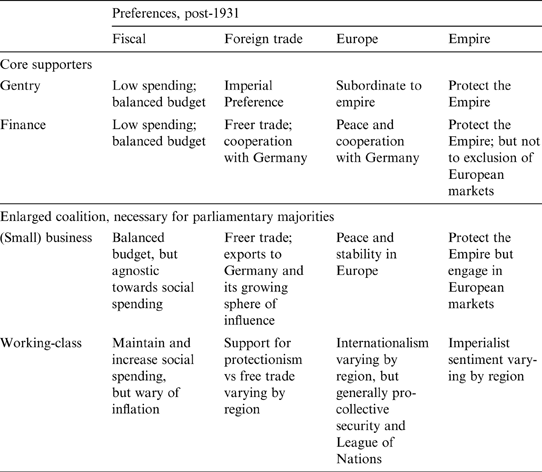
Electoral exigencies strongly favoured maintaining peaceful relations with Germany. At least since the 1918 Representation of the People Act, winning working-class votes had become essential for returning the Conservative Party to office.Footnote 57 Because of Britain's first-past-the-post electoral system, winning parliamentary elections – then as now – was not a question of national vote share but of winning in particular ‘battleground’ seats.Footnote 58 For the Conservatives, this meant reaching out beyond their traditional base and winning over predominantly working-class seats. Placating the working-class pushed Chamberlain towards appeasement as a strategy in several ways. Not least of all, it meant maintaining Conservative support for social spending (‘butter’).Footnote 59 Because working-class voters tended to oppose war and profiteering by the arms industry, and strongly supported collective security and the League of Nations, it also meant avoiding foreign policies that might leave the Conservatives open to charges of militarism and or war mongering.Footnote 60 See Table 2 for a breakdown of the Conservatives' electoral coalition.
The Conservatives' coalitional base
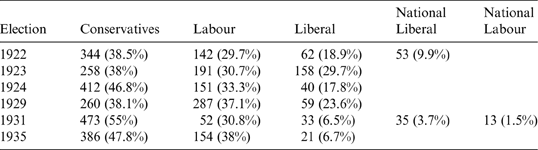
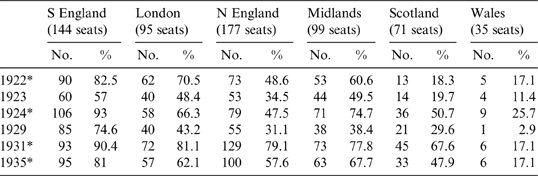
Experience and basic electoral arithmetic showed that the Conservatives could offend working-class sensibilities only at great electoral risk.Footnote 61 Even a clean sweep of seats in London and the South of England (where working-class preferences tended to reflect those of the export and financial services sectors) was not enough to deliver a parliamentary majority for the Conservative Party.Footnote 62 As such, Chamberlain could not neglect voters in the North of England and in Wales, where the contintental-oriented coal mining and manufacturing industries prevailed and working-class voters were staunchly internationalist in outlook. Still less could Chamberlain ignore the working-class's general opposition to rearmament or its faith in the League of Nations.Footnote 63 As Tables 3 and 4 illustrate, even small movements in the popular vote could spell electoral disaster for the Conservatives during the interwar period. Strong electoral performances in manufacturing regions like the North of England and the Midlands were essential to delivering parliamentary majorities. Towards this end, reform – not rearmament – was the order of the day. As John Ramsden comments, Chamberlain's domestic reforms ‘provided [Conservative] MPs with a solid diet of policy achievements to take even to their working-class electors when seeking a renewal of their support’.Footnote 64 By contrast, policies that risked being perceived as militaristic would have had the very opposite effect.
Seats won in House of Commons (percentage of popular vote in parantheses)
Note: F. W. S Craig, British Electoral Facts 1885–1975 (3rd edn, London: Macmillan, 1976).
House of Commons seats won by the Conservatives, by region (excluding university seats)
* Denotes a Conservative majority in the General Election.
Innenpolitik characterisations of the Conservatives' interwar base as constituting a City-Treasury-Bank nexus are thus accurate but incomplete.Footnote 65 Such a nexus existed, but alone it was not strong enough to deliver the parliamentary majorities necessary to wield power and shut out the Labour Party. In addition to its gentlemanly capitalist core, then, the Conservatives needed the support of large numbers of middle- and working-class voters. Among other things, this meant a foreign policy that did not require cuts to social spending, taxes hikes, or increases in government borrowing. Appeasement as a grand strategy met all of these requirements.
The fact that Chamberlain's domestic opponents could not agree on an alternative to appeasement only made the prime minister's choice easier. Rather than serving as a constraint, this elite split actually empowered Chamberlain.Footnote 66 The Labour Party opposed appeasement and arms manufacturing while simultaneously supporting a pact with the Soviet Union and collective security under the auspices of the League of Nations – impractical solutions both. Churchill, too, supported a ‘Grand Alliance’ with the Soviets. Other so-called anti-appeasers in the Conservative ranks were actually very much in the appeasement camp, even if they proposed appeasing Japan or Italy instead of Germany.Footnote 67 Proponents of other alternatives to appeasement also existed, including isolationists, outright pacifists, and those calling for a pre-emptive war against Germany.Footnote 68 Nevertheless, the case for dropping appeasement was not effectively put to Parliament or to the British people.
In the absence of a clear alternative, appeasement's opponents faced an uphill battle when it came to public sentiment. The most systematic account of public opinion during the period suggests that Chamberlain's efforts to avoid war enjoyed broad public support and, importantly, that he was aware of this fact. Using newspaper editorials as his ‘paramount’ gauge of public opinion,Footnote 69 Chamberlain had no reason to suspect that there would be electoral gains from ramping up rearmament above the level that he had deemed to be affordable. On the contrary, there was much to expect from a policy aimed at avoiding war.Footnote 70 In 1935, 11 million voters (38 per cent of Britain's adult population) had taken part in the so-called Peace Ballot, creating a significant impression among the elite that the British public was in favour of collective security and in opposition to arms manufacturing.Footnote 71 Between 1935 and 1939, Chamberlain saw little to change his mind on this point: in addition to a steady stream of newspaper editorials that broadly confirmed his reading of domestic politics, the fact that the British press and public lined up behind his decision in September 1938 to cede the Sudetenland to Germany only buttressed Chamberlain's perception that the public yearned for peace, not rearmament, and still less for war.
Appeasement explained: To Munich and after
British leaders repeatedly acquiesced in Germany's militarisation and expansion during the 1930s, from the reintroduction of German conscription and the Anglo-German Naval Agreement of 1935, to the remilitarisation of the Rhineland in 1936, to Germany's annexation of the Sudetenland in Czechoslovakia and even beyond. The strategy of appeasement reached its zenith with Neville Chamberlain as prime minister and principal architect of Britain's grand strategy, with the Munich Pact of September 1938 generally regarded as being the high water mark of appeasement. For Chamberlain, appeasement meant continued diplomatic and economic ties with Germany and the reasonable redress of Germany's security concerns and territorial grievances. Like Stanley Baldwin before him, Chamberlain was ‘striving to preserve the peace of Europe, not to win a war’.Footnote 72 As the foregoing discussion has detailed, this policy of appeasement was firmly rooted in a specific configuration of international and domestic incentives.
Consideration of the Munich Pact of 1938, the centerpiece of Chamberlain's efforts to appease Hitler, helps to flesh out Chamberlain's calculus more fully. Munich was the culmination of three visits to Germany by Chamberlain in September 1938, a diplomatic offensive to resolve the German-Czechoslovak crisis known to British officials as ‘Plan Z’.Footnote 73 The proximate cause of the crisis was Sudeten German demands, actively supported by Hitler, that the region be put under German control. Chamberlain sought to avoid a situation whereby German intervention to ‘free’ the Sudeten Germans would be met by French mobilisation and, ultimately, British entanglement. The objective of Plan Z was to avert war by conciliating German demands. Chamberlain came away from the negotiations with Hitler convinced that he had not only prevented the outbreak of war, but also had hammered into place a ‘method of consultation’ to resolve any future differences between between Britain and Germany.Footnote 74
Upon his return from Munich, Chamberlain was feted by crowds jubilant at the aversion of war. Chamberlain even ‘enjoyed the exceptional honour of joining the King and Queen on the balcony’ of Buckingham Palace before a cheering throng.Footnote 75 Newspaper coverage of Munich was effusive in its praise for Chamberlain; taking stock of British press's responses to Munich, Daniel Hucker concludes that ‘there was little political profit in criticizing those who had prevented a war that nobody wanted’.Footnote 76 Criticism in Parliament was largely reserved for specific terms of the Munich Agreement rather than the overall policy; detractors such as Labour's Clement Attlee were at pains to associate themselves with the British public's relief that war had been averted.Footnote 77
Support for the Munich Agreement was particularly strong within Chamberlain's own party, the prime minister being ‘greeted by a standing ovation’ as he entered the House of Commons on 3 October.Footnote 78 True, a small yet determined group of Conservative MPs expressed reservations about the agreement, but such dissent ‘was to the greatest extent kept private’, with only a handful of MPs abstaining from a vote of support (which Chamberlain won handsomely).Footnote 79 Those that did vocalise their dissent, including Duff Cooper and Churchill, were chastised by their local Conservative Associations, threatened with deselection and the termination of their parliamentary careers: ‘the dissenters had to tread carefully if they wanted to stay in the party [and] keep their seats in the House of Commons’.Footnote 80 Despite some parliamentary disunity, then, Conservative MPs and the party in the country were broadly supportive of Chamberlain's efforts – so much so, in fact, that some in the party, including the prime minister himself, even entertained the idea of an early election in order to ‘gain political capital from Chamberlain's personal prestige’.Footnote 81 Confident in his party's backing for a brokered European peace (including concessions to Germany), Chamberlain had little cause to doubt his achievements or his judgment that militarism did not pay.
That Chamberlain stuck to appeasement after Munich, consistently looking for diplomatic solutions to the crises of 1938–9, is indicative of his belief that appeasement enjoyed robust popular support, which, coupled with Chamberlain's emboldened authority within the Conservative Party, created a powerful incentive to ‘stay the course’ with a view to a securing a comfortable general election victory in 1939. When reports abounded in January 1939 that Germany was planning to invade the Netherlands, Chamberlain resisted any formal commitments that might ‘provoke rather than deter Hitler’.Footnote 82 That same month, an Anglo-German Coal Agreement was signed to cement economic relations between the two countries in the hope that political relations might also be calmed.Footnote 83 Even after the fall of Prague in March 1939, Chamberlain refused to honour Britain's security commitment to Czechoslovakia,Footnote 84 and just weeks later the government did nothing in protest over Germany's seizure of Memel from Lithuania.Footnote 85 As late as the day after the invasion of Poland in September 1939, Chamberlain's diary letters reveal that he was still actively weighing peace options.Footnote 86
Throughout, Chamberlain was convinced that his policy of appeasement could deliver lasting international security for Britain. He believed that revisions to the Versailles settlement could remove Germany's legitimate grievances without the need for military action by either side. Chamberlain was persuaded that moderates within the Nazi regime could be relied upon to restrain Hitler if diplomatic concessions were forthcoming from the international community.Footnote 87 Of course, ‘Chamberlain could only carry through his policy of German appeasement if Hitler co-operated’,Footnote 88 and it is now clear that Hitler was no man of peace. Nevertheless, Chamberlain's relinquishment of appeasement was as gradual as it was reluctant: only when the international situation got overwhelmingly dangerous, driving public and parliamentary opinion to a boiling point over Nazi bellicosity, did Chamberlain consign appeasement to history and declare the country at war over the issue of Poland's territorial integrity.Footnote 89
Chamberlain was an appeaser because he needed security on the cheap. Chamberlain did not appease Hitler simply to free up capacity to balance against a more pressing foreign adversary, as conventional triage model of appeasement would propose, but rather as a way to neutralise Britain's most pressing geopolitical threat. Nor was British appeasement the straightforward result of lobbying by narrow imperial interests – constituencies that, had they controlled British foreign policy, might even have made common cause with Germany. Instead, Chamberlain chose appeasement because of both geopolitical and domestic pressures. Internal balancing was at odds with Chamberlain's domestic goals, while other cost-saving strategies on which Chamberlain might have relied, such as external balancing, buckpassing, or disengagement, were impractical or counterproductive, or both. Britain was too integrated into the European economy, and Chamberlain's domestic agenda too dependent on stability on the Continent, to countenance a strategy of disengagement or isolationism.
Alternative explanations, domestic counterfactuals, and what ifs
An analysis of the Chamberlain case offers opportunities to evaluate several alternative theories of appeasement. First, the realist arguments that appeasement occurs when states face multiple threats and thus need to engage in ‘triage’ or else ‘buy time’ to fight against an emerging challenger have difficulty accounting for Chamberlain's policies. Britain did face multiple threats during the 1930s, but chose to appease its most proximate threat instead of its more distant rivals, Italy and Japan.Footnote 90 Meanwhile, our analysis shows that Chamberlain pursued rearmament to strengthen his diplomatic overtures towards Germany and withstand a German first strike, not to fight a balance of power-inspired war against Hitler.
Second, the Innenpolitik argument that appeasement was pursued in order to safeguard a particular form of social and economic order at home (that is, an elite-centered capitalist order) fails to explain why Chamberlain did not seek even closer ties with Germany than he actually did, for example by harnessing German power against the supposed Soviet menace. We can also rule out another commonplace Innenpolitik suggestion that public aversion to war explains appeasement because the British public's longstanding aversion to war was shattered after events like Kristallnacht in November 1938 and the invasion of Czechoslovakia in March 1939, yet Chamberlain persisted with appeasement.Footnote 91
Last, our analysis casts doubt on neoclassical realist arguments that see ‘under-balancing’ strategies like appeasement as ‘lowest common denominator’ responses to political polarisation and gridlock or the availability of resources.Footnote 92 While the party system at Westminster was fragmented in the 1930s, the case should not be overstated: Chamberlain held a huge parliamentary majority throughout his premiership and could rely upon the obedience of the vast majority of Tory backbenchers right up until the Norwegian Debate of November 1940. The ‘elite dissensus’ model fails to explain why Chamberlain clung to appeasement even after public and elite opinion solidified against appeasement of the Nazi regime following the invasion of Czechoslovakia in March 1939.Footnote 93
What would it have taken for Chamberlain to abandon appeasement in favour of a more active balancing strategy? We have argued that leaders are most likely to pursue appeasement when the demands for increased security conflict sharply with what they are trying to achieve domestically. In Chamberlain's case, a higher-cost strategy such as internal balancing would only have been possible if domestic constraints had eased. In the event, they did not, and with geopolitical pressure remaining constant (indeed, worsening) over the period, appeasement remained the strategy of choice.
Yet while we cannot rerun history to answer these questions about Chamberlain, the evolution of Franklin Delano Roosevelt's strategy towards Nazi Germany provides a useful case in point for considering the counterfactual argument.Footnote 94 To be sure, Germany's threat to the United States was more to do with trade and economics than military concerns.Footnote 95 Nevertheless, strategists in the US did fear that technological advances (especially in air warfare) would make the western hemisphere vulnerable to a Germany hegemonic in Europe, and even harboured suspicions of German designs on South America. Like Chamberlain, Roosevelt initially favoured diplomatic efforts to conciliate Hitler. Between 1936 and 1938, appeasement ran ‘like a leitmotif’ though US grand strategy.Footnote 96 This was clearest in Roosevelt's consideration of a peace initiative known as the Welles Plan, but it was also evident in a series of back-channel diplomatic missions that sought to address long-standing Germany grievances, split the emerging Berlin-Rome-Tokyo axis, and generally reduce the risk of war. By 1939, however, FDR had abandoned appeasement in favour of an ‘offshore balancing’ strategy.Footnote 97 Roosevelt took steps, sometimes in secret, to shore up Britain's defense and ratchet up pressure on Germany. The United States quickly became the ‘arsenal of democracy’ and Britain became America's first line of defense.
Why did Roosevelt opt for balancing when Chamberlain did not? Realist explanations cannot account for the difference. After all, the geopolitical threat posed by Germany was less immediate for the US than it was for Britain; if threat were the decisive factor, Chamberlain would have reversed course before Roosevelt. FDR even moved away from appeasement as the level of external threat intensified (that is, after the Czech Crisis) rather than embracing appeasement as the strategic triage model would predict. Strictly Innenpolitik explanations also cannot account for the difference. While some Democratic constituencies (for example, southern planters; Wall Street bankers) favoured a more vigorous response to Nazi Germany, Democratic interests (for example, organised labour; Western progressives) that were closely aligned with Roosevelt's New Deal reformist agenda opposed intervention in the European crisis. Like Chamberlain, Roosevelt had to contend with popular antiwar sentiment. Mass revulsion to the horrors of World War I may not have been as prevalent in the US as in Europe, but public opinion in the US was generally opposed to involvement in European affairs during the 1930s.
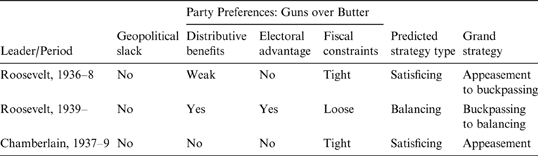
In Roosevelt's case, what tipped the scales toward balancing was a shift in the Democratic Party's preferences in the guns versus butter tradeoff (see Table 5). As our model would predict, the triggering event was domestic, not international, in origin. In 1937 and 1938, the US experienced one of the steepest economic descents in its history.Footnote 98 The so-called ‘Roosevelt Recession’ was so severe that many – although not all – Democrats, including organised labour, came to see increased military spending as an attractive way to prime the pump and sustain voters' confidence in the party. If domestic policies had failed to promote economic growth, perhaps a more vigorous – and expensive – foreign policy could step into the breach. Reflecting this domestic political shift, Roosevelt's efforts to support Britain, expand the navy, and strengthen the army received overall Democratic backing from 1939 onward.
FDR's changing political calculus
When the New Deal failed to bring economic prosperity, appeasement for Roosevelt became counterproductive and expendable. To be sure, the easing of the guns-versus-butter trade-off in the US did not make Roosevelt any less subject to the forces of external events than his British counterpart. But it did make it easier for Roosevelt to use those international events to move Democratic lawmakers his way, albeit in the guise of issuing ‘loans’ to Britain, not outright war-making assistance. In contrast to the situation prevailing in the earlier years of his presidency, in 1939 Roosevelt found himself at the head of a party with preferences for guns. Had Chamberlain's Conservative Party come to see domestic advantage in investing in guns, our theory predicts that he too would have moved toward a more active balancing strategy to deal with Germany.
Appeasement reconsidered
Few scholars still hold to the belief that Chamberlain's efforts to appease Nazi Germany were shaped by naiveté or negligence. Chamberlain's actions are now understood as hardheaded (rational) political calculations. Realists have allowed that appeasement was an understandable if imperfect strategy to cope with unforgiving international circumstances, while for Innenpolitik scholars Chamberlain's policies were in response to powerful economic interests or other perceived domestic political exigencies. In this article, we have argued that each of these approaches contributes valuable insight to understanding appeasement, but that each also incurs significant limitations by modelling a causal process in which explanatory variables emanate from just one level of analysis, whether international or domestic. Appeasement is not a singular response to multiple international threats; nor is it wholly attributable to domestic factors. Instead, appeasement is best understood as a strategy that cross-pressured leaders use to reconcile geopolitical and domestic imperatives.
Chamberlain was severely cross-pressured. He was under no illusion that Hitler's intentions were peaceful or of limited political scope, yet at the same time Chamberlain was not well positioned domestically to actively balance against Germany. Advocating active balancing before 1940 would likely have come at great personal political cost and also been unsuccessful. The resource constraints and partisan incentives facing Chamberlain also help to explain why appeasement cannot be explained as an attempt to ‘buy time’ for balancing; domestic circumstances made an expensive balancing strategy unattainable in the long-term just as much as in the near-term. Instead, Chamberlain saw great advantages in relying on diplomacy to cope with the Nazi threat. Unlike his counterpart Franklin Roosevelt, whose domestic constraints ultimately proved less static, Chamberlain found it difficult to drop appeasement in favour of more expensive defensive strategies as conditions in Mitteleuropa worsened.
Britain's policies of the 1930s were not produced by unique historical circumstances or the idiosyncrasies of one individual. Rather, they may be explained by deductively applying a model of grand strategy choice that emphasises how international and domestic pressures produce the grand strategy outcomes. Our approach thus underscores the value of individual level-of-analysis. That is, by centering the analysis on strategic choices (both political and geopolitical) and tradeoffs faced by the political leader, it is possible to generate a coherent and parsimonious explanation for what has hitherto been regarded as a perplexing anomaly: the decision to appease a rising challenger.