The steep growth of elite polarization since the early 1970s has been one of the most remarkable trends in contemporary American politics. It is almost hard to believe that only sixty-five years ago, the American Political Science Association (APSA) published a report admonishing the parties for excessive similarity.Footnote 1 Today, Democrats and Republicans seem to have clear and opposite stances on most issues, and political discourse has become increasingly aggressive and unyielding. Political scientists have, unsurprisingly, taken great interest in the origins of this trend. One common claim is that activists caused polarization. The conventional wisdom here is that activists are more extreme than legislators, they have become even more extreme over time, and changes to party nomination procedures in the late 1960s and early 1970s opened the process and allowed activists to pull elites away from the median voter.Footnote 2
This argument makes sense. It seems like both parties have armies of special interest groups lined up these days. In the 2016 election cycle, women's groups directed 98 percent of their $36 million in federal campaign contributions to Democrats.Footnote 3 On the other side of the aisle, Republicans received 98 percent of the $2.1 million from pro-life groups and 98 percent of the $5.9 million from gun rights groups. This trend extends beyond ideological and single-issue organizations, as 84 percent of donations from the building materials and equipment industry went to Republicans, while Democrats received 75 percent of the contributions from lawyers and law firms.Footnote 4 More broadly, Heaney, Masket, Miller, and Strolovitch show that very few delegates to the 2008 Republican National Convention shared organizational memberships (i.e., in social movements, political advocacy groups, etc.) with delegates to the 2008 Democratic National Convention, and vice versa.Footnote 5 In this light, it is not difficult to envision a narrative in which organized groups attach themselves to parties and then pressure them to take extreme policy positions and uncompromising attitudes.
Looking back at work by V. O. Key and others on group-party relations in the mid-twentieth century, however, this explanation for polarization becomes less compelling. According to these scholars, special interest groups typically avoided party alliances—with good reason.Footnote 6 Key remarked, for example, that “often it is unwise to back either party … it is better to have friends in both camps, for the group must promote its objectives whatever party is in power.”Footnote 7 Avoiding partisan alliance was part of a broader strategy to evade bright lights in the political arena, according to David Truman. While “interest groups rather generally participate in elections, they are usually timid about admitting it,” he noted in the early 1950s, with “most, in fact, plac[ing] a high premium on what is known as ‘keeping out of politics.’”Footnote 8 Among other dangers, associating with a party could alienate group members, who might have different party preferences.
From this perspective, what has been offered as an explanation for polarization sounds more like another side of the puzzle. It appears that neither parties nor groups wanted to “pick sides” in the middle of the twentieth century. Today, in contrast, there seems to be a high level of special interest partisanship. That is, groups and parties appear to have more stable, structured relationships. In some cases, we might even call them partnerships. Parties’ newfound commitment to clear, alternative positions on a broad range of issues—commonly characterized as “polarization” in the political science literature—is only part of the puzzle. The larger question is: Why have group-party relations become stronger and more structured since the mid-twentieth century?
There has been relatively little attention to group-party relations in political science since mid-century pluralism debates fizzled. Interest in organized groups rose in the 1980s, but few scholars answered Key's and Truman's calls to study groups’ relationship to parties. In their 2005 Annual Review of Political Science article on interest groups, Daniel Tichenor and Richard Harris call the dearth of scholarship on contemporary group-party relations “one of the most glaring lacunae of the discipline.”Footnote 9
This is beginning to change. A modern literature on group-party relations is developing, if more slowly than its subject. Most notably, Kathleen Bawn, Martin Cohen, David Karol, Seth Masket, Hans Noel, and John Zaller have recast parties as coalitions of interest groups rather than coalitions of office seekers, as in the traditional conception of parties.Footnote 10 While this reconceptualization has brought much-needed attention to the role of policy-demanding activists in party politics, I argue it has overstated the notion of group-party fusion. As works by Key and Truman make clear, parties and groups have not always been so intertwined.
In a separate book, David Karol takes a slightly different view of parties.Footnote 11 While he maintains that parties should be characterized as coalitions of groups, managed by politicians in this iteration of group-centered theory, he notes that groups vary in the strength of their attachment to parties, and that they can become more or less partisan over time. But this variation is an explanatory factor in Karol's book rather than a subject of study itself.
This article builds on prior work by mapping out a full continuum of relationships between parties and groups, and considering how and why they might change over time. In doing so, I focus largely on the parties’ perspective. I do not mean to suggest that policy-demanding groups have not affected the evolution of group-party relationships or party politics more generally. Certainly, they have.Footnote 12 But their role has received more attention from scholars, leading to an exaggeration of their impact on polarization. While office seekers and policy demanders have become closer since the early 1970s, I argue there are theoretical and empirical reasons to believe office seekers played a proactive role in this process.
In the mid-twentieth century, Key, Truman, and others noted that unstructured, pluralistic group-party relationships were largely attributable to national party weakness. This much-criticized feature of mid-century American politics has changed considerably over time. Daniel Galvin and Philip Klinkner have carefully documented extensive party-building efforts since the publication of APSA's Report on Political Parties in 1950.Footnote 13 This article adds to their insights by explaining how and why the demands of party building would encourage office seekers to institutionalize relationships with groups.
In this pursuit, I draw heavily on the new institutional economics literature on firms. As parties became more corporate over the contemporary era, it would make sense for them to undergo some of the broad organizational evolutions observed in the private sector. Moreover, the relationship between parties and certain groups is similar to the relationship between manufacturers and distributors. Communication with the electorate is the “distributional” phase of party operations. The classic tasks of advertising, position taking, and credit claiming, identified by David Mayhew as key to officeholders’ reelection, all require communication with voters in order to be effective.Footnote 14 Groups can help parties with this critical task by relaying party messages to their members. When a party incorporates a group into its infrastructure, it is acting much like a manufacturer acquiring a distributor. Examining firms’ incentives to expand through forward integration into postproduction functions like distribution can therefore provide fresh insight into parties’ incentives to build more structured relationships with groups. In sum, while pluralistic relations offer flexibility, institutionalized alliances offer significant efficiency and security gains. I argue that parties, like firms, should be particularly interested in these benefits when they are focused on major, long-term growth.
In developing this organizational theory of special interest partisanship, I challenge the field's heavy reliance on the ideological model of polarization. To understand polarization, scholars typically investigate why beliefs changed (e.g., why Republicans became more conservative) or why sorting occurred (e.g., why conservatives became Republicans). Either way, this perspective privileges the role of ideology. In contrast, the organizational model described herein emphasizes nonideological factors, like efficiency and security. I am not suggesting that ideology is irrelevant, but that focusing excessively on ideology obscures the equally important organizational roots of polarization.
To illustrate the plausibility of this perspective, I examine the institutionalization of group-party relations within the executive branch using archival documents collected at the Presidential libraries of Richard Nixon, Gerald Ford, Jimmy Carter, and Ronald Reagan. Archival evidence has been underutilized in scholarship on polarization and can offer a fresh perspective on this important development in American politics. This kind of evidence allows us to see what the party in government was hoping to gain by institutionalizing relationships with groups, what they feared, and what benefits they ultimately received in moving away from fluid, unstructured relations. Belying the popular argument that activists caused polarization, archival evidence shows elite party members making conscious, proactive decisions to strengthen relationships with groups and take more distinct positions on special interest issues. These findings are consistent with Karol's argument that coalitional considerations often lead politicians, who are responsible for managing the party's constituent groups, to choose certain positions on issues. The present analysis builds on Karol's insights by analyzing changes in the structure of group-party relationships as well as the substance of party politics.
To be clear, this empirical analysis is not meant to serve as a strict hypothesis test. Given only four cases and limited partisan variation within those cases, a traditional hypothesis test would be difficult to execute well.Footnote 15 However, archival evidence offers a rich picture of group-party relationships and unique insights into party members’ rationale for building stronger relationships with groups. This empirical analysis shows what different points on the continuum between separation and fusion can look like and illustrates the plausibility of the organizational theory of special interest partisanship developed herein.
DEFINING PARTIES AND GROUPS
Influenced by the work of Anthony Downs and Joseph Schlesinger, political scientists have traditionally defined parties as coalitions of office seekers.Footnote 16 John Aldrich amends this view slightly by acknowledging the role of activists, but still treats parties as groups of candidates.Footnote 17 This conceptualization has important implications for politics and policy—who we think parties are affects what we think they want and how they will attempt to get it. Party members are typically thought to be motivated primarily by electoral concerns, which encourage them to cater to the median voter.
Bawn et al. challenge this candidate-centered conceptualization of parties.Footnote 18 In their view, groups don't pressure parties—they are parties. We should think of parties not as coalitions of office seekers wishing to maximize reelection chances, they argue, but as collections of interest group activists seeking to maximize their chances of policy success. Groups join forces in this manner because they can get more out of cooperation than competition, just as, in the traditional theory of parties, office seekers realize they have much to gain from cooperation with other office seekers. This conceptualization suggests that parties will be less concerned with the preferences of the median voter than the goals of their constituent interest groups, lending credence to the notion of activists causing polarization.
While this group-centered theory has raised much-needed attention to the role of policy-demanding activists in party politics, I argue it has overstated group-party fusion—albeit usefully, for purposes of clarifying the departure from traditional candidate-centered theory. As Key, Truman, and others noted in the mid-twentieth century, groups and parties have not always had close, structured relationships. If groups and parties were once determined not to ally with each other, it is hard to think of them as having always been fused.
That's not to say fusion cannot occur. As Daniel Schlozman argues in his new book, When Movements Anchor Parties, some groups “forego autonomous action to ally with major political parties by virtue of the money, votes, and networks that they offer to the party with which they have allied.”Footnote 19 The two most prominent “anchoring groups” are labor, which forged an alliance with the Democratic Party during the New Deal era, and the Christian Right, which linked with the Republican Party several decades later. But relationships of this intensity were extremely rare in the mid-twentieth century and remain uncommon, even today. While many groups have strong relationships with parties today, few reach “anchor” status.Footnote 20
Moreover, work by Paul Frymer and John David Skrentny on “electoral capture” shows that alliance does not necessarily mean fusion between parties and groups.Footnote 21 When one of the two major parties rejects a group, that group can become electorally captured by the other party.Footnote 22 In this situation, the group's interests are unlikely to be well represented by either party even if it has formed an alliance with the more ideologically like-minded party. Since the group cannot credibly threaten to defect from the alliance without an alternative coalitional home, the party lacks strong incentives to act on the group's behalf. They argue that this has been the case for African Americans, who are captured within the Democratic Party. Fusion is, at best, an uneasy characterization of such group-party relationships.
Thus, I maintain Bawn et al.’s focus on the importance of groups in party politics, but depart from their characterization of groups as parties. It is useful to maintain a conceptual distinction between office seekers (parties, in the traditional sense) and policy-demanding groups in order to analyze variation in group-party relations. For conceptual clarity, I treat “parties” as coalitions of people whose job security depends greatly on elections, and/or whose primary responsibility is winning elections. This includes elected politicians, people they appoint and hire (e.g., many bureaucrats), and people who work for the organizations they represent (i.e., the Democratic National Committee [DNC] and Republican National Committee [RNC]). In Key's and Aldrich's language, it encompasses the “party-in-government” and the “party-as-organization.”Footnote 23 By “groups,” I mean coalitions of policy demanders who fall outside the formal scope of “parties.” I define parties and groups in this manner not to deny the existence of overlap between parties and groups, but to provide the clearest possible framework for considering variation in this overlap.Footnote 24
At one extreme, parties and groups are entirely separate, interacting on a short-term, ad hoc basis. At the other extreme, they maintain highly institutionalized alliances. To understand why parties would prefer one arrangement to the other, we need to think about the costs and benefits of different points on the continuum between these extremes, and how their value or importance might change over time.
BENEFITS OF UNSTRUCTURED GROUP-PARTY RELATIONSHIPS
We can begin by thinking about the benefits of separation. To understand the institutionalization of group-party relations in the contemporary era, we need to understand why pluralistic relations were so popular in the early to mid-twentieth century; as Avner Greif and David Laitin have argued, “only by understanding the mechanisms of reproduction … can you understand the process of change.”Footnote 25 For theoretical guidance on the benefits of separation, I turn to the robust mid-century literature on political pluralism.
Political pluralism is commonly conceived as a process of interaction in which groups compete for attention and policy in a political marketplace without a central power structure. While groups and parties may work together, Nelson Polsby notes that coalitions are typically “time bounded.”Footnote 26 Cooperation occurs only on a short-term basis, to the extent that it suits parties’ and groups’ immediate goals. In its most extreme form, pluralism involves no overlap between party and group infrastructure and no shared resources. In other words, special interest partisanship is low.
Weak national parties encourage this arrangement. In the mid-twentieth century, the conventional wisdom was that parties were in a state of “disorganization, if not of unrelieved chaos.”Footnote 27 Though this perception might be a bit overblown, David Truman noted, “it is apparent that the national party at any given time is fluid and unstable, consisting more of temporary personal alliances than of continuing institutionalized relationships.”Footnote 28 Consequently, he argued, “it follows that relations between political parties and other political interest groups will be similarly protean.”Footnote 29 Indeed, it is difficult to imagine strong external relationships existing alongside weak internal infrastructure.
Moreover, as E. E. Schattschneider argued in Party Government, when the center of party power was at the local level and patronage was the primary currency of politics, there was little incentive for national parties to stake out clear positions on issues.Footnote 30 This has implications for group-party relationships. If parties were using issues to develop their brand, there could be value in affiliating with groups associated with certain issues. When patronage drives politics, however, strong relationships with groups do not carry such benefits.
From the groups’ perspective, parties’ tendency not to take strong, alternative positions on issues at this time gives them space to negotiate with both parties. And low party discipline, resulting from weak national party leadership, makes special interest bipartisanship important. When national parties are “essentially devices for electing the president, rather than instruments for operating the government,” as David Truman (among others) argued that they were in the mid-twentieth century, groups know that bipartisan support is essential for achieving policy goals.Footnote 31 In this environment of weak party discipline, even under unified government, “friendly legislators of whatever party are thus the principal concern of most interest groups; they have nothing to gain and everything to lose by consistent partisanship.”Footnote 32
This environment makes group alliances less attractive to office seekers as well. In a formal study of group-party relationships, Nolan McCarty and Lawrence Rothenberg argue that parties and groups face significant challenges in forming alliances, even if they have strong motivations to do so.Footnote 33 They show that party leaders can help to solve this problem by enforcing agreements between rank-and-file party members and interest groups. In an environment marked by feeble party leadership, like that of the mid-twentieth century, this enforcement mechanism would be weak, and alliances with groups less feasible.
This was not necessarily a source of angst for parties. As Schlozman notes in his study of anchoring groups, alliance comes at a cost to parties. It can leave them vulnerable to backlash from other existing or potential supporters who disfavor the anchor. It also constrains their behavior, as they have to be especially sensitive to the group's views on their actions. Anchor status also comes with a price of “ideological patronage, and access” that parties may prefer not to give.Footnote 34
In particular cases, the cost may be worth paying. Group-level factors can influence decisions regarding partisanship for both sides.Footnote 35 Thus, at any given historical moment, we should expect to see variation between groups in the strength of their relationship to parties. And we have. The labor-Democratic alliance was a glaring exception to the overall trend of special interest bipartisanship in the mid-twentieth century, as discussed by Schlozman as well as J. David Greenstone in his classic book, Labor in American Politics. And many groups support both parties today, amid an overall climate of higher special interest partisanship. Nevertheless, pluralist scholarship helps to explain why the pressure system as a whole might lean toward bipartisanship, and why parties would tend to resist commitment to groups and their preferred issue positions. In a federal system with weak national party organizations and leadership, alliances carry few benefits and many costs.
American federalism, of course, remains intact. Since Truman's and Key's writing, however, the Democratic and Republican Parties have strengthened considerably as organizations and in government.Footnote 36 Party growth has great potential to coax groups and parties away from pluralistic relations. Groups can help parties with the arduous process of building. While some of the benefits that groups offer parties can be realized in a pluralistic setting, others are more valuable in an environment of greater institutionalization.
HOW GROUPS CAN AID PARTY BUILDING
To understand how groups can aid party building, we need to think in depth about the resources and services groups can offer parties. Special interest groups’ contributions to elections are well known. Their most obvious offerings, campaign funds, have increased dramatically since the mid-twentieth century. Organizations linked to interest groups are major sources of campaign support, and it is difficult to imagine contemporary electoral politics without them. However, as Richard Skinner notes in More than Money, financial resources are not the only or even necessarily the most valuable contributions groups can offer parties—other resources, like information and communication, are also important.Footnote 37
Other scholars have noted groups’ informational value as well. In their formal study of groups, Gene Grossman and Elhanan Helpman argue, “Many special interest groups are well placed to deal in information because their members gain knowledge about issues of concern to the group in the course of conducting their everyday business, and because groups frequently collect information that bears on their members’ interests.”Footnote 38 Information from groups can be useful to individual politicians as they make decisions about bill sponsorship and roll call voting. It can also facilitate broader party-building efforts. If a party is looking to recruit a new group into its coalition or please an existing member, it will need information about that group's issue positions and priorities.
Information can also flow in the other direction, from the party to groups to the electorate. A feminist organization might profile candidates in its newsletter, or a religious organization might encourage ministers to discuss political issues important to the party in their sermons. This kind of communication can be used to promote candidates and rally people around certain legislative programs. Churches have been particularly successful networks for political mobilization, as we have seen in the civil rights movement and the modern religious right.Footnote 39 Schlozman notes that groups with face-to-face networks are especially appealing to parties. Both anchoring groups in his analysis, organized labor and Evangelical Christians, had such resources to offer their respective partisan allies.
Schlozman argues that parties will bypass group leaders if they can manage to communicate directly with their followers. While parties undoubtedly attempt to do this at various points, I argue that there is value in communicating through group leaders even if parties can reach their members directly. Communication is expensive, and groups are often willing to share this cost. Interest group leaders may also have more credibility than parties with their members. Messages coming from these leaders can therefore be more persuasive than those coming from parties.
Given these resources, groups are well positioned to facilitate the process of party building. This alone cannot explain changes to the structure of group-party relations, however. Why wouldn't parties simply draw on these resources in a pluralistic environment? To help answer this question, we can consult the new institutional economics literature on firms. Building a firm involves replacing market mechanisms with administrative mechanisms; similarly, I argue, each step away from pluralistic relationships into more structured relationships is a step away from a free market system of group-party relations. While the corporate analogy is not perfect and should not be carelessly applied to parties, thinking about firms’ motivations can illuminate parties’ incentives to institutionalize relationships with groups.
THE PARTY AS A FIRM: INSTITUTIONALIZING GROUP-PARTY RELATIONSHIPS
Why establish a firm instead of operating through short-term contracts? If someone wanted to build and sell smartphones, for example, she could negotiate contracts with software engineers, plastic dealers, salespeople, and others whose goods or services she needed to run her business. By bargaining with all of these actors, she could always be confident that she was getting competitive prices. Over the long term, however, this is a costly way to conduct business. Some costs, like contract negotiation, arise before the exchange, while others, like implementation, surveillance, and problem resolution, appear afterwards. In his classic article on firms, Ronald Coase argues that certain organizational forms and contractual patterns can reduce or even eliminate these transaction costs.Footnote 40 Instead of negotiating with software engineers over each product, for example, the manufacturer could hire them to build operating systems for all of her products in-house. Rather than bargaining with dealers, she could establish her own sales department.
In sum, we can think of a firm as “a web or nexus of contracts” providing centralized leadership to manage exchange, so as to avoid transaction costs associated with making all deals on an open market through the traditional price mechanism.Footnote 41 By building administrative structure, firms are able to enjoy economies of scale, direct resources efficiently, and standardize processes to reduce transaction costs. Firm expansion—that is, the substitution of additional administrative mechanisms for additional market mechanisms—brings further efficiency gains.
This strategy can work for parties as well. Parties can replace the price mechanism (i.e., seeking assistance on a policy-by-policy or election-by-election basis) with administrative mechanisms in several respects. Rather than having ad hoc meetings with groups when issues relevant to those groups arise, parties can create infrastructure to routinize interactions with groups. They can also take more dramatic action and internalize groups, as manufacturers acquire distributors. This is a step beyond what Richard Skinner characterizes as “subcontractor” relationships between parties and groups. As independent subcontractors, groups could theoretically work for both parties, just as independent electricians could work on renovations for multiple building developers. A builder could strengthen the relationship between herself and an electrician by hiring the electrician to join her staff. In this case, the subcontractor would become an employee (i.e., fusion would increase). Authority would be centralized, and the overlap between their interests and resources would grow. Parties can take similar steps with groups.
Internalization is on the opposite side of the special interest partisanship continuum from pure pluralism—whereas the latter is marked by a lack of structure in group-party relationships, the former involves strong structure. Relationships at this extreme are very stable, dislodged only by serious conflict. They are also exclusive. That is, groups can only be internalized by one party at a time. Hence, special interest partisanship is high.
Internalization does not require the group to assume the party's name. Many corporate mergers end with the acquired company retaining its name. Indeed, the value of the acquiree's brand may have motivated the deal. Internalization does not require the group and party to occupy the same physical space either. It does, however, render them responsible to the same centralized authority: party leadership. Party leaders control access to the legislative agenda and influence the distribution of many resources desired by groups and rank-and-file party members. Again, the corporate analogy is not perfect and should not be exaggerated. Centralization of authority is unlikely to occur in parties and groups to the same degree that it occurs in many merged companies. Nevertheless, the analogy is instructive. To better understand why parties would build more structured relationships with groups, we can look to the literature on firm expansion.
In his classic study of American corporations, Alfred Chandler argues that increased production capacity makes firms less comfortable contracting product distribution out to wholesalers, who also sell their competitors’ products.Footnote 42 Their interests do not necessarily conflict, but neither do they align. By engaging in forward integration, internalizing postproduction functions like distribution, firms gain confidence that they are maximizing sales. In short, growth increases firms’ need for security, and forward integration can provide it.
Oliver Williamson argues that forward integration also protects product quality.Footnote 43 In a market system, producers rely on wholesalers and retailers to maintain the quality of their products. Because wholesalers and retailers bear only part of the cost of quality deterioration, their incentives to maintain product quality are lower than the producer's. The problem could be managed with proper supervision, but this, of course, is not free. Since metering and enforcement are cheaper to carry out internally than externally, firms have incentives to internalize distribution to protect the quality of their products. Thus, Williamson argues, firms will be more likely to substitute administrative mechanisms for market mechanisms—effectively increasing the size of the firm—when the quality of their particular products could deteriorate in the hands of distributors outside the firm.
They will also be more likely to internalize functions through integration when developing highly specific assets. Williamson argues that “as assets become more fully specialized to a single use or user, hence are less transferable to other uses and users, economies of scale can be as fully realized when a firm operates the asset under its own internal direction as when its services are obtained externally by contract.”Footnote 44 When assets are nontransferable, at least not without a substantial loss in value, internalization provides security.
Parties can simulate forward integration by creating long-term alliances with groups, enhancing efficiency in the legislative and electoral arenas. Stable alliances obviate the need to build a coalition de novo every time the party wants to pass an important piece of legislation. The same is true for electioneering. When special interest partisanship is high, parties know they can count on particular groups for support. While this may leave parties vulnerable to charges of extremism, it also streamlines the coalition-building process in the electoral and legislative arenas, lowering coordination and negotiation costs. On the whole, it heightens efficiency.
This much would be true, even if groups’ only contributions to parties were financial. When we consider groups’ other contributions to parties—namely, information and communication—we can see that movement away from pluralism also provides another key benefit: security. If group and party interests are at least partially aligned through a long-term relationship, parties need to worry less about the reliability of groups’ information. In his classic book on the farm lobby, John Mark Hansen notes that the parties’ greatest informational challenge lies not in acquisition, but in figuring out which source is best.Footnote 45 This creates an incentive for parties to identify groups with informational advantages that are likely to endure and then to build “close consultative relationships” with them to streamline the information gathering process over the long term.Footnote 46 In Hansen's narrative, groups’ informational advantage is given. And, to a large extent, it probably is. But scholarship on firms suggests that parties also have some control over the quality of groups’ information. When they are allied, and groups’ access is tied to parties’ electoral fate, their incentives are more aligned. Groups will be more motivated to gather and share high-quality information with the party.
Incentive alignment also provides security in the distribution of party messages through special interest group communications networks. Messages are “products” whose quality can deteriorate as they pass from “manufacturer” (i.e., the party) through the “distribution” process (i.e., the group's communication system). When the group's legislative agenda is linked to the party's electoral fate, the party can be more confident that the group is broadcasting favorable messages and working hard to mobilize voters behind the party. These dynamics were evident in the relationship between the labor movement and the Democratic Party in the early twentieth century. Allying with the Democratic Party broadened labor's support for the party, according to J. David Greenstone. Whereas before the alliance, labor leaders worked to mobilize their own constituency, after their informal integration into the party, they worked to mobilize the party's entire base.
From the groups’ perspective, there are a few things to consider. When national parties are stronger and more disciplined, bipartisan coalitions become much less important for passing legislation. This reduces groups’ need to maintain relationships with both parties. And as parties strengthened and began developing clear, alternative positions across a wider range of issues, many groups were left with less flexibility to move between parties.
There are also positive benefits to be gained through closer relationships with parties. Daniel Schlozman argues that alliance gives groups more power to “shape parties’ long-term trajectories by enacting favored policies and shaping parties’ ideological development.”Footnote 47 This suggests that the scope of a group's goals will affect whether or not it seeks anchor status. Groups aiming to make significant, long-term changes to American society will want to work through the parties because parties shape conflict. This tendency, along with labor's uniquely extensive face-to-face network, may help to explain the labor-Democratic alliance in an era of special interest bipartisanship.
A CONTINUUM OF GROUP-PARTY RELATIONS
Thus far, we have focused on two extremes. Under a system of pure pluralism, there is no structure governing group-party relationships; under a system of internalization, structure is strong and extensive. These are both ideal types, unlikely to be observed in the real world. As discussed earlier, parties are unlikely to fully internalize groups. And even at the time Truman and Key were writing, group-party relationships did not entirely lack structure. It is therefore useful to think of group-party relations on a continuum between these two extremes.
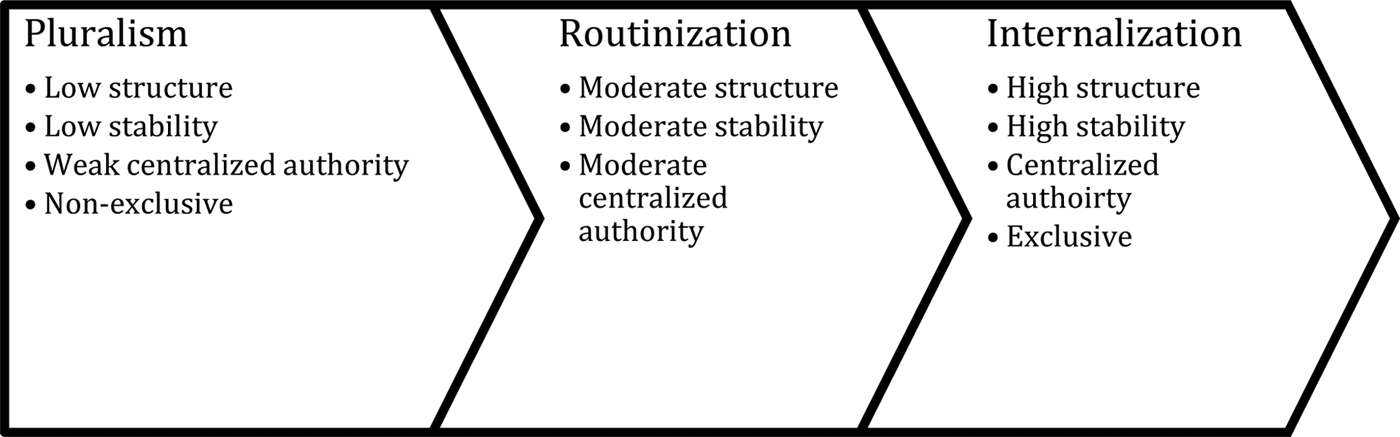
Figure 1 illustrates a continuum with three zones, ordered according to the amount of structure in group-party relationships. The left-most zone, pluralism, has the lowest level of special interest partisanship. At the most extreme point, there is no centralized structure or authority, and no overlap between party and group infrastructure. Parties and groups may work together, but only on a short-term basis in pursuit of immediate goals. To the right of this extreme, there may be a small amount of structure in group-party relationships. Parties may grow accustomed to working with certain groups, for example, so they might be more inclined to work with one group rather than another. This kind of repetition stems more from habit than obligation, however. Neither side has any significant commitment to the other.
A Continuum of Group-Party Relationships.

The right-most zone, internalization, has the greatest degree of structure. The hallmark feature of this type of relationship is exclusivity—groups maintain relationships with only one party. While relationships in this zone of high special interest partisanship are all highly stable, they can take a few different forms. At the most extreme point in the zone, the group becomes part of the party's apparatus. A step away from the right-most point, groups may remain autonomous as formal organizations, but answer informally to the same centralized authority as rank-and-file party members: party leaders. This does not mean party leaders have dictatorial powers over groups or rank-and-file party members, merely that they have a degree of power sufficient to incentivize groups and rank-and-file members to cooperate with them more often than not. Anchoring relationships would fall at this point on the continuum. Another step away from the extreme, we may find exclusive relationships without a clear centralized authority. A group and party may share goals, talent, and even infrastructure, but they maintain more independent power centers than we see in anchoring relationships. This type of relationship has developed in recent years between the Republican Party and new groups that Theda Skocpol and Alexander Hertel-Fernandez call “nonparty funders.”Footnote 48 The most prominent example is the Koch brothers’ national, federated organization, Americans for Prosperity (AFP). AFP works only with the Republican Party, and the two share many goals and resources, but AFP operates “parallel” to the party and is more clearly beholden to its architects, the Koch brothers, than to Republican Party leaders.
Between pluralism and internalization, there is a zone characterized by moderate structure in group-party relationships, which I have termed routinization. Such structure can come in a number of different forms. Instead of waiting until they need a group's help with something specific (e.g., passing a particular piece of legislation), the party could set up routine meetings with groups, for example. The party may want to check in regularly with a particular industry to get a sense of the challenges it faces, how it is affected by public policy, how policy could help it to operate more efficiently, and so forth. The party may also want to have regular conversations with leaders connected to particular voting blocs to get a sense of their reactions to policies under consideration. Under this kind of arrangement, relationships are likely to strengthen in the sense that parties and groups will become more familiar with each other and collaborate more often. In contrast to the internalization zone, however, there are no long-term obligations between parties and groups in this zone. Routinization can heighten efficiency by smoothing the lines of communication between parties and groups while maintaining some of the flexibility afforded by pluralistic arrangements.
Indeed, moving away from pluralism essentially replaces flexibility with efficiency and security. If all three are valuable, why might parties choose to sacrifice flexibility in favor of other advantages? Party growth ought to be a major factor. Chandler argues that forward integration often follows increased production capacity.Footnote 49 In the party setting, we can think of this as being related to party building. When parties are focused on institutional growth, and not only shorter-term political problems (e.g., getting particular pieces of legislation passed), we might expect movement away from pluralism. Groups have valuable resources to offer parties, and some of them—most notably, information and communication assistance—increase in value when group-party relations are more structured.
This organizational theory of group-party relations provides an alternative to the traditional ideological model of polarization and challenges the common argument that activists drove the rise of polarization over the contemporary era. While activists may play an important role in party politics, I argue that we can conceive of the rise of special interest partisanship as a largely endogenous change in the American party system. The need to increase efficiency and security provide plenty of motivation for parties to alter their relationships with groups.
PARTY BUILDING THROUGH GROUPS IN THE LATE TWENTIETH CENTURY
To demonstrate this organizational theory's plausibility, I examine group-party relationships in the executive branch from the Nixon administration through the Reagan administration. The period from 1968 to 1988 represents a critical era of change in this area. The institutionalization of group-party relations in the executive branch began cautiously in the Nixon administration and solidified with the internalization of certain groups under Reagan.Footnote 50 Archival materials, collected at each president's respective library, provide unique insight into this evolution, as they allow us to see not only what kinds of decisions were being made, but also why they were made.Footnote 51
This brief history supports key foundations of the organizational theory of special interest partisanship. First, it demonstrates that the party in government saw groups as a critical source of information and communication. This is important, since these types of resources are subject to enrichment by institutionalization of group-party relationships. Second, this narrative shows elite party members proactively seeking groups’ assistance with short-term goals as well as long-term party building. This suggests that the rise of special interest partisanship was, to a nontrivial extent, an endogenous change in the American party system. To be clear, I do not mean to suggest that presidents institutionalized relationship with groups solely to benefit their parties-as-organizations. Certainly, they were motivated to support their own reelection efforts and policy programs as well, and they could use their relationships with groups to these ends. However, the institutionalization of group-party relationships was not only meant to serve presidents’ individual goals—it was also intended to help Republicans build a new coalition to compete with the long-dominant New Deal Democrats.
This history is also consistent with the organizational theory's claim that the need for greater efficiency and security contributed to the institutionalization of group-party relationships. The Nixon case shows that elite party members were concerned about incentive alignment, which institutionalization is well suited to manage. Later, we can see that the Reagan administration addressed these concerns by moving into the internalization zone. Ideology was not the only, or even necessarily the most important factor driving changes in group-party relations.
Given the importance of party growth to the organizational theory of group-party relationships, it is not surprising that the major steps away from pluralism during this period occurred under Republican administrations. The two parties were in very different competitive positions in the mid to late twentieth century, which left them with differing levels of interest in party building. While there were several Republican presidents over this period, the party struggled in congressional elections. As Daniel Galvin has demonstrated, even Republican presidents—electorally victorious in their own right—viewed their party as the minority in the mid to late twentieth century.Footnote 52 This motivated Republican presidents to use the stature and resources of their position to bolster their party's infrastructure and, consequently, its long-term competitiveness, while Democrats ignored (and sometimes “preyed” upon) their party until Republicans gained control of Congress midway through Bill Clinton's first term.Footnote 53 The empirical analysis herein builds on Galvin's work by showing groups’ utility in this party-building process.
This analysis is not well positioned to offer a strict test of differences between parties, since Jimmy Carter is the only Democratic president who served during this period. Nevertheless, it is informative to see how he chose to use the group liaison office established by his Republican predecessor. The organizational theory of special interest partisanship would predict that, if Democratic presidents were less interested in party building at this time, Carter would not have been inclined to further institutionalize relationships with groups. Indeed, we can see that group-party relations looked quite different—specifically, more pluralistic—under Carter than under his Republican counterparts. While the limited partisan variation in this analysis's time period is insufficient to confirm a hypothesis, it is consistent with the organizational model's predictions.
The Nixon Administration
To a greater degree than his predecessors, Richard Nixon was determined to build a new Republican majority coalition to challenge the New Deal order.Footnote 54 It is therefore unsurprising that Nixon's tenure was a turning point for group-party relations. The party in government started to take an interest in group liaison during Franklin Delano Roosevelt's presidency, but no one person or institution was responsible for such efforts until Richard Nixon took office. In the interim, Joseph Pika notes, “staff members assumed liaison responsibilities as the White House figured out who might have enough personal knowledge to deal with issues as they arose.”Footnote 55 White House aide Bryce Harlow suggested formalizing group-party relations in the later years of the Eisenhower administration, but it was not until he served as an assistant for legislative affairs and counselor to Nixon that his advice led to action.Footnote 56
While Nixon did not establish a formal, dedicated office, he agreed to intensify White House interaction with groups. He granted most of this responsibility to Charles Colson, a boisterous special counsel to the president known for fierce politicking, who would later serve a prison sentence for his role in the Watergate scandal. This operation represented a significant centralization of group liaison, which mirrored proposed changes in the RNC.Footnote 57
In a November 1969 memo to H. R. Haldeman, Nixon's chief of staff, Colson described the proposed purpose of his new project. The starting mission was “to understand, organize and draw upon the resources of the domestic political substructure and to further the President's objectives and policies through direct contact and interchange with specific groups of all kinds.”Footnote 58 A “primary function” of his office would be to “identify and record information about all major domestic groups and organizations which have specific definable concerns.” In particular, he wanted to catalogue their “aims and policies,” their “political strengths and resources,” and their relationships with executive agencies and previous administrations. His office would also keep track of how the Nixon administration was faring with these groups.
In addition to gathering information, Colson also planned to build relationships with groups. This process would begin with “develop[ing] contacts and ‘friends’ in various special interest groups.” Acting as a “sounding board” for their concerns would help the White House anticipate problems and involving them in policy discussions would make them feel included, even if they did not actually affect the decision-making process. These relationships could then become “resources” that the White House could “activate” (an earlier handwritten draft used the term “exploit”) “in support of the President's positions.”Footnote 59 This was not simply a reaction to pressure from groups; it was, in Colson's words, a proactive effort “to mobilize constituencies around the country—all kinds, every kind—in order to build public support for the President's policies.”Footnote 60
Over the course of Nixon's first term, his administration focused more on electoral than legislative coalition building. This is not especially surprising, as the late 1960s and early 1970s were times of great electoral change in American politics. African Americans had recently gained protection of their voting rights, women were emerging as a more unified, independent voting bloc whose partisan position was not yet clear, and traditionally Democratic white Irish, Polish, and Italian Americans appeared to be reconsidering their partisan loyalties. The South was also in the midst of a transition from a one-party Democratic stronghold to a two-party region of Republican dominance. As traditional party bases loosened, the Nixon administration endeavored to figure out what a 1972 winning coalition, and a longer-term Republican coalition, might look like.
The administration recognized that thinking about the electorate in terms of groups could aid their long-term party-building efforts. A good example of this strategy was the “voter blocs” effort, a joint project of the White House and the Committee to Re-Elect the President leading up to the 1972 election.Footnote 61 The committee believed they could win a potentially tight election by “focusing attention on important blocs with common characteristics.” At the national level, the committee identified nine groups to which they could make “specific appeals,” and planned “a concerted effort … to appeal to individuals on the basis of their membership in the group.” Each group had its own Washington-based staff to “represent the interests of their constituency in overall campaign strategy.” The Committee to Re-Elect the President encouraged state party chairmen to adopt similar efforts “to generate volunteers for … the fundamental campaign activities of registration, voter identification, and get-out-the-vote.” The voter blocs project reflected a broader strategy to appeal directly to special interests in the electorate, essentially bypassing organized group leaders. They wanted to court to specific voting blocs, but worried about depending too much on organized groups whose reliability they questioned.
This direct communication strategy had limitations. Despite their reservations about group liaison, the administration valued organizations’ publicity capabilities. Parties in government need to advertise themselves, their positions, and their accomplishments. A March 1971 RNC memo noted, “Since we cannot depend upon the news media to convey our story accurately and fully, we must communicate with the voters in a variety of ways, including direct mail; television, radio and newspaper advertising; speakers; and the like.”Footnote 62 Groups could assist these efforts by sharing some of the costs and offering access to their networks, which were often larger than the party's.
Cost was a significant issue for Republicans during Nixon's first term, as the RNC found itself in “serious financial difficulty” leading up to the 1972 election.Footnote 63 Because communication expenditures were “the major cost item in the [RNC] budget,” a November 1971 memo argued that they needed to “develop some controlls [sic] and budgetary objectives in this area.”Footnote 64 A line item budget for June 1971 shows their monthly postage expenses ($43,000) were more than their rent ($18,000), airline ($4,000), employee benefits ($5,700) and professional fees ($7,770) expenses combined—second only to salaries ($166,000) as their highest single expense.Footnote 65 Overall, 19 percent of the 1971 RNC budget was slated for communications, and $193,000 of the $983,404 budgeted for Nixon's reelection was allocated for television, radio, and promotional video. The communications division of the RNC was responsible for direct mailing (both the mailing itself and the maintenance of distribution lists) as well as RNC publications like its weekly Monday, monthly First Monday, and miscellaneous promotional materials. It was also responsible for “develop[ing] new programs to bring members of American ethnic and minority groups and senior citizens into the Republican party” and “advis[ing] Chairman Dole on the interests and problems of American ethnics, senior citizens, blacks, agriculture and labor.”Footnote 66 These duties overlapped Colson's, and there was frequent communication—if not always cooperation—between the two offices.
Building relationships with groups could help them control costs in this area. Taking out a single-page ad in three Catholic newspapers in New Jersey, with a combined circulation of 173,700, was estimated in March 1972 to cost $2,590.Footnote 67 If the president met with Catholic leaders, however, Catholic newspapers across the country would cover the meeting for free. In scheduling such meetings, Colson's office made sure to “be alert to groups the President can receive, who have the will to publicize their reception.”Footnote 68
In addition to sharing costs, groups could also offer access to their networks, which were often larger than the party's. While the RNC's weekly publication, Monday, went out to 45,000 people, the National Council of Senior Citizens’ publication, Senior Citizen News, boasted a circulation of more than 2.5 million people.Footnote 69 Modern Maturity, a magazine published jointly by the AARP (formerly known as the American Association of Retired People) and the National Retired Teachers Association, circulated to 1.8 million people.Footnote 70 Another source puts AARP's publication circulation at 3.5 million.Footnote 71 Even these numbers are modest compared to the Catholic press, which was estimated to reach 50 million people.Footnote 72 These numbers were extraordinary in comparison to not only Monday's circulation, but also the RNC financial base. In 1977, for example, the RNC had approximately 300,000 contributors—a significant achievement, but still a small network in comparison to those available to other groups.Footnote 73
The nature of groups’ reach was also valuable to the party. A goal of the 1972 campaign was to make communication with the electorate more selective—a “rifle shot approach” as opposed to a “shotgun approach.”Footnote 74 While the RNC was developing its own ability to do this, special interest publications allowed the party to communicate messages to specific parts of the electorate at little to no cost. They provided, in many ways, a major shortcut for party building.
Knowing their value, group leaders could use their communications capabilities as currency with the administration. For example, in exchange for a public statement supporting a Social Security increase and “urging the states not to ignore the very real problems just because Congress did,” National League of Senior Citizens leader Bill Forst promised to “give the positive aspects of the President's ‘aging program’ front page coverage from now until the election, include special articles which various departments write concerning their programs benefiting the elderly,” and put a picture of himself with the president on the front page of the league's publication, which had a circulation of 150,000. This offer was especially significant for Nixon, since the group was traditionally “Democratically-oriented.”Footnote 75
Groups also offered information to the party. For example, the National Women's Political Caucus gathered information on candidates (both Democratic and Republican) running in the 1972 elections, and Colson's operation turned to groups—often grudgingly—for information on special interests in the electorate.Footnote 76 As with communication, they often tried to perform these tasks on their own. They did not want to rely too much on organizations whose credibility they could not assure. At Colson's request, in early 1972, the White House planned to conduct its own public opinion survey of older Americans. Their aim was clear, as an interoffice memo from Bud Evans, liaison to groups concerned with aging issues, to the Committee to Re-Elect the President's Deputy Director Fred Malek noted, “Hopefully, this survey will allow us to get away from relying on what organized older Americans’ organizations claim to be the opinion of the majority of older Americans, and will allow us to understand how the silent older people list their priorities. … This has been a point that Colson has constantly brought up, and is one for which it is time we established an answer.” Handwritten notes next to this section of the memo remark “good point” and “this is what prompted Bud and I to push for this poll.”Footnote 77
Their wariness of organized groups becomes especially apparent in their plans to create their own membership-based organization for older Americans. A January 1972 memo from Evans to Colson argued, “It is probable, but not absolutely certain, that a mass membership organization of older persons—properly controlled—should be created to provide an alternative to persons now joining existing associations.”Footnote 78 Again reinforcing the importance of communication, Evans noted that “a primary purpose of such a new organization would be control of comprehensive communications lines with those who call themselves ‘older Americans.’” They also talked about creating other organizations to help recruit volunteers, build “effective and continuous Republican communication lines” with older Americans in the electorate, and “develop organized ‘voices’ in the field of aging which will reflect Republican points of view after the election.” This was not a reaction to pressure from groups, or even older Americans in the electorate; rather, it was a proactive attempt to build the party.
Overall, Colson's work was significant because it centralized liaison for the first time. Colson's operation, though relatively small and informal, provided an important building block for further changes to group-party relations under Ford. The administration's correspondence and planning documents also illuminate parties’ incentives to proactively engage groups; closer group-party relationships do not necessarily stem from group pressure. The administration viewed groups as resources that could benefit Nixon as an individual politician and also help to build a new majority coalition to compete with the New Deal Democrats.
Archival materials also show that the elite party members particularly valued groups’ information and communication capacities. Groups were well positioned to help the party understand how to appeal to different slices of the electorate and communicate efficiency and cost-effectively with them. These materials also reveal the party's anxieties about groups’ reliability, a problem that can be addressed by changes in organizational structure (i.e., expanding the firm). Nixon's co-partisan successors increased the level of structure in group-party relations, moving rightward on the special interest partisanship continuum.
The Ford Administration
When Gerald Ford assumed the presidency after Nixon's resignation in 1974, he further institutionalized relations with groups by establishing the Office of Public Liaison (OPL). William Baroody, who assumed Colson's duties after his resignation during the Nixon administration, would direct this new office. Baroody's appointment itself tells us something about the office's purpose and place in the broader development of conservative infrastructure, as he had strong ties to the American Enterprise Institute (AEI), a prominent conservative think tank. AEI was one of the initial institutions established during Republicans’ long-term effort to build a conservative intellectual infrastructure to rival the Brookings Institution and the university system, which they believed to be dominated by Democrats.Footnote 79 Baroody's father founded AEI, and the younger Baroody returned there after his tenure at OPL.
From the start, Ford's liaison operation was more ambitious than Nixon's. The administration viewed OPL as one of four major “White House Links to America,” connecting the White House to the public by providing liaison to all private organizations.Footnote 80 Like the Nixon administration, they wanted to learn about and build relationships with a wide range of groups, not only those with similar ideological leanings. As Baroody explained in a presentation to the cabinet, “Because our constituency numbers 214 million Americans, we have found it most convenient and useful to rely on the currently existing structures of our society, i.e., the association, the club, the society, the fraternity, all organizations.”Footnote 81 Working through groups provided a “systematic” and efficient way to reach the American people.
OPL provided a centralized “point of contact,” serving “as a clearing house for communication directed to the White House on virtually every conceivable subject.”Footnote 82 Though this was no small task—they received approximately 2,500 such contacts per week—it was not their main focus. Baroody did not want to be an ombudsman.Footnote 83 Internal correspondence suggests that OPL was less concerned with listening and more concerned with persuading groups to support the president's programs. Thus, they spent most of their time actively reaching out to groups. Ultimately, they hoped that OPL would “establish for the President and his departments a ‘floating coalition’ in relationship to his governmental priorities and programs.”Footnote 84 These benefits could extend to the RNC as well. Special Counsel to the President Michael Raoul-Duval's notes for a meeting with Ford and the Republican Platform Committee encouraged the president to “indicate that the people back here will have the capability to turn on a lobby effort, if necessary, with special interest groups, Cabinet who are back here, etc.”Footnote 85 He proceeded to note, “This is a major resource that we should be prepared to take advantage of.”
To communicate effectively, the office first needed to know with whom they should be speaking. Part of OPL's job was to map out the special interest universe. An early memo to Ford promises that “within a relatively short time frame, we will be able to identify leaders of any segment of society in any geographical area of the country within a few hours.”Footnote 86 They then reached out to these groups during a series of routine meetings—a step away from pluralism into routinization on the group-party continuum.
Weekly Tuesday meetings (“Tuesdays at the White House’”) included an average of seventy people representing thirty-five organizations and 100 government actors representing twenty-five agencies or divisions. These meetings were geared toward citizen groups, like veterans, minority groups, religious groups, women's groups, and volunteer organizations—what they called the “human resources segment of society.”Footnote 87 OPL would bring together special interest representatives and government officials to encourage two-way communication about various issues like bilingual education, the 1976 defense budget, and housing.
Bimonthly Wednesday meetings (“Wednesdays at the White House”) focused more on business-oriented groups like labor organizations, food processors, and heavy manufacturers. These meetings included an average of twenty people representing twenty organizations and forty-one government participants representing thirty agencies or divisions.Footnote 88 In contrast to Tuesday meetings, which focused on specific issues, Wednesday meetings were more general discussions of groups’ interests.
Field conferences were also held across the country approximately twice a month, cosponsored by OPL, regional, state, and local organizations. In contrast to Tuesday and Wednesday meetings, field conferences included many different types of organizations and had a much larger group to government personnel ratio, at around 700:9. These meetings were also open to the media, which took full advantage of the opportunity, with an average of 400 representatives in addition to the White House press corps requesting credentials for each conference.
Conferences helped the administration communicate with special interests at a relatively low cost. Though Baroody's operation was more formal and ambitious the Colson's, it still operated with modest resources. They began with a staff of six, including Baroody and an administrative assistant, and a “very limited budget.”Footnote 89 This was not a problem, Baroody argued in an interview, because groups shared many of their operating costs. Field conferences essentially belonged to these organizational cosponsors, Baroody explained, “So, in terms of getting the hotel and putting the meeting itself on and the cost of that kind of thing, they are absorbed by the organizations.”Footnote 90 Local organizations were also responsible for inviting people, which helped the party because they would not necessarily know where to direct messages in different areas. In sum, field conferences helped to defray communication costs and link national and local resources at a time when national parties were relatively weak.
Reactions to OPL were mixed. To many, the office signaled a new responsiveness, or at least a new willingness to listen. The value of transparency was especially high after the Watergate and Pentagon Papers scandals, and many people lauded what appeared to be a more open door under Ford.Footnote 91 Others were more skeptical of what the New York Times called a “public relations campaign that is unsurpassed by any in previous Administrations.”Footnote 92 Echoing this sentiment, The New Republic referred to OPL as “Ford's Image Machine.”Footnote 93 To these critics, OPL looked like a shameless attempt by an unelected incumbent to build a base leading up to the 1976 election. There was some truth to this—even Baroody referred to field conferences as “road shows.”Footnote 94 Party infrastructure was thin, and Watergate had severely damaged public trust. Ford had only two years to rehabilitate his party's image and recruit core supporters before the general election. In this light, it is not surprising that creating OPL was one of his first actions as president.
Whether OPL was a base-building effort, a pure desire to regain people's trust in government and the Republican Party after Watergate, or something in between, it was a proactive attempt to build relations with groups—not a reaction to group pressure—and the motivation behind it was strategic, not ideological. Though OPL had many critics, few, if any, alleged that it was a response to pressure from groups. Many argued, as a Wall Street Journal headline did, that “Bill Baroody's Job is to Sell Ford's Policies to Leaders of Special Interest Groups,” not that Ford was acquiescing to arm-twisting.Footnote 95
All in all, OPL represented another step away from fluid, pluralistic group-party relationships. The notion of a “floating coalition” suggests that the party in government was not only concerned about their immediate needs (i.e., winning one election or passing one piece of legislation), but increasing their efficiency more broadly. Rather than contacting groups on an ad hoc basis to manage problems as they arose, the Ford administration built infrastructure to strengthen relationships with a wide range of groups. Exclusive partnerships had not yet developed on a broad scale, however. It probably would have been difficult for them to establish such relationships at this point, given that they did not even have a clear sense of the interest group universe.
While it may have been intended, in part, to help Ford build a base for his own campaign, OPL was also meant to be a party-building institution, consistent with other efforts to strengthen the party around this time. Like other Republican presidents, who viewed their party as the minority, Ford was concerned about not only his own reelection, but also party fortunes over the long term.Footnote 96 Such concerns were well-founded. Many people, including Ford, believed that the party was in danger of extinction. In a speech before the National Federation of Republican Women in September 1975, Ford warned that “America is truly on the road to one-party rule.”Footnote 97 This is, of course, rhetoric; but it is a very different kind of rhetoric than we typically hear today. Prominent party leaders were even talking about changing the party's name to rehabilitate its image.Footnote 98 The floating coalition that OPL aimed to create was not to be reserved exclusively for Ford—it would be deployed on behalf of the party as well. OPL also worked to build party infrastructure. One of its central objectives was to “improve communication between national and local leadership” through field conferences and other projects.Footnote 99 This was an important effort, since parties were still relatively decentralized at this time.
The Carter Administration
We know from work by Daniel Galvin that Democratic presidents were much less interested in party building than their Republican counterparts during the Democrats’ long period of dominance in Congress. Jimmy Carter was no exception to this trend. His relative lack of interest in party building should have had significant implications for his interactions with groups. Without the drive to build the party over the long term, Carter should have had less incentive to develop stronger, more institutionalized relationships with groups. Thus, we should expect his OPL to function differently than Nixon's and Ford's.
And, in fact, it did. While he maintained OPL, Carter used it very differently from his Republican predecessors and successor, consistent with the organizational theory of group-party relations. There were essentially two OPLs during his tenure. Under the direction of Midge Costanza, the first aimed to provide representation for groups in government. This only lasted for fifteen months before the administration changed the office's direction. Costanza's replacement, Anne Wexler, was a political campaign expert whose main objective was to use OPL to gather support for the president's legislative program. Wexler's OPL did not completely abandon what she called “case work.” As under Ford, there were still individuals responsible for maintaining relationships with different constituencies. This was necessary, she argued, because special interest groups had an increasingly significant presence in Washington. It was important to be aware and “responsive.”Footnote 100
But the office's primary objective was to advance the president's legislative agenda. Wexler summed up OPL's job as building “campaigns around issues” and her job as “lobbying the lobbyists.”Footnote 101 When faced with a new issue, they would think through every group that could have a stake in it (“it is a far bigger group than you might think at the start”) and talk to many groups to figure out who would support the effort and who would oppose it.Footnote 102 This strategy would often result in a coalition of groups that would not normally work together. Yet, because they all had an interest in the issue and a part in its development, she noted “when it came time for the vote they were fighting like the dickens for us. And that's when we were successful.”Footnote 103
This is not an entirely pluralistic group-party arrangement, since OPL was providing a certain degree of central power structure. However, it was a step back in the direction of pluralism. In contrast to Ford's OPL, Carter's was not focused on creating a floating coalition. The office's relationships were broad, bipartisan, and constantly in flux. Allies and opponents were fluid, changing continually from one issue to the next. They tried to keep groups that opposed particular bills in the negotiations “and talk with them and reason and negotiate.”Footnote 104 This did not always work, but they believed it was still worthwhile in the long run, as it allowed OPL to go back to those groups for support on other issues.
Party weakness had a lot to do with this strategy. The DNC was not helpful in coalition building, according to Wexler. More importantly, it was necessary to construct broad coalitions because partisan coalitions were difficult to achieve. It was not easy for the president to get widespread support from Congress, even from members of his own party. Legislators were not motivated by party, she recalled, but by what was in the bill for them.Footnote 105 Something that was important to Carter might not impact many congressional districts. Groups helped Carter bargain with Congress. OPL staff was “putting together what would become a working coalition on the Hill to get legislation passed and at the same time a grass roots effort to support that working coalition on the Hill.”Footnote 106 Through liaison efforts, Wexler stated, “We were then able, when necessary, to target grassroots efforts in particular Congressional districts or states. … Quite often we needed to do things like that.”Footnote 107
While Carter's pluralistic OPL may have been able to compensate to some degree for party weakness, it did not help to correct this problem in the long term. “It is not useful for political organizing and for building support around issues to have the ad hoc situation we had,” Wexler stated, “In fact it is destructive, but I don't know how else you can do it.” Building coalitions around issues “does not in any sense create a political base.” Indeed, it can erode the party. By “pandering to interest groups,” this strategy “makes them stronger and encourages them to divorce themselves a bit form their philosophical political party and say, in effect, ‘My issue first, my party second.’”Footnote 108
Even in the short term, OPL's ad hoc strategy had some major drawbacks, most notably in terms of efficiency. The problem with creating coalitions by issue is that “you have to start from scratch on every single issue,” Wexler noted, “You have to start all over again and reinvent the wheel every single time.”Footnote 109 It also has implications for the nature of the president's legislative program. Some issues cannot easily be tied to clear constituencies, making them difficult to push under this kind of system. Moreover, the considerable cost of this process limits the scope of the president's agenda. In the absence of economies of scale, there is only so much the administration can reasonably take on. In the next administration, moving away from pluralistic relations with groups brought significant efficiency gains for Reagan.
Given that Carter is the only Democratic president to serve during the time period under analysis, it is impossible to make strong claims about variation by party. Nevertheless, the case is suggestive. According to the organizational theory of special interest partisanship, in the absence of significant party-building efforts, incentives to institutionalize relationships with groups would be weak, at best. Indeed, Carter's OPL operated very differently from Ford's before and Reagan's afterward. In sum, his administration's ad hoc relationships with groups are consistent with the theory presented herein.
The Reagan Administration
OPL's operations shifted when Reagan took office, as his administration worked hard to further institutionalize relationships with groups. Though many view him as the father of the modern conservative coalition, Reagan did not build it alone. His achievements added to the significant liaison foundation built by Nixon and Ford. Like Nixon, Reagan wanted to build a long-term winning coalition to compete with the Democratic leviathan forged during Franklin Delano Roosevelt's presidency. Watergate interrupted Nixon's efforts, which may explain why the modern conservative coalition is often dated back to Reagan. Looking back, Colson remarked regretfully, “but for Watergate I've always felt that what became known as the Reagan Democrats would have been the Nixon Democrats.”Footnote 110
Reagan's OPL was larger than Ford's and Carter's, with a staff of 18.Footnote 111 To facilitate the creation of a new majority coalition, Reagan maintained his predecessors’ focus on group liaison; however, the nature of liaison changed. Compared to Ford and Carter, Reagan's OPL held fewer meetings with large groups both inside and outside Washington. Whereas Ford established loose liaison with a wide range of groups, Reagan engaged in strong liaison with a relatively small number of groups. Based on responses to 1980 and 1985 surveys of organizations, Mark Peterson finds that the Reagan administration “had regular, ongoing interactions with a rather limited number of groups in the sample of membership organizations.”Footnote 112 He also finds that more conservative groups were more likely to enjoy access. Twenty-eight percent of very conservative groups enjoyed “frequent” access, compared to four percent of very liberal groups, and two-thirds of very conservative groups enjoyed “at least occasional access,” compared to less than one-quarter of very liberal groups.Footnote 113
Under Reagan, the Republican Party partially internalized conservative Christian groups. In other words, instead of merely meeting with them on a routine basis or cooperating with them on specific projects, they engaged in a variation of forward integration. This represents an important moment in the history of group-party relations, as it marks the beginning of a long coalition that still exists today. While religious conservatives may be at the forefront of contemporary “culture wars,” Republicans’ decision to ally with them was not driven by ideological change. It was, in fact, a strategic party-building maneuver. This organizational innovation brought important efficiency gains in coalition building. Reagan needed broad-based support for his economic program, which was his chief concern, addressing social issues only when necessary to keep religious conservatives in the party's nascent coalition.
The administration was trying to build the party's infrastructure, creating a robust national network by strengthening links between national, state, and local levels. Their vision of a strong party as a strong network distinguished them from the Democratic Party at this time, whose thinking was more short term.Footnote 114 We can see the desire for network building in Reagan's decision to recruit Amway cofounder Richard DeVos as the party's finance chairman. The company became a multibillion-dollar enterprise by encouraging people to sell common household products to people they knew, and then encouraging those people to do the same. Reagan wanted DeVos to apply this business model to the Republican Party. Between January 1981 and August 1982, Galvin notes that DeVos “fundamentally restructured the party's fund-raising apparatus and redoubled his commitment to nurturing small donors.”Footnote 115 This was not all about money, as DeVos's “main goal was to turn small donors into grassroots party activists on a mission for the Republican party.” Reagan was correct about the value of this model, as the party raised more than $30 million in 1981 and more than $40 million in 1982—extraordinary numbers, considering that the party's entire budget in 1971 was $6.9 million.
Special interest groups, particularly religious groups, had great value in this pursuit. In an interview with scholar Philip Klinkner, Ben Cotton, an associate of RNC Chairman Bill Brock's, explained groups’ value in language consistent with the organizational theory of special interest partisanship. Klinkner summarizes, “Brock and others on the RNC saw the evangelical churches as a ‘distribution system’ for disseminating Republican information and as an institution for mobilizing voters.”Footnote 116 With strong infrastructure and communications capabilities, as Daniel Schlozman noted in his study of anchoring groups, religious conservatives provided for Republicans what unions had long provided for Democrats: a solid grassroots network and coalition anchor. Business could provide money, but not volunteers or communications networks. Though their missions are clearly distinct, structurally, labor and religious conservatives are very similar. Both have large face-to-face networks, and frequent, regularized contact with their members. They also have a degree of power over their members not seen in many other groups.
Communications networks were often discussed in letters between members of Congress and the president as well as interoffice memoranda.Footnote 117 In scheduling meetings with the president, OPL staff took special note of groups with a “strong national network” who were “adept at generating news.”Footnote 118 Communicating with special interest organizations was more efficient than attempting to communicate with special interests in the electorate, as Ford had previously noted. In a letter to Reagan, Rep. Robert Livingston (R-LA) emphasized the “ability of these groups to marshall [sic] public opinion in support of [the president's] programs unaided by public media.”Footnote 119 These remarks point out that the value of this communications network was not just in its reach, but also its position outside mainstream media. As Trent Lott (R-MS) reminded Reagan in a letter urging him to meet with pro-family leaders, “these individuals have their own means of communication which bypass the usual media outlets,” which Republicans viewed as left leaning.Footnote 120
OPL agreed, noting that groups “provide an important multiplier effect through their communications networks at the state and local levels.”Footnote 121 Pro-family activists “each have effective networks at their disposal” and “they are not only supporters of the President, they each feel it is their duty to educate and activate more people in the political process,” noted Morton Blackwell, OPL liaison to religious groups.Footnote 122 The communications capabilities of gun rights groups and religious and pro-family groups were tremendous. Moral Majority founder Jerry Falwell maintained a mailing list of more than five million names, his Old Time Gospel Hour program aired to audiences between sixteen and thirty million on more than 500 television stations every Sunday, and daily programs aired on over 500 radio stations.Footnote 123 The Moral Majority's annual budget exceeded $60 million—twice the amount the Republican Party was able to raise in 1981, even after adopting the Amway model.
In order to activate these networks, however, the administration found that it was important to have clear differences between the parties on issues. Though the religious right focused their energies on Republican candidates, they were more likely to become deeply involved in elections when candidates took different positions on abortion. A postcampaign memo notes, “We believe that pro-life campaign projects provided the winning increment in at least six 1980 Senate races in which pro-life Republicans faced pro-abortion Democrats.”Footnote 124 This logic extended to special interests in the electorate. Abortion had the potential to bring traditional Democratic identifiers across party lines, but this would only work if the parties took different positions on the issue.Footnote 125 This motivated rightward movement on the group-party continuum.
Internalization enhanced the value of group networks by aligning group and party incentives, making groups more reliable coalition partners. When the fate of the group's agenda becomes linked to the party's electoral fate, the party needs to worry less about the group's dependability, as the Nixon administration often did. Just as increased production can lead a firm to expand vertically instead of simply outsourcing tasks, as they are no longer comfortable contracting out product distribution to wholesalers who also sell their competitors’ products, so the Republican Party wanted to assure that, as they expanded, they could rely on key communications networks to spread favorable messages. A network is also a specific asset, intended to activate a select group of people. When assets are nontransferable, at least not without a substantial loss in value, internalization provides security. In this light, the party's internalization of groups with significant networking capacities is unsurprising.
This internalization of groups carries many important advantages for the party. First, it keeps the campaign infrastructure in abeyance between elections. When the party needs to gear up for another election, it does not need to build a new coalition from scratch. Second, it makes groups more likely to support all party candidates, not just the most prominent ones. This is valuable even to the president, who needs congressional support to push his agenda. Third, once their interests are aligned, groups are more likely to support the party on issues outside their own area. This is valuable not only because it helps to move the party's agenda forward, giving them support they might not otherwise have, but also because it increases legislative efficiency. With a long coalition in place, the party does not need to go out and build a new coalition every time it wants to pass the budget or a piece of legislation, as Carter's OPL did.
We can see this efficiency in action throughout Reagan's tenure. Religious and gun rights groups provided a vital support system for Reagan's economic program.Footnote 126 Right before Reagan's economic package went to Congress, OPL Director Elizabeth Dole reinforced the importance of mobilizing the conservative coalition—gun rights groups, pro-life groups, right-to-work groups, and the like. They “are his most avid supporters and have the most clout in terms of grassroots support, political organization and structure, ability to mobilize citizenry and influence members of Congress.”Footnote 127 This support extended to other issues as well. In March 1983, Jerry Falwell “announced Moral Majority's main goal for 1983 is to combat the nuclear freeze movement.”Footnote 128
This partnership was not motivated by ideological sympathy or persuasion. Reagan did not bring them into his coalition because he was deeply concerned about abortion or other highly ideological issues. The partnership provided an efficient way to push the administration's economic program and build a long-term coalition to compete with the New Deal Democrats. While the administration raised social issues periodically, they did not receive high priority. On some issues, like tuition tax credits to support parochial schools, the administration was simply not as supportive as they purported to be. Though they offered rhetorical support for this issue of great importance to Catholics, an OPL memo noted that tuition credits did not make the president's first tax cut proposal because they were expected to cause an unacceptable $4 billion loss in tax revenue.Footnote 129
On other issues—most social issues, in fact—the administration was not unsupportive, but not especially committed either. Economic issues were to be the centerpiece of their 1984 campaign and the top priority on their legislative agenda.Footnote 130 Social issues were raised cautiously and grudgingly. As the president's chief domestic policy advisor, Gary Bauer, wrote in a March 3, 1982, memo, “Rather than be forced to deal with social issues on an ad hoc basis and/or on someone else's timetable, I recommend we undertake an analysis of key components of the social agenda with an eye towards deciding which ones we are willing to support and under what terms and conditions.”Footnote 131 In this category, he included school prayer, busing, the Family Protection Act, and similar issues. Emphasizing the administration's strategic, instrumental attention to these issues, Bauer said, “By moving to the forefront on one or two of these issues, the President's social link can be reforged, and the conservative grassroots can be rejuvenated for the upcoming legislative battles. To do little or nothing will lead to greater conservative dissatisfaction and diminished active support for the economic battles.” Next to this section of the memo, Chief of Staff James Baker handwrote a note stating “Please tell [Elizabeth Dole] we're doing this via tuition tax credits and school prayer.”
Though relations were not always smooth, the alliance between religious conservatives and the Republican Party marked another shift away from pluralism. The party did not internalize all groups, of course. But they did have a core group of supporters who traveled across different issues, demonstrating considerably more structure in group-party relations than we saw earlier in the twentieth century. These party-building efforts were successful in the short term, as they helped Reagan enact sweeping economic reforms, as well as in the long term, as Republicans gained control of Congress in 1995 after a generation of Democratic dominance.
CONCLUSION
Over the course of Nixon's, Ford's, and Reagan's presidencies, liaison with special interest groups became more centralized and institutionalized. Groups and parties are closer today than they were in the middle of the twentieth century, and we see longer coalitions of groups and parties than V. O. Key and other prominent scholars observed in the mid-twentieth century. I argue that strategic party-building efforts played an important role in driving these changes.
My analysis complements some existing explanations for polarization, and brings others into question. On the one hand, it supplements McCarty, Poole, and Rosenthal's argument about the role of immigration.Footnote 132 Needing more efficient ways to reach an increasingly diverse and complex electorate, parties draw on groups for assistance with information gathering, coalition building, communication, and mobilization. As groups become more strongly linked to the party apparatus, group-party relations become more clearly defined and the parties become more distinct. On the other hand, this article challenges the increasingly popular argument that activists caused polarization. The rise of special interest partisanship reflected, at the very least, a joint effort between parties and groups.
While this belies conventional wisdom about polarization, it should not come as a surprise to students of political parties. In Why Parties?, John Aldrich makes the widely accepted argument that parties arose and have evolved over time to serve the needs of their elite members.Footnote 133 This is precisely what occurred in the realm of group-party relationships. Groups have resources that can be useful for party-building efforts; and these resources, particularly those involving information and communication, become even more valuable when parties and groups have stronger, more structured relationships.
These findings amplify David Karol's call to look beyond ideology in attempting to understand polarization. In his study of party position change, Karol finds that parties often switch their positions on issues to please groups within their coalition or attempt to recruit new groups. Because the substantive content of the ideological extremes has changed considerably over time, it is overly simplistic to think of polarization as a process in which some central ideological force pushes parties away from the center and each other. My analysis reveals additional limitations of the ideological model of polarization by highlighting the impact of organizational imperatives, like raising efficiency and security, on special interest partisanship.
The need for a more well-rounded view of polarization is more important than ever, as efforts are underway inside and outside the academy to find strategies for reducing polarization in the United States. The present analysis suggests that efforts to reduce polarization will need to contend not only with combatting extreme beliefs, but also with the organizational value of strong group-party relationships. Work by Bawn et al., and more recently by Masket, has shown that parties are remarkably resilient in the face of reforms that challenge their interests.Footnote 134 This suggests that reforms that would threaten to reduce efficiency and security for parties—whether these effects were intended or not—are unlikely to succeed beyond the short term. And, as Masket has shown, failed reforms often come at a significant cost to democratic quality.
It is worth noting that special interest partisanship is not necessarily detrimental to parties or democracy, though it may have some negative manifestations. Group and party strength are not inherently inverse, as E. E. Schattschneider famously argued.Footnote 135 In fact, groups played a critical role in twentieth-century party building. Institutionalizing relationships with groups provided important organizational benefits for the Republican Party as it endeavored to build a coalition to compete with the long-dominant New Deal Democrats. In this light, the transformation of group-party relations aided the development of a more competitive two-party system in the United States.
Still, additional work on the consequences of special interest partisanship would be valuable. Specifically, more research is needed to better understand the implications of group-party alliances for governance. I, and others, have argued that party alliance increases political access for groups. But how large is the drop-off in access to individual lawmakers and institutions when the group's ally party loses power? To what extent is participation in information gathering processes, like congressional hearings, restricted to ally groups, for example? Does special interest partisanship lead to less balanced fact-finding missions? Answering these types of questions can give us a better sense of the cost of high special interest partisanship for groups, as well as for policymaking. It can also contribute more broadly to our knowledge of group-party relationships, which has certainly improved in recent years, but remains rather limited in light of the importance of this subject in contemporary political life.