1 Introduction
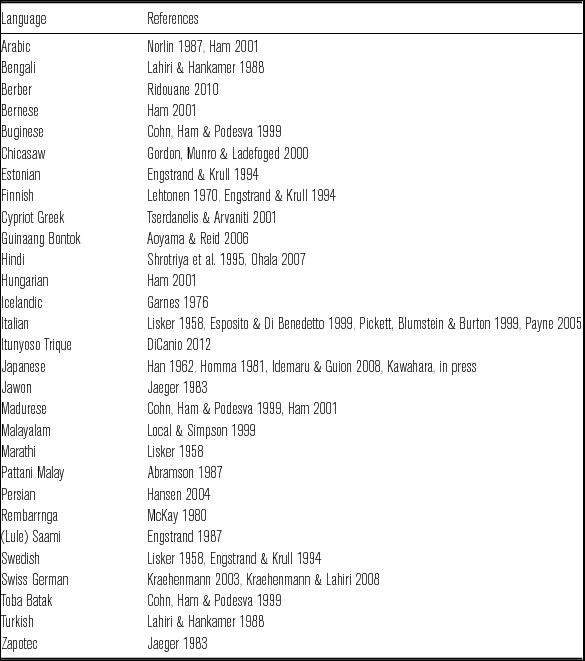
Languages can make use of phonetic duration to signal two sorts of semantic functions. The first is a lexical, phonological contrast. For example, in Japanese [kata] with a short [t] means ‘frame’ and [katta] with a long [tt] means ‘bought’. In most languages with such a length contrast, the contrast is binary; that is, the distinction is a matter of short vs. long.Footnote 1 The phonetic properties of such lexical short–long contrasts have been well studied for many languages; Table 1 summarizes previous phonetic studies on short vs. long consonants in various languages (this list is not exhaustive; see also Ridouane Reference Ridouane, Fougeron, Kühnert, D’Imperio and Valleé2010 for another recent summary.).
A summary of phonetic studies on lexical duration-based contrasts in consonants.

Less well studied are cases in which speakers use lengthening to express pragmatic emphasis. For example, in English, speakers can say Thank you sooooooo much to express an emphatic meaning; in this case, the speaker is trying to indicate that the speaker's degree of gratitude is very high.Footnote 2 An impressionistic observation seems to suggest that this sort of lengthening is not limited to a binary contrast – an intuition which will be confirmed in the experiment reported below. Compared to lexical singleton–geminate distinctions, the phonetic properties of this sort of contrast are understudied in the phonetics literature, and our experiment aims to fill this gap.
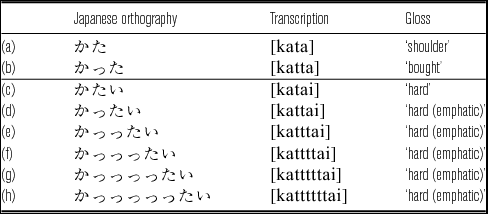
As a case study, we investigate the durational properties of emphatically lengthened consonants found in casual speech of Japanese, in which speakers lengthen segments to express emphasis (Aizawa Reference Aizawa1985; Nasu Reference Nasu1999; Kawahara Reference Kawahara2001, Reference Kawahara2013).Footnote 3 This emphatic lengthening is a characteristic of casual speech by young speakers, and frequently appears (orthographically) on the internet and in comic books. In this phenomenon, there can be various degrees of durational differences, beyond the standard short–long binary distinction. In Japanese, gemination is expressed orthographically with a small diacritic symbol (っ) preceding the mora containing the consonant in question, as shown in example (b) in Table 2. The emphatic lengthening that is at issue here can be expressed by the use of the same gemination marker. For example, Japanese speakers can take an adjective like the one in (c), and geminate the (word-medial) consonant to express emphatic meaning, as in (d). In casual writing, we observe examples in which consonants are accompanied by a number of gemination marks, as in (e)–(h).
The Japanese orthographic system for gemination. The forms in (a) and (b) represent a lexical singleton–geminate pair. The forms in (d)–(h) represent emphatically lengthened geminates, which are the focus of investigation in the current study.

The aim of this project is to investigate the durational characteristics of this multi-level emphasis pattern, the primary question being how many levels of distinction speakers can actually realize acoustically in this sort of pragmatically driven lengthening. While the phonetic properties of Japanese lexical geminates have been investigated in many instrumental studies in the past (see Kawahara, in press, for a recent overview), the current multi-level emphasis pattern has not been investigated from a phonetic/instrumental perspective. This paper thus offers the first experimental documentation of this emphasis pattern. More generally speaking, the phonetics of pragmatically lengthened segments has been less well studied than the phonetics of lexical short–long contrasts, and our study aims to provide extensive documentation of the first kind of lengthening.
2 Method
2.1 Stimuli
This study measured the duration of four coronal obstruents, [t d s z], as used in the emphatic environments.Footnote 4 For each sound, two adjectives were chosen, since adjectives are (semantically speaking) most likely to undergo emphasis. The adjectives used in this experiment, listed in Table 3, were all disyllabic and lexically accented on the second syllable (i.e. they all had an HL falling pitch contour on the second syllable). The target consonants were always placed in word-medial position. Each adjective was paired with a subject noun phrase to make a complete sentence: e.g. [ano kooɡi uzai] ‘That lecture is annoying’.
List of stimuli. Two adjectives for each consonant were chosen.

For each adjective, in addition to a non-emphatic rendition, five degrees of emphasis were created; e.g. [katai] (no emphasis), [kattai] (level 1 emphasis), [katttai] (level 2), [kattttai] (level 3), [katttttai] (level 4), and [kattttttai] (level 5), as illustrated in examples (c)–(h) in Table 2 above.
As a result, there were a total of 48 stimuli (4 consonants × 2 adjectives × 6 consonant lengths). A random number was assigned to each stimulus item to track which stimulus was actually pronounced.
2.2 Participants
The participants were seven native speakers of Japanese (Speakers FR, FV, SX, EG, NN, LV, TV). They were all undergraduate students at International Christian University (Tokyo, Japan). They were paid 500 Japanese yen for their time. They were all in their twenties at the time of recording.
2.3 Procedure
The experiment took place in a sound-attenuated room at International Christian University. Superlab version 4.0 was used to present the stimuli (Cedrus Corporation 2010). The stimuli and the instructions were presented in Japanese orthography. In the instructions, speakers were told that the experiment was about various levels of emphasis in Japanese, i.e. that they were going to be reading sentences with multiple gemination marks.
In order to prevent them from resorting to explicit counting of gemination marks by way of gesture, they were asked not to use gestures such as counting using fingers or nodding their heads. They were also told that their goal was not to count the gemination marks, but rather to pronounce Japanese utterances that are suitable for each stimulus. They were also told that the experiment was not a competition, and that the experiment was instead a test of what Japanese speakers actually do (i.e. the experiment was not for a prescriptive, but rather for a descriptive purpose).
Each block contained all the stimuli. After each block, the speaker took a short break. The order within each block was randomized by Superlab within each repetition. The speakers were asked to go through eight blocks (48 × 8 = 384 tokens), although due to time limitations, one speaker (Speaker NN) could only complete six repetitions (each speaker was assigned 30 minutes for this experiment because of a scheduling restriction). Some speakers mispronounced or skipped a few tokens.
As a practice session before the main session, all the speakers went through all the stimuli once to familiarize themselves with the stimuli and the task. After the practice phase, they were allowed to ask any questions that they had.
Their pronunciation was directly recorded into a portable recorder (TASCAM DR-40) with a 44.1 kHz sampling rate and a 16 bit quantization level. The experimenter (the first author) sat with the speakers throughout the experiment.
2.4 Acoustic analysis
To investigate the acoustic realizations of this emphasis pattern, this study focused on consonant durations, because they are the main acoustic correlate of Japanese length contrasts (Han Reference Han1962, Reference Han1992, Reference Han1994; Homma Reference Homma1981; Beckman Reference Beckman1982; Hirata & Whiton Reference Hirata and Whiton2005; Kawahara Reference Kawahara2006; Hirose & Ashby Reference Hirose, Ashby, Trouvain and Barry2007; Idemaru & Guion Reference Idemaru and Guion2008; Amano & Hirata Reference Amano and Hirata2010; Hirata & Amano Reference Hirata and Amano2012). There are other acoustic covariants of gemination in Japanese (Kawahara Reference Kawahara2006, Idemaru & Guion Reference Idemaru and Guion2008), and a post-hoc analysis on preceding vowel duration is reported in Section 3.3 below.
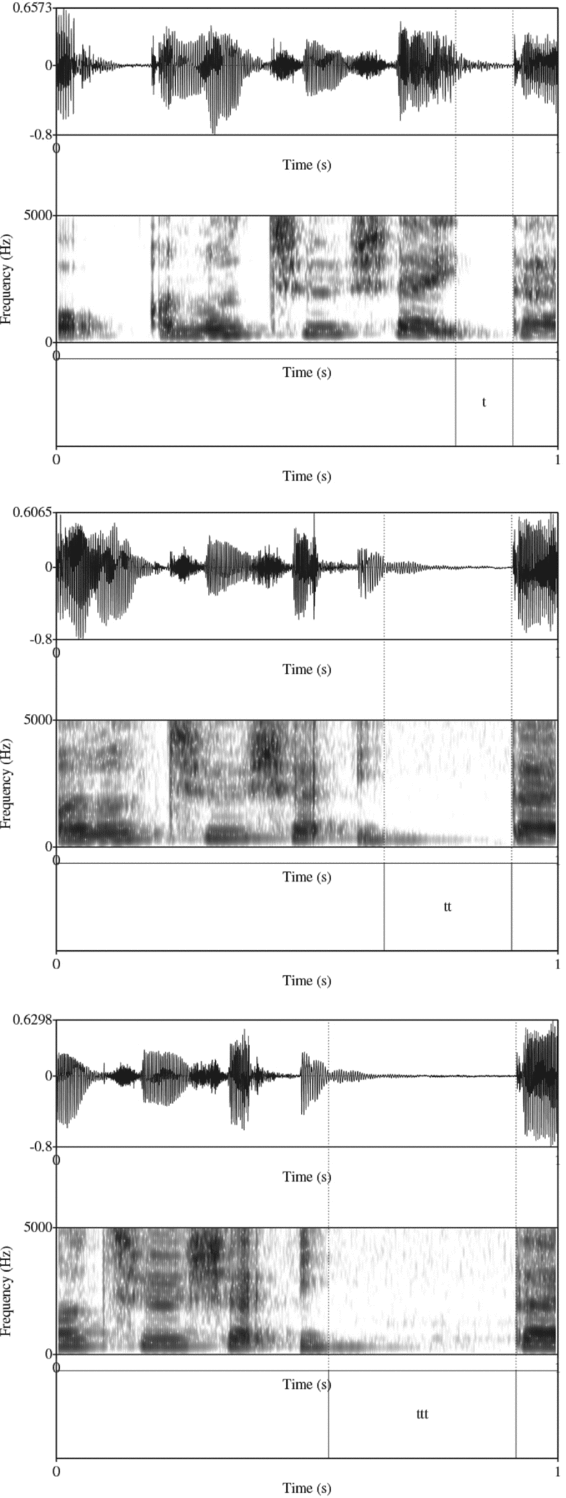
The boundary between the target consonants and the surrounding vowels was placed by inspecting both the waveforms (onset and offset of aperiodic noise for the fricatives and stop closure for stops) and spectrograms (abrupt cessation of F2 and F3 in particular). Figures 1 and 2 illustrate sample waveforms and spectrograms of three tokens of [t] and [s] (no emphasis, level 1 emphasis, level 2 emphasis) – the time scales are all 1000 ms. The acoustic analysis was performed using PRAAT (Boersma & Weenink Reference Boersma and Weenink1999–2014, Boersma Reference Boersma2001).
Sample waveforms and spectrograms of [t], pronounced in [it(tt)ai]. The time scales are all 1000 ms.

Sample waveforms and spectrograms of [s], pronounced in [mus(ss)ai]. The time scales are all 1000 ms.

2.5 Statistics
Since there are many comparisons (6 levels of emphasis × 4 types of consonants × 2 adjectives = 48 comparisons for each speaker), to avoid Type I error, we did not conduct pair-wise comparisons of every condition. Instead, we compared each level of emphasis by collapsing the consonant types and adjective types, thereby making only five pair-wise comparisons for each speaker. By Bonferroni adjustment, the α-level was set to be .05/5 = .01.Footnote 5 In addition, post-hoc inspection of the data also suggested that regression analyses would be useful, so they are reported in the results section. All statistical analyses were performed using R (R Development Core Team 1993–2014).
3 Results
3.1 Individual patterns
Since inter-speaker differences were apparent in the results, the results of individual speakers are reported separately. We discuss each speaker in order of how clearly they showed durational differences among different emphasis levels. The result figures have different y-axis scales, as different speakers used different durational ranges. After examining the behavior of each speaker, we summarize and compare the behaviors of all speakers in Section 3.2 below.
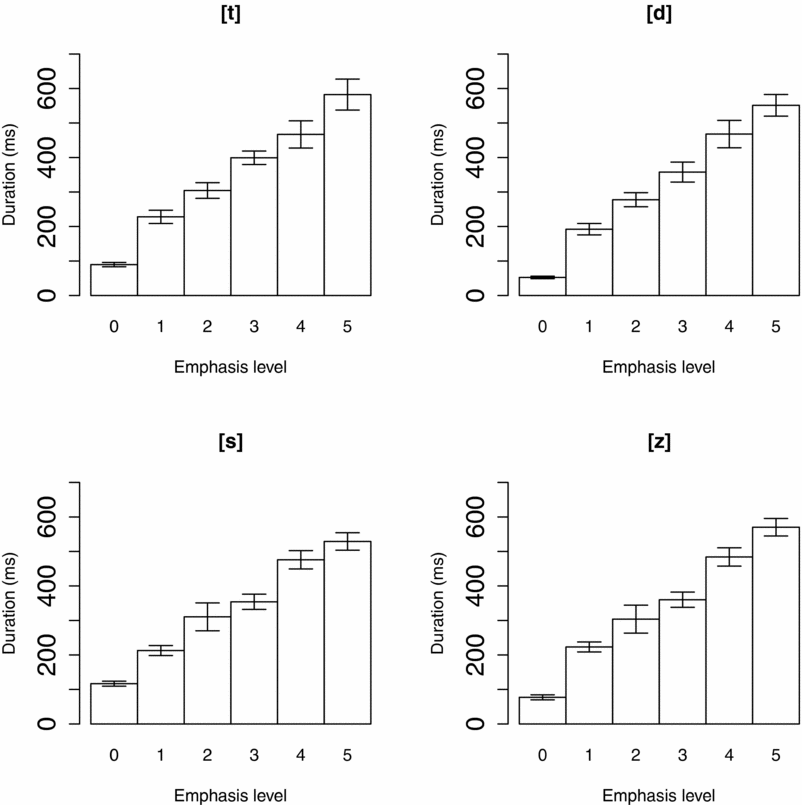
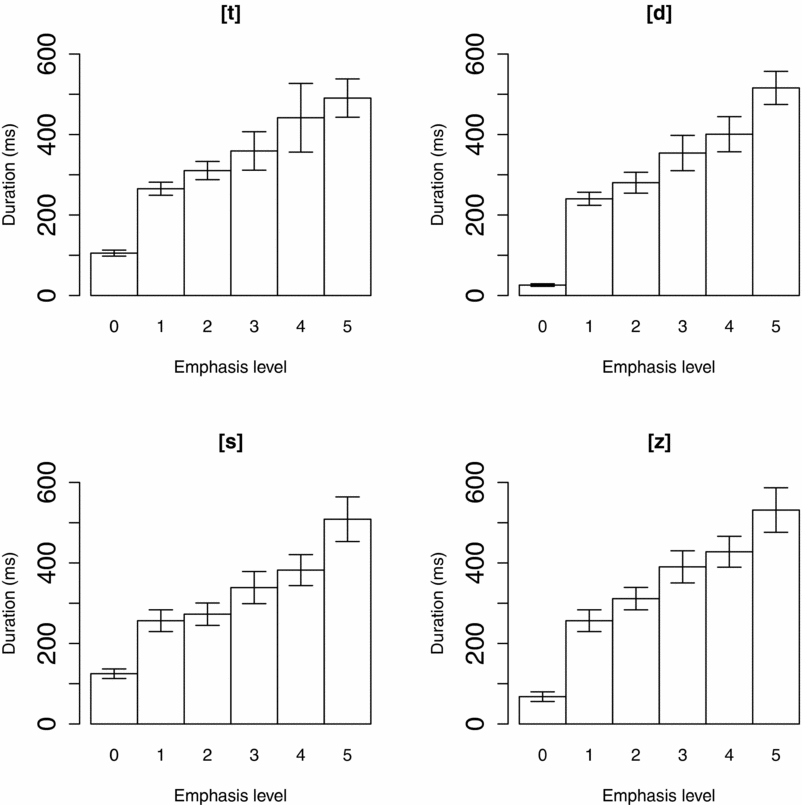
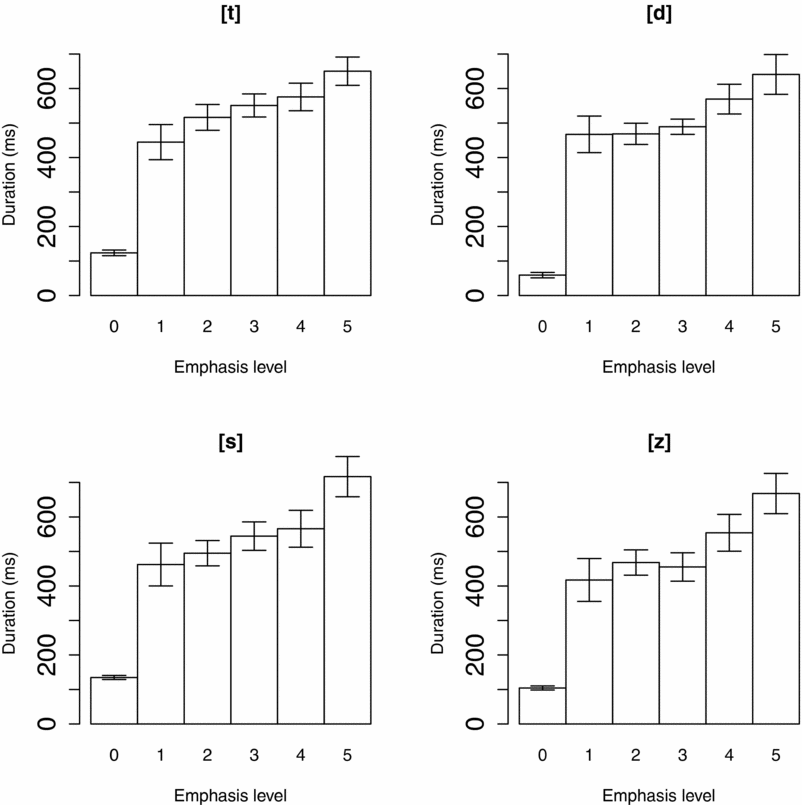
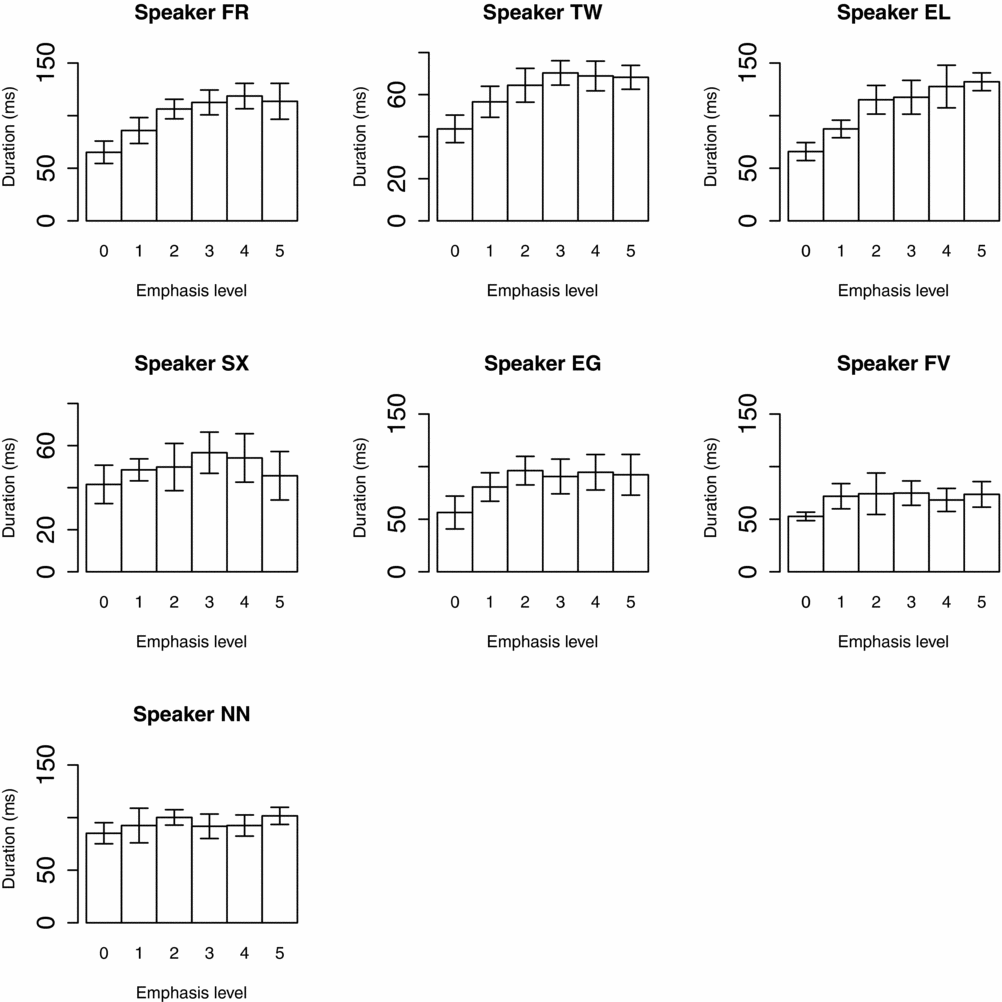
First, of the seven speakers, two (Speakers FR and TW) seem to make a perfect six-way distinction, i.e. the consonant durations for each level of emphasis are different. The results of these speakers are illustrated in Figures 3 and 4.
The average durations of each emphasis level with 95% confidence intervals: Speaker FR.

The average durations of each emphasis level: Speaker TW.

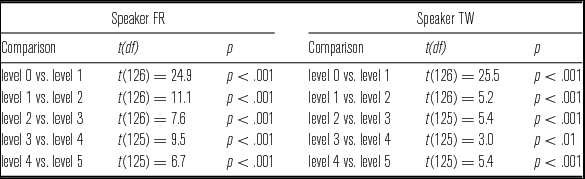
We observe that for both speakers there is a large increase in duration from plain consonants to the level 1 emphatically lengthened consonants. Further, within the emphatically lengthened consonants, there is a steady, linear increase in duration as the emphasis level increases. Non-paired multiple comparison t-tests show that all levels are different in terms of their duration. These results are given in Table 4.
Non-paired multiple comparison t-tests for Speakers FR and TW, showing the effect of emphasis level on duration. α = .01 after Bonferroni adjustment (.05/5).

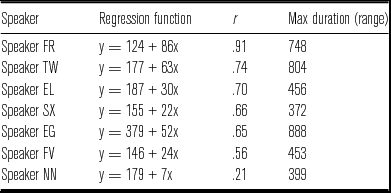
In addition, to assess the linear correlation between emphasis levels and duration within different levels of emphatically lengthened consonants, a linear regression was run with duration as the dependent variable and with emphasis level as the independent variable (no-emphasis consonants were not included in this regression analysis because of the non-linearity we observe between no-emphasis consonants and emphatically lengthened consonants). For both speakers, the effect of the emphasis level is significant (t(317) = 38.0, p < .001 for Speaker FR and t(316) = 19.6, p < .001 for Speaker TW). The estimated coefficients of emphasis level are 86 ms and 63 ms, respectively – these values are estimates of how many milliseconds these speakers increase a consonant's duration per emphasis level.
Finally, to numerically assess the strength of the correlation between emphasis levels and duration, Pearson correlation coefficients (r) were calculated. The no-emphasis consonants were excluded from this analysis also, because there are large jumps in duration between plain consonants and the emphatically lengthened consonants. The results show that r-values are .91 for Speaker FR and .74 for Speaker TW, both very high correlations (both significant at the p < .001 level).
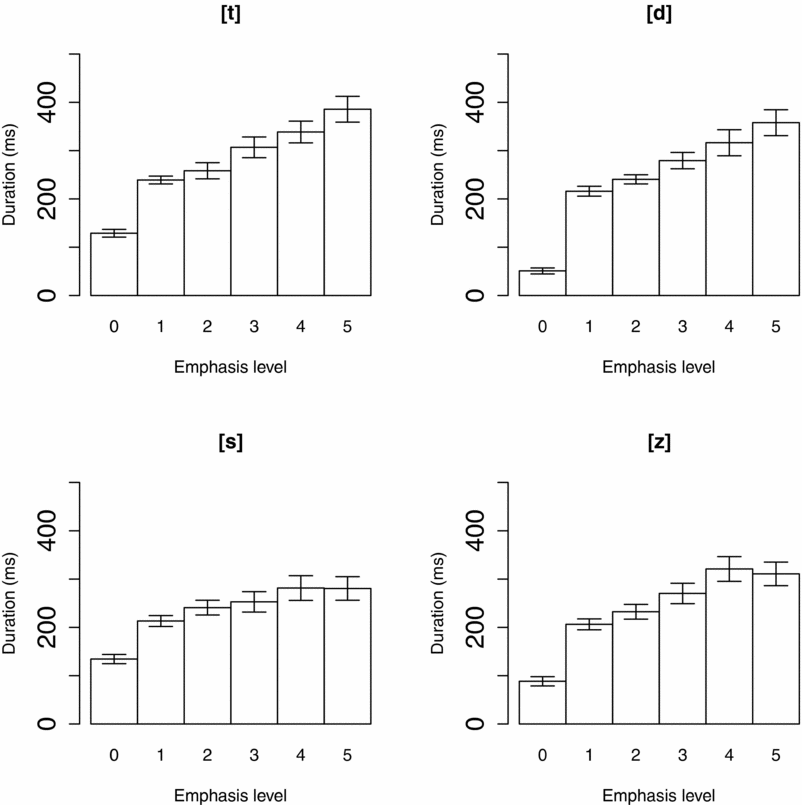
Other speakers also showed a steady increase in duration, but not as clearly as Speakers FR and TW. Speaker EL shows the next highest correlation between emphasis level and duration, as shown in Figure 5.
The average durations of each emphasis level: Speaker EL.

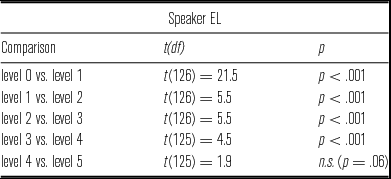
Although this speaker does not show a difference between level 4 and level 5 for the two fricatives, there seems to be a clear, general increase of duration as the emphasis levels go higher. The results of multiple comparison t-tests, given in Table 5, show that all the differences but the comparison between level 4 and level 5 are significant.Footnote 6
Non-paired multiple comparison t-tests for Speaker EL, showing the effect of emphasis level on duration. α = .01 after Bonferroni adjustment (.05/5).

The effect of emphasis is statistically significant in the regression model (t(317) = 17.3, p < .001), and the coefficient estimate is 30 ms. Despite the fact that this speaker does not show differences for some levels of emphasis, the r-value for Speaker EL is high (r = .70, p < .001). We also notice that the duration range is smaller (about 500 ms in Figure 5) compared to the previous two speakers (about 700 ms and 600 ms in Figures 3 and 4, respectively), and thus this speaker manages to – or at least attempts to – make six levels of duration distinctions within a smaller duration range. This characteristic is perhaps responsible for the smaller estimate of the effect of emphasis in the regression model.
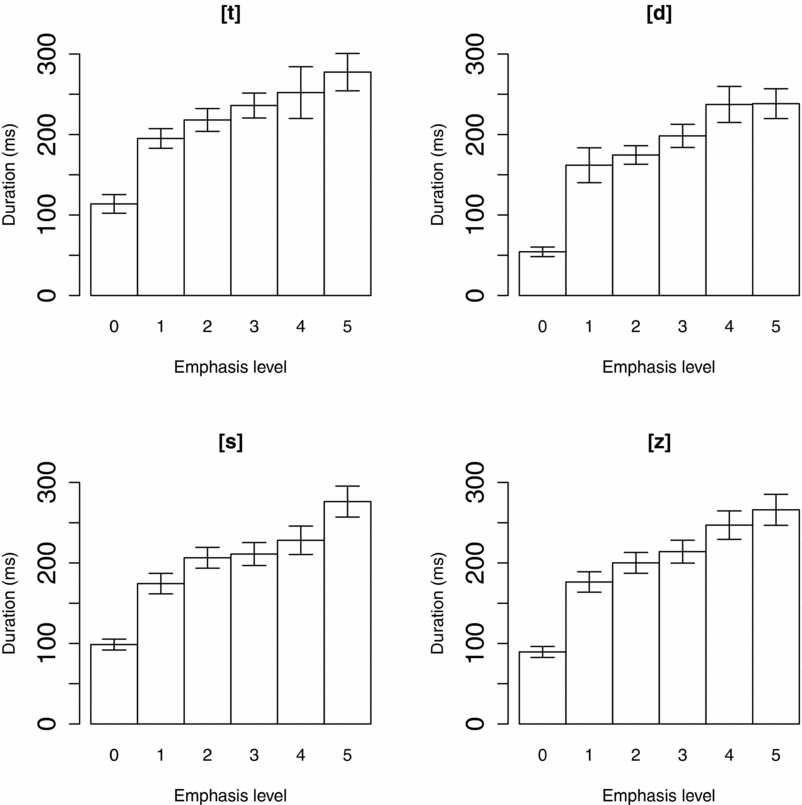
The next speaker, Speaker SX, shows some increase in duration correlating with emphasis levels, but we observe a number of emphasis pairs that are not differentiated from one another, as shown in Figure 6.
The average durations of each emphasis level: Speaker SX.

The speaker does not show a difference from level 2 to level 4 for [s], or between level 1 and level 2, or level 4 and level 5, for [d]. We also note that this speaker's duration range is even smaller than that of Speaker EL (the maximum range is about 300 ms in Figure 6).
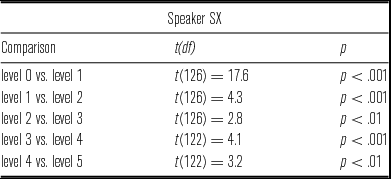
The effect of emphasis is still significant in the regression model (t(314) = 15.5, p < .001), but the coefficient estimate is lower (22 ms), compared to the previous three speakers. The smaller coefficient is presumably related to the fact that the duration range is smallest among the speakers we have seen thus far. This speaker's r-value is slightly lower than the previous speakers’ r-values (r = .66, p < .001). Nevertheless, all the differences turned out to be significant by multiple comparison t-tests, the results of which are given in Table 6, presumably because each level of difference is manifested by some if not all consonants.
Non-paired multiple comparison t-tests for Speaker SX, showing the effect of emphasis level on duration. α = .01 after Bonferroni adjustment (.05/5).

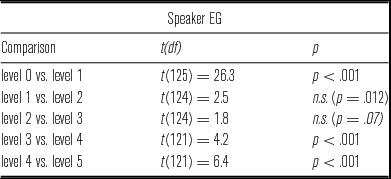
Next, as seen in Figure 7, Speaker EG often fails to show differences between emphasis levels in the middle range (between level 1 and level 2 as well as between level 3 and level 4 for [s], and from level 1 to level 3 for the two voiced consonants). The statistical tests, given in Table 7, show no significant differences between level 1 and level 3, but significant results elsewhere.
Non-paired multiple comparison t-tests for Speaker EG, showing the effect of emphasis level on duration. α = .01 after Bonferroni adjustment (.05/5).

The average durations of each emphasis level: Speaker EG.

It seems that this speaker has a four-way contrast: non-emphatic (level 0), emphatic (level 1 to 3), very emphatic (level 4), and most emphatic (level 5). As an anonymous reviewer pointed out, this speaker may only have these four-way internal representations, and translated the various degrees of gemination marks to fit into these categories.
The effect of emphasis is nevertheless significant in the regression analysis (t(310) = 15.1, p < .001), and the coefficient estimate is higher than Speaker SX (52 ms). Despite the apparent lack of differences in the middle range, r is reasonably high (r = .65, p < .001).
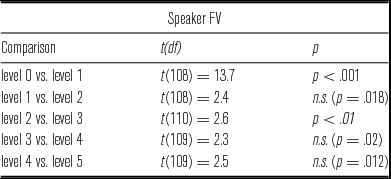
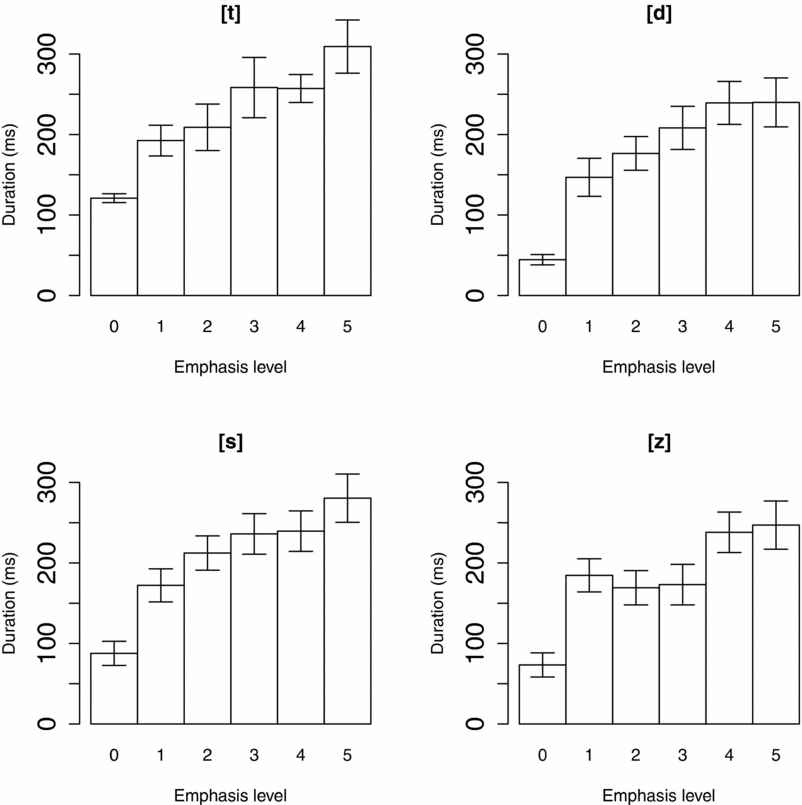
Speaker FV, shown in Figure 8, does show a steady increase in duration, but we observe that the speaker does not show a difference between certain emphasis levels; e.g. level 1 and level 2 as well as level 3 and level 4 for [t]; level 4 and level 5 for [d]; level 3 and level 4 for [s]; level 1 to level 3, and level 4 to level 5 for [z]. The statistical tests show that, after Bonferroni correction, only the difference between level 0 and level 1 and the difference between level 2 and level 3 are reliable, as can be seen in Table 8. The effect of emphasis is still significant in the regression analysis (t(275) = 11.2, p < .001), but the coefficient estimate is low (24 ms). r is also low (r = .56, p < .001), as compared to the other speakers we have seen.
Non-paired multiple comparison t-tests for Speaker FV, showing the effect of emphasis level on duration. α = .01 after Bonferroni adjustment (.05/5).

The average durations of each emphasis level: Speaker FV.

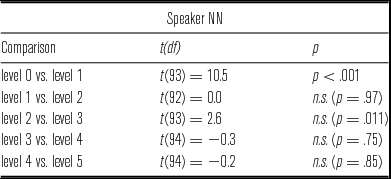
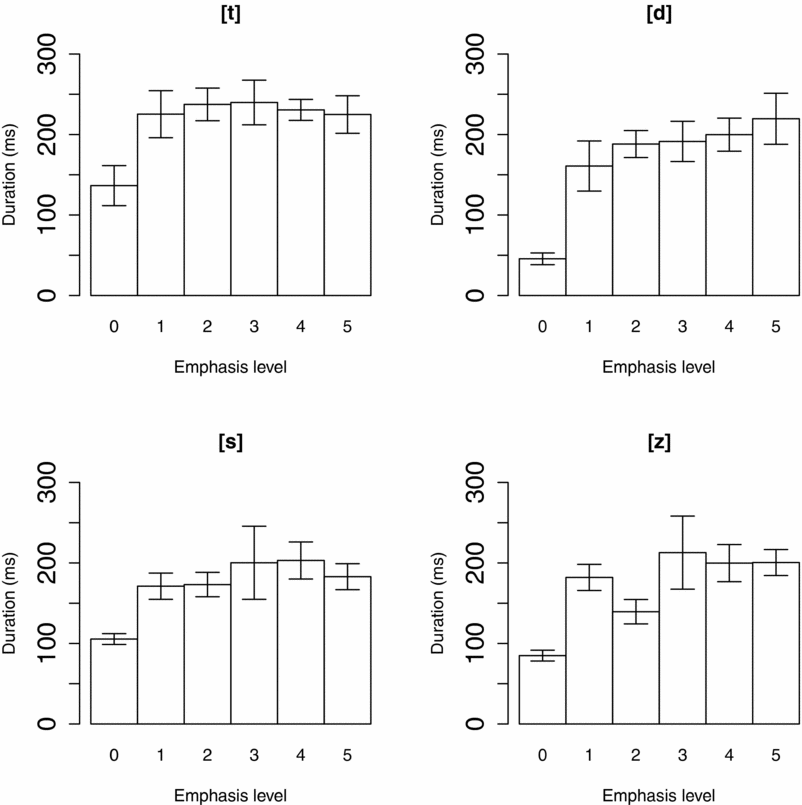
Finally, one speaker (Speaker NN) showed a more or less binary distinction, i.e. plain vs. emphatically lengthened, as shown in Figure 9. That is, this speaker does not seem to show distinctions among different levels of emphatically lengthened consonants (and this speaker seems to show an evident reversal between level 1 and level 2 for [z]). The results of multiple comparison t-tests, given in Table 9, support this observation. Although statistically significant (t(236) = 3.33, p < .001), the coefficient estimate in the regression model is as small as 7 ms. The r-value is also very low (r = .21, p < .001), compared to the other speakers. In short, this speaker may allow only two categories – no-emphasis and emphatically-lengthened – without any further distinctions among emphatically lengthened consonants.
Non-paired multiple comparison t-tests for Speaker NN, showing the effect of emphasis level on duration. α = .01 after Bonferroni adjustment (.05/5).

The average durations of each emphasis level: Speaker NN.

3.2 Summary of the patterns of closure duration
Table 10 provides a summary of each speaker's behavior. It provides the regression function for each speaker, as well as the r-value. The coefficients represent how many milliseconds each speaker increases consonant duration per emphasis level.Footnote 7 The r-values are a measure of the strength of the linear correlation between emphasis levels and duration. In addition, as a measure of their duration range, the maximum duration is provided for each speaker.
Summary of each speaker's behavior.

All speakers showed a positive correlation between duration and emphasis levels. There are only a few instances of evident reversals, although in a number of cases we observed no differences between certain levels of emphasis.
We also observed that there are noticeable differences among speakers. Two speakers (FR and TW) showed perfect six-way distinctions. One speaker (EL) showed some cases in which no differences were observed, but the correlation between emphasis levels and duration was still high. Speaker EG seems to have had four categories. One speaker (NN) made little distinction among emphatically lengthened consonants, although there was a very weak correlation between duration and emphasis levels.
In Table 10, we observe an association between how finely each speaker realizes different degrees of emphasis and duration range. For example, Speakers FR and TW, who showed a fine six-way distinction, have very large duration ranges. Speaker NN, who showed an almost binary contrast between plain consonants and emphatically lengthened consonants, has a small duration range. The correlation is not perfect, however, since for example, Speaker EL has a high r-value but nevertheless has a relatively small duration range.
To summarize, all speakers showed a positive correlation between emphasis level and consonant duration, although we also observe some inter-speaker variability. Some speakers (especially Speakers FR and TW) seem to have managed to perfectly distinguish six levels of consonantal duration differences. The current experiment included (only) up to level 5 emphasis; it remains to be seen where the limit lies with respect to how many levels of emphasis can actually be produced.
3.3 Is the effect of lengthening localized? The effect on the preceding vowels
This study focused on consonant duration, because the main acoustic correlate of Japanese geminates is constriction duration (Han Reference Han1962, Reference Han1992, Reference Han1994; Homma Reference Homma1981; Beckman Reference Beckman1982; Hirata & Whiton Reference Hirata and Whiton2005; Hirose & Ashby Reference Hirose, Ashby, Trouvain and Barry2007; Kawahara Reference Kawahara2006; Idemaru & Guion Reference Idemaru and Guion2008; Amano & Hirata Reference Amano and Hirata2010; Hirata & Amano Reference Hirata and Amano2012). However, in addition to the results given above, a question arises as to whether, when Japanese speakers are expressing emphasis, the effect of emphasis is localized to only the target consonants. To address this question, a post-hoc analysis examined the duration of preceding vowels using a subset of the data (namely, instances of the stimulus item [katai] ‘hard’, as this word provided the best environment for duration measurement of preceding vowels among our existing stimuli).Footnote 8
The results are shown in Figure 10 for each speaker (ordered as per the discussion in Section 3.1 and Table 10 above). We observe, first of all, that all speakers show longer preceding vowels in the emphatically lengthened conditions than in the plain consonant condition. This observation matches well with the earlier observation about Japanese that preceding vowels are longer before geminates than before singletons (Fukui Reference Fukui1978, Port, Dalby & O’Dell Reference Port, Dalby and O’Dell1987, Han Reference Han1994, Campbell Reference Campbell1999, Ofuka Reference Ofuka2003, Kawahara Reference Kawahara2006, Hirata Reference Hirata2007, Hirose & Ashby Reference Hirose, Ashby, Trouvain and Barry2007, Idemaru & Guion Reference Idemaru and Guion2008, Takeyasu Reference Takeyasu2012). This difference in duration between those preceding plain consonants and those preceding emphasized consonants, shown in Figure 10, is thus as expected from what we know about Japanese lexical geminates.
The average durations of preceding vowels for each emphasis level with 95% confidence intervals. The figures have different y-axis scales, because different speakers use different duration ranges.

In addition, we observe some differences in pre-consonantal vowel duration among different emphatic levels for some speakers, but the tendency is much less clear compared to the differences we observed in consonantal duration. Even the two speakers who showed the clearest six-way differences in consonantal durations (Speakers FR and TW) do not show differences in preceding vowel duration among levels higher than 2. Speaker EL also does not show differences for levels higher than emphasis level 2. The next three speakers (Speaker SX, EG, FV) only show a two-way difference between plain consonants on the one hand and the emphatically lengthened consonants on the other, reflecting the general pattern found in Japanese (see above), but they do not show clear differences among the emphatically lengthened consonants. For Speaker NN, the difference between the plain and emphatically-lengthened conditions does not seem substantial.Footnote 9
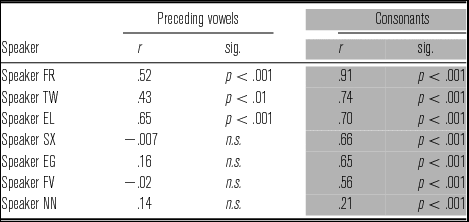
To compare the patterns of consonantal durations and vowel durations, Table 11 summarizes the correlation (Pearson's r) values between durations of preceding vowels and emphasis levels for each speaker. Recall that these values are a measure of the strength of correlation between durations and emphasis levels. In the rightmost column, r-values for consonants are reproduced for each speaker from Table 10 for the sake of comparison.
Summary of the correlation (Pearson's r) between duration of preceding vowels and emphasis levels for each speaker. The r-values for consonants are reproduced in the rightmost column for the sake of comparison.

Table 11 confirms the observations we made regarding Figure 10. Speakers FR, TW and EL all show positive correlation, but these r-values are not as high as those we observed for consonantal durations with these speakers (see the rightmost column). The other speakers do not show a significant correlation between emphasis levels and preceding vowel duration. It can be concluded that the consonant gemination pattern in Japanese targets consonant duration more than preceding vowel duration, and that the effect of lengthening is primarily localized to consonant duration.
4 General discussion
4.1 Theoretical discussion
There are a number of theoretical questions that the current results bear on. One implication of this study, beyond providing the first experimental description of the emphatic gemination pattern in Japanese, is that at least two speakers showed clear six-way differences, and all but one speaker showed a steady linear correlation between duration and emphasis level. In general, then, from the point of view of articulation, it is likely that speakers can make durational differences that go beyond a binary distinction. This finding is interesting in light of the observation that for lexical singleton–geminate contrasts, the differences are usually limited to a binary difference (Ladefoged & Maddieson Reference Ladefoged and Maddieson1996). This conclusion – that they can produce more than binary durational differences – does not of course automatically generalize to the speakers of other languages, but at least some speakers from one language are able to produce six-way durational differences. Future cross-linguistic examinations are needed in order to further examine this conclusion.
Another theoretical question that arises is why, given that speakers can in general make durational distinctions beyond a binary contrast, do natural languages usually exploit only a two-way distinction for lexical contrasts. An obvious hypothesis would be that perception is playing a role here – a three-way durational contrast may be difficult to perceive and may cause confusion, which is to be avoided, following the spirit of Adaptive Dispersion Theory (see e.g. Liljencrants & Lindblom Reference Liljencrants and Lindblom1972; Lindblom Reference Lindblom, Ohala and Jaeger1986; Flemming Reference Flemming1995; Schwartz et al. Reference Schwartz, Boë, Valleé and Abry1997a, Reference Schwartz, Boë, Valleé and Abryb; Padgett Reference Padgett2002; Diehl, Lindblom & Creeger Reference Diehl, Lindblom, Creeger, Solé, Recasens and Romero2004; see especially Engstrand & Krull Reference Engstrand and Krull1994 and Kawahara Reference Kawahara2012 for the relevance of perceptual dispersion in durational dimensions). Another hypothesis is more formal – that phonological systems build on binary distinctive features (the length contrast being one of these) (Chomsky & Halle Reference Chomsky and Halle1968), such that lexical contrasts are always limited to binary distinctions by Universal Grammar. Settling this debate is beyond the scope of the present paper, and warrants future experimental studies.
Third, an anonymous reviewer raises the question of how the current results bear on the representation of long segments generally. In current phonological theory, there are, broadly speaking, two competing approaches: (i) simply representing long segments as [+long] (Kuroda Reference Kuroda1967, Chomsky & Halle Reference Chomsky and Halle1968), and (ii) separating timing slots from segmental content, with timing slots being represented by, for example, C-slots (McCarthy Reference McCarthy1979), moras (Hayes Reference Hayes1989) or by root nodes (Selkirk Reference Selkirk, Dunlap and Padgett1990) (see Davis Reference Davis, van Oostendorp, Ewen, Hume and Rice2011 for a recent overview). For the emphatic lengthening phenomenon at least, it is impossible to simply deploy a [+long] feature, because the contrast is not binary. The second type of theory can more parsimoniously accommodate the lengthening phenomenon, because in principle, timing slots can be added for each emphasis level.Footnote 10
Finally, recall that for all the speakers, the emphatically lengthened consonants were longer than the plain consonants (despite the fact that not all speakers realized differences among the different levels of emphasis). Moreover, as observed in all the results figures, all speakers have a very large increase in duration from plain consonants to emphatically lengthened consonants, and this increase is larger than the observed differences among the different levels within the emphatically lengthened consonants.Footnote 11 Thus it seems that Japanese speakers overall make a binary contrast between plain and emphatically lengthened consonants, and within the emphatic consonants, speakers choose different options about how to scale the degrees of emphasis.Footnote 12 That is, plain consonants are not 0 on the scale of emphasis, but instead are categorically different from all emphatically lengthened consonants. This pattern may imply that the distinction between non-emphatic and emphatic is semantically more important than the finer degrees of emphasis, and that speakers reflect this difference of semantic importance in their production of emphasized and plain consonants.
4.2 Remaining questions
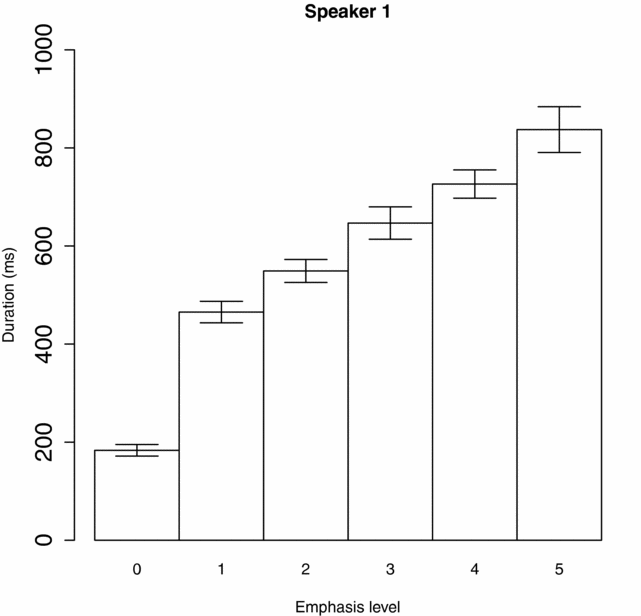
The current study also raises several questions. For example, would speakers of other languages be able to make similar durational differences? Would there be a difference between languages that exploit duration-based lexical contrasts (as in Japanese) and those that do not (as in English)? In a follow-up study currently in progress, we have examined a similar phenomenon in English, using examples like That guy is soooooo creepy and That joke is suuuuper funny (Dresher et al. Reference Dresher, Korostoff, Pangilinan, Trombetta and Kawahara2013). The preliminary results, partly illustrated in Figure 11, show that at least some English speakers – who do not have a phonological length contrast in their native language – do make differences that are similar to those found in our current project. This sort of cross-linguistic comparison should be examined in future studies.
An illustration of vowel lengthening by emphasis level by an English speaker (from Dresher et al. Reference Dresher, Korostoff, Pangilinan, Trombetta and Kawahara2013).

The phenomenon of emphatic lengthening in Japanese (and other languages) can be studied from other perspectives as well. For example, it is conceivable that emphasis is conveyed along other acoustic dimensions, such as intensity differences. In such cases, would we expect to see the same sort of fine-grained patterns which go beyond binary distinctions? Another question is whether Japanese speakers make similar levels of differences in actual production patterns in naturalistic settings, i.e. even when they are not prompted in experimental settings. Yet another question is that of perception: Given that speakers can produce distinctions that go beyond binary, to what extent can native speakers perceive them?Footnote 13 These are interesting questions, which are, however, beyond the scope of the current study. Ultimately, our project may raise more questions than it answers, but for that very reason, this project will open up opportunities for future studies on the phonetics of pragmatic emphatic lengthening.
5 Final summary
In summary, while the phonetics of lexical singleton–geminate contrasts is well studied, there are few if any phonetic studies on pragmatically lengthened segments. The current paper has offered a first study of pragmatically lengthened consonants, using Japanese as a case study. It has shown that two speakers made six-way durational distinctions, and all other speakers (expect for one) showed a steady correlation between consonant duration and emphasis level. The locus of durational differences is chiefly localized to consonant duration. This study raises many questions about the phonetics of pragmatic lengthening in Japanese and other languages, and thus opens up opportunities for future phonetic studies.
Acknowledgements
The recording for this experiment was conducted while the first author was a visiting scholar at International Christian University (Tokyo), which was made possible by a fellowship offered by the Japan ICU Foundation, for which we are grateful. The help by research assistants at the Rutgers Phonetics Laboratory with the acoustic analysis was indispensable. John Kingston and three anonymous reviewers offered very helpful comments on this project. Remaining errors are ours.