Emergency nurses are the primary component of the nursing workforce to respond to disasters. Reference Hutton, Veenema and Gebbie1 In mainland China, the main forces of disaster relief are national emergency medical rescue teams, private rescue organizations and medical personnel. Reference Division, Division and Meng2 Among them, emergency nurses comprise a large proportion. Reference Fan, Yu and Yujun3 To cope with the Wenchuan (2008) and Yushu (2010) earthquakes, the Chinese government sent teams of emergency nurses to the designated areas. As frontline healthcare providers, emergency nurses undertook many tasks and responsibilities, such as physical and psychological care, information dissemination, health education and triage. Reference Wenji, Turale and Stone4 Disaster preparedness is defined as “nurses have the knowledge and ability to effectively anticipate, respond to, and recover from dangerous events or conditions that may occur, will occur, or have occurred, and their effects.” 5 Studies have shown that disaster preparedness is a crucial factor in disaster response that can minimize the effects of disasters. Reference Najafi, Mohammad and Haghani6 Therefore, the disaster preparedness of emergency nurses is particularly important to the quality and efficiency of disaster relief.
Background
China is a country with frequent natural and human-made disasters. According to the Chinese government’s most recent data, 19 million people were affected by various disasters in 2016, and the direct economic loss was approximately 8 billion dollars. Reference Zhang, Zhu and Sheng7 According to the National Bureau of Statistics, Guangdong is the most populous province in China. The new urbanization construction data of Guangdong Province show that there will be 13 million recurrent population in Guangdong every year, which is estimated that 6 million people enter and 7 million people exit Guangdong Province annually for school or business. Reference Wang8 Moreover, Guangdong Province has been considered 1 of the most vulnerable provinces with high exposure to typhoons, rain storms, floods, extraordinarily serious traffic accidents and respiratory infectious diseases. Reference Nguyen, Liou and Terry9 For example, during COVID-19 pandemic, Guangdong Province was severely affected. Reference Wang, Liao and Li10 According to the National Health Commission of the People’s Republic of China, as of July 23, 2021, Guangdong Province had 2,834 confirmed cases, behind Hubei Province in mainland China. 11 In addition, with the intensification of the epidemic scale abroad, a new situation has emerged in epidemic prevention and control, and the focus of prevention and control has shifted from actively controlling the outbreak at home to actively preventing and controlling imported cases. As an important border port, Guangdong province has seen a gradual increase in imported cases, which has brought new challenges to epidemic prevention and control. Reference Lizhen, Yonghong and Bo12 Excessive work intensity, job burnout, and the risk of infection have caused different degrees of negative impact on physical and psychological health among healthcare personnel. Reference Dong and Bouey13,Reference Xiao, Zhang and Kong14 Given these concerns, the disaster preparedness of emergency nurses in Guangdong Province is of great concern. Furthermore, a study has shown that the current level of disaster preparedness among emergency nurses is at a medium-to-low level in China, and most of them lack disaster relief knowledge, skills, and management capacity. Reference Najafi, Mohammad and Haghani6 Additionally, a research lag on disaster preparedness could lead to poor rescue quality and even threats to emergency nurses’ own safety during disaster relief. Reference Tan, Liao and Su15
At present, there have been some studies on disaster preparedness of nurses in mainland China. Existing studies used a variety of research methods, including experimental research, qualitative interviews and literature review. Reference Xia, Li and Chen16,Reference Yang, Xiao and Cheng17 Research subjects in these studies have included nursing students and nurses in the ICU, community, and other specialties. Reference Chen, Yang and Hu18,Reference Liao, Ma and Gao19 The settings for these previous studies focus on inland areas, including Sichuan Province and Hubei Province. Reference Wenji, Turale and Stone4,Reference Xia, Li and Chen16 Factors associated with nurses’ disaster preparedness usually includes age, gender, educational level, professional title, disaster relief training, and disaster relief experience. Reference Liu, Yu and Liu20 However, limitations of these published studies include small sample sizes, unclear research methods, incomplete data results, and common variables.
Based on the current situation of medical resources and disaster preparedness in China, 4 variables were included as supplementary variables, namely, hospital type, American Heart Association (AHA) saver status, member of a Chinese Emergency Medical Rescue Team (CEMRT), and willingness to participate in a disaster relief mission. Hospital type can be divided into emergency hospitals and nonemergency hospitals. Emergency hospitals are emergency rescue designated hospitals established by the Chinese government. Reference Lv, Li and Chen21 The AHA savers master knowledge and skills to save the heart. Reference Seo22 CEMRT refers to the team that sets up rescue members to the disaster area immediately after a disaster or epidemic outbreak, including fixed and temporary teams. 23 Willingness to participate in a disaster relief mission can affect the level of disaster preparedness. Reference Chovaz, Patel and March24 Therefore, these 4 variables may have an impact on the disaster preparedness of emergency nurses.
At present, there is no study on the disaster preparedness level and influencing factors of emergency nurses in Guangdong Province, and the variables used in the existing studies are relatively common. In conclusion, it is necessary to make up for the deficiencies of existing studies, comprehensively consider the role of the 4 new variables, and deeply explore the influencing factors of emergency nurses’ disaster preparedness.
Aims
This study aimed to evaluate the disaster preparedness of emergency nurses and to examine influencing factors on disaster preparedness in Guangdong Province, China.
Methods
Study Design
This study used a cross-sectional design and convenience sample.
Setting and Sample
This descriptive cross-sectional survey was conducted with nurses from the emergency departments of 26 public hospitals in Guangdong province (the Pearl River Delta, Eastern, Western, and Northern regions in Guangdong province) from August 21, 2018 to August 31, 2018. To be eligible, all respondents were required to be certified registered nurses and formally employed in emergency departments. The inclusion criteria were age (≥ 18 y) and willingness and ability to provide informed consent to participate in the study. Nonregistered and student nurses were excluded. The included hospitals consisted of 20 tertiary hospitals, 3 secondary hospitals, 2 primary hospitals, and 1 community hospital.
The required sample size for multiple regression analyses used in this study was at least 89 participants (power = .90; Alpha = .05; number of independent variables controlled = 13; number of independent variables tested = 6). Reference Cohen25 The requirement of sample size for linear regression analyses was 385 (precision = .10; error rates = .95). Reference Ostle and Malone26
Ethical Consideration
The study was approved by the nursing school of the corresponding author’s affiliation and emergency department managers of 26 public hospitals. All participants were fully informed about the study and the voluntary nature of participation. Participants provided their informed consent, and the information received from them was treated as confidential and anonymous.
Measurements
Demographics
The online questionnaire included items about demographic characteristics, including age, gender (male-1; female-2) and educational level. Items also addressed work-related factors, such as hospital level (tertiary-1; not tertiary-2), hospital type (emergency hospital-1; nonemergency hospital-2), and dichotomous problems (yes-1; no-2), such as whether the respondent is an AHA saver, whether they are a member of CEMRT, and whether they have attended disaster relief training in the 5 past years. All variables were treated as categorical variables. Quartile cutoff points for age were chosen to ensure the balance in each stratum. Age was classified into 4 levels: 18 to 24 y-1, 25 to 28 y-2, 29 to 33 y-3, and 34 y and above-4. Similar to previous studies, Reference King, Spritzer and Al-Azzeh27 , educational level was classified into 5 levels: technical secondary school-1, college-2, bachelor-3, master-4, and doctor-5. Those who scored 1 or 2 were recategorized into the “below bachelor’s degree” group, while those who scored 3, 4, or 5 were recategorized into the “bachelor’s degree and above” group.
Mainland China version of the Disaster Preparedness Evaluation Tool (DPET-MC)
The DPET, developed by Tichy et al. in 2007, is one of the most widely used scales to assess perceived levels of disaster preparedness in nurse practitioners. Reference Tichy, Bond and Beckstrand28 Chinese scholars have translated the DPET scale into Chinese in mainland China Reference Zhen and Yu29 and Taiwan, China. Reference Chen, Chou and Liao30 Because the previous mainland China version was directly translated into Chinese without cultural adaptation, dimension and item modification, and complete psychometric tests, further development was needed. Due to the different political backgrounds, economic policies, cultures, and medical health levels between Taiwan and mainland China, the Taiwan version of the DPET could not be used directly. Reference Shinozaki, Wang and Yuan31 Moreover, the Taiwan version retains the entries for the response to biological terrorism, which are the task of the Chinese Center for Disease Control and Prevention (CDC) in mainland China, not the task of emergency nurses. Therefore, we adjusted the DPET again.
The DPET-MC, a modified version of the DPET, was used to measure perceived levels of disaster preparedness in emergency nurses. It contained 34 items within 5 subscales: predisaster awareness (3 items), predisaster knowledge (8 items), disaster management (10 items), knowledge and skills in the workplace (6 items), and postdisaster knowledge and skills (7 items). The original DEPT scale, which had been developed in English by Tichy et al., Reference Tichy, Bond and Beckstrand28 was translated to Chinese, the local language, by the forward-back translation method. It was culturally adapted and validated for Chinese emergency nurses using robust validation techniques, with permission from the original authors. Items were assessed using a 6-point Likert scale (1 = “strongly disagree”; 6 = “strongly agree”). Scores on the total scale and each dimension, ranged from 34 to 204, 3 to 18, 8 to 48, 10 to 60, 6 to 36, 7 to 42, and higher scores indicated better disaster preparedness. According to our previous study, Reference Jia, Sihui and Xinglan32 the DPET-MC scale has been validated by exploratory and confirmatory factor analyses (model chi-squared/degree of freedom: 1.98, root mean square error of approximation: .07, comparative fit index: .90; incremental fit index: .91; Tucker-Lewis Index: .90), and the reliability has been proven to be satisfactory (Cronbach’s alpha value = .97) (as shown in Supplementary Materials File 1).
Data Collection
The descriptive study was based on an online questionnaire that followed the Checklist for Reporting Results of Internet E-Surveys (CHERRIES) Reference Eysenbach33 rendered by means of a software program called “Questionnaire Star” (Changsha Ranxing Information Technology Limited Liability Company, Changsha, China). The CHERRIES statement is the first checklist for ensuring the quality of biomedical research that uses Web-survey methodology. The questionnaire consisted of 2 sections. Section A focused on demographic and work-related questions, and Section B included the Disaster Preparedness Evaluation Tool (DPET), described in more details below. The online questionnaire survey was conducted through WeChat software based on the smartphone. When respondents opened up the questionnaire system, it could be completed without a password and took the respondents approximately 15 min to complete. To ensure active participation, researchers contacted head nurses of emergency departments in each hospital individually, asking them to help distribute questionnaires in the WeChat groups and monitor the whole process. Participants who agreed to participate in the study were required to open the questionnaire and submit it only after completing all questions, so it was impossible to submit an incomplete answer. Participants who completed the questionnaire were given a small gift worth 1 to 3 yuan in return. To avoid repeated access and completion of the questionnaire, an Internet provider (IP) number was used for access restriction. Online questionnaires were available for 10 d. After the deadline, the system would close automatically, after which participants would be unable to fill in and submit questionnaires. The data collection was done on August 31, 2018. Completed questionnaires were collected automatically and exported to an Excel file after the respondents answered the questions.
Data Analysis
Data were analyzed using the IBM Statistical Package for Social Sciences (SPSS) version 23.0. Descriptive analyses of the distribution of the sample and the prevalence of disaster preparedness were conducted. Independent sample t-tests, 1-way analyses of variance (ANOVA), with Levene’s test to assess homogeneity of variance, and Person or Spearman correlation analyses were used to compare the differences and examine the relationships between participants’ demographic and work-related variables and disaster preparedness. Statistically significant independent variables were included in the multivariate analysis. Before the multiple linear regression analysis, the variance inflation factors were used to examine the multicollinearity in all variables. Finally, a multiple linear regression model was performed to identify salient variables associated with disaster preparedness among demographic and work-related factors. P-values in this study were 2-tailed. Alpha was set at 0.05 for statistical significance.
Results
Descriptive Analyses of Study Participants and Disaster Preparedness
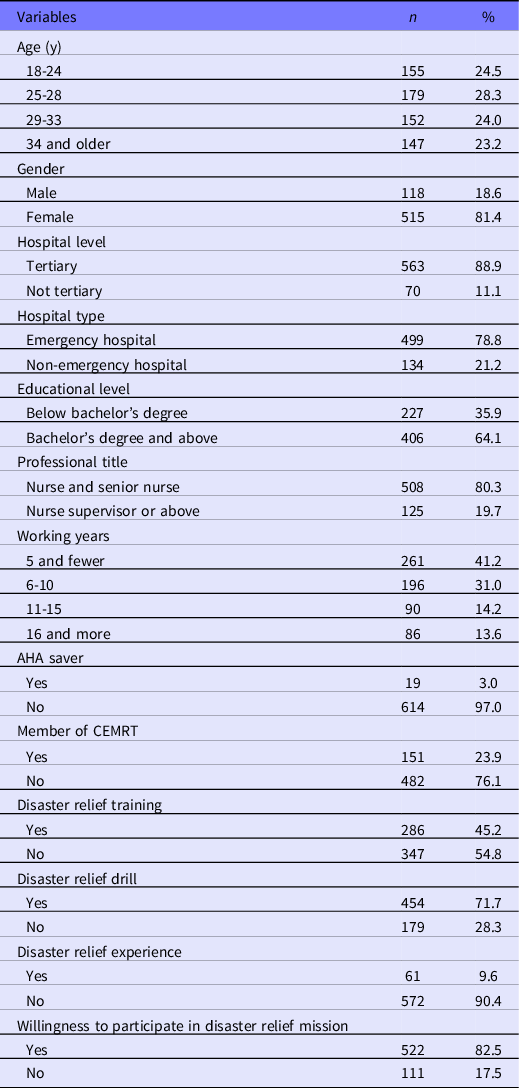
A descriptive analysis of the demographic characteristics and work-related information of 633 participants is shown in Table 1. Most participants were female (81.4%) and had a bachelor’s degree and above (64.1%).
Descriptive analysis of participants (N=633)

Abbreviations: AHA: American Heart Association; CEMRT: China Emergency Medical Rescue Team.
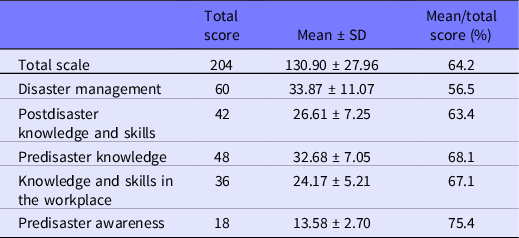
The mean scores and proportions for the total scale and for the 5 dimensions are presented in Table 2. The score for disaster management was lowest, while the score for predisaster awareness was highest.
Total score, mean ± SD score, and percentage for the DPET-MC scale and 5 dimensions

Univariate Analyses of the Factors Associated With Disaster Preparedness
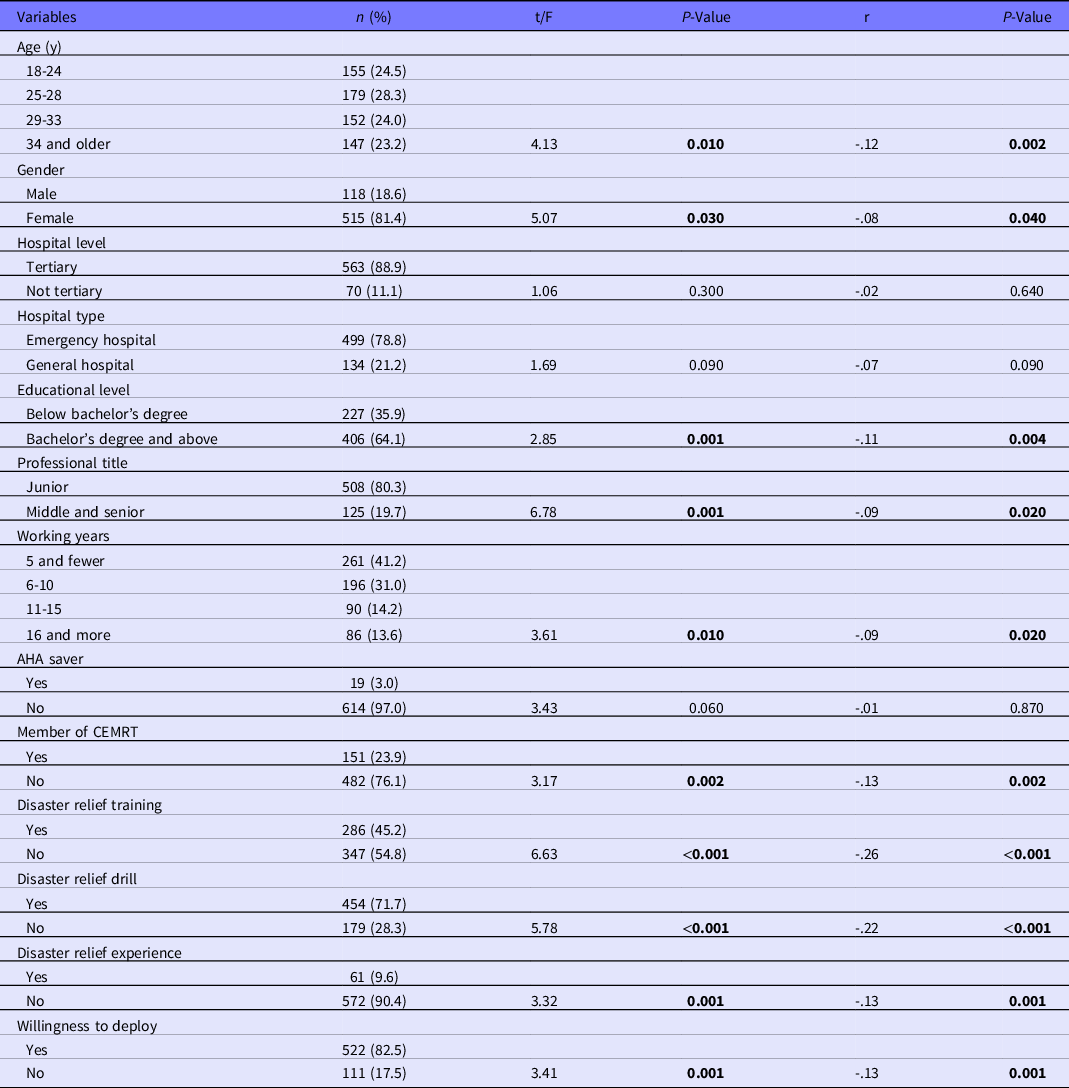
Independent sample t-tests, ANOVA, and Pearson or Spearman correlation analyses revealed that nurses of younger age and male gender, those who were members of CEMRT, those who had attended disaster relief training and drills, those who had participated in a disaster relief mission and those who were willing to participate in a disaster relief mission were more likely to report higher levels of perceived disaster preparedness. Nurses who had a higher educational level, a higher professional title, and more years employed were more likely to report lower DPET-MC scores (see Table 3).
Univariate analyses of the factors associated with disaster preparedness (N=633)

Regression Analyses Examining Covariates of Disaster Preparedness
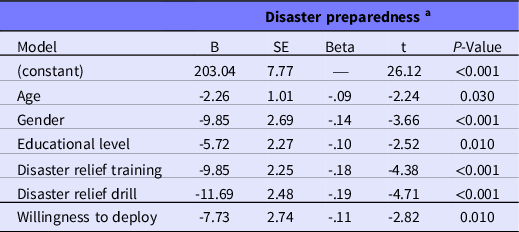
Regression analyses examining covariates of disaster preparedness are presented in Table 4. In the disaster preparedness model, age, gender, educational level, disaster relief training, disaster relief drill experience, and willingness were significant correlates explaining 14% of the total model variance. All 6 variables were negatively associated with disaster preparedness, suggesting that younger age, male gender, lower educational level, having participated in disaster relief training, having participated in a disaster relief drill, and being willing to participate in a disaster relief mission reported higher perceived disaster preparedness levels.
Regression analyses examining covariates of disaster preparedness (N=633)

a F=18.20, P<.001, R Reference Division, Division and Meng2 =.15, adjusted R Reference Division, Division and Meng2 =.14.
Discussion
This study showed that emergency nurses perceived they had a moderate level of disaster preparedness and a moderate-to-low level of disaster management in Guangdong Province, China. Disaster management needed to be improved most urgently in the 5 dimensions of predisaster awareness, predisaster knowledge, disaster management, knowledge and skills in the workplace, and postdisaster knowledge and skills. Six factors affected disaster preparedness, including age, gender, disaster training experience, disaster drill experience, willingness, and educational level. Disaster training experience and disaster drill experience were significantly correlated with disaster preparedness among emergency nurses. Several factors included in this study had rarely been explored before, namely, hospital type, AHA saver status, member of CEMRT, and willingness to participate in a disaster relief mission. The results could provide a more comprehensive reflection on disaster preparedness among Chinese emergency nurses.
Compared with prior studies among Chinese clinical nurses in Jiangsu Province and the results of male nurses in Hubei Province using the DPET questionnaire, Reference Xue, Dou and Chang34,Reference Deng, Xiong and Liu35 our findings represented a similar level of disaster preparedness. However, the level of disaster preparedness in our study was higher than those in Changsha, China, 7 Asia Pacific countries, and Jordan. Reference Al, Bond and Alasad36–Reference Usher, Mills and West38 This discrepancy might be explained by the fact that the participants were emergency nurses and the instrument was the modified version of the DPET (DPET-MC) in our study. The DPET-MC scale is shorter than the original scale and is targeted at emergency nurses in mainland China, so it is more suitable for this study. The emergency department is the first response department in the face of emergencies, and emergency nurses receive more disaster-related education and training and are more familiar with disaster knowledge and skills than nurses in other departments. Reference Pata, Gatto and Buonsenso39,Reference Jee, Khamoudes and Brennan40 Since the Wenchuan earthquake, China has strengthened the development of disaster nursing and established 5 international emergency medical teams and 48 domestic emergency medical teams. Reference Hai41 In 2009, the Disaster Nursing Professional Committee of Chinese Nursing Association was established to jointly organize several training sessions for key teachers in earthquake disaster nursing. Reference Changqing, Hongfei and Zhonglan42 In addition, The State Council has designated May 12 as “Disaster prevention and mitigation Day” in China, and regularly held disaster training activities every year. Reference Ming and Yupu43 In 2011, China’s first disaster nursing research center was established, cultivating doctoral and master students in disaster nursing. Subsequently, 3-A hospitals in Sichuan and Guangdong began to establish mobile nurse banks for disaster rescue, mainly for emergency and ICU nurses. Reference Zhang, Zhang and Gong44
Our study indicated that the disaster management ability of emergency nurses needs to be improved most urgently. Disaster management can be defined as minimizing the consequences of a disaster and providing full preparation with regard to communication and coordination among all partners, available resources and professional engagement. Reference Khorram-Manesh, Lupesco and Friedl45 Disaster management is the most challenging dimension in disaster preparedness and involves interdisciplinary and multidisciplinary cooperation. For example, in the COVID-19 pandemic, emergency nurses had to work with the laboratory department in the hospital, the center for disease control (CDC), and community health institutions. Reference Zhang, Cheng and Cheng46 At present, disaster management system is vertically managed by the health administration department, and horizontally coordinated by the CDC, medical institutions, quarantine institutions, community health institutions, and blood collection and supply institutions in China. The medical institutions are responsible for implementing the decisions of the health administration department and cooperating with other departments. Reference Jianhong, Yugai and Zhiyong47 Emergency nurses are an important group in disaster response in China. Therefore, hospitals should build systematic disaster nursing management systems and set up professional disaster nursing rescue teams. The nursing department of the hospital is responsible for leadership and overall planning, the head nurse of each department responds and executes, and then assigns specific tasks to the nurses who are actively involved. Reference Juan, Fengli and Zhaoyuan48 Nurse managers should comprehensively coordinate training and drills of disaster knowledge, skills and qualities of personnel in all departments, learn the emergency plan, and regularly organize physical training and tests. Reference Hendrickx, Hoker and Michiels49
As revealed in the multiple linear regression model of disaster preparedness, 6 independent variables were significantly associated with disaster preparedness. Being young and male, having attended disaster relief training, having attended disaster relief drills, and being willing to participate in disaster relief missions could positively affect disaster preparedness. Disaster relief training and drills had the greatest impact on disaster preparedness, indicating that disaster nursing education is the most effective way to improve emergency nurses’ disaster preparedness. The findings of our study were consistent with previous studies revealing that having disaster experience and having participated in disaster training and drills were more likely to report higher levels of perceived disaster preparedness. Reference Xue, Dou and Chang34 Studies indicated that disaster simulation training was better than routine lessons, whereas it not only had a positive impact on education but also showed an important effect on interdisciplinary collaboration and teamwork in disaster management. Reference Jeong and Lee50 Tabletop exercises, case scenario exercises, and virtual reality simulation exercises could also be used to promote disaster preparedness and disaster management among emergency nurses. Reference Chiang, Ting and Chao51
Both the World Health Organization (WHO) and Centers for Disease Control and Prevention (CDC) have developed programs for training, including drills, in response to disasters and emergencies. 52,53 The emergency department could work with other departments of the hospital, such as the public health department and the infectious diseases department, the local community and the ministry of emergency management to jointly plan and conduct simulation drills. Furthermore, hospitals could cooperate with fire, public security, and traffic departments to carry out interdisciplinary and multidisciplinary disaster simulation exercises of different kinds of disasters, such as earthquakes, floods, nuclear and biochemical disasters, fires, and traffic accidents. Reference Primeau and Benton54 These not only enable emergency nurses and personnel of various organizations to better understand their own position and role in disaster relief, but also enable various departments and organizations to strengthen communication and collaboration, and better perform their functions.
Similar to previous studies, our study found that younger age strongly correlated with higher perceived levels of disaster preparedness. Reference Xue, Dou and Chang34 Reasons might be that younger nurses have more opportunities and time to participate in disaster education and training than older nurses, while older nurses might be left out of education for longer. Thus, we strongly suggest continuing education on disaster preparedness for older and in-service nurses. Online education, as an information-based distance education mode, effectively solves the requirements of time and place for traditional education mode. Reference Lee, Hernandez and Marshall55 Meanwhile, it pays more attention to the autonomy of students and can well motivate the classroom atmosphere. Reference Muflih, Abuhammad and Karasneh56 Studies found that the majority of nurses were able to complete their in-service education through online education. Reference Perfetto57 MOOC (massive open online courses), including Coursera, Udacity, and edX online learning platforms could provide more learning opportunities for in-service nurses.
Our study found that male nurses had higher reported levels of disaster preparedness. The results were consistent with a study among 1093 health-care workers in Yemen found that disaster preparedness was positively associated with male gender. Reference Al-Hunaishi, Hoe and Chinna58 Reasons might be that male nurses have better strain capacity, stronger physical and psychological qualities, and undertake more rescue and handling work. Reference Zhang and Tu59 In addition, the civil war in Yemen has led to a reduction in the number of female health-care workers, which has affected the level of disaster preparedness. Reference Dureab, Shibib and Al-Yousufi60,Reference Kalsvik61 However, females make up a larger proportion of nurses and are also an important force in disaster relief. Reference Sheng, Zhang and Wang62 Therefore, hospitals should provide more physical, technical, and psychological education and training for female nurses, to enhance disaster relief ability, relieve psychological pressure, and arouse enthusiasm. Married female nurses should be provided with more humanistic care to avoid excessive worries about their families. Reference Lee and Hwang63 Furthermore, hospitals should offer systematic disaster training and drills to both male and female nurses, do a good job in the division of labor of disaster relief tasks, and give play to their respective advantages, so as to achieve the best disaster relief effect of male and female cooperation (Figure 1).
Emergency nurses’ DPET-MC score by age and gender groups. DPET-MC: Mainland China version of the Disaster Preparedness Evaluation Tool.

The results showed that willingness to participate in disaster relief missions could positively affect the disaster preparedness level of emergency nurses. Disaster relief willingness is the embodiment of professional responsibility and humanitarianism. Reference Zhang64 Emergency nurses with strong willingness will participate in disaster relief missions and disaster-related training more actively. Reference Ganz, Margalith and Benbenishty65 Disaster relief willingness is affected by professional ability, psychological condition, family, and rescue risk. Therefore, it is necessary for hospitals and nurse managers to strengthen disaster knowledge and skills training, increase psychological counseling, establish security systems to ensure nurses’ safety and improve incentive mechanisms. Reference Ganz, Margalith and Benbenishty65
Notably, we found that educational level was negatively correlated with perceived levels of disaster preparedness. Previous studies among Chinese nurses have shown that a higher educational level is a predictor of better disaster preparedness. Reference Deng, Xiong and Liu35 The research shows that higher education is divided into 2 independent levels in mainland China, namely, the specialized education and the undergraduate education. The cultivation methods and objectives are unique, and the postgraduate education is the advanced course after the undergraduate education. Specialty education pays attention to the training of professional and technical talents that meet the needs of economic development, while undergraduate education and graduate education pay attention to the training of high-level talents who have the initial ability to engage in scientific research or take on special technology. The talents trained by the specialized education have more practical ability in the work position, while those trained by the undergraduate education and postgraduate education have more theoretical basis. Compared with the former, they lack practical ability. Reference Yanhong and Qi66 However, nursing is a profession that requires not only theoretical competence, but also practical competence. Thus, colleges and universities should draw lessons from foreign advanced experience and set up specialized courses of disaster nursing, especially incorporate practice and simulation exercises. Based on the actual situation, the Ministry of Education should formulate the teaching plan and education outline of disaster nursing and compile appropriate teaching materials. Reference Zhang, Zhu and Zhou67 Additionally, hospitals should provide personalized disaster nursing education and training for emergency nurses with different educational levels.
Limitations
Several limitations of this study were discussed. First, a convenience sample limited the generalizability of the findings to only emergency nurses in 26 hospitals in Guangdong, China. Future studies could use random sampling frames to enhance the external validity of the findings. Second, causal relationships could not be established in the cross-sectional study. Further studies could collect time-based data to explore causal relationships between disaster preparedness and associated factors. Third, the variables included in this study were not comprehensive enough. More relevant influential factors should be considered in future studies. Finally, the results were based on the self-report of disaster preparedness and were not confirmed with objective measurements. Other rating scales could be used comprehensively on the basis of self-rating scales to make the results more objective in future studies.
Implications for Emergency Clinical Practice
As our results demonstrated, emergency nurses have a moderate level of disaster preparedness, and disaster management needs to be improved most urgently among the 5 dimensions. Interdisciplinary and multidisciplinary cooperation could effectively improve disaster management ability of emergency nurses. Age, gender, educational level, disaster relief training experience, disaster relief drill experience, and willingness of emergency nurses were found to closely correlate with perceived levels of disaster preparedness in this sample, especially disaster relief training and drill experience. Disaster nursing education, training, and drills could promote emergency nurses’ disaster preparedness. Our study participants were emergency nurses at public hospitals, who are the major component of disaster relief. Therefore, our evidence and recommendations will be beneficial for emergency nursing practice.
Conclusion
Hospitals and nurse managers should establish professional disaster nursing management systems and disaster rescue teams, carry out interdisciplinary and multidisciplinary cooperation, and provide appropriate psychological support and safety considerations. At the same time, disaster simulation training and drills should also be provided for emergency nurses. The consequences of natural and man-made disasters are severe. As the main component of disaster relief, emergency nurses shoulder considerable responsibility. This study measured the level of emergency nurses’ disaster preparedness, discussed the factors affecting disaster preparedness, and offered practical strategies for improvement.
Supplementary material
To view supplementary material for this article, please visit https://doi.org/10.1017/dmp.2021.327
Acknowledgments
The authors thank all of the emergency nurses who took part in this research.
Funding statement
The authors were supported by the Elite Youth Education Program, Guangzhou University of Chinese Medicine, Guangdong, China (grant number: QNYC20170201); and the Guangdong Medical Research Foundation, Guangdong General Hospital, Guangdong, China (A2019023).
Conflict(s) of interest
The authors do not have any actual or potential conflicts of interest to disclose.