Introduction
Interactions between service seekers and service providers take place in various forms and settings whether these are face-to-face service encounters or telephone interactions during which representatives serve customers. Focusing on telephone service encounter (TSE)—defined as verbal interactions taking place via the telephone during which service or information requested by customers is being provided—this article aims to accomplish two goals: (i) I describe and analyze current discursive practices and interaction patterns of TSE based on data collected recently in China, and (ii) I compare current data with findings obtained from comparable data collected in the same linguistic community over a decade ago to identify, characterize, and account for changes. Built upon my previous research (Sun Reference Sun1998, Reference Sun, Sun and Kadar2008), this study takes a situated, comparative discursive approach, motivated by recent observations of business discursive practices in China.
The comparison of the two sets of data shows clear differences with regard to structural elements, the linguistics routines utilized, and the interaction patterns. I propose that discursive practices are dynamic, and are situated in, constitute, and reflect the realities of the community nested in the larger economic and sociocultural context within the specific periods of time. In view of patterned characteristics, I argue that the observed shifts may constitute, in part, a reconstruction or reshaping of the TSE discursive register in response to redefined context and realigned footing. Episodically or structurally, the new features, with routinized institutional openings and closings, may indeed directly index a more “recognizable” TSE spoken genre for interactions that occur only through the audio-channel in institutional settings.
This study, a conventional pragmatic analysis of transcribed discourse data, is informed by several theoretical models, as each framework provides insight that allows us to uncover patterns or to account for observed discursive phenomena. The framework of Ethnography of Communication (Hymes Reference Hymes, Gumperz and Hymes1972; Saville-Troike Reference Saville-Troike2002) provides a model to examine communicative events based on an understanding of the community and the sociocultural background. Examining the issue of language and identity within the context of a globalized new economy, Heller (Reference Heller2003) proposes an ethnographic, sociolinguistic approach to offering a broad framework for undertakings focused on the interactions between language use, time, and space. Heller (Reference Heller2011) further posits to approach sociolinguistics as a form of critical practice, informed by a political economy, which enables researchers to discover how language works “as situated social practice” (Reference Heller2011:10) as well as how social processes unfold over time and across space, understanding that such processes are constrained by material conditions. In addition, Goffman's theory of footing (Reference Goffman1981) about social interaction sheds light on the analysis of the comparison between the data. In this research, analytical concepts of both global structural elements and local realization (Bös Reference Bös, Fitzmaurice and Taavitsainen2007) are incorporated; the former are similar to act sequences, while the latter refers to the linguistic forms utilized for the structural elements enacted. Transcripts of the recorded data are examined, which form the basis of observations and analysis of this study.
This study is intended to contribute to an increasing body of research focused on changes in various aspects of language use due to external social factors (e.g. Backhaus Reference Backhaus2005; Coulmas Reference Coulmas2005; Thomaj Reference Thomaj2006; Sonntag Reference Sonntag2009). As there are significant economical, social, and political changes now taking place in the world, it is crucial to investigate the impact of external factors on discourse interaction and language use in particular communities to further our understanding of how language and society interact in a globalizing world. At the same time, methodologically, examining discourse practices occurring in the same community from two different points of time thus places such research on solid ground, offering an innovative and promising approach to research in sociolinguistics and discourse analysis in addition to allowing us to perceive similarities and differences over time.
While discourse analysis itself is a relatively new field in linguistics, studies approaching discourse analysis from a diachronic perspective are considerably less well developed. As a discipline, discourse analysis has been largely concerned with synchronic analysis, and a call was made to “turn our minds to diachronic studies of discourse as well” (Calvo Reference Calvo1992:26). Brinton (Reference Brinton, Schiffrin, Tannen and Hamilton2001) rightly argues that one might “legitimately talk of discours(al) change” (Reference Brinton, Schiffrin, Tannen and Hamilton2001:140), similar to changes in other aspects of linguistics such as phonology or morphology, for example. According to Brinton (Reference Brinton, Schiffrin, Tannen and Hamilton2001), there are three approaches to historical discourse analysis: historical discourse analysis, discourse- oriented historical linguistics, and diachronically oriented discourse analysis. While historical discourse analysis focuses on older texts, discourse-oriented historical linguistics seeks to find origins of diachronic change in discourse. Studies in the third category seem to be further limited, focusing on “changes in discourse marking, functions, and structures over time” (Brinton Reference Brinton, Schiffrin, Tannen and Hamilton2001:140). Although historical pragmatics has gained growing recognition (Arnovick Reference Arnovick1999), most of the studies in this newly established field examine language use of the past, which is different from the focus of this study with its focus on a comparison of discourse practices over time.
Research examining the intersection of discourse analysis and diachrony is rather limited, whether it is approached from a sociolinguistics, a diachronically oriented discourse analysis, or a pragmatics perspective. It is precisely this lack of scholarly attention to changes in discursive practices that the current analysis addresses.
Service encounters
Halliday (Reference Halliday, Halliday and Hasan1989) provides an account of the three variables of the context of situation, namely, field, tenor, and mode, all of which always shape language use. Discussing service encounters, Hasan (Reference Hasan, Halliday and Hasan1989) observes that a service encounter constitutes the field (what is happening), institutionalized agents become the tenor (who are taking part), and phonic channel and the spoken medium specify features of the mode (what part of language is in use).
Taking a historical pragmatics perspective, Bös (Reference Bös, Fitzmaurice and Taavitsainen2007) investigates Early Modern English (EME) service encounters and compares these with their modern counterparts. The comparison between EME and present-day English (PDE) service encounters is presented in terms of the global structure, which refers to greetings, service bids, and need presentations, among others, and the local structure, which are the communicative means used for the global structure. A major difference found in the global structure involves the absence, for the most part, of a bargaining section in PDE encounters, which is, however, central in EME. With regard to the local structure, differences displayed include the need presentation: while direct speech acts such as imperatives appear to be more frequent and preferred in EME, this is not the case in PDE. In addition, the use of the off-record declarative statements in PDE is absent in EME. These features indicate an apparent shift in politeness strategies, as Bös observes.
There are also studies focused on business servers' granting responses (e.g. Vinkhuyzen & Szymanski Reference Vinkhuyzen, Szymanski, Richards and Seedhouse2005). Exploring interactional grounds and the outcomes, Vinkhuyzen & Szymanski examine how grammatical forms of customers' requests constrain employees' nongranting responses based on service encounters in a local copy center in the UK. Focusing on the phenomenon of question-question structure in customer-request-server-response sequences, Merritt (Reference Merritt1976) demonstrates the relationship between observed patterns and the pragmatic interpretation of the encounters in context, pointing out the inadequacy of analyzing individual sentences on their own.
It is well recognized that communication in most social situations involves the interactional (interpersonal) dimension of language as well as the transational aspect of language, even if it is a transaction-oriented event; therefore, talk is not just one kind versus another. Although service encounters are task-oriented in nature, as the goals are clearly stated and the direction of the discourse remains unaltered in most cases, the topic of rapport and solidarity building between customers and servers has been explored as well (e.g. Ide Reference Ide, Chu, Guerra and Tetreault1997; Cheepen Reference Cheepen and Coupland2000). Ide (Reference Ide, Chu, Guerra and Tetreault1997) suggests there has been a shift towards an informal style as shown in business associates' choice of language based on short exchanges between customers and cashiers at the checkout counter in the US. Focusing on small talk, Cheepen (Reference Cheepen and Coupland2000) describes transactional talk as “increasingly characterized by a level of informality,” with “a flavor of friendliness about our transactional dialogues” (291), or efforts by service personnel to close the distance between the customers and themselves through small talk.
As interactional and sociolinguistic patterns may vary across cultures, some scholars have examined service encounters in Chinese contexts (e.g. Pan Reference Pan2000; Orr Reference Orr2007). Focusing on a spoken genre of bargaining in traditional Chinese local markets, the study by Orr (Reference Orr2007) shows that bargaining encounters feature the domination of a transaction frame and the exchange of commodities purchased. In spite of changing attitudes about consumers, the participants still behaved primarily as outgroup persons for business, and the interaction evidenced little concern for interpersonal relationship.
Pan (Reference Pan2000) examines service encounters in two types of settings in China: state-owned enterprises and privately owned stores. It is found that encounters in state-owned businesses are characterized with minimal verbal interaction, typically with no greeting or politeness ritual at the end of the interaction, and such service encounters are focused on transactions only. However, if the encounters take place between acquainted parties in the same setting, the interactions display more verbal exchanges, face strategies, and small talk; thus the interpersonal aspect is addressed, indicating that there are two systems at work: an inside versus an outside relationship. Interactions in privately owned stores, however, show a very different picture in that the interactional style, found only between acquaintances in state-owned enterprises, is adopted between unacquainted parties for business purposes as evidenced in greetings (typically seller-initiated), offering of service, and phatic talk for closing. The differences indicate a change in ideology and discursive practice, as Pan points out.
Beyond face-to-face encounters, there are also services provided to customers via the telephone in addition to email or the internet; such services are definitely on the rise with the fast growth in technology and telecommunication. There are some important differences, however, between face-to-face service encounters and those taking place over the telephone. While service encounters may not always involve linguistic realization in order to complete the transactions (Blum-Kulka Reference Blum-Kulka, Fitch and Sanders2005), linguistic realization of all illocutions is critical or crucial for the completion and success of TSE; language serves a “constitutive” role (Hasan Reference Hasan, Halliday and Hasan1989) in such interactions. In addition, TSE takes place via the audio channel instead of both participants sharing physical presence. Therefore, all other means of communication, including nonverbal language of facial expressions or gestures that might assist us in typical face-to-face communication, are unavailable. In spite of some differences between a face-to-face service encounter (FSE) and TSE, TSE constitutes a subvariety of institutional discourse, features of which are discussed in, for example, Drew & Heritage (Reference Drew, Heritage, Drew and Heritage1992), which include goal-oriented activities, restrictions of contributions, and inferential frameworks and procedures particular to the context.Footnote 1
Researchers from other disciplinary perspectives including business, sociology, and psychology have also studied service encounters as well. From a business point of view, one of the major concerns is the quality of services. Since quality has direct impact on customers' satisfaction as well as the competitiveness of businesses, quality-control programs relating product and service to customer evaluations have been created and strengthened; in addition, service industries have used surveys to elicit customers' feedback (e.g. Bolton & Drew Reference Bolton and Drew1991). Concerns about these surveys include the instruments or processes used for such assessments. In addition, many studies have focused on possible variables that might contribute to the quality of customer service, for example, gender bias on customer evaluation of service encounters (e.g. Moshavi Reference Moshavi2004), personality and performance relationships (e.g. Furnham & Miller Reference Furnham and Miller1997), customer service aptitude (Furnham & Miller Reference Furnham and Miller2008), and the use of compliments (by a salesperson) as well as their effect on the outcomes of the products sold over the phone (Dunyon, Gossling, Willden, & Seiter Reference Dunyon, Gossling, Willden and Seiter2010).
Examining telephone service encounters in three different countries in an attempt to provide insight for the instruction of Language for Specific Purpose, Varcasia (Reference Varcasia, Bowles and Seedhouse2007) conducted a study based on data collected in Italy, Germany, and England. The study investigated nongranting responses in telephone calls to small businesses. The findings suggest that, when giving a nonsatisfying response, there are cross-culturally shared strategies used as well as different tendencies in delivery of responses among the three languages. Conducting research on the same topic using data from customers' calls to an airline in Korea, Lee (Reference Lee2011) examines how the nongranting of customers' requests is negotiated, showing how agents design their talk to shape customers' requests into ones that can be granted in order to avoid an on-the-record failure for service granting.
The issue of power or inequality between the two parties involved is one of the salient differences between institutional talk and casual conversation, as discussed in the scholarship on institutional talk (e.g. Thornborrow Reference Thornborrow2002). Cases of interactions between call-center agents and clients, according to Cheepen (Reference Cheepen and Coupland2000), are not the same. While customers are in general considered to be “always right,” the agents in such contexts are the ones who have the specialist information, so it is a give-and-take balance rather than a simple relationship as in other institutional contexts (Cheepen Reference Cheepen and Coupland2000). Hasan (Reference Hasan, Halliday and Hasan1989) points out, by contrast, that it is the customers who are in a superordinate position in a service encounter.
Findings based on an earlier study, however, indicate a display of power difference discursively enacted in the Chinese TSE context. Using data collected in Mainland China in the mid 1990s, Sun (Reference Sun and Hallen2004) describes an apparent asymmetry in participation between the customers and business associates. Sun (Reference Sun, Sun and Kadar2008) further characterizes customers' discursive features as including mitigation markers for requests, signature thanking, and other-elevated tokens, whereas none of these components is observed in employees' discursive behavior. Both the nonreciprocal pattern of participation and the distinctive discursive features exhibited by two different institutional roles indicate a hierarchical relationship in contrast to the observation by Hasan (Reference Hasan, Halliday and Hasan1989) that customers were in a subordinate position while business representatives assumed the superordinate status. These findings provide a basis for the current study.
The context
Tremendous economic and social changes have taken place in China since its adoption of the economic reforms policy. Prior to the economic reform in 1978, China's economy was a planned system, with both output quotas and distribution of materials or goods controlled by the central government. Enterprises were owned either by the state or collectively, with no private enterprises in existence. “In theory, everyone was the owner of the enterprises. Yet in reality, no one was held accountable for the economic result” (Chen Reference Chen2002:575). In addition, the Tie Fanwan (or ‘iron rice bowl’) system—the equivalent of a guaranteed lifetime employment—evidently stifled economic productivity. Although it was not economically healthy, the system remained intact for almost thirty years. Most importantly, economic development was not recognized as a legitimate priority then, and economic output itself did not matter much. As “the slogan resounding in every office and workshop of business enterprise was to ‘put politics in command’” (Chen Reference Chen2002:571), anyone advocating a priority otherwise would be criticized. In fact, pursuing economic development required courage and adventurous spirits then.Footnote 2 Largely as a result of such policies, “China was a closed-in economic entity before 1978, isolated from the rest of the world economically” (Wu Reference Wu2007:26).
The most fundamental change in 1978 was a shift—a strategic decision by the government to transfer its focus from politics to economic construction or “socialist modernization” (Chen Reference Chen2002). As socialism was redefined under the leadership of Deng Xiaoping, a wider socialist framework merged with market forces as an ideological breakthrough. The idea was to “rely upon the dynamic capitalist elements to spearhead economic growth” (Lee-Wong Reference Lee-Wong2009:225).
Tremendous reforms followed. In the countryside, the “household-contracted responsibility system” was implemented, under which collective land was contracted to households. Each household then gave back a certain amount, based on a calculation of expected output, to the state and the collectives. This system boosted production and raised living standards. Meanwhile, reforms occurred in thousands of state owned enterprises (SOE) in urban areas, with controls loosened from the central government.Footnote 3 Burgeoning privately or collectively owned enterprises mushroomed as well, including collectively owned township and village enterprises, which, flourishing especially in the coastal region and the vicinity of major cities, played a critical role in improving rural incomes and welfare in China. The average per capita income in China more than quintupled from 1978 to 2002 (Hanser Reference Hanser2005). During the reform era, economic growth in China has averaged more than 9% and per capita growth in GDP has been about 8% (Lippit Reference Lippit2005). There were also efforts aimed at eliminating the “iron rice bowl” syndrome, or lifetime guaranteed employment. While contracted workers only accounted for 0.6% of the work force in 1983, the percentage increased to 50.7% by 1996, becoming the leading form of employment (Chen Reference Chen2002).
Similar to other parts of China, the metropolis of Shanghai has witnessed a significant transformation. Shanghai's development, as part of the central government's strategy in early 1990s for closer integration with the world economy, benefited considerably from the central government's preferential domestic policies to make it one of the international economic, financial, and commercial centers. More recent urban development was further spurred by the hosting of the World Expo in 2010 in an effort to make Shanghai more cosmopolitan for commerce, information, technology, and service. These efforts have resulted in the city's numerous rebuilding efforts for its infrastructure and environment; these efforts have also led to a drive for civility in language use and etiquette.Footnote 4 The metropolis currently has a population of approximately nineteen million, including both residents and work force in transit.
Economic reforms since 1978 have reshaped almost every aspect of life for ordinary Chinese people, yet one of the most visible outcomes of the reform is what is called “China's consumer revolution” (Hanser Reference Hanser2005). The rise of a consumer economy and consumer culture is a radical change for a China formerly highly centralized with a planned economy as well as a scarcity of consumer products. Several measures in the 1980s significantly improved consumer goods, including the redirection of resources and loosening of restrictions on private businesses. More importantly, while every commodity had a fixed price set by the government before 1978, price control was reformed in the early 1980s. A combination of factors thus led to a prolific outcome of the production of materials for consumers.
Rapid economic development, market economy, globalization, and continued opening up to other countries have also led to changes in values, ideology, and the development of consumerism, which is “indispensable to globalization” (Bao Reference Bao2008:563). It used to be that customers had little choice of services and products; there was no competition for enterprises or services. Customers, therefore, did not have many options to choose from regarding either products or services. Today's consumers in China, however, are appealed to, sought after, or even competed for—a completely different status.Footnote 5 Such a change in ideology about consumers has certainly affected the perceived status and the relationship between customers and representatives in China.
Data
Using findings from a decade ago, this study approaches discourse analysis through a comparative lens using two sets of data. The examination of similar speech events taking place in the same community provides a meaningful way to compare discursive practices over time, enabling us to identify, uncover, and delineate differences and patterns, if any, across the two sets of data.
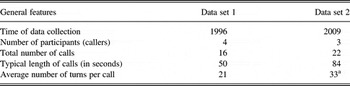
The corpus used to describe current business discursive practices is referred to as data set 2, a corpus that is comprised of twenty-two telephone calls in Chinese recorded in Shanghai, China in early 2009. In addition, findings from an earlier study based on a comparable set of data collected in 1996—data set 1—are drawn upon for comparison.Footnote 6 Both sets of data consist of naturally occurring telephone calls made by customer callers, while each set of data constitutes part of a larger corpus of telephone interactions. Table 1 below summarizes a comparison of major features of the two sets of data.
Overview of the data in comparison.

aThe average number of turns is rounded up.
Data set 1, collected in the mid 1990s, consists of sixteen calls to businesses, services, or institutions; these calls were recorded by four female native speakers of Chinese. Data set 2, obtained in early 2009, is comprised of twenty-two telephone calls recorded by three of the four female participants, who also contributed to data set 1 over a decade ago in the mid 1990s. The participants were all female, aged between thirty-five and fifty. While all four women were high school graduates, two participants obtained associate degrees and one obtained a graduate degree. Their job titles include administrative staff, administrator, and technical assistant. All of the participants had extensive experience with the use of the telephone both at work and at home. During the data collection period, each of the participants had recording devices with her for approximately two weeks, and most of the calls were made at their respective residences. Methodologically, the fact that the new data were provided by the same participant callers who recorded telephone calls for data set 1adds rigor to the findings of this study.
Although all of the participants for data set 2 also contributed to the collection of data set 1, the businesses or services reached were not necessarily the same, as there was no control of the destinations nor intended match for the businesses or services called between the two sets of data. While no calls were made to restaurants in data set 1, several calls were directed to restaurants in data set 2. This is due to several changed living conditions, including the dramatic increase in the types and numbers of restaurants, dining out being more affordable, and the availability of telephone contact for restaurants. Other places reached, which were absent in data set 1, include banks, taxi companies, and government offices. As the participants only recorded phone calls when communication needs arose, all of the audio-recorded interactions were naturalistic and authentic. Due to technical reasons, only landline calls were recorded. The names of businesses, services, or individuals used in this article are pseudonyms to avoid revealing the identity of the enterprises or individuals.
As can be seen from Table 1, the average length of calls jumped from fifty seconds in data set 1 to eighty-four seconds in data set 2, an increase of almost 60% with regard to the duration of the service interaction. In terms of the average number of turns for each call, there is a similar pattern: while there were twenty-one turns per call for data set 1, data set 2 has thirty-three turns, an increase of 50% or more, again indicating an increase in the length of the encounter. The average length and average number of turns per call are certainly not primary indicators for the quality of social interactions such as TSE, but the differences across the two sets of data seem to show a consistent pattern when we take into account other features of the discursive interactions, which are presented below.
In order to examine how the events of TSE unfold and close, both the notions of global structure and local structure (Bös Reference Bös, Fitzmaurice and Taavitsainen2007) are important. Global structure elements are similar to act sequences in analysis of speech events (Hymes Reference Hymes, Gumperz and Hymes1972; Saville-Troike Reference Saville-Troike2002). The structural dimension is important because institutional talk has a specific internal shape, which is “built from component phrases or activities that characteristically emerge in a particular order” (Heritage Reference Heritage, Fitch and Sanders2005:120). By contrast, the local structure, or local realization of the global elements, refers to the communicative means used, namely, specific linguistic forms that enact or realize the functions of the global elements. Using these two analytical concepts enables us to accomplish several objectives. First, we recognize components that are constitutive of the global structure; we also identify the linguistic forms, namely, the local realizations, used for these global elements. In addition, we discover similarities and differences between the two sets of data through comparing structural elements, particular linguistic forms, and the distribution of discursive features and interaction patterns. Primarily due to the length constraint, the following analysis focuses on the opening and closing phases of TSE.
Data analysis consists of several stages, including (i) transcription, (ii) identification, (iii) categorization and coding of the global structural elements and local realization of the various forms, (iv) quantitative analyses such as the average number of turns, length of calls, and the distribution percentages of the different patterns, and (v) a comparison between the two sets of data with several dimensions as shown below.
The unfolding of the events
The opening phase of telephone interactions fulfils several functions, including opening the channel of communication and the constituting or reconstituting of the relationship (Scollon Reference Scollon1998). Schegloff (Reference Schegloff1968, Reference Schegloff1986) identifies four sequences in telephone conversation openings: answer to summons, identification, greeting, and the how-are-you sequence. Zimmerman (Reference Zimmerman and Schiffrin1984) discusses the phases of calls to 911 emergency as containing opening, request, interrogative series, response, and closing. Using the analytical concepts of global structural elements and local realization of the elements, we examine data set 1 and data set 2 below. For each excerpt to follow, the first line presents a phonetic transcription. The second line offers a transliteration, followed by the translation of the utterance in the third line.
Global structural elements
Excerpts (1) and (2) are presented below as examples of typical openings respectively for the two sets of data. Excerpt (1), from data set 1, shows the opening of the telephone interaction between a caller and a store clerk. It serves as a starting point as well as a basis for comparison for our discussion of data set 2. Excerpt (2), from data set 2, shows the beginning of the interaction between a restaurant employee and a caller who wanted to find out information about a takeout dish.
(1) From data set 1Footnote 7

(2) From data set 2

Excerpt (1) opens with a starter ‘hello’ (line 1), followed by the customer's attempt in line 4 to verify the business reached. In Excerpt 2, the first turn of the opening involves both global elements of greeting and business self-identification along with another phrase with the semantic meaning tantamount to an invitation for request. However, the caller still made an attempt to verify the business reached (line 2), a phenomenon we discuss further in the section on business self-identification. The two excerpts present a general overview of the unfolding of the events in both data set 1 and data set 2 although variations are common within each set of data.
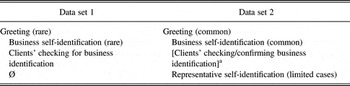
In general, in data set 1, one element is typically present: the customers' checking of the business reached; by contrast, business self-identification is uncommon. In data set 2, quite often, greeting and business self-identification are present although customers' verification is also present sometimes. In addition, in some cases, a new feature of employee identification is observed as well, which is nonexistent in data set 1. Table 2 below presents a summary of the differences between the data in terms of the global elements for the opening.
Comparison of patterns for the opening.

aSquare brackets indicate an optional sequence that does not always occur.
Categories of opening routines
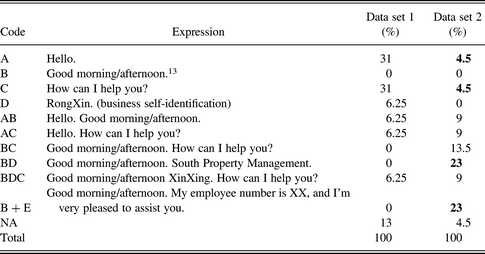
In order to further describe and compare data sets 1 and 2, various forms used by the employees in their first turnFootnote 8 are presented below in (3). All of the initial expressions are categorized, and each of them received a code for ease of reference. A single-letter category stands for one word or an expression, which can stand alone and has appeared on its own in the data at least once, such as category A, ‘Hello.’ By contrast, a single-letter category might also co-occur with another category, such as B, which then forms a two-letter category, for example, AB or AC. A category such as AB thus indicates the presence of both expressions A and B as in ‘Hello. Good morning.’
(3) Comparison of first-turn expressions
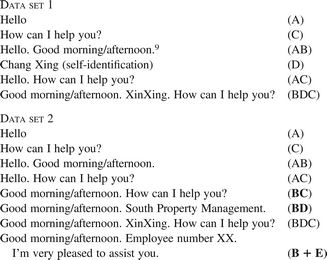
We observe from (3) that there is a wider range of expressions in data set 2 than data set 1, as the categories of BC, BD, BDC, and B + E (shown in boldface) are simply nonexistent in data set 1. We start with a discussion of the various forms observed in data set 1.
The categories of A, C, D, AB, and AC all occurred in data set 1. Category A, ‘Hello,’ when produced with a low-to-high intonation,Footnote 10 is a typical way for native speakers of Chinese to answer telephone calls at their residence (see Sun Reference Sun2002),Footnote 11 similar to the use of ‘Hello’ in English for answering calls. However, it does not constitute a greeting as the ‘Hello’ in English. Category C, ‘How can I help you,’ literally means ‘Please speak’ and can be interpreted as ‘Please go ahead,’ ‘I am listening,’ or ‘I am at your service.’ Category AB, with the use of both A and B as in ‘Hello, good morning/afternoon,’ is an interesting phenomenon. Although the combined use of A and B does not add propositional meaning, the co-presence of B represents a register that is somewhat formal and is a more pleasant tone to offset, perhaps, the lack of respect or courtesy towards customers one might feel with the sole use of form A in a service encounter. The category coded as AC consists of two expressions: the word ‘Hello’ accompanied by an expression offering service, ‘How can I help you,’ which clearly indicates an interaction taking place in a formal register, compared with an opening that is comprised of a casual ‘Hello’ as in category A. The category BDC as in ‘Good morning/afternoon. Rong Xin. How can I help you?’ is the most comprehensive in that it involves greeting, self-identification, and an offer of service. It occurred only once in data set 1 as part of a recorded message, however. The categories discussed above form an overall picture of the opening routines used in the initial turn of the employees' interaction in data set 1.
We now examine the categories only observed in data set 2, which are shown in boldface in (3). The category BC, ‘Good morning/afternoon. How can I help you?,’ is similar to AC in that it also consists of two expressions. The difference between AC and BC lies in the use of a more formal greeting, ‘Good morning/afternoon,’ in BC instead of the casual ‘Hello’ in AC. Next, the category BD consists of both greeting and business self-identification. Preceded by the greeting, ‘Good morning/afternoon’, business self-identification follows, which indicates the institutional nature as well as the telephonic mode of the interaction. Neither BC nor BD is observed in data set 1.
The last category, B + E, is different from any of the previous categories in several respects: first, the use of the honorific pronoun ‘you’ (Gu Reference Gu1990; Kadar Reference Kadar2007) conveys a rather formal greeting of ‘Good morning/afternoon.’ Secondly, self-identification by the employee (category E) as in ‘Employee number XX is pleased to assist you,’ is a completely new feature, and it becomes part of the opening routine for representatives in cases that involve a recorded message in the initial turn. This phenomenon is nonexistent in data set 1. The last part of the expression (E), ‘I'm very pleased to assist you,’ is very interesting as well, as it is clearly part of a scripted, newly introduced, set phrase.Footnote 12
While Jaworski (Reference Jaworski, Coupland and Jaworski2009) suggests that the speech act of greeting has become one of the most typical resources for the enactment and mediation of the tourist experience, greeting also plays a crucial rule in customer callers' experience with the businesses or services they reach, given that verbal language via the telephone constitutes the sole means of communication. It is perhaps no wonder that business opening routines have received considerable attention.
Distribution
In addition to the occurrence of the new categories of BC, BD, and B + E observed in data set 2, the distribution of the various categories of expressions also presents sharp contrasts as shown in Table 3 below. The numbers in boldface indicate considerable difference compared with data set 1. In data set 1, categories A (31%) and C (31%) form two of the most common opening routines, each representing almost one-third of the total number of calls, while two-letter categories are only observed in the cases of AB and AC, yielding a combined 19% of the total.
Comparison of distribution of expressions.
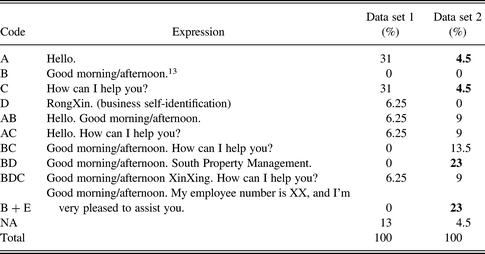
In data set 2, in contrast, the emerging categories (BC, BD, and B + E) account for approximately 60% of the calls while none of these categories is found in data set 1. In addition, the combined percentage of categories A and C has decreased drastically to a mere 9%. In fact, most opening routines in data set 2 fall under the two-letter categories, indicating that more functions are performed in the first turn in data set 2.
Business self-identification
Business self-identification at the outset of TSE is taken for granted in many countries, for example, in the US or the UK, as it is a common practice in such contexts; this was not the dominant pattern in China a decade ago. In fact, only two out of the sixteen calls in data set 1 involve business self-identification. The picture has changed considerably, however. Actually, more than half of the calls in data set 2 clearly exhibit the element of business self-identification; the percentage of business self-identification increases if we include business self-identification accomplished through a recorded message. Of the other eight calls, the very first utterance cannot be determined in three cases. The fourth call can actually be safely assumed to contain business identification, but it is still not counted as we would rather err on the conservative side.Footnote 14 As a result, only four calls in data set 2 clearly do not involve business self-identification, a sharp contrast with data set 1 in which 87% of the calls involve no business self-identification.
It is also important to note that changes such as business self-identification is likely a fairly recent discursive feature for both clients and representatives. The recentness of such a practice is reflected in the fact that callers in several calls in data set 2 still made an attempt to verify the place reached in spite of the fact that the name of the enterprise was pronounced by the recipients of the calls, as shown in excerpt (2). Such a seemingly “redundant” occurrence of business identification (self-identification by the business to be followed by caller's confirmation check) may be due to two factors. First, in some cases the name of the business or service was not clearly enunciated; rather, it was verbalized in a blurry manner along with a greeting in the same turn without an audible pause in between the two phrases. Therefore, clients were not able to capture the name provided, which led to their seeking confirmation of the enterprise reached. This did not seem to be the case for calls answered by representatives working for the telephone directory service or other major companies, who presumably have received professional training and are also more likely to be subject to customer service evaluation for their jobs. The other factor might be customers' expectation, as they were used to check the names of the business themselves, and they might not have anticipated this new feature. Cheepen (Reference Cheepen and Coupland2000) discusses a similar phenomenon about callers' unexpectedness for responses to automated messages.
A last point about business identification concerns variations among enterprises. Although self-identification is observed in most of the calls for data set 2, it clearly does not mean all of the businesses or services have adopted such a component. In general, however, the larger the enterprise, the more likely it has incorporated this structural feature.
Employee self-identification
While employee self-identification is not observed in data set 1, data set 2 includes several calls in which employees identified themselves. It is also interesting that the way in which identification is achieved is not necessarily the same as noted in the patterns observed in other cultures such as the US or UK, for example. In business practices in many Western countries, business self-identification is followed by representatives' individual identification. As can be seen from excerpt (4) below, nevertheless, identification is achieved using an employee number instead of a name.
(4)

The phenomenon of employee self-identification has been discussed in previous scholarly works. In a study by Pan, Scollon, & Scollon (Reference Pan, Scollon and Scollon2002), ethnic Chinese employees working in the US were shown to be resistant to the practice of providing their names in spite of the fact the they fared well in all other categories of the performances for their interactions with customers on the phone; this serves as an illustration of the practice of individual employee self-identification being “foreign to Chinese culture” (Pan et al. Reference Pan, Scollon and Scollon2002:49), showing cross-cultural differences.
Although recipient employee self-identification was not a common practice in Chinese culture, the recently observed phenomenon of representative identification in the case of large corporations indicates an attempt at customer-service quality control as well as individual accountability, a change from the past. Since identifying oneself by name as a representative in such contexts constitutes culturally marked behavior, using an employee number may have provided an alternative without violating the cultural convention in this respect, perhaps a solution for the conflict between, on the one hand, the need for customer-service quality control with modern standards in the context of globalization and, on the other hand, the need to maintain Chinese cultural conventions.
Automated messages
While only one out of the sixteen calls in data set 1 contains an automated message, the use of recorded messages in data set 2 has become a fairly common feature; in fact, ten out of the twenty-two phone calls involve the use of a recorded message. The increase in the use of recorded messages is another indication of the extent to which various businesses and services have sought to move toward more standard practice with increased attention to clients' needs and improved access to information on a systematic and regular basis. These businesses include the telephone directory service, banks, department stores, restaurant reservation lines, and some municipal government offices. While some recorded messages consist mostly of a phrase such as ‘welcome to…,’ others include more extensive components. For example, businesses with telephone operators answering phone calls typically provide responses at two levels, first by the operator and then the shop attendant. The following is a call made to a department store with different branch stores in Shanghai.
(5)

Having examined the beginning of the speech event, we now turn to the closing phase of the interaction.
Closing interactions
In this section, we focus on two global structural elements in the closing phase: (i) expression of appreciation, or thanking, which functions as the initiation of a closing in the context of TSE in most cases, and (ii) leave-taking. Although both elements are present in data set 1 as well, the percentage of occurrence and distribution patterns exhibit striking differences across the two sets of data. In addition, we discuss customer evaluation—a completely new discursive phenomenon not observed in data set 1. It is also important to mention that when data set 1 was compared first with similar American English data for TSE and then with casual Chinese telephone conversations between family members and friends, two patterns stood out: first, leave-taking did not occur in most of the Chinese TSEs in data set 1; in addition, an asymmetrical pattern of interaction emerged in data set 1.
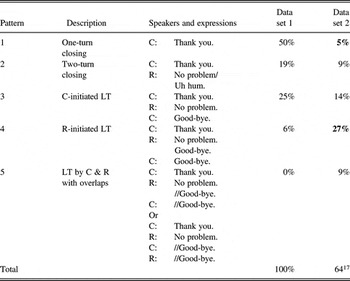
In data set 2, however, both of these phenomena have almost disappeared: first, the percentage for leave-taking (regardless of who initiates it and whether it is reciprocal) increased to 76% of the calls for data set 2 while it is only observed in 31% in data set 1, a drastic change. Secondly, participation by both representatives and customers displays a more reciprocal pattern, unlike the asymmetrical pattern in most of the calls in data set 1. A comparison of the distribution of the different patterns for closing is presented below with considerable differences shown in boldface.
Acknowledgement
Similar to calls observed in data set 1, the act of thanking, enacted by the customers in most of the calls, constitutes the initiation of closing in most cases. There are, however, important differences between the two sets of data. In data set 2, out of the seventeen calls for which typical closing sequences are relevant,Footnote 18 all of the representatives, with the exception of one call, provided a verbal response to the clients' expression of appreciation or what is termed as “signature thanking” (Schegloff & Sacks Reference Schegloff and Sacks1973). The excerpt below shows an example of a closing in which the client's appreciation token of ‘Thank you’ at the end of the call was acknowledged verbally, as in ‘No problem,’ by the representative.
(6)

The increase in the rate of the business staff members' response to clients' verbalized appreciation in data set 2 provides a contrast with data set 1 in which eight of the sixteen calls did not exhibit any verbal acknowledgement to customers' thanking. These eight calls (Pattern 1 in Table 4) were brought to a close with a single turn of ‘Thank you’ from the client without a reciprocal reply from the representative; the clients' thanking in these calls in fact constitutes the terminal utterance. In comparison, this pattern has seen a significant decrease from 50% in data set 1 to 5% in data set 2 over the period of a decade or so.
Comparison of distribution and patterns of closing.

In a few of the calls, it is also noted that representatives extended the verbal token of ‘Thanks’ to clients, a phenomenon not observed in data set 1. Excerpt (7) below illustrates such a case.
(7)

Although it may seem a rather conventional practice for most readers that the token of appreciation was addressed to the client by the representative (line 2), this was quite a marked phenomenon in such interactional context in China, as customers typically were not shown appreciation by the business associates in the past—a new practice indeed.
It is also important to note that as more representatives respond verbally to customers' expression of appreciation in data set 2, the next possible and relevant turn in the interaction—leave-taking—then becomes meaningful and possible, which explains the reason, to a large extent, for a higher percentage of the leave-taking sequence in data set 2, which is discussed below. In most cases, representatives conveyed verbal acknowledgment in response to clients' expressed appreciation in data set 2.
Leave-taking
Response to leave-taking as well as initiation of leave-taking by representatives in data set 2 has also projected a drastically different picture from the earlier patterns. First, 76% or a majority of the calls in data set 2 exhibit the presence of the leave-taking sequence, but it is only observed in 31% of the calls in data set 1. Secondly, data set 2 manifests a dramatic increase in representative participation featuring 58%.Footnote 19 Given that half of the calls in data set 1 ended with one single turn by the customer, this is a drastic change. Actually, there are also several cases in which representatives initiated leave-taking, as shown in excerpt (8) whereas there is only one case of representative-initiated leave-taking for data set 1 (6%).
(8)

To sum up, most of the representatives also participated in leave-taking, so the asymmetrical pattern of interaction in data set 1 has largely disappeared, presenting a more reciprocal interaction dynamic.
Evaluation
A new feature observed in data set 2 is the occurrence of customer satisfaction evaluation, a speech event not observed a decade ago.Footnote 20 Excerpt (9) below shows part of a call made to a bank. The caller was interested in obtaining specific information with regard to promotional packages for personal banking. At the end of the call, the client was invited to rate the service she received, as shown in line 6 (partly), although it was possible that the invitation was initially extended in line 4. The recorded prompt started in line 8, and the client was instructed to key in her ranking of the service by pressing a number: 1 for satisfaction, 2 for average, and 3 for dissatisfaction.
(9)

Customer evaluation is a fairly new phenomenon for business practice in Mainland China, as it was virtually nonexistent in data set 1. Although there is only one occurrence in data set 2, customer satisfaction evaluation was experienced by the researcher as well during a few of the calls made in the same period.
Discussion
Differences in practice
Observed differences in data set 2, as discussed earlier, include: (i) new global structural components for opening and closing, (ii) an increase in the use of formulaic routines for opening, and (iii) a more reciprocal pattern of interaction and participation.
Specifically, the structural element of business self-identification has increased significantly to approximately 60% of the enterprises reached compared with 12.5% in data set 1. Although staff self-identification is still uncommon, it was virtually unheard of a decade ago. Another new feature is the observed customer evaluation, which was also nonexistent in data set 1. The increase in representatives' acknowledgements in response to clients' expressed appreciation in closing is sequentially significant as well, as it makes the next act of leave-taking (76% in data set 2) possible.
Observed differences in representatives' discourse, however, are certainly not due to idiosyncratic behaviors of a few agents. Rather, they represent shifts in a variety of ways at several levels rather than one change in a single direction. The emerging patterns also suggest a possibility of the reshaping of language use for the TSE register in the Chinese context, partly as a result of globalization. Next we examine the issue of footing, or the participants' stance, which reflects a shift as well.
A shift in footing
The relationship between the client and the agent over the telephone is a complex one due to the consideration of equality and, more importantly, inequality (Cheepen Reference Cheepen and Coupland2000). Although the caller might be the superior notionally, discoursal superiority is with the call-center agent who is in control of the information and the discourse, according to Cheepen. In this study, patterns in representatives' discourse and interaction of data set 2 consistently depict a shift from those of data set 1.
How, then, do we account for such apparent display of differences, given that both data set 1 and data set 2 constitute similar speech events in the same community? Goffman's (Reference Goffman1981) theory of footing offers a perspective to account for the phenomenon: such a change can be viewed as a realignment of footing, which refers to participants' alignment, stance, posture, or projected self in relation to their interlocutors in social interactions. As Goffman explained, a change in footing is very commonly language-linked, which is what I observed in this research as well. However, there is an important difference here: while Goffman used the notion to discuss changes in footing by individuals between different utterances, very often within the same speech event, we see here a change in footing as manifested in representatives' language use across time, rather than within the speech event, and in discursive practices collectively, when we compare the two sets of data, instead of individually. I propose, in this case, that the notion of footing needs be conceptualized in a collective sense because a comparison based on individual data is not possible; callers did not necessarily call the same businesses as they did a decade ago, not to mention that they would not be speaking with the same representatives after a decade.
If we revisit the tenor or relationship issue between customers and business associates for TSE in the past, we might understand better how such footing might have undergone a change as manifested in discursive interactions. Economic reforms have directly affected all enterprises as well as their employees, and the status change for customers has a direct impact on the power relation and interaction between the customers and business associates, too. In pre-reform decades, partly due to the limited supply of consumer goods, store clerks were in a position to act as gatekeepers to goods, and they were also notorious for the way they interacted with customers: they might abuse customers or ignore them altogether (Hanser Reference Hanser2005); their interactions with customers, satisfactory to the customers or otherwise, did not have any impact on their income, employment, or the outcomes of sales since, first, it was all planned economy, and second, employees' jobs were all guaranteed for life before 1978. The situation started to change with the reforms and the growth of a market economy, and the lifelong employment system seems to have disappeared for the most part. Customers' patronage of businesses also directly affects the profit or even the very existence of some of the enterprises—for example, restaurants in the city, many of which are now privately or collectively owned.
Hasan (Reference Hasan, Halliday and Hasan1989) proposes to view service encounters as involving a hierarchical relationship, and it is the customers who are in the superordinate status. This was certainly not the case for data set 1. A phenomenon such as a bald-on-record reply (Brown & Levinson Reference Brown and Levinson1987), which is tantamount to a nongranting of service with minimal amount of face work, was observed in data set 1 in response to a customer's request for information. In fact, the concept of winning customers was fairly foreign and probably irrelevant in most cases prior to 1978, as there was no reason for enterprises to gain more customers, given that businesses had no control of anything including raw materials, products, and wages.
Nowadays customers are more often viewed as patrons—patrons who are to be served and competed for; the balance of power has thus shifted. In many cases, customers are in a position to choose products or services. Such choices have led to tremendous differences in terms of the power relationship as well as interactional dynamics. Furthermore, Chinese culture has long experienced hierarchical social structures historically, traditionally, and ideologically; it is more likely, therefore, that power differentiation is often perceived, construed, and displayed in social interactions, which might not be the case, or perhaps not to the same extent, in societies that do not emphasize hierarchical social structures as much historically and ideologically.Footnote 21
The current research has also cast new light on the role of the interaction dimension in transaction-oriented events in the Chinese context. The marked increase in the use of more formalized tokens as well as more courteous interactions with customers—as manifested in, for example, a more or less reciprocal participation pattern for closing compared to the patterns in the past—seems to show a different interaction dynamic for TSE, suggesting the largely neglected interpersonal aspect of communication is perhaps receiving attention, which is not unrelated to the issue of a shift in footing and power discussed above. Although the distinction between inside and outside relations still pertains in Chinese interactions, the ways in which business associates carry out communication with customers in data set 2, which falls under an outside relation, indicate realigned footings and redefined contexts of the TSE.
If discursive features of Chinese TSE in the past are to be placed close to the transaction end of the continuum, current discursive practices have clearly moved somewhat in the direction of the interaction end of the continuum. In this respect, the shift is in sync with observations noted in other speech communities in that more attempts are being made at addressing the interpersonal aspect of language use in service encounters, thus sharing similarity with casual conversations in Chinese in general, an aspect that was largely neglected in such speech events in the past.
Such a realignment is manifested in several respects, including discursive choices drawn upon, the way information is provided to customers, and interactional patterns. First, clients were addressed more as an equal conversation partner, and in some cases they might even enjoy a higher social status—if we interpret the use of the deferential pronoun ‘you’ observed in several calls as an indication of a higher status in spite of the fact that the lexical choice might be scripted. Some representatives also conveyed tokens of appreciation to customers, which constitutes a rather marked contrast compared with the past. In addition, a much higher level of participation by the agents in closing than that in data set 1 also reflects a shift. Although expressed appreciation to customers is more likely encouraged or even required by some businesses instead of agents' personal choice, the practice itself symbolizes a change in attitude, ideology, and the status of customers. The fact that more businesses now provide self-identification and the fact that some companies have institutionalized customer service evaluation is also evidence of concerns for customer access to information and quality of service.
Such a shift in tenor is thus both structurally displayed through prescribed opening routines, if not closing procedures as well, and discursively exhibited in representatives' interaction behavior. Whereas customers were clearly not in a superordinate position for TSE in the past, the picture has begun to change: the status of customers, which constitutes a core component of tenor, has changed considerably, largely related to the changed role of consumers in the community.
It is worth noting, however, that the shift in footing in fact reflects perceptions of the businesses about customers in general, not merely those of the associates. As employees of enterprises or institutions, associates act as representatives of the businesses or services for which they work; their discursive behaviors are thus constrained by the practices of the institutions. By contrast, their discursive behaviors contribute to the image and identity of the very business they represent.
A spoken genre in the making?
The observations discussed above suggest that efforts are being made to institutionalize changes in discursive practices for TSE in the Chinese context, as more businesses adopt formalized verbal protocols and formulaic routines for openings. In fact, the use of business self-identification at the outset of the speech event may become one of the newly incorporated signature elements, similar to the notion of signature thanking (Schegloff & Sacks Reference Schegloff and Sacks1973)—which functions as a register marker indicating both the nature of the institutional interaction as well as the TSE mode of discourse—as such identification is certainly not called for in face-to-face service encounters.
By the same token, customer satisfaction evaluation is also presumably one of the most apparent institutionally implemented changes in business practices. Both these requirements must have constituted part of the institutional changes, required and implemented by the management, as these features are definitely beyond the discretion of individual representatives. However, this is not to suggest that the findings presented in this article can be generalized to all business practices in mainland China; great variation might still be in existence among different enterprises, depending on ownership, locale, scale of the business, and training of the staff members, for example. Therefore, whether similar changes have occurred elsewhere in China and, if so, to what extent, remains to be explored further.
While openings for TSE in the past, for the most part, were not distinctive from the practice of individuals' answering telephones at residences—for example, in the case of a representative's use of a single “Hello” as a response to summons, which is also how someone answers the phone at home—the adoption of business self-identification and more formulaic routines seem to constitute a departure from prior practices, contributing to a change that leads to opening routines that are more “recognizable” (Hakulinen Reference Hakulinen, D'hondt, Östman and Verschueren2009:58). The pronuncement of business name and phrases such as ‘How can I help you’ mark such speech events as institutional interactions; thus they become signature phrases, which in fact more accurately represent the nature of TSEs.
As the observed changes in TSE seem to emerge along with some newly adopted (to the community) features, including boundary markers for such events, namely, discursive choices that reflect both the nature of the institutional discourse as well as the register or mode of TSE, these new forms and features may indeed contribute to and constitute, partly, a reconstruction or reshaping of the language use for the TSE register in the community. Episodically or structurally, the new features, with routinized institutional openings and closings, may indeed directly index a more “recognizable” TSE channel-specific spoken genre of interactions that occur only in institutional settings.
While both these newly incorporated global features have already been in practice for some time in other cultures and communities, their new appearance in the Chinese community under examination seems to partly reflect the effect of globalization as well. Discussing the relationship between discourse and globalization, Fairclough (Reference Fairclough2006) observes that there are new discourses, practices and identities (including genres and styles) made available for local action. Although the shifts in TSE practices take place in the Chinese context and form “situated action in particular places” (139), these changes reflect the impact of globalization, and the practices in the making indeed constitute an example of glocalization in the sense that they are not purely local but are interconnected and influenced by practices in the larger, global context.
Conclusion
Changes in discursive practices did not occur on their own; “neither language nor the social world is static”, and they are maintained mutually as well as change mutually (Eckert & McConnell-Ginet Reference Eckert and McConnell-Ginet2003:52). One of the arenas that clearly reflects economic and social changes and the result of globalization is business discursive practice, as discussed in this study. Compared with earlier findings, changes have been observed in both structural components of the speech events and in discursive realization of the structural elements. The observations in this article provide insight into the shifts in practices and dynamics in business discursive practices; they also provide evidence of how such shifts are actually manifested in specific discursive space (Heller Reference Heller2011), namely, in Chinese TSEs.
Situated, comparative discourse analysis as described in this research enables us to perceive how discursive practices evolve in a particular speech community, what patterns emerge, what new forms take shape, and why. Just as importantly, the current analysis casts light on the myriad dimensions of social change from a sociolinguistics and discourse perspective. It is, therefore, important and valuable to explore and examine the interplay of language and society at the discourse level across time.