Implications
There is a growing interest in the Iberian Peninsula and other countries throughout the world to increase backfat depth and intramuscular fat content of pig carcasses destined to the dry-cured industry. A useful strategy consists of increasing slaughter weight from 120 to 160 kg BW (Iberian and Mangalica pigs, Italian heavy pigs). Under these circumstances, castration of boars and gilts will result in more homogeneous carcasses, easier and better drying processes and better quality of primal cuts. This research intends to evaluate the interest of castration of gilts, as is currently practised in Iberian pigs, on growth performance and carcass quality of gilts slaughtered at two different ages. The data can be used in future research comparing intact and immunocastrated gilts.
Introduction
Traditionally, pig production in Spain has been based on the fattening of intact males and gilts (IG) slaughtered at 95 to 105 kg BW. Currently, 41.1 million hams and their shoulder pieces are destined to the production of dry-cured products (Cruz, Reference Cruz2009) in which excessive lean carcasses and high unsaturated fatty acid (FA) content are not desirable. Pigs slaughtered at 100 kg BW produce carcasses that are leaner and have more content of linoleic acid (C18:2) than pigs slaughtered at heavier weight. In this respect, the dry-cured industry prefers a BF depth over 20 mm, a Musculus gluteus medius (GM) fat depth wider than 18 mm and a content of C18:2 in BF <15% (Latorre et al., Reference Latorre, García-Belenguer and Ariño2008 and Reference Latorre, Ripoll, García-Belenguer and Ariño2009). In addition, carcasses destined to the dry-cured industry require hams with a fresh weight over 9.5 kg (Diario Oficial Comunidades Europeas (DOCE; 1999). Castration of males and the increase in SW to at least 115 kg BW are useful practices to meet these quality criteria (Latorre et al., Reference Latorre, Lázaro, Gracia, Nieto and Mateos2003a and Reference Latorre, Medel, Fuentetaja, Lázaro and Mateos2003b). However, even at these final BW a high proportion of IGs fail to meet these requirements, especially those related to GM fat depth (Latorre et al., Reference Latorre, García-Belenguer and Ariño2008). Castration of gilts is a common practice in the production of Iberian pigs that are slaughtered at 145 kg BW or more and in which a certain amount of fat at GM is required (Serrano et al., Reference Serrano, Valencia, Fuentetaja, Lázaro and Mateos2009b). Peinado et al. (Reference Peinado, Medel, Fuentetaja and Mateos2008) observed that castration of gilts increased the proportion of carcasses that fulfilled the requirements of the dry-cured industry for a minimal amount of BF and GM fat and a maximal amount of C18:2 in pigs slaughtered at 114 and 122 kg BW, increasing the economic value of pork meat. Therefore, castrated gilts (CGs) might be a good alternative to IG for the production of heavy pigs intended for the industry of dry-cured products. There is a dearth of information on the effects of castration of gilts on productive performance (Serrano et al., Reference Serrano, Valencia, Fuentetaja, Lázaro and Mateos2008, Reference Serrano, Valencia, Fuentetaja, Lázaro and Mateos2009a and Reference Serrano, Valencia, Fuentetaja, Lázaro and Mateos2009b) and carcass quality (Mayoral et al., Reference Mayoral, Dorado, Guillén, Robina, Vivo, Vázquez and Ruíz1999) of Iberian pigs. However, few data are available on the effects of female castration on growth performance and carcass quality in conventional crossbred pigs.
An increase in SW increases intramuscular fat (IMF) content and improves meat quality (Candek-Potokar et al., Reference Candek-Potokar, Monin and Zlender2002) resulting in carcasses better adapted for the production of high-quality dry-cured products. However, heavy pigs need longer feeding periods and have poorer feed conversion ratio (FCR) than lighter pigs. In addition, the production of heavy pigs, results in overly fatty and excessive size primal cuts that penalizes marketing of the end products. Consequently, the final SW in pigs destined to the production of dry-cured primal cuts is a compromise between growth performance parameters and carcass and meat quality traits. The purpose of this research was to investigate the effects of castration of crossbred gilts from Landrace × Large White dams and Pietrain × Large White sires slaughtered at different BW on productive performance, carcass and meat quality.
Material and methods
Husbandry and diets
The experimental procedures used in this experiment were approved by the Animal Ethics Committee of the Universidad Politécnica de Madrid and were in compliance with the Spanish guidelines for the care and use of animals in research (Boletín Oficial del Estado, 2005). A total of 200 gilts (50 ± 3 days of age and 23.3 ± 1.47 kg BW) were used to study the influence of castration of gilts (coded IG and CG) and SW (106 and 122 kg BW) on performance, carcass and meat quality. All pigs were the progeny of Landrace × Large White dams (Copese S.A., Segovia, Spain) and Pietrain × Large White sires (Gene+, Erin, France). From birth to the start of the experiment, pigs were managed according to the standard commercial procedures. The pigs were fattened in a naturally ventilated finishing barn with 20 pens (3.64 × 2.75 m2) provided with concrete floors (80% slatted). On arrival to the experimental farm, pigs were individually weighed and stratified by BW into 10 groups of five pigs each per treatment. Each treatment was replicated five times and the experimental unit consisted of a group of 10 pigs penned together (1 m2/pig). At eight days on trial (58 ± 0.7 days of age and 29.8 ± 1.64 kg BW), half of the gilts were ovariectomized as indicated by Serrano et al. (Reference Serrano, Valencia, Fuentetaja, Lázaro and Mateos2008).
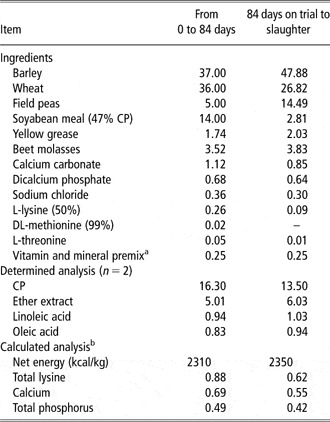
The feeding programme used was common for all pigs and consisted of two diets offered for ad libitum consumption as 4-mm pellets. All the diets were based on cereals and soyabean meal and were formulated to meet or exceed the nutrient requirements recommended by Fundación Española Desarrollo Nutrición Animal (FEDNA; 2006) for pigs at these ages. The ingredient composition and the calculated (Fundación Española Desarrollo Nutrición Animal, 2003) and determined (Association of Official Analytical Chemists International (AOAC), 2000) nutrient value of the diets are shown in Table 1.
Ingredient composition and nutrient content of the diets (%, as-fed basis unless otherwise indicated)

aSupplied per kilogram of diet: 7000 I.U. vitamin A (trans-retinyl acetate); 1600 I.U. vitamin D3 (cholecalciferol); 20 I.U. vitamin E (all-rac-tocopherol-acetate); 1.0 mg vitamin K3 (bisulphate menadione complex); 0.7 mg thiamin (thiamine-mononitrate); 3.0 mg riboflavin; 9 mg pantothenic acid (D-Ca pantothenate); 15 mg vitamin B3 (niacin); 100 mg choline (choline chloride); 1 mg pyridoxine (pyridoxine hydrochloride); 0.016 mg vitamin B12 (cobalamin); 16.5 mg Cu (CuSO4·5H2O); 75 mg Fe (FeSO4·7H2O); 40 mg Mn (MnO2); 110 mg Zn (ZnO); 0.1 mg Co (CoSO4); 0.3 mg Se (Na2SeO3); 0.8 mg I (Ca(IO3)2) and 125 mg ethoxiquin.
bAccording to Fundación Española Desarrollo Nutrición Animal (2003).
Performance traits
Individual BW and feed consumption per pen were recorded at 0, 8, 54, 84, 96 and 117 days on trial, and these data were used to calculate average daily gain (ADG), average daily feed intake (ADFI) and FCR per replicate by period and cumulative. The information provided at 8 days on trial (day of castration of half of the gilts) and 54 days on trial (46 days after castration) was used to evaluate the recovery of the pigs after castration. The pigs that died or were withdrawn from the trial were weighed and the data were included in the calculation of FCR. The pigs were slaughtered when the pre-planned average BW was achieved; 106 kg BW (96 days on trial that corresponded to 146 days of age) or 122 kg BW (117 days on trial that corresponded to 167 days of age). Therefore, all pigs from each of the SW groups were slaughtered on the same day.
Carcass traits
The day before slaughter, pigs were fasted for 14 h, individually weighed and transported 50 km to the slaughterhouse (Alfrese, S.A., Segovia, Spain) where they were allowed a 12 h rest period with full access to water but not to feed. The pigs were electrically stunned (225 to 380 V, 0.5 A, 5 to 6 s), exanguinated, scalded, skinned and eviscerated according to standard commercial procedures. Carcasses were split down the centre of the vertebral column and weighed, and the hot carcass yield was calculated. The head was then removed at the atlanto-occipital junction and the carcasses were blast chilled at 2°C (1 m/s) for 2 h. At 2 h post mortem, an incision was made into the Musculus semimembranosus (SM) of the left ham and the initial pH (pH2; 2 h from slaughter) was measured using a Crison pH meter (Crison 507, Crison Instruments S.A., Barcelona, Spain) equipped with a glass electrode (model no. 52-11, Crison Instruments S.A., Barcelona, Spain) as described by Stalder et al. (Reference Stalder, Maya, Christian, Moeller and Prusa1998). In addition, BF depth between the third and fourth last ribs on the middle of the carcass (skin included) and fat thickness over the GM at the thinnest point were measured in the left side of each carcass using a flexible ruler with a precision of 0.5 mm. Carcasses that had ⩾20 mm of BF received a score of 100 and carcasses with less BF received a score of 0. Similarly, carcasses that had ⩾18 mm of GM fat depth received a score of 100 and those below this value received a score of 0. These scores were established according to the criteria of the industry for high quality, value-added dry-cured products.
Carcasses were jointed to yield hams, shoulders and loins according to the simplified European Community-reference method (Branscheid et al., Reference Branscheid, Dobrowolski and Sack1990) and the weight of hams and shoulders was measured at 2 h post mortem (fresh untrimmed weight). Carcasses with a fresh ham weight of at least 9.5 kg received a score of 100, whereas carcasses with hams below this weight received a score of 0 (DOCE, 1999). Hams, shoulders and loins were suspended in the air and chilled for 24 h at 4°C. At 24 h post mortem, untrimmed hams and shoulders (chilled weight) and trimmed loins were weighed again and the ultimate pH (pH24; 24 h from slaughter) of the SM was measured as indicated previously. The difference between weight of hams and shoulders measured at 2 and 24 h post mortem was divided by the weight obtained at 2 h to estimate shrink loss. At 48 h post mortem, hams and shoulders were trimmed of external fat as described by Serrano et al. (Reference Serrano, Valencia, Fuentetaja, Lázaro and Mateos2009b) and weighed again, and the trimmed ham and shoulder yields were calculated. For carcass and meat quality parameters, the experimental unit was the pen composed of 10 or five pigs, respectively.
Meat traits and FA profile of backfat (BF)
After collection of the carcass data, a sample (300 ± 25 g) of Musculus longissimus thoracis (LT) was excised at the level of the last rib from the left side of five carcasses chosen at random from each replicate. Meat samples were weighed, vacuum packaged and frozen at −20°C during 54 days for subsequent analyses. The day before the analysis, the LT samples were thawed in vacuum package bags for 24 h at 4°C, removed from packages, blotted dry and weighed. Thawing loss was calculated by dividing the difference in weight between the fresh and thawed samples by the initial fresh weight. In addition, objective measures of pork colour (lightness (L*), redness (a*), yellowness (b*)) were determined on all thawed chops after a 20 min bloom period (CM 2002 Minolta chromameter, Minolta Camera, Osaka, Japan) as described by Serrano et al. (Reference Serrano, Valencia, Fuentetaja, Lázaro and Mateos2009a). In addition, the chroma (c*) as c* = (a*2 + b*2)1/2 and the hue angle (H°) as H° = arctan (b*/a*) were calculated as estimators of colour intensity (Wyszcecki and Stiles, Reference Wyszcecki and Stiles1982).
The IMF, crude protein and moisture content of the LT samples were determined with a near infrared transmittance meat analyzer (Infratec® 1265, Tecator, Höganäs, Sweden) as described by Latorre et al. (Reference Latorre, Lázaro, Valencia, Medel and Mateos2004). Drip loss was determined using 15-mm thick LT slices excised from each thawed chop. The slices were weighed and placed on a metallic net in a hermetic plastic cage at 4°C during 24 h without application of any external force. Afterwards, samples were weighed again and the difference between the weight of the slice before and after conservation in the cooler was divided by the initial weight to determine drip loss. Cooking loss and shear force were determined as described by Honikel (Reference Honikel1998) and Peinado et al. (Reference Peinado, Medel, Fuentetaja and Mateos2008), respectively.
From two of the same five carcasses used to study meat traits, BF samples, including the skin and the lean, were obtained at 10 cm from the coccyx. The samples were vacuum packaged in individual plastic bags and frozen at −20°C during 54 days until subsequent analyses. The FA profile of the samples was determined as described by Peinado et al. (Reference Peinado, Medel, Fuentetaja and Mateos2008). Briefly, FA was extracted with diethyl ether from a 200 mg sample and analysed by chromatography (Autosystem XL, Perkin Elmer, Boston, MA, USA). Carcasses with BF containing ⩽12.0% C18:2 received a score of 100 and those with >12.0% C18:2 received a score of 0. This score on C18:2 content was established according to the criteria of the industry for high quality, value-added dry-cured products.
Sensorial evaluation of fresh meat
Samples of LT (2.5 cm thick) from one individual pig, which was randomly selected from two replicates of each treatment were taken for sensorial evaluation as described by Candek-Potokar et al. (Reference Candek-Potokar, Zlender, Lefaucheur and Bonneau1998a). The selection of the trained judges was carried out in accordance with ISO 8586-1 (International Standards Organization Norms (ISO), 1993). Sensorial evaluation was carried out as described by Fernández-Dueñas et al. (Reference Fernández-Dueñas, Myers, Scramlin, Paks, Carr, Killefer and McKeith2008). Briefly, seven trained panellist conducted the sensorial evaluation of chops (two sessions with four samples each) for intensity of meat odour and flavour, toughness, juiciness and overall acceptability. Equal bite size (7.5 g) from each treatment was blind coded and the order of presentation was randomized. Water was provided to the panellists between sample evaluations. Scores were measured on a 10-cm anchored unstructured line scale in which 0 was the minimum and 10 the maximum score.
Statistical analyses
Data were analysed as a completely randomized design using the PROC MIXED procedure of Statistical Analysis Systems Institute Inc. (SAS, 1990; Cary, NC, USA). The model included the main effects of castration of gilts and SW as well as the interaction. There were five pen replicates per treatment for all traits except for the sensorial evaluation in which only two pen replicates per treatment were used. For performance and carcass traits, the experimental unit was the average of 10 pigs within a pen. For meat quality traits and FA profile of BF, the experimental unit was the average of five and two pigs that were randomly selected from each pen, respectively. For sensorial evaluation, the experimental unit was the chop obtained from one pig randomly selected from two pens per each treatment. Trained panellists and session were used as fixed effects. The average weight of the pen initially was used as a covariate for growth performance parameters. Data in tables are presented as least squares means for growth performance parameters and as means for all other traits. The Pearson correlation coefficients (r) were calculated to determine the relationship between carcass traits and FA profile of BF. An α value of <0.05 was considered as significant, whereas α values between 0.05 and 0.10 were considered as a tendency. Mortality data were analysed using the PROC CATMOD procedure of SAS (1990).
Results
No significant interactions between castration of gilts and SW were detected for any of the traits studied and therefore, only main effects are presented.
Performance traits
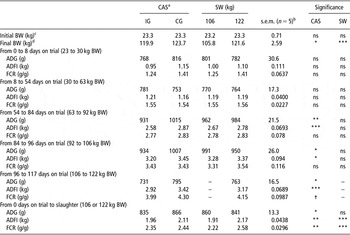
Mortality and percentage of animals withdrawn from the trial (4%) was considered normal for pigs reared under standard management conditions and were not affected by the treatment. The percentages were 2% and 6% for IG and CG; and 3% and 5% for gilts slaughtered at 106 and 122 kg BW, respectively (data not shown). At the beginning of the trial, gilts had an average age of 50 days and weighed 23.3 kg BW (Table 2). From the day of castration to 46 days after surgery (from 8 to 54 days on trial and 30 to 63 kg BW), no differences in productive performance were observed between IG and CG. However, from 54 to 96 days on trial (63 to 106 kg BW), CG had higher ADFI (2.87 v. 2.58 kg from 63 to 92 kg BW and 3.45 v. 3.20 kg from 92 to 106 kg BW; P < 0.05) and ADG (1015 v. 931 g from 63 to 92 kg BW and 1007 v. 934 g from 92 to 106 kg BW; P < 0.05), but no differences were observed for FCR. From 96 to 117 days on trial (106 to 122 kg BW), CG had higher ADFI (3.42 v. 2.92 kg; P < 0.001) and ADG (795 v. 731 g; P < 0.05) but tended to be less efficient (4.30 v. 3.99 g/g; P < 0.10) than IG. For the entire experimental period, CG had higher ADFI (2.11 v. 1.96 kg; P < 0.01) and ADG (866 v. 835 g; P < 0.05) but were less efficient (2.44 v. 2.35 g/g; P < 0.01) than IG. Consequently, BW at slaughter was higher for CG than for IG (123.7 v. 119.9 kg BW; P < 0.05). Pigs slaughtered at 106 kg BW consumed 260 g less feed per day and were 0.36 units more efficient than pigs slaughtered at 122 kg BW (P < 0.001).
Effect of CAS of gilts and SW on ADG, ADFI and FCR of pigs

CAS = castration; SW = slaughter weight; ADG = average daily gain; ADFI = average daily feed intake; FCR = feed conversion ratio; IG = intact gilt; CG = castrated gilt.
aSurgery was performed at 8 days after the start of the trial.
bFive pens of 10 pigs each per treatment.
c50 days of age.
d167 days of age.
†P < 0.10; *P < 0.05; **P < 0.01; ***P < 0.001. The interaction CAS × SW was ns (P > 0.10).
Carcass traits
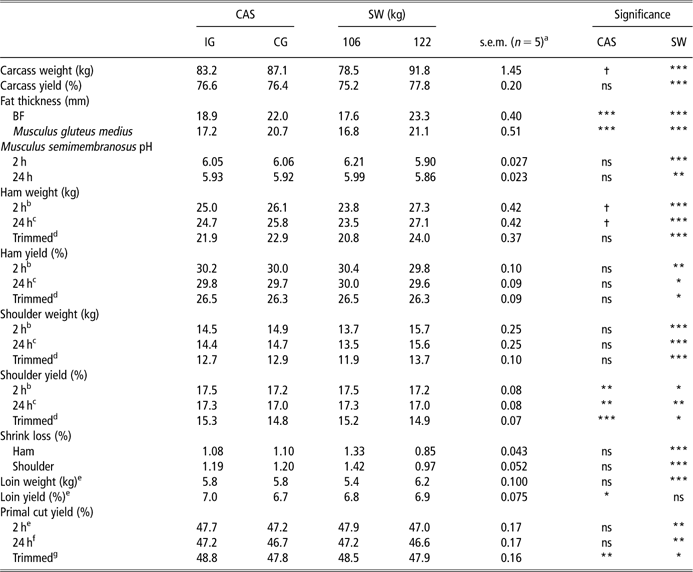
Castration of gilts tended (P < 0.10) to increase carcass weight but did not affect carcass yield (Table 3). In addition, gilt castration increased BF (22.0 v. 18.9 mm; P < 0.001) and GM fat (20.7 v. 17.2 mm; P < 0.001). The correlation (r) between BF and GM fat thickness was 86.1% (P < 0.001; data not shown). No differences between IG and CG were observed for pH, ham yield and shrink loss. However, trimmed shoulder (15.3% v. 14.8%; P < 0.001), loin (7.0% v. 6.7%; P < 0.05) and primal cut (48.8% v. 47.8%; P < 0.01) yields were higher for IG than for CG.
Effect of CAS of gilts and SW on carcass quality and primal cut yield

CAS = castration; SW = slaughter weight; IG = intact gilt; CG = castrated gilt; BF = backfat.
aFive pens of 10 pigs each per treatment.
bFresh untrimmed weight.
cChilled weight after being suspended in the air for 24 h at 4°C.
dTrimmed weight (measured after chilling for 24 h).
eDetermined in fresh hams and shoulders.
fDetermined in chilled hams and shoulders after being suspended in the air for 24 h at 4°C.
gDetermined in hams, shoulders and loins.
†P < 0.10; *P < 0.05; **P < 0.01; ***P < 0.001. The interaction CAS × SW was ns (P > 0.10).
An increase in SW from 106 to 122 kg BW increased (P < 0.001) carcass weight (78.5 v. 91.8 kg), carcass yield (75.2% v. 77.8%) and carcass fat (17.6 v. 23.3 mm for BF and 16.8 v. 21.1 mm for GM) and decreased (P < 0.001) shrink loss. The pigs slaughtered at 106 kg BW had higher (P < 0.01) pH at 2 and 24 h post mortem and more (P < 0.05) trimmed ham (26.5% v. 26.3%), shoulder (15.2% v. 14.9%) and primal cut (48.5% v. 47.9%) yields than pigs slaughtered at 122 kg BW. However, loin yield was not affected by SW.
Meat traits, FA profile of BF and sensorial evaluation of fresh meat
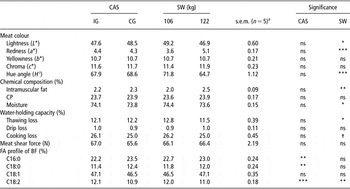
In general, castration of gilts did not influence any of the meat quality traits studied (Table 4). The only difference observed was for FA profile of BF; CG had higher concentration of palmitic (C16:0; 23.5% v. 22.2%; P < 0.01) and stearic (C18:0; 12.4% v. 11.4%; P < 0.01) and lower of C18:2 (10.9% v. 12.1%; P < 0.001) acid than IG. No differences were observed for oleic acid (C18:1) content.
Effect of CAS of gilts and SW on Musculus longissimus dorsi traits and on FA profile of BF

CAS = castration; SW = slaughter weight; IG = intact gilt; CG = castrated gilt; FA = fatty acid; BF = backfat.
aFive pens with measurements conducted in five or two pigs of each pen per treatment for carcass and fat traits, respectively.
†P < 0.10; *P < 0.05; **P < 0.01; ***P < 0.001. The interaction CAS × SW was ns (P > 0.10).
Meat redness (a*) increased (P < 0.001) and lightness (L*) and hue angle (H°) values decreased (P < 0.05) as SW increased from 106 to 122 kg BW. Meat from heavier pigs had more IMF (2.5% v. 2.0%; P < 0.01) and less moisture (73.6% v. 74.4%; P < 0.05) content than meat from lighter pigs. Thawing loss of the LT decreased (P < 0.05) at a rate of 0.81 percentage units and cooking loss tended (P < 0.10) to decrease at a rate of 0.75 percentage units for every 10-kg increase in SW from 106 to 122 kg BW. However, SW did not affect drip loss percentage or shear force values. The FA profile of BF was little influenced by SW; the only difference observed was for C18:2 concentration that was higher in pigs slaughtered at 106 kg BW than in pigs slaughtered at 122 kg BW (12.0% v. 11.0%; P < 0.01).
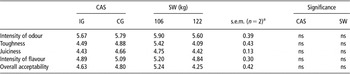
Sensorial panel evaluation did not detect any difference in fresh meat quality among treatments (Table 5). The effects of trained panellist and session were not significant (data not shown).
Effect of CAS of gilts and SW on sensorial attributes of fresh meat

CAS = castration; SW = slaughter weight; IG = intact gilt; CG = castrated gilt.
aThe experimental unit was the chop obtained from one pig randomly selected from two pens per each treatment.
The interaction CAS × SW was ns (P > 0.10).
Proportion of suitable carcasses for the dry-cured industry
No differences in the percentage of carcasses that fulfil the quality criteria requested by the dry-cured industry for ham weight were observed between IG and CG (Table 6). However, the proportion of carcasses that fulfil the criteria of a minimal amount of BF depth above 20 mm (72.4% v. 50.5%; P < 0.001), of fat at GM above 18 mm (78.2% v. 41.8%; P < 0.001) and of C18:2 content of BF below 12.0% (85% v. 50%; P < 0.05) was higher for CG than for IG.
Effect of CAS of gilts and SW on percentage of carcasses that fulfil the requirements for high-quality dry-cured hams

CAS = castration; SW = slaughter weight; IG = intact gilt; CG = castrated gilt; BF = backfat.
aFive pens with measurements conducted in five or two pigs of each pen per treatment for carcass and fat traits, respectively.
bBF depth between the third and fourth last ribs on the middle of the carcass (skin included). Fat thickness over the M. gluetus at the thinnest point.
*P < 0.05; ***P < 0.001. The interaction CAS × SW was ns (P > 0.10).
The percentage of carcasses that fulfil the quality criteria requested by the dry-cured industry for a minimum weight of the hams was 100% for pigs slaughtered at 122 kg BW but only 94.3% for pigs slaughtered at 106 kg BW. For a minimal amount of BF depth and fat at GM, the proportion that fulfiled the requirement was higher for pigs slaughtered at 122 kg BW than for pigs slaughtered at 106 kg BW (83.1% v. 39.3% for BF and 76.4% v. 42.7% for GM fat; P < 0.001). No differences for the percentage of carcasses that fulfil the quality criteria for C18:2 concentration in BF were observed between SW (60.0% and 75.0% for pigs slaughtered at 106 and 122 kg BW, respectively).
Discussion
Performance traits
From 96 to 117 days (last 21 days of the trial), the ADG of the pigs was lower than expected, and below that observed from 84 to 96 days on trial (763 v. 971 g as an average). This period of fattening coincided with extreme ambient temperatures that occasionally reached 35°C inside the building. Owing to that, ADFI of pigs was reduced and consequently, ADG was penalized.
For the entire experimental period, CG had higher ADFI and ADG but worse FCR than IG, results that agree with data of Peinado et al. (Reference Peinado, Medel, Fuentetaja and Mateos2008) in crossbred of (Pietrain × Large White) × (Landrace × Large White). The poorer FCR observed for CG than for IG was consistent with their fatter carcasses. Castration of gilts did not affect growth performance at 54 days on trial (46 days after surgical castration). The authors have not found any report studying the effects of female castration on growth performance of conventional pigs immediately after surgery. In Iberian pigs, Serrano et al. (Reference Serrano, Valencia, Fuentetaja, Lázaro and Mateos2009b) observed that castration of gilts decreased ADG and tended to impair feed efficiency for the first 30 days after surgery. Differences in the characteristics of the breeds used (selected breeds v. non-selected native breeds) together with the time elapsed from surgery to growth performance control (46 v. 30 days) might explain the discrepancies observed between experiments.
In this study, ADFI increased by 163 g and FCR was impaired by 225 g per each 10-kg increase in SW from 106 to 122 kg BW, values that are consistent with data reported by other authors. For example, Serrano et al. (Reference Serrano, Valencia, Fuentetaja, Lázaro and Mateos2008) observed that ADFI increased by 164 g and FCR was impaired by 182 g per each 10-kg increase in BW in Iberian × Duroc pigs from 145 to 156 kg BW. In addition, Cisneros et al. (Reference Cisneros, Ellis, McKeith, McCaw and Fernando1996) reported in Duroc pigs that ADFI increased 100 g per each 10-kg increase in BW from 100 to 160 kg BW. Latorre et al. (Reference Latorre, García-Belenguer and Ariño2008) observed that ADG decreased and FCR increased with increases in SW from 120 to 140 kg of BW. Consequently, feed cost will be higher when pigs are slaughtered at a heavier SW.
Carcass traits
No data are available on the effect of castration of gilts on carcass traits of pigs slaughtered at 106 kg BW. Peinado et al. (Reference Peinado, Medel, Fuentetaja and Mateos2008) compared castrated heavy pigs exclusively (114 and 122 kg of SW), whereas in this research CG and IG destined to fresh consumption (106 kg of SW) are compared with CG and IG destined to further dry-curing processes (122 kg of SW). Castration did not affect carcass yield of gilts, in agreement with data of Peinado et al. (Reference Peinado, Medel, Fuentetaja and Mateos2008) in crosses of Landrace × Large White with Pietrain sires slaughtered at heavy weight. In addition, CG had more carcass fat depth than IG in accordance with data of Serrano et al. (Reference Serrano, Valencia, Fuentetaja, Lázaro and Mateos2009a). A moderate increase in carcass fat thickness facilitates the drying of the primal cuts during the curing process, improving the quality of the end products (Guerrero et al., Reference Guerrero, Gou, Alonso and Arnau1996).
Castration of gilts did not affect SM muscle pH at 2 or 24 h post mortem, which agrees with data of Cisneros et al. (Reference Cisneros, Ellis, McKeith, McCaw and Fernando1996) and Terlouw et al. (Reference Terlouw, Berne and Astruc2009) in Duroc pigs. Shrink loss was not affected by castration, even though BF was thicker in CG than in IG. Similar data have been reported by Latorre et al. (Reference Latorre, Lázaro, Valencia, Medel and Mateos2004). Shoulder and trimmed primal cut yields were higher in IG than in CG, consistent with data of Serrano et al. (Reference Serrano, Valencia, Fuentetaja, Lázaro and Mateos2008 and Reference Serrano, Valencia, Fuentetaja, Lázaro and Mateos2009a) who observed higher shoulder yield in IG from Iberian × Duroc pigs. López-Bote et al. (Reference López-Bote, Fructuoso and Mateos2000) indicated that castration causes changes in the physiology and nutrient metabolism in pigs, which in turn might modify the proportion of primal cuts of the carcasses.
Carcass yield increased 1.6 percentage units per each 10-kg increase in BW from 106 to 122 kg BW, a value that is within the range previously reported for Duroc (Cisneros et al., Reference Cisneros, Ellis, McKeith, McCaw and Fernando1996; Virgili et al., Reference Virgili, Degni, Schivazappa, Faeti, Poletti, Marchetto, Pacchioli and Mordenti2003) and Pietrain × Large White (Latorre et al., Reference Latorre, Lázaro, Valencia, Medel and Mateos2004) crossbred pigs. Gu et al. (Reference Gu, Schinckel and Martin1992) indicated that the allometric coefficient of the carcass is >1 and; therefore, carcass yield is expected to increase with BW, consistent with the results of this experiment. An increase in SW from 106 to 122 kg BW increased carcass fat, which agrees with data of Cisneros et al. (Reference Cisneros, Ellis, McKeith, McCaw and Fernando1996), Ellis et al. (Reference Ellis, Webb, Avery and Brown1996) and Latorre et al. (Reference Latorre, Lázaro, Valencia, Medel and Mateos2004). Trimmed ham yield decreased 0.10 percentage units per each 10-kg increase in SW. In this respect, Cisneros et al. (Reference Cisneros, Ellis, McKeith, McCaw and Fernando1996) reported a decrease in ham yield of 0.2 percentage units per each 10-kg increase in SW in Hampshire × (Yorkshire × Duroc) pigs from 100 to 160 kg BW.
Meat traits, FA profile of BF and sensorial evaluation of fresh meat
Colour, tenderness and IMF content are valuable characteristics that influence consumer choice for dry-cured products. No data are available on the effect of castration of gilts on meat traits of pigs slaughtered at 106 kg BW. In general, castration of gilts did not affect meat colour or tenderness of the loin at any age in agreement with data of Peinado et al. (Reference Peinado, Medel, Fuentetaja and Mateos2008) in heavy weight gilts. In addition, IMF content was similar for IG and CG, results that agree with data of Serrano et al. (Reference Serrano, Valencia, Fuentetaja, Lázaro and Mateos2008) in Iberian × Duroc pigs. In fact, Sather et al. (Reference Sather, Jones and Joyal1991) suggested that lipid content of the LT appears to be more affected by the genetics of the pigs than by gender, in agreement with the results of this trial. The lipid content of the LT was between 2.2% and 2.3% for IG and CG, respectively. Several authors (DeVol et al., Reference DeVol, McKeith, Bechtel, Novakofski, Shanks and Carr1988; Fortin et al., Reference Fortin, Robertson and Tong2005; Rincker et al., Reference Rincker, Killefer, Ellis, Brewer and McKeith2008) reported that a threshold level of marbling of around 2.0% to 2.5% ensures a satisfactory eating experience of pork meat. Therefore, both IG and CG have sufficient IMF to ensure adequate quality of the carcasses. Water-holding capacity was similar for IG and CG confirming data of Peinado et al. (Reference Peinado, Medel, Fuentetaja and Mateos2008) in Pietrain × Large White sires mated to Landrace × Large White dams. Drip loss varied from 0.2% to 2.7% below the range of 5.3% to 6.9% reported by Bee et al. (Reference Bee, Biolley, Guex, Herzog, Lonergan and Huff-Lonergan2006). The difference in value observed between these experiments with respect to drip loss might be related to the methodology used for estimation; frozen samples of LT after thawing in this research and fresh meat in the experiment of Bee et al. (Reference Bee, Biolley, Guex, Herzog, Lonergan and Huff-Lonergan2006).
In this experiment, C18:2 content of all fat samples was low and below 15%, maximum level admitted by Italian high-quality dry-cured products, but it was higher in fat from IG that in fat from CG (12.1% v. 10.9%; P < 0.001). An increase in C18:2 content reduces the consistency of BF impairing water migration. Consequently, a high proportion of C18:2 will reduce the rate of moisture loss during the curing process jeopardizing the quality of the final product (Ruíz-Carrascal et al., Reference Ruíz-Carrascal, Ventanas, Cava, Andrés and García2000; Gandemer, Reference Gandemer2002). In addition, an increase in C18:2 content increases the rate of fat oxidation, which might affect the aroma and flavour and the general quality of the end products (Wood et al., Reference Wood, Richardson, Nute, Fisher, Campo, Kasapidou, Sheard and Enser2003 and Reference Wood, Enser, Fisher, Nute, Sherad, Richardson, Hughes and Whittington2008). Therefore, carcasses from CG were better adapted to the production of dry-cured products than carcasses from IG.
In this experiment, meat redness (a*) increased and meat lightness (L*) and hue angle (H°) decreased as SW increased from 106 to 122 kg BW in accordance with most studies that report that meat becomes darker (Ellis et al., Reference Ellis, Webb, Avery and Brown1996) and redder (Latorre et al., Reference Latorre, Lázaro, Valencia, Medel and Mateos2004; Corino et al., Reference Corino, Rossi, Musella, Pastorelli and Cannata2009) and had more myoglobin content (García-Macías et al., Reference García-Macías, Gispert, Oliver, Diestre, Alonso, Muñoz-Luna, Siggens and Cuthbert-Heavens1996) as the pig ages. Meat from pigs slaughtered at heavier weight had more IMF and less moisture content than meat from pigs slaughtered at lighter weight in accordance with data of Candek-Potokar et al. (Reference Candek-Potokar, Zlender and Bonneau1998b), Weatherup et al. (Reference Weatherup, Beattie, Moss, Kilpatrick and Walker1998) and (Corino et al., Reference Corino, Rossi, Musella, Pastorelli and Cannata2009). A minimal amount of fat is desirable to maintain the quality of meat products and in fact, an increase in the IMF content tends to improve the sensory properties of pork meat. For example, meat flavour is improved when the lipid content of the meat increases because fat oxidation is a precursor of satisfactory aroma compounds (Gandemer, Reference Gandemer2002). Therefore, increasing SW from 106 to 122 kg BW might contribute to improve the quality of dry-cured products. Thawing and cooking loss decreased with increases in SW but Warner–Bratzler force was not affected. Most published research conducted with pigs slaughtered within commercial ranges of SW (100 to 125 kg BW) has not found any effect of age on meat tenderness (Ellis et al., Reference Ellis, Webb, Avery and Brown1996; Weatherup et al., Reference Weatherup, Beattie, Moss, Kilpatrick and Walker1998). Pigs slaughtered at 122 kg BW had less C18:2 content in BF than pigs slaughtered at 106 kg BW. The higher C18:2 content of the BF of lighter pigs found in this research agrees with data of Serrano et al. (Reference Serrano, Valencia, Fuentetaja, Lázaro and Mateos2009b) who reported a negative correlation between BF thickness and the unsaturation of BF. In this respect, Corino et al. (Reference Corino, Musella and Mourot2008) have shown that the proportion of C18:2 in BF was lower in pigs slaughtered at 160 kg BW than in pigs slaughtered at 110 kg BW.
Previous data by Peinado et al. (Reference Peinado, Medel, Fuentetaja and Mateos2008) have shown that castration of gilts improves meat traits, but no data are available on the effects of castration on sensorial quality of the meat. In this experiment, no differences in fresh meat quality between IG and CG were detected by the panel. This observation was consistent with the similar chemical composition of the LT from gilts of both groups. However, the number of panellists and of samples analysed were small, making it necessary to take these data cautiously. In barrows, for example, Banón et al. (Reference Banón, Gil and Garrido2003) observed that castration of males increased IMF content as well as the sensorial quality of dry-cured ham. SW did not influence the sensory quality of fresh meat although heavier pigs had more IMF than lighter pigs, data that agree with results of Fjelkner-Modig (Reference Fjelkner-Modig1981). In contrast, Leach et al. (Reference Leach, Ellis, Sutton, McKeith and Wilson1996) observed a linear increase of the resistance of meat to cutting with age. In this respect, Correa et al. (Reference Correa, Faucitano, Laforest, Rivest, Marcoux and Gariépy2006) indicated that insoluble collagen content of pig meat increased with increases in SW. In addition, Corino et al. (Reference Corino, Rossi, Musella, Pastorelli and Cannata2009) reported that consumers were able to detect differences in the colour of meat from pigs slaughtered at 120 or 160 kg BW. Probably, differences in final BW of the pigs among trials might explain at least in part, the discrepancies observed.
Proportion of suitable carcasses for the dry-cured industry
Castration of gilts increased the proportion of carcasses that met industry requirements for a minimal amount of BF from 50.5% to 72.4% and of GM fat from 41.8% to 78.2%. Similarly, Peinado et al. (Reference Peinado, Medel, Fuentetaja and Mateos2008) reported that the percentage of carcasses with a GM fat depth ⩾20 mm was 77% for CG but only 36.6% for IG. Therefore, castration of gilts will benefit the drying and ripening processes as well as the aroma and flavour of final dry-cured products (Ruíz-Carrascal et al., Reference Ruíz-Carrascal, Ventanas, Cava, Andrés and García2000). In addition, an increase in SW from 106 to 122 kg BW increased the proportion of carcasses that fulfilled the requirements for a minimal amount of BF from 39.3% to 83.1% and of GM fat from 42.7% to 76.4%. Latorre et al. (Reference Latorre, García-Belenguer and Ariño2008) have reported that an increase in SW to 130 kg BW increased carcass weight as well as fat thickness of the carcass and of the ham to levels above those required by the dry-cured industry. Therefore, an increase in SW of IG might be a good strategy to increase the percentage of suitable carcasses for the dry-cured industry.
Castration of gilts and an increase in SW above 106 kg BW will increase the value of primal cuts of carcasses destined to the dry-cured industry. Although these results favour castration of gilts to improve quality of primal cuts intended for the dry-cured industry, the European Union legislation on animal welfare does not allow surgical castration of gilts (Gispert et al., Reference Gispert, Oliver, Velarde, Suarez, Pérez and Font i Furnols2010). But the results of this experiment might be applicable for other methods of castration of gilts, such as immunocastration.
Conclusions
CGs had poorer feed conversion but better growth rate, more carcass fat and less proportion of C18:2 in BF than gilts. Consequently, a higher proportion of carcasses from CGs met the requested minimal criteria for producing high-quality dry-cured hams as compared with gilts. An increase in SW from 106 to 122 kg BW, also improved primal cuts fat content and meat quality but impaired FCR. When all these traits are considered, castration of gilts and increasing the BW at slaughter might be sound management practices for the production of primal cuts destined to the dry-cured industry. In contrast, IGs slaughtered at lower BW (106 kg BW) might be a better alternative when the carcasses are destined to the fresh meat industry.
Acknowledgements
This study was supported by Project No. 20010241 COPESE-CDTI (Ministry of Science and Technology, Madrid, Spain). Financial support for MP Serrano was provided by Ministerio de Ciencia e Innovación, Consejería de Educación de la Comunidad de Madrid and Fondo Social Europeo (Madrid, Spain). Appreciation is expressed to Estación Tecnológica de la Carne (ITACYL, Guijuelo, Salamanca, Spain) for help in meat analyses.