Introduction
CHDs are the most common causes of congenital heart lesions, representing around 40% of inborn defects and are one of the main causes of death in the first year of life. Reference Cardoso, Rosa and Fabiano1 With an incidence of 8 to 10 cases per 1000 live births, Reference Belo, Oselame and Neves2 these anomalies cause 7% of neonatal deaths, 25% of which are due to severe malformations. Reference Changlani, Jose and Sudhakar3
Adolescents living with CHD have limited functional capacity compared to their healthy controls. Reference Schaan, Feltez and Schaan4 In these patients, muscle strength is often reduced, affecting motor and functional skills when practicing activities of daily living. Reference da Niedermeyer, Shizukuishi and Schaan5 Neuromuscular fitness, understood as the ability to achieve good performance in strength manifestations, whether maximal strength, explosive strength, or strength endurance, Reference Barbosa, Romanzini and Batista6 has predictive potential for health and its reduction can lead to important functional limitations. Reference Savage, Shaw and Miller7
Studies indicate that one in four adolescents with CHD have an inadequate body composition, with a high level of adiposity. Reference Honicky, Cardoso and de Lima8 On the other hand, despite not being a consensus in the literature, the upper arm muscle area is a strong candidate for an early indicator of deterioration in nutritional status, especially in muscle-protein depletion. Reference Ellemunter, Dumke and Steinkamp9 Upper arm muscle area is important in the assessment of adolescents with CHD, especially because there is a correlation between muscle strength and upper arm muscle area in adolescents. Reference Marrodán Serrano, Romero Collazos and Moreno Romero10
Therefore, it is important to know the number of adolescents with CHD with reduced muscle strength assessed not only in a manifestation of strength, but in different manifestations in the neuromuscular scope and to analyse the association of neuromuscular fitness with indicators of body composition and clinical factors of CHD. Considering that many of the studies in this population evaluate muscular strength only by handgrip strength or by singular manifestations of strength, the present study has the distinction of evaluating muscular strength in its various manifestations, by grouped strength, reducing the risk of failing outside the diagnosis of some type of inappropriate force. Low neuromuscular fitness plays an important role in this worrying scenario and appears to be associated with body composition and clinical factors of CHD. This knowledge is necessary to better guide the clinical approaches of health professionals in order to mitigate muscle weakness, increasing the functional capacity of adolescents with CHD.
Therefore, the objective of the present study was to evaluate neuromuscular fitness with a multifactorial approach and its associations with other clinical and morphological indicators in adolescents with CHD. Specifically, we aimed to estimate the prevalence of insufficient clustered-NMF in adolescents with CHD and to test the association between neuromuscular fitness and indicators of body composition (waist-to-height ratio, sum of skinfolds and arm muscle area) and clinical indicators of CHD (type of CHD in terms of the presence of cyanosis, complexity of CHD, number of cardiac catheterisations, cardiac surgeries and hospitalisations due to cardiac problems).
Materials and methods
Study design and location
It is an observational cross-sectional study, carried out from September/2023 to May/2024 with adolescents from 27 cities in the state of Alagoas attended at the reference centre for treatment and monitoring of children and adolescents with CHD in Alagoas, “Casa do Coraçãozinho” (Little Heart House), in Maceió-AL, Brazil, municipality that has a human development index of 0,735, 11 located at the approximate geographic coordinates of 9°40′ S latitude and 35°44′ W longitude. 12
Participants
The population comprised adolescents with CHD between 10 and 18 years of age from Alagoas. During data collection, 112 adolescents with CHD within the target age range were assisted and the study reached a sample of 60 participants. The inclusion criteria were diagnosis of CHD; age between 10 and 18 years; and receiving care at Casa do Coraçãozinho. The exclusion criteria were inability to stand and/or move; inability to speak and/or hear; medical contraindication to performing muscle strength tests; having Down syndrome; or being pregnant. Losses were those who did not complete the full protocol.
Characterisation variables
Variables analysed: age, sex, body mass, height, ethnicity, education of the guardian, place of origin, family income and body mass index for age, using a semi-structured questionnaire developed for this study. Body mass index scores for age were calculated using the Anthroplus® software and the interpretation according to WHO. 13
Neuromuscular fitness (outcome)
Maximum isometric strength (handgrip strength test) was assessed with the hydraulic handgrip dynamometer (model SH5001, Saehan, SAEHAN Corporation, Changwon, Korea), following the Canadian Society for Exercise Physiology protocol. 14 Handgrip strength was relativised by the ratio of maximum values of handgrip strength (kgf) by body mass index. The cut-off points for inadequate strength was defined according to He et al. Reference He, Pan and Wang15 . Vertical jump test (Jump-and-Reach Test) was used to evaluate de strength using the best value of two jumps Reference Guedes and Guedes16 and the cut-off points to inadequate strength were defined according to Ortega et al. Reference Ortega, Artero and Ruiz17 . Isotonic strength resistance of the abdomen and upper limbs muscles was tested by abdominal and elbow flexion tests, respectively. The first was proposed by the Fitnessgram Reference Plowman and Meredith18 and the second was adapted, Reference Rikli and Jones19 where the total number of elbow flexions was recorded in a 30-second interval with dumbbells loads adapted for adolescents (2 kg for girls and 3 kg for boys). Relative elbow flexion strength was calculated by the ratio between repetitions and body mass (kg).
The cluster of NMF (z-NMF) was calculated by the sum of the individual z scores of the four strength tests, using the mean and standard deviation of the sample itself. Neuromuscular fitness was classified by a score from 0/4 to 4/4, where 0/4: inadequate in all 4 tests, 1/4: adequate in only 1 test, 2/4: adequate in only 2 tests, 3/4: adequate in only 3 tests, and 4/4: adequate in all 4 tests. Neuromuscular fitness was classified as inadequate when the adolescent presented at least 1 inadequate test. Also, a cluster of NMF (z-NMF) was calculated by the sum of the individual z scores of the four strength tests, using the mean and standard deviation of the sample itself. This was obtained in order to study the association between neuromuscular fitness with indicators of body composition and clinical factors of CHD.
CHD clinical and body composition variables (exposures)
The type of CHD was verified in an interview and medical records and classified according to the nature of the heart disease as cyanotic or acyanotic, Reference Burch and Dedieu20 that is, the classification applied before surgical treatment was considered.
CHD were classified as simple, moderatem and complex, according to severity. Reference Warnes, Liberthson and Danielson21 Information on the number of catheterisations, surgeries, and cardiac hospitalisations was collected in an interview.
Body mass (kg) and height (cm) were measured using digital scale (model HBF-514c 150 kg, Omron, Omron Healthcare, Yangzhou, China) and stadiometer (model portable personal caprice - ES2060, Sanny, America Medical of Brazil Ltd., Saint Bernard of the Field, Brazil), respectively, following the Stewart; Marfell-Jones protocol. Reference Stewart and Marfell-Jones22 Waist and arm circumferences (cm) were measured according to the ACSM protocol. 23 The waist-to-height ratio was calculated by the ratio between waist perimeter (cm) and height (cm). Triceps and subscapular skinfold (mm) was measured using scientific adipometer (model premium, AvaNutri, AvaNutri Health Equipment Ltd., Three Rivers, Brazil) following the ACSM protocol. 23 Upper arm muscle area was calculated based on the arm circumference (cm) and the triceps skinfold (cm) according to the equation proposed by Frisancho. Reference Frisancho24
Somatic maturation and physical activity (covariates)
To predict the somatic maturation of adolescents, the equation proposed by Mirwald et al. was used. Reference Mirwald, Baxter-Jones and Bailey25 Physical activity was estimated by the Physical Activity Questionnaire for Children validated to Brazilian adolescents by Guedes, Guedes. Reference Guedes and Guedes26 After calculating the final score (1 to 5), physical activity was categorised as insufficiently active (score from 1 to 2,86) and active (score from 2,87 to 5) using specific cut-offs for adolescents with CHD. Reference Voss, Dean and Gardner27
Statistical analysis
The data were entered into a Microsoft Excel® spreadsheet (version 2019, Microsoft Corporation, Redmond, EUA). Relative and absolute frequencies (95% confidence intervals), mean (or median), and standard deviation (or interquartile range) were calculated. The normality of the variables was analysed using the Shapiro–Wilk test, graphical analyses, and coefficient of variation.
The associations between z-NMF (outcome) and morphological and clinical factors (exposures) were performed in multivariate analyses. For categorical variables, ANCOVA was used. Simple and multivariate linear regression modelled the relationship between z-NMF and indicators of body composition and clinical factors separately, adjusted for covariates (age, sex, somatic maturation, and physical activity). The regression coefficients (β*), 95% confidence interval, p-value, adjusted coefficient of determination (R2adj), and effect size (d) were estimated. The effect size cut-off points were 0,2 (small), 0,5 (medium), 0,8 (large), and 1,3 (very large). Reference Cohen28
All analyses were performed in STATA® version 13.0 and GraphPad Prism® version 5.0, establishing a p < 0,05. The sample calculation was performed according to Faul et al. Reference Faul, Erdfelder and Buchner29
Results
The study included 60 adolescents with CHD from the state of Alagoas (supplementary figure S1). Incomplete data were observed in the vertical jump (n = 3), abdominal (n = 6), and elbow flexion (n = 4) tests. The mean age was 12.7 ± 2.1 years, and 55% were female. The majority (82%) of the adolescents were black or mixed race, and the fewer were white. Regarding physical activity, 95% of the participants showed insufficient physical activity pattern. Regarding body mass index for age, 12% were thin or severely thin, 56% were eutrophic, and 32% were overweight (overweight, obese, or severely obese) (Table 1).
General characteristics, body composition indicators, clinical factors of CHDs and muscle strength of the study participants. (n = 60)

N = sample; SD = standard deviation; IQR = interquartile range; kg = kilograms; cm = centimeters; WHR = waist-to-hip ratio; ∑SF = sum of skinfolds; mm = millimeter; UAMA = upper arm muscle area; PAQ-C = physical activity questionnaire for children and adolescents; N° = number; relative HGS = handgrip strength relative to BMI; LMR = localized muscular resistance; rpt = repetition; relative elbow flexion = elbow flexion relative to body mass; z-NMF = neuromuscular fitness (variable resulting from the sum of the z scores of the four strength tests). * n = 57; ** n = 54; *** n = 56 and **** n = 53.
The most prevalent CHDs were ventricular septal defect (21.7%), atrial septal defect (18.3%), tetralogy of Fallot (13.3%), aortic stenosis, and coarctation of the aorta (8.3% each) (Figure 1). Regarding clinical factors, 23% of the adolescents had cyanotic CHD and 77% had acyanotic CHD. Regarding complexity, 50% had simple CHD, 42% had moderate CHD, and 8% had severe CHD. Of the total, 28% underwent at least one cardiac catheterisation, 50% underwent at least one cardiac surgery, and 38% were hospitalised for a cardiac problem at least once (Table 1).
Prevalence of CHD in adolescents. Congenital heart disease study, Alagoas, Brazil - 2024. EA = Ebstein’s anomaly; PA = pulmonary atresia; TA = tricuspid atresia; ASD = atrial septal defect; VSD = ventricular septal defect; coA = coarctation of the aorta; AVSD = atrioventricular septal defect; DORV = double outlet right ventricle; AS = aortic stenosis; SAS = subaortic stenosis; PFO = patent foramen ovale; PDA = patent ductus arteriosus; MVP = mitral valve prolapse; TOF = tetralogy of fallot. sample n = 60.

Muscle strength in the four tests performed and the individual and clustered values for z-NMF are described in Table 1. Muscle strength was inadequate in 33% for relative handgrip strength, 33% for vertical jump strength, 78% for abdominal, and 27% for elbow flexion resistance strength (Figure 2). Regarding the neuromuscular z-fitness of the 53 adolescents who completed the four strength tests, 9% obtained 1/4 score, 38% achieved 2/4 score, 42% reached 3/4 score, and only 11% reached 4/4 score. Thus, 89% of the adolescents presented inadequate neuromuscular z-fitness.
Prevalence of muscle strength levels in adolescents. Congenital heart disease study, Alagoas, Brazil - 2024. Relative HGS = handgrip strength relative to BMI; LMR = localized muscular resistance. Relative elbow flexion: elbow flexion relative to body mass; z-NMF = neuromuscular fitness (variable resulting from the sum of the z scores of the four strength tests). Relative HGS: n = 60; vertical jump: n = 57; abdominal LMR: n = 54; relative elbow flexion: n = 56; z-NMF: n = 55.

Bivariate analyses (supplementary table S1) show negative correlations between strength and adiposity indicators (relative handgrip strength with waist-to-height ratio and with the sum of skinfolds, and upper limb strength with waist-to-height ratio) and positive correlations with arm muscle area (fast strength and z-NMF).
Supplementary Table S2 and Supplementary Figure S2 show the comparison of mean values of muscle strength with clinical factors of CHD. With the exception of relative handgrip strength, all neuromuscular variables in individual and clustered variables were lower in adolescents with cyanotic (vs. acyanotic) CHD. No other neuromuscular variable was different between the categories of clinical factors in CHD.
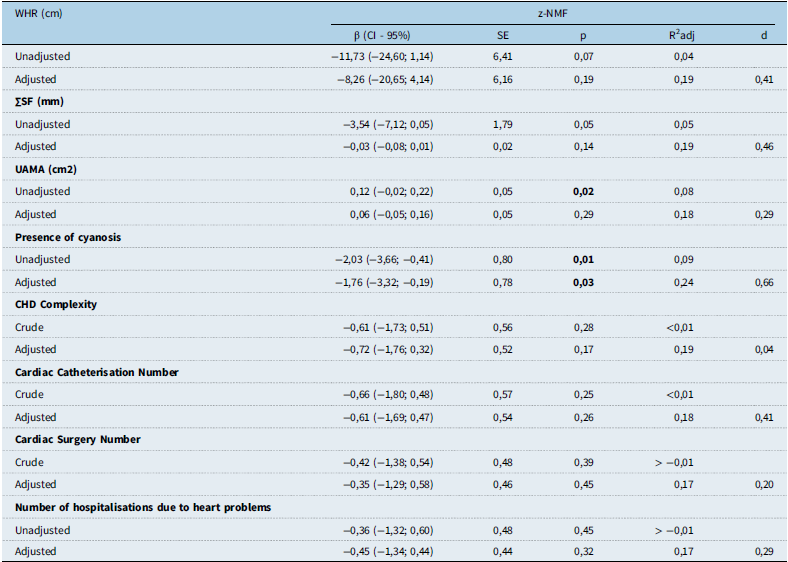
An inverse and significant association between the presence of cyanotic-type CHD and neuromuscular z-fitness was found in unadjusted and adjusted (age, sex, somatic maturation, and physical activity) linear regression analysis (p = 0.03; β = −1.76; effect size = 0.66), explaining 24% of the outcome. However, no significant association was found between neuromuscular z-fitness and the other clinical factors of CHD (Table 2).
Unadjusted and adjusted linear regression analysis of z-NMF (continuous value) with body composition indicators and clinical factors of CHDs (n = 53)

β = standardized beta regression coefficient; CI = 95% confidence interval; SE = standard error; p = p-value (statistical significance, p < 0,05); R2adj = adjusted R2 of the model; WHR = waist-to-height ratio; cm = centimeter; ∑SF = sum of skinfolds; mm = millimeter; UAMA = upper arm muscle area. z-NMF is the result of the sum of the z-scores of four muscle strength tests: HGS relative to BMI, vertical jump, abdominal LMR, and upper limb LMR relative to body mass. D = effect size. Data in bold indicate statistical significance.
A positive and significant association was observed only between the arm muscle area and z-NMF in the unadjusted linear regression analysis (p = 0,02; β = 0,12), but this was non-significant when adjusted for age, sex, somatic maturation, and physical activity. No significant association was found between z-NMF and the waist-to-height ratio or with the sum of skinfolds (Table 2).
Discussion
The main findings of this study were 1) High prevalence of inadequate neuromuscular fitness evidenced in 89% of adolescents with CHD 33%, both in maximum isometric strength (by handgrip strength) and in vertical jump strength, 78% in abdominal strength resistance and 27% in upper limb strength resistance and 2) adolescents with cyanotic CHD presented significantly lower mean muscle strength compared to acyanotic ones in most strength variables with medium effect size. Similarly, the presence of cyanotic CHD was inversely and significantly associated with z-NMF (medium effect size), adjusted for confounders, maintaining this association after adjustment and 24% of the outcome variance.
The low levels of muscle strength found in this study converge with findings that point to below-mean muscle fitness in young people with CHD. Reference Pyykkönen, Rahkonen and Ratia30 Eshuis et al. Reference Eshuis, van Duinen and Lelieveld31 also reported decreased handgrip strength and total muscle strength in adolescents with CHD, that impacting maximum oxygen consumption and exercise capacity. Evidence indicates that this population has lower tolerance to aerobic exercise loads than the healthy population, which directly interferes with the level of general physical fitness. Reference Schaan, Feltez and Schaan4 Another study with adolescents with CHD concluded that muscle strength is directly related to physical fitness and is often decreased, affecting motor and functional skills, directly associated with decreased exercise capacity. Reference Ferrer-Sargues, Peiró-Molina and Cebrià Iranzo32 One explanation for these findings may be the cardiopulmonary deficits found in patients with CHD, which interfere with muscle strength capacity, Reference Meyer, Wang and Brudy33 since this, together with aerobic endurance, are the basic functions of physical fitness that are most closely related to the cardiovascular system. Reference Takken, Giardini and Reybrouck34 Also, there is evidence that myostatin is elevated in young people with CHD and may play a potential role in the aetiology of reduced muscle strength, as it is a negative regulator of skeletal muscle mass. Reference Bish, George and Maybaum35 Morever, Hirono et al. Reference Hirono, Okudaira and Takeda36 revealed that neuromuscular fitness could also be significantly explained by muscle mass, which is one of the main contributors to muscle strength. The low levels of muscle strength found in this study can also be explained by the alarming physical inactivity evidenced in 95% of our sample. Considering that physical activity is necessary for the physical development of young people with CHD and regular physical exercise can improve neuromuscular fitness, therefore, low levels of physical activity can compromise muscle strength in young people with CHD. Reference Takken, Giardini and Reybrouck34
In this study, it was observed that patients with cyanotic CHD had significantly lower mean muscle strength (medium effect size) compared to patients with acyanotic CHD, except for relative handgrip strength, which, although lower in cyanotic CHD, was not significantly different. Our findings reinforce previous studies that also pointed to this difference in muscle strength between the two groups. Reference Neidenbach, Oberhoffer and Pieper37 Similarly, another study, when comparing handgrip strength in the same population, did not observe a significant difference between the cyanotic and acyanotic CHD groups. Reference de Rêgo and Pinho38 This reinforces the need to evaluate strength from different perspectives, since some tests may be more sensitive than others to the loss of neuromuscular fitness. The reduction in muscle strength in patients with cyanotic CHD may be explained by the deficiency in skeletal muscle oxygenation present in these patients, which can result in muscle weakness and fatigue. Reference Ross, Arakaki and Ciesielski39 This mechanism can be exemplified in the study by Moalla et al. Reference Moalla, Elloumi and Chamari40 who observed improvements in maximum voluntary contraction and time to exhaustion (muscle fatigue), explained by the increase in muscle oxygenation also observed after strength training.
Similarly, a negative association was found between the presence of cyanotic CHD and z-NMF, even after adjustment for confounders (age, sex, somatic maturation, and physical activity). This occurs because, even during activities that lasts a few seconds and are considered as anaerobic, such as muscle strength activities, aerobic energy turnover contributes to overall demand for ATP, which is facilitated by the O2 transport system. Reference Malina, Bouchard and Bar-Or41 Knowing that the presence of cyanosis in adolescents with CHD implies a deficiency in skeletal muscle oxygenation, muscle strength in these patients is impaired by early muscle weakness or fatigue. Reference Ross, Arakaki and Ciesielski39 For example, during a 30-second task, approximately 20 to 25% of the energy is provided through aerobic methods. Reference Inbar, Bar-Or and Skinner42 Tests used here, such as the abdominal and elbow flexion tests, to measure isotonic strength resistance of the abdomen and upper limbs muscles, may had been prone to suffer influence from the aerobic metabolism, explaining their capacity to differentiate cyanotic from acyanotic CHD patients.
The type of CHD of the patients evaluated showed that ventricular septal defect (21.7%) and atrial septal defect (18.3%) are the most prevalent CHD in the adolescents evaluated, heart diseases of simple complexity and acyanotic nature, followed by TOF (13.3%), of moderate complexity and cyanotic type, AS (83%) and CoA (8.3%), the last two of moderate complexity and acyanotic nature. These results are similar to other studies that also point to acyanotic heart diseases as the most common, with emphasis on ventricular septal defect, atrial septal defect, pulmonary stenosis, aortic stenosis, PDA and CoA. Reference Warnes, Liberthson and Danielson21,Reference Born43 The most prevalent cyanotic CHDs in these studies were TOF, corroborating our findings and transposition of the great arts, which was not observed in our participants. A previous study with children aged 0 to 11 years carried out in Alagoas Reference Chaves, Pinto and Barreto44 found PDA (33.7%) to be the most prevalent among acyanotic CHDs, followed by ventricular septal defect (28.7%) and atrial septal defect (20.0%). The most prevalent cyanotic CHDs they found were TOF (3.7%), converging with our findings, followed by pulmonary atresia with ventricular septal defect (2.5%), found among the least prevalent in our study. These differences found with the study by Chaves et al. Reference Chaves, Pinto and Barreto44 can be explained by the difference in age range in relation to our study.
Among the most common CHDs in our findings, their potential restrictions on physical activities include: 1) ventricular septal defect and atrial septal defect—when small, they often do not result in significant restrictions, while larger ones require moderation until they are surgically corrected; 2) TOF—even after surgical correction, many patients can participate in moderate activities, but high-intensity activities may be restricted. Therefore, it is necessary to recognise warning signs, such as chest pain, dizziness, excessive shortness of breath, or palpitations on exertion. Reference Dold, Haas and Apitz45 CHDs can impact neuromuscular fitness, depending on the nature and severity of the condition, and may result in reduced aerobic capacity, which affects muscle resistance and results in faster fatigue, as well as some heart diseases can cause inadequate muscle perfusion, limiting the supply of oxygen and essential nutrients, resulting in muscle weakness and lower physical performance. Reference Dold, Haas and Apitz45
A positive association was found between z-NMF and arm muscle area in the unadjusted analysis, but disappeared in the adjusted analysis. This may be due to the adjustment for somatic maturation, which most influenced z-NMF (significant variable associated). In this sense, somatic maturity is a proxy variable that directly account to muscle strength in adolescents, and this factor must be taken into account Reference Silva and Oliveira de46 when evaluating neuromuscular fitness. Since adolescents with advanced maturation are usually stronger than their peers with normal and delayed maturation, which is explained by the greater body size and muscle mass content of young people with advanced maturation, according to Freitas et al. Reference Freitas, Maia and Beunen47 On the other hand, muscle strength levels in young people in the pre-pubertal maturation stage may be influenced by the improvement in muscle efficiency and not by the increase in muscle mass, with this growth being limited by low levels of sexual hormones, unlike young people in the post-pubertal maturation stage who have higher hormone levels. Reference Takken, Giardini and Reybrouck34
Although we did not find a significant association between adiposity indicators (waist-to-height ratio and sum of skinfolds) and z-NMF, previous findings have shown that young people with excess adiposity have worse neuromuscular fitness levels than young people with normal adiposity. Reference Lopes, Malina and Gomez-Campos48 A correlation was found between muscle strength and the waist-to-height ratio (relative handgrip strength and upper limb strength) and with the sum of skinfolds (relative handgrip strength) only in bivariate analysis. This can be explained by the fact that fat generally has a negative influence on strength performance and, from a mechanical perspective, represents an inert load, therefore, correlations between fat and motor performance are consistently negative during adolescence. Reference Malina, Bouchard and Bar-Or41
Limitations of the present study include the cross-sectional design that does not allow for causality verification. Therefore, it is suggested that future research prospectively analyse neuromuscular fitness, body composition, and clinical factors of CHD to demonstrate causal relationships. Furthermore, the instruments for assessing muscle strength are limited to the field-based procedures, as there are other more accurate in the laboratory. The sample size and selection bias may also be other limitations, considering that the adolescents evaluated were those who had access to medical care at the collection site. One strong point that can be highlighted is the evaluation of different manifestations of muscle strength in CHD adolescents and calculated a cluster z-score for the analyses, as well as using a conservative criterion for defining inadequate neuromuscular fitness. We believe that the results can be generalised to other centres with a different case mix, especially in samples with similar characteristics, but studies with larger samples must be carried out to confirm this.
Conclusion
Inadequate levels of muscle strength were observed (27 to 89%), both in the individual manifestations of muscle strength and in the clustered strength analysis (z-NMF) in adolescents with CHD. Neuromuscular fitness was associated with the type of CHD and the presence of cyanosis in adolescents, regardless of age, sex, somatic maturation and physical activity. Neuromuscular fitness was not associated with any of the body composition indicators analysed (waist-to-height ratio, sum of skinfolds and arm muscle area).
Supplementary material
For supplementary material accompanying this paper visit https://doi.org/10.1017/S1047951125100851
Acknowledgements
To God, our families and each of the study participants.
Financial support
This study had its own funding.
Competing interests
The authors declare no conflict of interest.
Ethical standards
The authors state that all procedures contributing to this work are in compliance with the ethical standards of the relevant national guidelines on human experimentation indicated by Resolution No. 466, of December 12, 2012, of the National Health Council and with the Declaration of Helsinki of 1975, as revised in 2008, and were approved by the Research Ethics Committee of the Federal University of Alagoas, under opinion 6.302.083 and CAAE registration: 70383923.9.0000.5012.