INTRODUCTION
Conservation agriculture (CA) – a management system revolving around minimal soil disturbance, crop residue retention and crop diversificationFootnote 1 is being promoted in many countries today. It can also lead to improved soil health, productivity of soils and positively affect eco-system services such as clean water, improve biodiversity and reduce greenhouse gas emissions. Major benefit of CA in the Indo-Gangetic Plains (IGP) of India is that it results in earlier planting and additional benefits in terms of soil health, eco-system services and improved productivity of inputs (Hobbs et al., Reference Hobbs, Sayre and Gupta2008).
Erenstein, (Reference Erenstein, Sumberg and Thompson2012) presented a paper at the Contested Agronomy 2010 workshop in the UK. It highlighted the lack of progress and constraints of CA-based technologies in the IGP of South Asia. He challenged the idea that zero-till (ZT) wheat in rice–wheat systems could be further developed into full CA systems. He also questioned whether farmers would adopt CA beyond the on-station experiments in the NW parts of the IGP and noted that CA was not adopted in the Eastern IGP or other geographies beyond the RW systems of the IGP. His paper did highlight the role of the Rice–Wheat Consortium (RWC) that was formed in the late 1980’s that countered some institutional resistance to CA and promoted improved collaboration with farmers and the private sector, especially equipment manufacturers. The RWC promoted positive farmer field and station experimentation that initiated the start of accelerated adoption of CA in the Western side of the IGP (Harrington and Hobbs, Reference Harrington, Hobbs, Ladha, Singh and Erenstein2009). Erenstein, (Reference Erenstein, Sumberg and Thompson2012) based his paper on data available in the early 2000’s. At that time progress in CA research and adoption was mainly in the wheat phase of the rice–wheat system and in the NW regions of India (Punjab, Haryana and Western Uttar Pradesh States) and the Punjab of Pakistan. Since that time research and farmer experimentation of CA has been expanded by Indian and Pakistan scientists to extend the technology to both rice and wheat and other crops in the system. They have also tested CA in other geographic areas and systems (for example dryland areas of Madhya Pradesh not reported here).
The objective of this paper is to look at CA development and progress since 2008. It first takes a look at how CA began, mainly Western areas of India and Pakistan, before proceeding to what has happened since 2008 using data from Eastern India. This is followed by a brief summary of what is suggested for the future and what direction CA should take in South Asia.
CONSERVATION AGRICULTURE AND HOW IT STARTED IN THE WESTERN IGP
The ‘Green Revolution’ was introduced in South Asia in the late 1960’s. It consisted of modern, short-statured, insect and disease resistant varieties of wheat and rice coupled with improved availability of modern chemical fertilizers and irrigation. It depended on strong policy support, including prices and was an ongoing effort, not just a one-shot deal. Green Revolution practices continued to evolve over the years and even decades since its introduction. It led to a significant increase in cereal production that provided needed calories for a growing population. It also resulted in the emergence of rice–wheat as the major cropping system in the IGP of South Asia (Gupta et al., Reference Gupta, Naresh, Hobbs, Jiaguo, Ladha, Ladha, Hill, Duxbury, Gupta and Buresh2003; Gupta and Seth, Reference Gupta and Seth2007; Timsina and Connor, Reference Timsina and Connor2001). Here, rice is grown in the warm and wet summer season and wheat in the cooler winter months. Although rice and wheat are the major crops, the rice–wheat system includes other minor crops (maize, legumes, pulses, vegetables and others) grown in the winter season or on higher land in the summer.
Animals are an important component of the system, despite having been replaced by tractor power for tillage, transport and post-harvest threshing (Byerlee et al., Reference Byerlee, Heisey and Hobbs1989; Hobbs et al., Reference Hobbs, Gupta, Meisner, Uphoff, Ball, Fernandes, Herren, Husson, Laing, Pretty, Palm, Sanchez, Sanginga and Thies2005). Farmers still raise dairy cows for milk and other animals such as goats and chickens. Animals are a major source of manure but much of it is used for cooking fuel rather than being applied to fields for crop production. Manure is applied to soil mainly for higher value crops and seedbeds or on land close to the homestead. Animals are important to households as a ‘bank’ that can be tapped when cash is needed. Ruminants are mainly fed wheat or rice crop residues with some fodder crops (berseem clover) grown as feed. Maize is also grown mainly as grain to feed chickens or fodder for dairy cows. Rice and wheat residues not gathered for feed are typically burned after harvest to facilitate establishment of the next crop.
Overcoming late planting
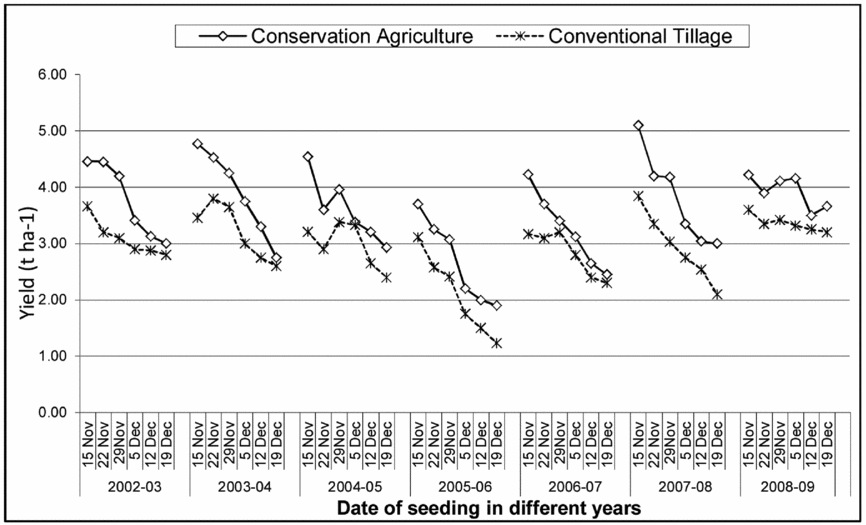
The rice–wheat system has a number of interacting management practices that affect system productivity (Byerlee et al., Reference Byerlee, Sheikh, Aslam and Hobbs1984 and Reference Byerlee, Heisey and Hobbs1989). Growing rice under puddled soil conditions leaves the soil in a poor physical condition, especially in heavier textured soils, for the next crop. Farmers undertake multiple plowings to obtain a fine soil tilth; this increases costs and takes time resulting in delays for planting wheat or other crops after rice that in turn reduces their yields. Figure 1 shows that wheat, whether planted with CT or CA declines in yield when planted late. This is mostly related to the issue of heat stress during flowering and grain filling. This is exacerbated by climate change. Earlier planting and timeliness of operations allows wheat to escape this terminal heat stress although the actual affect varies by year since the onset of higher temperatures varies by year. If planting is delayed beyond mid- to late-November, wheat yields decline about 1 to 1.5% per day. Note that late planting depressed wheat yields in all seven years in both CA and conventional tillage (CT). Note also that the yield advantage of CA over CT is especially large at earlier and more favourable planting dates despite using the same fertilizer doses and seed drill in both treatments. An important point about comparing CA with CT is to plant the CA at the optimal time for CA; seeds germinate better in CA treatments if the soil moisture is higher and therefore soil strength is lower. If CA is delayed and planted later and has the same planting date as CT, soil moisture will be lower and soil strength higher and germination in CA will be affected, biasing the results in favour of CT. Essentially tillage reduces soil strength but also dries out the soil.
Wheat yield under different seeding dates (variety and fertilizer rates were similar) from 2002–2003 to 2008–2009 in CA and CT systems in eastern U. P. (Unpublished data from farmer participatory trials conducted in Eastern Districts of Uttar Pradesh by UP Singh, BHU, Varanasi, UP, India.

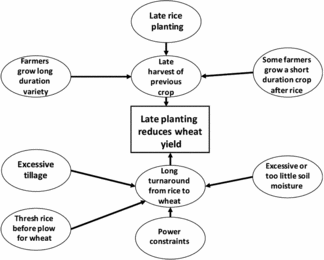
Based on diagnostic surveys of RW farmers in the region, Figure 2 shows how planting delays in wheat had multiples causes and therefore several possible solutions. For instance, the late harvesting of long duration rice varieties led farmers to plant wheat in December or even later in January (Byerlee et al., Reference Byerlee, Heisey and Hobbs1989; Hobbs and Gupta, Reference Hobbs, Gupta, Ladha, Hill, Gupta, Duxbury and Buresh2003). This was a very useful exercise since it demonstrated that one single problem, like delayed wheat planting (timeliness of operations), had multiple causes and therefore several solutions. Late harvest of rice because of late maturing rice varieties could be resolved by introducing earlier maturing rice varieties or by planting the rice crop earlier. But this paper concentrates on the problem of excessive tillage farmers undertake to establish wheat after rice.
The most common causes of late wheat planting in South Asian rice–wheat systems (Hobbs and Gupta, Reference Hobbs, Gupta, Ladha, Hill, Gupta, Duxbury and Buresh2003; Byerlee et al., Reference Byerlee, Heisey and Hobbs1989).

Zero-till (ZT) wheat as a solution for late planted wheat
Farmers believed that in order to get a good wheat crop, they had to prepare a fine seed bed. Puddling rice soils was the traditional way to grow rice in this region and had several benefits including easier transplanting of rice seedlings, ponding of water (reduced percolation of water) to help control weeds, various nitrogen and other nutrient transformations that occur under anaerobic conditions, and land levelling. But the poor physical (and possibly biological) condition of the soil after puddled rice required many passes of the plow – animal or tractor drawn – to get the fine tilth thought to be necessary for wheat establishment. This took time and in some cases the soil was too dry or too wet to plant wheat. When it was too dry a pre-planting irrigation was needed that further delayed planting.
This led to a search for a suitable ZT drill from New Zealand in 1985 that had fixed, inverted-T coulters and was purchased for a ZT wheat establishment study in Pakistan. The same drills were then imported to India in 1989 to allow studies on ZT wheat after rice in Pantnagar University in Uttar Pradesh, India. It was apparent from the start that indeed wheat could be established without tillage, that it could be planted earlier and thus lead to higher yields than in tilled fields. In fact, there were a number of other unforeseen benefits besides planting date that soon became apparent with this system: the costs of production were reduced; less diesel was needed; there was less wear and tear on tractors; fewer weeds germinated (in particular Phalaris minor, a major weed of wheat in this system); water was saved through not needing the first irrigation; irrigation was easier and faster; and there was less post-irrigation waterlogging and yellowing of wheat plants. With the addition of a fertilizer box to the ZT drill, basal fertilizer could be applied by placement and thus improve fertilizer efficiency. A boost to this technology occurred in the late 1980’s when the price of fossil fuels spiked and raised the price of diesel. Farmers were much more willing to experiment with this technology that reduced their costs of land preparation.
CHALLENGING THE LIMITED FUTURE FOR ZT AND CA: UNDERSTANDING EARLY IMPEDIMENTS TO WIDESPREAD ADOPTION
Erenstein (Reference Erenstein, Sumberg and Thompson2012) raised the issue of the definition of CA that involves reduced or no-tillage, permanent residue soil cover and rotations; was ZT of wheat really CA and why was wheat grown with ZT and not rice and other crops in the system? He also raised the issue of experiment station trials instead of trials in farmer fields and that CA was not being promoted in other geographic areas of South Asia with different climates and soils. The following are some responses to the points raised by Erenstein. CA, or at the beginning ZT wheat, was also contested by other South Asian groups in terms of anticipated negative consequences of this new establishment system. Some of these will be described below to show how they were resolved and helped negate the contested assertions leading to accelerated adoption of ZT or CA on a systems basis.
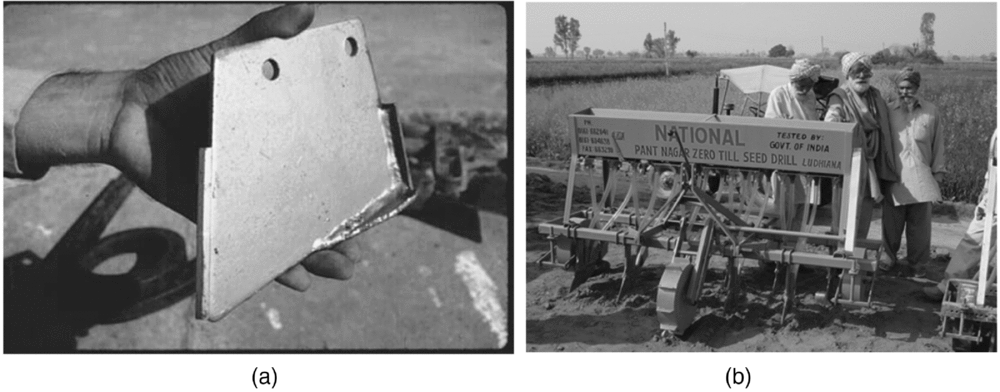
The first constraint related to slow farmer adoption was the availability of implements capable of planting ZT wheat. Engineers at Pantnagar University, UP, India worked with local private sector farm equipment manufacturers in Ludhiana to manufacture a suitable drill. They took the inverted-T openers off the New Zealand drill purchased by CIMMYT in 1989 and placed them on a locally produced seed drill. They then strengthened the frame and modified the openers to work better in IGP soils. These improvements were based on interactions of innovative farmers, scientists and local manufacturers in farmer fields. The result was the first locally manufactured ZT drill in 1990 (Figure 3a and b). Later, the same people worked together to find solutions for loose straw clogging the seed drill. This meant that ZT could be used in hand harvested (no loose straw) and combine harvested fields (loose straw) (Sims et al., Reference Sims, Hobbs and Gupta2009).
(a) and (b): The NZ inverted-T opener and the locally manufactured Indian seed drill with these openers (Photograph: Peter Hobbs).

The second issue of experiment station versus farmer field trials was related to South Asian University policy for using equipment in farmer fields. In Pantnagar, the University required that all University-owned equipment used in farmer field trials be returned to campus the same day. This restricted equipment testing to researcher managed trials in just a few nearby fields. After a couple of years of hard work only 20 h of ZT could be found in this area. In Haryana State, on the other hand, drills were brought in by a CIMMYT project using DFID, UK funds in 1995. Because they belonged to the CIMMYT project they were allowed to be loaned out to innovative farmers and, after proper training, left in the villages for use as needed. This led to farmer experimentation with the technology, suggestions to local manufacturers for improvements and rapid adoption of ZT wheat. Local farmers could see for themselves that the practice worked on their own farms. In two years, in Haryana, over 100,000 h of wheat was planted this way. This led to a demand for the new planting equipment, a rise in sales of ZT drills and subsequently increase in ZT wheat in the IGP of South Asia (Hobbs et al., Reference Hobbs, Sayre and Gupta2008; Laxmi et al., Reference Laxmi, Erenstein and Gupta2007; Rehman et al., Reference Rehman, Nawaz, Wakeel, Saharawat, Farooq, Farooq and Siddique2015).
A third issue against the use of ZT wheat and the slow adoption in Pakistan came from the provincial extension service in Pakistan's Punjab. The Director General of Extension in that State proclaimed that all rice stubble had to be plowed under in order to control the rice stemborer (Scirpophaga incertulas), a major pest of rice; The DG said that the use of ZT wheat would greatly increase the population of rice–stem borer overwintering in the rice stubble in the wheat season and decimate the next rice crop. Entomologists at the National Agricultural Research Institute in Islamabad undertook research in farmer fields with and without tillage and measured the fate of stemborer eggs and larvae during the wheat season and their impact on the next rice crop (Inayatullah and Ehsan-ul-Haq, 1990). They found higher larval density in ZT wheat plots in December–January but almost identical numbers with CT in February–March. This was due to larval mortality through predation and death in the no-till plots that resulted in no difference in stemborer populations for the next rice crop. But despite this evidence, the Director refused to change his belief. This political decision slowed the progress of CA in Pakistan. Nevertheless, many farmers have used ZT wheat after rice in the rice–wheat system for many years since then and there have been no reports of increased stemborer activity in the rice crop. In India, this issue was not raised so it did not affect adoption or promotion. There have been no subsequent reports of increased stemborer activity in rice (Jaipla, et al., Reference Jaipla, Malik, Yadav and Gupta2015).
A fourth issue raised was the lack of access to ZT equipment by poor farmers. The argument was that these farmers did not have the financial resources to buy tractors and implements such as ZT drills; this technology was only available to rich farmers with bigger landholdings and owners of tractors. However, resource poor farmers were hiring tractor owners to do at least the first tillage in their fields. That was a win-win for both parties; the farmer could get his land plowed faster and the tractor owner was getting income by providing this service. When ZT wheat was introduced, the first opponents to ZT were these tractor operators who thought they would lose a source of income if this technology were adopted. Local scientists and farmers, however, convinced these tractor owners to buy ZT drills and rent them out for one-pass zero till wheat establishment. These service providers were able to increase their incomes with less wear and tear on their machines (Keil et al., Reference Keil, D'souza and McDonald2015). There is a growing number of service providers planting wheat for small landholders using ZT. It is far easier to train a fewer number of operators on how to plant ZT properly rather than attempting to extend ZT practices to the almost 120 million cultivators in IndiaFootnote 2. This may also help address the social issue of young males leaving the rural areas for work in the cities. If they can get loans, training and equipment they can become service providers for ZT wheat (or other crops) sowing, as well as land levelling, application of herbicides, harvesting and threshing.
The number of manufacturers making ZT equipment has grown significantly as demand for this equipment grew. Many new innovations have been made by local manufacturers in the last decade, including: fixed openers; features for planting into loose residues following combine harvesting (the happy seeder with and without disc openers); fertilizer application systems for improving fertilizer efficiency by placement; and ZT machinery for small two-wheel tractors and medium and larger four wheelersFootnote 3. The development of drills that can plant into loose stubble has helped reduce the need to burn rice residues to facilitate wheat sowing. Less burning of rice straw has meant this valuable resource can be left to feed the soil biota while reducing air pollution and improving human health. Burning or partial burning of rice residues is still happening; however, since insufficient numbers of residue handling drills are available at the moment. It is hoped that demand will increase and sales will meet demands once farmers see the benefits of leaving residues in the field rather than burning them.
Erenstein, (Reference Erenstein, Sumberg and Thompson2012) raised a fifth issue concerning the definition of CA. His argument was that ZT wheat does not meet the full definition of CA. It is true that early work in South Asia focused on ZT establishment of wheat after rice to resolve the issues of late planting of wheat as described above, but also an explosion in the population of herbicide resistant Phalaris minor weed in wheat in NW India and PakistanFootnote 4 (Malik and Singh, Reference Malik and Singh1993 and Reference Malik and Singh1995). However, leaving anchored rice stubble was promoted in hand harvested rice fields to provide the ‘residue retention’ component of CA. What was missing was the third factor, rotation. In many of the rice–wheat fields, rice is the only suitable crop that can be grown in the wet and flooded monsoon season. The engineers and manufacturers of equipment (National Agro-Industries for example) now have implements that allow ZT planting of many other crops including maize, legumes, mustard/rape, sunflower and rice. This means crop rotation could be used as an integrated weed control practice. They have adapted the seed metering system to allow other crops to be planted at optimal spacing for these crops. CA can now be used in other non-rice cropping systems in India and crop rotation can be part of the package and by retaining more residues more closely meets the three-pillar definition of CA.
A sixth issue relates to the burning of rice residues by farmers caused by an increase in adoption of combine harvesters in the region, especially the Eastern IGP. Loose straw was the problem and at first farmers burnt it. Local engineers and equipment manufacturers have since worked to develop seed drills that could establish different crops into the loose residue. An array of seed drills that work well in different residue situations are now available for farmers or service providers to buy. Since residues are also used by farmers to feed livestock, engineers and manufacturers have developed machinery that can harvest and bale some of the loose straw for animal feed while retaining the rest in the field for soil cover.
Erenstein, (Reference Erenstein, Sumberg and Thompson2012) made a seventh point that advances in South Asia with CA in rice–wheat systems were mainly in the wheat crop and that the use of this system in rice was problematic. Two issues relate to rice (1) soils are puddled to impound water to help control weeds; (2) farmers have traditionally preferred transplanting rice into puddled soils and have been averse to experimenting with direct seeding. CA does not work with transplanted rice on puddled soils. If the rice phase cannot incorporate CA principles, then many advantages obtained in the wheat phase in relation to improved soil health are lost in the rice phase. Indian scientists have recently made progress on ZT direct seeded rice (ZTDSR) and direct seeded rice (DSR) to replace the puddled, transplanted traditional rice system. There is also work on adapting a rice transplanter from China to transplant rice in un-puddled soil. This requires soil to be softened by flooding and then using the transplanter with seedlings produced in seed mats; but the soil is not puddled.
An eighth issue raised by Erenstein, (Reference Erenstein, Sumberg and Thompson2012) was related to research being confined to only the Western areas of the IGP. Since this publication Indian scientists have expanded their work beyond the Western IGP (Aryal et al., Reference Aryal, Sapkota, Jat and Bishnoi2015; Coventry et al., Reference Coventry, Poswal, Yadav, Gupta, Gill, Chhokar, Kumar, Sharma, Kumar, Mehta, Kleemann and Cummins2011; Erenstein et al., Reference Erenstein, Malik and Singh2007) and have begun work in Eastern India (Keil et al., Reference Keil, D'souza and McDonald2015) and the black cotton soils of Madhya Pradesh (MP) (Raj Kumar Jat, Reference Jat2015; Singh et al., Reference Singh, Singh, Tomar and Gupta2013). This was made possible by public and private support from Indian and International donors. One of the key interventions was the development of three Borlaug Institutes for South Asia (BISA) in Ludhiana (Punjab), Jabalpur (MP) and Pusa (Bihar). These Institutes conduct good quality research and engagement including long-term experiments, training and interactions with local research and extension agencies, machinery makers, policy makers and farmers. Indian scientists were supported to play a much bigger role in the planning and implementation of research in their own country. These scientists realized the importance of involving farmers in participatory evaluation of CA in order to accelerate adoption and so include farmer participation as a component of their research.
The final Erenstein, (Reference Erenstein, Sumberg and Thompson2012) issue mentions that research on CA in South Asia tended to adhere to small plot research on experiment stations. In fact, from the early work on ZT wheat in South Asia there was a strong component of on-farm participatory research where innovative farmers were provided the means to experiment with the ZT machinery and see for themselves if it worked. Once convinced it worked, they were the best extension agents and influenced other farmers in their village to try the ZT drill. It was this model of participatory research in Haryana State that accelerated adoption within a short period of time in the late 1990’s and early 2000’s (Erenstein et al., Reference Erenstein, Malik and Singh2007).
Farmers were involved from the start in seeing and experimenting with CA practices. They visited the experiment stations but were also encouraged by scientists to experiment on their own lands. Another major intervention was the training and equipping of local people to be service providers for CA. There are now a number of service providers who provide CA services to farmers for a fee. Many have been trained by the Borlaug Institute for South Asia (BISA) and other Institutions before applying their knowledge. This is a key component for successful adoption of CA in India since it is easier to train a small number of service providers than to train many of the small landholder farmers, many that cannot afford a tractor or the equipment. Linkages of service providers with local CA equipment manufacturers is also important. Policies are needed to encourage local entrepreneurs to become service providers; provision of loans to buy needed equipment and good training in proper application of CA and other technology (harvest, seed, fertilizer, etc.) would go a long way to help accelerate adoption of CA and other important technology and information.
The Eastern IGP is characterized by small and fragmented farm holdings, poor input and output marketing infrastructure, poor access to new technologies (including irrigation infrastructure), frequent climatic aberrations (floods, drought and temperature), and a shorter wheat growing season compared to the Western IGP leading to lower potential yields. Increasing input, energy and labour costs, and poor access to mechanization and knowledge, forced farmers to use sub-optimal crop management practices that lead to lower crop yields and farm profit. It is also anticipated that climate change will impact this geographic zone of India through a shorter winter growing season and higher temperatures during grain filling.
To address these challenges, several CA-based management practices – developed and disseminated in the last 15 years by various Indian and international institutions such as ICAR, SAU and CGIAR organizations in the region – were promoted to farmers in Eastern India. This includes not only ZT wheat but also ZT for both rice and wheat. ZT was shown to improve productivity and profitability with improved resource use efficiency and to have better potential to adapt to aberrant weather situations and climate change (Jat et al., Reference Jat, Sapkota, Singh, Jat, Kumar and Gupta2014; Jat, Reference Jat2015, Reference Jat2016). The main constraint in adoption of these practices was timely availability of appropriate knowledge and inputs including machinery. To resolve these issues scientists started working in cluster mode called ‘climate smart villages’ or ‘Hubs’ to demonstrate a range of climate smart practices with side by side comparison with existing practices. This allowed farmers to evaluate potential yield and economic benefits and to develop their confidence in these practices.
During 2012 to 2016, the scientists at the Bihar BISA institute in collaboration with the CIMMYT CSISA project in eastern India formed 40 climate smart villages in Vaishali and Samastipur districts of Bihar and had demonstrations of a range of agriculture practices based on the long-term strategic research trials in the region. This allowed collaboration of local farmers in designing and experimenting with various climate smart technologies together with the researchers and most important the local service providers and equipment manufacturers. Many on-farm trials were conducted in these villages by farmers with assistance from service providers and project scientists and reported in annual reports (Jat, Reference Jat2015 and Reference Jat2016) and used field days to extend the results to other farmers who learnt from the local farmers conducting these experiments.
The major practices that farmers chose to study were ZT wheat (ZTW), ZTDSR, permanent raised bed wheat (PBW), permanent raised bed maize (PBM), ZT maize, laser land levelling and new climate resilient varieties. Cropping system intensification was also undertaken by adjusting planting dates, selecting suitable varieties to fit the system, using systems for expert-based nutrient management, and introducing better water and weed management. The average results of these demonstrations showed that interventions improved productivity, profitability and resource use efficiency over conventional farmer's practices. DSR recorded similar or higher rice yield but significantly higher net returns compared to TPR. The higher net returns of DSR was mainly due to lower costs of production of DSR as compared to puddled transplanted rice. Zero tillage and permanent raised bed planting systems in wheat improved wheat productivity by 21 to 24% and net returns by 50 to 66%, respectively, as compared to conventional broadcasted wheat. The higher profitability in wheat under ZT and PB was mainly due to higher productivity with the improved planting system (Jat et al., Reference Jat, Sapkota, Singh, Jat, Kumar and Gupta2014). Laser land levelling and bed planting also saved irrigation water by 17 to 22 % and increased wheat yield by 10 and 21%, respectively, as compared to conventional farmer's practice. Zero tillage and permanent raised beds increased maize productivity by 47 and 52%, and net returns by 21 and 49%, respectively, as compared to conventional maize (Jat, Reference Jat2016). Data on actual adoption rates are still being collected and analysed but informal estimates suggest that farmers are very pleased with the results they see in their fields in terms of better yields, less costs, savings in water and labour for both the rice, wheat and other crops grown in these selected villages. They are also happy with the service provider system introduced in these villages.
In summary, CA for a cropping system like rice–wheat in the IGP of South Asia is complex and cannot be expected to be immediately fully adopted. Farmers have a history passed on from their fathers and grandfathers of how to farm. Technologies like ZT and growing rice without transplanting and puddling the soil are new and very different from current practice. For technology like new varieties or fertilizer it is relatively easy to extend. Management systems like CA on the other hand are better introduced step-wise with each step having positive outcomes first rather than introducing the entire package. Farmers want to test and evaluate new ideas and technology and see that they benefit before they adopt them. It helps to identify innovative farmers in a community who are willing to experiment and see for themselves if other ideas are better than the ones they presently use. These innovative farmers then become the best extension agents. Also, related to adoption is having the needed enabling factors in place to allow farmers to adopt new management systems. Since there are many resource poor farmers in India who cannot afford to own a tractor or piece of equipment, the use of service providers (farmers already used them for ploughing and harvest), properly trained, financed and motivated is suggested as a mechanism to enable farmers to adopt technologies like CA. Last, having a rigid definition of CA is not useful. What is better is to foster-improved management practices in a stepwise fashion over time to get farmer acceptance of CA. Farmers and policy makers can become aware of the benefits of CA by introducing an initial component of CA like ZT wheat. This often will facilitate adoption of other components of CA and to other crops after that.
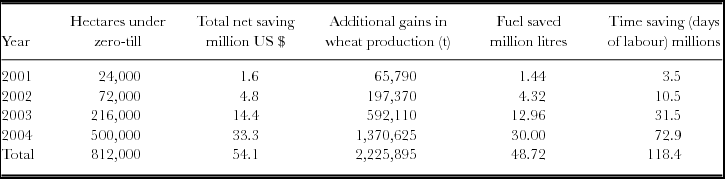
It is hard to estimate the number of service providers and the acreage of ZT wheat (or other crops) presently operating in South Asia today because statistics are not collected on this management system. One estimate of the area of CA in 2012 in South Asia is 5.0 million h (Friedrich et al., Reference Friedrich, Derpsch and Kassam2012). The drivers for this adoption include (i) availability of new farm machinery; (ii) availability of improved chemicals for control of weeds, pests and diseases; (iii) a decreasing labour force; (iv) increasing production costs, energy shortages, erosion losses, pollution hazards and escalating fuel costs and (v) residue burning (Jat et al., Reference Jat, Saharawat and Gupta2011). Farmers are encouraged to adopt CA because of the benefits of lower costs of production while getting equal or better yields. Table 1 shows some projected benefits in terms of net savings, gains in wheat production, fuel savings and labour saving plus water savings based on hectares of land under ZT. These figures can be multiplied by 5 if the 5 million h estimate for 2012 is reasonable.
Projected area coverage, savings in fuel and labour and additional gains in productivity of wheat (Mehla et al., Reference Mehla, Verma, Gupta and Hobbs2000).

Because zero-till takes advantage of residual soil moisture from the previous rice crop and cuts down on the need for a subsequent irrigation requirement, water use is reduced by about 0.1 M3 h−1.
ISSUES RELATED TO ADOPTION OF DIRECT SEEDED (DSR) AND ZT RICE
This section returns to the issue of adding ZT or direct seeded (DSR) rice as a replacement for puddled, transplanted rice (TPR) to the rice–wheat systems explained above that any benefits accrued from ZT wheat in terms of soil health will be lost if the following rice crop is traditionally transplanted on puddled soils. There are three major issues related to promoting a non-puddled way to grow rice: (1) the large quantity of water needed to puddle a rice field; (2) weed control in rice by ponding water and (3) the large amount of labour needed to transplant the rice (up to 30 person-days per hectare after uprooting the seedlings from the seedbed (IRRI Knowledge Bank)). Puddling soils to make transplanting rice seedlings feasible has significant effects on soil physical and chemical properties and probably also soil biology. Changing the way rice is grown by introducing a non-puddled, direct seeded (or ZT) system will help alleviate these soil problems.
In parts of South Asia, especially in the dryer, more arid areas of NW India and Pakistan, growing rice traditionally has resulted in a drop in underground water tables. Governments and researchers are now looking for ways to grow crops with less water. One way to achieve this is to move to DSR, where the crop is planted like any other cereal. Data from the BISA, Ludhiana, Punjab farm in India have determined that 12.5 M3 of water ha−1 are required to grow a crop of puddled, transplanted rice (Jat, Reference Jat2015 and Table 2). Eliminating TPR and substituting DSR uses 2.5 M3 less water ha−1 without sacrificing yield. Even more water can be saved if the fields are not flooded to help control weeds and alternate methods to control rice weeds are developed. Since this system can use a ZT drill, work is also underway to look at ZT rice (ZTDSR) as a way to further reduce water use.
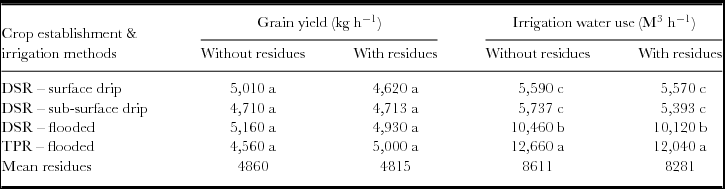
Effect of water management options on the grain yield of rice (2014) and savings in irrigation water (BISA Station, Ludhiana, Punjab, India, 2015).

Means followed by the same letter are not significant at 0.05 probability using Duncan's mean separation.
DSR = Direct seeded rice; TPR = transplanted rice.
An exciting new research thrust in the Punjab State of India at the BISA farm is the testing of new water management options for growing rice and wheat. Table 2 shows preliminary data obtained for rice using surface and sub-surface drip compared to flooding in TPR and DSR treatments. The yields are similar for all systems but the drip system saves almost 57% of irrigation water compared to traditional flooding (BISA, 2015). The sub-surface drip system is costlier to install since it needs to be placed at a depth (10 cm or more) to prevent damage when seeding and to provide water to the roots. Two additional benefits occur with the drip systems. First, the drip lines can be used for fertigation of the crop at planting and also top dressing to improve nutrient use efficiency. Second, for the sub-soil drip system, an unanticipated benefit was that fewer weeds germinated because the surface soil was dry. The researchers at the BISA farm in Ludhiana will continue this research with wheat to assess rice–wheat system water savings. They are looking at the spacing of the drip lines and measuring the benefits of different fertilizer strategies.
Use of herbicides in South Asia are often mentioned as an issue because of the problems of proper training, equipment and availability of the proper herbicides in local shops. However, herbicide use is a common practice these days in many parts of South Asia. For the DSR system, researchers have identified a mixture of bispyribac sodium and pyrozosulfuron as an effective mixture to manage the complex weeds that germinate in DSR (Singh et al., Reference Singh, Jat, Ganie, Chauhan and Gupta2016). Another practice being promoted is to grow a cover crop of Sesbania sesban intercropped with rice at seeding. This legume crop is knocked down 30 days after seeding with a spray of 2,4D. It suppresses weeds and supplies nitrogen to the rice crop but does not compete that much with the growing rice crop. After several years of weed-free rice using herbicides and mulch, the weed seed bank in the soil is reduced and weeds become less of a problem.
Another technology that would ease the problem of controlling weeds in DSR is herbicide tolerant (HT) rice into rice–wheat systems. Service providers could provide good quality HT seed to the farmer and be trained to apply the glyphosate herbicide uniformly at the proper dose and timing. Since rice is a self-pollinated crop, farmers could keep their own seed for several years and still retain the HT gene.
The third major issue with puddled, transplanted rice is the large amount of labour it requires. Information available from the IRRI knowledge bank indicates that 30 people-days per hectare are needed to transplant rice after the seedlings have been up-rooted from the seedbed. It seems that despite the large population in South Asia, labour for agriculture is becoming costlier and more difficult to find. In a recent visit to Eastern India, labour scarcity was the major issue raised by the farmers we met. The cost of labour for producing puddled, transplanted rice was said to be around $200 ha−1 compared to $10 ha−1 for ZTDSR.
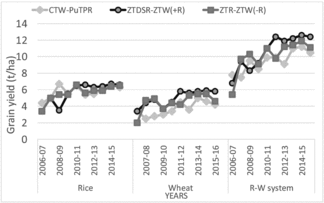
The results for CA in both rice and wheat phases systems are very encouraging (Figure 4). ZTDSR followed by ZT wheat plus residue retention in both crops gave significantly better yields and net returns than TPR followed by conventionally tilled wheat (Jat, Reference Jat2015 and Reference Jat2016). This data from the BISA station in Bihar indicates that after 2–3 seasons of CA with residue retention, there is an improvement in soil physical and biological properties (soil health), along with higher yields and net returns.
Long-term effect of tillage and crop establishment methods on productivity of rice, wheat and system using same variety and fertilizer levels (Jat, Reference Jat2016).

PRESENT AND FUTURE RESEARCH DIRECTIONS IN RICE–WHEAT SYSTEMS IN SOUTH ASIA
Apart from the research on the rice and wheat crops outlined earlier research is also underway now and in the future to add other crops to the rice–wheat system. The following are some initial results to show advances being made in this regard.
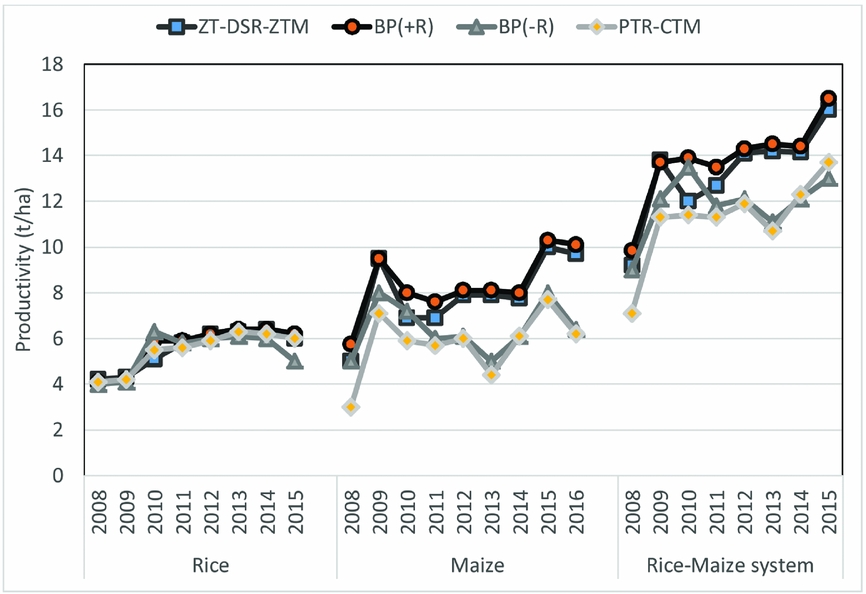
Maize is rapidly emerging as a favourable option for farmers in South Asia, particularly in rice-based systems in eastern India. It helps in system diversification (and biodiversity) by introducing new rotations. Initial work has focused on four tillage systems: (1) ZT maize after ZT rice, with anchored residues (2) maize on permanent beds (ZT on beds) after rice and keep rice residues, (3) maize on permanent beds after rice, removing rice residues, (4) conventional till maize after conventional puddled transplanted rice. Data is presented in Figure 5 and shows the importance of residue retention when combined with zero-tillage (on beds or flat).
Rice–maize system productivity (t ha−1) under different tillage practices over 9 years. (Jat, Reference Jat2016).

Researchers are also looking at DSR (also ZT) to allow farmers to plant earlier than TPR system. They no longer have to wait for rains or to irrigate for land preparation and if they use ZT they can plant even earlier. This has two possible benefits:
First, if the rice variety is not photoperiod-sensitive and matures earlier, wheat can be planted early and avoid the heat stress when it matures in March/April. But if wheat is planted too early, it bolts (does not tiller) and this results in low yield. Plant breeders are now looking for wheat varieties that can be planted earlier, (end of October), do not bolt and do not sacrifice yield. They found that varieties with weak vernalization requirement like HD2927 and CSW 18 (two Indian varieties) performed much better and did not have yield reductions compared to other non-vernalization sensitive varieties with October planting. Yields decline with all wheat varieties as planting date is delayed due to heat stress during grain filling in March/April; early wheat planting avoids this terminal heat stress. Since global climate change seems to be raising the temperatures during wheat grain filling in South Asia, this is a good strategy to mitigate climate change.
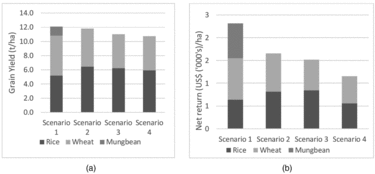
Second, by changing the rice variety and its date of planting using ZTDSR land can be available for wheat planting in October resulting in wheat harvest by the end of March. A crop of mung bean can then be added as a legume to the system. The productivity and profitability of this system is shown in Figure 6a and b. All rice varieties were planted the first week June by ZT, except for the 4th scenario (d) that was seeded in seedbeds the first week of June but transplanted 25 days later. Results show that long duration rice gave slightly higher rice yields but caused a delay in wheat planting that further delayed mung planting. Only the late March mung planting date produced a good crop. Later planted mung dates failed because of early monsoon rains and pests. The lowest productivity and net returns were in the 4th scenario (d) with lower cereal yields and no mung production. Introduction of the mung crop enhanced economic returns if planted early enough to escape monsoon rains and pests, but also added to soil carbon and nitrogen build-up and utilized residual nitrate before it is leached from the soil profile by the monsoon rains. Interestingly, harvest of mung was done by hand by women in the community who share the produce on a 25:75 basis. This helped improve household food security and provided local employment for women.
(a) and (b): Productivity and profitability (cumulative yield) under different scenarios in rice–wheat systems of the Indo-Gangetic Plains of Bihar. (Raj Kumar Jat, BISA 2015).

CONCLUSION
This paper shows that much progress on extending and fine tuning the use of CA to farmers in the IGP of South Asia by scientists and stakeholders has occurred since ZT wheat was first introduced in the early 1990’s. The paper shows that introducing a new technology or management system like ZT or CA takes time. Farmers first have to test and evaluate a new technology and see for themselves the benefits before they are likely to consider adopting it. Enabling factors have to be put in place like appropriate equipment or ways to control weeds before they can even be assessed by farmers. At the time of the Erenstein paper in 2010, research on CA in rice–wheat systems was a progress in action. This paper outlines the progress in addressing the various issues raised in the 2010 paper. Responsible intensification research and farmer experimentation using a step wise approach has successfully moved from an emphasis on the wheat phase of RW systems to the rice phase and has shown that using CA in both crops (and other crops) of the system increases yields, water use efficiency, profits, reduces fuel and greenhouse gas emissions and labour. These findings were also confirmed in many village and farmer field, farmer managed experiments in the various South Asian CA research locations in the IGP, including in the eastern regions, previously neglected. Critical to success was the development of new and improved seed drills by local equipment manufacturers for handling loose residues and for planting a wider range of crops. With those machines, work has also started and been successful in diversifying the cropping systems and allowing the addition of rotations to the CA package. Although not recorded in this paper, research and farmer field activities have started and been successful in the black cotton soils of MP and other ecosystems of South Asia with much different cropping system and soils than the RW system in the IGP (Singh et al., Reference Singh, Singh, Tomar and Gupta2013). In these black cotton soils, the use of disc openers on a happy seeder with retention of surface residues is vital for success and establishment of any crops with zero-tillage on these difficult to manage soils. Future research will expand to other cropping systems and environments to introduce CA to farmers in other parts of South Asia.
Farmers adopting CA are getting better yields at lower cost, less labour and with more efficient use of inputs and water. This is allowing farmers more profitable, responsible intensification of existing agricultural land. It has also provided some solutions for dropping water tables and helping to mitigate the problem of climate change (a consequence of greenhouse gas emissions). One very important conclusion relates to the definition of CA. The full adoption of all three CA principles takes time. The data presented in this paper shows that it is better to introduce parts of the CA principles stepwise to farmers using the ones that have immediate positive outcomes first rather than introducing the entire package. The researchers in India first introduced ZT in wheat. This helped with more timely planting and serendipitously a way to control herbicide resistant weed problems. Farmers saw immediate benefits and were then more willing to discuss other parts of the package like residue retention, rotations and using CA principles on the flat and on permanent beds. They were then ready to look at the rice phase or use ZT on other crops that could be used to diversify the cropping system using CA.
Another important factor in this paper is the involvement of innovative farmers in their own fields to experiment with the technology so they can see for themselves the benefits and then become the best people to extend the technology to their neighbours. Also important was using a ‘hub’ system suggested by the scientists with the CSISA project that involved key players from farmers to agribusiness to researchers working together in selected villages. This helped accelerate adoption of CA since innovative farmers who were willing to try CA and other technologies like laser levelling then became the major way to extend knowledge to other local farmers. Since there are many farmers with small landholdings who cannot afford to own a tractor or buy a ZT drill, training service providers and helping them finance the equipment they need is the best way to accelerate adoption of CA and make technology available to this important but poorer sector of the agricultural community.
Finally, much of this work has been done in recent years. Now that CA has been demonstrated to be a reliable management system in many different parts of South Asia, especially India, and manufacturers are making and selling appropriate equipment, the future of food security in India looks more optimistic than before. The Indian scientists have also developed confidence in their abilities to conduct good research and interact with farmers so that the research is not left station bound but is adopted by farmers for the benefit of the nation.