Previous research has shown cognitive benefits from bilingualism across the lifespan in studies with older adults (Bialystok, Craik, Klein & Viswanathan, Reference Bialystok, Craik, Klein and Viswanathan2004; Bialystok, Craik & Luk, Reference Bialystok, Craik and Luk2008; Bialystok, Craik & Ryan, Reference Bialystok, Craik and Ryan2006; Gold, Kim, Johnson, Kryscio & Smith, Reference Gold, Kim, Johnson, Kriscio and Smith2013; Schroeder & Marian, Reference Schroeder and Marian2012), young adults (Colzato et al., Reference Colzato, Bajo, van Den Wildenberg, Paolieri, Nieuwenhuis, La Heij and Hommel2008; Costa, Hernández, Costa-Faidella & Sebastián-Gallés, Reference Costa, Hernández, Costa-Faidella and Sebastián-Gallés2009; Costa, Hernández & Sebastián-Gallés, Reference Costa, Hernández and Sebastián-Gallés2008; Luo, Luk & Bialystok, Reference Luo, Luk and Bialystok2010; Prior & MacWhinney, Reference Prior and MacWhinney2010), young children (Bialystok & Viswanathan, Reference Bialystok and Viswanathan2009; Carlson & Meltzoff, Reference Carlson and Meltzoff2008; Kalashnikova & Mattock, Reference Kalashnikova and Mattock2014; Kapa & Colombo, Reference Kapa and Colombo2013; Martin-Rhee & Bialystok, Reference Martin-Rhee and Bialystok2008), and infants (Kovács & Mehler, Reference Kovács and Mehler2009; Singh, Fu, Rahman, Hameed, Sanmugam, Agarwal, . . . & Rifkin-Graboi, Reference Singh, Fu, Rahman, Hameed, Sanmugam, Agarwal and Rifkin-Graboi2014). However, little is known about the consequences for different types of bilingual experience. It is clear that how bilinguals use their languages is a relevant, if not well-understood, variable (Green & Abutalebi, Reference Green and Abutalebi2013).
As recently argued, bilingualism is better characterized as a spectrum than a categorical variable (Luk & Bialystok, Reference Luk and Bialystok2013). Bialystok and Barac (Reference Bialystok and Barac2012) showed that children who had spent a longer time in an immersion education program perform better on executive control tasks after controlling for age and other factors, and Singh and Mishra (Reference Singh and Mishra2012, Reference Singh and Mishra2013) reported larger advantages for more proficient than less proficient bilinguals. However, the opposite situation has not been studied: namely, individuals who had learned a second language, even to a high level of fluency, and then stopped using it. The question is whether there are residual effects of bilingualism after the individual becomes functionally monolingual. French immersion programs in Canada provide an opportunity to study such individuals, as some students go on to pursue French studies and continue to speak French, while others cease all use of French once they leave the program. In the present study, we administered cognitive tasks to individuals who had maintained French language skills beyond secondary school (‘full bilinguals’) and those who stopped using French after primary school (‘lapsed bilinguals’) and compared their performance to a group of monolinguals.
One well-studied executive control task in this research is the flanker task (Eriksen & Eriksen, Reference Eriksen and Eriksen1974) with most studies demonstrating better performance by bilinguals than monolinguals (Carlson & Meltzoff, Reference Carlson and Meltzoff2008; Costa et al., Reference Costa, Hernández, Costa-Faidella and Sebastián-Gallés2009, Reference Costa, Hernández and Sebastián-Gallés2008; Emmorey, Luk, Pyers & Bialystok, Reference Emmorey, Luk, Pyers and Bialystok2008). The task requires participants to indicate the direction of a target arrow in the presence of similar- (congruent) or dissimilar-facing (incongruent) arrows. Accuracy is generally at ceiling, but bilinguals often perform faster than monolinguals, particularly on incongruent trials. However, the evidence has been inconsistent (Costa et al., Reference Costa, Hernández, Costa-Faidella and Sebastián-Gallés2009), and studies in which participants are not clearly monolingual or bilingual are particularly unlikely to find these results (Paap & Greenberg, Reference Paap and Greenberg2013). Therefore, the nature or duration of bilingualism might impact these findings.
Working memory is another aspect of executive control that has sometimes shown differences between bilinguals and monolinguals (Blom, Kuntay, Messer, Verhagen & Leseman, Reference Blom, Kuntay, Messer, Verhagen and Leseman2014; Morales, Calvo & Bialystok, Reference Morales, Calvo and Bialystok2013) and sometimes not (Engel de Abreu, Gathercole & Martin, Reference Engel de Abreu, Gathercole and Martin2011). Working memory is arguably the most central aspect of cognitive processing, so we included a working memory task in our investigation. We chose a difficult version of the recent-probe task (Jonides & Nee, Reference Jonides and Nee2006; Sternberg, Reference Sternberg1966) that was used by Bialystok, Poarch, Luo and Craik (Reference Bialystok, Poarch, Luo and Craik2014). Because the task is complex, there are few ceiling effects that could mask group differences in some studies, such as those often found with the flanker task.
To summarize, we investigated whether individuals who had achieved a high level of bilingualism in childhood but did not maintain it into young adulthood performed executive function tasks more like monolinguals or like full bilinguals who had the same childhood experience.
Method
Participants
The study included 80 university students between the ages of 17 and 33. Participants were classified into three groups: 27 functional monolinguals (M age = 20.8 years, SD = 1.9), 23 lapsed bilinguals (M age = 21.7 years, SD = 4.1), and 30 full bilinguals (M age = 21.4 years, SD = 2.3). We note, however, that the full bilingual group was strongly L1 (English) dominant so does not qualify as a group of balanced bilinguals, the group used in most research examining bilingualism and executive control. Thus, any evidence for cognitive advantages in this group would be more compelling. One participant in the lapsed bilingual group was excluded from analyses due to computer malfunction, for a final sample of 79 participants. Participants were recruited from either an undergraduate participant pool (receiving course credit) or advertisements posted on campus (receiving $20). Individuals were excluded if they spoke or understood any language in addition to English or French, or if they reported using French in the home.
Questionnaires
Language and Social Background Questionnaire (LSBQ)
The LSBQ (Luk & Bialystok, Reference Luk and Bialystok2013) was administered to obtain information regarding the participants’ language background, skill level, and the contexts in which they spoke English and French. Participants rated their ability in English and French for speaking, understanding, reading, and writing as well as their overall level of bilingualism on a 5-point Likert scale.
French Language Experience Questionnaire (FLEQ)
This questionnaire was used to examine the French language experience of all participants. It included questions about length of time spent in a French-speaking community, study abroad experiences, and the type of school attended (e.g., English school with French courses, English school with a French Immersion component, French school with no English courses, etc.) from grade 1 through university.
Standardized Background Measures
Standardized tests were used to assess English receptive vocabulary (Peabody Picture Vocabulary Test – III, PPVT; Dunn & Dunn, Reference Dunn and Dunn1997), French receptive vocabulary (Échelle de Vocabulaire en Images Peabody, ÉVIP; Dunn, Thériault-Whalen & Dunn, Reference Dunn, Thériault-Whalen and Dunn1993), verbal fluency in English and French (Delis, Kaplan & Kramer, Reference Delis, Kaplan and Kramer2001), and fluid intelligence (Cattell Culture Fair Intelligence Test; Cattell & Cattell, Reference Cattell and Cattell1960). These tests were administered according to published instructions.
Executive Control Tasks
Flanker Task
The flanker task (Eriksen & Eriksen, Reference Eriksen and Eriksen1974; cf., Emmorey et al., Reference Emmorey, Luk, Pyers and Bialystok2008) was to determine whether a red chevron was pointing left or right as quickly and accurately as possible using computer mice that were positioned on each side of the display. The task consisted of three types of blocks: baseline, neutral, and mixed (congruent/incongruent). In the baseline block, there was a single red chevron in the center of the screen; in the neutral block, the chevron was flanked by four black diamonds; and in the mixed block, the red chevron was flanked by black chevrons facing either in the same (congruent) or opposite (incongruent) direction. The target chevron could appear in the second, third, or fourth position in the row of five stimuli. Five blocks were presented in the following order: baseline (30 trials), neutral (30 trials), mixed (30 congruent, 30 incongruent trials), neutral (30 trials), and baseline (30 trials).
Working Memory Task
An adapted version of the recent-probe task (Jonides & Nee, Reference Jonides and Nee2006; Sternberg, Reference Sternberg1966) was administered to assess proactive interference in working memory (cf., Bialystok et al., Reference Bialystok, Poarch, Luo and Craik2014). Participants were presented with an array of four stick figures for 2500 ms, followed by a blank screen for 1500 ms. Subsequently, a single stick figure appeared on the screen and participants were asked to indicate whether this figure was one of the four in the previous display. Following an initial set of practice trials, participants were given three minutes to study pictures of the stick figures before beginning the task.
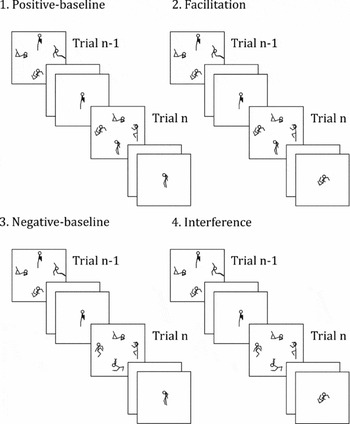
There were four trial types, as depicted in Figure 1: Positive-baseline, requiring a “yes” response to a probe that was in the array but did not appear in the n-1 trial; facilitation, requiring a “yes” response to a probe that appeared in both the target array and the n-1 trial; negative-baseline, requiring a “no” response to a probe that did not appear in the array or in the n-1 trial; and interference, requiring a “no” response to a probe that did not appear in the array but was shown in the n-1 trial. The task consisted of a single block of 64 total trials: 16 positive-baseline, 16 facilitation, 16 negative-baseline, and 16 interference.
Working memory task conditions.

Procedure
Informed consent was obtained at the beginning of the test session, followed by completion of the LSBQ and FLEQ. Tasks were presented in the following order, with English and French versions counterbalanced across participants: receptive vocabulary, verbal fluency, flanker, Cattell, working memory, receptive vocabulary, verbal fluency.
Results
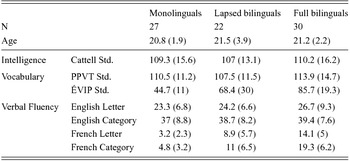
Participant characteristics are presented in Table 1. One-way ANOVAs revealed no significant differences between language groups for age, Cattell standardized scores, or PPVT, Fs ≤ 1, but a significant group effect for French receptive vocabulary, F(2, 76) = 27.8, ƞp 2 = .42, p < .001. Planned comparisons showed that full bilinguals outscored lapsed bilinguals, p < .05, who in turn outperformed monolinguals, p < .001.
Participant characteristics and mean score (and standard deviation) for measures of intelligence and language proficiency.

Verbal fluency scores are also presented in Table 1 Footnote 1 . There were no differences between groups for the number of exemplars generated in English for either letter, F(2, 73) = 1.4, p = .25, or category fluency, F < 1, but significant group differences were found in French for both letter, F(2, 73) = 40.5, ƞp 2 = .53, p < .001, and category fluency F(2, 73) = 49.9, ƞp 2 = .58, p < .001. Post-hoc comparisons revealed that the full bilinguals generated more exemplars than lapsed bilinguals for both fluency conditions, ps < .001, and that lapsed bilinguals generated more exemplars than did monolinguals, ps < .001. Thus, all group contrasts for measures of French proficiency were significant, supporting the division of participants into monolingual, lapsed bilingual, and full bilingual.
Flanker Task
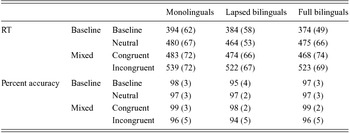
Performance on the flanker task was high, with more than 94% of trials correct for all groups on all trial types. These data are reported in Table 2, but because accuracy was essentially at ceiling, they were not analyzed further.
Mean flanker reaction time in ms (and standard deviation) for each condition by language group

Mean reaction times for the flanker task are shown in Table 2. Incorrect trials and correct trials below 50 and above 1500 milliseconds were excluded from RT analyses. The remaining data were analyzed with two mixed factor ANOVAs: a 2-way ANOVA for the baseline block for language group (monolinguals, lapsed bilinguals, full bilinguals) by trial type (baseline, neutral), and a 2-way ANOVA for the mixed block condition for language group by trial type (congruent, incongruent). The first analysis revealed a main effect of trial type, F(1, 76) = 537.2, ƞp 2 = .88, p < .001, as baseline trials were faster than neutral trials. There was no main effect of language group, F < 1, or interaction between language group and trial type, F(2, 76) = 2.5, p = .09. The analysis of the mixed block also revealed a main effect of trial type, F(1, 76) = 152.8, ƞp 2 = .67, p < .001, as congruent trials were faster than incongruent trials. The main effect of language group and the interaction of language group and trial type were not significant, Fs < 1.
Working Memory
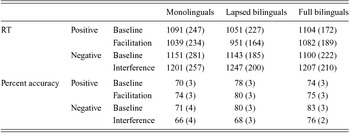
Mean RT data and accuracy from the working memory task are presented in Table 3. We conducted 2-way mixed factor ANOVAs separately for positive trials (the correct response is “yes”) and negative trials (the correct response is “no”) because the processing involved in each is different, particularly in the relation between the baseline and the alternative.
Mean working memory RT in ms (and standard deviation) by condition and language group

For accuracy data, the analysis of positive trials revealed no significant effect of trial type, F(1, 76) = 2.1, p = .15, group, F(2, 76) = 1.6, p = .21, or their interaction, F < 1. For negative trials, there was a main effect of trial type, F(1, 76) = 16.4, ƞp 2 = .18, p < .001, because interference trials were less accurate than baseline trials. There was also a main effect of language group, F(2, 76) = 4.6, ƞp 2 = .11, p < .01. Planned pairwise comparisons revealed that full bilinguals outperformed monolinguals, and the lapsed bilingual group was between them and not significantly different from either. The language group by trial type interaction was not significant, F(2, 76) = 1.1, p = .34.
The reaction time data were submitted to the same analyses. Incorrect trials and correct trials below 300 and above 2500 milliseconds were excluded from analyses. In the analysis of the positive trials, there was a main effect of trial type, F(1, 76) = 9.3, ƞp 2 = .11, p < .01, as facilitation trials were faster than baseline trials. There was no main effect of language group, F(2, 76) = 1.5, p = .23, and no interaction of language group by trial type, F(2, 76) = 1.4, p = .26.
For the negative trials, there was an effect of trial type, F(1, 76) = 19.78, ƞp 2 = .21, p < .001, this time because interference trials were slower than baseline trial. Again, there was no main effect of language group or interaction of language group and trial type, Fs < 1.
Discussion
Previous research examining fully fluent bilinguals and monolinguals has demonstrated advantages for bilinguals in some executive control tasks. Such advantages have also been reported for individuals who were not fully bilingual or were in the process of becoming bilingual (e.g., Khare, Verma, Kar, Srinivasan & Brysbaert, Reference Khare, Verma, Kar, Srinivasan and Brysbaert2013). Other evidence has suggested that more balanced proficiency in two languages is associated with greater cognitive advantages (Kushalnagar, Hannay & Hernandez, Reference Kushalnagar, Hannay and Hernandez2010). What is not known is what happens to individuals who had been actively bilingual at a previous time in their lives and did not continue to function in that other language. Are there residual effects of bilingualism that persist after the individual becomes functionally monolingual?
Using French immersion education to investigate this question dramatically reduces variance inherent in typical monolingual and bilingual populations. All the participants in the present study belonged to a homogenous demographic of students attending public schools in the same urban center. Individuals in the two bilingual groups had attended French immersion programs from about the age of 5 years, a decision undoubtedly made by their parents, but some of them left the program after grade 6 (11 years old) for a regular English stream. Participants in the full bilingual group continued their middle school and high school education in French and were maintaining French in their current lives. We note, however, that even this group is not balanced in their proficiency or usage of the two languages, making this study a conservative test of the hypothesis. The monolingual students in the same public education system had encountered obligatory French classes at some point, but these were minimal and all participants in that group reported no use of French in their lives. The results of French vocabulary and fluency tests confirmed these group designations. Therefore, a comparison of the performance of these three groups on executive control tasks provides a reasonably clear assessment of the effect of bilingual experience on cognitive performance.
The two executive control tasks, flanker and recent probe working memory, yielded different results. The flanker task showed expected task effects between congruent and incongruent trials, but no significant language group effects. The task was very simple and produced accurate responses and fast RTs for all participants. Under these conditions, it is difficult for one group to perform even faster (cf., Paap & Greenberg, Reference Paap and Greenberg2013; see also Kroll & Bialystok, Reference Kroll and Bialystok2013). Bilingual advantages in performing this task are more likely to emerge for children (Yang, Yang & Lust, Reference Yang, Yang and Lust2011) and older adults (Bialystok et al., Reference Bialystok, Craik and Luk2008) where the task is generally more effortful and performance is substantially slower. In a study with young adults, there were no group differences in behavioral measures, but monolinguals and bilinguals used different brain networks during task performance, particularly for the incongruent trials (Luk, Anderson, Craik, Grady & Bialystok, Reference Luk, Anderson, Craik, Grady and Bialystok2010). Hence, equivalent behavioral results may mask group differences in performance.
The recent-probe working memory task is more difficult, and group differences did emerge in accuracy scores, although not in reaction time. The crucial trials are the two negative trial conditions in which a familiar stimulus must be rejected because it did not appear in the current trial. Rejection is more difficult if the stimulus did appear in the previous trial, increasing its familiarity and creating interference.
The accuracy results showed that the full bilinguals outperformed the monolinguals on these conditions, and the lapsed group fell somewhere between them, statistically indistinct from both. The bilingual advantage on this task replicates results from a study comparing monolingual and bilingual younger and older adults (Bialystok et al., Reference Bialystok, Poarch, Luo and Craik2014).
The current results show that accuracy in performing this difficult working memory task depends on language experience. As predicted, bilinguals were more successful than monolinguals in avoiding interference from the lure in the negative trials. Individuals who had previous experience with bilingualism were somewhere between these groups, and not significantly different from either; numerically the scores from the lapsed group were higher than those from the monolinguals but lower than those from the bilinguals. This pattern is consistent with an executive control advantage weakening if bilingualism is not maintained. There were no other differences between the three groups, so most potential sources of confound, such as language proficiency and intelligence, can be ruled out. Moreover, participants in all groups performed equivalently on the positive conditions, and that too is consistent with the predictions.
It would be interesting to know whether the lapsed bilinguals had cognitive advantages over their monolinguals peers at the moment of their graduation from the immersion program. Retrospective data such as these cannot capture possible differences that perhaps contributed to the decision by some students to continue in an immersion program and others to leave, but we do note that, at the time of the present study, all participants performed equally on English language proficiency and intelligence tests. Additionally, it remains to be seen whether such advantages could be regained through further language training, either in French to restore the individual's previous level of fluency, or even fluency in a new language.
In summary, our data are consistent with the idea that the executive control advantages from bilingualism are calibrated to the current level of bilingual activity. Maintaining that level of bilingualism is crucial to maintaining the benefits that ensue, but lapsing to monolingualism does not fully erase those gains.