The genus Leptogorgia Milne-Edwards & Haime, 1857 (Anthozoa: Alcyonacea: Gorgoniidae) has a widespread occurrence (Meditteranean Sea; Atlantic coast of Europe to South Africa; Atlantic coast of America and Antilles; Pacific coast of America), with about 100 valid species from the shallow to the deeper waters (Bayer, Reference Bayer1961; Grasshoff, Reference Grasshoff1992; Breedy & Guzman, Reference Breedy and Guzman2005).
Two species of Leptogorgia are reported so far from the Mediterranean Sea: L. sarmentosa Esper, 1789 and L. viminalis (Pallas, 1766), which are distinguished by morphological criteria, colony growth form, colour, and sclerite size (Grasshoff, Reference Grasshoff1992).
The colonies of L. sarmentosa are brick-red to pale yellow, branched in all directions with branches thin, often overhanging, and thus direction downwards. Those of L. viminalis, on the other hand, are yellow, brown or violet branched in one plane with upright branches (Carpine & Grasshoff, Reference Carpine and Grasshoff1975).
Leptogorgia sarmentosa Esper, 1789 is a typical circalittoral member of the benthic Mediterranean fauna normally found between 10 and 300 m depth, on boulders which are usually found on soft bottoms or rocks lying burrowed in sediment, in a wide range of current velocities but favouring strong ones (Carpine & Grasshoff, Reference Carpine and Grasshoff1975; Weinberg, Reference Weinberg1976). It feeds on nanoeukaryotes, dinoflagellates, diatoms, ciliates, as well as detrital POC and is considered a microplankton suspension feeder (Ribes et al., Reference Ribes, Coma and Rossi2003).
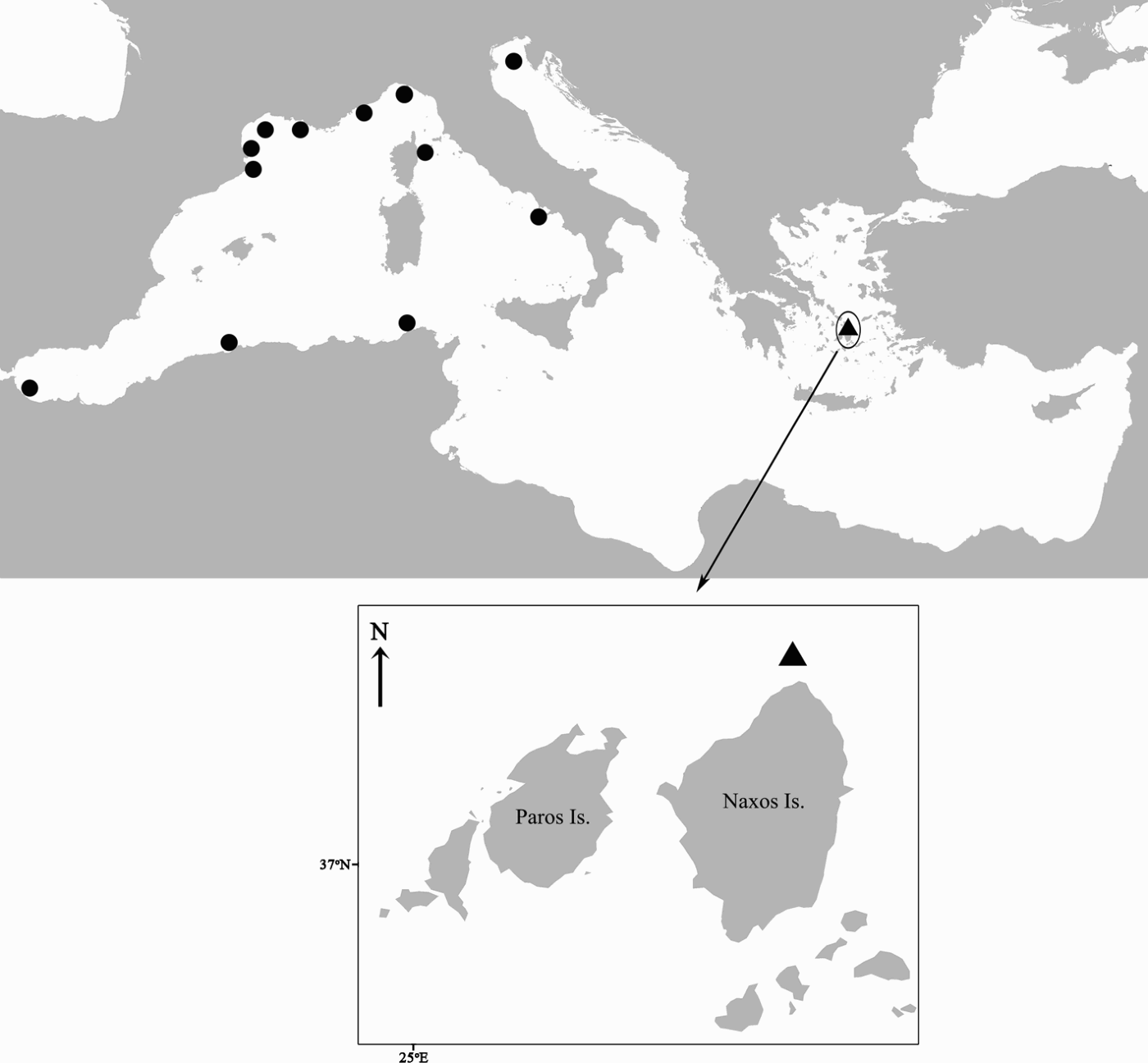
Records of the species in the Mediterranean (Figure 1) are available mostly for the western part (Carpine & Grasshoff, Reference Carpine and Grasshoff1975; Weinberg, Reference Weinberg1976; Grasshoff, Reference Grasshoff1992) and the Adriatic Sea (Pax & Müller, Reference Pax and Müller1962). In the nearest Atlantic region it has been found from Biscay to Guinea Gulf (Stiasny, Reference Stiasny1937; Grasshoff, Reference Grasshoff1992).
Geographical distribution of Leptogorgia sarmentosa in the Mediterranean Sea (dots) and location of Aegean record (triangle).

In July 2000, one colony of an uncommon coral species was collected together with the soft coral Eunicella singularis (Esper, 1791) with gill-nets at a depth of 30 m at Naxos Island (central Aegean Sea) (37°22′15″N 25°52′17″E). The colony was attached to a small calcareous stone. The sampling area is oligotrophic and not seriously affected by human activities. The animal was dried and sent to the Institute of Fisheries Research (FRI) at Kavala where it has been deposited (MFRI IA52). The dried specimen allowed its safe identification as Leptogorgia sarmentosa Esper, 1789 according to Grasshoff (Reference Grasshoff1992).
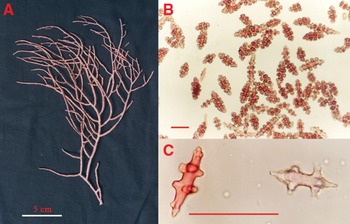
The colony (Figure 2A) has the form of many short, straight and slender ramifications, ramifying in an almost dichotomous way. The colony grows in one plane, and reaches 248 mm in height and 177 mm width. The dry colour is brick-red. The polyps lie either randomly distributed or follow each other at regular intervals on either sides of the branches, in the same plane as the entire colony. Three types of sclerites (Figure 2B, C) have been found and measured as follows:
(a) spindles with rough warts from coenenchyme, brick-red in colour; length: 52–196 µm (mean 106 ± 37.6 µm, N = 70); width: 24–48 µm (mean 35 ± 5.59 µm, N=70); average slenderness (width/length): 0.18–0.57 (mean 0.36 ± 0.11);
(b) spindles with smooth warts from anthocodia, brick-red in colour; length: 36–156 µm (mean 82.3 ± 23.4 µm, N=50); width: 12–32 µm (mean 23 ± 6.3 µm, N=50); average slenderness (width/length): 0.15–0.39 (mean 0.29 ± 0.06);
(c) spiny spindles probably from the rind, colourless and transparent; length: 28–44 µm (mean 36.2 ± 4.54 µm, N = 25); width: 20–32 µm (mean 25.8 ± 2.85 µm, N=25); average slenderness (width/length): 0.55–0.89 (mean 0.72 ± 0.09).
The colony (A) spindles from anthocodia and coenenchyme (B) and spiny spindles from the rind (C) of Leptogorgia sarmentosa found in the Aegean Sea. Scale bars: 50 µm.

Twenty-one gorgonian species are documented in the Mediterranean Sea (Carpine & Grasshoff, Reference Carpine and Grasshoff1975; Grasshoff, Reference Grasshoff1992; Hofrichter, Reference Hofrichter2003). The finding of L. sarmentosa represents the first record of this species in the eastern Mediterranean and raises the known number of recorded species to twelve (Carpine & Grasshoff, Reference Carpine and Grasshoff1975; Vafidis et al., Reference Vafidis, Koukouras and Voultsiadou-Koukoura1994).
The higher species diversity in the western basin can be explained by the occurrence of a number of Atlantic species with eastern boundaries in the Mediterranean, i.e. in various areas of the western basin; western Mediterranean faunal composition constitutes 71% Atlanto–Mediterranean and 29% endemic species whereas the eastern Mediterranean one of 58% Atlanto–Mediterranean and 42% endemic species (Vafidis et al., Reference Vafidis, Koukouras and Voultsiadou-Koukoura1994; Hofrichter, Reference Hofrichter2003). Intensive research effort in the western Mediterranean may also be responsible for this difference in numbers. Another reason is the general impoverishment in the diversity of the eastern part biota due to the oligotrophic conditions in the area (Por & Dimentman, Reference Por, Dimentman, Dumont and Wergel1989). Intensive sampling of the eastern Mediterranean in biotopes such as submarine caves and coralligenous bottoms, rich in gorgonian species, could provide further evidence on the number of the gorgonian species in the area.