INTRODUCTION
The fishery for the common prawn, Palaemon serratus (Pennant 1777) (Neal, Reference Neal2008), is relatively small compared with other European ‘prawn’ fisheries (Nephrops norvegicus and Pandulus borealis); however, in the UK it has significant regional economic importance. In Cardigan Bay (Wales), the fishery accounts for ~76% of total UK landings (estimate from 2013; MMO, 2015). Commercial exploitation of prawns in Cardigan Bay is exclusively an inshore static-gear pot fishery, with most vessels working within six nautical miles of the coast. The fishery begins to target prawn in early autumn and continues through to the following spring (Cardigan Bay Fishermen's Association (CBFA) personal communication). The fishing season is dictated by the reproductive migrations of P. serratus, which are thought to move inshore to release larvae during the summer and then move offshore in winter. Similar seasonal migrations are reported in a range of palaemonid species, including for P. serratus in other regions (Guerao & Ribera, Reference Guerao and Ribera2000; González-Ortegón et al., Reference González-Ortegón, Pascual, Cuesta and Drake2006). The seasonal migration of prawns inshore in the summer decreases static gear catches to levels that are no longer economically viable (CBFA personal communication). Nonetheless, the Cardigan Bay prawn resource is integral in maintaining the economic viability of many fishing businesses as it provides income during a time of the year when the catchability of other target species, such as European lobster (Homarus gammarus), is low. The fishery is therefore an important element in a necessarily diverse static-gear sector.
Commercial demand for a larger-sized prawn has resulted in the introduction of voluntary size-grading of catch by fishers. Since 2008, many Cardigan Bay fishers have used a 10 mm bar-spacing riddle (CBFA personal communication). Prawns that fall through the bars and into the sorting box are discarded overboard, whilst prawns retained by the riddle are stored onboard, usually within small viver systems.
As with many small-scale artisanal fisheries, the Welsh prawn fishery is considered data-poor, with little information pertaining to the fisheries biology of the species. Combined with limited management and the lack of a formal stock-assessment, there is considerable uncertainty about the future sustainability of the fishery. Indeed, fluctuations in inter-annual landings in the Irish fishery (Fahy & Gleeson, Reference Fahy and Gleeson1996; Kelly et al., Reference Kelly, Tully, Lehane and Breathnanch2009) suggest a variable biomass that may be vulnerable to periodic overfishing or recruitment failure in the absence of management. Understanding the interaction of fishing activities with the species biology is necessary to inform future evidence-based management of the fishery and more generally, understanding the reproductive biology of a fished species is critical information when considering ‘supply-side’ ecology of benthic populations with economic value (Underwood & Fairweather, Reference Underwood and Fairweather1989; Anger, Reference Anger2006).
The common prawn is patchily distributed throughout European inshore waters (Kelly et al., Reference Kelly, Tully, Lehane and Breathnanch2009) and occurs between the Mediterranean Sea in the south and the temperate coastal waters of the UK and Ireland in the north (Forster, Reference Forster1951). Although the longevity of the species has been speculated to be up to 5 years (Cole, Reference Cole1958; Forster, Reference Forster1959), P. serratus are more likely to have a relatively short lifespan, with individuals persisting for between 2–3 years (Forster, Reference Forster1951; Fahy & Gleeson, Reference Fahy and Gleeson1996). Similar to other palaemonids, P. serratus is sexually dimorphic, with adult females attaining significantly larger sizes (Forster, Reference Forster1951; Berglund, Reference Berglund1981). Sexual dimorphism may influence mortality rates between the sexes, from both size-selective commercial exploitation and natural mortality through predation (Berglund & Rosenqvist, Reference Berglund and Rosenqvist1986). For female palaemonids, a larger body size also allows for increased fecundity (Guerao et al., Reference Guerao, Pérez-Baquera and Ribera1994). Compared with other similar species, P. serratus broods contain larger eggs with high nutritional values (Morais et al., Reference Morais, Narciso, Calado, Nunes and Rosa2002), which are thought to reflect environmental conditions and increase successful recruitment through the larval phase (Parker & Begon, Reference Parker and Begon1986). The planktonic larval phase is characterized by temperature-dependent periods of incremental growth and metamorphosis (Reeve, Reference Reeve1969a; Kelly et al., Reference Kelly, Tully and Browne2012), while salinity has been shown to influence mortality rates during the early life stages (Kelly et al., Reference Kelly, Tully and Browne2012).
The aim of this research was to fill the knowledge gaps for this data-poor fishery by presenting baseline catch and population biology characteristics (length frequency, sex ratio, size at maturity) during the adult stage of the species life-history and to highlight several potential implications of a mandatory technical conservation measure of riddling catches at 10 mm.
MATERIALS AND METHODS
In August 2013, six commercial fishermen operating from five different ports in Cardigan Bay, Wales, were each given three standard prawn traps (referred to hereafter as ‘science pots’) (Figure 1). The cylindrical pots were fitted with 8 mm mesh on all sides with 35 mm circular entrance at both ends. Once a month, when possible, each fisher recorded the date and GPS location of a haul and the entire contents of each science pot were kept separate and stored frozen. Samples were retained for scientific analysis during two fishing seasons (2013–2014 and 2014–2015), ending in May 2015.
The homeports for the six active Palaemon serratus fishers in Cardigan Bay, Wales; who contributed monthly samples (when possible) during the prawn fishing seasons from 2013, 2014 and 2015. Ports are numbered north to south and are as follows: 1, Aberdovey (2 fishers); 2, Aberystwyth; 3, New Quay; 4, Cardigan; 5, Fishguard.

Scientific pot samples were assessed in the laboratory using a dissecting microscope. All animals caught in the science pots were identified, weighed and measured. Palaemon species were identified according to the illustrated key published by González-Ortegón & Cuesta (Reference González-Ortegón and Cuesta2006). Sex was recorded; male prawns were identified by the presence of an appendix masculina on the second pleopod pair. All morphometric measurements were recorded to the nearest 0.1 mm and included the carapace length (CL; the distance between the posterior of the eye-orbit to the posterior of the cephalothorax carapace segment), carapace width (CW; the widest point of the cephalothorax carapace) and pleura width (PLW; the widest section of the second abdominal pleura). The reproductive state (ovigerous or not) was also noted for female prawns and the fecundity of ovigerous females was calculated from a subsample of 10% of the entire egg mass (wet weight). The fecundity was estimated using the following formula (1); where ϒ indicates the subsample calculated as a proportion of the total eggs mass (T), which was then used to calculate fecundity (F).
 $${\Upsilon _{\left( {{\rm approx}. = 0.1} \right)}} = \displaystyle{{{\rm Weigh}{{\rm t}_{{\rm subsample}}}} \over {{T_{{\rm weight}}}}}$$
 $$F = \displaystyle{{{\rm Coun}{{\rm t}_{{\rm subsample}}}} \over \Upsilon}$$
All statistical analyses were run in ‘R’ (R Core Team, 2014). Prior to statistical modelling data were tested for normality using the Kolmogorov–Smirnov test and inspected visually using a Q-Q plot. Heteroscedasticity was tested using Levene's test and a Cook's distance plot was used to check for outliers. A Hartigan's dip test was used on length distribution data for non-unimodality. The likelihood of the sample having a 1:1 sex-ratio was tested using a G-test. Since we were not able to determine size-at-age for the sampled population, age cohorts are inferred from the observed length distribution. A mixed population approach was used to determine statistical differences between sexes and cohorts within a mixed bi-modal dataset. Using the R packages ‘MIXTOOLS v1.0.3’ (Young et al., Reference Young, Benaglia, Chauveau, Hunter, Hettmansperger and Xuan2015) and ‘MIXDIST v0.5–4’ (Macdonald & Du, Reference Macdonald and Du2011), the mean and standard deviation of the two modes in aggregated male and female length distribution data is presented alongside a goodness-of-fit Chi-square test. We use the results to evaluate the length distributions of immature and mature populations as well as sexual dimorphism within a single mixed-population cohort.
The size of functional maturity was estimated by relating growth parameters (CL) and ovigerous status (binary variable, where 0 = no eggs and 1 = gravid) of females using a logistic regression model (Roa et al., Reference Roa, Ernst and Tapia1999) reformulated by Walker (Reference Walker and Hamlett2005) to give:
 $${P_i} = {\left\{ {1 + {e^{ - \ln \left( {19} \right)\left( {\displaystyle{{{\rm C}{{\rm L}_i} - {\rm C}{{\rm L}_{50}}} \over {{\rm C}{{\rm L}_{95}} - {\rm C}{{\rm L}_{50}}}}} \right)}}} \right\}^{ - 1}}$$
where P i is the proportion of the female population gravid at a given CL. Model parameters were estimated using generalized linear model with logit link function and a binomial error structure. Confidence intervals were added by bootstrapping the generalized linear model (1000 runs). The base R code was constructed by Harry (Reference Harry2013) and is available online.
To describe morphometric maturity and determine at what CL positive allometry occurs, an iterative search procedure was used whereby PLW is modelled against CL for male and female populations separately using piecewise linear regression. The analysis examines the linear morphological relationship (CL:PLW) and searches for significant deviations between male and female growth patterns, indicating sex-specific morphological changes in preparation for sexual reproduction described as a ‘puberty moult’ (Hartnoll, Reference Hartnoll1974). The method searches each potential ‘breakpoint’ or ‘inflection’ (c) within a predetermined range until the model has found the point at which the total residual mean standard error is minimized (Crawley, Reference Crawley2007). The model simulation then produces a value (CL) at which the linear models above and below the breakpoint c show the statistically strongest inflection. The model applied to both male and female datasets is described mathematically using the equation (3).
 $${y_i} = \left\{ {\matrix{ {{\beta _{0}} + {\beta _1}C{W_i}, \; \; C{W_i} \lt c} \cr {{\beta _{2}} + {\beta _3}C{W_i}, \; \; C{W_i} \ge c} \cr}} \right\}$$
where y i is the CL of individual i, c is a breakpoint (inflection) between linear relationships applying above and below the value of carapace length equal to c, and the β parameters are the intercepts and slopes of the two linear relationships.
In order to relate the morphological estimate of population characteristics, fisheries catches (CL) results are converted to CW using the following equations (4) produced by linear regression (P < 0.05):
 $$\!\!\!{\rm C}{{\rm W}_{{\rm Male}}} = 0.563\,{\rm C}{{\rm L}_{{\rm Male}}} + 0.643$$
 $${\rm C}{{\rm W}_{{\rm Female}}} = 0.6389\,{\rm C}{{\rm L}_{{\rm Female}}} - 0.297$$
Individuals with a CW < 10 mm are assumed to be discarded through the use of a 10 mm spaced riddle.
RESULTS
Severe weather conditions during the 2013 and 2014 fishing seasons limited the fishing opportunities and the number of individual prawns that could be sampled within that season (N = 765). In total, fishers returned 82 pot-samples and 4233 P. serratus underwent laboratory analysis (Table 1).
Total number of individual prawns (and number of pot samples returned) by CBFA members during the 2013–2015 Palaemon serratus research period in Cardigan Bay. (−) Indicates an absence of information on how many science pots were hauled for the given sample. Ports are displayed from north to south and are named as follows: 1, Aberdovey; 2, Aberystwyth; 3, New Quay; 4, Cardigan; 5, Fishguard.

Sexual dimorphism and riddling
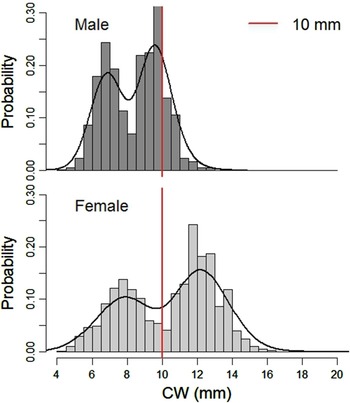
Sexual dimorphism was evident in the length distributions of all samples. Moreover, prawn populations showed bimodal distributions when data were aggregated by fishing season and location (Hartigan's dip-test; D Male = 0.95, D Female = 0.04, P value < 0.001). The majority of male prawns and the smaller sized cohort of female prawns caught in the small mesh science pots were of a size that would be discarded using the 10 mm riddle employed by Cardigan Bay fishers (Figure 2).
A length frequency histogram with a probability density function for male (above) and female (below) Palaemon serratus caught in science pots during the 2013–2015 Palaemon serratus research period in Cardigan Bay. The solid vertical red line represents the voluntary sorting size (10 mm CW) used by many fishers in Cardigan Bay.

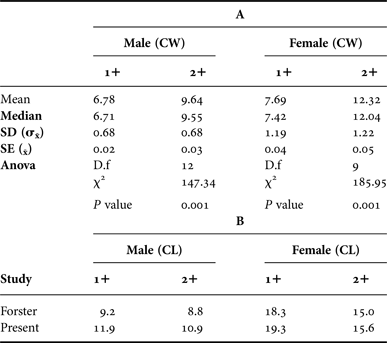
Carapace width varied significantly between sexes and two cohorts were identified using a mixed population cohort analysis (1+ and 2+; summary statistics and ANOVA results in Table 2). Table 2 compares dimorphism highlighted by Forster (Reference Forster1951) and the present study. A higher proportion of the males (78.3%) caught were smaller than 10 mm CW compared with the females (39.7%) in catches.
(A) Descriptive statistics for mixed-population cohort analysis of 1+ and 2+ cohorts of P. serratus caught during the 2014/2015 fishing season in Cardigan Bay, showing CW as the morphometric measure (mm). (B) The average CL (mm) of male and female 1+ and 2+ cohorts of Palaemon serratus reported by Forster (Reference Forster1951) and this study.

Length data reported in Forster (Reference Forster1951) were presented in terms of total length (TL) and equated to CL using the formula described in Emmerson et al. (Reference Emmerson, Haig, Robson and Kaiser2015).
The maximum size observed in the sampled population showed females grew to a size considerably greater than males, whilst the length distribution of catches show that the average male prawn within the 2+ cohort does not reach a size at which it recruits into the Cardigan Bay prawn fishery.
Sex ratio
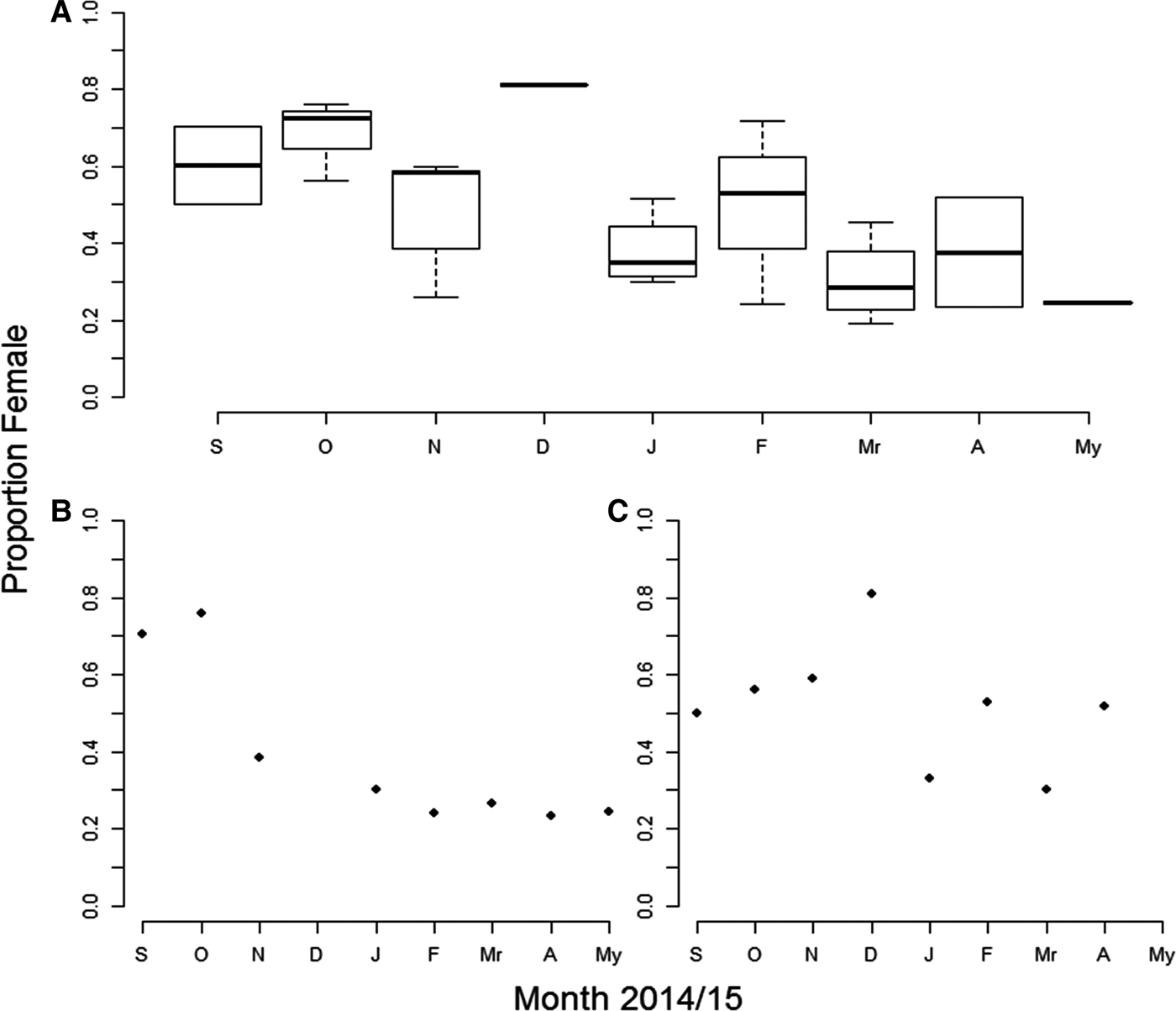
The sex ratio of catches varied significantly from the expected 1:1 ratio, with both male and female directed skews being observed throughout the sample period (Figure 3A).
(A) The sex-ratio of prawn (Palemon serratus) caught in science pots from during the 2014/2015 in Cardigan Bay and (B) the sex ratio of catches in localized datasets from New Quay and (C) Aberystwyth.

For all locations sex ratios were female skewed in autumn and winter samples, with a higher proportion of males caught in spring. Where an extended time-series was available from a single location, data exhibited strong temporal trends in the sex ratio and declining abundance of females as the fishing season progressed in New Quay (Figure 3B); however, the data trend was less clear in the samples from Aberystwyth (Figure 3C).
Size at maturity (SOM)
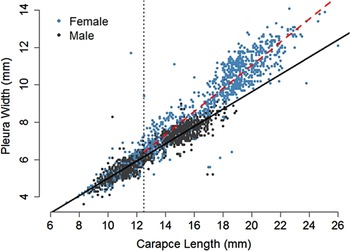
Using an iterative search procedure, an inflection point was detected in the linear relationship between CL and PLW in the female dataset. The data suggests that for pleura morphometrics, males display an isometric growth pattern and females an allometric growth pattern. For females, the CL:PLW inflection point was detected at 12.5 mm CL (Figure 4).
Inflection point indicating allometric growth based on morphometric variance between iterative tests on linear models of PLW and CL for the prawn Palaemon serratus. The dotted vertical line is the value with the lowest mean standard error (12.5 mm CL). Solid black line shows the linear male relationship. Hashed line shows the allometric female relationship after inflection event.

Size at maturity (L50)
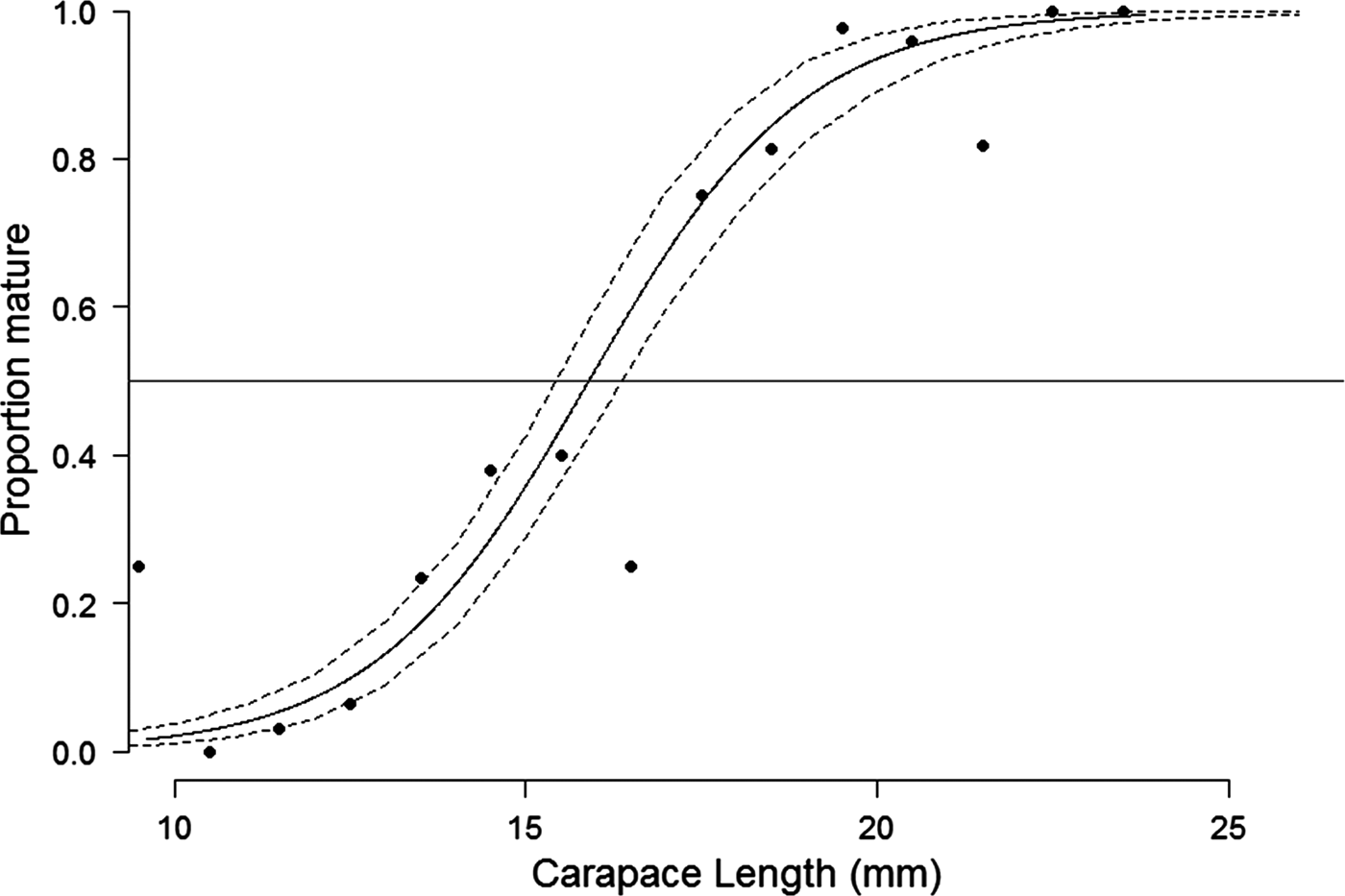
Maturity is expressed as L50, which is the size (CL) at which 50% of the females were observed to be gravid (carrying eggs). The maximum likelihood estimate of L50 estimated by the generalized linear model with a binomial distribution was 15.9 mm CL (upper and lower confidence intervals = 16.4 and 15.4 mm CL respectively; Figure 5).
Functional maturity model fit for female prawn (Palaemon serratus) from Cardigan Bay (Wales) with 95% CIs as indicated by the presence or absence of eggs. The horizontal line represents L 50 (15.9 mm CL) for the females sampled within period of peak spawning (April; N = 544).

Fecundity
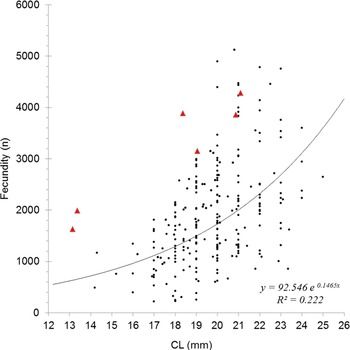
Of the 616 gravid prawn that were captured by scientific pots, 273 (44%) were analysed for fecundity using the equation described (1). Prawn ranged in size from 14.2 to 25 mm (CL) and produced fecundity estimates of between 221 and 5121 eggs per animal.
A Spearman's correlation was run to assess the relationship between CL and fecundity. There was a strong positive correlation, which was statistically significant (r S = 0.48, P < 0.001) and is explained by the power relationship below (Figure 6; equation (5)). The fecundity data exhibit a high degree of variability with CL explaining just 22.2% of the variation in fecundity. Data points shown as triangles represent available fecundity data from Forster (Reference Forster1951).
 $${\rm Fecundity} = 92.546\, {e^{0.1465\, CL}}$$
Fecundity of gravid prawn (Palaemon serratus) from Cardigan Bay (Wales) with size (CL) (N = 273). The solid line shows the power relationship between the correlating variables CL and Fecundity (P < 0.001; R 2 = 0.222). The red triangle points and associated hashed trendline show the fecundity data available from Forster (Reference Forster1951).

DISCUSSION
Sexual dimorphism
Our results confirm that P. serratus in Cardigan Bay are sexually dimorphic, with females occupying a broader length-distribution than males in the sampled populations. These results mirror the sexual dimorphism that has been reported elsewhere for Palaemon serratus (Guerao & Ribera, Reference Guerao and Ribera2000) and many other Palaemon spp., with typically slower growth rates and smaller sizes in males (Berglund, Reference Berglund1981; Ito et al., Reference Ito, Watanabe and Murano1991; Bilgin et al., Reference Bilgin, Ozen and Samsun2009; Al-Maslamani et al., Reference Al-Maslamani, Watson, Kennedy, Al-Mohannadi and Le Vay2013).
The evolutionary cause for dimorphism in this species is likely to have resulted from selection based on the differing reproductive roles of the sexes (Shine, Reference Shine1989). The current size-selective exploitation and resulting pressure on mature females could potentially result in evolutionary responses that change growth and reproductive patterns at a genetic level (Conover & Munch, Reference Conover and Munch2002; Walsh et al., Reference Walsh, Munch, Chiba and Conover2006; Swain et al., Reference Swain, Sinclair and Hanson2007). Given the short lifespan of P. serratus, fishery-induced responses such as decreasing size-at-maturity and size-at age may occur over a timescale of years or decades (Reznick et al., Reference Reznick, Shaw, Rodd and Shaw1997; Thompson, Reference Thompson1998; Koskinen et al., Reference Koskinen, Haugen and Primmer2002; Stockwell et al., Reference Stockwell, Hendry and Kinnison2003), a phenomenon that has been demonstrated in a number of other exploited populations (Grift et al., Reference Grift, Rijnsdorp, Barot, Heino and Dieckmann2003; Barot et al., Reference Barot, Heino, O'Brien and Dieckmann2004; Olsen et al., Reference Olsen, Heino, Lilly, Morgan, Brattey, Ernande and Dieckmann2004). Indeed, the selection pressure towards large females and potential decrease in growth rates may have a negative effect on the value of the species in the long term, which runs contrary to the larger prawns desired by the market. Hence it is important to continue monitoring these life history characteristics, in order to determine any long-term changes, particularly in females. It would also be valuable to compare populations with varying degrees of commercial exploitation.
Length frequency and commercial fishing
At present, the fishery is not subject to any statutory harvest-control rules or technical measures that aim to encourage sustainable exploitation of prawn populations in Welsh waters in addition to the requirement for commercial fishers to hold a shellfish licence. The voluntary riddling of catch using either a 10 mm riddle or >10 mm pot mesh by some fishers ensures both a better market price and may return as many as 40% of females to sea including sexually immature individuals. Since the grading of prawns is an entirely voluntary practice, it is not possible to determine the relative proportion of common prawn landings in the UK that have been graded at sea, on the quayside or not at all. Whilst the mortality rate amongst prawns discarded at sea is still to be determined, personal observations indicate a very high level of mortality when prawns are graded on the quayside. The absence of information on discard mortality rates calls into question the real value of the riddling practice, particularly since the mortality rate is likely to be high. If the rate of mortality amongst discarded prawn is at a significant level, the sex-specific consequences of riddling may not be as severe as the data suggest. Nonetheless, there is a need to ensure that riddling is done at sea over fishing grounds and habitat from which the prawn were removed. Some fishermen argue that a larger mesh size on the fishing gear is a more appropriate conservation measure. We suggest that a gear comparison trial be conducted to determine the gear design that maintains catchability whilst promoting the escape of undersized prawn. Importantly the interaction between riddling and size-selectivity (i.e. that a riddle will retain prawn only of a size ≥10 mm) is an assumption in this study and not empirically validated. Future research needs to collect data on retention rates of a known size distribution of animals being graded in order to evaluate the real size and sex specific implications of the technical measure.
In 2008, when voluntary measures were adopted by some Cardigan Bay fishers, it was hoped that the discarding of small prawn at sea would provide additional ecological and economic value by improving market prices and releasing immature prawns to improve yield-per-recruit and spawner-per-recruit respectively (CBFA personal communication). Our results show that by applying a size-selective harvesting regime, the Cardigan Bay prawn fishery subjects the female population to a much higher level of removal relative to the male population. Indeed, the immediate consequence of the quasi-minimum-landing-size would have been the discarding of ~78% of male prawns caught in pots, compared with a female discard rate of ~40% on average throughout the fishing season. The bi-modal distribution of size-frequency data was present in all spatial and temporal combinations, representing a strong indication that two cohorts of prawns are present during the fishing season. With the assumption that commercial activities select prawn at a size 10 mm CW under the voluntary MLS, data show females are recruiting into the fishery in their second year at a mean size of 12.32 mm CW (SE ± 1.22). However, fewer 2+ males are recruited into the fishery, as the average male in their second year is 9.64 mm CW (SE ± 0.84).
Our study shows similar patterns in length-cohort distribution to previous studies. Forster (Reference Forster1951) reported a female population attaining a greater modal size than males within the 2+ cohort (TLMo ♀ ≈ 92.5 mm; TLMo ♂ ≈ 77.5 mm). The above values are comparable to those reported in this study; however, the historical data indicate a smaller average size of prawn within the 1+ group than we observed in this study (see Table 2), although the difference is unlikely to be significant. The difference in 1+ size is likely to be as a consequence of differing sampling methods employed by the two studies; Forster (Reference Forster1951) used fishery independent trawl surveys in contrast to the present study, which used fishery-dependent ‘science pots’, which were fished alongside commercial gear and therefore targeted the larger prawns.
Sex bias in the fishery
A consequence to size-selective fishing and higher rates of removal of female prawn may be evident in the temporal trend of sex ratios (Figure 3A), representing sex-overfishing on a regional scale. However, Figure 3B, C shows that decreasing catchability of female prawn is location specific, with samples from Aberystwyth showing a near 1:1 sex ratio late into the fishing season in comparison to fishing grounds to the south, although the proportion of females in spring is still lower than during winter. The decreasing abundance of females in catches marks the end of the prawn season as it is perceived by fishers as a weakening fishery that yields less marketable catch. Seasonal variation in sex ratios has been observed in a range of palaemonid species (see Kim, Reference Kim2005; Al-Maslamani et al., Reference Al-Maslamani, Watson, Kennedy, Al-Mohannadi and Le Vay2013) and has been attributed to differential migration patterns, seasonal habitat preferences and possibly mortality between males and females (Berglund, Reference Berglund1981). Female P. serratus are known to migrate between habitats to release larvae in Wales (Haig et al., unpublished data) and hence it is unsurprising that we observe temporal and spatial changes in sex ratio as the fishing season progressed in Cardigan Bay as this may reflect localized differences in timing of migration or habitat availability.
On a regional scale, fishing behaviour follows an inter-annual pattern whereby fishers in the south experience the onset of the fishing season, with fishing opportunities gradually opening in a northward direction along the Cardigan Bay coast (personal observation and CBFA personal communications). Similarly, fishing opportunities decline earlier in the south relative to the north, with fishermen from Aberystwyth and Aberdovey continuing to fish for months after fishing has ceased to be commercially viable in Fishguard and New Quay (personal observation and CBFA personal communications). Fishermen therefore hold the view that females migrate in a northerly direction, sustaining different rates of catch in different areas through the season. The scientific evidence presented here neither validates nor disproves this view on the migratory behaviour of prawn in the region. Further fisheries independent research (ideally using mark recapture methods) is required to determine if the observed patterns in female catch indicate sex-overfishing, decreasing catchability as a result of seasonal migration by females, or a cumulative response to both of these.
The potential for sex-overfishing identified by this study may have consequences on recruitment levels in the future, although the life-history of palaemonids (highly fecund and typically multiple broods per season) may safeguard it against depletion events. The data show female skewed catches in the early period of both fishing seasons (Emmerson et al., Reference Emmerson, Haig, Robson and Kaiser2015), which indicates the population has a degree of resilience in sustaining size-selective fishing at present effort levels. The research presented here cannot draw a conclusion with regards to sex-overfishing in the absence of both long-term datasets and evidence pertaining to adult migration patterns.
Size at maturity
Crustacean fisheries are most commonly managed in the UK using a minimum landing size (MLS), appropriated by maturity characteristics. In order to determine a valid MLS in decapod crustaceans, maturity indicators such as morphological sexual maturity and functional maturity can be applied (Waddy & Aiken, Reference Waddy and Aiken2005; Pardo et al., Reference Pardo, Fuentes, Olguin and Orensanz2009). Size at maturity has been determined from allometric growth parameters (Hartnoll, Reference Hartnoll1974; Little & Watson III, Reference Little and Watson2005; Claverie & Smith, Reference Claverie and Smith2009) and specifically the CL:PLW relationship in Palaemonidae species (Cartaxana, Reference Cartaxana2003). In this study, the pleura has been shown to undergo allometric growth in female P. serratus, which expand the brood chamber in preparation for egg carriage at a size CW = 7.7 mm. At this point, females undergo an expansion in the PLW relative to males as they continue to grow. It is highly likely that this dynamic allometry amongst females represents a physical change of the abdomen in preparation for egg bearing and thus a sign of sexual maturity. Only 1.5% (N = 9) of ovigerous females were observed at a size below our estimate of morphological size at maturity, implying a high degree of confidence in the results of the iterative search procedure used. A total of 18.6% of females (N = 361) captured by scientific pots throughout this study had a CW < 7.7 mm and were assumed to be sexually immature. With a CW < 10 mm, immature female prawn that have yet to develop their brood chamber and are released by Cardigan Bay fishers onto the fishing ground from where they were captured.
The size at morphological sexual maturity supports the results from this study's estimate of functional maturity (L50), with the results implying that female prawn undergo a puberty moult at an estimated size CW = 7.7 mm, whilst 50% of females are able to contribute to the reproductive capacity of the population by the size CW = 9.9 mm (15.9 mm CL). In this way, the voluntary measure of releasing prawn below CW = 10 mm by CBFA fishers has been shown to be a potentially valuable conservation measure. The CL50 reported here is greater than that reported in similar studies elsewhere for the species (Ireland; CL50 = 12.5 mm; Kelly et al., Reference Kelly, Tully, Lehane and Breathnanch2009), though similar to previous estimates for the Welsh population (CL50 = 16.5; Huxley, 2011).
Fecundity
Palaemon serratus were found to carry between 221 and 5121 eggs at any one time (mean average = 1916). This is similar to estimates published by Forster (Reference Forster1951), who found large prawn (TL = 105 mm) carry up to 4282 eggs and within a similar range of other Palaemonidae species (Corey & Reid, Reference Corey and Reid1991). The fecundity (number of eggs carried) of female prawns was positively correlated with body size (CL); however, there was a high degree of variability between individuals and CL only explained ~23% of the variation. Studies of similar species (P. elegans, P. adspersus and P. xiphias) report R 2 values >0.95 (Guerao et al., Reference Guerao, Pérez-Baquera and Ribera1994; Cartaxa, Reference Cartaxana2003; Bilgin & Samsun, Reference Bilgin and Samsun2006). Different methodologies for estimating fecundity may be the reason behind the variable R 2 values reported here and in the published literature. In particular, previous fecundity estimates were derived from the number of eggs at stage 1 (e.g. Guerao et al., Reference Guerao, Pérez-Baquera and Ribera1994) in order to account for egg loss during incubation, which can be the result of mechanical stress or parasites (Glamuzina et al., Reference Glamuzina, Conides, Prusina, Cukteras, Klaoudatos, Zacharaki and Glamuzina2014) and has been reported to be as high as 38% in this species (Reeve, Reference Reeve1969 Reference Reeveb in Zimmermann et al., Reference Zimmermann, Carvalho and Mantelatto2015). Egg counts by developmental stage were unavailable in this study, which is the likely explanation for the high variability in the fecundity estimate. Nonetheless, the results are within the range reported for the species, as shown in Figure 6, and provide an important baseline from which to further understand the reproductive capacity of the Welsh P. serratus population by providing an estimate between the numbers of eggs laid on pleopods during spawning and the total that eventually hatched.
Fecundity can be influenced by temporal-spatial variations of environmental factors such as depth (e.g. P. naval; Thessalou-Legaki, Reference Thessalou-Legaki1992), mean bottom temperature (e.g. P. borealis; Parsons & Tucker, Reference Parsons and Tucker1986) and habitat (e.g. E. modestus and P. gravieri; Oh & Park, Reference Oh and Park2000). We recommend future studies pay particular attention to the problem of egg loss during brooding on pleopods by staging eggs using the criteria outlined in Guerao & Ribera (Reference Guerao and Ribera1995). Preservation of samples would permit a more accurate estimate of real fecundity, which should incorporate egg stage, size-dependent egg losses and egg-quality into the fecundity estimate. The limited scope and resources dedicated to the present study have constrained the data available for our fecundity estimate; however, it provides a useful baseline from which to continue monitoring.
Management
The aim of this research was to provide a series of region-specific indicators that can be used by fisheries managers in the Cardigan Bay prawn fishery to guide biologically appropriated management measures. The voluntary measures employed by some fishing industry members in Cardigan Bay are effective at protecting 50% of the female brood stock in their catch providing the discard mortality rate is low. The process of grading prawn on the deck of a commercial fishing boat can be resource intensive and fishers have engineered bespoke riddle systems or replaced gear for larger mesh traps that may increase the efficiency of the gear in selecting larger prawn. While the results presented here demonstrate the potential ecological benefits of using either a larger mesh size, or a riddle in the prawn fishery, many commercial operations do neither (CBFA personal communication). Given the potential economic and ecological value of increasing the size prawn reaching the market and the reluctance of some industry members to alter their fishing strategy, a comprehensive analysis of technical options should be explored. This might include the effectiveness of escape panels and minimum mesh-sizes (Fothergill, Reference Fothergill2006), which would allow animals to escape before being exposed to increased stress and mortality rates associated with handling.
The limited evidence presented here suggests that there has not yet been an observable effect of overfishing on size-at-maturity of females in Cardigan Bay. However, declining CPUE in other exploited populations on the coast of Ireland suggest that overfishing can occur (Fahy & Gleeson, Reference Fahy and Gleeson1996) and hence long-term monitoring of any changes should be included as part of ongoing fisheries management. At present, there are no statutory requirements to collect size at maturity data on P. serratus despite it being recognized as an important parameter for fisheries management. Ideally, these investigations would be replicated at an appropriate temporal scale; and given the short lifespan of P. serratus, we recommend biennial replication. Given the potential for sex-overfishing within a size-selective harvesting regime in the Welsh prawn fishery, the extent of which is yet to be fully understood, affording a scientifically validated level of protection to juvenile females via a MLS would be a valuable safeguard against recruitment failures in the future.
ACKNOWLEDGEMENTS
This project would not have been possible without the help of the Welsh Fisherman's Association, particularly Jim Evans, who facilitated our introduction to many fishers who collaborated with the study. Similarly, we wish to thank Huw Evans of the Cardigan Bay Fisherman's Association who supervised the project and provided valuable insight from an industry perspective. We thank the following fishers for their invaluable input to this research: Llew and Ryan Hughes, Chris Hicks, Dean Parry, Mark Hughes, David ‘Sturdy’ Jones, David Kendall and Paul Walsh. Finally, the authors extend their gratitude to Dr Vlad Laptikhovsky and the two anonymous reviewers who highlighted revisions that greatly improved this paper.
FINANCIAL SUPPORT
This project was funded by the Cardigan Bay Fishermen's Association via the European Fishery Fund (EFF) and the Welsh Government.