Introduction
The purpose of this paper is to establish benchmark estimates of inbreeding levels in England based on the evidence of historical pedigrees. Knowledge of inbreeding levels and rates of cousin marriage in historical times can be used as one predictor of health risk and status, since inbreeding increases homozygosity, and thus affects the segregation of autosomal recessive disorders. Indeed, the global focus of consanguineous marriage has been societies with high levels of inbreeding, in order to examine the possible adverse health outcomes. Whilst indigenous populations in contemporary England show low levels of consanguineous marriage (Coleman, Reference Coleman1980), there is little systematic information on past levels of inbreeding, largely because England lacks the comprehensive records of Roman Catholic marriage dispensations that have been widely used to study consanguineous marriages in Europe (e.g. Sutter & Tabah, Reference Sutter and Tabah1955; Moroni, Reference Moroni1967; Danubio et al., Reference Danubio, Piro and Tagarelli1999; and many other publications). In Britain, inbreeding levels have been calculated from pedigrees only in geographically or socially isolated populations (e.g. Brennan et al., Reference Brennan, Leslie and Dyke1982, for Orkney Islanders and Williams, Reference Williams, Harper and Sunderland1986, for Welsh gypsies) but not for mainstream, non-isolated populations, largely because of the difficulty and complexity of undertaking such work.
One aim of this paper, then, is to establish secure estimates of inbreeding in rural England from extensive pedigree data. Earlier studies have estimated historical English inbreeding levels and frequency of cousin marriage in mainstream populations using techniques such as marital isonymy, published pedigrees and surveys (Darwin, Reference Darwin1875; Pearson, Reference Pearson1908c; Bramwell, Reference Bramwell1939; Bell, Reference Bell1940; Smith, Reference Smith2001). These techniques have acknowledged limitations, but until recently there has been no practicable alternative. In the past decade there has been a huge increase in the amount of raw genealogical material available online and through electronic media, due to the growth of the internet and of public interest in family history (Day et al., Reference Day, Kippen, Lucas and Lucas2006). The availability of this material has made the construction of detailed pedigrees achievable for large numbers of individuals, across multiple locations. The resulting large genealogical database can generate more secure estimates of inbreeding and cousin marriage in the past, and will illuminate earlier studies based on less complete sampling methods.
A second aim is to test a number of hypotheses that predict the dependence of inbreeding rates on socioeconomic and geographical variables observed in the study area. The predicted associations are: (1) that ‘closed’ villages (Mills, Reference Mills1959; Spencer, Reference Spencer2000) will have higher inbreeding than ‘open’ villages; (2) that through constraint on mate choice, the small Roman Catholic minority population will have higher inbreeding than the majority Protestant population (McCullough & O'Rourke, Reference McCullough and O'Rourke1986); and (3) that higher social classes will have higher levels of inbreeding than lower social classes (Bittles & Egerbladh, Reference Bittles and Egerbladh2005; Bras et al., Reference Bras, Van Poppel and Mandemakers2009).
Background
The study area centred on the villages of Stourton and Kilmington, which are situated less than two miles apart in south-western England. Stourton and Kilmington were agricultural villages with around 650 and 550 inhabitants respectively in the first half of the 19th century, declining to about 400 and 350 inhabitants by the beginning of the 20th century.
Stourton had a significant minority of Catholic families (Stourton, Reference Stourton1899; Hutchings, Reference Hutchings2005). Nine per cent of infants born in Stourton were baptized in the Roman Catholic faith.
Stourton was a ‘closed’ village from the mid-eighteenth century. English rural villages could be classified as ‘closed' or ‘open'. A closed village had one proprietor who owned almost all the land and the number of labourers' cottages was strictly limited by the landowner (Mills, Reference Mills1959, Reference Mills2006; Holderness, Reference Holderness1972; Spencer, Reference Spencer2000). The churchwardens tried rigorously to exclude paupers from obtaining a legal settlement there (Spencer, Reference Spencer2000).
Kilmington, on the other hand, was a more standard rural village comprising a variety of large and small landowners. It had no Catholic minority although in the second half of the 19th century, 5% of infants born in Kilmington were baptized as Methodists.
The villages of Stourton and Kilmington were selected to be the research focus due to the high level of availability of a wide array of records, the contrast between ‘open’ and ‘closed’ villages, the presence of a sizeable Catholic minority in Stourton with which to make inter-denominational comparisons and the position of Wiltshire roughly in the middle of most English historical demographic measurements: for example, Ogle (Reference Ogle1890) for marriage rate; Adair (Reference Adair1996) for illegitimacy rate; Woods (Reference Woods2000) for nuptiality, fertility, illegitimacy and mortality rates in Wiltshire and other English counties.
Data sources
Raw data were collected for the period 1580–1980. Baptism, marriage and burial records from the adjoining counties of Wiltshire, Somerset and Dorset were photographed and transcribed by either one author (CD) or volunteers. Literally millions of previous transcriptions of church and other records in the three counties were collected electronically and church records from over 1000 parishes and congregations in Wiltshire, Somerset and Dorset could be searched simultaneously. The internet was used to access a collection of several billion records. Sources of data were not limited to church records, but included census records for the period 1821–1911 (plus the Catholic census of 1767), Bastardy Bonds, wills, land deeds, settlement examinations, removal orders, Quarter Session calendars, civil registration indices, apprenticeship records, school logs, emigration records, military records, monumental inscriptions, charity lists and personal papers. Some information was provided by descendants interested in their family history.
Methods
One author (CD) manually constructed detailed pedigrees of all parties to the 803 marriages that took place in the Anglican and Catholic churches in Stourton and Kilmington in the 19th century, using a wide array of data sources. Each individual was linked into their family, so that parents, children, spouses, siblings and ancestors could all be viewed rapidly.
In some cases the pedigrees stretched for ten generations. In 82% of marriages, all four parents of the bride and groom could be identified. In only two cases (0.2%), no parents of the bride or groom could be determined. The families and individuals were entered into a genealogical computer program (The Master Genealogist 2011). The inbreeding coefficient of every person in the database, and the genetic relationship between members of each couple, were calculated automatically and cross-checked (FSpeedPro, 2005; The Master Genealogist, 2011).
Results
In this section the overall levels of cousin marriage in the two parishes are presented, and then the associations of religious affiliation and occupation with these variables are demonstrated.
Cousin marriage
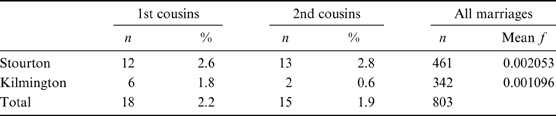
There were no marriages where the relation was closer than 1st cousin. Included in the results for 1st cousin marriage are two 1st cousins once removed, and one each of couples who were simultaneously 1st cousins and 2nd or 4th cousins. Included in the results for 2nd cousins were one set of 2nd cousins once removed where the groom was the offspring of a 1st cousin marriage in the same line, one set of 2nd cousins once removed who were also 3rd cousins once removed, and a couple who were simultaneously 2nd and 3rd cousins. Because of differences in population structure between the two villages, the levels of cousin marriage in Stourton and Kilmington were considered separately (Table 1).
First and second cousin marriages in Stourton and Kilmington 1800–1899
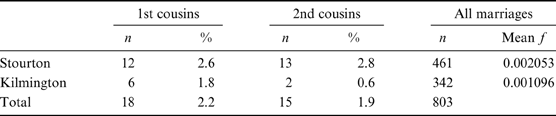
When 1st and 2nd cousin marriages are considered together, Stourton shows higher rates of consanguinity than Kilmington (χ 2=4.738, p=0.029). This difference can be accounted for largely by Stourton's excess of 2nd cousin marriages compared with Kilmington (χ 2=5.446, p=0.020), and the rates of 1st cousin marriage do not differ between the villages (χ 2=0.684, p=0.408). The mean inbreeding coefficient of Stourton was almost twice that of Kilmington.
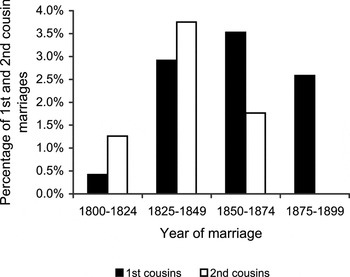
However, cousin marriage rates varied over time, as indicated in Fig. 1. Both 1st and 2nd cousin marriages showed a rise then fall, although the trend for 1st cousin marriages was a generation later than for 2nd cousin marriages.
First and second cousin marriages in Stourton and Kilmington, 1800–1899.

Geographical proximity played a part in consanguineous marriages so the birthplaces of the parties to a marriage were examined. Table 2 shows the proportion of spouses in various degrees of consanguineous marriages who were born in the same village as each other. The more closely related to each other the bride and groom were, the more likely they were to be born in the same village as each other.
Relative birthplace of spouses in marriages in Stourton and Kilmington 1800–1899 (%)

Religion and occupation
In this section the associations between cousin marriage and the religious affiliation and occupation of individuals in the study area are presented. In the following analysis, the religion attributed to individuals was the one into which they had been baptized as infants. For example, Protestants who converted to Catholicism on marriage to a Catholic were counted as Protestants. In this context, Protestants were predominantly Anglicans, with small numbers of Methodists and Congregationalists. In addition to the figures below, the religion of six grooms and seven brides could not be determined. None of them was involved in consanguineous marriages.
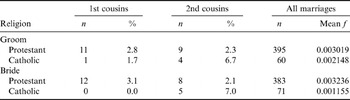
Table 3 shows that Catholics had higher rates of 2nd cousin marriage than Protestants, approaching statistical significance (χ 2=3.265, p=0.071), though rates of 1st cousin marriage, and rates of 1st and 2nd cousin marriage combined, were not significantly different between the two religious denominations (χ 2=0.205 and 1.073, p=0.651 and 0.300, respectively).
First and second cousin marriages in Stourton 1800–1899, by religion

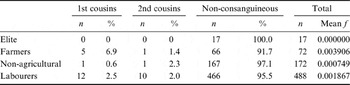
Did the occupation of groom affect the rate of cousin marriage (Table 4)? Grooms were divided into groups according to their occupation. The ‘Elite’ group included clergy, gentlemen and baronets. ‘Farmers’ were men who owned their livestock, crops, machinery and occasionally their land, and who employed labourers. The ‘Non-Agricultural’ group included shopkeepers, millers, clerks, butchers and tradesmen such as carpenters and shoemakers. ‘Labourers’ were almost exclusively agricultural labourers, although some grooms were described as ‘general labourers’. Farmers had significantly higher rates of 1st cousin marriage than labourers (χ 2=4.288, p=0.038), and this type of marriage was almost absent from the non-agricultural occupations.
Marriages in Stourton and Kilmington 1800–1899, by occupation of groom

Discussion
It has been shown that Stourton had higher rates of consanguineous marriage (and of 2nd cousin marriage in particular) than Kilmington (Table 1), and differences in population structure and religious affiliation are discussed to explain them.
The differences in consanguineous marriage rate between Stourton and Kilmington may be due to their status as closed and open villages. As a closed village, Stourton received limited in-migration. The limitation on labourers' cottages and strict enforcement of the settlement rules prevented itinerant labourers from settling in a closed village. In 1855, the head of the Hoare family owned all of the labourers' cottages in Stourton parish, as well as 28 out of the 43 rateable properties (Churchwardens of Stourton, 1835–1868). Only two additional labourers' cottages were built in the period 1838–1855, so that it was virtually impossible for a new labourer to move into the village. There was a rigorous attempt by the churchwardens to exclude non-parishioners from the parish, with large sums of money spent on court cases against other parishes in an attempt to have paupers removed from Stourton (Churchwardens of Stourton, 1701–1863). With fewer people able to settle in the village from outside, the pool of available spouses who were not related would have been smaller in Stourton than in Kilmington.
Another difference between Stourton and Kilmington was the presence in Stourton of a Catholic minority. The Roman Catholic Church required a dispensation for marriage between people related by consanguinity, and this requirement might be expected to have discouraged consanguineous marriage (The Canon Law Society of Great Britain and Ireland 1995, p. 607). Although the cost of dispensation for marrying one's cousin was the same for 1st as for 2nd and more distant cousins, it appears that the general Roman Catholic discouragement of consanguineous marriage was applied more forcefully at the 1st cousin level than at the 2nd cousin level.
However, there were only a small number of Catholics in Stourton, and an almost complete absence of co-religionists in the surrounding area. Only 9.5% of the marriages in the area in the 19th century were mixed. This constraint on mate choice resulted in an elevated level of 2nd cousin marriage, without consanguineous marriage per se being a desired outcome. The same phenomenon has been observed in ‘classic’ genetic isolates, such as the Amish (Khoury et al., Reference Khoury, Cohen, Diamond, Chase and McKusick1987), the Samaritans (Bonné-Tamir, Reference Bonné-Tamir, Eriksson, Forsius, Nevanlinna, Workman and Norio1980) and in Tristan da Cunha (Roberts, Reference Roberts1979). Both its nature as a closed village, and the presence of an endogamous Catholic minority, could explain Stourton's higher levels of cousin marriage, especially at the level of 2nd cousin.
How do the levels of cousin marriage observed in the present study compare with the results of previous investigations of consanguineous marriage in English populations? Earlier studies of historical consanguinity are limited in extent and method.
Following two requests for information addressed to readers of the British Medical Journal (Pearson, Reference Pearson1908a,Reference Pearsonb), Karl Pearson reported that 4.7% of the marriages documented by his respondents were between 1st cousins (Pearson, Reference Pearson1908c). A major limitation of the readers' responses, as Pearson acknowledged, was that people who had made, or were the offspring of, consanguineous marriages, were probably most likely to respond to the invitation. In the same paper he reported that 1.3% of the marriages of parents of children in Great Ormond Street Hospital were between 1st cousins (Pearson, Reference Pearson1908c).
A later survey of patients in a number of hospitals across England reported a 1st cousin marriage frequency of 0.6%, with very little variation between provincial hospitals and those in London (Bell, Reference Bell1940). Bell also gave figures of 1.4% and 1.0% for 1st cousin marriages in two rural areas rumoured to be of high consanguinity.
Finally, a study using established pedigrees compiled by amateur family historians in many parts of the United Kingdom from about 1890 to 1912 produced an estimate of 1.1% for 1st cousin marriages (Smith, Reference Smith2001).
At 2.6%, Stourton's 1st cousin marriage rate was almost twice that of Pearson's reported hospital patients in 1908 and almost four times that of Bell's 1940 hospital figure. Kilmington, on the other hand, had a level of 1st cousin marriage closer to that of the 1908 hospital survey and the survey of pedigrees. Whilst there are some concerns about the reliability of the hospital survey data, on balance the earlier studies fall in line with the results from Kilmington, with Stourton's higher rates of cousin marriage explained by the particular circumstances discussed above.
Frequency of cousin marriage varied by social class. Table 4 showed a comparatively high number of farmers in 1st cousin marriages in Stourton and Kilmington. Seven per cent of farmers married 1st cousins, and 1.4% married 2nd cousins, a much higher percentage of 1st cousin marriage and lower percentage of 2nd cousin marriage than among either agricultural labourers, or the non-agricultural population. On the assumption that cousin marriage was purely a matter of random chance, Hajnal (Reference Hajnal1963) predicted that 2nd cousin marriages would be between two and 4.5 times as frequent as 1st cousin marriages, depending on variables such as population growth and migration. Clearly in the present study, there was a preference for 1st cousin marriage among the farming population.
A study of consanguinity in north-eastern Sweden demonstrated that a slightly higher socioeconomic status was associated with higher levels of consanguinity (Bittles & Egerbladh, Reference Bittles and Egerbladh2005). A study of marriages in five Dutch provinces in the period 1870–1922 also showed that the upper classes, middle classes and farmers were more likely to contract 1st cousin marriages than other occupation groups (Bras et al., Reference Bras, Van Poppel and Mandemakers2009). Similarly, a study of a Spanish village in the period 1850–1910 indicated that landowners were more likely to contract consanguineous marriages than tenants, although both of the identified social groups avoided 1st cousin marriage (Abelson, Reference Abelson1978). In Japan and South India, consanguineous marriage is favoured by land-owning families, although in other parts of Africa and Asia consanguineous marriage is a feature of the poorest classes of people (Bittles, Reference Bittles1993).
In rural Britain, farmers' sons tended to marry farmers' daughters, partly as the new wife was expected to already be familiar with farm routine and partly because her family was expected to contribute towards the setting up of a new farm for the young couple. Marrying someone of the same social class also maintained prestige (Rees, Reference Rees1961, p. 85). In Stourton and Kilmington, 64% of the marriages of farmers' sons were to farmers' daughters, despite the fact that farming families comprised less than 10% of the population (see Table 4). Since there were fewer farmers than labourers, the available pool of potential mates was smaller amongst farmers and their daughters. This may also have increased the frequency of cousin marriage in this class.
A kinship study of a West Country village in the period 1860–1960 demonstrated how some farming families moved up the social and economic scale by marrying cousins and thereby consolidating small land-holdings (Williams, Reference Williams1963, pp. 70–71). Bramwell (Reference Bramwell1939) opined that the upper and middle classes in England were endogamous because of the need to preserve money and property in the family. This is supported by the observation that farmers in Stourton and Kilmington had higher rates of 1st cousin marriage than lower occupational groups, but lower rates of 2nd cousin marriage. Such marriages between distant relations would have had little effect in ‘keeping money in the family’. This behavioural distinction between 1st cousin and more remote consanguineous marriage was made by Wachter in his modelling to resolve the ancestor paradox (Wachter, Reference Wachter, Wachter, Hammel and Laslett1978). Wachter considered the decision to marry (or avoid marriage to) a 1st cousin marriage to be a conscious choice, whereas marriages between more remote kin he modelled as a random occurrence.
Although Table 4 seems to indicate that there were no consanguineous marriages in the elite group, this is because few of their marriages took place in the churches in Stourton and Kilmington. Rather, they were married in more prestigious locations such Fleet Street in London and Bath Abbey. These marriages do not feature in the quantitative analysis of the current study as they occurred outside the research area. In fact the owners of Stourton practised consanguineous marriage almost as the norm. The first occupier of Stourhead House was Henry Hoare who married his 1st cousin Jane Benson in 1702 and produced eleven children. His son Henry had six children by two wives and his youngest daughter Ann Hoare married her 1st cousin Richard Hoare in 1756. Two of Richard and Ann Hoare's six children, Henry Hugh and Henrietta Ann, married their 2nd cousins. The Hoare family habit of cousin marriage was not uncommon for their era and class. As indicated, the readers of the British Medical Journal, who were likely to have been of higher social status than the general population, reported higher figures of consanguineous marriage than other studies. Following his son's extensive researches on the subject of cousin marriage (Darwin, Reference Darwin1875), Charles Darwin opined that cousin marriage was not dangerous amongst ‘the upper classes’ (Darwin, Reference Darwin1878, p. 466).
Conclusion
This study of 803 marriages in 19th century south-western England included eighteen (2.2%) between 1st cousins and fifteen (1.9%) between 2nd cousins. There were, however, variations detected within these summary figures, and rates of consanguineous marriage were shown to be influenced by the organization of the village, with a closed village having higher levels of inbreeding than an open one; by religion of the spouses, with Catholics having lower rates of 1st cousin marriage but higher rates of 2nd cousin marriage than Protestants; and by social class of the spouses, with farmers contracting more 1st cousin marriages than labourers.