Introduction
Paid domestic work has traditionally been common in societies with strong social hierarchies and marked social inequalities (Anderson, Reference Anderson2000; Lutz, Reference Lutz2002; Sarti, Reference Sarti, Pasleau and Schopp2006; Razavi, Reference Razavi2011). Domestic services continue to be an important source of employment for women, particularly in countries with high levels of income inequality, such as South Africa, India and the region of Latin America (Razavi, Reference Razavi2011). In Europe, until the mid-twentieth century, domestic servants were often employed by wealthier households, but then this practice began to disappear (Sarti, Reference Sarti, Pasleau and Schopp2006). In recent decades, the employment of paid domestic labour has re-emerged in many post-industrial welfare states, as domestic services have become an alternative way to organise care and outsource household activities (Anderson, Reference Anderson2000; Lutz, Reference Lutz and Lutz2008). Nevertheless, paid domestic work continues to be closely linked with overlapping inequalities based on gender, ‘race’ and class; usually it is white upper and middle-class households that hire poorer migrant women to take care of their homes (Nakano Glenn, Reference Nakano Glenn1992; Anderson, Reference Anderson2000; Parreñas, Reference Parreñas2001; Lutz, Reference Lutz and Lutz2008; Tronto, Reference Tronto, Dahl, Keränen and Kovalainen2011).
It has been suggested that the growing demand for domestic workers reflects several global developments, such as ageing populations, the growing number of women entering the labour market, increasing economic inequalities, migration and changes in the provision of care (Anderson, Reference Anderson2000; Lister et al., Reference Lister, Williams, Anttonen, Bussemaker, Gerhard, Heinen, Johansson, Leira, Siim, Tobio and Gavanas2007; Williams, Reference Williams, Dahl, Keränen and Kovalainen2011). Yet there are considerable differences in the size of the domestic services sector between countries, and the social factors determining the proportion of domestic workers in the labour force have received little quantitative empirical analysis. Some previous studies have explored these phenomenon at national (Milkman et al., Reference Milkman, Reese and Roth1998) and regional (Rogers, Reference Rogers, Valenzuela and Mora2009) levels, but international quantitative comparisons have been scarce, mostly due to the lack of reliable data.
The present article contributes to this discussion by exploring the phenomenon of paid domestic labour through a global comparison. The analysis covers seventy-four countries and is based on recently published data estimating the global incidence of paid domestic labour, compiled by the International Labour Office (ILO) (see ILO, 2013). Drawing on variables identified in previous studies, this article examines how the different macro-level factors of economic inequality, care needs and labour markets are associated with the prevalence of paid domestic labour. Previous studies from European countries (Williams and Gavanas, Reference Williams, Gavanas and Lutz2008; Shutes and Chiatti, Reference Shutes and Chiatti2012; Williams, Reference Williams2012; Gil Araujo and González-Fernández, Reference Gil Araujo and González-Fernández2014) emphasise the role of different regimes related to care, gender, migration and employment in shaping the sector of domestic services. While institutions and policies are without doubt important for the presence of domestic workers in a society, in this article it is argued that in a global comparison, paid domestic labour is connected to the larger development of economic inequalities and the unequal distribution of income. The gap between the poor and the rich has increased during recent decades nearly everywhere in the world (OECD, 2008; UNRISD, 2010). At the same time, the importance of paid domestic work may be expected to rise in both affluent and less affluent countries, with more wealthy households being able to afford hired help, and more workers willing to accept working in domestic services. An international comparison on the issue helps to shed light on the macro-level of paid domestic labour; that is, the societal developments driving the phenomenon.
The first section of this article provides an overview of paid domestic work and the global distribution of the sector. This is followed by a review of previous studies on the macro level of paid domestic work and an empirical analysis of the association between macro-level factors and the proportion of domestic workers.
Mapping paid domestic work in a global context
There is no universal definition for a domestic worker, and there are many alternative ways of categorising occupational tasks as domestic work.Footnote 1 Generally, the term is applied to ‘persons who are employed by a household to perform domestic and care work in the household’ (ILO, 2013: 8). Thus, the heterogeneous group of domestic workers comprises cleaners, nannies, cooks, drivers, gardeners and caregivers for older, sick and disabled people, among others. Some domestic workers work for one household while others have several employers; some work part-time and others full-time. While in some affluent countries domestic services are increasingly provided by private companies, due to data limitations and cross-national comparability, the present study concentrates on domestic workers employed directly by private households. We will return to this in the section on data and methods.
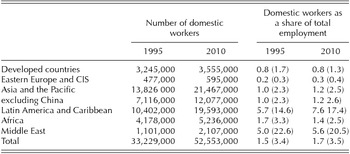
According to official statistics compiled by the ILO, there are at least 53 million domestic workers in the world, but unofficial estimates claim the number to be closer to 100 million (Table 1; ILO, 2013).Footnote 2 Domestic work is a fast-growing sector. During the past fifteen years, the number of domestic workers has increased by almost 20 million. The prevalence of paid domestic work varies significantly across world regions. It is highest in Latin America and the Caribbean (17.4 per cent of female and 5.7 per cent of total employment), where the colonial tradition of hiring domestic help still remains common among high and middle income families (see Kuznesoff, Reference Kuznesof, Chaney and García Castro1989; Thomson, Reference Thomson2009; Blofield, Reference Blofield2012). In affluent countries, the ILO estimates that 3.5 million persons are employed in domestic services, which accounts for nearly 1 per cent of total employment. In Asia, the share of domestic workers in total employment is slightly higher (1.2 per cent), with the share being twice as high if women alone are taken into account.
Global and regional estimates on the number of domestic workers in 1995 and 2010

Note: The percentages in parenthesis give the proportion of female domestic workers of total female employment (numbers of female domestic workers not shown).
Source: ILO (2013).
The region of Eastern Europe and CIS has the lowest prevalence of paid domestic labour. As previous studies (Bauer and Österle, Reference Bauer and Österle2013; Cangiano, Reference Cangiano2014) have shown, in many Eastern European countries care arrangements tend to be informal and there is less tradition of privately hired help. However, the region is closely connected to the phenomenon as a significant proportion of care workers (especially in elderly care) migrating to Central and Southern European countries come from Eastern Europe (see Bettio et al., Reference Bettio, Simonazzi and Villa2006; Schwenken and Heimeshoff, Reference Schwenken and Heimeshoff2011; Cangiano, Reference Cangiano2014).
Domestic work is a female-dominated occupation: around 80 per cent of domestic workers are women, and in some regions, such as Latin America, this proportion is over 90 per cent (ILO, 2011). A significantly smaller share of paid domestic work is performed by men, who typically work as security guards, chauffeurs and gardeners (Kilkey, Reference Kilkey2010; ILO, 2013). The more common jobs in the domestic-work sector, those of cleaners, nannies and other caregivers, are mainly occupied by women. Since most domestic workers are women, and paid domestic work is strongly related to gender norms, research on the subject has mostly focused on female domestic workers.Footnote 3
Analysing the macro level of paid domestic work: the role of economic development and income inequality, care needs, and changing labour markets
Based on mostly qualitative and theoretical research, three particular factors have been identified as contributing to the development and cross-country variation in the prevalence of paid domestic labour. These factors are economic development and inequality; care needs and the distribution of care responsibilities; and global migration and the changing structure of labour markets.
Economic development and income inequality
Coser (Reference Coser1973) and other social theorists (for example, Stigler, Reference Stigler1946; Chaplin, Reference Chaplin1978) considered the household servant to be an obsolete occupation that would disappear with the social and economic development of societies. Coser suggested that the once-respected status of servants had become stigmatised, which rendered the occupation undesirable for ordinary citizens, ‘When conditions have reached such an impasse’, he stated, ‘the status and role become obsolescent’ (Coser, Reference Coser1973: 39). This hypothesis would appear to be supported by the differences between affluent and less affluent countries, as the proportion of domestic workers is usually higher in the latter compared to the former (Milkman et al., Reference Milkman, Reese and Roth1998). On the other hand, the re-emergence of domestic workers in many wealthier countries suggests that paid domestic work does not disappear completely with social and economic development (Sassen and Portes, Reference Sassen and Portes1987; Milkman et al., Reference Milkman, Reese and Roth1998; Sarti, Reference Sarti, Pasleau and Schopp2006).
Another hypothesis suggests that paid domestic work is not so much tied to a country's economic and social development as measured by indices such as gross domestic product (GDP), but rather is more strongly related to the level of economic inequality within countries. Milkman et al. (Reference Milkman, Reese and Roth1998) showed that income inequality is a significant predictor of the size of the domestic services sector within the largest metropolitan areas of the United States: domestic workers were more prevalent in areas with higher levels of income inequality. Other significant determinants were related to the supply of domestic workers, such as the proportion of female African Americans and Latinas, and the proportion of the total female labour force who were foreign born. Although the study only covers the US, the authors suggest the same to be true in international comparisons. The importance of income distribution is also discussed in several qualitative studies (for example, Rollins, Reference Rollins1985; Nakano Glenn, Reference Nakano Glenn1992; Anderson, Reference Anderson2000; Parreñas, Reference Parreñas2001) on the micro level of paid domestic work, which linked the presence of domestic workers within the context of gender, ‘race’ and class inequalities. As stated by Bridget Anderson in Doing the Dirty Work (Reference Anderson2000), and various other scholars (for example, Ehrenreich and Hochschild, Reference Ehrenreich and Hochschild2002; Lutz, Reference Lutz2011; Tronto, Reference Tronto, Dahl, Keränen and Kovalainen2011), paid domestic work is still seen as an occupation that reinforces negative status hierarchies within the female population.
Income inequality is also related to increasing urbanisation, and it has been suggested that paid domestic work reflects an urban rather than a rural social phenomenon (Rodgers, Reference Rogers, Valenzuela and Mora2009). Domestic workers are said to concentrate in urban areas as a result of factors pushing unemployed individuals away from poor rural areas and pulling them towards becoming domestic workers in wealthier urban areas (Jacka and Gaetano, Reference Jacka and Gaetano2004; UNRISD, 2010). The increasing labour demand in urban areas is, in turn, explained by the increase in people of the urban middle class who are more likely to employ domestic workers (Sassen, Reference Sassen2001; UNRISD, 2010; Razavi and Staab, Reference Razavi and Staab2010). This trend is also evident in large metropolitan areas, the ‘global cities’ (Sassen, Reference Sassen2001), where employees of international companies moving to these cities create demand for household services.
Based on Milkman et al. (Reference Milkman, Reese and Roth1998), in this study it is hypothesised that domestic workers are more prevalent in countries with high levels of income inequality, while support for the traditional modernisation hypothesis of paid domestic work and lower economic development (GDP per capita) is not expected. As the level of urbanisation may partly reflect income inequality (wealthy urban class employing poor rural migrants), it has been included in the analysis in order to test whether the level of urbanisation is associated with a higher prevalence of domestic workers when income inequality is taken into account. Following earlier studies, we assume the level of urbanisation to be positively associated with the prevalence of paid domestic work.
Care needs and the distribution of care responsibilities
Many tasks comprising domestic work in private households are related to the taking care of others, particularly of children and elderly people. These tasks are often discussed under the concept of ‘care work’, which includes direct care (bathing, feeding, talking to and accompanying) and indirect care, such as doing the laundry, cooking and shopping (Razavi, Reference Razavi2007). The demand for long-term care for elderly people is growing rapidly in aging populations as the proportion of elderly people in the population increases but the potential ‘pool of family carers’ (that is, the working-age population) decreases (Colombo et al., Reference Colombo, Llena-Nozal, Mercier and Tjadens2011; Cangiano, Reference Cangiano2014). In addition, a growing number of women are entering the labour markets, and changing family structures are creating challenges for families to reconcile work and family life and for governments to fulfil their responsibilities in providing care (Lister et al., Reference Lister, Williams, Anttonen, Bussemaker, Gerhard, Heinen, Johansson, Leira, Siim, Tobio and Gavanas2007; Yeoh and Huang, Reference Yeoh and Huang2010).
The responsibility of organising care has been differently distributed in different societies, and these different ‘care regimes’ (Anttonen and Sipilä, Reference Anttonen and Sipilä1996; Bettio and Plantenga, Reference Bettio and Plantenga2004) are suggested to affect the need for domestic services (Lister et al., Reference Lister, Williams, Anttonen, Bussemaker, Gerhard, Heinen, Johansson, Leira, Siim, Tobio and Gavanas2007). In many developing countries households needing help with care responsibilities have no alternative but to hire private help, or in the case of lower income families, mostly rely on the family for supportFootnote 4 (Thomson, Reference Thomson2009; Blofield, Reference Blofield2012; 10).
However, it is not only the shortage of care provision that creates a demand for domestic services, but also the nature of the provision. Williams and Gavanas (Reference Williams, Gavanas and Lutz2008; see also Williams, Reference Williams, Dahl, Keränen and Kovalainen2011) suggest that it is the intersection of care, employment, gender and migration regimes that shapes the sector of domestic services. This hypothesis would appear to be supported by the differences between countries with different welfare systems: demand for domestic workers is lower in the Nordic countries, which have strong governmental care provision and promotion of gender equality. In contrast, higher demand for domestic services is typically found in countries with fewer opportunities for publicly provided care. These countries include liberal welfare states where care needs are met via the market economy, and Southern European countries where the responsibility of care falls to the family and where the traditional division of labour between men and women is more marked (Williams and Gavanas, Reference Williams, Gavanas and Lutz2008; Williams, Reference Williams, Dahl, Keränen and Kovalainen2011; see also Van Hooren, Reference Van Hooren2010; Widding Isaksen, Reference Widding Isaksen2010).
Following assumptions made by previous studies, two variables central to the theory of care needs have been chosen here for analysis. In this article, it is hypothesised that a large elder population and a high female employment rate are positively associated with the prevalence of paid domestic labour. However, following the findings of Saraceno and Keck (Reference Saraceno and Keck2010), it should be noted that these factors might be differently reflected within care needs. While the proportion of the population over the age of sixty-five is more important for elder care, the female employment rate may reflect the need for childcare and household work.
Migration and changing structure of labour markets
Finally, the changing size of the domestic work sector may reflect the globalisation of labour market structures and the movement of the labour force across nations. This has been described as the ‘transnationalisation of care’ by some social theorists (for example, Yeates, Reference Yeates2011), referring to a social process that connects ‘people, institutions and places across borders’ and creates a mobile workforce for domestic services (Yeates, Reference Yeates2011: 1113; see also Parreñas, Reference Parreñas2001; Mahon and Robinson, Reference Mahon and Robinson2011). The increasing migration of women is considered to be a particularly important driver for the supply of domestic workers (Hochshild, Reference Hochschild, Hutton and Giddens2000; Parreñas, Reference Parreñas2001; Ehrenreich and Hochshild, Reference Ehrenreich and Hochschild2002). Moreover, the global migration of women between countries is creating a need for carers for the families who are ‘left behind’ in the countries supplying domestic workers (Razavi, Reference Razavi2007). Hochshild (Reference Hochschild, Hutton and Giddens2000) describes care migration as a global care chain, a growing phenomenon in the globalised world where women in developing countries take care of the children of women who themselves take care of the children of families in rich countries. Thus, this ‘international transfer of caretaking’ (Parreñas, Reference Parreñas2001: 561) connects migrant care work closely with global inequality, or as Tronto (Reference Tronto, Dahl, Keränen and Kovalainen2011: 170) puts it, the ‘long lasting legacy of colonialism’.
International migration flows of domestic workers are complex but move mostly from Latin American countries to Europe and Northern America; from Indonesia, India, Ethiopia and Sri Lanka to the Gulf countries; and from the Philippines to almost all regions (Parreñas, Reference Parreñas2000; Ehrenreich and Hochschild, Reference Ehrenreich and Hochschild2002; Lutz, Reference Lutz and Lutz2008). In 2010, nearly 100,000 household service workers from the Philippines left the country to work overseas (Philippine Overseas Employment Administration, 2010). Within Europe, care workers predominantly migrate from eastern European countries, such as Poland, Ukraine and Romania, to Western parts of the continent to countries like Germany, France, the UK and Italy (see Lutz, Reference Lutz2011; Triandafyllidou, Reference Triandafyllidou2013; Cangiano, Reference Cangiano2014). Furthermore, domestic workers do not only migrate from the global south to the affluent countries of the global north, but also ‘from south to south’, that is, within the southern hemisphere.Footnote 5 Moreover, in many developing countries a large proportion of domestic workers are national migrants from poor rural areas who move to large cities to find work and end up working in domestic services that offer them an avenue of employment (D’Souza, Reference D’Souza2010).
In this study, migration is seen as a determinant for the prevalence of paid domestic work. With reference to the above, it is hypothesised that a high incidence of migration increases the prevalence of paid domestic labour in a country. Furthermore, previous studies have associated the prevalence of paid domestic work with employment policies and general employment quality (Cangiano and Shutes, Reference Cangiano and Shutes2010; Williams, Reference Williams, Dahl, Keränen and Kovalainen2011). Domestic work is often referred to as one of the most vulnerable and precarious occupations in today's labour markets, both because of the nature of the job (performed in private household and thus ‘invisible’) and because of the high degree of informal work arrangements (Anderson, Reference Anderson2000; Lutz, Reference Lutz and Lutz2008; ILO, 2013). This precariousness has also been seen as part of a wider employment trend: an increasing proportion of jobs in today's labour markets are characterised by part-time and short-term contracts, low wages and low job security (ILO-UNDP, 2009: 47). Weakly regulated labour markets generate low-wage labour, with poor working conditions, in sectors like private care services (Morgan, Reference Morgan2005). These types of low-wage jobs are often referred to as non-standard employment (Goldthorpe, Reference Goldthorpe1983; Kalleberg, Reference Kalleberg2000) or vulnerable employment (TUC, 2008; ILO, 2009; Pollert and Charlwood, Reference Pollert and Charlwood2009). These jobs may be particularly prevalent in the domestic services sector because of the low societal status of domestic and care work, and the generally poor control over the rights of workers employed in private households (Anderson, Reference Anderson2000; Blofield, Reference Blofield2012; Suleman, Reference Suleman2014; Gil Araujo and González-Fernández, Reference Gil Araujo and González-Fernández2014).
In order to conceptualise the association between employment structures and paid domestic labour, this analysis uses the concept of vulnerable employment, as defined by the ILO (ILO, 2009), as the sum of own-account workers and unpaid family workers. This definition is based on the premise that both groups of workers are ‘less likely to have formal work arrangements, access to benefits or social protection programs and are more “at risk” to economic cycles’ (ILO, 2010: 18). The term is also used as an indicator of overall employment quality, as a high number of workers in vulnerable employment normally indicates widespread informal work arrangements (ILO, 2012). Following previous studies, it is expected that a higher proportion of vulnerable employment is associated with a higher prevalence of paid domestic labour.
Data and methods
Data
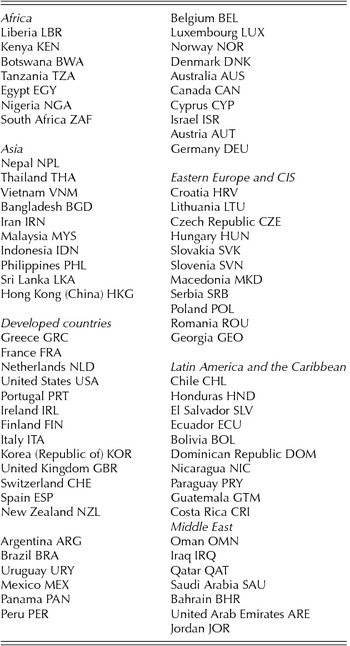
Data for the analysis are derived from the statistical databases of the ILO and the World Bank. The numbers of domestic workers are based on the ILO database from the newest data available from 2006 to 2010. The original data concerned 117 countries, but the availability of data for other variables used in the analysis limited the sample to seventy-four countries. The countries are divided into six groups:Footnote 6 Eastern Europe and the CIS countries; Asia; Latin America and the Caribbean; Africa; the Middle East; and the developed countries (see Appendix 1).
The numbers of domestic workers from the ILO database are mostly derived from official publications (censuses, labour force surveys and other household survey reports) and from the ILO's statistical database, LABORSTA. The definition of domestic worker used by the ILO draws on the industry-based approach based on ISIC,Footnote 7 defining all persons employed by private households as domestic workers. The employment figures used to calculate the proportion of domestic workers within the total employment are based on the ILO's Global Employment Trends (GET) model.Footnote 8
There are two main challenges related to the data quality. Firstly, sampling and measurement are always a concern when using cross-national data, as there may be differences between countries in how data are collected. As discussed earlier, the data mainly include domestic workers employed by private households, excluding workers of private companies from the scope of the analysis. Secondly, there is the challenge of the extent of informal work. A great deal of paid domestic work takes place in the shadow economy, where neither employers nor domestic workers pay taxes or social security benefits, and thus these workers do not appear in official statistics (ILO, 2011; Schwenken and Heimeshoff, Reference Schwenken and Heimeshoff2011). This problem applies to developing as well as developed countries. The advantage of the ILO data used in this study is that they are mostly based on national labour force surveys that are designed to cover all forms of employment, whether registered or not (ILO, 2013: 13). However, some non-registered workers may be reluctant to provide information about their jobs when interviewed by a government official. Moreover, since surveys usually rely on household registration data, undocumented migrant workers are usually excluded from the sample.
Given the challenges related to documentation of domestic workers, it needs to be borne in mind that the data used in this study do not represent the full extent of the domestic services sector. Still, the ILO data are the most comprehensive data available for international comparison so far.
The dependent variable used in the analysis was the proportion of paid domestic labour as a percentage of total employment. A natural logarithmic transformation was applied to the variable when used in regression models to adjust for the skewed distribution.
Based on previous literature, seven variables were chosen to test the determinants of cross-country variation in the prevalence of paid domestic labour. The data on independent variables are derived from the statistical database of the World Bank. The database consists of data collected mostly by the member countries, and they are often used for studies measuring the development progress of different countries.Footnote 9 The availability of annual data depends on the practices of each country's national systems. In this study, the covariates used in the analysis are formed by calculating the average of each factor available for the years 2006−10.
The female employment participation rate and the proportion of the population over sixty-five years old were used as indicators related to care needs. The structure of labour markets was assessed by the potential supply of paid domestic labour, that is, by the proportion of migrants in the total population, and the level of vulnerable employment, such as unpaid family workers and own-account workers, as a percentage of total employment.Footnote 10 Related to the economic characteristics, three variables were used to measure the economic status of the countries: the level of the urban population and the gross domestic product (GDP) per capita. For GDP per capita, a log-transformed scale was also applied in the regression analysis. Income inequality is captured by the Gini index multiplied by 100 (where 100 means total inequality and 0 total equality).
Method
There were missing data for the reference period (2006−10) for the Gini index (thirty-two countries), vulnerable employment (thirteen), female employment participation rate (eight) and proportion of migrants (one). The missing data were imputed using linear regression imputation with data of other covariates included in the analysis and data for the variable of interest from earlier years (between 1980 and 2005), except for female employment for which previous data were not available. The R2 values of the regression models were 0.90 for the Gini index, 0.96 for vulnerable employment, 0.23 for female employment and 0.91 for migration ratio when data from previous years and other covariates were used to predict the available data in these outcomes. This indicated that a substantial proportion of variance could be predicted with the imputation predictors, providing fairly accurate imputated values for missing values.
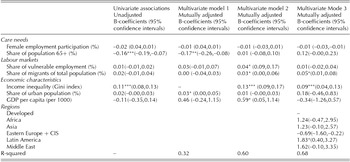
Linear regression analysis was used to test the association between the macro-level variables and prevalence of paid domestic labour. The analysis starts with the univariate associations between the dependent variable and the independent variables. The regression models are presented in Table 3. Previous studies show that income inequality is a strong predictor of paid domestic labour prevalence (Milkman et al., Reference Milkman, Reese and Roth1998). To test the hypothesis, Model 1 shows the associations between dependent and independent variables excluding income inequality (Gini index), while Model 2 includes all independent variables in the analysis. As noted in the introduction, there are significant regional differences in the prevalence of domestic workers. In the analysis, this is taken into account by introducing regional dummies (Model 3) to test the impact of region on the phenomenon. Finally, to further examine the association between income inequality and prevalence of paid domestic labour, this association is presented in a separate regression plot (Figure 1).
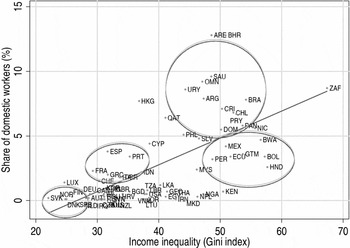
Prevalence of paid domestic work by level of income inequality
Note: Correlation: 0.63 (without South Africa ZAF: 0.61).

Results
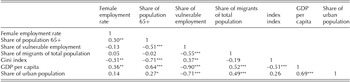
Appendix 2 shows the correlations between the independent variables. Higher Gini index figures showed high correlation with lower levels of GDP per capita and a smaller proportion of elderly population, and low correlation with the female employment rate and vulnerable employment. Moreover, the higher a country's GDP per capita, the higher the proportion of the elderly population and the lower its vulnerable employment rate. Furthermore, countries with higher rates of vulnerable employment had lower urbanisation levels and smaller proportion of migrant population.
The first column of Table 2 shows the univariate associations; that is, associations that are not adjusted for the other variables. These results do not support the hypothesis that care needs are associated with a higher share of paid domestic labour, as a higher proportion of over sixty-five-year-olds is associated with a lower prevalence of paid domestic labour, and the association with the latter and the female employment participation rate is not significant. High-income inequality was associated with a higher share of domestic workers among the employed, whereas the proportion of vulnerable employment, urban populations and GDP per capita were not related to the prevalence of paid domestic labour.
Predicting the prevalence of paid domestic labour by macro-level covariates

Note: *p<0.05, **p<0.01, ***p<0.001.
The first multivariate model in Table 2 examined the independent associations of macro-level variables with domestic work when adjusted for the other variables, except for income inequality. Only two associations remained statistically significant: the proportion of the population over sixty-five years old and the size of the urban population. However, when income inequality was added into the model (multivariate model 2, Table 2), these associations disappeared. Here, greater income inequality, higher GDP per capita and a higher proportion of migrants in the total population were significantly associated with a higher prevalence of paid domestic labour.
Regional dummy variables were added in the third and final multivariate model (Table 2). Compared to the regions of developed countries, and taking into account all the other macro-level variables, the proportion of paid domestic labour was higher in Latin America and the Caribbean countries. In addition, after adjusting for regional differences, a higher proportion of migrants in the total population and greater income inequality were associated with a higher prevalence of paid domestic labour in the third model.
Income inequality
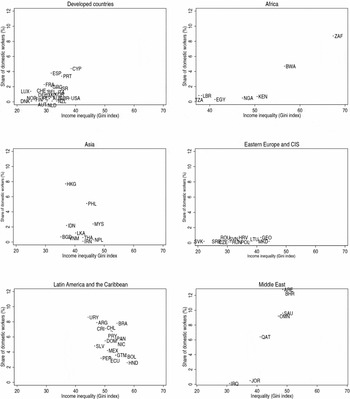
Figure 1 shows the regression plot of domestic work share plotted against the Gini index, which was observed to be the strongest determinant of domestic work prevalence in the analysis above. There were notable differences between countries across the Gini index, with the widest variation in the proportion of domestic workers in countries characterised by high levels of income inequality (Gini index > 40). The regression plots are shown by region in Appendix 3.
Western European countries are all located in the left-hand corner of Figure 1 with the Gini index between 25 and 40 and the share of paid domestic labour between 0.1 and 4 per cent. However, considerable differences can be identified within the region (see Appendix 3). These can be interpreted as similar to the divisions in welfare regimes (Esping-Andersen, Reference Esping-Andersen1990, Reference Esping-Andersen1999), or more specifically in the distribution of care responsibilities towards children, the elderly and the disabled. In the Nordic countries, where public care provision enables both women and men to participate in the labour market (with less need for private care), there is a low incidence of domestic workers and also a low level of income inequality. In contrast, Southern European countries have the highest prevalence of paid domestic labour in this group of countries and the greatest income inequality. These are countries where organising care is typically the responsibility of the household, usually women. Most of the middle European countries (France, Luxembourg and Switzerland) are situated between Southern European and Nordic countries in terms of the incidence of paid domestic work with slightly greater income inequality than in the Nordic countries.
Furthermore, another group is formed by countries with high-income inequality (Gini index around 40 or more) and the proportion of paid domestic labour over 4 per cent high. These are mostly countries of Latin America and Middle East, but also South Africa, Hong Kong and the Philippines. Some of the countries that traditionally have been seen as having an equally large sector of domestic services as the countries in the previous group are located under the regression line, with fairly low incidence of paid domestic work (Mexico, Guatemala, Ecuador, Peru, Bolivia, Honduras, Malaysia). While there may be many reasons for the difference, one explanation could be a lower level of urbanisation. As mentioned earlier, domestic workers are usually more common in urban than in rural areas, and hence when observed on national level, the phenomenon seems smaller.
Discussion
This article is the first attempt to quantitatively assess the determinants of the prevalence of paid domestic labour in a global context using a sample of seventy-four countries. Macro-level variables were derived from three socio-economic domains, care needs, labour markets and economic factors, which in previous studies have been hypothesised to be relevant, based mostly on qualitative and theoretical research.
The findings did not support the modernisation hypothesis of paid domestic labour decreasing alongside the economic development of societies (see Coser, Reference Coser1973), as a lower level of GPD per capita was not associated with a higher prevalence of paid domestic labour. On the contrary, domestic worker prevalence was higher in countries with higher GDP per capita; however, the association disappeared when region was taken into account. A higher level of income inequality was strongly associated with a greater proportion of paid domestic labour in the total employment. Thus, the results support the findings of Milkman et al. (Reference Milkman, Reese and Roth1998) on domestic work prevalence within the United States. The association between income inequality and paid domestic labour remained unchanged even when controlling for six other variables related to the demand and supply of domestic services.
Another variable associated with a higher prevalence of paid domestic labour after controlling for all macro-level factors was a proportionally larger migrant population, suggesting that migration is an important driver for paid domestic work. This result is in line with our hypothesis. As noted before, in many countries, across regions, paid domestic work is to a large extent performed by migrants. Yet it should be kept in mind that migration is not only a supply factor, but may also be influenced by the demand for care workers in the receiving countries, as in the case of the global cities of Europe and Asia (that is, Sassen, Reference Sassen1988).
A positive association was observed between the other labour market variable, vulnerable employment and the prevalence of paid domestic labour. However, this association disappeared when controlling for region. A more suitable factor for measuring the quality of employment might be the share of informal employment, but this information is only available for developing countries and not for OECD countries.
After controlling for all factors, no association was found between elderly proportion and domestic labour prevalence. In the first and second model, the association between the size of the elder population and the prevalence of paid domestic labour was negative, probably reflecting the fact that despite the growing need for care in developed countries, domestic workers are still significantly more common in developing countries, where age structure is usually younger than in developed countries. The other variable related to care needs, female employment rate, was not associated with prevalence of paid domestic labour. However, the variable may be problematic in explaining the phenomenon in a global comparison, as working women's dependence on private care services varies across countries. In many countries, hiring private help in the household (or informal care arrangements) is crucial, especially for mothers’ employment, while in others, such as the Nordic countries, women's employment rate is high, but due to other arrangements (usually public day care) being available, the use of private care services is low, which might have introduced bias into the analysis. However, the results remained unchanged when Nordic countries were excluded from the analysis (data not shown). A better measure for care needs would be the share of public expenditure on social and care services, but these data are only available for OECD countries.
As hypothesised earlier, the level of urbanisation was positively associated with the prevalence of paid domestic labour, indicating that a large domestic sector is more common in countries with higher levels of urbanisation. However, the association disappeared when controlling for income inequality.
Taking into account all the other study covariates, there were more domestic workers in Latin America compared to the region of developed countries. This is not surprising, since the level of paid domestic work is traditionally high in the whole Latin American region, a phenomenon that is related not only to lack of public care provision. Latin America has the highest inequalities of all regions in the world, and these inequalities are reinforced in the social class divisions. In the context of marked social hierarchies, domestic servants in wealthy households are part of a cultural tradition that is still sustained in the twenty-first century (Stefoni, Reference Stefoni, Valenzuela and Mora2009; Thomson, Reference Thomson2009; Blofield, Reference Blofield2012).
On the whole, the results of this research suggest that the preconditions for the domestic work sector still lie heavily in income distribution within societies. Discussions on domestic services, especially in Europe and the US, increasingly emphasise the need for help in ordinary households and see paid domestic work as an alternative to public care provision (see Dahl et al., Reference Dahl, Keränen and Kovalainen2011; Triandafyllidou, Reference Triandafyllidou2013). Population ageing, together with other societal developments, will only increase the demand for domestic and care services in the future (Colombo et al., Reference Colombo, Llena-Nozal, Mercier and Tjadens2011; Cangiano, Reference Cangiano2014). While this need may not be exaggerated, it seems that the link to the class structure still remains even in ‘modern’ societies. Furthermore, previous micro-level studies on the status of domestic workers conclude that class inequalities between employers and employees intersect closely with other inequalities related to gender, ethnicity and nationality, making the power relations in female and migrant dominated domestic work sector particularly unbalanced (for example, Parreñas, Reference Parreñas2000; Ehrenreich and Hochshild, Reference Ehrenreich and Hochschild2002; Gurung, Reference Gurung2009; Lutz, Reference Lutz2011; Gavanas, Reference Gavanas2013).
Numerous studies on global care migration have studied these inequalities in transnational context, concluding that the phenomenon of paid domestic work is related to a wider global division that can be described as what Parreñas (Reference Parreñas2001) calls the ‘international transfer of caretaking’ and Hondagneu-Sotelo (Reference Hondagneu-Sotelo2001) the ‘new world domestic order’, where affluent countries recruit migrant workers to fill the gaps of the care deficit, while families in less affluent countries have to cope with informal care solutions.
In their study on the US, Milkman et al. focus on inequalities between domestic workers and their employers, concluding that ‘the greater the disparity in resources between rich and poor households, the more easily the former can employ members of the latter as domestic labourers’ (1998: 496). However, it could be argued that a higher prevalence of paid domestic labour is not only linked to social and economic differences between workers and employers, as it may also reflect inequality in care among households: wealthier households are able to pay for a domestic worker or a nanny, while poor households in most countries have to rely on the family. Hence, as also noted in previous studies (Tronto, Reference Tronto, Hamington and Miller2006; Razavi, Reference Razavi2011), private care services are often seen as risking the reinforcement of social inequalities. This may be especially true for gender equality. Since it is more often women (than men) who are responsible for the care of children, sick or older people, poor availability of public care services usually means that fewer women have the opportunity to participate in the labour market. As numerous studies have shown (for example, Cangiano and Shutes, Reference Cangiano and Shutes2010; León, Reference León2010; Zechner, Reference Zechner and Widding Isaksen2010; Williams, Reference Williams2012), public policies can play an important role in how care is formed, not just for those providing care but also for those receiving it.
International comparison of a complex phenomenon such as paid domestic work is a challenging task, but it does give us some notion of the status of the sector in today's societies. Given the relatively high correlations between some of the macro-level variables, it may be difficult to determine their associations independently from the other variables. In addition, due to data limitations these results should be interpreted with caution. Thus, although income inequality appears to be the most crucial variable, the other variables identified in the univariate analysis may still be important in understanding the cross-national distribution of paid domestic labour. One can also see the high correlations reflecting the complexity of the phenomenon and how closely the different macro-level factors of paid domestic work are linked with economic inequality.
While this article has focused on quantitatively assessing the factors related to paid domestic labour prevalence, further investigation into the patterns of this prevalence would prove valuable, particularly concerning the role of different institutions.
List of countries

Pairwise correlations between covariates

Prevalence of paid domestic labour by income inequality, regional distribution