Introduction
Trauma is the leading cause of death in the Western world accounting for just under 65,000 fatalities in the age group from one year to 44 years in the United States of America.1 Designated Level 1 Trauma Centers are well-established within a full-scale trauma system.Reference Celso, Tepas and Langland-Orban2–Reference MacKenzie, Rivara and Jurkovich4 As the care for trauma patients continues to be centralized, the question remains whether trauma surgeons should be in-house (IH) at all times in centers treating severely injured patients to improve outcome. Therefore, the additional value of such an IH attending trauma surgeon compared to on-call (OC) trauma surgeons remains to be elucidated.Reference Durham, Shapiro and Flint5–Reference Porter and Ursic7
Many Level 1 Trauma Centers are staffed by IH attending trauma surgeons available 24/7, whereas other institutions function on an OC basis with defined response times while 24/7 coverage is provided by senior residents.Reference Cox, Bernard and Bottiggi8,Reference van der Vliet, van Maarseveen and Smeeing9 Several studies have reported positive effects of IH attending surgeons, as reduction in preventable deaths has been suggested by some authors. Reference Durham, Shapiro and Flint5,Reference Claridge, Carter, McCoy and Malangoni10–Reference Luchette, Kelly and Davis12 However, the additional value of IH attending trauma surgeons in terms of overall mortality or hospital length-of-stay (HLOS) is still under debate. Reference Demarest, Scannell and Sanchez13,Reference Helling, Nelson, Shook, Lainhart and Kintigh14 Process-related improvements (ie, shorter turnover time to intensive care unit [ICU] and more Computed Tomography [CT] scans) have recently been contributed to IH trauma surgeons. Reference van der Vliet, van Maarseveen and Smeeing9,Reference Havermans, de Jongh, Bemelman, van Driel, Noordergraaf and Lansink15
In the Amsterdam University Medical Center, location AMC (Amsterdam, the Netherlands), trauma surgeons were required to be IH if expected response time was to exceed 15 minutes. Trauma surgeons living in the vicinity of the Trauma Center were permitted to be OC (eg, from home). The aim of the present study was to describe the experience in a single, large volume, Level 1 Trauma Center in the Netherlands with both IH and OC trauma attending coverage.
Methods
Study Design
All patients presenting to the trauma room of the Amsterdam University Medical Center, location AMC, from January 1, 2012 through December 31, 2013 were included. The patients were identified from the regional trauma registry database. Patients under the age of 18, patients transferred after primary trauma screening at another hospital, and patients without a trauma care documentation were excluded. Anonymous data were collected from patient documentation systems and emergency department (ED) logistics databases. All patient data were gathered prospectively in order to comply with national and institutional quality control initiatives. Data extraction was performed by multiple investigators. Data regarding surgeon attendance (IH versus OC) were gathered from the surgical department’s duty roster as a spreadsheet. The number of trauma surgeons IH versus OC was evenly divided during 2012-2013. Every included patient was assigned an identifier for IH trauma surgeon attendance versus OC attendance. A cutoff value of 1700h and 0800h was introduced separating daytime from nighttime (IH/OC) trauma surgeon attendance. For this study, a waiver for approval was received by the institutional review board: AmsterdamUMC METC W14_185 # 14.17.0230.
Outcome Measures
The primary outcome variable studied in this cohort was overall mortality in relation to IH or OC attending trauma surgeons (after 1700h). Overall trauma patient mortality during daytime was considered a control population. Chart review was performed by two authors in order to investigate (potentially) preventable death (PPD). Additionally, time to operating theater, HLOS, and ICU admittance were studied, as were demographic data (eg, age, gender, type of trauma, and Injury Severity Score [ISS]). Prehospital data such as involvement of a physician-staffed prehospital helicopter Emergency Medical Service (HEMS) were utilized to accurately define the studied patient population.
This study was performed at a tertiary care facility complying with all requirements to be a designated Level 1 Trauma Center as defined by the American College of Surgeons Committee on Trauma (ACSCOT; Chicago, Illinois USA) 16 caring for a population of 1.36 million inhabitants covering 2097 km Reference Celso, Tepas and Langland-Orban2 (ca. 800 sq. miles). The hospital has been Joint Commission International (JCI) accredited uninterruptedly since 2012. The ED is equipped with two (adjacent) trauma rooms and a central, sliding gantry 64-slide CT scanner as well as an additional CT scanner in a bordering room. Reference Frellesen, Boettcher and Wichmann17,Reference Fung Kon Jin, Goslings, Ponsen, van Kuijk, Hoogerwerf and Luitse18 Surgical interventions are commonly performed in one of two available hybrid operating theaters or a designated trauma theater depending on patient needs.
Trauma team activation is coordinated by a senior ED nurse and closely follows guidelines as set forth by Advanced Trauma Life Support (ATLS). Reference Henry19 Two types of trauma team activations are possible depending on prehospital assessment of need: Reference Eastes, Norton, Brand, Pearson and Mullins20–Reference Harmsen, Giannakopoulos, Terra, de Lange de Klerk and Bloemers24 major trauma team and minor trauma team activation. Major trauma team activation includes anesthetist and anesthetist technician, two ED nurses, a trauma team leader (surgical senior resident), emergency physician, radiologist, and radiology technician. Daytime (0800-1700h) major trauma team activation required mandatory attendance of a trauma surgeon. In case prehospital assessment rules out airway involvement or insufficient airway protection and/or suspects a low energy trauma mechanism, the anesthetist (and technician) and trauma surgeon are not called upon immediately, resulting in minor trauma team activation. Minor trauma team activation may be upgraded to major trauma team upon patient presentation or changes in prehospital patient status resulting in prompt trauma surgeon and anesthetist attendance. During non-office hours (1700-0800h), only a major trauma team activation is possible (including anesthetist) where the role of the trauma surgeon is fulfilled by senior surgical residents trained and certified in ATLS methodology.
In the Netherlands, trauma surgeons staffing Level 1 Trauma Centers commonly treat visceral trauma as well as extremity trauma (fractures and soft tissue), including trauma to the pelvis and spine. Vascular trauma beyond hemorrhage control or permanent ligation is commonly treated by vascular surgeons. Reference Goslings, Ponsen, Luitse and Jurkovich25 All trauma surgeons participating in this study were board certified by the Dutch Trauma Surgery Society (Nederlandse Vereniging voor Traumachirurgie [NVT]; Amsterdam, the Netherlands).
Statistical Analysis
Dichotomous and categorical variables were reported with percentages, while not normally distributed continuous variables were reported as medians with interquartile range (IQR). Normally distributed continuous variables were reported as means. Bivariate analysis was performed by either chi-squared (with Yates’ continuity correction) or Mann-Whitney U tests for dichotomous and continuous variables, respectively. Logistic regression analysis was performed to adjust for possible differences between the OC and IH group, with mortality as the dependent variable. All statistical analyses were performed using SPSS 25 (IBM Corp; Released 2017. IBM SPSS Statistics for Windows, Version 25.0. Armonk, New York USA). A P value of <.05 was considered statistically significant.
Results
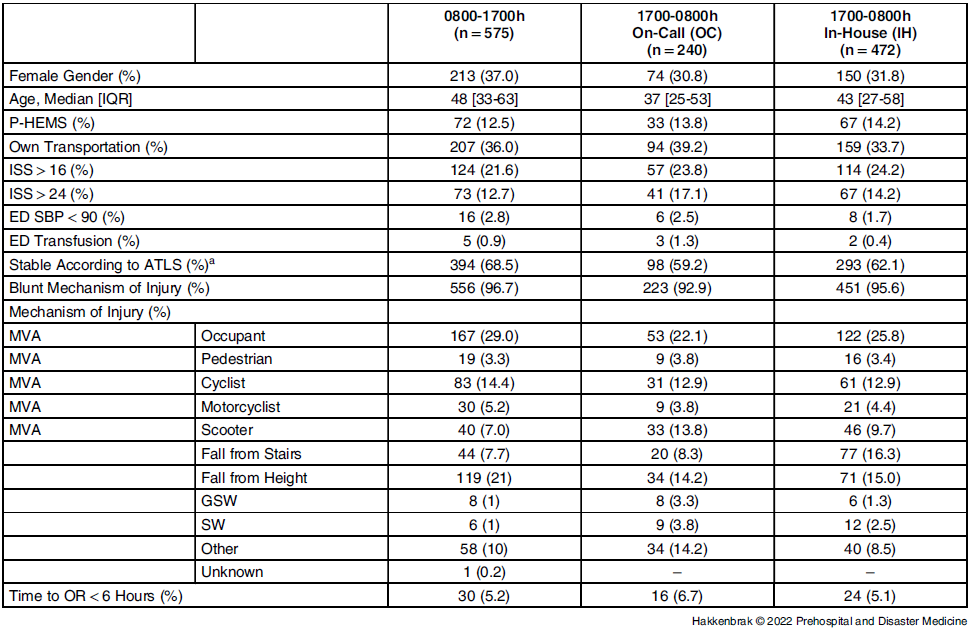
During the defined study period, a total of 1,287 unique trauma cases in 1,285 patients were presented to the trauma team of seven surgeons. Four surgeons were IH and three were OC. Patient data and demographics are shown in Table 1. Of all cases, 712 (55.3%) presented between 1700h and 0800h. These 712 cases were treated by an IH attending in 66.3% (n = 472) and an OC attending in 33.7% (n = 240). The ISS was >16 in 124 daytime patients (21.6%), 57 (23.8%) patients in the OC group, and 114 (24.2%) patients in the IH group (n.s.). Patient ICU admittance and admittance to the trauma ward were comparable between OC, IH, and daytime, as was the number of patients staying for longer than one day (Table 2).
Demographics of All Patients per Group

Abbreviations: P-HEMS, prehospital helicopter Emergency Medical Services; ISS, Injury Severity Score; ED, emergency department; SBP, systolic blood pressure; ATLS, Advanced Trauma Life Support; MVA, motor vehicle accident; GSW, gunshot wound; SW, stab wound; OR, operating room.
a Stable according to ATLS = GCS>13; sO2>94%; HR<100/min; SBP>90; BR>10/min or <29/min (no endotracheal tube).
Outcomes of All Patients per Group

Abbreviations: ICU, intensive care unit; LOS, length-of-stay.
a Data missing for three cases.
Emergency Surgery
During the non-office hours, 38 patients underwent emergency surgery. No significant difference was found in the time between initial presentation at the trauma room and arrival in the operating theater (OC 1:16h [SD = 0:45h]; IH 1:31h [SD = 1:18h]). The most frequently encountered intervention was neurosurgical decompression (n = 21; 55.3%) followed by laparotomy (n = 7; 18.4%) and angiography/coiling (n = 6; 15.8%). Thoracotomy was performed in five patients: one in the OC cohort, and four in the IH attending cohort, with a mortality rate of 100%. Coronary intervention, external fixator placement, wound exploration, and thoracotomy in the operating theatre accounted for one each.
Mortality
Daytime (0800h-1700h) mortality was found to be 5.0% (n = 29). A total of 37 (5.2%) patients deceased due to trauma from 1700h through 0800h. In the group of patients treated by an IH attending trauma surgeon, the overall mortality rate was 5.5% (n = 26); in the group treated by an OC attending, the overall mortality rate was 4.6% (n = 11; P = .599; Table 2).
When correcting for age, gender, presence of HEMS on the scene, prehospital interventions (chest tube placement and intubation), prehospital vital signs (systolic blood pressure and Glasgow Coma Scale), and ISS, no significant differences were found in mortality between the IH and OC group (P = .256; OR 0.655).
In the group of fatalities treated by an IH attending trauma surgeon during the non-office hours, the ISS was >16 in 24 of the 26 patients; 24 patients were regarded unstable at arrival according to ATLS; 12 of the13 fatalities were considered preventable death compared to one PPD. In the group of fatalities treated by the OC attending, the ISS was >16 in 10 of the 11 patients; 11 (100%) cases were regarded unstable according to ATLS; three of the 11 fatalities were considered preventable death compared to one PPD.
Extensive chart review revealed that three of the 28 cases (10.7%; deaths excluding death from traumatic brain injury [TBI]) were PPDs (ie, on-going bleeding after multiple intervention), two of which occurred after 1700h: once with a trauma surgeon IH and once with the trauma surgeon being OC.
Cause of Death
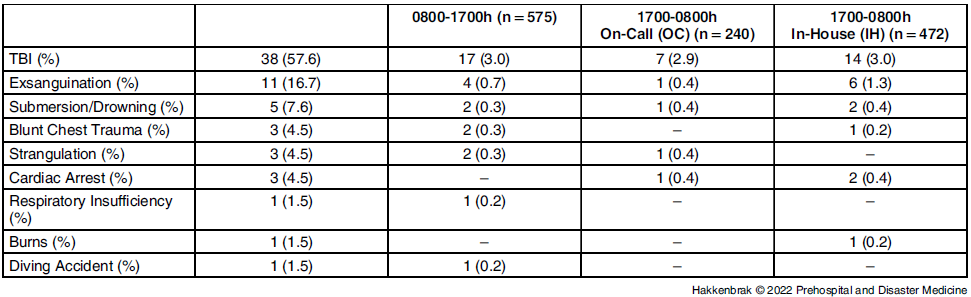
Overall, TBI accounted for 57.6% of the deaths (n = 38), exsanguination for 16.7% (n = 11), submersion/drowning for 7.6% (n = 5), blunt chest injury for 4.5% (n = 3), strangulation for 4.5% (n = 3), and cardiac arrest (preceding the trauma) for 4.5% (n = 3). Diving accidents, respiratory insufficiency (late), and burns were responsible for 1.5% mortality each (n = 1; Table 3).
Cause of Death

Abbreviation: TBI, traumatic brain injury.
Discussion
The commitment of major resources and personnel for the care of the injured patient has decreased preventable death and improved the overall management of trauma patients. Reference van der Vliet, van Maarseveen and Smeeing9,Reference Luchette, Kelly and Davis12 Additionally, preventable deaths have been shown to be reduced in trauma systems that are established in concordance with the guidelines of the ACSCOT. 16 One of the prerequisites to comply with the requirements for a designated Level 1 Trauma Center, as stated by the ACSCOT, is IH attendance of a trauma surgeon during non-office hours. 16 Over the last decades, several studies have tried to correlate the presence of an IH attending trauma surgeon to clinical outcome in terms of reduction in (preventable) mortality compared to OC trauma surgeon attendance. Reference Durham, Shapiro and Flint5,Reference Cox, Bernard and Bottiggi8
In this study, the experience of a single Level 1 Trauma Center with IH and OC trauma attending coverage was described in relation to mortality. In terms of mortality, no difference was found between the IH patients and the OC group. Previous studies included overall in-hospital trauma-related mortality in contrast to this study, describing solely trauma-related mortality during non-office hours. Reference van der Vliet, van Maarseveen and Smeeing9,Reference Havermans, de Jongh, Bemelman, van Driel, Noordergraaf and Lansink15 Additionally, other studies did not limit changes while assessing IH and OC trauma surgeon attendance in order to optimize trauma care (ie, renovation of the trauma room, facilities, and additional training and accreditation of health care staff). Reference Luchette, Kelly and Davis12,Reference Havermans, de Jongh, Bemelman, van Driel, Noordergraaf and Lansink15,Reference Fung Kon Jin, Goslings, Ponsen, van Kuijk, Hoogerwerf and Luitse18 Nonetheless, the level of care improved, but the role of staff attendance in this improvement remains questionable. Reference Claridge, Carter, McCoy and Malangoni10,Reference Helling, Nelson, Shook, Lainhart and Kintigh14 Studying a single variable (IH and OC attending) adds to the strength of this study.
Although PPDs are rare in Level 1 Trauma Centers, they do occur and are mostly caused by error in judgment and delay in treatment. Reference Saltzherr, Wendt and Nieboer26 In terms of reduction of PPDs, some studies have suggested a substantial benefit attributable to IH attending trauma surgeons. Reference Durham, Shapiro and Flint5,Reference Claridge, Carter, McCoy and Malangoni10–Reference Luchette, Kelly and Davis12 In this study, preventable deaths were uncommon and evenly distributed during daytime and non-office hours in both the IH and OC groups. Remarkably, the time taken to reach the operating theater commonly exceeded one hour in this study. A possible explanation is that the majority of patients undergoing emergency surgery in this institute had suffered blunt TBI and were transferred to the care of the neurosurgeons performing subsequent operations. As such, the diagnostic and logistic process differ significantly from patients suffering from traumatic hemorrhage.
In addition, TBI may be severe and require prompt neurosurgical intervention. Therefore, neurologists are present in the trauma bay to assess whether immediate neurosurgical consultation is necessary in order to prevent treatment delay for those in need of urgent surgical intervention. Since medical history and prior physical health as well as severity of TBI with regard to functional outcome are taken into consideration before performing neurosurgical procedures, treatment of TBI may be more complex and time consuming than that of traumatic hemorrhage.
In the Netherlands, trauma surgeons staffing Level 1 Trauma Centers treat both visceral and orthopedic injuries, making them leaders in the assessment and management of severely injured patients. Surgical residents are well-trained in trauma during their residency, participating in important (and mandatory) trauma courses such as the ATLS and Definitive Surgical Trauma Course (DSTC), making them proficient to independently lead trauma teams in the ED and to perform damage control interventions under supervision of a trauma surgeon. The level of training required to lead a trauma team is identical for both the senior surgical resident and attending trauma surgeon and is dictated by mandatory training and courses. However, the attending trauma surgeon will be more experienced with regard to surgical skills and management of the severely injured patient as a result of increased exposure. Therefore, procedures such as resuscitative thoracotomy or laparotomy are reserved to be performed by the attending trauma surgeon. In this study, the thoracotomies were performed by the attending trauma surgeon, assisted by the senior surgical resident.
Limitations
Some limitations should be noted. A limitation of this retrospective study might be misclassification bias due to documentation deficits. This was addressed by evaluating data by multiple investigators and utilizing standardized abstraction forms for data extraction. Presence of an attending trauma surgeon at the bedside on patient first presentation was not retrieved for IH nor for OC trauma surgeon attendance. The duty roster of the trauma surgical staff, however, may be considered random, adding to the value of the presented outcomes. The majority of the traumatic injuries were the result of blunt trauma, as penetrating injury is relatively rare in the Netherlands. Reference Rikken, Chadid, Peters, Geeraedts, Giannakopoulos and Tan27 Therefore, the results of this study apply to trauma environments primarily treating blunt trauma.
Based on the results of this study, benefit on mortality by IH trauma surgeon attendance compared to OC trauma surgeon attendance was not demonstrated. It is the trauma team’s commitment to trauma care and the available facilities and not IH or OC definitions that impact survival in trauma patients. Furthermore, resources need to be made available to treat the substantial number of TBI patients seen in Level 1 Trauma Centers.
Conclusion
Trauma-related mortality during non-office hours did not differ between IH trauma surgeon attendance and OC trauma surgeon attendance. Additionally, daytime mortality of trauma patients (with the hospital in full operation) was equivalent to the mortality observed during the non-office hours. Results of this study do not substantiate benefit on mortality by IH attendance compared to OC trauma surgeon attendance.
Conflicts of interest/funding
The authors declare no conflicts of interest. No funding was received for this study.
Author Contributions
TS and JH performed data collection and statistical analysis. SM, NH, TS, and JH performed the data analysis/interpretation. SM, NH, DE, GG, FB, TS, and JH contributed to the writing and critical revisions.