From theoretical perspectives, the effectiveness of corrective feedback (CF) on learners’ interlanguage development has been the topic of much discussion in SLA research. The effectiveness of CF lends support to SLA theorists who emphasize the importance of negative as well as positive evidence in second language (L2) development (Gass, Reference Gass1997; Long, Reference Long, Ritchie and Bhatia1996, Reference Long2007) as opposed to those who argue that positive evidence alone is sufficient (Krashen, Reference Krashen1981) and that negative evidence in the form of CF can even be detrimental to interlanguage development (Truscott, Reference Truscott1999). Theoretically motivated interactional studies have typically examined conversational moves triggered by communication breakdown and message incomprehensibility (i.e., negotiation for meaning). However, the application of findings of dyadic conversation to L2 classrooms can only be indirect at best. As Lyster and Mori (Reference Lyster and Mori2006) argued, “teacher-student interaction has a clearly pedagogical focus that relates not only to meaning but also to formal accuracy, quality of expression, and literacy development” (p. 278; i.e., negotiation of form). To further inform theoretical discussions of oral CF and especially its educational value in L2 classrooms, this article presents a meta-analysis of 15 quasi-experimental CF studies (N = 827) that involve teacher-student interaction in classroom settings.
CORRECTIVE FEEDBACK
An increasing number of SLA studies show that CF plays a role in L2 learners’ interlanguage development. Two recent meta-analysis studies provide helpful findings for future studies in this vein: Mackey and Goo (Reference Mackey, Goo and Mackey2007) conducted a meta-analysis of 28 interaction studies (including 20 oral CF studies), and Russell and Spada (Reference Russell, Spada, Norris and Ortega2006) performed a meta-analysis of 15 CF studies (including 10 oral CF studies). Russell and Spada found that CF is facilitative of L2 development; they identified a very large effect size of 1.16.Footnote 1 Similarly, Mackey and Goo discovered that providing CF in L2 interaction has a medium effect size of 0.71 in immediate posttests and a large effect size of 1.09 in delayed posttests. These results support the consensus that focus on form through CF is beneficial. Russell and Spada concluded, however, that “the wide range of variables examined in CF research is spread rather thin; more work is needed to consolidate efforts and focus on those CF variables that appear to be particularly fruitful for future investigation” (p. 156).
Research Setting
One of the key variables known to differentially affect CF effectiveness is whether the research is conducted in a laboratory or a classroom setting. Previous review articles (Ellis & Sheen, Reference Ellis and Sheen2006; Nicholas, Lightbown, & Spada, Reference Nicholas, Lightbown and Spada2001; Spada, Reference Spada1997; Spada & Lightbown, Reference Spada, Lightbown, Mackey and Polio2009) pointed out that the effectiveness of CF and subsequent learning outcomes are notably different in laboratory and classroom settings, and the meta-analysis of interaction studies by Mackey and Goo (Reference Mackey, Goo and Mackey2007) confirmed that empirical data from classroom and laboratory settings generate essentially different results. They reported medium effect size values for classroom studies (d = 0.57 for immediate posttests and d = 0.76 for long delayed posttests) and much larger effect sizes for laboratory studies (d = 0.96 for immediate posttests and d = 1.20 for long delayed posttests). Learners in laboratory settings may be more sensitive to CF because variables such as intensity and consistency are well controlled for; in the case of classroom settings, teachers may have difficulty delivering CF following specific linguistic targets in a consistent manner (Ellis & Sheen; Nicholas et al.). To reveal CF patterns with potential pedagogical implications, we chose to focus exclusively on classroom studies in the present meta-analysis. As Spada and Lightbown recently remarked, “classroom-based studies are most likely to lead to a better understanding about the kind of interaction that occurs in classrooms where the teacher is the only proficient speaker and interacts with a large number of learners” (p. 159).
CF Types
Much variation in the operationalization of supposedly similar constructs across CF studies has been noted in previous meta-analyses, one of the most salient problems being the definitional fuzziness of different types of CF. Russell and Spada (Reference Russell, Spada, Norris and Ortega2006) drew no conclusions about the relative effectiveness of CF types, acknowledging that, despite the increasing number of observational and experimental studies on the efficacy of various types of CF, sufficient data to arrive at such conclusions are lacking. Similarly, Mackey and Goo (Reference Mackey, Goo and Mackey2007) emphasized “the need for greater theoretical specificity or practical motivations in making claims about the superiority of one feedback type over another” (p. 440).
Based on the growing body of research on CF in classroom settings, a comparison of three different types of CF is included in this meta-analysis: recasts, explicit correction, and prompts. In that way, we consider feedback types not only in terms of implicitness and explicitness but also in terms of Ranta and Lyster’s (Reference Ranta, Lyster and DeKeyser2007) distinction between reformulation, which “includes recasts and explicit correction because both these moves supply learners with target reformulations of their non-target output” (p. 152), and prompts, which “include a variety of signals, other than alternative reformulations, that push learners to self-repair” (p. 152). Lyster and Ranta (Reference Lyster and Ranta1997) defined recasts as “the teacher’s reformulation of all or part of a student’s utterance, minus the error” (p. 46). Explicit correction also provides the correct form but, unlike recasts, “clearly indicates that what the student had said was incorrect” (p. 46). Prompts include elicitation, metalinguistic clues, clarification requests, and repetition. Although prompts include a range of CF types, they have one important feature in common that differentiates them from reformulation moves: They withhold correct forms and instead provide clues to prompt students to retrieve these correct forms from their existing knowledge. In terms of linguistic evidence, therefore, explicit correction provides both negative and positive evidence, recasts provide positive evidence and possibly also negative evidence, and prompts provide only negative evidence.
Because prompts can include both implicit and explicit CF moves, Ellis (Reference Ellis2006) suggested that differentiating implicit and explicit strategies in studies of CF effectiveness would more aptly reflect “current interest in the relative contributions of implicit and explicit feedback to acquisition” (p. 29). However, limiting comparisons of CF effectiveness in L2 classrooms to only implicit versus explicit distinctions in this way (a) assumes the existence of nonoverlapping definitions of CF types that might permit categorical comparisons of implicit versus explicit interventions and (b) overestimates both the theoretical value and feasibility of comparing implicit and explicit CF types in classroom settings. Researchers have often differentiated CF types in terms of explicitness, but this has proven problematic. Recasts, for example, are often considered categorically implicit (Long, Reference Long, Ritchie and Bhatia1996; Long & Robinson, Reference Long, Robinson, Doughty and Williams1998), yet research shows that, depending on discourse context, instructional setting, and learner orientation as well as formal characteristics such as linguistic targets, length, and number of changes, recasts can also be quite explicit (Ellis & Sheen, Reference Ellis and Sheen2006; Nicholas et al., Reference Nicholas, Lightbown and Spada2001; Sheen, Reference Sheen2004, Reference Sheen2006). Similarly, CF considered explicit also comes in many shapes and sizes. Some explicit feedback techniques include provision of the correct form (e.g., Lyster & Ranta, Reference Lyster and Ranta1997; Sheen, Reference Sheen and Mackey2007), whereas other techniques withhold the correct form and either provide metalinguistic information (e.g., Ellis, Reference Sheen and Mackey2007) or simply a metalinguistic clue (i.e., not an explanation) that indicates that the learner’s utterance is ill-formed (e.g., Loewen & Nabei, Reference Loewen, Nabei and Mackey2007).
Prompts range from implicit to explicit but are distinguishable from recasts and explicit correction in terms of what Ortega (Reference Ortega2009) called demand—that is, “the degree of conversational urgency exerted upon interlocutors to react to the negative feedback” (p. 75). Prompts are not necessarily explicit in terms of the linguistic information they provide but might be considered explicit in terms of their illocutionary force. In other words, by prompting, a teacher provides cues for learners to draw on their own resources to self-repair, whereas by providing explicit correction or recasting, a teacher both initiates and completes a repair within a single move. Prompts thus fit well with instructional discourse, as they resemble the clueing procedure identified by McHoul (Reference McHoul1990) in his study of feedback in subject-matter classrooms. Clueing is a “withholding phenomenon [...] different from that encountered in conversation” (p. 355), whereby teachers show students where their talk is in need of correction and not how the correction should be made. McHoul found that teachers tended to provide correct responses only as a last resort when the clueing failed to elicit self-repair. Because the main purpose of our meta-analysis is to investigate the effectiveness of CF in classroom settings, the comparison of prompts that withhold correct forms with other CF types that provide correct forms has considerable ecological validity because teachers are able to make online decisions about whether to withhold or to provide correct forms in response to students’ errors (i.e., prompts vs. reformulation), but they may not be able to make online decisions about whether to deliver CF either explicitly or implicitly. This is especially true given the wide range of variables that interact to determine degrees of explicitness from a learner’s perspective. That prompts comprise four specific types of CF also has ecological validity in the sense that it remains more feasible for teachers to select from a range of prompts than to consistently use only one type (e.g., only clarification requests or only repetition of error).
Recasts, explicit correction, and prompts are compared here because their definitions are sufficiently categorical to allow for relatively clear comparisons. Other classifications of CF types, notably those that distinguish between recasts and negotiation in many studies of interaction (e.g., Iwashita, Reference Iwashita2003; Mackey, Reference Mackey2006; Mackey & Philp, Reference Mackey and Philp1998; Oliver, Reference Oliver2000), are less categorical for two reasons. First, negotiation for meaning conflates CF types that are input-providing and output-pushing (to use terminology from Ellis, Reference Ellis2006) such as confirmation checks and clarification requests, respectively, thus precluding analysis of the effects of different types of processing. Second, because negotiation for meaning includes confirmation checks, it overlaps with recasts, many of which “are often part of negotiation sequences and function as confirmation checks” (Loewen & Philp, Reference Loewen and Philp2006, p. 540; see also Lyster, Reference Lyster1998), thus precluding clear comparisons between recasts and negotiation. Further questioning the feasibility of distinguishing recasts from negotiation for meaning, specifically in classroom settings, Ellis (Reference Ellis2001) called the distinction “an uncomfortable one, because it necessitates interpreting the intention of the teacher” (p. 24).
The comparison of recasts, explicit correction, and prompts is not only feasible but also has the potential to contribute theoretically to the study of SLA, because of the different types of evidence they afford and the different types of processing they activate. As Philp, Mackey, and Oliver (Reference Philp, Mackey, Oliver, Philp, Oliver and Mackey2008) noted, “interaction research has continued to develop from roots found in first language acquisition research on child-directed speech” (p. 4). Researchers drawing on first language (L1) acquisition studies such as those by Farrar (Reference Farrar1990, Reference Farrar1992) advocate the use of recasts, arguing that they (a) serve as both positive and negative evidence and (b) maintain a primary focus on meaning while enabling learners to notice errors in their interlanguage production (Doughty, Reference Doughty and Robinson2001; Long Reference Long, Ritchie and Bhatia1996, Reference Long2007). However, as Ellis and Sheen (Reference Ellis and Sheen2006) suggested, recasts can serve as both positive and negative evidence if learners perceive the teacher’s corrective intention but only as positive evidence if learners are not consciously aware of their illocutionary force (see also Leeman, Reference Leeman2003). In classroom settings in which there is already a primary focus on meaning (e.g., content-based instruction), it is difficult for learners to know whether teachers are responding to the veracity of their utterance or its form (Lyster, Reference Lyster1998, Reference Lyster2007).
Other CF researchers hypothesize that L2 learning resembles skill acquisition, which entails a gradual transition, through practice in meaningful contexts, from effortful to automatic use of rules, and that L2 instruction should be designed to help L2 learners develop automaticity in target language use (see DeKeyser, Reference DeKeyser, Doughty and Long2003, Reference DeKeyser2007). These researchers advocate CF such as prompts, which provide learners with instances of negative evidence combined with cues leading to the retrieval of alternative forms, thus allowing for opportunities to practice emergent target forms in contexts of interaction (e.g., Lyster, Reference Lyster2007; Ranta & Lyster, Reference Ranta, Lyster and DeKeyser2007). Long (Reference Long2007) questioned the psycholinguistic rationale for prompting and claimed that “acquisition of new knowledge is the major goal, not ‘automatizing’ the retrieval of existing knowledge” (p. 102), but, as Lyster pointed out, “the ultimate goal of instruction is not to continuously present only new knowledge to students, without sufficiently providing subsequent opportunities for assimilation and consolidation of that knowledge” (p. 119).
Age Factors
Feedback effectiveness as a function of learners’ age has, surprisingly, been given scarce research attention despite the well-known impact of age on L2 development. Notable exceptions are studies by Oliver (Reference Oliver2000) and Mackey and Oliver (Reference Mackey and Oliver2002). In her classroom, observational study (10 adult and 10 child English-as-a-second-language [ESL] classrooms), Oliver discovered that teachers responded differently to adult and child learners’ nontargetlike production in the course of oral interaction, noting that “teachers have greater expectations for adult learners, encouraging greater risk taking from their learners” (p. 138), whereas with children, teachers “hold greater control of the interactions, reducing the opportunity for nontargetlike utterances by the younger learners” (p. 138). Oliver concluded that CF might be a good fit for child learners because it “is provided at a time in their cognitive and psycholinguistic development when it is most conducive for their learning” (p. 143). Mackey and Oliver followed up with a pretest and posttest experiment in which 22 child ESL learners participated in three 30-min information- gap tasks in teacher-student dyads. With results showing that child learners benefited from interactional CF and that the effects were more immediate than those observed with adult ESL learners (cf. Mackey & Philp, Reference Mackey and Philp1998), Mackey and Oliver concluded that children’s sensitivity to recasts seems to be due to the fact that implicit feedback such as recasts is functionally similar to L1 feedback given by caregivers.
THE PRESENT STUDY
Inspired by this review of relevant CF studies, we conducted a quantitative research synthesis to summarize and interpret the findings obtained in classroom quasi-experimental studies of CF. Our intention is to achieve a better understanding of CF effectiveness, with a focus on its pedagogical capability, and to reveal relevant patterns across studies that will generate worthwhile research questions for future CF studies designed to investigate the complex of variables that affect CF effectiveness in L2 classrooms. Unlike a narrative review of CF effectiveness, the meta-analysis approach adopted here to synthesize previous studies entails a statistical procedure that permits meaningful comparisons of their multifaceted results.
The usefulness of meta-analysis as a trustworthy tool for research synthesis has been widely recognized in the area of instructed SLA studies since Norris and Ortega’s (Reference Norris and Ortega2000) seminal study (see also Norris & Ortega, Reference Norris, Ortega, Norris and Ortega2006). A meta-analysis involves “gathering and weighting available evidence offered by results from all primary studies addressing a common research problem” (Norris & Ortega, Reference Norris and Ortega2000, p. 423) by calculating Cohen’s d index, which is designed to measure an effect size between two contrastive groups of means (i.e., pretest and posttest for time and experimental vs. control groups for group). As Cohen (Reference Cohen1988) explained, “the larger this value, the greater the extent to which the phenomenon under study is manifested” (p. 10).
The current meta-analysis adopts inclusion and exclusion criteria that differ from those adopted by Russell and Spada (Reference Russell, Spada, Norris and Ortega2006) and Mackey and Goo (Reference Mackey, Goo and Mackey2007) to answer not only questions of theoretical relevance but also questions of classroom applicability. In other words, rather than taking into account all oral CF studies conducted in a variety of settings, only quasi-experimental studies conducted in L2 classrooms were selected. Due to these focused selection criteria, only 15 studies are included in the present meta-analysis (N = 827). Therefore, results will need to be interpreted with caution even if they may be considered sufficiently reliable to have implications for future CF studies and for practitioners in L2 classrooms, given the 95% confidence intervals calculated for the purpose of robust statistical analyses. Our analyses take into account a variety of independent and dependent variables conducted in primary research (i.e., CF types, immediate vs. delayed posttest results, and types of outcome measurements) and compare the relative effectiveness of CF in L2 classrooms with contextual factors (i.e., second language [SL] vs. foreign language [FL] settings), length of treatment, and learners’ age (i.e., child vs. young adult vs. adult learners). The research questions are formulated as follows:
1. How effective is CF on target language development in L2 classrooms?
2. If effective, to what extent does CF effectiveness vary according to the following variables?
a) Types of CF
b) Types and timing of outcome measures
c) Instructional setting (SL vs. FL classroom)
d) Length of treatment (brief vs. short-to-medium vs. long)
e) Learners’ age
Considering that the selection and characterization of the reviewed studies need to be clarified for the purpose of a robust meta-analysis, the procedures of inclusion versus exclusion will now be outlined.
METHOD
Data Selection
The current study focuses exclusively on published work without including so-called fugitive literature (e.g., unpublished doctoral dissertations and conference presentations). The fact that studies accepted for publication tend to have statistically significant results gives rise to the so-called file-drawer problem whereby studies without statistical significance remain unpublished (see Lipsey & Wilson, Reference Lipsey and Wilson2001, for details). However, following Norris and Ortega (Reference Norris and Ortega2000), we did not attempt to retrieve any so-called fugitive literature because our purpose is to investigate the current state of knowledge based on accessible published literature. Ultimately, this approach allows us to achieve “an accurate synthesis of exactly those findings from those studies that are published and reported, and that therefore in many ways define this research domain” (Norris & Ortega, p. 432).
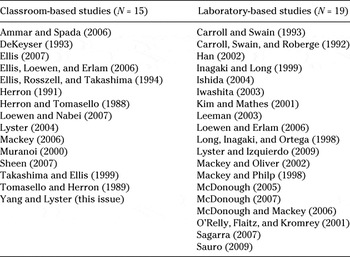
We searched electronic databases such as the Education Resources Information Center (ERIC) and the Linguistic and Language Behavior Abstracts (LLBA) to identify studies of oral CF published since 1980 in major academic journals (e.g., Applied Linguistics, The Canadian Modern Language Review, Language Awareness, Computer Assisted Language Learning, Language Learning, The Modern Language Journal, Studies in Second Language Acquisition, System, TESOL Quarterly), including this special issue of SSLA devoted to CF. The following key words, among others, were used: feedback, CF, explicit feedback, implicit feedback, recasts, prompts, explicit correction, negotiation, L2 learning, and pre/post design. We also referred to relevant review chapters to check potential sources (e.g., Doughty & Long, Reference Doughty and Long2003; Doughty & Williams, Reference Doughty and Williams1998; Ellis, Reference Ellis1999, Reference Ellis2003; Long, Reference Long2007; Lyster, Reference Lyster2007; Mackey, Reference Mackey2007). After excluding observational studies that did not experimentally measure learners’ interlanguage development (e.g., Ellis, Basturkmen, & Loewen, Reference Ellis, Basturkmen and Loewen2001; Lyster & Ranta, Reference Lyster and Ranta1997; Oliver, Reference Oliver2000) as well as experimental and quasi-experimental studies that adopted a pretest and posttest design but did not report necessary information for calculating Cohen’s d index (e.g., Doughty & Varela, Reference Doughty, Varela, Doughty and Williams1998; Havranek & Cesnik, Reference Havranek and Cesnik2001; Loewen, Reference Loewen2005; Loewen & Philp, Reference Loewen and Philp2006), 34 CF studies qualified for a meta-analysis (see Table 1; note that two of the laboratory-based studies are computer-assisted language learning studies in which the feedback appeared in written format on the computer screen yet was provided during computer-mediated communication designed to simulate face-to-face communication).Footnote 2
Thirty-four classroom- and laboratory-based CF studies qualified for a meta-analysis

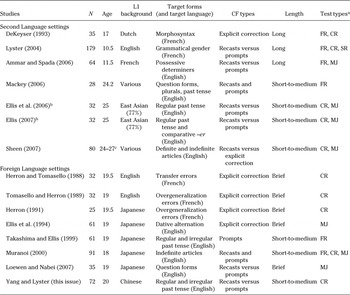
We then excluded all laboratory-based studies (e.g., Carroll & Swain, Reference Carroll and Swain1993; Leeman, Reference Leeman2003; Lyster & Izquierdo, Reference Lyster and Izquierdo2009; Mackey & Philp, Reference Mackey and Philp1998; McDonough, Reference McDonough2005, Reference McDonough and Mackey2007) and selected only quasi-experimental classroom-based studies. Although it would have been possible to conduct a meta-analysis of 34 CF studies, we decided against conflating research settings. As Norris and Ortega (Reference Norris, Ortega, Norris and Ortega2006) claimed, “the problem is to define what makes studies ‘similar enough’ to be included in a review, or ‘different enough’ to be excluded, the so-called apples and oranges problem” (p. 16). With respect to CF studies, one of the controversial problems that influence the construct validity of primary research is whether studies were conducted in classroom or laboratory settings. Thus, interpreting data extracted from both classroom- and laboratory-based studies together does not correspond to the main purpose of this study, which is to examine CF effectiveness in L2 classrooms. It should be noted, however, that the instructional treatments employed in the 15 studies differ in substantial ways; Table 2 provides an overview of the 15 studies with information concerning number of participants, their age and L1 background, linguistic targets, CF types, treatment length, and types of outcome measures.
Overview of the 15 selected studies

a The abbreviation FR corresponds to free constructed-response measures, CR corresponds to constrained constructed-response measures, SR corresponds to selected-response measures, and MJ corresponds to metalinguistic judgments.
b These are the same participants.
c Because Sheen (Reference Sheen and Mackey2007) did not report the average mean of learners’ age, we contacted her and recalculated their age.
Data Computation
To calculate Cohen’s d index, three statistical elements are required: (a) group means, (b) standard deviations, and (c) sample sizes. The equation in (1), adapted from Cohen (Reference Cohen1988), was used, with the pooled between-groups standard deviation.Footnote 3
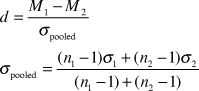
where M is the mean and σ is the standard deviation.
When the published study provided only t or F values, the formula provided in (2) was used to obtain d values (Lipsey & Wilson, Reference Lipsey and Wilson2001; see, e.g., Herron, Reference Herron1991; Takashima & Ellis, Reference Ellis1999).
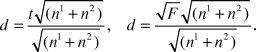
When the study reported proportions of participants who showed improvements, Cohen’s d was calculated based on arcsine transformation (Lipsey & Wilson; see, e.g., Mackey, Reference Mackey2006): Cohen’s d = arcsinetreatment – arcsinecontrol.
The current study calculated 95% confidence intervals to analyze whether two groups of effect sizes are significantly different (e.g., immediate vs. delayed posttests, recasts vs. prompts). Cohen’s d can be identified by calculating two contrastive means of dependent variables. Because Norris and Ortega (Reference Norris, Ortega, Norris and Ortega2006) recommended analyzing d values separately for between- and within-group comparisons in instructed SLA studies, to examine the data in a thorough manner, d values were calculated separately for the mean difference between experimental and control groups at the time of posttests (between group; n = 15) as well as between pretests and posttests (within group; n = 10). Unlike previous meta-analysis studies (i.e., Mackey & Goo, Reference Mackey, Goo and Mackey2007; Norris & Ortega, Reference Norris and Ortega2000), all 15 CF studies in the current meta-analysis included control groups; therefore, no baseline groups (i.e., using least attention-focused groups when there is no control group) for between-group differences had to be chosen, which enabled an independent analysis of between- and within-group contrasts. Although some scholars suggest that one study should contribute to only one effect size (Lipsey & Wilson, Reference Lipsey and Wilson2001), we decided to implement inclusive adoption of multiple independent and dependent variables (e.g., treatment groups, CF types, timing of posttests, and outcome measures) to conduct a fine-grained analysis of all developmental changes among students in any given study, especially in light of the complexities of L2 classrooms.Footnote 4
Coding
This section explains how the independent variables were operationalized, including four instructional factors (i.e., types of CF, instructional setting, treatment length, and participants’ age) and two methodological factors (i.e., types and timing of outcome measurements). CF intensiveness (i.e., whether the study was designed to direct CF intensively at a specific linguistic target) was not treated as an independent variable because of the number of targets that the primary studies focused on varied, and it was difficult to define intensiveness versus extensiveness categorically in this meta-analysis.Footnote 5
Types of CF. Following Lyster and Ranta’s (Reference Lyster and Ranta1997) original taxonomy, CF types were classified as (a) recasts, (b) explicit correction, and (c) prompts (what Lyster and Ranta called negotiation of form: i.e., clarification requests, repetition of error, elicitation, metalinguistic clues). Seven studies were selected for recasts (i.e., Ammar & Spada, Reference Ammar and Spada2006; Ellis, Reference Ellis and Mackey2007; Ellis, Loewen, & Erlam, Reference Ellis, Loewen and Erlam2006; Loewen & Nabei, Reference Loewen, Nabei and Mackey2007; Lyster, Reference Lyster2004; Sheen, Reference Sheen and Mackey2007; Yang & Lyster, this issue), seven studies for prompts (i.e., Ammar & Spada; Ellis; Ellis et al.; Loewen & Nabei; Lyster; Takashima & Ellis, Reference Ellis1999; Yang & Lyster), and six for explicit correction (i.e., DeKeyser, Reference DeKeyser1993; Ellis, Rosszell, & Takashima, Reference Ellis, Rosszell and Takashima1994; Herron, Reference Herron1991; Herron & Tomasello, Reference Herron and Tomasello1988; Sheen; Tomasello & Herron, Reference Tomasello and Herron1989). Although Muranoi (Reference Muranoi2000) labeled two of his treatment groups as recasts, both groups were excluded from our analysis of CF types because they received not only recasts but also requests for repetition (i.e., clarification requests, thus a combination of recasts and prompts). Mackey’s (Reference Mackey2006) study was also excluded from the comparisons of CF types because the feedback treatment in her study conflated both recasts and negotiation (which included clarification requests that prompted participants to self-repair). The studies by Ellis and Ellis et al. were framed as comparisons of explicit and implicit feedback but operationalized explicit CF as metalinguistic information in the form of a prompt (e.g., You need past tense) rather than as explicit correction (e.g., “No, not goed—went,” Ellis et al., p. 341).
Referring specifically to these studies, Figure 1 attempts to group CF types along a continuum that ranges from implicit to explicit and according to the dichotomous distinction between reformulations and prompts. Although we place recasts toward the implicit end of the continuum, we do so in relation to explicit correction for the purpose of distinguishing these two types of reformulation while acknowledging that recasts themselves range from more implicit to more explicit (Loewen & Philp, Reference Loewen and Philp2006; Sheen, Reference Sheen2006). To classify prompts as implicit or explicit, we followed suggestions by Ellis (Reference Ellis2006), Loewen and Nabei (Reference Loewen, Nabei and Mackey2007), and Lyster (Reference Lyster2002) that clarification requests and repetition are more implicit than elicitation and metalinguistic clues. The classification of prompts at discrete points along this continuum is rather crude and open to further refinement, but we reiterate that the distinguishing feature of prompts in this classification pertains less to their varying degrees of implicitness or explicitness and more to their common trait of withholding correct reformulations.
Types of CF.

Whereas recasts and prompts in the studies included in this meta-analysis were generally delivered in the context of communicatively driven teacher-student interaction, explicit correction was operationalized with slightly less consistency and across a broader spectrum of instructional activities. In Sheen’s (Reference Sheen and Mackey2007) study, explicit correction, provided during narrative-retelling tasks, included the correct form along with metalinguistic explanation—for instance, The fox. You should use the definite article thebecause you’ve already mentioned fox. The explicit correction treatment in DeKeyser’s (Reference DeKeyser1993) study lasted an entire school year and was thus arguably less likely to maintain the consistent use of only one CF type, as illustrated by the only example provided (How many times?) that serves more as a prompt. Yet the teacher in the treatment class had been asked “to correct mistakes as frequently and explicitly as possible” (p. 505) and her use of CF was observed to be “usually quite conspicuous” (p. 506). In contrast, the comparison teacher was asked to provide no feedback, yet occasionally provided “inconspicuous” corrections “without explicitly saying ‘no’, ‘wrong’, or anything of the kind, and without making the students self-correct” (p. 506). Explicit correction in the studies by Ellis et al. (Reference Ellis, Rosszell and Takashima1994), Herron (Reference Herron1991), Herron and Tomasello (Reference Herron and Tomasello1988), and Tomasello and Herron (Reference Tomasello and Herron1989) was not delivered during communicative tasks per se but rather through so-called garden-path techniques that induced learners to make errors in their use of target forms. In response to the errors, the teacher wrote the incorrect form on the chalkboard, crossed it out, wrote the correct form, and then said it aloud before providing a brief explanation.
Durability. The durability of the effects of form-focused instruction and interaction has been difficult to ascertain in previous SLA research. On the one hand, Norris and Ortega (Reference Norris and Ortega2000) showed that the effectiveness of L2 instruction appeared to decrease gradually between immediate and delayed posttests, but they included various types of instruction (e.g., focus-on-form, focus-on-forms, and focus-on-meaning instruction). On the other hand, in their meta-analysis of the effectiveness of L2 interaction only, Mackey and Goo (Reference Mackey, Goo and Mackey2007) observed that “the efficacy of interaction on learner performance in both delayed tests is significantly greater than in the immediate post-tests” (p. 425). In the present study, effect sizes were calculated separately for immediate and delayed-posttest sessions, with posttests conducted within 1 week of an instructional treatment considered as immediate, and those after 2 weeks and up to 6 weeks considered delayed.
Types of Outcome Measures. Because different types of dependent-variable measures assess learners’ interlanguage development from different perspectives, their effects are expected to vary in size. Following Norris and Ortega’s (Reference Norris and Ortega2000) classification, CF effects were examined in relation to four different types of outcome measure:Footnote 6
1. Free constructed-response measures require learners to produce the target language freely without many constraints.
2. Constrained constructed-response measures require learners to complete tasks in which the use of the target features was necessary.
3. Selected-response measures require learners to select the correct answer among several alternatives.
4. Metalinguistic judgments require learners to judge the grammaticality of target structures.
Two previous meta-analysis studies provided conflicting results about the influence of outcome measures on L2 performance. Whereas Norris and Ortega (Reference Norris and Ortega2000) found that effect sizes associated with metalinguistic judgments and free constructed-response measures were substantially lower than those with selected-response measures and constrained constructed-response measures, Mackey and Goo (Reference Mackey, Goo and Mackey2007) noted a linear relationship, on immediate posttests in particular: Closed-ended production was better than open-ended production, which was better than prompted response (i.e., a combination of metalinguistic judgments and selected-response measures).
Instructional Setting. Mackey and Goo’s (Reference Mackey, Goo and Mackey2007) meta-analysis of interaction studies revealed differences between SL and FL settings, with significantly larger effects in FL settings (d = 0.88) than in SL settings (d = 0.64), but no difference at delayed posttests. In the present meta-analysis, the influence of FL versus SL settings on CF effectiveness is also compared, but rather than estimating the extent to which learners could access the target language outside of the classroom, we adopted Stern’s (Reference Stern1983) definition to distinguish these two settings: “A ‘second language’ usually has official status or a recognized function within a country which a foreign language has not” (p. 16). Following this definition, seven studies were conducted in SL settings and eight in FL settings, as shown in Table 2.
Length of Treatment. Norris and Ortega’s (Reference Norris and Ortega2000) meta-analysis took into account the length of instructional treatment as an independent variable by analyzing the effects of brief treatments (less than 1 hr), short treatments (1–2 hr), medium treatments (3–6 hr), and long treatments (more than 7 hr). They found that less instruction could actually be more effective. For our analysis, we considered five studies as brief treatments (less than 1 hr), seven studies as short-to-medium treatments (1–3 hr), and three studies as long treatments (more than 7 hr).
Learners’ Age. To investigate the age-related effects of CF, all d values (based on CF types and timing of posttests) were compared with participants’ age. Most studies reported the mean age of participants, but others reported only their current educational level, which enabled us to predict participants’ age (e.g., sixth-grade students are 11.5 years old, first-year university students are 18 years old). The participants in the studies included in the meta-analysis fall into three age categories: (a) Child learners are students in elementary school with a mean age of 10–12 years (n = 243); (b) young-adult learners are students either in the last year of high school or a university undergraduate program and have a mean age of 17–20 years (n = 444); (c) adult learners are ESL students who attend a language school or community college and have a mean age above 23 years (n = 140). However, this study does not compare these as three discrete groups but instead considers age as a continuous variable in a simple regression analysis designed to examine negative linear relationships between the effects of CF and learners’ age.
RESULTS
The results that concern the overall effectiveness of CF in L2 classrooms are presented first, followed by results that assess how its effectiveness varies according to CF types, timing and types of outcome measures, instructional setting, treatment length, and age. The 15 CF studies created 43 d values for between-group contrasts, and 10 studies yielded 33 d values for within-group contrasts. For the between-group contrasts, each study contributes an average of 2.86 d values (SD = 1.24): k (i.e., the number of instructional treatments that contribute effect sizes) = 13 for adult learners, k = 22 for young-adult learners, and k = 8 for child learners. For within-group differences, each study contributes an average of 3.3 d values (SD = 1.25): k = 12 for adult learners, k = 13 for young-adult learners, and k = 8 for child learners (see the Appendix for a summary of all results).
Effects of CF
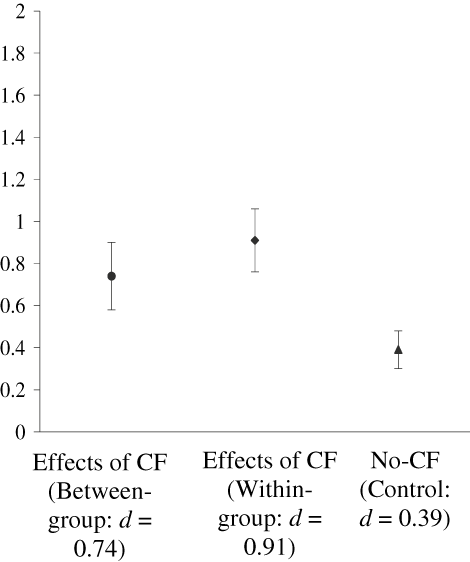
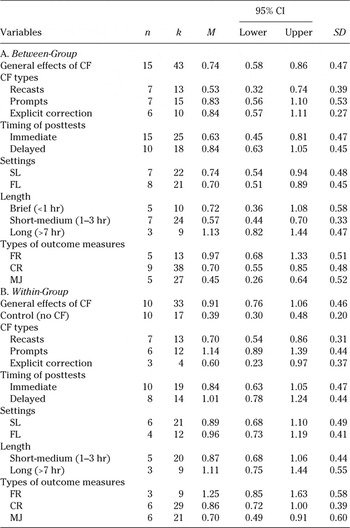
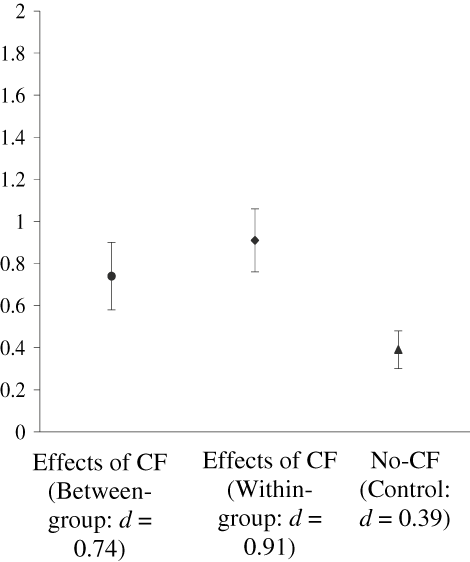
The between-group contrasts for CF effects created 43 d values, with a mean effect size of 0.74 (SD = 0.47) and confidence intervals (CIs) above zero (0.58–0.90), which demonstrates that the impact of CF is significant in L2 classrooms with medium-to-large effects. Within-group contrasts created 33 d values, with a mean effect size of 0.91 (CI = ± 0.15, SD = 0.46). Even though the control groups demonstrated a small effect size of 0.39 (CI = ± 0.09, SD = 0.20), CF effectiveness proved significant in the context of within-group contrasts because there is no overlap of confidence intervals between experimental groups that receive CF (0.76–1.06) and the control groups that did not (0.30–0.48). The effects of CF could be considered medium (d = 0.52) if the effect found for the control groups (d = 0.39) is subtracted from the overall large effect (d = 0.91). These results are presented in Figure 2.
Effects of CF in L2 classrooms.
Types of CF
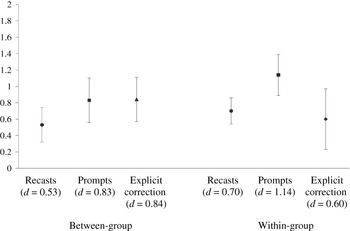
With respect to the between-group contrasts, the results support medium effects of 0.53 for recasts (n = 7, k = 13, CI = ± 0.21, SD = 0.39), large effects of 0.83 for prompts (n = 7, k = 15, CI = ± 0.27, SD = 0.53), and large effects of 0.84 for explicit correction (n = 6, k = 10, CI = ± 0.27, SD = 0.27). In the within-group contrasts, we found medium effect sizes of 0.70 for recasts (n = 7, k = 13, CI = ± 0.16, SD = 0.31), large effect sizes of 1.14 for prompts (n = 6, k = 12, CI = ± 0.25, SD = 0.44), and medium effect sizes of 0.60 for explicit correction (n = 3, k = 4, CI = ± 0.37, SD = 0.37). Taken together, with confidence intervals above zero, recasts, prompts, and explicit correction are all significantly effective in L2 classrooms both in the between- and within-group contrasts. Whereas explicit correction did not prove significantly different from either recasts or prompts—neither in between- nor within-group contrasts—the analysis of confidence intervals found the differential effectiveness of prompts to be significantly larger than that of recasts in the within-group contrasts (see Figure 3). Considered reliable, therefore, the analysis yields the following three patterns and relative weights associated with different types of CF in L2 classrooms:
1. Recasts, prompts, and explicit correction all yielded significant effects.
2. Prompts yielded large effect sizes and proved significantly more effective in the within-group contrasts than recasts.
3. Effects of explicit correction cannot be distinguished from those of recasts and prompts.
Types of CF in L2 classrooms.

We acknowledge, however, that standard deviations and confidence intervals of all three types of CF (i.e., prompts, recasts, and explicit correction) are widely ranged. One possible reason for such variability could be that CF treatments are difficult to implement in classroom settings with the same kind of consistency found in more controlled situations such as laboratory settings.
Immediate and Delayed Effects of CF
Between-group contrasts generated 25 d values at immediate posttests with a mean effect size of 0.63 (CI = ± 0.18, SD = 0.47). Ten CF studies generated 16 d values at delayed posttests, with a mean effect size of 0.84 (CI = ± 0.21, SD = 0.45). As for within-group contrasts, 10 studies generated 19 d values at immediate posttests with a mean effect size of 0.84 (CI = ± 0.21, SD = 0.47), whereas 8 studies generated 14 d values at delayed posttests, with a mean effect size of 1.01 (CI = ± 0.23, SD = 0.44). Both immediate and delayed effects of CF thus exhibit medium-to-large effect sizes, with overlapping confidence intervals as illustrated in Figure 4, which indicates that there is no significant decline in gains between immediate and delayed posttests.
Immediate and delayed effects of CF.

Types of Outcome Measures
Three types of outcome measures were considered for this analysis (i.e., free constructed-response measures, constrained constructed-response measures, and metalinguistic judgments), which yielded 78 d values for between-group contrasts (n = 15) and 69 d values for within-group contrasts (n = 10).Footnote 7 On average, one study uses 1.93 outcome measures (SD = 0.96) to examine the effectiveness of an instructional treatment (i.e., the number of tests used in the primary studies roughly ranges between 0.96 and 2.89). With respect to the between-group contrasts, the mean effect size of free constructed-response measures is 0.97 (n = 5, k = 13, CI = ± 0.29, SD = 0.51), the mean effect size of constrained constructed-response measures is 0.70 (n = 9, k = 38, CI = ± 0.15, SD = 0.48), and the mean effect size of metalinguistic judgments is 0.45 (n = 5, k = 27, CI = ± 0.19, SD = 0.52). With respect to within-group contrasts, we identified the mean effect size of free constructed-response measures as 1.25 (n = 3, k = 9, CI = ± 0.38, SD = 0.58), the mean effect size of constrained constructed-response measures as 0.86 (n = 6, k = 29, CI = ± 0.14, SD = 0.39), and the mean effect size of metalinguistic judgments as 0.70 (n = 6, k = 31, CI = ± 0.21, SD = 0.60).
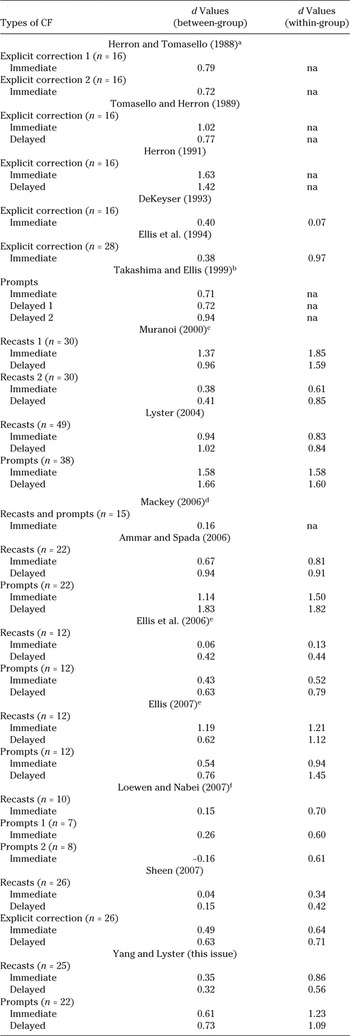
The means indicate large effect sizes for free constructed-response measures and medium-to-large effect sizes for constrained constructed-response measures and metalinguistic judgments. The analysis of confidence intervals shows that the effects of free constructed-response measures are significantly larger than those of metalinguistic judgments in the between-group contrast, and the difference between these two measures almost reached significance, with slight overlapping confidence intervals in the within-group contrasts. Therefore, students in L2 classrooms appear to exhibit improvement more clearly in free constructed-response measures than in metalinguistic tasks. Due to overlapping confidence intervals, however, the differential effects of constrained constructed-response measures in comparison with free constructed-response measures and metalinguistic judgments remain unclear. The results are graphically presented in Figure 5, and d values are summarized in Table 3.
Types of outcome measures.

Summary of d values in 15 selected studies

Instructional Setting
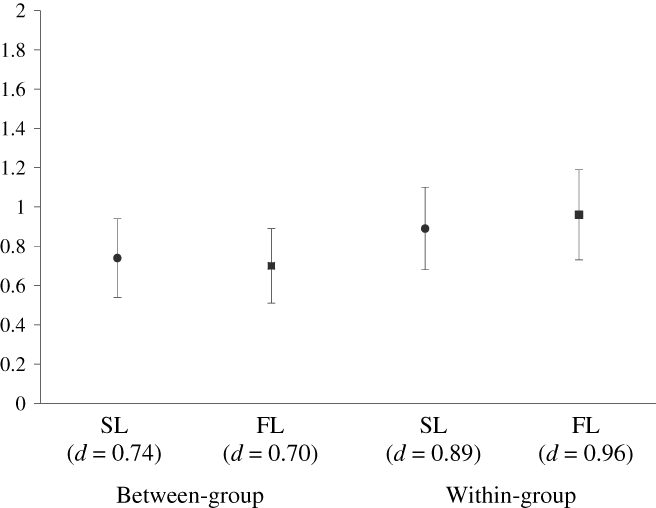
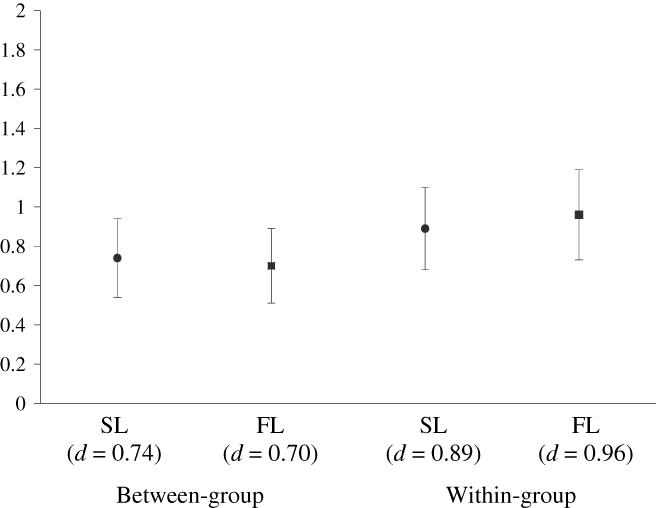
To investigate how the effects of CF are related to instructional setting, effect sizes were calculated separately for studies conducted in SL and FL settings. As for the between-group contrasts, the mean effect size for SL studies is 0.74 (n = 7, k = 22, CI = ± 0.20, SD = 0.48) and 0.70 (n = 8, k = 21, CI = ± 0.19, SD = 0.45) for FL studies. Within-group contrasts yielded mean effect sizes of 0.89 (n = 6, k = 21, CI = ± 0.21, SD = 0.49) for SL studies and of 0.96 (n = 4, k = 12, CI = ± 0.23, SD = 0.41) for FL studies. This analysis does not indicate different CF effects in SL versus FL settings because of the overlaps both in the between- and the within-group contrasts, as illustrated in Figure 6.
Effects of CF in SL and FL settings.
Length of Treatment
With respect to between-group contrasts, the mean effect size of brief treatments is 0.72 (n = 5, k = 10, CI = ± 0.36, SD = 0.58), the mean effect size of short-to-medium treatments is 0.57 (n = 7, k = 24, CI = ± 0.13 SD = 0.33), and the mean effect size of long treatments is 1.13 (n = 3, k = 9, CI = ± 0.31, SD = 0.47). With respect to within-group contrasts, we identified the mean effect size of short-to-medium treatments as 0.87 (n = 5, k = 20, CI = ± 0.19, SD = 0.44) and of long treatments as 1.11 (n = 3, k = 9, CI = ± 0.36, SD = 0.55).Footnote 8 Taken together, these results reveal the following pattern: Whereas the value of brief treatments remains unclear, the analysis of confidence intervals shows that long treatments (0.82–1.44) are significantly more effective than short-to-medium treatments (0.44–0.70) in the between-group contrasts (see Figure 7).
Effects of CF and length of instruction.

Age
To investigate how the effects of CF are linearly related to learners’ age, instead of calculating d values for each group, we chose to perform a simple regression analysis for all d values in the between-group contrasts (n = 15, k = 43) and the within-group contrasts (n = 10, k = 33), by comparing the average mean of all d-values as a dependent variable (an outcome) and the participants’ age as an independent variable (a predictor factor). Although the data need to be interpreted with caution due to the small number of child and adult CF studies, our purpose here is to identify possible patterns of age-related effects on CF effectiveness worthy of further investigation.
The between-group contrasts yielded a significant linear relationship between effects of CF and age, F(1, 41) = 14.573, p < .0001. The model used here shows that the age factor explains 26.2% of the variance of the effectiveness of CF in L2 classrooms (r = –.51). With respect to within-group contrasts, a significant linear relationship was identified between effects of CF and the age factor, F(1, 31) = 6.075, p < .02. The model used here shows that the age factor explains 16.4% of the variance of the effectiveness of CF in L2 classrooms (r = –.40). Thus, general effects of CF and learners’ age are negatively correlated, and the possible pattern for effects of CF is such that younger learners are more affected than older learners.Footnote 9
DISCUSSION
This discussion addresses our research questions, which asked whether CF is effective in L2 classrooms and, if so, whether its effectiveness varies according to (a) types of CF, (b) types and timing of outcome measures, (c) instructional settings, (d) treatment length, and (e) learners’ age. However, it is important to emphasize the need to interpret the results with caution and to consider them tentative, given the obvious limitations: the small N, the relatively broad range of confidence intervals and standard deviations in all contexts, and the inclusive contribution of several k from one sample study.
Overall Effects of CF
Based on the premise that results of laboratory-based studies cannot predict the pedagogical effectiveness of CF, the current meta-analysis included only classroom quasi-experimental CF studies to assess the pedagogical value of CF techniques in L2 classrooms. First, the current study shows that CF makes a significant impact on L2 learners’ performance with a medium yet substantial effect (d = 0.74) for posttests in comparison with control groups (i.e., the between-group contrasts). This result concurs with those of previous meta-analysis studies (Mackey & Goo, Reference Mackey, Goo and Mackey2007; Russell & Spada, Reference Russell, Spada, Norris and Ortega2006). Whereas students who received CF displayed large effect sizes (d = 0.91) in comparison with their pretest performance (i.e., the within-group contrasts), the present study also found that control groups exhibited medium effect sizes (d = 0.39). This result could be attributed to test-retest effects or to the fact that even participants in control groups, by virtue of being in classroom settings, also received instruction but without intentionally designed CF treatments. The results demonstrate that CF groups are significantly different from no-CF groups, with no overlap in confidence intervals. Although some scholars doubt the effectiveness of oral CF in L2 classrooms (e.g., Truscott, Reference Truscott1999), the current study, along with previous meta-analyses, illustrates its effectiveness.
CF Types
The analysis of differential effects of recasts, prompts, and explicit correction in L2 classrooms revealed three patterns: (a) Recasts, prompts, and explicit correction all yielded significant effects; (b) prompts yielded large effect sizes and proved significantly more effective in the within-group contrasts than recasts, which yielded medium effect sizes; and (c) the relative effects of explicit correction remained indistinguishable from those of recasts and prompts.
Therefore, whereas all three types of CF are able to positively affect L2 learners’ interlanguage development, CF in classroom settings may be more effective when its delivery is more pedagogically oriented (i.e., prompts) than conversationally oriented (i.e., recasts). In theoretical terms, classroom learners appear to benefit from the positive evidence available in recasts as well as from the opportunities they provide to infer negative evidence, but these learners seem to benefit even more from the negative evidence available in prompts and from the greater demand they impose for producing modified output. That the effects of explicit correction cannot be distinguished from the effects of recasts and those of prompts might be attributable to the types of linguistic evidence available in explicit correction and the overlaps in this regard with recasts and prompts. In other words, explicit correction—similar to recasts—conveys positive evidence by providing the correct form; at the same time, explicit correction—similar to prompts—conveys negative evidence by indicating that the student’s utterance was incorrect. Worthy of further pursuit in this regard would be research designed to tease apart the specific attributes of recasts, prompts, and explicit correction that contribute to their variable effectiveness in classroom settings.
Our results are different from those of Mackey and Goo (Reference Mackey, Goo and Mackey2007), who found much larger effects for recasts (d = 0.96), but we attribute this to differences in the inclusion criteria between the two studies: Our study included only classroom studies (n = 15) in the meta-analysis, whereas Mackey and Goo included CF studies conducted in both laboratory (n = 15) and classroom settings (n = 5). In short, the research setting factor considerably influences the relative effectiveness of different types of CF.
Durability
The overall durability of the effectiveness of CF was analyzed by contrasting effect sizes at immediate and delayed posttests. The between- and within-group contrasts alike yielded medium-to-large effect sizes for both immediate and delayed posttests, with an overlap of confidence intervals, which shows that CF has an immediate impact on L2 performance and that the magnitude of the effectiveness does not decline significantly during the interval between the CF treatment and delayed posttests. We attribute these results to the strategic and intensive delivery of CF across the studies analyzed. In other words, in all but one study (i.e., DeKeyser, Reference DeKeyser1993), CF was provided during oral interaction that had been pedagogically designed to elicit target forms from students and to create strategic opportunities for teachers to provide CF. It may be the case that when CF is provided in this way, with relative intensity during form-focused activities designed to elicit target forms in the context of oral interaction, its effects are sufficiently robust not only to appear immediately after the instructional treatment but also to be sustained over time, which in the present analysis ranged from 2–6 weeks.
Outcome Measures
In their meta-analysis of L2 instructional interventions, Norris and Ortega (Reference Norris and Ortega2000) noted that many studies employed outcome measures that favor the effectiveness of explicit treatments because these measures required “the application of explicit declarative knowledge under controlled conditions, without much requirement for fluent, spontaneous use of contextualized language” (p. 486), a research bias criticized by Doughty (Reference Doughty, Doughty and Long2003). Mackey and Goo’s (Reference Mackey, Goo and Mackey2007) meta-analysis of interaction studies as well as the present meta-analysis of CF studies (see also Spada & Tomita, in press) noted a tendency for more studies than those noted by Norris and Ortega to employ measures that require learners to produce target structures, with or without constraints, more than selective-response measures or grammatical judgment tasks.
This analysis of the relationship between CF effects and different outcome measures (i.e., free constructed-response measures, constructed-response measures, and metalinguistic judgments tasks) identified relatively large effect sizes for free constructed-response measures and medium-to-large effect sizes for constructed-response measures and metalinguistic judgments. Additionally, the analysis of the confidence intervals illustrated that free constructed-response measures generate substantially larger effects than metalinguistic judgments. The finding that the effects of oral CF are larger when students’ improvement is tested by formats with fewer constraints, such as free constructed-response measures, is especially noteworthy. One possible interpretation of this finding is related to the principle of transfer-appropriate processing, according to which the kind of cognitive processing that occurs during learning tasks should ideally resemble the kind of processing involved during communicative language use (e.g., Lightbown, Reference Lightbown and Han2008; Segalowitz, Reference Segalowitz, De Groot and Kroll1997, Reference Segalowitz and Riggenbach2000). In other words, because CF is provided during actual target language use, its impact on learners’ subsequent target language use in contexts “with relatively few constraints and with meaningful communication as the goal for L2 production” (Norris & Ortega, Reference Norris and Ortega2000, p. 440) is more transfer appropriate than the effects of decontextualized grammar lessons or communicative language teaching without CF. However, such explanations are speculative, due to the small N and relatively large confidence intervals and standard deviations. The tentative pattern suggested by the present analysis (i.e., larger effects for free constructed-response measures than for constructed-response measures and metalinguistic judgments) justifies further research into the variable effects of CF as measured by production tasks that are more or less controlled as well as by other tasks designed to assess both implicit and explicit knowledge of the target language.
SL Versus FL Settings
With respect to contextual influences on the effects of CF, no significant difference was found between studies in SL and in FL settings. This finding suggests either that distinctions between SL and FL settings are too fluid to yield distinguishable results (see Berns, Reference Berns, VanPatten and Lee1990; Block, Reference Block2003) or that cognitive processes triggered by CF are similar across instructional settings. As Mitchell and Myles (Reference Mitchell and Myles2004) argued, “the underlying learning processes are essentially the same for more local and for more remote target languages, despite differing learning purposes and circumstances” (p. 6). We suggest that more qualitative types of research have the potential to contribute to “a better understanding of the relevant contextual variables that influence classroom learners’ attentional biases toward one type of interactional feedback over another” (Lyster & Mori, Reference Lyster and Mori2006, p. 294).
Length of Instruction
Comparisons of how differential amounts of instruction impact CF effectiveness yielded one significant difference—namely, the between-group difference between short-to-medium (d = 0.57) and long treatments (d = 1.13). As is the case with other variables, these results point to the need for more research to further probe this topic; to our knowledge, there has not been any research specifically focusing on the length of instruction as a variable that influences CF effectiveness. However, it might be the case that length of instruction alone is not a reliable index for SLA processes, as suggested by Norris and Ortega’s (Reference Norris and Ortega2000) acknowledgement that the small differences they observed between shorter and longer term treatments were likely due to a number of study variables, such as “the interaction of length and intensity of instruction with target structures, the interaction between treatment and type of outcome measures, and other moderator variables” (p. 487).
Learner Age
A simple regression analysis showed that the effects of CF are linearly related to learners’ age, with the age factor accounting for 26.2% of the variance in the effects of CF for between-group contrasts and 16.4% of the variance in the effects of CF for within-group contrasts. This negative linear relationship between effects of CF and learners’ age indicates that the effects of CF could be influenced by how old L2 learners are: The younger the learners are, the more they benefit from CF. It is possible that younger learners are especially sensitive to the impact of CF (Mackey & Oliver, Reference Mackey and Oliver2002; Oliver, Reference Oliver2000) because it engages implicit learning mechanisms that are more characteristic of younger than older learners.
It may be the case that the advantage of younger learners is attributable to the fact that they received relatively longer instructional treatments (e.g., 7.5 hr in Ammar & Spada, Reference Ammar and Spada2006; 9 hr in Lyster, Reference Lyster2004) in comparison with adult learners (e.g., 90 min in Ellis, Reference Ellis and Mackey2007; 90 min in Sheen, Reference Sheen and Mackey2007). Although we acknowledge the possibility of various interpretations of the results, we speculate that the benefits that child and younger learners showed in our meta-analysis can be explained by age factors rather than by length of instruction, for the following reasons: Whereas only inconclusive results have been yielded by previous studies that investigated the impact of variable treatment length on L2 learning outcomes (e.g., Norris & Ortega, Reference Norris and Ortega2000), other SLA studies have demonstrated more conclusively that learners’ age influences L2 developmental processes in significant ways (e.g., DeKeyser & Larson-Hall, Reference DeKeyser, Larson-Hall, Kroll and De Groot2005; Hyltenstam & Abrahamsson, Reference Hyltenstam, Abrahamsson, Doughty and Long2003; but see also Birdsong, Reference Birdsong2006; Marinova-Todd, Marshall, & Snow, Reference Marinova-Todd, Marshall and Snow2000).
CONCLUSION
To measure the pedagogical effectiveness of CF in L2 classrooms, we performed a meta-analysis of quasi-experimental studies conducted in classroom settings, focusing on various independent and dependent factors (i.e., timing of posttests, CF types, and types of outcome measures) and examining the effects of CF in relation to instructional settings, length of treatment, and age. Results showed that, irrespective of instructional settings, CF is facilitative of L2 development and that its impact is sustained at least until delayed posttests. Effect sizes in both between- and within-group contrasts were large for prompts, medium for recasts, and varied from large to medium for explicit correction. In comparison to the control groups, the prompt groups made significantly more progress than the recast groups between pretests and posttests. With respect to age, younger learners appeared especially sensitive to CF, benefiting from it significantly more than older learners. Additionally, students displayed different magnitudes of improvement through various outcome measurements, with the effects of CF most apparent in measures that elicit free constructed responses. The effects of long treatments proved to be significantly larger than those of short-to-medium treatments but not distinguishable from brief treatments, thus preventing any conclusions about length of instruction, especially in the absence of research that specifically investigates the relationship between length of treatments and CF effectiveness; the effects of CF might be more influenced by other variables such as CF intensiveness and types of outcome measures.
We conclude with some suggestions for further research as well as for practitioners in L2 classrooms. First and foremost, it is effective to employ CF in response to students’ nontargetlike production because it contributes to target language development over time. That the effects of oral CF are durable and more apparent in free constructed-response measures than other types of measures points to the important role of CF as an effective form-focused instructional technique propitious for strengthening form-meaning connections and thus worthy of further exploration by teachers and researchers alike. In terms of CF types, the effects of prompts are larger than those of recasts in classroom settings, but a more substantial number of classroom studies that compare these CF types are necessary before drawing firm conclusions. Given the wide range of CF types that constitute both explicit correction and prompts, further research is also warranted to identify the components of these CF types that might contribute to their effectiveness. Additionally, further research is needed to probe the many learner characteristics that were not accounted for in this meta-analysis but that are known to mediate the effects of CF for individual learners (e.g., learners’ proficiency, literacy levels, degree of anxiety, L1 background). As for age, the overall impact of CF in classroom settings might be greater for younger learners than for older learners; one suggestion provided here is that, especially for younger learners, L2 instruction with appropriate CF techniques might have the potential to affect the development of target language accuracy. In other words, teachers might consider enhancing the pedagogical potential of CF not only by reformulating child learners’ nontargetlike forms (i.e., recasting) but also by providing a variety of unambiguous signals and metalinguistic clues through various other types of CF.
Finally, given that the field of CF research has grown dramatically over the past 20 years, the time is ripe for research syntheses designed to move the research agenda forward. Yet, we stress the need to conduct meta-analyses in this domain through criteria of inclusion versus exclusion carefully selected in conjunction with research objectives, because theoretical and methodological constructs of CF studies are enormously diverse. Whereas our purpose was to explore the pedagogical value of CF by selecting only classroom-based CF studies, inclusion of the laboratory-based studies that we excluded from the current meta-analysis would also be of value to further investigate the effectiveness of CF in other interactional contexts.
APPENDIX
SUMMARY OF RESULTS BY STUDY

Notes
The abbreviation “na” corresponds to not applicable.
a Explicit correction was directed to both feedback groups; one group (explicit correction 1) received feedback on direct object pronoun replacement and the other group (explicit correction 2) on negation.
b In Takashima and Ellis (Reference Ellis1999), delayed posttests took place 2 weeks (delayed 1) and 7 weeks (delayed 2) after the intervention.
c In Muranoi (Reference Muranoi2000), the two recast groups are different in that one group (recasts 1) received explicit instruction on the target form but the other group (recasts 2) received comments on the content of their task performance.
d In Mackey’s (Reference Mackey2006) experiment, the distinction between recasts and clarification requests was labeled as recasts and negotiation rather than recasts and prompts.
e The intention of both studies (Ellis, Reference Ellis and Mackey2007; Ellis et al., Reference Ellis, Loewen and Erlam2006) was to compare explicit (i.e., metalinguistic) and implicit (i.e., recasts) feedback. Ellis et al. operationalized explicit feedback as metalinguistic feedback, citing Lyster and Ranta’s (Reference Lyster and Ranta1997) definition of this CF type: “comments, information, or questions related to the well-formedness of the learner’s utterance” (p. 47). Therefore, we categorized Ellis’s explicit feedback as prompts.
f In Loewen and Nabei’s (Reference Loewen, Nabei and Mackey2007) study, one prompt group (prompts 1) received clarification requests, whereas the other (prompts 2) received metalinguistic clues.