The Swedish mining company that was to become known as Boliden began to operate its first copper smelter, equipped with state-of-the-art environmental technology, in 1929. From the outset of the project, Boliden was aware of the immense risks associated with both the expected emissions of arsenic and sulfur and the disposal of these substances. The smelter was therefore furnished with Europe's tallest smokestack and the latest in U.S. smoke abatement technology—the Cottrell Precipitator—as well as other technologies developed in-house by Boliden.Footnote 1 To minimize smoke damage to cropland and forests, the smelter had been located on the coastline, about thirty miles from the mine. Moreover, these investments and considerations were made before the emergence of any serious pollution problems and in the absence of social protests, litigation, or regulatory pressure. As such, these proactive corporate strategies appear to conflict with the widely held view of the environmental strategies of firms during this period, which stresses that such strategies were defensive responses to external forces.Footnote 2 This prevalent view rests heavily on evidence from the United States. Our study provides a contrast by exploring such strategies in a European country—specifically, why proactive strategies were adopted by Boliden.
Business historians such as Christine Meisner Rosen have argued for nearly two decades that environmental issues have been of greater importance to business than is usually acknowledged.Footnote 3 Yet, the emergence of corporate environmental policies has remained a fairly under-researched field in business history, especially in a non-U.S. context.Footnote 4 The research that has been published identifies regulatory pressures as the primary driver behind corporate environmental strategies.Footnote 5 This is consistent with a view that companies have usually perceived purification measures as a cost only, which in turn has made regulation necessary to put pressure on companies to take action. The relationship between environmental goals and industrial competitiveness has often been thought of as a trade-off, not the least within the neoclassical paradigm. However, as Michael E. Porter and Mark R. Kramer argue in their recently introduced concept of creating shared value (CSV), corporate strategies to avoid social harms including pollution does not mean that profits are not maximized. Instead they suggest that addressing social issues can lead firms to innovate and pursue cost-saving paths. The aspiration of the CSV concept is that managers viewing the corporation as socially embedded will actively uncover the potential for value creation for all stakeholders, in order to remain competitive and secure organizational longevity.Footnote 6 Proactive business strategies should, according to Porter and Kramer, be adopted to avoid negative externalities such as pollution. As Porter and Kramer argue,
Efforts to minimize pollution were once thought to inevitably increase business costs—and to occur only because of regulation and taxes. Today there is a growing consensus that major improvements in environmental performance can often be achieved with better technology at nominal incremental cost and can even yield net cost savings through enhanced resource utilization, process efficiency, and quality.Footnote 7
The jury is still out as to whether, in the contemporary context, the aspiration to create shared value can become a reality. However, history can provide some useful empirical evidence. As is well known, stakeholder concepts of capitalism were widespread before the 1970s, even in the United States. Robert Strand and R. Edward Freeman have explicitly observed that the CSV model resembles many long-established practices in Scandinavian business.Footnote 8 Business history research supports this view.Footnote 9 The case of Boliden provides an opportunity to explore the mechanisms at work in depth. The proactive strategies adopted by Boliden might be related to a belief that preventing environmental damage was actually good for business because it avoided negative outcomes for the company's local stakeholders. Indeed, cooperation between companies and their stakeholders is widely seen as a long-standing practice in Nordic business.
A related stream of research has explored the historical development of corporate social responsibility (CSR). This concept has gained attention within business history, not least because of the resonance of some historical debates to contemporary debates on the role of business in society.Footnote 10 Archie Carroll et al., who examined the history of CSR in U.S. business, suggest that the reasons for firms to “do good” had to do with legal compliance, response to demands from various pressure groups, and actions based on self-interest.Footnote 11 In studying more broadly the history of concepts of responsibility in a global perspective, Geoffrey Jones looks beyond national characteristics and identifies four factors that seem to have driven a belief that corporations have responsibilities beyond making money for their owners. The first factor is spirituality or, essentially, religious beliefs; the second relates to self-interest, in securing legitimacy and a good reputation; and the last two factors are related to government: fear of government intervention as well as frustration over governments’ incapability to deal with major social and environmental issues.Footnote 12
Historical research into the copper industry in the nineteenth and early twentieth centuries provides several examples of a reluctant industry that has dealt with pollution issues as a cause of external pressure. Examining primarily the American experience, Donald Macmillan, Duncan Maysilles, Timothy J. LeCain, and others have shown that it was social protests, litigation, and regulation that forced the industry to undertake measures to abate emissions, including developing new technologies.Footnote 13 One of the most clearly illustrative examples from the United States is that of the Anaconda Company. Environmental destruction and the conflicts caused by the smoke from Anaconda's smelter prompted President Theodore Roosevelt to create the Anaconda Smelter Smoke Commission (1911–1920), with the directive to suggest measures that the company should undertake to address the smoke issue.Footnote 14 Lawsuits against the copper industry were simultaneously taking place in Ducktown, Tennessee, leading to the U.S. Supreme Court's first verdict in an air-pollution case, in 1907.Footnote 15 Further litigation was also going on in the copper districts of California and Utah.Footnote 16 As shown by LeCain and others, the conflicts and court cases, which eventually led to regulations, forced the U.S. copper producers to cut their emissions of sulfur and arsenic significantly. Although the pollution problems were far from being solved, the pollution issue had emerged as an issue that constrained managerial decisions in the highly polluting copper industry.
Prior to the Boliden project, Sweden had not experienced anything resembling the severe environmental destruction that had taken place in the U.S. copper districts in the early 1900s. Nor had the comparatively small Swedish cities experienced smoke-pollution problems comparable to cities like Detroit, Pittsburgh, or London.Footnote 17 This meant that Sweden had seen no environmentally related litigations resembling those in the United States. Instead, conflicts and a political debate emerged in Sweden during the early 1900s, essentially because of a growing number of pulp and paper mills causing odors and visible water pollution.Footnote 18 In 1909, the Swedish government appointed a committee that in 1915 suggested a regulatory framework for air- and water-pollution control through a mandatory concession system.Footnote 19 In the Swedish case, though, the deep economic recession of the early 1920s came to downplay concerns over industrial pollution and the Swedish government declined the proposition, arguing that the new legislation would endanger the competitiveness of the country's industry. The legal frameworks of the interwar period were therefore built on regulations already established in the second half of the nineteenth century. The most important of these regulations was the Public Health Act of 1874, which constituted the first governmental “all-embracing” attempt to address sanitary issues, which to some degree included industrial pollution.Footnote 20 Also, a case law practice had evolved (Imissionsrätten) that made it possible for a private person to sue any neighbor, including a company, for damage to private property caused by “nuisances.”Footnote 21
The fact that the legislative and political pressure on air-pollution control in Sweden during the 1920s and 1930s was weak, or even nonexistent, shows that the proactive strategies were not responses to regulation as such. Essentially there was no legislation limiting smoke damage and holding a polluting company responsible to a supervising government body. Still, the potential damage to property, particularly forests, could potentially have been costly for Boliden. The Swedish legal framework had a long tradition and was directly linked to private property rights. Still, legal frameworks do not act. Similar regulation in the United States did not bring about a proactive strategy in the American industry. It is therefore necessary to look closer at the Boliden case to uncover all relevant aspects behind the attempts by Boliden to limit smoke damage.
Copper Smoke and Early Abatement Technologies
Even by the standards of the Industrial Revolution, the copper industry was notorious for the highly toxic nature of its emissions. Sulfides are the most plentiful copper ores on Earth, and the toxicity of the smoke from copper smelters is related to geology and the different molecular bonds in the specific ore. As indicated by the name, sulfide ores contain sulfur. In addition, the economically valuable sulfide ores also contain metals and half-metals such as gold, silver, iron, arsenic, nickel, silicon, mercury, and lead.Footnote 22 At the different stages in the refining process of these metals, compounds of sulfur, arsenic, or other toxic substances are released. In Britain, copper smoke had already emerged as a political issue by the eighteenth century.Footnote 23 In Wales, the concentration of copper smelters, especially in the area of Swansea, created environmental, legal, and technical problems worse than any smelter district had experienced before.Footnote 24 Yet, as argued by Edmund Newell, although Britain had seen many pollution-related court cases, especially in Wales, the copper smoke prompted only minor constraints to its business activities before the copper industry declined in the early twentieth century.Footnote 25
The global demand for copper skyrocketed in the 1880s with the rapid development of electricity and electrical applications, especially in the United States.Footnote 26 After an earlier dominance by British enterprises, German and especially U.S. firms came to dominate the global copper markets until well after World War II.Footnote 27 In the 1880s, the American Butte producers, led by the Anaconda and Boston & Montana firms, emerged as the world market leaders.Footnote 28 In 1911, the world market was dominated by giant American groups such as Phelps Dodge and the United Metals Selling Co. group including Anaconda-Amalgamated; the Lake mines; the Arizona Copper Co.; Greene-Cananea; and the American Smelting and Refining Co. (ASARCO). Operations in other major copper-producing regions such as Germany, Chile, Australia, and Japan were smaller in scale than their American counterparts.Footnote 29 Consequently conflicts and litigations related to smoke from the copper smelters are found in the U.S. copper districts, in tandem with the emergence of large-scale smelting production.
Litigations in the United States from the late 1890s to the interwar period spurred technical development aimed at reducing both sulfur and arsenic emissions. One of the worst methods still in use during the early 1900s was the roasting of ore in open pits, where the ore was simply piled with logs. The ore burned for days, releasing huge clouds of arsenic oxide and sulfur dioxide (SO2) into the air.Footnote 30 The deaths in Deer Dodge Valley of thousands of horses and cows, apparently poisoned by arsenic, spurred the first comprehensive litigation against the Anaconda Company.Footnote 31 The development of technologies and practices causing less environmental damage included roasting ores in furnaces from which the fumes were emitted though a central—and, preferably, very tall—smokestack. One of the first methods of lowering SO2 emissions was to capture the sulfurous material in the copper smoke and convert it into sulfur acid.Footnote 32 The so-called Gerstenhöfer roasting furnace (sometimes known as the Gerstenhöfer calciner), which condensed the acid gas and converted it into sulfuric acid, had been introduced in Germany and Britain in the 1860s.Footnote 33 The economic impact of pollution was clearly demonstrated in the United States when about four hundred Utah farmers successfully sued ASARCO, a company that at the time was controlled by Guggenheim Brothers. One consequence of the 1906 verdict was the prohibition of smelting ores with a high sulfur content. Two smelters were shut down, while two companies continued to process high-sulfur ores, with technology borrowed from the Ducktown smelters and by installing sulfuric acid plants that removed much of the SO2.Footnote 34 Another critical issue was arsenic. To minimize the release of arsenic particles, the smelters added a seemingly primitive technology in the form of “bag houses,” a technology that was both costly and inefficient as it captured arsenic pollution in the fibers of long woolen bags.Footnote 35
However, a more radical technology soon emerged. The electrical precipitator was invented by Frederick Cottrell after Selby Smelting & Lead Co. hired the Berkeley scientist to solve pollution problems that had forced their smelter to shut down for several months. In 1907, after extensive testing, Cottrell demonstrated the successful operation of the electric precipitator, which captured liquid sulfuric acid mist and metallic dust.Footnote 36 Cottrell was next hired by ASARCO, in 1911, to install the device in the company's smelters. He was subsequently employed by the Anaconda Company to develop a precipitator for its giant Washoe smelter in Deer Dodge Valley. The precipitator captured about 90 percent of the solids in the smoke, including 94 percent of the arsenic. The smoke abatement solution included a smokestack with a bank of twenty precipitators at its base. The smokestack was completed in 1919, and with a height of 585 feet (170 meters), it was the largest freestanding masonry structure in the world.Footnote 37 In the meantime, the pollution issue had emerged as a constraint on managerial decisions; however, it also opened up new business opportunities and prospects for advancement for entrepreneurs who realized the strategic potential of pollution-control technologies. The development of such technologies related to sulfur and arsenic emissions came to involve the production of sulfur and arsenic as commercial by-products. In short, new smoke abatement technologies had been developed and were available in the United States by the time the Boliden project was established. Yet, the transfer of such technology required both motivation and relevant engineering skills. Besides, it was not obvious that a technology developed for a certain type of ore could easily, and at no cost, be adapted to ores with a different composition.
The Start of Boliden and the Environmental Issue
The key person behind the Boliden project was Oscar Falkman, a mining engineer who had worked at, among other places, Carnegie Steel in Pittsburgh.Footnote 38 One of Falkman's close partners, Paul Palén, had been employed at several copper smelting plants in the United States between 1905 and 1912, including one year as a draftsman at De Lamar Copper Refining Co. in Chrome, New Jersey; a short period at the Elkhorn Silver Mining Co. in Montana; about a year at the Washoe Smelter in Anaconda; and five years as chemist and assistant smelting superintendent at Old Dominion Copper Mining & Smelting Co. in Globe, Arizona.Footnote 39 This overseas experience was far from unique among the men's peers. Around 40 percent of newly graduated Swedish engineers started their careers in the United States or in Germany.Footnote 40 The Swedish entrepreneurs Falkman and Palén, with their personal experience of the smelting industry overseas, were thus part of a network of engineers in the United States and Germany.
The history of Boliden begins in 1918, when Falkman—by then the manager of a venture capital fund, Centralgruppens Emissions AB—launched a metal ore–prospecting project in the Boliden district of Northern Sweden. The project was financed by one of Sweden's three business banks, Skandinaviska Banken, under the leadership of chief executive officer (CEO) Oscar Rydbeck.Footnote 41 Equipped with a new device for electrical prospecting and a sensitive gravity meter, Falkman and his colleagues discovered a large deposit of sulfide ore in 1924. The main ore body proved to contain a concentration of 20.2 grams of gold per metric ton—a remarkably high amount—along with a significant concentration of copper and silver. Apart from these precious metals, the ore proved also to have a rare and complicated structure of arsenic and sulfur with varying intrusions of arsenopyrite and chalcopyrite. The sulfur content was very high, accounting for 30.2 percent of the ore's content; the arsenic concentration reached 9.8 percent, while the copper concentration was around 2.5 percent.Footnote 42
As a consequence of the postwar economic crisis of the early 1920s and the collapse of Centralgruppens Emissions AB in 1926, the project was organized as two mining companies: Västerbottens Gruv AB and Skellefteå Gruv AB. Falkman remained as the manager of both companies, and the two companies were still directly under the control of Skandinaviska Banken. A more dramatic shift in corporate structure and ownership took place in 1929 when Skandinaviska Banken sold its shares in the two companies to the Swedish industrialist and global financier Ivar Kreuger, who consolidated the two companies into one: the Boliden Mining Company (Boliden Gruv AB). With Kreuger controlling the company, Falkman remained as its CEO. For simplicity, we refer to the mining company as Boliden, even before it emerged from the consolidation in 1931.
In 1925, a small shaft had been opened at a location known as Boliden to obtain definite data on the magnitude of the ore deposit. Further operations started in 1926 with mining at different levels, as deep as 250 meters. It was not mining-related environmental risks that posed a fundamental challenge to the managers. The problem was arsenic: the ore deposit in Boliden contained so much arsenic that it had no counterpart elsewhere in the world. Initially, the ore was exported to Freiberg, Germany, and to ASARCO's Tacoma smelter, outside Seattle. However, without any refinement of the ore, these two smelters could process only the Boliden ore with the highest concentration of gold.Footnote 43 Thus, it was decided in 1926 that Boliden would build its own smelter, beginning the complicated process of developing a smelting program, including construction of Europe's highest smokestack. As Palén wrote in the Engineering and Mining Journal in 1932, “The unique composition of the Boliden ore—especially its high arsenic content—necessitated careful study to work out the flow-sheet.”Footnote 44
In 1926, before the site of the smelter had been chosen, Falkman and Palén embarked on a trip to the United States. Their purpose was to consult American expertise regarding the smelting program and, especially, to learn about how American companies had dealt with the sulfur and arsenic issue. In October 1926, Falkman wrote a memorandum in New York, concluding that smoke damage had been a serious problem at almost every American smelter. It was, according to Falkman, impossible to predict the harmful consequences that could arise at Boliden if no actions were taken to prevent pollution.Footnote 45 During their trip, Falkman and Palén met with several engineers and metallurgists, and Falkman visited the ASARCO Tacoma smelter to learn about the smelting program there. First of all, he found, a very tall smokestack seemed to be absolutely necessary; no damage to growing crops had been reported around the smelter since the company had begun operating its 170-meter chimney. In addition, Falkman was informed that the absence of sulfuric smoke damage after 1920 was due to the installation of Cottrell precipitators.Footnote 46 Based on climate conditions in the United States, Falkman calculated that a 120-meter stack should be tall enough to avoid smoke damage in Northern Sweden, but as a precaution, he suggested that Boliden should build a smokestack even taller.Footnote 47
The Cottrell device would make it possible for Boliden to extract sulfur and arsenic from the smoke, yet a big concern for Falkman and his colleagues was the form in which the sulfur and arsenic should be extracted. For advice, Falkman consulted the distinguished American metallurgist Louis Davidson Ricketts, who had been a member of Roosevelt's Anaconda commission. Above all, Ricketts advised Falkman not to put the construction of the smelter into the hands of American consultants, but rather to engage professionals familiar with Swedish conditions. Ricketts also recommended that Falkman should pay attention to the ongoing experiments taking place in the United States and Germany regarding the production of liquid sulfur as a by-product.Footnote 48 However, for safety reasons, Boliden would not adopt a method to produce liquid sulfur as a by-product. The Boliden managers considered liquid sulfur to be too dangerous to store and transport. Developing a process that could enable solid sulfur production was expected to take some time, and Falkman therefore suggested the company begin with a prototype plant.Footnote 49 He directed the board of directors to investigate the cost of erecting a 153-meter smokestack, and to use the Cottrell precipitator to produce solid sulfur.Footnote 50 A solution to the arsenic problem still remained to be found.
The central challenge facing the company was to figure out a way to separate the arsenic from the flue gases in a form that was not overly hazardous. In charge of these research and development (R&D) programs at Boliden was Axel Lindblad. Indeed, Lindblad had already proposed a method in which the arsenic and approximately half the sulfur were extracted from the flue gases, in 1925.Footnote 51 Then, in the next step, the arsenic and sulfur formed a substance known as realgar (sulfur arsenic), which at first was considered harmless, but regrettably also had no commercial value.Footnote 52 The sulfur arsenic could be stored for later use in the manufacturing of arsenous acid, which was used in impregnated wood and the manufacturing of pesticides. Lindblad was granted a patent for the sulfur arsenic process in 1926. Testing was undertaken at the Metallurgische Gesellschaft in Frankfurt during the winter of 1927.Footnote 53 Also, ongoing negotiations with Metallbank were held in Frankfurt over large-scale trials of the manufacturing process.Footnote 54 The arsenic problem was more troublesome than first realized, since it proved that the sulfur arsenic was much more environmentally hazardous than first anticipated. The substance was indeed combustible and could even self-ignite, causing an inextinguishable fire that would release smoke in the form of highly toxic arsenous acid.Footnote 55 The Boliden board stated a need for purely innovative work concerning the arsenic.Footnote 56 Here, the Americans offered no transferable technical solutions.
One strategy that was considered was to export the ore with the highest arsenic content to Freiberg in Germany. Another was to mix the arsenic with concrete, achieving a building material suitable for harbors and the like; alternatively, the arsenic-concrete could be dumped in the Baltic Sea.Footnote 57 Meanwhile, the Boliden engineer Lindblad was elaborating on a new method that directly formed arsenous acid, thereby avoiding the combustible sulfur arsenic. Again, testing took place in Germany, this time in the German company Krupp's roasting furnace.Footnote 58 Briefly, the new method included the evaporation of sulfur as SO2 from the ore, resulting in blister or raw copper. The smoke gases from the furnaces were collected in a Cottrell precipitator, which removed the arsenic and most of the particulate matter. This material was in turn refined for the production of arsenous acid and solid sulfur.Footnote 59 The method basically followed the principles used in the American smelters but was modified on the basis of Lindblad's research and the outcomes of the German trials. This method came to be known as the Rönnskär process (sometimes called the Skellefte process) and was now ready for a large-scale pilot plant, which would later become the full-scale smelter at Rönnskär.Footnote 60
A coastal location for the smelter was chosen in 1927. The first, and most obvious, option for the managers and the board was to locate the smelter close to the mine. A location close to the mine would have meant low transportation costs because the deposit was situated quite close to the already existing state railway trunk line.Footnote 61 However, one of the basic arguments in favor of the coastal location was the low risk of smoke damage to vegetation that could be expected. In 1928, the company made a formal agreement with the city of Skellefteå to buy Rönnskär, a coastal area about fifty kilometers (thirty-one miles) from the Boliden mine. It was in this agreement that the company committed itself to “undertake measures at the smelting and purification plants” that could be reasonably called for in order to prevent, as far as possible, harmful effects from gases and waste in solid and liquid form.Footnote 62 The agreement stated that the company had no legal responsibility for any damage to vegetation on municipal land, but that the company was legally responsible for damage on private property.Footnote 63 Of its twenty-one paragraphs, only one concerned the environment. The local board of public health—which was responsible for overseeing that industrial operations were in compliance with the Public Health Act, the main regulatory tool to control air pollution—had no objections to the location of the smelting activity.Footnote 64
Pollution-Control Technology as a Strategic Asset
The question of which technology and process were to be used was not definitively settled. While the Boliden-developed Rönnskär process was ready for a large-scale pilot plant test, the company's board members were made aware in April 1929 that the Norwegian company Orkla Grube A/S (Orkla Mining Co.), in Trondheim, had developed “some sort of method” for the roasting of copper-bearing pyrite ores.Footnote 65 Orkla was controlled by Sweden's most influential business group, the Wallenberg group (controlled by the Wallenberg family) and, at this point, competitor of Boliden's owner, Skandinaviska Banken. Orkla was keen to sell its technology to Boliden through a licensing agreement. Tests on the Boliden ore were initiated at Orkla's smelter in Oskarshamn, Sweden, with results reported to be very promising.Footnote 66 The board therefore declared that the so-called “Orkla process” was to be considered for implementation at Rönnskär, even though Orkla had revealed no details about its processing method. Falkman and some of the other Boliden managers opposed this, arguing that the Orkla process presented no significant improvement over the Rönnskär process. The Royal Institute of Technology in Stockholm was therefore engaged to evaluate both methods.Footnote 67 It was clear, however, that the Orkla process produced sulfur arsenic, which had been dismissed by Boliden's managers as being overly hazardous. On the basis of this information, the Boliden board decided to stop negotiations with Orkla.Footnote 68 A business deal was therefore declined on the basis of environmental considerations. However, the process would resurface later that year in a more complicated drama, involving American players.
In 1929, Ivar Kreuger took over Boliden. Within three years, Kreuger would become globally infamous as the greatest financial swindler of the twentieth century, but at this stage he was known worldwide for his consolidation of the fragmented match industry into Swedish Match and for his loans to cash-starved governments in return for match monopolies.Footnote 69 Between 1925 and 1930, Kreuger established monopolies in fourteen countries around the world. In the mid-1920s, Kreuger & Toll had started to buy large stock positions in leading Swedish industrial corporations, such as LM Ericson and SKF. He also formed the SCA group in 1929. This meant that Kreuger, backed by Skandinaviska Banken, was challenging the powerful Wallenberg business group.Footnote 70
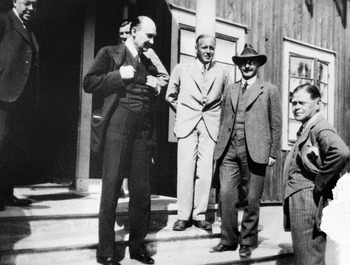
It was Oscar Rydbeck, the CEO of Skandinaviska Banken, who prompted Kreuger's interest in Boliden. By the late 1920s, it had become clear to Rydbeck that the Boliden mine represented not only potentially high value but also a significant risk due to the environmental and technical uncertainties associated with the Rönnskär smelter. These risks constituted an important motive for Rydbeck to sell the bank's Boliden shares.Footnote 71 Meanwhile, Boliden had attracted national and international interest, not least in the United States. Prior to Kreuger's acquisition of Boliden, the Wallenberg group had contacted Skandinaviska Banken, declaring its desire for a takeover in cooperation with the American company Guggenheim Brothers.Footnote 72 Skandinaviska Banken, however, was not interested in selling Boliden to the competing Wallenberg group, preferring to strike a deal with Kreuger.Footnote 73 The takeover started during the fall of 1929 and was completed in December of the same year. To mark the takeover, Kreuger visited both the Boliden mine and the Rönnskär smelter while attending the company's board meeting in July 1930. Figure 1 illustrates this occasion.
Ivar Kreuger visiting Boliden, 1930. Pictured are (far left) Dr. Axel Lindblad (Boliden), (left to right) Director Ivar Kreuger (Kreuger & Toll), Dr. Olof Baeckström (Boliden), manager Oscar Falkman (Boliden), Krister Littorin (Kreuger & Toll), and (behind Ivar Kreuger) manager Erik Wesslau (Boliden). (Source: Photographer unknown, photo no. SM C 00529, Boliden AB's arkiv, Bildarkivet, Skellefteå Museum.)

Yet, before the takeover was completed, Kreuger had already been in contact with international experts to arrange a valuation of the mine, including Elias Anton Cappelen Smith, director and chief metallurgist at Guggenheim Brothers, and the British consulting company Selection Trust.Footnote 74 Cappelen Smith showed no interest in collaborating with Kreuger (however, this situation would soon change). Instead, a private consulting engineer, formerly employed at the British Selection Trust, was engaged. The consultant delivered a report on the Boliden mine in November 1930.Footnote 75 In addition to this foreign expertise, Kreuger also engaged Gunnar Magnuson, an experienced director from the pulp and paper industry, as an industrial expert at Kreuger & Toll with responsibility for Boliden.Footnote 76 Magnuson would function as Kreuger's right hand in most practical issues related to Boliden.
Concerns about environmental risks did not cease with the takeover by Kreuger—quite the opposite, in fact. Magnuson involved a professor from Centralanstaltens Kemiska Avdelning to undertake a scientific survey of the environmental impacts of the smelter smoke and to evaluate potential damage from the Rönnskär smelter at different production levels. The reason was that Kreuger wanted to increase the production capacity at the Rönnskär smelter considerably.Footnote 77 In March 1930, the report to Kreuger & Toll was delivered, citing no less than forty-one cases of smoke damage in Europe and the United States.Footnote 78 The report noted that the most serious cases of sulfur “poisoning,” as recorded in the literature, concerned the Anaconda Company, around the Washoe copper smelter, and from the Tennessee Copper Co. in Ducktown. It was concluded that the damage reported in the United States was much more severe and large-scale compared to the situation in Europe.Footnote 79 The report did not include technical aspects, but only reported on damage from copper smoke. For Boliden's managers, the information was neither new nor surprising, but the report itself shows that even an internationally powerful businessman like Kreuger was interested in environmental risks.
While construction of the Rönnskär smelter was underway, Kreuger started negotiations with both the Wallenberg group and Guggenheim Brothers on implementing either the Orkla method or a method suggested by Guggenheim Brothers at Rönnskär.Footnote 80 The question of sulfur emissions had apparently been overlooked in previous reports; in short, Kreuger had learned that the volume of SO2 emissions was lower with the Orkla method.Footnote 81 The lower volume of sulfur emissions also meant a larger sulfur production. In the spring of 1930, however, the board confirmed that the Rönnskär smelter was to employ its own method—namely, the Rönnskär method—both as a result of Falkman's fierce resistance to the Orkla method and, as Falkman put it, due to the fact that “Kreuger had, contrary to many other men, the pleasant trait to usually listen to arguments, even though the arguments were against his intentions.”Footnote 82 Still, and for reasons unknown to Falkman, Kreuger kept the collaboration with Orkla alive.Footnote 83 In late March 1930, Kreuger decided that testing with the Boliden ore should be conducted at Orkla's facilities.Footnote 84 Kreuger also suggested that an Orkla-based facility should be constructed at Rönnskär, even though the plant would soon be operational. Again, Falkman rejected these proposals on both environmental and economic grounds.Footnote 85 The issue was concluded instead with Kreuger & Toll financing a pilot furnace at Orkla's Norwegian plant.Footnote 86
Kreuger's motives for keeping the Orkla discussions active likely had to do with a desire for gaining control of the sulfur market. Monopolies were Kreuger's specialty. In November 1929, Magnuson—Kreuger's right hand—had contacted Palmer, Flygt & Co. in London asking for information about the British market for sulfur acid.Footnote 87 Kreuger's interest in entering the sulfur market suggests that sulfur abatement technologies could be of strategic economic importance.Footnote 88 Indeed, in conversations with Magnuson, Kreuger had suggested that it would be wise if Kreuger & Toll could join forces with the Wallenberg group to exploit the Orkla method in a separate company. Kreuger would, according to this plan, own 80 percent of the shares in the new company, which would buy ores at market prices from Boliden. In this way, Kreuger planned to bring the conflicting interests together; that is, the profits from the Orkla method would be realized in the new company. Kreuger had also mentioned that he could possibly become interested in buying Orkla in the future.Footnote 89 Clearly, Kreuger considered both a friendly, cooperative strategy and a hostile takeover. Also, the Orkla method may, in Kreuger's mind, have been a means for reaching strategic ends rather than for improving on the production process at Rönnskär. Yet, companies on the sulfur market had close ties to the leading copper producers—a link that had been created by the copper smelters’ initial problems with sulfuric emissions.Footnote 90 Kreuger's strategy was therefore not separate from a solution to sulfur emissions.
While discussions with Orkla were taking place, Kreuger and Guggenheim Brothers made a deal. Before Kreuger's takeover of Boliden, the Guggenheim Brothers's chief metallurgist, Cappelen Smith, had suggested that Guggenheim Brothers and Kreuger & Toll should form a joint American holding company. Kreuger was interested in Cappelen Smith's suggestion, but he believed the plan should be put on hold for a couple of years.Footnote 91 Yet, it did not take long before Kreuger and Guggenheim Brothers agreed to jointly develop the mining industry in Boliden: a deal was made in New York in June 1930.Footnote 92 Under the deal, Guggenheim Brothers would send consulting engineers to examine and report on the nature and extent of the ore body in Boliden. Also, Guggenheim Brothers, at their own expense, would develop a metallurgical process adapted to the treatment of the Boliden ore, including a solution to the sulfur and arsenic problems. Moreover, if it could be confirmed before December 1931 that the ore body contained at least fifteen million tons of proved and probable commercial ore, Guggenheim Brothers would have the right to obtain a certain share of the company—specifically, twice the proven reserve—as well as the right to acquire 20 percent of its common shares.Footnote 93
In July 1930, four experts from Guggenheim Brothers arrived in Northern Sweden to visit Boliden, including two Americans—Dr. R. M. Overbeck and Robert Marsh. Marsh immediately started to outline a report not only containing an estimate of ore reserves and drift calculations, but also addressing the environmental effects that could be expected from running the smelting program planned for Boliden.Footnote 94 Falkman was certainly not impressed with the presence of the Americans at the mine. In a note, he wrote that “Mr. Marsh and Mr. Overbeck are not knowledgeable in mining in a strictly narrow sense. To allow them [to] decide on the future work of the mining progress, seems to me not appropriate, and would certainly not promote the best possible results.”Footnote 95
Marsh delivered his report on Boliden in April 1931, concluding that the company was potentially facing major and critical problems. For one, it was, according to Marsh, unlikely that world demand for arsenic would increase; therefore, the company would likely be forced to store huge quantities of arsenic for years to come:
[I]t is the universal experience of all plants handling large quantities of these poisonous materials that it seriously affects the health of the workman, regardless of any precaution which it is possible to take. For these reasons we consider it essential to remove the arsenic as an insoluble compound, thus eliminating all danger in handling, storage or disposal. . . . The roasting of 2,000 tons of Boliden ore per day would produce about 700 tons of sulphur and as much sulphur dioxide. If this were discharges [sic] through the Rönnskär stack, it is our firm conviction that it would result in the destruction of trees and agricultural crops within a radius of at least 15 kilometres. Moreover, the mixture of sulphur fumes with small quantities of white arsenic, which would be deposited on the vegetation in this area would endanger all animal life.Footnote 96
There were two points in this report that, in Cappelen Smith's opinion, could not be emphasized “too strongly”: first, the inevitable damage to forest and crops that would be caused by the huge quantities of sulfuric gases emitted by the roasting and smelting processes planned for the Rönnskär smelter; and second, the tremendous responsibility to be assumed by the company in storing huge quantities of arsenic, in the form of arsenic oxide, for many years into the future.Footnote 97 Cappelen Smith warned Kreuger that the way Boliden had designed its metallurgical process implied risks of environmental damage of almost biblical proportions. Strikingly, Cappelen Smith used environmental risk as his main argument for selling the Guggenheim process. In a note on the Guggenheim Brothers's report written by Marsh, Magnuson declared that he was not convinced of its arguments—that the information provided was incomplete and, as such, the method could not be assessed. He also argued that the arsenic (to be extracted from the smoke as suggested in the Rönnskär method) could be stored safely and that the risks with sulfur emissions would be the same with both alternatives.Footnote 98
Falkman was similarly unimpressed by the conclusions of the Guggenheim Brothers's report. In fact, Falkman wrote to Kreuger to argue against most of the suggestions and conclusions it contained. According to Falkman, the storage of sulfur arsenic—a by-product of both the Orkla and the Guggenheim methods and, before them, the method proposed by Boliden's own engineer Lindblad in 1926—was overly dangerous. He pointed out that sulfur arsenic was ignitable and, if ignited, would create a cloud of arsenic acid that would cause “severe disasters.” To dump the sulfur arsenic into the sea—an option suggested by Lindblad in 1926 was certainly too much of a risk; to illustrate this, Falkman referred to German experiences. On the other hand, he argued, arsenic acid was stable and could not develop gases.Footnote 99 Concerning workers’ safety, and referring to points made by the Americans, Falkman wrote,
As the memorandum argues, it is indisputable that the handling of arsenic materials involves certain risks for the workers. Therefore, we at Rönnskär are also focused on, as extensively as possible, mechanizing all of the arsenic transports and the like, and by doing so, we hope to keep the risks to a minimum. That the risk of exposure would completely disappear, as the memorandum asserts, if one binds the arsenic as arsenic sulfur instead of sulfuric acid, is incorrect.Footnote 100
Falkman argued that both Guggenheim Brothers and Orkla had overlooked the unknown and potentially much more serious risks of arsenic oxide in the production of sulfur arsenic.Footnote 101 Indeed, he stated that the Guggenheim report had emphasized environmental risks over economic arguments to justify its choice of method. But he also stressed that Guggenheim Brothers had not provided further information about how their process really worked. Indeed, Falkman doubted that Guggenheim Brothers even had a process and suggested they used arguments about environmental risks instead to advance the deal with Kreuger.Footnote 102
Palén, the Boliden chief engineer, went in the fall of 1931 to meet with Guggenheim Brothers in New York to see a demonstration of their metallurgical process. Falkman and Magnuson (the latter representing Kreuger) arrived shortly after. The Swedes got the impression that the Guggenheim process was far from being ready for production on industrial scale. The first stages of the metallurgical process were still only on laboratory scale. Furthermore, Palén reported that Guggenheim Brothers had not been doing any work on the subsequent stages, including the converter process in their laboratory. Instead, Guggenheim Brothers suggested that their converter process would be “done in the similar manner” as that used by the Tennessee Copper Co.Footnote 103 Therefore, Palén traveled to Tennessee Copper Co., in Copperhill, but was not impressed. There was a leakage of gases from the converter with a “thick cloud of sulfur smoke constantly pouring out.”Footnote 104 Palén wrote that if this was the process that Guggenheim Brothers were suggesting be implemented at the Rönnskär smelter, it was certainly a questionable solution.Footnote 105 Falkman and Magnuson concluded that the advantages attributed to the Guggenheim process were in fact impossible to verify, as the laboratory scale experiments were never demonstrated to the Swedes.Footnote 106 Palén, however, had other important contacts; in November, he met with “old friends” at the offices of the International Precipitation Co. in New York. Indeed, this was the company founded in 1907 by Frederick Cottrell and the discussion focused on the extraction of solid sulfur.Footnote 107
Then, in December 1931, the collaboration and the deal with Guggenheim Brothers were terminated. On December 5, Magnuson informed Cappelen Smith that Kreuger had decided not to prolong their agreement.Footnote 108 Kreuger's main argument was twofold: that the anticipated quantity of ore (fifteen million tons) had not been proven, and that Boliden had already adopted its own smelting process.Footnote 109 The possibility of a deal would not be discussed again—within only three months, Kreuger was dead. Just five days after Kreuger's death in Paris on March 12, 1932, Guggenheim Brothers sent a letter to Magnuson asking him to inform the company of whether he wished to consider the “sulfur question” further.Footnote 110 Magnuson did not pick up the thread.
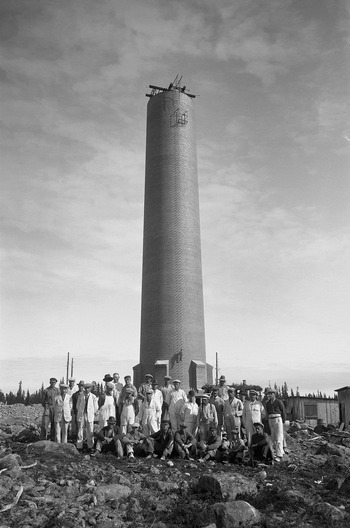
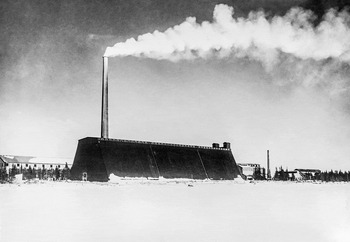
In June 1932, Palén published an article in the Engineering and Mining Journal presenting the smelting process adopted at the Rönnskär smelter.Footnote 111 In it, he stated that one of the main problems in planning the smelter had been the removal of the large amounts of arsenic from the roaster gases because no similar operation on a large scale was known to be active elsewhere in the world. Among the most impressive structures at the Rönnskär smelter were its 153-meter-high smokestack (Figure 2) and the arsenic storage, a concrete structure (110 meters long, 40 meters wide, and 23 meters high) capable of holding about 120,000 tons of crude arsenic (Figure 3).Footnote 112
Construction of the Rönnskär stack, 1928. (Source: Unknown photographer, photo no. SM X 00470, Boliden AB's arkiv, Bildarkivet, Skellefteå Museum.)

The arsenic storehouse, Rönnskär smelter (behind the storehouse is the Rönnskär stack), 1932. (Source: Photographer unknown, photo no. BOL 4480, Boliden AB's arkiv, Bildarkivet, Skellefteå Museum.)

The two buildings—symbols today of a dirty industrial past—were monuments to the engineering expertise of the early 1930s in their efforts to control pollution. The technology was not comparable with its state-of-the-art counterpart a few decades later, but it was cleaner than the technology used in Anaconda, Salt Lake City, and Ducktown three decades earlier.
Proactive Strategies and the Creation of Shared Value with the Local Community
Despite the Boliden managers having incorporated a proactive strategy to prevent smoke damage right from the planning stages of the project, the surrounding environment was soon affected by SO2 emissions. Initially, only relatively low-sulfur ore was processed at the plant, but in 1935 the company started to treat ore with substantially higher sulfur content. Between 1931 and 1940, annual SO2 emissions increased from 4,000 tons to around 100,000 tons. Complaints from farmers and forest landowners began to increase around 1934.Footnote 113 As mentioned, the company preferred a process that produced solid sulfur to one producing sulfur acid, due to the risks of storing and transporting sulfur acid. A pilot plant to produce solid sulfur was ready in 1931, but the production program was not operationalized as the board believed the profit opportunities were too uncertain. However, in 1933, Falkman clearly declared to the board that the need to construct a full-scale sulfur plant was urgent, regardless of whether the sulfur production was profitable or not. He argued that the smoke damage to the area would otherwise lead to major compensation claims—and probably to intervention by the authorities.Footnote 114 The board approved the investment, and the sulfur plant for extraction of solid sulfur was finally ready in 1935.
The proactive strategy adopted by Boliden managers contributed to the avoidance of more serious smoke damage. The company's managers made persistent efforts to find technical solutions where arsenic-related risks were prevalent at least until the mid-1930s. Relying on environmental arguments, Falkman and the other managers fought fiercely against Kreuger's plan to adopt the Guggenheim smelting process. The reason for Krueger's eventual compliance with the position of Boliden's managers was, according to Falkman, that Kreuger accepted their arguments.Footnote 115 Ultimately, it was not a question of downplaying profit maximization out of the goodness of either Falkman's or Kreuger's heart, but a proactive strategy aimed at avoiding conflicts that would have interfered with Falkman's ambition to build a long-lasting, profitable business. Avoiding excessive pollution was seen as a reasonable and even necessary step in establishing a modern mining industry, which is in line with Michael E. Porter and Mark R. Kramer's concept of shared-value creation: that causing social harm can (and does) create internal costs for a company.Footnote 116 Falkman, with his farsighted perspective in building the business, stressed that Boliden should provide safe employment and give something back to the region in which it worked. These CSV-related ideas were not restricted to the working environment and emissions. One way Falkman could achieve his paternalistic ideal—which had deep historical roots in Swedish manufacturing—was to engage the London-based architect Tage William-Olsson to create a model community in the town of Boliden, which bears the same name as the company. Quality housing, pleasant gardens, and clean water, among other things, were designed to create a comfortable environment for the workers.Footnote 117 Other exponents of CSV included the building of a school for children, meeting houses for laborers and their families, and facilities for independent church activities.Footnote 118 The company also started a fund for mitigating the anticipated social costs associated with the mine's eventual depletion.Footnote 119 Falkman believed that such investments would not only improve the bottom line but also act as a step toward good working relations and high productivity.Footnote 120 The same belief can be seen in the company's integration of technology that would purify the smelter smoke. Yet, the rate of workplace accidents and injuries was high during the initial operation of the Rönnskär smelter. During 1931 and 1932, 30 percent of the workers experienced some kind of accident.Footnote 121 Falkman saw to it that a public medical clinic, with one doctor, was established at the Rönnskär smelter in 1931.Footnote 122
Over the following decades, the general knowledge of ecosystems and health issues evolved, uncovering critical and increasingly complex environmental concerns. In addition to arsenic and sulfur, emissions of mercury, cadmium, lead, and copper were added to the spectrum of potential problems at the Rönnskär smelter. During the 1960s, there was a growing awareness that a major gap existed in general knowledge of both the scope and the effects of emissions from Swedish industry. In contrast to the interwar period, the 1970s and 1980s saw a period of strong legal pressure on the company to redefine long-term investment strategies and related R&D. In terms of environmental investments, the company has devoted resources to in-house R&D and worked proactively against regulation until the present.Footnote 123 Unlike the Anaconda Company and Tennessee Copper Co., the Rönnskär smelter is still in operation and in fact is one of the most efficient smelters in the world, specializing in recycling complex materials such as electronic scrap.
Conclusion
In this article we have explored why the Swedish mining company Boliden adopted proactive environmental strategies when it started operations during the interwar period. Clearly, investing in environmental technology was seen as a source of competitive advantage. Without this investment the company could not utilize the gold and would have polluted the surrounding environment to a much larger extent. These proactive strategies adopted by the company represent a shared value argument: good for business and good for the environment. Indeed, as argued by Porter and Kramer, the “health” of the communities around a company is closely intertwined with the competiveness of that firm. From an environmental perspective, this means that Boliden, within the limits of best available technology, but also by developing its own methods, tried to internalize the social costs of pollution. Values were therefore shared with the local community, as the environmental costs were not fully externalized to landowners and other stakeholders. Since the company also undertook other CSV-compatible measures, it is clear that environmental concerns were part of a broader value system, including both social responsibility and respect for the property of others. In short, excessive pollution was perceived as bad for the chances of a long-lasting, profitable, and sustainable business.
Boliden's managers made efforts to prevent damage from smoke; in addition, we found that solutions to the smoke problems were related to other strategic decisions. It seems, for instance, that Kreuger realized that the sulfur-abating technologies were a means by which to enter, and possibly even control, the cartelized sulfur market. The interrelation between environmental issues and the production of sulfur may also explain the interest in environmental technologies by both Guggenheim Brothers and Orkla. From this perspective, it is important to recognize that efforts were being made to identify and further develop technologies that would satisfy both economic and environmental needs simultaneously, an argument already suggested by Timothy J. LeCain and Hugh Gorman.Footnote 124 The commercialization of both sulfur and arsenic was an issue of high priority in terms of economies of scope. Concerns about smoke damage became integrated with what we normally recognize as traditional business motives. The blurring of boundaries between different motives makes it difficult to determine where environmental issues end and other business interests begin. This fundamental entanglement is, however, central to the analysis and distinguishes the Boliden case as an example of CSV rather than of CSR. While CSR is about taking responsibility as value is created in a production process, CSV is about creating value through a production process that is inseparable from the value creation outside the company. This is not simply consumer surpluses or wage creation, but processes that can be understood in terms of positive externalities or avoidance of negative externalities. In the case of environmental issues, CSV is probably most often associated with the avoidance of negative externalities but can be distinguished from CSR by the fact that such avoidance is indispensable for value creation within the company. For instance, it is clear that Boliden tried to achieve profitability in both the sulfur and the arsenic business. No clear trade-off existed between investing in abatement technology and profits in the way Boliden's managers and engineers handled these two issues. The technology was simultaneously a production process and a means of reaching environmental goals. Clearly, the motive for integrating pollution-control technology can be seen as a way to efficiently exploit economies of both scale and scope, in Alfred D. Chandler's terms. Controlling the toxic copper smoke allowed a larger-scale production than would have otherwise been possible, considering potential damage, while simultaneously producing sulfur and arsenic as by-products of the copper- and gold-making process.
The Boliden case also exemplifies the possibilities offered by global learning. Managers at the company had witnessed environmental problems in the United States and learned from their experience. This is not discussed by Porter and Kramer, but it helps us to understand further why Boliden came to the conclusion that environmental technologies could be a competitive advantage. The company never questioned whether smoke damage should be avoided or not; rather, the question—and the challenge—was about how to prevent a situation similar to that of certain copper districts in the United States. The American copper industry was on the front line of the struggle with toxic copper smoke, and the Swedish entrepreneurs learned, transferred that knowledge and technology, and developed them further for adaptation to the Swedish geophysical, climatological, and institutional context. The importance of knowledge about local conditions for adaptation of the technology was stressed by one of the American consultants, Louis Davidson Ricketts. Straightforward technological transfer from the United States was not an option.
The government was not explicitly involved in Boliden's search for, and development of, technology to prevent smoke damage, nor in its sending top engineers on trips to the United States seeking consulting expertise. As shown by the works of McCain, Maysilles, and others, extensive social protests, lawsuits, and court cases forced American copper companies to take action. Boliden's managers and engineers were fully aware of this, allowing the situation to not be repeated in the Swedish case. Rather, extensive smoke damage, related protests by farmers and ranchers, and litigations in the United States functioned as a warning. Although the Swedish managers faced the threat of government intervention if they caused smoke damage to the degree experienced in the United States, this does not appear to have been a prevailing motivation. Also, in response to the company's convincing report on the successful development of smoke abatement technologies, the municipal government had no objections.
Finally, national institutions were important, but not in the way that is usually assumed when environmental issues are discussed. It was not government policies per se but rather the Swedish concept of property rights that mattered the most. Norms among Swedish business leaders had long been formed by paternalistic ideals, and Falkman asserted his vision of building a modern and lasting industrial community. Conflicts with forest landowners, forestry companies, and farmers were perceived as working against these ideals. The Boliden managers’ respect for private property probably mattered more for the environmental-related strategies than a compassion for nature. Running a business at the expense of forest landowners and farmers stood in contrast to the notion of respect for private property because it implied “doing bad” to the local community. Needless to say—and thus Boliden's managers did not explicitly say it—you cannot destroy what belongs to someone else. It may be that the heritage of this stance in Scandinavia is a historical social structure characterized by a large proportion of self-owning smallholder farmers and a weak aristocracy. Besides, the Swedish nuisances legislation did open for processes against companies in cases when property had been damaged. In this respect, at least, Sweden's experience resembled that of the United States.