The prevention of catheter-associated urinary tract infections (CAUTIs) has historically focused on appropriate use and maintenance. It is not clear how culturing practices affect the National Healthcare Safety Network (NHSN)-defined CAUTI events in the setting of other interventions to reduce catheter risk. The objectives of this study were to assess compliance with best practices related to the use and maintenance of devices and to evaluate how culturing practices affect CAUTI rates in the intensive care units (ICU) of 2 large teaching hospitals.
Methods
We conducted an intervention to reduce catheter risk and to improve culturing stewardship in the adult medical and surgical ICUs at 2 academic tertiary-care hospitals (hospital A: 60 ICU beds; hospital B: 140 ICU beds) for the first 6 months of 2015. We compared the use of urinary catheters, urine cultures, and NHSN-defined CAUTI events in the ICUs of both hospitals for the first 6 months of 2014 and 2015. The intervention consisted of educating the ICU teams, including resident physicians and nurses, on strategies to reduce the risk of urinary catheter use, and appropriate testing for CAUTI. A toolkit was developed and used to educate resident physicians at both institutions. 1 Identical presentations were given to resident physicians at both institutions addressing the appropriate use of devices and laboratory workups for CAUTI. Face-to-face weekly audits and feedback on appropriate device use were provided to nurses and/or physicians along with monthly lectures to resident physicians.
During the first 6 months of 2015, weekly audits were performed on the maintenance elements (break in the seal, urinary bag position, and catheter securement). Appropriate indications for urinary catheter use were based on the 2009 Centers for Disease Control and Prevention guidelines.Reference Gould, Umscheid, Agarwal, Kuntz and Pegues 2 Urinary output monitoring in critically ill patients was considered appropriate only if there was need for hourly measurement of urinary output.Reference Lo, Nicolle and Coffin 3 Catheter utilization, urine culture use and the 2015 NHSN-defined CAUTI rates 4 were measured and compared for the first 6-month periods of 2014 and 2015. Because the NHSN CAUTI definitions changed between 2014 and 2015, we reevaluated all the 2014 events to match the 2015 definition. The institutional review boards at each of the participating institutions approved the study.
Statistical analysis
Data on device use and compliance on maintenance processes were analyzed using the Pearson χ2 test. The z test was used to compare person-time rates. All data were analyzed using SPSS version 25.0 software (IBM, Armonk, NY), and a P value of .05 or less was considered statistically significant.
Results
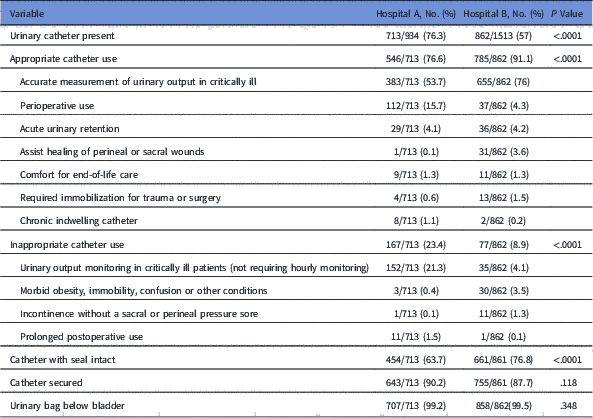
Of 2,447 patients evaluated in weekly audits, 1,575 patients (64.4%) had urinary catheters present (Table 1). Urinary catheters were present with appropriate indication in 1,331 of 1,575 patients (84.5%). The most common appropriate reasons for using catheters were accurate measurement of urinary output in 1,038 of 1,575 patients (65.9%), perioperative use in 149 of 1,575 patients (9.5%), and acute urinary retention in 65 of 1,575 patients (4.1%). Catheter utilization was 76.3% in hospital A and 57% in hospital B (P < .0001). The appropriate reasons for use were 76.6% for hospital A compared to 91.1% for hospital B (P < .0001). Hospital B had a higher proportion of patients with urinary catheters used for fluid monitoring in critically ill patients (76% vs 53.7%; P < .0001).
Weekly audits on Urinary Catheter Indications and Compliance with Processes in 2015 at Both Facilities

Compliance with proper maintenance: the catheters were secured 88.8% of the time, and the urinary bag was below the bladder >99% of the time in both institutions combined; however, the catheter seal was intact only in 63.7% of catheters for hospital A compared to 76.8% for hospital B (P < .0001). No significant changes in compliance were detected for the 3 catheter maintenance variables evaluated over the 6-month period.
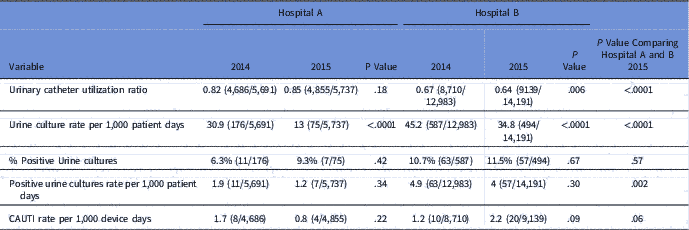
Comparing 2014 and 2015, urine culture rates in hospital A were 30.9 and 13 per 1,000 patient days respectively (−57.9%; P < .0001), and in hospital B, the urine culture rates were 45.2 and 34.8 per 1,000 patient days, respectively (−23%; P < .0001) (Table 2). The decrease in the rate of urine cultures per 1,000 patient days at hospital A was accompanied by a reduction in positive urine culture rates per 1,000 patient days and a reduction in CAUTI event rates of >50% without reaching statistical significance. On the other hand, although the positive urine culture rate per 1,000 patient days did not increase for hospital B, the CAUTI event rates increased without reaching statistical significance (Table 2). There were no significant differences in the percentage of positive urine cultures at both facilities based on the number of urine cultures done over the 2014 and 2015 periods; however, positive urine culture rates per 1,000 patient days for hospital B in 2015 were >3 times higher than hospital A. The CAUTI rates in 2015 were 0.8 (hospital A) and 2.2 (hospital B) per 1,000 catheter days (P = .06).
Urinary Catheter Utilization, Urine Cultures and CAUTI Rates in 2014 and 2015 at Both Facilities

Note. CAUTI, catheter-associated urinary tract infection.
Discussion
We evaluated urinary catheter use, appropriateness, maintenance, and culturing practices at 2 large tertiary-care centers. We observed minimal to no improvement in the use of urinary catheters with our intervention, consistent with the results of recent national efforts.Reference Saint, Greene and Krein 5 Most catheter indications were labeled for accurate measurement of urinary output and for perioperative indications. The differences in urinary catheter utilization between the 2 institutions may be related to different practice patterns at each facility and the interpretation of the need for fluid monitoring. Both facilities had high compliance with the maintenance elements, with hospital A having a higher proportion of patients with broken catheter seal. Securement devices were used in ~90% of the patients.
We found significant differences in culturing practices between the 2 institutions for baseline and intervention periods. The reduction in obtaining urine cultures in hospital A was not associated with an increase in the proportion of positive urine cultures. Hospital B had an increase in CAUTI rates with a stable and lower catheter utilization ratio, but hospital B requested almost 3 times more urine cultures per 1,000 patient days compared to hospital A. This striking variation between the 2 hospitals has a powerful effect on the identification of surveillance-based NHSN CAUTI events. Culturing practices greatly affect the number of NHSN-defined CAUTI events, regardless of whether these labeled events are clinically present.Reference Al-Qas Hanna, Sambirska, Iyer, Szpunar and Fakih 6
Our study has some limitations. It includes a quasi-experimental before-and-after design without a control arm, and without baseline data from 2014 to compare process measures. We did not account for fever prevalence, an important factor that may influence the NHSN surveillance definition events. In addition, the possibility of classification bias exists when abstracting information related to appropriateness reasons for using urinary catheter and potential variations when implementing intervention activities at each institution. Furthermore, cultural factors could have influenced adoption at both facilities.
We conclude that even with structured efforts to reduce NHSN-defined CAUTI events in intensive care, mixed results occur, and they may be heavily influenced by culturing practices. Therefore, we highlight 2 important issues. First, the device utilization ratio should be considered as an additional performance measure for urinary catheter harm.Reference Fakih, Gould and Trautner 7 Second, culturing stewardship may disproportionately help reduce NHSN-defined CAUTI events, compared to interventions focused on reducing bacteriuria risk of the catheterized.Reference Mullin, Kovacs and Fatica 8 Culturing stewardship does not result in less harm related to clinical CAUTI, but it has key implications on curbing unnecessary antimicrobial use for asymptomatic bacteriuria.Reference Garcia and Spitzer 9 Our findings underscore the importance of both working to reduce catheter use and incorporating “improving the culture of culturing” to the resident physicians training in teaching institutions.Reference Fakih and Khatib 10
Acknowledgments
The authors thank resident physicians and nurses from both institutions who participated during the study period.
Financial support
This study was supported by a contract from the Agency for Healthcare Research and Quality (grant nos. HHSA290201000025I and HHSA29032001T) under a subcontract with the Health Research and Educational Trust. The opinions expressed in this document are those of the authors and do not reflect the official position of AHRQ or the US Department of Health and Human Services.
Conflicts of interest
Dr Reyes reports grants from Theravance, Cubist, and the Centers for Disease Control and Prevention, outside the submitted work. Dr Zervos reports consultancy for Cempra, grants from National Institute of Health, National Safety Foundation, Paratek, Cempra, Melinta, Merck, Cerexa, Pfizer, Tetraphase, Genentech, Allergan, Michigan Department of Community Health, and the Centers for Disease Control and Prevention, outside the submitted work. All other authors report no conflict of interest relevant to this article.