I. INTRODUCTION
A few years ago, the model developed in David Ricardo’s Essay on the Influence of a Low Price of Corn on the Profits of Stock ([1815] 2004, vol. IV, pp. 1–41, hereafter Essay on Profits), object of fierce opposition from Thomas R. Malthus, was formally proved correct by Francisco L. Lopes (2008, p. 604), who put forward the following statement: “The Ricardo–Malthus controversy on the rate of profit is a remarkable example of how the lack of analytical tools may hinder the progress of economic knowledge. If Ricardo had at his disposal the techniques of a modern economist, he would have easily overcome Malthus’ criticism.” In addition, it was argued that such a theoretical standoff within the classical school stemmed from Ricardo’s inability to think in terms of a system of general equilibrium, likely due to his customary practice of recursive reasoning; that is, of framing abstract constructs as a concatenation of successive events. Lopes’ conclusion, though, may be deemed a little too harsh on British early nineteenth-century economists, for he insinuates that only with the aid of modern formal tools would it be feasible to properly tackle the problem faced by Ricardo.
In what follows, we intend to qualify this rather strict assessment, showing that even with the limited technical resources available to the economists of the time, it was possible to provide a suitable answer for the conundrum proposed by Malthus regarding the behavior of the profit rate. In order to do so, the second section presents a brief account of his key allegations against Ricardo’s theory of capital accumulation, which was sketched out in the Essay on Profits and later fully articulated in On the Principles of Political Economy and Taxation ([1817] 2004, vol. I). Next, the evolution of Colonel Robert Torrens’ systemic view of the economy is examined in order to track the exact way he succeeded in constructing a formal engine capable of handling most of the theoretical controversies of the period.Footnote 1 The final section covers not only some applications of such an analytical tool but also the way Torrens addressed what we designate here as ‘Malthus’ Challenge’, certifying its inaccuracy by means of a quantitative example. The closing remarks highlight the merit of Torrens’ achievement in this particular field of economic inquiry.
II. MALTHUS’ CHALLENGE
From a historical perspective, the most prominent charge Malthus levied against Ricardo’s view on the evolution of a market-oriented society involved the idea that the dependence of general profits on the state of the land represented only a long-run obstacle to economic expansion, since, in the meantime, the actual rate of return was subjected to other forces regulating the demand and supply of capital, as commonly accepted with respect to the remuneration of land and labor. In the Principles of Political Economy ([1820] 2004, vol. II, pp. 301–331), Malthus pointed out as permanent constraints of effectual demand the satiability of the wants of consumers, the human love for indolence, along with the impossibility of the laborers absorbing the entirety of their production. For these reasons, savings and the consequent capital accumulation could become excessive when pushed beyond a certain optimal limit, bringing forth, in such a case, an overflow of commodities bound to reduce prices as well as the profit rate, the end result appearing in the form of a general glut. To neglect the forces of demand and supply in their regulating influence on the profit rate would be like “overlooking the change of direction given to a ball by a second impulse acting at a different angle from the first” (2004, vol. II, p. 266). Ricardo never took this conjecture seriously. He always assumed, in accordance with Mister Mill’s Principle (Say’s Law), that the human desire for luxuries and other amenities was boundless. Hence, no widespread lapse in demand would ever succeed, and the progress of capital accumulation could be put in check only by an elevation in the price of food: “If there were no such rise what could prevent population and capital from increasing without limit?” (letter to Malthus [17 October 1815] 2004, vol. VI, p. 130).Footnote 2
The present paper is interested also in another aspect of Malthus’ thought. Soon after the Essay on Profits was published, Ricardo asked him for no mercy with regard to the criticism of the theory exposed in the pamphlet ([14 March 1815] 2004, vol. VI, p. 188). The appeal was hardly necessary, considering that the dispute between them with reference to the nature of the profit rate had already been evolving for some time. One of the main observations Malthus intended to formulate about the Essay on Profits had been partially anticipated in his Observations on the Effects of the Corn Laws (1815a), where he attacked Adam Smith’s conclusion that a bounty on corn exports would have no real impact on the activity because such a policy tended to raise wages and, therefore, the prices of raw materials and all manufactured commodities, leaving the difference between the farmer’s advances and revenues unaltered. Malthus objected, first, that the laborers’ expenditures comprised not only bread or grain, but also, and in almost the same proportion, manufactured articles such as fuel, candles, tea, sugar, clothing, and so on. As a consequence, wages would adjust in a partial and lagged way relative to variable corn prices, while the population would react at an even slower pace to movements in the reward of labor. Agriculture, furthermore, could not be treated as an exception to the general principle that capital flows into any sector where demand outweighs supply and the profit rate is greater than in alternative employments. It would be perfectly normal that an increase in the price of corn, induced by the progress of manufactures or the foreign commerce, would result in a boost in agricultural profits and, through this effect, in more capital applied upon the land. “Nothing then can be more evident both from theory and experience, than that the price of corn does not immediately and generally regulate the prices of labour and all other commodities,” observed Malthus peremptorily, noting further “that the real price of corn is capable of varying for sufficient length to give a decided stimulus or discouragement to agriculture” (1815b, pp. 15–16).Footnote 3
With respect to Ricardo’s invitation, it did not take long for his friend to fulfill the request. The parson had already written to Francis Horner, that same day, questioning the fact that the farmers’ expenses, in the Essay on Profits, were calculated exclusively in corn, instead of in the actual materials used as capital in agriculture ([14 March 1815] 2004, vol. VI, pp. 187–188; see also letters to Ricardo [5 August and 9 October 1814], pp. 117–118, 140–141). Besides that, Malthus believed it essential to take into account the notion that if the price of provisions increased, thanks to the progress of accumulation and the restrictions on imports, agricultural produce would reach an augmented purchasing power in terms of manufactured articles. This change in relative prices would cause a lowering in the real costs of raising food and, thus, a more tangible return in the activity, especially in areas of superior productivity. Here, Ricardo’s logic is turned upside-down. In the Essay on Profits, he defended the free trade in corn as a sure way to reduce labor costs and, by this channel, to promote a rise in profits as a whole. Malthus, for his part, argued that the opposite process might have a similar ending. If cheaper food meant a higher profit rate in manufactures, why could not a more expensive price of corn, meaning a cheaper relative price for manufactured articles, also engender an improvement in agricultural profits, especially in the more fertile lands? After all, would not both sectors be complementary, determining together the profit rate of the economy? “Pray think once more on the effect of a rise in the relative price of corn, upon the whole surplus derived from land already in cultivation. It appears to me I confess, as clear as possible that it must be increased” (letter to Ricardo [12 March 1815] 2004, vol. VI, p. 185).
The same argument was to resurface in Malthus’ An Inquiry into the Nature and Progress of Rent (1815b). When dealing with the laws governing the oscillations in rent, he mentioned four factors with the potential to contract the expenses of cultivation: first, the accumulation of capital, lowering profits on stock; second, the population growth, forcing wages down; third, either the improvements in agriculture or the stepping up of laborers’ diligence, reducing the number of workers needed to obtain a given supply; and, last, an expanded demand for agricultural produce, increasing its price without a commensurate addition in costs. Or, as Malthus commented regarding this fourth factor:
If a great and continued demand should arise among surrounding nations for the raw produce of a particular country, the price of this produce would of course rise considerably; and the expenses of cultivation, rising only slowly and gradually to the same proportion, the price of produce might for a long time keep so much a head, as to give a prodigious stimulus to improvement, and encourage the employment of much capital in bringing fresh land under cultivation, and rendering the old much more productive. (1815b, p. 24; see also pp. 26–27)
In the Inquiry, Malthus introduced yet another version of this same argument, involving now the purchasing power of wages. He associated the low value of the precious metals with the high price of raw produce consequent on increasing wealth, so much so that “one of them cannot be had without the other” (1815b, p. 39). However, this state of affairs would not be detrimental to the laborers, as may be thought at first glance; on the contrary, with its being to their “unquestionable advantage.” After a time, when the higher price of corn had already been fully incorporated into wages, the laboring classes would enjoy an effective gain with respect to all other objects of convenience that did not experience a similar price rise. In other words, Malthus attempted to argue that increased wages accompanying higher corn prices could buy more manufactured articles, so that a kind of substitution effect should happen in the laborers’ consumption bundle, improving, therefore, their general condition (1815b, pp. 39–41).Footnote 4 His convictions remained unshaken even after the publication of On the Principles of Political Economy and Taxation, which contained Ricardo’s refined theory of value designed to substantiate his claims on the agricultural restraint to capital accumulation. In the Principles of Political Economy, Malthus retorted that, from a practical standpoint, actual short-run profits were favored by the improvements in cultivation techniques or in the implements of husbandry, as well as by the more intense exertions of productive laborers in the transition of society to a higher civilized station. Key here also, he went on, was the fact that the prices of domestic and foreign manufactured articles did not keep pace with food prices, so that agricultural sales receipts tended to move ahead of the respective capital outlays (2004, vol. II, pp. 271–275).
In a nutshell, Malthus’ Challenge amounted to this: if, for whatever reason, the relative price of the agricultural produce increased with respect to the manufactured articles, this effect could raise the overall profit rate, at least for some time, due to the reduction in farmers’ real costs, allowing a higher yield on the capital invested on the land. Let us see, then, how Torrens, with the scanty formal resources available to him, managed to straighten out this intriguing riddle of classical economics.
III. TORRENS’ SYSTEMIC VIEW OF THE ECONOMY
In his Essay on the External Corn Trade (1815), Torrens offered a strong defense of free trade based on a Smithian view of rent formation. In a progressive society, as he described the process, an expanding capital stock intensifies competition among producers, making the profit rate in commerce and manufactures descend to the level obtainable on less fertile lands. At the same time, as the demand for labor becomes brisk, the consequential rise in wages stimulates population growth, so that the necessity of additional food provides the final motive to the occupation of inferior soils: “At length cultivation ascends the hills and scales the mountains, and the country wears the aspect of a universal garden” (1815, p. 51).
This ideal scenery was dismantled in England by the restrictions on foreign corn adopted in the wartime legislation, occasioning losses to industrial and commercial concerns, as well as to the public in general. For Torrens, the additional revenue from the rise in the price of corn was appropriated by the landowners at the renewal of their leasing contracts, while the ensuing adjustment in wages triggered a price inflation throughout the economy. This whole process, however, was bound to culminate in a fall in both the internal and the foreign demand for manufactures, making for less profits and high industrial unemployment at home, thus prompting the outward flow of capital and migratory movements that would eventually depress domestic farming. “Here, then, agriculture, after having, for a time, retained a preternatural vigour, under the influence of an artificial stimulus, would begin to exhibit the symptoms of decline,” said Torrens with a prophetic voice, adding that “[t]he landlord, the farmer, and all the persons to whom they give employment, will be involved in the general distress” (1815, pp. 248–249). The best remedy for this disastrous prospect was, of course, the free importation of corn, although the colonel recommended that the removal of restrictions should be conducted carefully in order to avoid huge losses for producers.
In 1818, Torrens published in the Edinburgh Magazine the article “Strictures on Mr. Ricardo’s Doctrine Respecting Exchangeable Value” (1993a). In it, he stated that, first, if sales revenues must exceed costs and, second, if competition among producers imposes the uniformity of the profit rate over all sectors, then the values of the commodities must be calculated as a proportion of their respective capital requirements rather than as the sum of direct and indirect labor spent on them. To substantiate this idea, he presented some numerical examples showing how actual competitive prices may differ from values in the Ricardian sense. In one of his cases, he assumed wages of 1s a day and a profit rate of 20%. An individual A then buys a quantity of silk produced by ninety days’ labor, at the price of 108s, profits included, and hires ten laborers for 10s to work it up. Meanwhile, individual B purchases a quantity of wool produced by ten days’ labor at the price of 12s, and advances 90s in wages to ninety laborers in charge of processing the material. The resulting commodities possess the same Ricardian value of 100 days’ labor, but their final prices are 143s for wrought silk and 122s for the woolen cloth. Whether this illustration actually violates Ricardo’s theory is a question outside the scope of the present paper (see, however, Hollander Reference Hollander1979, pp. 208–218; and Peach Reference Peach2009, pp. 176–186). Regardless, it contains a truly important analytical step in the development of Torrens’ view on value; that is, the application of the rule of prices with a uniform profit rate not only to the final product, but also to the inputs of the productive process.
Another theoretical refinement in the approach Torrens was forging through his economic inquiries appeared the next year, 1819, in the article “Mr Owen’s Plan for Relieving the National Distress,” published by The Edinburgh Review (1993b). This succinct work disputed the philanthropist’s proposal for constructing small communities in the shape of parallelograms, where a few thousand people would occupy themselves in a variety of activities. According to Torrens, none of Owen’s suggestions had the capacity to affect the profit rate, determined by the fertility of the soil, the productivity of labor in agriculture and in manufactures, and, lastly, by the general level of wages. The first factor reveals Torrens’ now-evident sympathy for the contents of the Essay on Profits, already manifest in his A Letter to Lord Liverpool (1816).Footnote 5 Despite this change of mind, he grabbed the opportunity to strike at Ricardo’s thesis that assured the permanent opposition between wages and profits. Indeed, this was the moment when Torrens reached another plateau in his analytical method, for he did not hesitate to break into the enemy’s territory and to introduce the calculus of the common profit rate encompassing the agricultural and the manufacturing sectors at the same time, with the reciprocal use of material resources. Based on this new perspective, Torrens declared that the strength of Ricardo’s proposition rested critically on the hypothesis of stationary techniques of production. Nevertheless, in case of improvements in the “effective powers of industry,” the rate of profit and the amount of wages could rise in parallel instead of at the expense of each other (1993b, p. 86).Footnote 6
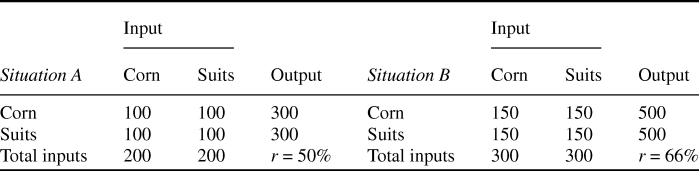
The example concocted by Torrens is of the input–output style and, even though plain, it is worth reproducing here. On the one hand, it displays an undeniably theoretical progress, while, on the other, it reveals the limitation of his thinking at that juncture. This is so because the proportions between the final product and the total employment of resources in both sectors are identical, allowing the direct estimation of the profit rate without his having to worry about the prices of agricultural and manufactured commodities. Torrens’ hypothetical economy produces corn and suits, where each sector hires 100 men for an annual wage of 1 quarter of corn and 1 suit, with the original profit rate r totaling 50% (situation A). After the introduction of some technical improvements in both sectors (situation B), notwithstanding the rise of annual wages to 1.5 quarter and 1.5 suit, the profit rate increases to 66%, as depicted in Table 1 below.
Torrens’ Simplified Economy 1819

Source: Torrens (1993b, p. 86).
The last stage in the development of Torrens’ analytical structure takes place in the second edition of his Essay on the Influence of the External Corn Trade (1820, with a slight change in title, hereafter Essay on Corn Trade). In the preface, the author acknowledged the theoretical contributions brought forward by Ricardo, Malthus, Edward West, and John R. McCulloch after the first edition of the book, composed in haste due to the importance of the then-ongoing debate respecting the Corn Laws. Torrens felt that this hurry resulted in a number of inaccurate conclusions, which the new and improved edition was attempting to remedy (1820, pp. xv–xxi). The corrections came in the form of an additional chapter with almost 100 pages in which the colonel introduced his new apparatus to cope with abstract economic problems. Within the framework of the capitalistic system, the principle of universal competition, as Torrens saw it, could be represented through a compact formal structure having as its assumptions: (1) a network of connections among the productive sectors, each using some kind of input from the remaining others; (2) the existence of a surplus in the cultivation or manufacturing of any commodity with respect to its total quantity employed as capital by the conjoint operation of all productive unities; (3) the conformity between the supply of, and the demand for, each final product, prices being, therefore, at their natural level; (4) the inputs as either raw materials or goods pertaining to the laborers’ subsistence basket, with no use of fixed capital and, therefore, no amortization allowances; (5) the final products as identical to the inputs employed as capital; and (6) the prevalence of a uniform profit rate over the whole economy and proportionate to actual costs. In order to examine the analytical effects of such a set of premises, Torrens lay before the reader twenty-four cases of simplified economies with the novelty of competitive prices and a common profit rate set over the quantitative system put forth in the Owen article the previous year.7
The specific form of this general system, which he hammered against each and every theoretical problem he examined in the new chapter, is indicated below (although Torrens himself did not present it explicitly; on this, see Hisamatsu Reference Hisamatsu2009). So, x ij is the quantity of input i used in the production of commodity j, X j is the total supply of commodity j (1=agriculture, 2=manufactures), p a is the price of the agricultural produce, and p m is the price of the manufactured article, while r stands for the common profit rate.
 $$\eqalign{ & ({p_a}{x_{11}} + {p_m}{x_{21}})(1 + r) = {p_a}{X_1} \cr & \cr}$$
 $$({p_a}{x_{12}} + {p_m}{x_{22}})(1 + r) = {p_m}{X_2}$$
System (1)-(2) has three variables (pa, pm, and r) and two equations. If one price is taken as numéraire, the other two variables admit of positive values. Before presenting Torrens’ personal method of calculus to solve the above system in some of its applications, what deserves notice here is the fact that such a pioneering approach rests on the recognition of the mutual interdependence of the economic sectors. There is no logical priority conferred on agriculture or on manufactures, while the relative prices and the profit rate are determined simultaneously. Torrens himself, when examining the causes of rent, provided a detailed explanation about his way of seeing the interconnection of productive sectors in economics:
When the divisions of employment have been once thoroughly introduced, the greater part of every man’s wants is supplied by the produce of other man’s labour; and the greater part of every man’s capital is replaced, not by the articles he himself produces, but by those which are produced by other capitalists, and which he obtains by means of barter or exchange. Hence, the amount of the return which the capitalist obtains, does not depend wholly upon the productive powers of the industry which he immediately carries on, but also on the productive powers of all the other branches of industry from which any of the ingredients of his capital are derived. (1820, pp. 420–421, see also p. 393; and 1821, p. 83)
It is clear, then, that Torrens gradually developed a systemic approach to the economy, intended to guide him, in a quantitative way, through the variety of theoretical problems with which he had been dealing. Unfortunately, the potential of this method was not fully appreciated and, in most instances, not even understood by the economists of the time. Let us see, then, how the colonel managed to apply his new tool to contemporary analytical questions.
IV. APPLICATIONS OF TORRENS’ SYSTEM AND MALTHUS’ CHALLENGE
Torrens did not waste any time and immediately put his system to work. From the beginning, he denied Smith’s suggestion of corn’s possessing an invariable value, since, under the conditions of cross-influence among the various economic sectors and of frequent improvements in their respective powers of production, no commodity would exhibit immutable costs or, consequently, a permanent fixed price. Following the refutation of Smith’s proposition on the value of corn, the Physiocratic idea of an intrinsic and exclusive productiveness of agriculture was flatly rejected on the grounds that a capital invested in any other segment of the economy should receive a return identical to the one obtained in farmlands for expenses of the same magnitude; otherwise, no manufacturing activity would ever take place (1820, pp. 349–365).
When discussing his own theory of the profit rate, Torrens mentioned as determinants of the yield on capital the fertility of the soil, the dexterity of labor either in the cultivation or in the processing of raw materials, and, finally, the real wages: that is, the effective consumption by laborers during the production phase. In order to prove this reasoning, he adopted as reference a specific configuration for his simplified system, with x 11=x 12 and x 21=x 22, meaning that costs are forcibly equal whatever the prices may be, while X 1 and X 2 are each proportionate to the total use of inputs, making the reference profit rate materially determined right at the outset. From this vantage point, it was easy for Torrens to evaluate the behavior of the aggregate return on the capital stock, for instance, after the cultivation of inferior lands, being enough for this purpose to assume a lower value for X 1. Next, the impact of an advance in labor productivity in agriculture or in manufactures could be estimated through an increase in X 1 or X 2. Finally, the measurement of the effect of higher wages requires only some proportionate augmentation in the corresponding x ij inputs for a given X j (1820, pp. 390–394).
The interesting question is: how did Torrens find the proper numerical values for the relative prices and the profit rate in his several examples? The procedure was simple and, at the same time, ingenious. He did not calculate prices or the profit rate in all of the twenty-four cases he worked out in his book. However, when he actually did so, costs were always taken as identical or proportionate between the sectors, irrespective of the actual prices, since he invariably made x 11=kx 12 and x 21=kx 22 , for some k>0 (most of the time, he assumed k=1). So, by the principle of competition, he assured the uniformity of the profit rate. Sales revenues across the sectors must then be either identical or proportionate, which implies p aX 1=kp mX 2. Relative prices can, therefore, be calculated immediately by the quotient p m/p a=X 1/(kX 2).Footnote 8 After the attribution of some arbitrary value to p a, it is straightforward to estimate pm (or vice versa) and the correspondent profit rate r. As Torrens often emphasized: “From the perpetually operating law of competition, the employment of equal capitals for equal times yields results of equal exchangeable value” (1820, p. 361). These restrictions, though, should not be seen as key theoretical assumptions that, once removed, could render Torrens’ system impaired or useless. Instead, they are simply an operational rule which he devised to extract numerical solutions from some problems he was analyzing. None of his conclusions, therefore, were compromised by such a technique.
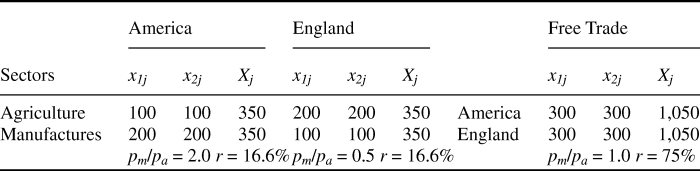
The most conspicuous use of his innovative approach was conducted near the end of the Essay on Corn Trade’s additional chapter, when Torrens discussed the advantages of international commerce. In reference to new and thinly populated countries, like the America of his time, he stated that only first-quality lands are tilled, while the reduced numbers of its inhabitants offer narrow markets to serial production, limiting the extent of the division of labor and the “effective powers” of the manufacturing industry. On the other hand, in old and advanced countries, like England, the return on capital is low because of the necessity to cultivate inferior soils for growing food. However, the increasing population and the high natural price of labor cause a more accurate division of employment as well as an extensive use of machinery, thus reducing the natural price of wrought goods. Hence, in America, the profit rate is potentially high in agricultural unities and low in manufacturing enterprises, while, in England, the opposite situation prevails. For instance, in the numerical example set forth by Torrens, America and England, operating in isolation, both have a profit rate of just 16.6%. If commercial restrictions were removed and free trade fully implemented, the two countries could direct all domestic resources to their most profitable employment; that is, America would specialize in agriculture and England in industry. As a result, they would be able to exchange their respective production at a one-for-one basis with the supranational profit rate registering a hike to 75%, as shown below in Table 2.
Free Trade According to Torrens Reference Torrens1820
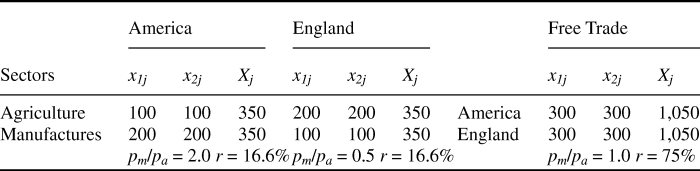
Source: EICT (1820, pp. 408–411). Observations: (1) x1j = quarters of corn, xzj = suits.
Some modern scholars proposed a neo-Ricardian understanding of Torrens’ theory, stating that he built his analytical structure based on the ideas contained in the Essay on Profits. This interpretation portrays his conception of the profit rate as being essentially of a material character and formed exclusively in the agricultural sector.9 As previously mentioned, Torrens, in fact, paid tribute to the strong influence of Ricardo’s theory in the Essay on Corn Trade, though it must not be forgotten that he also mentioned his indebtedness to other important authors. In addition, such selective reading rests upon a particular configuration of system (1), when x 21=0 and, consequently, r=(X 1/x 11) - 1, so that the agricultural profit rate, to be applied on the manufacturing sector as well, is independent of relative prices. However, this possibility was admitted in just three of the twenty-four cases covered in the whole book; more specifically, when the Physiocratic doctrine was being refuted under the argument that whatever the magnitude of the pure agricultural profit rate, the same rate would be replicated a fortiori in the manufacturing sector. Even in the general case x ij>0, a purely material profit rate requires a surplus product exactly proportionate to the total absorption of each and every input in the economy. This singular configuration of system (1)-(2), nonetheless, was extremely constrained to allow an in-depth analysis of the rate of profit’s main determinants, a crucial step to a more effective assault on the protectionist rhetoric.
Returning to the subject at hand, Torrens confronted Malthus’ theory of gluts in the Essay on the Production of Wealth, in a long section in which he weighed the principles regulating the process of capital accumulation (1821, pp. 339–430). Considering an economic system with multiple interconnected sectors, the effectual demand for any commodity is defined as the quantity of the ingredients of capital with which the consumers are willing to part in exchange for it. A positive profit rate means, therefore, that each commodity commands an assortment of things greater than the one employed in its own production. Whenever the correct proportions among all components of capital and other consumption articles prevail, the only limit to effectual demand would be production in and of itself. As long as the availability of fertile land and the level of wages leave behind some profits to the capitalist above the acceptable minimum, effectual demand may experience continuous expansion. Torrens insisted that, in this context, Malthus’ worries about excessive savings were “fallacious” and “inconsistent”, for anything the capitalist abstracted from his personal satisfaction would be automatically converted into new capital. Consequently, no lapse of demand could ever materialize from the decision to spend less on luxuries or other conveniences. Pressed by competition, the producers of the now-overstocked consumption articles could no longer proceed with their operations on the same scale as before, thus being forced to redirect part or even all of their resources to the provision of the additional components of capital eagerly sought. Similar adjustments would come about if a number of producers abandoned their activities for the sake of more leisure or ease, another event that Torrens felt had been unjustifiably feared by Malthus (1821, pp. 380–389).
Despite his optimistic outlook with regard to the correcting powers of competitive forces, the colonel did not deny the possibility of a cyclical and cumulative disequilibrium in the economy. The real causes of this phenomenon, though, were far removed from what Malthus had indicated. They encompassed, first, the producers’ occasional mistaken forecasts about the actual outlets for their inventories, and, second, the irregularity of seasons, throwing upon the market, once in a while, crops far beyond their regular demand. If any of these situations were to occur, and the willingness to buy something in abnormal supply called for a large price cut, its respective sales revenue would decrease, dragging down in the sequence the receipts of the capital suppliers to this particular commodity, and so on. After some time, when panic takes hold of the whole community, a credit squeeze sets in, interest rates rise, and profits disappear, triggering a general run for money characteristic of recessive periods. Torrens recognized, then, that the interdependence among the productive branches worked to propagate all over the economy, in a kind of multiplier effect, some types of localized disturbances: “From the foregoing illustrations, it will be apparent, that a glut of a particular commodity may occasion a general stagnation, and lead to a suspension of production, not merely of the commodity which first exists in excess, but of all the other commodities brought to market” (1821, p. 414). The upturn of the commercial cycle would begin only when interest rates eventually declined to the lowered level of profits and demand started to pick up again, due to the swell in purchasing power of the ready cash owned by moneyed capitalists.Footnote 10
Finally, it is time to inspect how Torrens dealt with what we have been referring to as Malthus’ Challenge. In the supplementary chapter of the Essay on Corn Trade, the first salvo emerged when he drew attention to the fact that, since profits have an ineluctable tendency to settle down on a common level, they would always be elevated or depressed concomitantly in all sectors of the economy. So, if the cultivation of inferior tracts of land raises the cost of producing food and, therefore, its respective natural value, manufacturing profits would necessarily fall. There would be no way, held Torrens, that such a situation could ever be profitable to the farmer while being deleterious to the manufacturer, for their interests are inevitably tied together: “The same causes which raise or lower the profit rate in one occupation, raise or lower it in all” (1820, p. 398).
The second line of attack on Malthus’ Challenge conducted by Torrens involved his contesting the more subtle argument that the rate of profit does not fall in agriculture due to an increased difficulty of producing corn, for otherwise the farmer would have his capital invested in more profitable opportunities such as manufacturing or commerce. Additional capitals, Torrens explained, could not be employed in the latter activities unless more food and materials had been previously available, and the provision of such supplies, would require, as a matter of necessity, the occupation of inferior lands: “Hence, in the first instance, the value of raw produce is raised, as compared with that of wrought goods; and this depresses manufacturing profit, until the cultivation of inferior soils becomes the most beneficial occupation which the accumulating capital of society can obtain” (1820, p. 402). It was also of no avail to say that those farmers operating on lands with better productivity would obtain higher profits after a rise in the price of corn, for this condition would subsist only during the prevalence of leases contracted prior to this event. At their renewal, the profit differential would be appropriated by the landowners, due to the competition among the agricultural producers: “When the rent of the two farms was thus adjusted according to their degree of fertility, the cultivator of the best could obtain no greater profit than the cultivator of the worst” (1820, p. 404).
The third skirmish with the theories of Malthus occurred when Torrens found fault with the former’s suggestion that laborers might have their condition improved by a higher corn price. This could be true during some limited period and for a few unmarried individuals, who would spend their extra purchasing power on superfluities, supposing an unabated demand for labor; but, under a restrictive system, any increase in agricultural costs diminishes the profit rate and, therefore, weakens the main incentive for accumulating capital. Accordingly, the demand for labor is contracted and the real wages reduced, so that no actual gain accrues to the laborer as a result of a rise in the price of corn. The hardships would be tougher, of course, on the more numerous families. Torrens was quite incisive on this aspect when pondering the difficulties that the restrictive policy would bring to the married workingmen:
If, in our mania for growing an independent supply of corn, we were to force lands of a still inferior quality into cultivation, and thereby lower profits, and check accumulation, until three children to each marriage became sufficient to keep the supply of labour even with the demand, then one half of the children born to the labouring classes would be cut off by famine. Such are the benefits which restricted importation, and the consequent high price of provisions, are calculated to confer on that great portion of the population which lives by wages! (1820, pp. 415–416).
The quantitative approach against Malthus’ Challenge appears early in the new chapter of the Essay on Corn Trade, but it has been cast aside until now as it involves the use of system (1)-(2), the most powerful piece among the colonel’s artillery. To begin with, he defined as a gross mistake the proposition that an increased price for food or raw produce could be beneficial to the farmer in the same proportion as it revealed itself prejudicial to the manufacturer: “This is a fundamental error, and the prevalence of it frequently leads to the most mischievous practical results” (1820, p. 398). Torrens then mercilessly discharged his heavy ammunition on this kind of reasoning. Were Malthus’ thesis correct, an increase in the productive costs of the corn-raising sector would mean a higher relative price for corn compared with wrought goods, so that an elevation in the overall profit rate would forcibly come into effect. This, though, is not the case when such a proposition is translated into system (1)-(2).
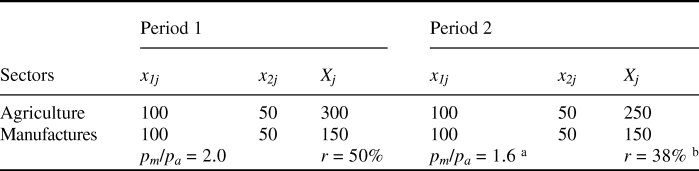
Suppose, then, as Torrens did, that two individuals, a farmer and a manufacturer, produce, respectively, corn and suits with the same expenses; that is, 100 quarters of corn and 50 suits, as in Table 3. If, in some initial period, the farmer raises 300 quarters of corn and the manufacturer fabricates 150 suits, the common profit rate is 50% and 2 quarters of corn are needed to buy 1 suit. When less productive lands are brought into cultivation in a subsequent period, however, the same farming costs will result in a reduced crop, for instance, of 250 quarters of corn, while the manufacturer’s productive process suffers no change. Under these new conditions, even though just 1.6 quarters of corn are now required to buy 1 suit, as predicted by Malthus’ Challenge, the profit rate does fall to 38%, as anticipated by Torrens (to 36.3% actually; see Table 3). The riddle was solved and the reverend was proven wrong! It should be kept in mind here, as a last observation, that the standards for formal proof among the classical economists of the time, if any, were scarcely rigorous and exhaustive. So, the “demonstrative” example conceived by Torrens against the criticism of Malthus, although not of a general character, ought to be seen as a true accomplishment.
Torrens’ System and Malthus’ Challenge
Source: EICT (1820, pp. 398–401). Observations: (1) correct values in Period 2: (a) p m/p a = 1.66 and (b) r= 36.3%. The discrepancies are due to Torrens’ rounding relative prices to 1.6; (2) x 1j = quarters of corn, x 2j = suits.
V. CONCLUDING REMARKS
Schumpeter once assessed Torrens’ contribution to classical economics as being not truly enlightening because the military man was careless in his writing and not a good technician (1963, p. 490). This appraisal, as shown, did not do full justice to Torrens’ prowess in economic analysis. His intellectual capacity has been recognized more recently by O’Brien, who extolled him as one of the best theorists of the classical period (2004, p. 5). Malthus’ Challenge was not easy to unravel, as Ricardo experienced himself. Torrens, for his part, despite being somewhat confusing when laying down and ordering his ideas, was able to develop through time, step by step, a consistent mechanism capable of tackling the major theoretical questions surrounding him, especially by embracing the following assumptions: (1) the necessity of applying the same price, with a common profit rate, not only to the final product but also to the inputs; (2) the recognition of the interdependence among all sectors of the economy; and (3) the simultaneous determination of relative prices and the profit rate.
Perhaps the most interesting facet of this whole story dwells in Torrens’ resolute will not to be stopped by the complexity involved in the solution of a nonlinear system. This was far from a trivial task, at least for the classical economists of the early nineteenth century. Indeed, his personal method of finding the competitive prices and the overall profit rate, notwithstanding its lack of sophistication, was inspired by his own economic theory, and, in the end, proved to be quite clever and remarkably efficient in providing the answers for which he had been searching. It was, certainly, simpler than the more elaborate techniques available to modern economists, but nevertheless, still a little ahead of its time, considering that none of Torrens’ interlocutors seemed to grasp what he was actually endeavoring to do.