Introduction
Cocaine is the second most used illegal drug in Europe after cannabis and it is estimated that 15.5 million Europeans have tried cocaine at least once in their life, amounting to a lifetime prevalence of 4.6%. Moreover, cocaine is the primary illegal drug responsible (European Monitoring Centre for Drugs and Drug Addiction, 2012) for drug-dependence treatment in North and South America (United Nations Office on Drugs and Crime, 2011). Cocaine is classified as a highly addictive drug (Nutt et al. Reference Nutt, King, Saulsbury and Blakemore2007) and it is estimated that 5–6% of users will meet dependence criteria within the first year of use and around 21% by the age of 45 years (Wagner & Anthony, Reference Wagner and Anthony2007). The health risks associated with cocaine abuse include severe medical complications, such as cardiovascular or respiratory incidences, and a number of psychiatric disorders (Buttner, Reference Buttner2012). Because drug addiction results in high economic and societal costs (Olesen et al. Reference Olesen, Gustavsson, Svensson, Wittchen and Jonsson2012), and effective pharmacological treatment options are currently lacking (O'Brien, Reference O'Brien2005), an adequate characterization of the core feature of cocaine addiction, maladaptive decision-making, is crucial for the development of effective prevention and treatment strategies.
The term ‘decision-making’ describes the ability to select an optimal course of action from multiple alternatives. Selecting an adequate choice entails constant updating and integrating of information about the value of present and potential actions as well as future states pertaining to current needs (Fellows, Reference Fellows2004; Lucantonio et al. Reference Lucantonio, Stalnaker, Shaham, Niv and Schoenbaum2012). Decision-making deficits in dependent cocaine users (DCU) are well captured by the paradox that they compulsively seek and take the drug despite encountering adverse legal, financial, health-related and social consequences (Koob, Reference Koob2009). In line with these everyday life difficulties, experimental studies in DCU have provided evidence that chronic cocaine use is linked to deficits in the processing of reward and punishment contingencies, as measured by the Iowa Gambling Task (IGT) (Bechara et al. Reference Bechara, Dolan and Hindes2002; Verdejo-Garcia et al. Reference Verdejo-Garcia, Benbrook, Funderburk, David, Cadet and Bolla2007a ; Kjome et al. Reference Kjome, Lane, Schmitz, Green, Ma, Prasla, Swann and Moeller2010), and a preference for smaller immediate over larger delayed rewards, henceforth referred to as Delay Discounting (DD) (Kirby & Petry, Reference Kirby and Petry2004; Heil et al. Reference Heil, Johnson, Higgins and Bickel2006; Bickel et al. Reference Bickel, Landes, Christensen, Jackson, Jones, Kurth-Nelson and Redish2011a ). Consequently, it has been suggested that DCU experience ‘myopia for the future’; they thus fail to incorporate ongoing feedback to guide future behaviours and instead make impulsive decisions that are based on immediate reward availability (Rachlin & Green, Reference Rachlin and Green1972; Ainslie, Reference Ainslie1975; Bechara et al. Reference Bechara, Dolan and Hindes2002). An elevated reward impulsivity as measured by DD has been associated with negative outcomes in the financial, academic and health domains (Mischel et al. Reference Mischel, Ayduk, Berman, Casey, Gotlib, Jonides, Kross, Teslovich, Wilson, Zayas and Shoda2011) and poor treatment response in DCU (Washio et al. Reference Washio, Higgins, Heil, McKerchar, Badger, Skelly and Dantona2011).
Because we live in complex, continuously changing social environments, decision-making often takes place in the form of social interaction and is strongly influenced by self and others regarding preferences and social cognitive abilities (e.g. emotion recognition, theory of mind, empathy) (Couture et al. Reference Couture, Penn and Roberts2006; Fehr & Camerer, Reference Fehr and Camerer2007). Social decision-making (SDM) encompasses multiple facets including trust, cooperation, fairness, altruism, norm-abiding decision-making, punishment, social learning, and competitive social interactions (Rilling & Sanfey, Reference Rilling and Sanfey2011). To date SDM has not been investigated in an experimental setting in cocaine users; however, a growing number of findings imply that cocaine users may exhibit deficits during social interactions. For instance, decision-making deficits in crack cocaine-dependent individuals were associated with self-reported social dysfunction (Cunha et al. Reference Cunha, Bechara, de Andrade and Nicastri2011). Moreover, cocaine users feature a 22-fold increased risk for an antisocial personality disorder (ASPD) and clinical reports have given account of egocentrism and blunted emotion in cocaine-dependent individuals (Rounsaville, Reference Rounsaville2004). Notably, adequate socio-cognitive abilities are known to have a strong impact on the development, course and outcome of psychiatric diseases (Couture et al. Reference Couture, Penn and Roberts2006) and may also affect the course of dependence and treatment success in stimulant abusers (Homer et al. Reference Homer, Solomon, Moeller, Mascia, DeRaleau and Halkitis2008). Thus, understanding how cocaine addiction may be associated with maladaptive social interaction is fundamentally important. Recent advances in game-theoretic approaches have provided the unique opportunity to quantify SDM in psychiatric disorders (Kishida et al. Reference Kishida, King-Casas and Montague2010). Therefore, we relied on economic decision-making tasks to investigate social preferences such as fairness and efficiency preferences in cocaine users in comparison with controls. In these tasks, participants are considered fair if they distribute money evenly between themselves and their interaction partner, whereas they are deemed unfair if they allocate money in a more self-serving manner as reflected by a higher monetary payoff for themselves and a smaller payoff for their interaction partner. Furthermore, the design also allows an assessment of individuals' efficiency preferences, i.e. any subject motivated by efficiency concerns values the total monetary payoff for the group positively.
Given that the transition to dependence is not dichotomous but rather gradual, advancing from habitual to compulsive use (Haber, Reference Haber2008), recreational cocaine use can be thought of as an intermediate step in addiction. Recreational cocaine users (RCU) are not (yet) addicted but administer the drug regularly for personal pleasure. A growing number of studies suggest that the recreational use of cocaine or prescription stimulants is associated with subtle cognitive impairments in attention, memory and components of executive functions (Rahman & Clarke, Reference Rahman and Clarke2005; Colzato et al. Reference Colzato, van den Wildenberg and Hommel2007, Reference Colzato, van den Wildenberg and Hommel2009b ; Reske et al. Reference Reske, Eidt, Delis and Paulus2010, Reference Reske, Delis and Paulus2011; Soar et al. Reference Soar, Mason, Potton and Dawkins2012; Vonmoos et al. Reference Vonmoos, Hulka, Preller, Jenni, Baumgartner, Stohler, Bolla and Quednow2013) that are similar but less pronounced compared with DCU (Jovanovski et al. Reference Jovanovski, Erb and Zakzanis2005; Vonmoos et al. Reference Vonmoos, Hulka, Preller, Jenni, Baumgartner, Stohler, Bolla and Quednow2013). Additionally, we recently reported changes in early information processing and blue-yellow colour vision deficits in RCU, suggesting putative alterations of catecholamine neurotransmission at an early stage of cocaine abuse (Hulka et al. Reference Hulka, Wagner, Preller, Jenni and Quednow2013; Preller et al. Reference Preller, Ingold, Hulka, Vonmoos, Jenni, Baumgartner, Vollenweider and Quednow2013). Moreover, young adults with recreational stimulant use showed more pronounced risk-taking behaviour (Leland & Paulus, Reference Leland and Paulus2005) and a subgroup of cocaine-preferring occasional stimulant users exhibited altered neural activity during a reinforcement-based decision-making task (Stewart et al. Reference Stewart, Flagan, May, Reske, Simmons and Paulus2013). However, decision-making has not systematically been investigated in relatively pure RCU.
In this cross-sectional study, we investigate SDM and non-SDM (NSDM) behaviour of RCU and DCU in comparison with an age-, sex- and verbal intelligence-matched healthy control group. We report on effects of cocaine abuse on measures of fairness and efficiency preferences and extend on previous reports in the domain of risk taking and discounting of delayed rewards by incorporating a group of RCU. Based on prior studies demonstrating more subtle cognitive and decision-making deficits in recreational stimulant users compared with dependent users (Colzato et al. Reference Colzato, Huizinga and Hommel2009a ; Reske et al. Reference Reske, Eidt, Delis and Paulus2010, Reference Reske, Delis and Paulus2011; Soar et al. Reference Soar, Mason, Potton and Dawkins2012; Stewart et al. Reference Stewart, Flagan, May, Reske, Simmons and Paulus2013; Vonmoos et al. Reference Vonmoos, Hulka, Preller, Jenni, Baumgartner, Stohler, Bolla and Quednow2013) and a very clear dose-dependent association of cognitive dysfunctions and cumulative cocaine use (Vonmoos et al. Reference Vonmoos, Hulka, Preller, Jenni, Baumgartner, Stohler, Bolla and Quednow2013), we hypothesize that RCU exhibit similar but less pronounced behavioural changes compared with DCU.
Method
Participants
The present sample represents the cross-sectional part of the longitudinal Zurich Cocaine Cognition Study (ZuCo2St) and consists of 68 RCU, 30 DCU and 68 healthy control subjects (total of 166 subjects). Details regarding recruitment, selection process and study procedure are provided in the online Supplementary text. Inclusion criteria for the two cocaine user groups were cocaine as the primary drug (> 2-fold higher cocaine concentrations in the hair samples than any other drug), cocaine use of > 0.5 g per month (over the past 6 months), and an abstinence duration of < 6 months. Cocaine dependence was diagnosed according to the Diagnostic and Statistical Manual of Mental Disorders, fourth edition (DSM-IV) criteria, with only DCU meeting these criteria. All participants had to be aged between 18 and 60 years and proficient in German. Exclusion criteria were use of opioids, excessive MDMA intake (>50 pills lifetime in RCU, > 200 pills in DCU, > 5 pills in controls), excessive cannabis use (>5 g per week or daily use), intake of prescription drugs affecting the CNS, presence of a current or previous Axis I DSM-IV psychiatric disorder [other than cocaine and alcohol abuse/dependence, attention deficit hyperactivity disorder (ADHD), and a former affective disorder], neurological disorders or head injury, and a family history of a severe DSM-IV psychiatric disorder such as schizophrenia, bipolar disorder or obsessive–compulsive disorder. Participants were instructed to abstain from illegal drugs for a minimum of 3 days and from alcohol for at least 24 h prior to study completion.
Polytoxic drug abuse is one of the major confounding factors in addiction research and the reliability of self-reported data has been questioned (Hser, Reference Hser1997). Therefore, urine samples were collected on the day of testing to control for recent drug use. To objectively characterize drug use over the last 6 months, hair samples were collected on the day of testing and analysed with liquid chromatography–mass spectrometry (see online Supplementary text).
Participants received financial compensation of 170–225 Swiss Francs (CHF), depending on their decisions in some of the tasks. The study was approved by the Cantonal Ethics Committee of Zurich and all participants provided written informed consent.
Clinical interviews and questionnaires
The Structured Clinical Interview for DSM-IV Disorders (SCID-I) was carried out by trained psychologists and all participants completed the SCID-II personality questionnaire to evaluate the severity of ASPD symptoms (Wittchen et al. Reference Wittchen, Wunderlich, Gruschwitz and Zaudig1997a ,Reference Wittchen, Wunderlich, Gruschwitz and Zaudig b ). To estimate pre-morbid verbal intelligence the Mehrfachwahl–Wortschatz-Intelligenztest (MWT-B; multiple choice vocabulary intelligence test) was applied (Lehrl, Reference Lehrl1999). Drug use was assessed by means of the Interview for Psychotropic Drug Consumption, which has been described in detail elsewhere (Quednow et al. Reference Quednow, Kuhn, Hoenig, Maier and Wagner2004). The brief version of the Cocaine Craving Questionnaire was used to assess current cocaine craving (Tiffany et al. Reference Tiffany, Singleton, Haertzen and Henningfield1993; Sussner et al. Reference Sussner, Smelson, Rodrigues, Kline, Losonczy and Ziedonis2006). As psychiatric co-morbidities such as ADHD and depression are frequently present among addicted individuals (Rounsaville, Reference Rounsaville2004; Ivanov et al. Reference Ivanov, Schulz, London and Newcorn2008; Perez de Los Cobos et al. Reference Perez de Los Cobos, Sinol, Puerta, Cantillano, Lopez Zurita and Trujols2011), we used the Attention Deficit Hyperactivity Disorder Self-Rating Scale (ADHD-SR; Rosler et al. Reference Rosler, Retz, Retz-Junginger, Thome, Supprian, Nissen, Stieglitz, Blocher, Hengesch and Trott2004) and the Beck Depression Inventory (BDI; Beck et al. Reference Beck, Ward, Mendelson, Mock and Erbaugh1961). In the ADHD-SR, clinically relevant ADHD symptoms were diagnosed if at least six of items 1–9 (inattention) were affirmed, at least three of the items 10–14 (hyperactivity), and at least one of the items 15–18 (function).
Behavioural tasks
SDM
Participants' social preferences were assessed in a Distribution Game followed by a Dictator Game (Charness & Rabin, Reference Charness and Rabin2002; Engelmann & Strobel, Reference Engelmann and Strobel2004) implemented in z-Tree (Fischbacher, Reference Fischbacher2007). Participants were informed that each of the games only had one trial and that each game was played with a different interaction partner. The Distribution Game involves two players, player A and B. Player A chooses one of 10 possible point distributions ranging from a fair distribution where both players would receive 25 points each to the most opportunistic distribution where player A would receive 40 points and player B one point. Player B is a passive recipient and is merely informed about which distribution player A chose and how many points both players receive. In addition, the Distribution Game also allows classification of subjects according to their efficiency preferences. A subject that is motivated by efficiency concerns values the total monetary payoff for the dyad positively. Participants were classified as ‘fair’ when they chose the first distribution, as ‘unfair and efficient’ when they chose distributions two to five (yielding a higher total payoff), and as ‘unfair and inefficient’ when they selected distributions six to 10 (resulting in lower overall payoff for the dyad; online Supplementary Fig. S1). The Dictator Game always followed the Distribution Game, and the participants were told that they would play with another player B. Player A receives an endowment of 50 points and can give any amount from 0 to 50 points to player B. All subjects received a payment according to the points earned in the tasks. In both tasks, each point earned was worth CHF 0.25. At the end of the experiment subjects received payment in cash or via online banking. In order to guarantee anonymity of the cocaine users, interaction partners were simulated by the computer (details in the online Supplementary material). After study completion participants were asked whether they had doubts about the realness of their interaction partners by means of a five-point Likert scale (1 = not at all to 5 = very much).
NSDM
We tested participants' risk-taking preferences and planning abilities using the IGT, which has been described in detail before (Bechara et al. Reference Bechara, Dolan and Hindes2002; Quednow et al. Reference Quednow, Kuhn, Hoppe, Westheide, Maier, Daum and Wagner2007). Intertemporal choice was measured using the DD according to Kirby et al. (Reference Kirby, Petry and Bickel1999). Further details of the tasks are given in the online Supplementary material.
Statistical analysis
Statistical analyses were performed with PASW 19.0 (SPSS Inc., USA). Demographic data and drug use patterns of the three groups were analysed by means of analysis of variance (ANOVA) with Sidak-corrected post-hoc analyses and by means of frequency analyses (Pearson's χ 2 test). We conducted correlation analyses (Pearson's product-moment) to examine if performance in SDM and NSDM tasks was related. Moreover, we conducted multiple regression analyses to examine the association of pre-selected predictors including age, sex, years of education, and two dummy coded group contrasts (controls v. RCU, controls v. DCU) with SDM and NSDM. Further multiple regression analyses were conducted to investigate how drug use patterns are related to performance in the SDM and NSDM tasks. Finally, the potential effects of psychiatric symptoms, cocaine craving and recent drug use (positive urine toxicology) on SDM and NSDM were explored by means of multiple regression analyses. As the assumptions of homoscedasticity and parametric distribution were not met by some variables, the drug use variables grams per week and lifetime use in grams were log-transformed (log10) and the constant 1 was added because the data contained 0 values. To reduce data quantity, to obtain a measure of how strongly cocaine users deviate from controls' SDM preferences, and because of a significant intercorrelation of the Distribution and Dictator Games (r = 0.61, p < 0.001) we computed a composite SDM score. The composite score was derived by averaging z-transformed measures of the Distribution and Dictator Games (payoffs B) according to means and standard deviations of the control group.
Results
Demographic variables
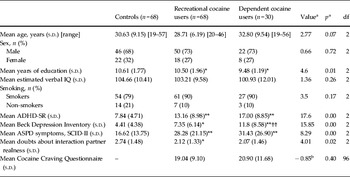
Groups did not differ regarding socio-economic status (online Supplementary Table S1) and demographic variables except for years of education (Table 1). RCU and DCU did not differ from controls regarding age, but DCU were by trend slightly older than RCU. Moreover, there were marginally, but not significantly, more males in the cocaine user groups compared with controls and a previous study has reported sex differences in IGT performance (Bolla et al. Reference Bolla, Eldreth, Matochik and Cadet2004). Therefore, we introduced years of education, age and sex as covariates in all statistical models. As RCU and DCU both reported more symptoms of ADHD (14 RCU and eight DCU exhibited clinically relevant ADHD symptoms) and depression than controls (Table 1), additional analyses were conducted to examine a potential association of these factors with decision-making.
Demographic data

df, Degrees of freedom; s.d., standard deviation; IQ, intelligence quotient; ADHD-SR, Attention Deficit Hyperactivity Disorder-Self-Rating; ASPD, Antisocial Personality Disorder; SCID-II, Structured Clinical Interview for DSM-IV Axis II.
a Analysis of variance (all groups) or χ 2 test (all groups) for frequency data.
b t test (only cocaine user groups).
Mean value was significantly different from that of the control group: * p < 0.05, ** p < 0.01 (post-hoc test, Sidak).
†† Mean value was significantly different from that of the recreational cocaine user group (p < 0.01, post-hoc test, Sidak).
Self-reported and objective drug use
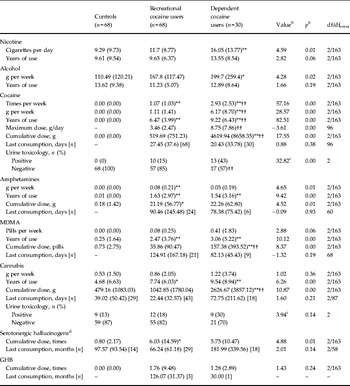
Self-reported drug use showed that RCU used cocaine on a regular basis, with a mean weekly consumption of about 1 g cocaine. Several participants tested positive for cocaine and cannabis in the urine toxicology analyses but we decided not to exclude them in order to investigate potential effects of recent drug use (Table 2).
Self-reported drug use a

Data are given as mean (standard deviation) unless otherwise indicated.
df, Degrees of freedom; MDMA, 3,4-methylenedioxy-N-methylamphetamine (methylenedioxymethamphetamine); GHB, γ-hydroxybutyric acid; LSD, lysergic acid diethylamide; DMT, N,N-dimethyltryptamine; 2-CB, 4-bromo-2,5-dimethoxyphenethylamine.
a Consumption per day or week captures the last 6 months; duration of use and cumulative dose are averaged within the total group. Last consumption is averaged only for subjects who used the drug in the last 6 months. In this case, sample size is shown.
b Analysis of variance or χ 2 test (all groups).
c t test (only cocaine user groups).
d Hallucinogens = psilocybin, LSD, DMT, 3,4,5-trimethoxyphenethylamine (mescaline), 2-CB.
Mean value was significantly different from that of the control group: * p < 0.05, ** p < 0.01 (post-hoc test, Sidak).
†† Value was significantly different from that of the recreational cocaine user group (p < 0.01, post-hoc test, Sidak).
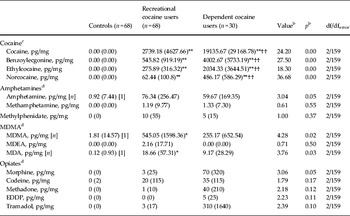
Results from the hair toxicology analyses revealed that self-reported cocaine use (g/week, cumulative dose, duration of use) corresponded with concentrations of cocaine and its metabolites in the hair samples (r = 0.29−0.41, all p < 0.01). Importantly, hair toxicology provided evidence that the RCU and DCU enrolled in the present study are unique with regard to three crucial aspects (Table 3). (1) For both drug user groups, cocaine had been the main drug of use over the past 6 months and concentrations of cocaine and its metabolites were seven-fold higher in DCU than in RCU. (2) RCU and DCU did not differ significantly with regard to concentrations of amphetamines, methylphenidate, MDMA and opiates. (3) For both RCU and DCU, concentrations of amphetamines and opiates were below the recommended cut-off value of 200 pg/mg (Cooper et al. Reference Cooper, Kronstrand and Kintz2012), indicating no regular use of these drugs over the past 6 months. Although the MDMA concentrations for RCU and DCU were above the cut-off value for MDMA, it is noteworthy that these concentrations are rather low and substantially lower than cocaine concentrations. Therefore, the present cocaine user samples had little poly-toxic drug use and did not differ from one another with regard to drugs other than cocaine.
Hair toxicological analyses a

Data are given as mean (standard deviation).
df, Degrees of freedom; MDMA, 3,4-methylenedioxy-N-methylamphetamine (methylenedioxyamphetamine); MDEA, methylenedioxyethylamphetamine; MDA, 3,4-methylenedioxyamphetamine; EDDP, primary methadone metabolite.
a The hair analysis was performed on two hair samples (each 3 cm in length) per participant capturing drug use over the last 6 months. Concentrations were averaged over the two samples. If the hair sample was not long enough, only one sample was analysed (3 cm, 3 months).
b Analysis of variance (all groups).
c Cut-off value for cocaine = 500 pg/mg.
d Cut-off value for amphetamines, MDMA and opiates = 200 pg/mg.
Mean value was significantly different from that of the control group: * p < 0.05, ** p < 0.01 (post-hoc test, Sidak).
†† Mean value was significantly different from that of the recreational cocaine user group (p < 0.01, post-hoc test, Sidak).
Task correlations
Correlations revealed that SDM and NSDM tasks indeed measured different aspects of decision-making as neither the Distribution Game nor the Dictator Game was associated with the IGT (r = −0.01 and −0.02) and DD (r = −0.05 and −0.11). The Distribution Game and the Dictator Game correlated significantly (r = 0.61, p < 0.001), whereas the IGT and the DD did not correlate (r = 0.01).
SDM
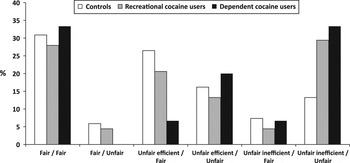
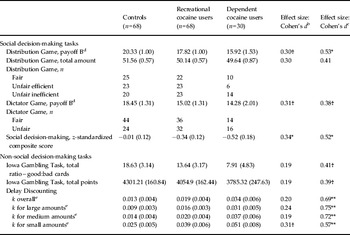
In the Distribution Game, DCU (β = −0.20, t = −2.40, p < 0.05) and by trend also RCU (β = −0.15, t = −1.78, p = 0.08) chose point distributions that were more profitable for themselves and yielded lower payoffs for participant B (Table 4 and online Supplementary Table S2). Overall, participants from all three groups chose the fair distribution most often (Fig. 1, Table 1). However, DCU chose the unfair inefficient distributions more frequently compared with controls (χ 2 1 = 10.74, p < 0.01) and RCU (χ 2 1 = 8.3, p < 0.01) (online Supplementary Figs S1 and S2). Analyses regarding the Dictator Game showed trends that both RCU (β = −0.16, t = −1.85, p = 0.07) and DCU (β = −0.15, t = −1.73, p = 0.09) gave fewer points to their interaction partners compared with controls (Table 4 and online Supplementary Table S2). Analysis of the SDM composite score revealed that both RCU (β = −0.17, t = −2.02, p < 0.05) and DCU (β = −0.20, t = −2.35, p < 0.05) acted in a more self-serving manner than controls (Table 4 and online Supplementary Table S2). All groups reported to have had only a few doubts about the realness of the interaction partners. Interestingly, RCU (p < 0.05) and by trend DCU (p < 0.1) reported even fewer doubts than controls (Table 1). Introducing the factor ‘doubts about the realness of the interaction’ as an additional predictor into the analysis neither changed the results for the Distribution Game (controls v. RCU: β = −0.16, t = −1.85, p = 0.07; controls v. DCU: β = −0.21, t = −2.34, p < 0.05) nor for the Dictator Game (controls v. RCU: β = −0.18, t = −2.04, p < 0.05; controls v. DCU: β = −0.16, t = −1.77, p = 0.08) and was not a significant predictor variable for either of the tasks (p > 0.6). Surprisingly, SCID-II ASPD symptoms were not correlated with SDM parameters. Importantly, introduction of ASPD symptoms as a further predictor in the regression analyses did not change the main results, indicating that SDM alterations in cocaine users could not be explained by the presence of increased ASPD symptoms in this group.
Frequency (%) of how often the three groups chose the ‘fair’, ‘unfair efficient’ and ‘unfair inefficient’ distributions in the Distribution Game and whether they distributed the money in a fair or unfair manner in the Dictator Game. Almost all of the participants, independent of which group they belong to, remained ‘fair’ in the Dictator Game if they already had been ‘fair’ in the Distribution Game. In contrast, controls who chose one of the distributions classified as ‘unfair efficient’ in the Distribution Game often chose a fair point allocation in the Dictator Game, while dependent cocaine users (DCU) who also chose one of the distributions classified as ‘unfair efficient’ in the Distribution Game were more likely to allocate points in the Dictator Game in a selfish manner. Moreover, the number of subjects choosing one of the ‘unfair inefficient’ distributions in the Distribution Game was substantially higher among recreational cocaine users (RCU) and DCU than among controls, and these RCU and DCU almost exclusively allocated the money in an unfair manner in the Dictator Game.

Behavioural task parameters a

Data are given as mean (standard error) unless otherwise indicated.
a All parameters are corrected for age, sex and years of education.
b Controls versus recreational cocaine users.
c Controls versus dependent cocaine users.
d Used for the social decision-making composite score.
e k = free parameter that determines the discounting rate.
Significant post-hoc test: * p < 0.05, **p < 0.01 (Sidak).
† Marginally significant post-hoc test (p < 0.1, Sidak).
Because in the Distribution Game efficiency preferences cannot be assessed independently from fairness preferences, adding a Dictator Game allowed us to isolate efficiency preferences in the Distribution Game. Thus, because efficiency preferences do not matter in the Dictator Game, it serves both as a clean measure for fairness preferences but also as a control for the fairness domain of the Distribution Game. We found that almost all participants remained ‘fair’ in the Dictator Game if they had already been ‘fair’ in the Distribution Game. In contrast, controls who chose one of the distributions classified as ‘unfair efficient’ in the Distribution Game often chose a fair point allocation in the Dictator Game, while DCU who chose unfair efficient distributions in the Distribution Game were more likely to allocate points in the Dictator Game in a self-serving manner (χ 2 1 = 5.03, p < 0.05). Furthermore, the number of subjects choosing one of the unfair inefficient distributions in the Distribution Game was substantially higher among RCU and DCU than among controls and both groups almost exclusively allocated points in an unfair manner in the Dictator Game (χ 2 1 = 4.17–5.03, p < 0.05).
NSDM
A repeated-measures analysis of covariance revealed that in the IGT (Table 4 and online Supplementary Table S2), despite the fact that, overall, both RCU (net score: d = 0.18) and particularly DCU (d = 0.49) chose fewer favourable cards than controls, no statistically significant group effect emerged (F 2,159 = 1.81, p = 0.17). As expected, the factor quartile was significant (F 3,477 = 2.83, p < 0.05), reflecting a learning curve (online Supplementary Fig. S4A).
In the DD (Table 4 and online Supplementary Table S2), groups significantly differed in their preferences for smaller immediate and larger delayed monetary rewards (F 2,163 = 6.52, p < 0.01; online Supplementary Fig. S3B). Sidak-corrected post-hoc comparisons showed that DCU were more likely to choose immediate rewards compared with controls (p < 0.01). As expected, discounting of delayed rewards varied with reward magnitude (F 2,326 = 34.79, p < 0.001). Correlation analyses showed that k for medium amounts was strongly related to the cocaine metabolite ethylcocaine determined in the hair toxicology (r = 0.37, p < 0.0001), indicating that especially subjects who consumed cocaine in combination with alcohol showed increased levels of impulsivity with regard to reward (Pennings et al. Reference Pennings, Leccese and Wolff2002).
Multiple regression and correlation analyses of substance use
Associations between drug use patterns and SDM and NSDM tasks were assessed by multiple regression models, with cumulative drug use, weekly consumption and duration of use as predictor variables. Only cocaine users were included for these analyses (n = 98). All three models had the common predictors of cocaine craving, positive cocaine urine toxicology, and age of cocaine use onset to control for recent drug effects, craving urges, and potentially more severe cocaine-related developmental effects due to early age of cocaine use onset. Only models explaining significant amounts of variance are reported in this section (see online Supplementary Tables S3 and S4).
None of the drug variables in the three models predicted behaviour in the Distribution and Dictator Games (online Supplementary Table S3) and the IGT (online Supplementary Table S4). In contrast, cumulative cocaine and cannabis use as well as years of cocaine and cannabis use were significant predictors for performance in the DD, reflecting that more intense and longer cocaine use was associated with stronger discounting of delayed rewards, whereas a higher and longer cannabis consumption was associated with lower discounting of delayed rewards (online Supplementary Table S4). Weekly consumption of cocaine, MDMA, cannabis, alcohol, and nicotine neither predicted performance in SDM nor NSDM tasks. Moreover, age of cocaine use onset was not a significant predictor in any of the SDM and NSDM tasks.
We conducted additional correlation analyses to examine potential associations between performance in SDM and NSDM tasks and cannabis use in controls (n = 68). However, in controls none of the cannabis use parameters correlated with any of the tasks (p > 0.21).
Potential co-factors
Additional analyses were conducted to investigate potential effects of psychiatric symptoms, cocaine craving, and recent drug use on performance in SDM and NSDM tasks (online Supplementary text, Supplementary Table S5, Supplementary Fig. S4). In the SDM tasks, cocaine users with and without clinically relevant ADHD and depression symptoms exhibited more self-serving money allocation behaviour. Moreover, mainly cocaine users with high cocaine craving scores allocated money in a more self-serving manner compared with controls. Recent cocaine and cannabis intake (positive urine toxicology) was not significantly associated with performance in SDM tasks, as both cocaine users with positive and negative cocaine and cannabis urine toxicology exhibited more self-serving behaviour. None of the IGT regression models explained a significant amount of variance. Lastly, cocaine users with elevated BDI symptoms discounted delayed reward significantly stronger than controls. All other DD regression models were not significant.
Discussion
In this study, we report on differences in individual and social decision-making in RCU and DCU in comparison with a control group. Careful psychiatric diagnostic procedures ensured that cocaine users had few psychiatric co-morbidities and detailed hair toxicology analyses showed relatively sparse poly-substance use. Our study yielded the following major findings. (I) during social interaction, both RCU and DCU distributed money in a more self-serving manner than controls. More specifically, both groups took more money for themselves in the Distribution Game and gave less money to the second interaction partner in the Dictator Game. (II) DCU exhibited significantly elevated reward-related impulsivity in the DD (d = 0.69) and chose fewer advantageous cards in the IGT (d = 0.41), although the latter was not statistically significant. Higher cumulative doses of cocaine and longer duration of use were associated with a lower net score in the IGT and stronger discounting of delayed rewards in the DD. Taken together, our results indicate that both RCU and DCU show more self-serving behaviour in social interaction tasks, whereas only DCU show deficits in the processing of reward and punishment contingencies and exhibit increased reward-related impulsivity.
To our knowledge, no studies have assessed human social interaction using an experimental economic approach in cocaine addiction research so far. We observed that control subjects who chose one of the distributions classified as ‘unfair efficient’ in the Distribution Game often chose a fair point allocation in the Dictator Game, while DCU who also chose one of the distributions classified as ‘unfair efficient’ in the Distribution Game were more likely to allocate points in the Dictator Game in a selfish manner. Thus, it appears that the proportion of controls who seem to place a higher value in efficient distributions do this at the cost of fairness towards the other player. However, if efficiency preferences do not matter, as in the Dictator Game, the same subjects still care for fairness. This is not observed in those DCU who chose efficient distributions in the Distribution Game, as they seem to care only about efficiency and less about fairness. Furthermore, among RCU and DCU the number of subjects choosing one of the unfair inefficient distributions in the Distribution Game was substantially higher and, among these, almost everyone allocated points in an unfair manner in the Dictator Game. Consequently, these findings suggest that cocaine users are less concerned about fairness in dyadic interactions, compared with controls. Although the self-serving behaviour was more pronounced in DCU than RCU when compared with controls, the absence of a significant correlation between amount of cocaine use and self-serving SDM could signify that cocaine users may have a predisposition towards more self-serving behaviour. Additionally, also cocaine craving enhances the propensity to act selfishly, indicating that SDM preferences in cocaine users also have a state component.
Because of the cross-sectional design of our study, it is impossible to substantiate whether the differences in SDM among cocaine users and controls are due to a certain predisposition, drug-induced cerebral alterations, or an interaction thereof. Nevertheless, the fact that both cocaine user groups exhibited more self-serving SDM than controls and the lacking relationship between cocaine-use patterns and SDM behaviour putatively support a stronger implication of pre-existent factors. Consistent with this notion, a prior study showed that chronic cocaine use is associated with selective deficits with regard to higher-level emotional reasoning such as understanding, managing and regulating emotions (Fox et al. Reference Fox, Bergquist, Casey, Hong and Sinha2011). Therefore, cocaine users might have a vulnerability that hinders them to adopt another person's perspective and to feel empathy.
Regarding performance in the IGT, the results of the present study were largely consistent with earlier data (Bechara et al. Reference Bechara, Dolan and Hindes2002; Verdejo-Garcia et al. Reference Verdejo-Garcia, Benbrook, Funderburk, David, Cadet and Bolla2007a ; Kjome et al. Reference Kjome, Lane, Schmitz, Green, Ma, Prasla, Swann and Moeller2010) in that they showed that particularly DCU chose fewer advantageous cards in the IGT than controls. However, although a medium effect size was present, the difference was not statistically significant, which is consistent with results from a prior study (Bolla et al. Reference Bolla, Eldreth, London, Kiehl, Mouratidis, Contoreggi, Matochik, Kurian, Cadet, Kimes, Funderburk and Ernst2003) but not others (Bechara et al. Reference Bechara, Dolan and Hindes2002; Verdejo-Garcia et al. Reference Verdejo-Garcia, Benbrook, Funderburk, David, Cadet and Bolla2007a ; Kjome et al. Reference Kjome, Lane, Schmitz, Green, Ma, Prasla, Swann and Moeller2010). The lack of statistical significance in our study might be explained by two reasons. First, we applied stringent criteria to exclude subjects with severe psychiatric co-morbidities and toxicological hair analyses ensured that participants had little co-use of other illegal drugs. Therefore, even the DCU of the present study might have a higher level of general functioning compared with those of other study samples (Bechara et al. Reference Bechara, Dolan and Hindes2002; Verdejo-Garcia et al. Reference Verdejo-Garcia, Benbrook, Funderburk, David, Cadet and Bolla2007a ,Reference Verdejo-Garcia, Perales and Perez-Garcia b ; Kjome et al. Reference Kjome, Lane, Schmitz, Green, Ma, Prasla, Swann and Moeller2010). Second, the IGT gains were paid, which is in line with observations of a previous study reporting impaired IGT performance in cocaine users only if monetary gains were hypothetical but not when the money they won was actually paid (Vadhan et al. Reference Vadhan, Hart, Haney, van Gorp and Foltin2009).
In the present study, we replicate previous results on intertemporal choice in DCU (Kirby & Petry, Reference Kirby and Petry2004; Heil et al. Reference Heil, Johnson, Higgins and Bickel2006; Bickel et al. Reference Bickel, Landes, Christensen, Jackson, Jones, Kurth-Nelson and Redish2011a ). Importantly, although not statistically significant, also RCU exhibited slightly steeper discounting rates than controls with small effect sizes across reward magnitudes (d = 0.19−0.31; Table 4). The stronger effect found for DCU and the correlations between higher cumulative cocaine doses and longer duration of use with stronger discounting of delayed rewards might suggest that reward-related impulsivity is increased by the use of cocaine. This interpretation is concordant with animal studies showing that chronic administration of cocaine can cause sustained elevations in impulsive choice in rats and monkeys (Olausson et al. Reference Olausson, Jentsch, Krueger, Tronson, Nairn and Taylor2007; Mendez et al. Reference Mendez, Simon, Hart, Mitchell, Nation, Wellman and Setlow2010). Nevertheless, DD has also been shown to have trait-like stability (Casey et al. Reference Casey, Somerville, Gotlib, Ayduk, Franklin, Askren, Jonides, Berman, Wilson, Teslovich, Glover, Zayas, Mischel and Shoda2011; Mischel et al. Reference Mischel, Ayduk, Berman, Casey, Gotlib, Jonides, Kross, Teslovich, Wilson, Zayas and Shoda2011; Odum, Reference Odum2011) and a prospective study revealed that the ability to delay gratification in childhood predicted physical health, substance dependence, finances and criminal offences in adulthood (Moffitt et al. Reference Moffitt, Arseneault, Belsky, Dickson, Hancox, Harrington, Houts, Poulton, Roberts, Ross, Sears, Thomson and Caspi2011). Thus, it is probable that predisposed tendencies of impulsive decision-making may render individuals more prone to initiate drug use, and, subsequently, neuroadaptations induced by repeated cocaine use may amplify pre-existing reward impulsivity resulting in the well-described compulsive drug-seeking behaviour – the inability to forego rewarding short-term effects of the drug in favour of the long-term benefits associated with abstinence (Bolla et al. Reference Bolla, Cadet and London1998). A surprising finding in our study was that greater cumulative cannabis use and longer duration of use were associated with less pronounced discounting of delayed rewards in cocaine users. To our knowledge, the only study where the relationship between cannabis use and DD was systematically investigated showed no significant differences in the DD preferences between former dependent marijuana users and controls and only a trend for stronger DD in current dependent marijuana users (Johnson et al. Reference Johnson, Bickel, Baker, Moore, Badger and Budney2010). Combined, these results may suggest that the association between cannabis use and DD is weaker than for cocaine and other drugs. The cocaine users in our sample who strongly co-use cannabis exhibited lower reward impulsivity as compared with users with less cannabis co-use (see online Supplementary Fig. S4). Interestingly, cannabis use was not correlated with DD in controls.
Because psychiatric co-morbidities such as ADHD are frequently present among addicted individuals (Ivanov et al. Reference Ivanov, Schulz, London and Newcorn2008; Perez de Los Cobos et al. Reference Perez de Los Cobos, Sinol, Puerta, Cantillano, Lopez Zurita and Trujols2011), we investigated how ADHD symptoms influence decision-making behaviour. However, ADHD symptoms were not a significant confounding factor regarding our results. Interestingly, cocaine users with high but not those with low levels of cocaine craving acted in a more self-serving manner compared with controls in the SDM while craving intensity was not related to performance in the NSDM tasks. One could speculate that strong craving urges may have fostered thoughts about obtaining cocaine as soon as possible, which could have led cocaine users to maximize their monetary profit. Furthermore, also recent drug use did not seem to influence behaviour in SDM and NSDM tasks. In line with the finding of altered intertemporal choice in depressive patients (Takahashi et al. Reference Takahashi, Oono, Inoue, Boku, Kako, Kitaichi, Kusumi, Masui, Nakagawa, Suzuki, Tanaka, Koyama and Radford2008), particularly cocaine users with slightly elevated depression scores exhibited stronger DD than controls with low depression scores. However, it should be noted that specifically DCU reported more depressive symptoms so that our DD results are not simply explained by depression. Finally, symptoms of depression did not seem to impact SDM.
The current findings should be interpreted bearing some limitations in mind. Given the cross-sectional design it is not possible to answer conclusively whether deficits in SDM and NSDM precede cocaine use or are due to cocaine-induced neuroadaptations. Therefore, data from longitudinal and prospective investigations are desirable to decompose further the effects of predisposition and sequelae of cocaine use. In the current study, we merely obtained behavioural results. Combining functional imaging with behavioural measures could be of great importance for future studies. Finally, in order to guarantee anonymity of the cocaine users, we had to use a cover story in the social interaction paradigms. However, we assessed whether participants had doubts about a real interaction and introduced this measure as a covariate into the statistical analyses, which did not change the results.
Identifying vulnerability markers and adverse drug-induced effects with regard to impaired decision-making in cocaine users is critical and may benefit the development of successful prevention and treatment strategies enhancing quality of life. For example, it was recently demonstrated that working memory training decreased the propensity to discount delayed rewards in stimulant addicts (Bickel et al. Reference Bickel, Yi, Landes, Hill and Baxter2011b ). Moreover, a large body of research has provided evidence that remediation efforts targeting neurocognitive and social cognitive skills in schizophrenia patients improve real-world psychosocial and disease outcomes (Lindenmayer et al. Reference Lindenmayer, McGurk, Khan, Kaushik, Thanju, Hoffman, Valdez, Wance and Herrmann2013; Medalia & Saperstein, Reference Medalia and Saperstein2013; Mueser et al. Reference Mueser, Deavers, Penn and Cassisi2013). Likewise, knowledge from tasks measuring SDM could be integrated in therapeutic interventions for cocaine-addicted individuals, for example in the form of social skills trainings.
Conclusion
In sum, these findings are the first to show that RCU and DCU both exhibit more self-serving behaviour regarding money allocation in social interaction paradigms. Interestingly, mainly the DCU performed worse in the IGT and showed elevated reward-related impulsivity compared with controls. The absence of significant correlations between SDM preferences and cocaine use implies that changes in SDM may have a trait component. In contrast, the intermediate performance of RCU compared with controls and DCU in NSDM tasks and the association of higher cumulative cocaine doses and longer duration of cocaine use with a lower net gain in the IGT and stronger DD suggest that NSDM may partially be influenced by cocaine use. Our results might have implications for the conceptualization of treatment approaches that specifically target social interaction and decision-making deficits in cocaine users.
Supplementary material
For supplementary material accompanying this paper visit http://dx.doi.org/10.1017/S0033291713001839.
Acknowledgements
The study was supported by grants from the Swiss National Science Foundation (SNSF; grant no. PP00P1-123516/1) and the Olga Mayenfisch Foundation. C.E. received a personal grant from the SNSF (grant no. PA00P1_134135). We are grateful to Alex Bücheli (Streetwork Zürich), Rudolf Stohler and Roland Kowalewski (Research Group Substance Use Disorders, Clinic for General and Social Psychiatry, University Hospital of Psychiatry), Lars Stark and Thilo Beck (ARUD, Zurich), Eric La Serra (Klinik St Pirminsberg, Psychiatrie-Dienste Süd, Kanton St. Gallen), and Michael Schaub (Research Institute for Public Health and Addiction, Zurich) for supporting the recruitment of participants. Moreover, we thank Joëlle Barthassat, Christina Gruber, Nina Ingold, Kathrin Küpeli, Franziska Minder, Valery Rohrbach, Claudia Schulz, and Stefanie Turin for the excellent technical support. Finally, we thank Urs Fischbacher for providing the opportunity to run pilot studies in his laboratory and James Hulka for carrying out programming adaptations in the IGT.
Declaration of Interest
None.