Introduction
Social interaction is at the core of children's language and literacy development (Bruner, Reference Bruner1983; Kuhl, Reference Kuhl2007; Vygotsky, Reference Vygotsky1978). Often, social effects are operationalized by measuring features of child-directed speech that predict child language outcomes. For instance, the number of words directed to children, the diversity of vocabulary, and syntactic complexity of caregiver speech predict child outcomes such as vocabulary size (Cartmill, Armstrong, Gleitman, Goldin-Meadow, Medina & Trueswell, Reference Cartmill, Armstrong, Gleitman, Goldin-Meadow, Medina and Trueswell2013; Hart & Risley, Reference Hart and Risley1995; Huttenlocher, Haight, Bryk, Seltzer & Lyons, Reference Huttenlocher, Haight, Bryk, Seltzer and Lyons1991; Rowe, Reference Rowe2012). These approaches focus on how caregiver input influences children's development. Yet research suggests reciprocal effects in language use between the parent and child during interactions (e.g., Huttenlocher, Waterfall, Vasilyeva & Hedges, Reference Huttenlocher, Waterfall, Vasilyeva, Vevea and Hedges2010). Indeed, measures which take into account participation from both speaking partners are highly predictive of children's language outcomes (Goldin-Meadow, Levine, Hedges, Huttenlocher, Raudenbush & Small, Reference Goldin-Meadow, Levine, Hedges, Huttenlocher, Raudenbush and Small2014; Reed, Hirsh-Pasek & Golinkoff, Reference Reed, Hirsh-Pasek and Golinkoff2017; Romeo, Leonard, Robinson, West, Mackey, Rowe & Gabrieli, Reference Romeo, Leonard, Robinson, West, Mackey, Rowe and Gabrieli2018a; Romeo, Segaran, Leonard, Robinson, West, Mackey, Yendiki, Rowe & Gabrieli, Reference Romeo, Segaran, Leonard, Robinson, West, Mackey, Yendiki, Rowe and Gabrieli2018b; Tamis-LeMonda, Kuchirko & Song, Reference Tamis-LeMonda, Kuchirko and Song2014). One such measure is the extent to which dyads engage in extended conversations containing multiple speaker turns (Gilkerson, Richards, Warren, Oller, Russo & Vohr, Reference Gilkerson, Richards, Warren, Oller, Russo and Vohr2018; Hirsh-Pasek, Adamson, Bakeman, Owen, Golinkoff, Pace, Yust & Suma. Reference Hirsh-Pasek, Adamson, Bakeman, Owen, Golinkoff, Pace, Yust and Suma2015; Romeo et al., Reference Romeo, Leonard, Robinson, West, Mackey, Rowe and Gabrieli2018a; Romeo et al., Reference Romeo, Segaran, Leonard, Robinson, West, Mackey, Yendiki, Rowe and Gabrieli2018b; Zimmerman, Gilkerson, Richards, Christakis, Xu, Gray & Yapanel, Reference Zimmerman, Gilkerson, Richards, Christakis, Xu, Gray and Yapanel2009). With this in mind, the current study examined whether an intervention can increase conversational turn-taking between parents and their preschool-aged children.
Conversational turn-taking has been measured in several ways. One approach is to globally rate the extent to which a conversation is equally participatory between two speakers, what Adamson, Bakeman, Deckner and Nelson (Reference Adamson, Bakeman, Deckner and Nelson2012) term fluency and connectedness (FC). Their work had documented significant variation between mothers and their 18- to 30-month-old children on a 7-point scale of FC, as well as differences in FC by child age and vocabulary size. Hirsh-Pasek et al. (Reference Hirsh-Pasek, Adamson, Bakeman, Owen, Golinkoff, Pace, Yust and Suma2015) found that high levels of FC between parents and two-year-olds predicted the children's oral language abilities one year later, controlling for other conversational features such as joint engagement and participation in routines and rituals.
A more fine-grained approach of measuring turn-taking is to quantify the number of conversational turns produced by speaking partners. A conversational turn is defined as a series of utterances that are contingent upon a previous speaker's turn (Dunn & Brophy, Reference Dunn, Brophy, Astington and Baird2005; Dunn & Cutting, Reference Dunn and Cutting1999; Slomkowski & Dunn, Reference Slomkowski and Dunn1996). Just as global coding approaches including FC show variation across families, the quantity of conversational turns in a given interaction varies considerably across dyads. Further, on average, families who engage in more turn-taking have children with stronger social skills and more developed cognitive skills such as false belief understanding (Dunn and Brophy, Reference Dunn, Brophy, Astington and Baird2005; Ensor & Hughes, Reference Ensor and Hughes2008).
A recent approach to calculating the quantity of turn-taking is to automatically count the quantity of child vocalizations and temporally contingent interlocutor responses using recording devices such as the Language Environment Analysis system (LENA Foundation, Boulder, CO). Findings from LENA studies indicate the quantity of turn-taking varies considerably between families; for instance, Romeo and colleagues (Reference Romeo, Leonard, Robinson, West, Mackey, Rowe and Gabrieli2018a) reported a range of 86 to 330 conversational turns per hour in their socioeconomically diverse sample of parents and preschool-aged children. LENA studies also find that the quantity of parent-child conversational turns is positively associated with aspects of children's language and literacy abilities as well as brain areas responsible for language processing over and above other features of speech such as adult word count, child word count, and maternal education or income (Gilkerson et al., Reference Gilkerson, Richards, Warren, Oller, Russo and Vohr2018; Romeo et al., Reference Romeo, Leonard, Robinson, West, Mackey, Rowe and Gabrieli2018a; Romeo et al., Reference Romeo, Segaran, Leonard, Robinson, West, Mackey, Yendiki, Rowe and Gabrieli2018b; Zimmerman et al., Reference Zimmerman, Gilkerson, Richards, Christakis, Xu, Gray and Yapanel2009).
The studies described above are correlational in nature and thus it is difficult to ascertain whether there are other factors contributing to variations in parent-child conversational turns. For instance, Adamson and colleagues (Reference Adamson, Bakeman, Deckner and Nelson2012) found that toddlers with stronger language skills (i.e., vocabularies over 50 words) were more capable at sustaining conversation with their mothers. Several recent studies have addressed this issue of correlation versus causation using intervention designs, in which parent-child dyads are assigned to receive information about conversational turn-taking (Gilkerson et al., Reference Gilkerson, Richards, Warren, Oller, Russo and Vohr2018; Suskind, Leffel, Graf, Hernandez, Gunderson, Sapolich, Suskind, Leininger, Goldin-Meadow & Levine, Reference Suskind, Leffel, Graf, Hernandez, Gunderson, Sapolich, Suskind, Leininger, Goldin-Meadow and Levine2016; Zhang, Xu, Jiang, Gilkerson, Xu, Richards, Harnsberger & Topping, Reference Zhang, Xu, Jiang, Gilkerson, Xu, Richards, Harnsberger and Topping2015). This work shows that providing parents with such information increases the quantity of their conversational turns as measured by LENA relative to families in a control condition.
A limitation of intervention research using LENA is that this technology does not yield information on the semantic contingency or content of the turns. In the current study, we also take an intervention approach to increase turn-taking, yet rather than asking parents to increase the quantity of turns – which could be interpreted by parents as a nebulous or abstract suggestion – we informed parents about decontextualized language, a semantic feature of conversation that we predicted would lead to more turn-taking. By counting each conversational turn and coding the turn's content, we are able to ask whether the intervention leads to more conversational turns and, importantly, whether it also enhances the turns’ semantic content.
We intervened around decontextualized language because it is a challenging yet developmentally-appropriate feature of conversation for preschool-aged children. Defined as talk about abstract, non-present concepts that go beyond the “here-and-now” (Curenton & Justice, Reference Curenton and Justice2004; Snow, Reference Snow1983; Snow, Reference Snow1991), decontextualized conversations with caregivers are predictive of children's oral language skills during preschool and kindergarten (Rowe, Reference Rowe2012; Tabors, Roach & Snow, Reference Tabors, Roach, Snow, Dickinson and Tabors2001) and literacy abilities into adolescence (Uccelli, Demir-Lira, Rowe, Levine & Goldin-Meadow, Reference Uccelli, Demir-Lira, Rowe, Levine and Goldin-Meadow2018). Examples of decontextualized talk between preschool-aged children and adults include references to past or future events, explanations, and pretense (Dickinson & Tabors, Reference Dickinson and Tabors2001). Engaging in decontextualized talk during early childhood prepares children for the language they will come to use in formal schooling because it contains a number of academic language features. Take, for example, the following two conversations (A-B) between a parent and four-year-old child:
(A) Mother: Look at that bird over there.
Child: I see it.
(B) Mother: Do you remember what the bird did at the zoo last week?
Child: It flew right in front of us.
Mother: Yes. And do you remember what the zookeeper said about the bird?
Child: Its bones are hollow.
Compared to contextualized talk about the “here-and-now” in (A), the decontextualized conversation in (B) contains more sophisticated vocabulary and is more syntactically complex (e.g., longer utterances, embedded clause, question formation) (Curenton & Justice, Reference Curenton and Justice2004; Demir, Rowe, Heller, Goldin-Meadow & Levine, Reference Demir, Rowe, Heller, Goldin-Meadow and Levine2015; Snow & Uccelli, Reference Snow, Uccelli, Olson and Torrance2009). Indeed, Demir and colleagues (Reference Demir, Rowe, Heller, Goldin-Meadow and Levine2015) found that decontextualized utterances from parents to 30-month-old children contained nearly double the number of morphemes (a measure of syntactic complexity) than contextualized utterances. Decontextualized talk is also more conceptually complex, as it is more likely to contain references to abstract ideas (e.g., causal explanations) or distant events (e.g., recounting a previous experience) that require reasoning, sequencing, and engaging one's episodic memory (Westby, Reference Westby and Simon1991). We propose that conversations that include decontextualized language will also contain more turn-taking because they require speakers to generate common ground (Clark, Reference Clark2014) through language to ensure their message is clear to their conversational partners.
Recent work indicates that educating parents about decontextualized language leads to an increase in both parent and child decontextualized utterances during home mealtimes for the month following the training session (Leech, Wei, Harring & Rowe, Reference Leech, Wei, Harring and Rowe2018). Research shows that mealtimes are a context that are conducive to talking about decontextualized topics (Beals, Reference Beals, Dickinson and Tabors2001; De Temple & Beals, Reference De Temple and Beals1991). Here, we examine whether conversations during mealtimes among dyads who received an intervention would also be longer and more sustained than those of families who did not receive the intervention. Our approach of measuring turn-taking involved transcribing and coding every conversational turn during language samples before and after the implementation of the decontextualized language intervention. This fine-grained approach allowed us to understand the semantic features of conversations that contain more sustained turn-taking. Our central research question was: does a decontextualized language intervention increase the quantity and change the semantic content of parent-child conversational turns? A secondary question asked whether the intervention changed other features of conversational turns that are known to support children's oral language skills (i.e., longer mean length of utterance (MLU) and increases in word types and tokens)?
Method
Participants
Thirty-six parent-child dyads participated in the study. The dyads were recruited through direct mailings, advertisements placed in public spaces, parenting magazines, and on social media sites in the surrounding areas of a large city in the Northeast United States. Children were between 4;0 and 5;0 (years; months) (M = 4;4, 18 girls, 18 boys), had no known developmental or language delays, and heard English as their primary language at home. Most children in the sample were first-born (n = 31) and had at least one sibling (n = 32). Parents were primarily mothers (n = 32) and the majority had received at least a four-year college degree (n = 34). Thirty-three of the parents were White, two were Asian, and one was Mixed Race.
Procedure
The current paper uses a subset of data from a larger intervention study on family mealtimes (see full procedure in Leech et al., Reference Leech, Wei, Harring and Rowe2018). Here, we analyze two timepoints from this dataset: a baseline interaction and a home mealtime. The baseline visit took place in a university laboratory and lasted 40- to 60-minutes, during which dyads had a snack without the experimenter present and were instructed to interact as they typically would at home. The interaction was video-recorded for later transcription and coding (note that, due to equipment malfunction, one laboratory interaction was missing). Immediately after, half of the parents (n = 18) were assigned to receive a decontextualized language training program, described in more detail below. Remaining parents comprised a no-treatment control condition.
All parents then recorded four mealtimes at home, spaced once per week during the month following the visit. The current paper examines the third mealtime interaction, which took place three weeks following the laboratory visit. This visit was chosen because it was the only timepoint for which data was available from all families. Families were instructed to record a mealtime that resembled their typical routines, with most families recording dinner conversations. Further, given variation in routines across families, family members beyond the target parent and child were present for many of the recordings (M = 3.02; SD = 0.80; Range = 2–5 family members including the target parent and child), thus we control for the number of family members present in analyses.
Decontextualized language intervention
Parents assigned to the training condition received a 20-minute program conveying what decontextualized language is and why it is important for children's school readiness and early language and literacy skills. We designed “R.E.A.D.Y. talk” to be an acronym to provide parents with four examples of decontextualized conversation in an easily remembered framework (Recall past events, Explain new words and concepts, Ask lots of questions, Discuss the future and a message to increase efficacy and motivate parents to incorporate these conversations into their daily interactions with their children: You can make a difference in your child's academic success). Critically, the training program did not discuss the importance of conversational turn-taking nor the potential connection between decontextualized talk and back-and-forth conversation. Parents watched a video developed by the research team which introduced each letter of R.E.A.D.Y. and provided video models of each example. Afterwards, the researcher engaged the parent in a short semi-structured interview, during which she summarized the video content and answered any questions. The researcher then asked the parent to try and engage the child in decontextualized conversations as much as possible over the next month. Families in the control condition received the training program materials at the end of the study.
Transcription and coding
Each mealtime recording was reliably transcribed using the CHAT conventions in the CHILDES system (MacWhinney, Reference MacWhinney2000). Laboratory recordings were approximately ten-minutes in length. Only the first ten minutes of the home mealtime recordings were transcribed to ensure comparability across families and timepoints. Following transcription, a second research assistant verified each transcript. Recordings were transcribed verbatim into utterances, which were defined as verbal segments bounded by grammatical closure, terminal intonation contour, or a pause by the speaker.
Our unit of analysis was the conversational turn, defined as the utterances of one speaker bounded by another speaker's utterances. Turns could be a semantically contingent response or an utterance that initiated the conversation. We identified every conversational turn to calculate measures of the quantity and semantic content of turns. We also used automated analyses in the CLAN program to calculate mean length of utterance (MLU), word types, and word tokens. Data from the parent and child were combined when calculating each of these measures.
Quantity of turns
We were interested in counting turns that were semantically contingent upon the previous turn. Indeed, previous studies that use methods such as LENA devices are not able to capture this level of detail. To do this, we segmented the transcripts into conversations (see reliability section below), defined as at least one turn from two or more speakers linked together by a common theme or topic (Conti-Ramsden & Friel-Patti, Reference Conti-Ramsden and Friel-Patti1987; Conti-Ramsden, Hutcheson & Grove, Reference Conti-Ramsden, Hutcheson and Grove1995). Coders were trained to mark the start of a new conversation when a speaker's turn purposefully changed the established topic from the previous turn. Therefore, conversations could and did vary considerably in length. Our measure of conversational turn quantity was the average number of semantically-contingent turns per conversation during each mealtime.
Decontextualized turns
We calculated decontextualized turns on the longest conversation per mealtime per family, or the portion of the recording in which the dyad used the “peak” amount of conversational turns. Each turn within these conversations was given a code for whether or not it contained a decontextualized reference. If not, it was considered contextualized, or involving topics grounded in the present context. We defined decontextualized language broadly to include references to past events, future events, explanations, open-ended questions, connections between the present and non-present, and talk about scripts or routines (Table 1). This definition was consistent with the focus of the training program and falls in line with previous work that has operationalized decontextualized talk in these ways (e.g., Cummins, Reference Cummins1983; Snow, Reference Snow1983; Snow, Reference Snow1991).
Coding scheme to categorize decontextualized utterances

Additional measures of speech
The linguistic complexity of all conversational turns was measured using the mean length of utterance (MLU) in morphemes. Word tokens indexed the total number of words within all dyads’ conversational turns. Word types indexed the vocabulary diversity, or the number of different words produced within all conversational turns. Data from the parent and child were combined when calculating each measure of speech.
Reliability
Inter-rater reliability was calculated separately for the quantity of conversational turns and decontextualized turns. The first author developed the coding scheme and then trained condition-blind research assistants to code the remaining transcripts. Both reliability checks were performed on a randomly selected sample of fifteen percent of the transcripts. For the quantity of turn-taking, Cohen's Kappa was .86 (% agreement = 93.3%), and for decontextualized conversational turns, Cohen's Kappa was .72 (% agreement = 80%).
Data trimming
We analyzed only the turns produced by the target parent and child, not additional family members. Second, we removed all utterances that were marked as unintelligible or as behavior management comments. This resulted in a corpus of 8,316 conversational turns nested within 1574 conversations across the two time points.
Results
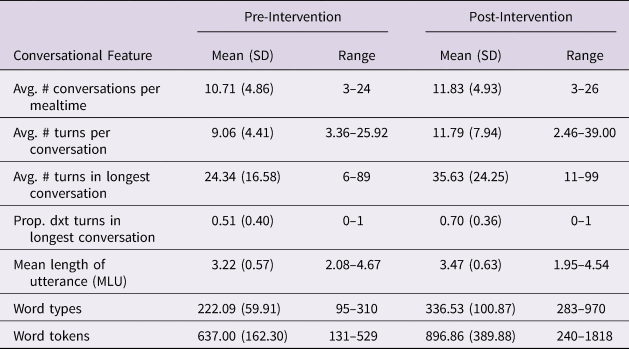
Preliminary analyses revealed considerable variation across families in conversational turn measures. Means, standard deviations, and ranges for these measures can be found in Table 2.
Descriptive statistics of dyads’ conversational turns before and after the intervention for entire sample (N = 36)

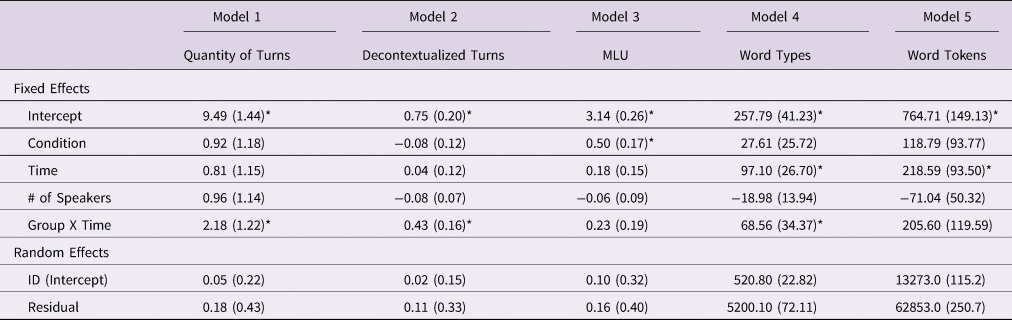
Next, we addressed our primary research question of whether the intervention changed aspects of conversational turn-taking. First, we compared the average number of turns per conversation (quantity of turn-taking) and the proportion of turns coded as decontextualized between conditions before and after the intervention. Analyses were conducted using mixed-effects models (lmer package in R) with dyad ID as a random effect and fixed effects for the Number of Speakers at the Meal, Group (control, training), Time (pre-intervention, post-intervention), and the interaction between the latter two terms. Note that the Number of Speakers at the Meal was negatively but non-significantly associated with turn-taking measures, suggesting that more speakers at a meal led to both fewer total turns and fewer turns containing decontextualized language.
Exploring the overall quantity of turn taking, we found no main effect of Group or Time on the average number of turns per conversationFootnote 1, but a significant Group x Time interaction, Estimate = 9.69 (SE = 2.50), t = 3.87 [95% CI: 4.83–14.65], (Table 3 Model 1). Simple slopes post hoc analyses indicated no significant difference by Group in dyadic turn-taking prior to the intervention, Estimate = −1.28, t = −0.64. However, dyads assigned to the intervention group engaged in significantly more turn-taking after the intervention than those in the control group, Estimate = −8.41, t = 4.29 (Figure 1 Panel A). Specifically, following the intervention dyads’ in the training condition averaged 16.04 turns per conversation (SD = 9.05) as compared to 7.53 in the control condition (SD = 3.12).
A parent-focused intervention significantly increased the quantity and content of parent-child conversational turn-taking, evidenced by a significant difference between conditions in the average turns per conversation (Panel A) and proportion of decontextualized turns in the longest conversation (Panel B) at the post-intervention data point. Error bars represent the standard error of the mean.

Series of regression models predicting the effect of the intervention on various features of conversation

Note. Cell numbers represent parameter estimate (standard error) from mixed effects models. * indicates parameters with a 95% confidence interval that does not contain zero.
We next examined whether dyads who received the intervention used more decontextualized conversational turns (Table 3 Model 2) during their longest conversation. Again, we found no main effect of Group or Time on the proportion of turns coded as decontextualized. A significant Group X Time interaction emerged, Estimate = 0.43, SE = 0.16, t = 2.74, [95% CI: 0.12, 0.74]. This interaction suggests that by the post-intervention mealtime, dyads in the intervention condition (M = 0.88; SD = 0.19) used a greater proportion of decontextualized turns than dyads in the control condition (M = 0.52; SD = 0.41), Estimate = 0.35, SE = 0.12, t = 2.92 (Figure 1 Panel B). No group differences in proportion of decontextualized turns were found during the mealtime prior to the intervention, Estimate = −0.08, SE = 0.12, t = −0.63.
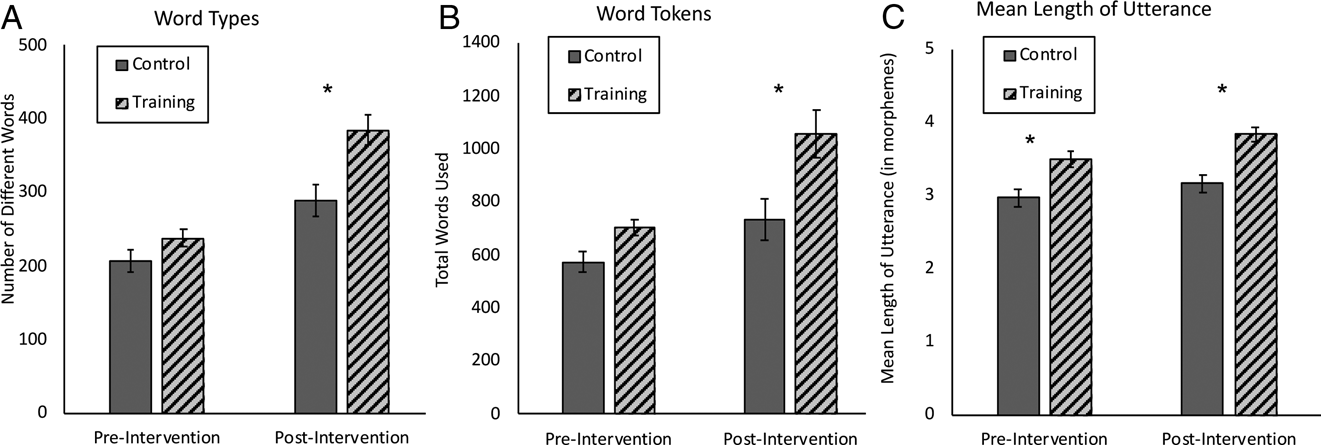
Finally, we explored the possibility that additional features of dyads’ conversational turns – mean length of utterance (MLU), word types, and word tokens – also changed as a function of the intervention. Mixed effects models were run with identical specification to the analyses presented above (Table 3 Models 3-5). For MLU, a main effect of Group emerged, Estimate = 0.50, SE = 0.17; t = 2.89, [95% CI: 0.16, 0.84] (Table 3, Model 3). Follow-up analyses revealed that MLU among training condition dyads was significantly longer at the pre-intervention time point (MControl = 2.95, MTraining = 3.45) as well as the post-intervention time point (MControl = 3.13, MTraining = 3.87). However, no main effect of Time or significant interactions emerged, (Table 3, Model 3). Given that we saw condition differences in MLU at the pre-intervention timepoint, we must interpret a lack of interaction with caution.
Turning to word types (Table 3, Model 4) and tokens (Table 3, Model 5), there was no main effect of Group but a significant main effect of Time for both word types (Estimate = 97.10, SE = 26.70; t = 3.64, 95% CI: 44.74, 148.33) and word tokens (Estimate = 218.59; SE = 93.50; t = 2.34, 95% CI: 34.83, 397.93). Dyads’ conversational turns contained significantly more diverse vocabulary words and more total words after the intervention than prior to the intervention, irrespective of their group assignment. The Group X Time interaction was significant for word types, (Estimate = 68.56, SE = 34.37, t = 2.00, 95% CI: 2.05, 135.56), but not for word tokens (Estimate = 205.60, SE = 119.59, t = 1.72, 95% CI: −25.57, 439.29). In other words, intervention dyads showed a significant pre- to post-intervention increase in the diversity of vocabulary (word types) but not more total words (word tokens).
A parent-focused intervention significantly increased the diversity of vocabulary used within conversational turns (Panel A). The total number of words produced (Panel B) was larger for both groups at the post-intervention data point. For mean length of utterance, training condition dyads produced more syntactically complex conversational turns during both time periods (Panel C). Error bars represent the standard error of the mean.

Discussion
We conclude that encouraging parents to incorporate decontextualized language into their everyday conversations with children leads to conversations that are longer and more sustained. Specifically, we show that the quantity of turn-taking, proportion of decontextualized turns, and diversity of vocabulary increased during home mealtimes among families who received information about the importance of decontextualized language. There are a number of theoretical and practical implications of this finding, which we discuss in more detail below.
First, these results point to benefits of engaging in decontextualized conversations beyond those shown in previous research. We know that decontextualized language exposes children to abstract concepts (e.g., cause-and-effect reasoning, discussions of past and future events) and encourages the use of sophisticated vocabulary and complex syntactic structures (Curenton & Justice, Reference Curenton and Justice2004; Demir et al., Reference Demir, Rowe, Heller, Goldin-Meadow and Levine2015; Rowe, Reference Rowe2012; Snow & Uccelli, Reference Snow, Uccelli, Olson and Torrance2009; Westby, Reference Westby and Simon1991). Here, we add that decontextualized language also generates longer episodes of turn-taking, which to our knowledge has not been shown by previous research. This is especially important given recent findings showing that the quantity of conversational turns is highly predictive of children's concurrent and later brain and behavioral language outcomes (Gilkerson et al., Reference Gilkerson, Richards, Warren, Oller, Russo and Vohr2018; Hirsh-Pasek et al., Reference Hirsh-Pasek, Adamson, Bakeman, Owen, Golinkoff, Pace, Yust and Suma2015; Romeo et al., Reference Romeo, Leonard, Robinson, West, Mackey, Rowe and Gabrieli2018a; Romeo et al., Reference Romeo, Segaran, Leonard, Robinson, West, Mackey, Yendiki, Rowe and Gabrieli2018b; Zimmerman et al., Reference Zimmerman, Gilkerson, Richards, Christakis, Xu, Gray and Yapanel2009).
Importantly, prior work on conversational turns has focused more on the quantity of turn-taking and less on semantic features of the turns. Our method of coding each conversational turn revealed that in addition to observing that the intervention increased turn quantity, the number of decontextualized turns and the vocabulary diversity of those turns also increased. Why might longer conversations be associated with more decontextualized language and diverse vocabulary? To communicate effectively about a decontextualized topic, a speaker must use explicit language to make her point, and a listener must use inferential or reasoning skills to keep up with the conversation because one cannot rely on cues from the immediate context. We argue that these increased demands make decontextualized language and diverse vocabulary more likely to appear. Future research should examine whether qualities of conversational turns – measured as decontextualized language or by some other feature – are in fact more predictive of later language outcomes than the quantity of turn-taking.
Interestingly, we did not find that the intervention led conversational turns to be more linguistically complex, as measured by MLU. This is surprising given that Demir and colleagues (Reference Demir, Rowe, Heller, Goldin-Meadow and Levine2015) found decontextualized language to contain longer MLUs compared to contextualized language. One possibility for these differing findings may be due to our relatively small sample size. Dyads in the training condition used significantly more complex language prior to the intervention, indicating that random assignment did not work for this variable (though it did for all other dependent variables). It will be important to replicate this study with a larger sample to determine if the null finding is in fact an artifact of random assignment.
A practical implication from these data is a framework for how a general intervention approach around one feature of conversation can confer benefits to other features of conversation. In our study, the training protocol did not provide any information about turn-taking, yet informing parents about decontextualized language also extended their conversations in ways known to support language development. We speculate that it may be as or more effective to provide caregivers with information about semantic features of conversation such as decontextualized language than information about structural features of conversation such as turn-taking. Whether structural or semantic features are more amenable to intervention, of course, is a point worth following-up in future research.
In the future, we are interested in extending this work in a number of ways. First, as this study established the effectiveness of the intervention as it applies to mealtimes, a next step is to determine whether effects extend to other conversational contexts. Mealtimes are conducive to conversation (Beals, Reference Beals, Dickinson and Tabors2001; De Temple & Beals, Reference De Temple and Beals1991), and as such we observed most families –regardless of condition – engaged in many sustained conversations, likely far more than would have been observed in other contexts such as book reading or toy play. It will be important to establish whether the intervention works during these other conversational contexts. This could be accomplished through day-long LENA recordings during which conversations could be randomly sampled and coded for the presence of decontextualized language.
A second future direction is to understand the generalizability of conversational turn-taking interventions beyond the educated population of parents used as this study's test case. This direction is interesting in several respects. For instance, is there also a positive association between decontextualized language and conversational turns among families of diverse linguistic or SES backgrounds? Second, we know there are average differences between lower- and higher-SES families in the frequency and content of conversation (note however that some aspects of decontextualized language differ by SES while others do not; Rowe, Reference Rowe2012), and these differences are thought to contribute to gaps in kindergarten readiness. An intervention focused around conversation may be one opportunity to support kindergarten readiness for children from diverse SES backgrounds.
Most important, there is evidence that early language experiences such as turn-taking matter for later language and literacy development (Golinkoff, Hoff, Rowe, Tamis-LeMonda & Hirsh-Pasek, Reference Golinkoff, Hoff, Rowe, Tamis-LeMonda and Hirsh-Pasek2019). We argue our data speak to the positive role of engaging children in extended conversations during everyday opportunities and believe these experiences are a key ingredient in building strong language skills during early childhood.
Acknowledgements
We thank Julia Wang, Ran Wei, and Brianna Swenson for assistance with data collection, transcription, and coding; the participating parents and children; the University of Maryland for a SPARC dissertation grant to Kathryn Leech, and the Harvard Graduate School of Education for start-up funds to Meredith Rowe. We also thank Samuel Ronfard for comments on earlier versions of this manuscript.