INTRODUCTION
Trichinellosis is an important foodborne zoonosis caused worldwide by nematodes of the genus Trichinella, which can infect a wide range of hosts including humans. The complete life-cycle of Trichinella occurs in the same host and targets 2 distinct intracellular niches: the intestinal epithelium and the skeletal muscle cells. Within the small intestinal epithelium, the infective muscle larvae (ML) moult to adulthood, mate and reproduce. Then the gravid females release newborn larvae (NBL), which migrate to striated muscle through the bloodstream and lymphatic circulation. Migrating NBL leave the capillaries and invade the muscle cells (Gottstein et al. Reference Gottstein, Pozio and Nöckler2009). During this last step of life cycle, NBL develop into infective larvae and cause the transformation of muscle cells into nurse cells, which protects the parasite from host immune response and allows the exchange of nutrients needed for the development and survival of larvae. In these nurse cells, Trichinella larvae can survive for many years (Despommier, Reference Despommier1998). Two clades in Trichinella genus have been identified: the encapsulated and the non-encapsulated. Encapsulated species such as Trichinella spiralis induce the nurse cell to produce a collagen capsule, whereas the non-encapsulated species do not have the ability to induce a collagen synthesis (Pozio et al. Reference Pozio, Zarlenga and La Rosa2001).
Proteinases play a variety of roles during parasite life cycle such as invasion of host cells, penetration of tissues, parasite development and immune evasion. Indeed, parasite serine proteinases have been described as actively participating in parasite survival and establishment of infection (Dzik, Reference Dzik2006). Serine proteinases with chymotrypsin-, elastase- or trypsin-like activities are the most abundant proteinases of excretory/secretory products or crude extract proteins from T. spiralis (Todorova, Reference Todorova2000; Todorova and Stoyanov, Reference Todorova and Stoyanov2000; Bien et al. Reference Bien, Näreaho, Varmanen, Gozdzik, Moskwa, Cabaj, Nyman and Savijoki2012; Wang et al. Reference Wang, Cui, Hu, Liu and Wang2014). Antibodies induced by serine proteinases of adult T. spiralis and larvae can inhibit their enzymatic activity and may participate in reducing tissue damage during Trichinella invasion and migration (Todorova, Reference Todorova2000; Todorova et al. Reference Todorova, Knox and Kennedy1995). Thus, serine proteinases of T. spiralis are thought to be attractive targets for vaccines strategy and are also interesting candidate antigens for the development of serological tests. A highly antigenic T. spiralis serine proteinase, named NBL1, was obtained by suppression subtractive hybridization cDNA library of T. spiralis NBL stage (Liu et al. Reference Liu, Wang, Fu, Li, Wu, Le Rhun, Chen and Boireau2007). Epitope mapping using truncated recombinant NBL1 indicated that the C-terminal part of NBL1 (NBL1-C) was the main immunodominant region. In addition, an evaluation of potential antigenicity of NBL1 in serological tests showed that NBL1-C can be useful for the early detection of Trichinella infection in pigs (days 20–25 post-infection), which were not detected with ES antigens (Boireau et al. Reference Boireau, Liu, Fu, Le Rhun, Bahuon, Vallee, Le Guerhier, Hernandez Bello and Wu2007). Furthermore, we have also found that pigs immunized with recombinant NBL1-C protein, significantly inhibited the installation of the parasite in muscles (I. Vallee, personal communication, 2011). All these data indicate that NBL1 behave as a crucial antigen of Trichinella.
To further characterize the biological roles of NBL1 and also to propose new serological tools based on recombinant proteins, monoclonal antibodies (mAbs) specifically directed against NBL1-C were produced. These mAbs will indeed be useful tools for identification of serologically relevant epitopes and for characterization of NBL1 expression in vivo.
MATERIALS AND METHODS
Parasites and antigens preparation
T. spiralis (ISS004) parasites were maintained by serial passages in female OF1 mice (Charles River Laboratories, l′Arbresle, France). ML of T. spiralis were recovered from infected OF1 mice at 35 days post-infection (dpi) by the standard HCl–pepsin digestion method (Gamble et al. Reference Gamble, Bessonov, Cuperlovic, Gajadhar, Van Knapen, Noeckler, Schenone and Zhu2000). Pre-adult worms (L20h) and 5-day adult worms (AD5) were recovered from infected mice intestines at 20 h post-infection (hpi) and 5 dpi respectively as previously described (Zocevic et al. Reference Zocevic, Mace, Vallee, Blaga, Liu, Lacour and Boireau2011). To collect NBL, adult female worms harvested at 6 dpi were incubated in pre-warmed serum-free RPMI 1640 medium containing 2 mm L-glutamine, 100 U mL−1 penicillin and 100 μg mL−1 streptomycin at 37 °C under 5% atmospheric CO2 for 18 h. After incubation, NBL delivered by adult female worms were isolated from the culture medium by filtration using 0·2 mm filter and centrifugation at 13 000 g, 4 °C for 10 min.
Somatic extracts of AD5 and NBL mix stages; NBL and ML were prepared as follows: T. spiralis worms from different development stages were washed several times with phosphate-buffered saline (PBS) and resuspended in PBS. Parasites were frozen at −80 °C overnight. After thawing at room temperature, parasites were homogenized using a glass tissue homogenizer and then frozen in liquid nitrogen. This procedure was repeated twice with a difference, that the freezing at −80 °C was performed for 1 h. Then, the homogenate was centrifuged at 10 000 g at 4 °C for 1 h. The concentration of total antigens was determined with the BCA Protein assay kit (Thermo Fisher Scientific, Waltham, MA, USA). Each preparation of total antigens was divided in aliquots and stored at −80 °C until use.
Preparation of serum
Three 10-week-old specific pathogen-free (SPF) pigs (German Yorkshire) and 3 female OF1 mice (Charles River Laboratories) were infected orally with 20 000 T. spiralis (ISS004) ML and 300 T. spiralis (ISS004) ML, respectively. Blood samples were collected from OF1 mice at 35 dpi and from SPF pigs at 60 dpi. Sera were collected after centrifugation at 2000 g for 30 min, divided in aliquots and stored at −80 °C until use.
Preparation of recombinant NBL1-C (rNBL1-C)
Construction of NBL1-C expression plasmid
The sequence encoding the C-terminal part of NBL1 (NBL1-C) (GenBank: AF331160.1) was amplified by PCR using primers carrying BamHI and NotI restriction sites (forward primer: 5′-CCCCCCGGATCCGAAAATTCTCCTGAAGGA-3′; reverse primer: 5′- CCCCCCGCGGCCGCCTAGTGGTGGTGGTGGTGGTGCTTAGAAAAGTGATAATA-3′). Sequence encoding 6 histidines was also added into the reverse primer to allow a purification step. PCR was carried out in a total volume of 50 μL containing 1 μL of DNA template, fusion buffer containing 1·5 mm MgCl2, 200 μ m dNTPs, 0·5 μ m forward primer and reverse primer, 1 U fusion DNA polymerase (Finnzymes, Espoo, Finland). The PCR was performed as follows: 1 cycle of denaturation for 5 min at 98 °C; 30 cycles of denaturation (30 sec, 98 °C), annealing of primers (30 sec, 55 °C) and elongation (1 min, 72 °C); and 1 final cycle of elongation for 10 min at 72 °C. The purified PCR product and PGEX-6P-1 plasmid (GE Healthcare, Waukesha, WI, USA) were digested with BamHI and NotI (Fermentas, Waltham, MA, USA) at 37 °C for 16 h. After purification using the NucleoSpin Extract II kit (Macherey-Nagel, Düren, Germany), the PCR product was inserted into the BamHI and NotI sites of PGEX-6P-1 plasmid using T4 DNA ligase (New England BioLabs, Beverly, MA, USA). The recombinant plasmid was then transferred into competent Escherichia coli strain DH5α by thermal shock. The plasmid containing the recombinant NBL1-C was screened by PCR. Subsequently, the selected recombinant clones were sequenced to exclude PCR errors.
Expression and purification of rNBL1-C
After plasmid extraction using PureLink Quick Plasmid Miniprep Kit (Invitrogen, CA, USA), the recombinant PGEX-6P -1-GSTSj-NBL1-C was transferred into competent E. coli strain BL21 (GE Healthcare) by thermal shock for expression. Cells were grown in LB culture medium containing 100 μg mL−1 ampicillin at 37 °C until an OD600 of 0·6 was reached. Expression of the recombinant protein was induced by adding 0·5 mm isopropyl β-D-1-thiogalactopyranoside (IPTG) for 3 h at 37 °C. Then, the cells were harvested by centrifugation at 4 °C, 12 000 g for 30 min, and resuspended in lysis buffer (20 mm Tris–HCl, pH 8·0, 300 mm NaCl and 0·5 mg mL−1 lysozyme). The solution was subjected to 3 freeze–thaw cycles using liquid nitrogen and water, respectively. After treatment with DNaseI (5 μg mL−1; Sigma, Saint Louis, MO, USA) and centrifugation at 12 000 g , 4 °C for 30 min, the soluble rNBL1-C was first purified by Ni-affinity chromatography (Qiagen, Dusseldorf, Germany) according to the instructions of the manufacturer. Then the recombinant GST Sj -NBL1-C was submitted to a second step of purification using a GST-sepharose column (GE Healthcare). After binding, the recombinant fusion protein was cleaved on-column by 800 U PreScission proteinase (GE Healthcare) to remove the GST Sj protein according to the manufacturer's instructions. Purity of the recombinant protein was assessed after migration on a 15% sodium dodecyl sulphate–polyacrylamide gel electrophoresis (SDS–PAGE) (Laemmli, Reference Laemmli1970) and stained with Coomassie Brilliant Blue R (online Fig. S1.A in Supplementary Materials). After a column cleavage, the rNBL1-C was removed from GSTSj and recovered with a very high level of purity. As expected, a band with a molecular mass of approximately 15 kDa was obtained. The concentration of rNBL1-C was determined with a Microplate BCA Protein Assay Kit – Reducing Agent Compatible (Thermo Fisher Scientific).
Antigenicity analysis of the recombinant NBL1
The rNBL1-C (0·5 μg well−1) was separated by 15% SDS–PAGE and transferred onto a PVDF membrane (Amersham Pharmacia Biotech, Waukesha, WI, USA). After blocking in 5% (wt/vol) skim milk in TBS-T (TBS, 0·1% Tween-20) at 37 °C for 90 min, membranes were incubated for 2 h at room temperature with serum samples diluted at 1:300 in 5% (wt/vol) skim milk in TBS. After 3 washes with TBS-T, membranes were incubated with 1:10 000 dilution of horseradish peroxidase (HRP)-conjugated rabbit anti-pig immunoglobulin G (IgG; Sigma) for 1 h at room temperature. Finally, membranes were washed 5 times with TBS-T and the peroxidase was developed using the ECL plus Western blotting detection system (GE Healthcare). The results showed that the rNBL1-C was recognized by serum from pigs infected with 20 000 ML of T. spiralis and collected at 60 dpi (online Fig. S1B, lane 1). No recognition was observed with the Trichinella-negative pig serum (online Fig. S1B, lane 2). This result indicated that the recombinant protein expressed in E. coli remained antigenic and is a suitable antigen for production of mAbs against rNBL1-C.
Immunization of mice and production of mAbs
Female BALB/c mice (Charles River Laboratories) were immunized with 20 μg of rNBL1-C (20 μg/25 μL) mixed with an equal volume of Montanide ISA70™ adjuvant (SEPPIC, Puteaux, France). A boost was given 2 weeks after the first injection according to the same conditions as mentioned above. Both immunizations were performed by foot-pad injection. 3 days after boosting, mice were sacrificed and popliteal lymph nodes were harvested to isolate lymphocyte using Lympholyte M (Tebu-bio, Boechout, Belgium) according to the manufacturer's instructions. Separated lymphocyte were fused with murine myeloma cells SP2/0 at a ratio of 5:1 using PEG/DMSO (Sigma) and distributed in 96-well culture plates. After culture in a selective medium containing hypoxanthine, aminopterin and thymine (HAT), hybridomas that grew successfully were cloned by a limiting dilution method using the medium without HAT in 96-well plates. A total of 310 hybridomas were obtained and their supernatants were screened by ELISA using rNBL-1. Positive hybridomas that produced antibodies against rNBL1-C were subcloned quickly 2–3 times by limiting dilution to ensure monoclonality and stability.
Serological screening
Supernatants of hybridomas were screened for antibodies against NBL1-C by indirect ELISA using rNBL1-C. Hybridoma clones producing high titres of antibodies against NBL1-C were selected. Briefly, 96-well plates (Nalgen Nunc International; Roskilde, Denmark) were coated with 100 μL well−1 of rNBL1-C at a final concentration of 10 μg mL−1, in sodium carbonate–bicarbonate buffer, pH 9·6 and incubated for 1 h at 37 °C, followed by an overnight incubation at 4 °C. Then, the solution was discarded and the plates were washed 5 times with washing buffer (0·05% Tween-20, distilled water). Plates were blocked by adding 200 μL well−1 of blocking buffer (1% gelatin, 0·05% Tween-20, PBS) and incubated at 37 °C for 30 min. After 5 washes, 200 μL well−1 of culture supernatants from different hybridomas were added in duplicate, and the plates were incubated at 37 °C for 2 h. The plates were then washed 5 times as described above, and 100 μL well−1 of HRP-conjugated rabbit anti-mouse IgG (Sigma) diluted at 1:10 000 in blocking buffer were added, and the plates were incubated at 37 °C for 1 h. Finally, the plates were washed, and the enzyme reaction was developed with 100 μL well−1 of 3, 3′, 5, 5′-tetramethylbenzidine substrate (TMB; Invitrogen). After a 10-min-incubation in dark at room temperature, the reaction was stopped by addition of 50 μL of 12% sulphuric acid. The OD values were measured at 450 nm using an IEMS reader (Thermo LabSystems, Cergy Pontoise, France). Serum from mice immunized with rNBL1-C and culture supernatant of myeloma cell were used as positive and negative controls respectively for ELISA. Isotypes and titres of each mAb were determined respectively using the Pierce® Rapid ELISA Mouse mAb Isotyping Kit and the Easy-Titer® IgG Assay Kit (Thermo Fisher Scientific) according to the manufacturer's instructions.
Characterization of stage specificity of mAbs by Western blot
The specificity and reactivity of mAbs were determined by Western blot using rNBL1-C and somatic extract antigens of NBL, mix stage AD5-NBL and ML. 0·5 μg rNBL1-C and 30 μg somatic extract antigens from mix stage AD5-NBL or ML and 10 μg somatic extract antigens from NBL1 respectively were separated by 15% SDS–PAGE and transferred onto a nitrocellulose membrane (Hybond-C Nitrocellulose; Amersham Pharmacia Biotech). After blocking, membranes were incubated with the selected hybridoma cells culture supernatant for 1 h at room temperature. Serum samples from mice infected with 300 T. spiralis ML were collected at 35 dpi and from mice immunized with rNBL1-C were used as positive controls. For negative control, myeloma cell culture supernatant was used. After 5 washes with TBS-T, membranes were incubated with alkaline phosphatase-conjugated rabbit anti-mouse IgG (Sigma) diluted at 1:10 000 in TBS containing 5% skim milk for 1 h at room temperature. Finally, membranes were washed 5 times with TBS-T and incubated with Bromo-chloro-indolyl phosphate/nitroblue tetrazolium substrate (Invitrogen) for 10 min in dark at room temperature. The reaction was then stopped with distilled water.
Characterization of stage specificity of mAbs by indirect immunofluorescence assay
The specificity of selected mAbs against NBL1-C was further characterized by indirect immunofluorescence assay with frozen sections of T. spiralis from different developmental stages (L20h, AD5, ML and NBL). T. spiralis L20h, AD5, ML and NBL were embedded in optimal cutting temperature compound (OCT) (Cellpath, Powys, Great Britain) and frozen at −15 °C. Frozen sections (6 μ m) of the parasite at each stage were prepared and fixed with cold acetone for 30 min. After washing with 10 mm PBS, pH 7·4, for 5 min, cryosections were incubated with 0·075% saponin in 10 mm PBS to block nonspecific binding for 15 min at room temperature. After blocking, sections were incubated with culture supernatant of selected hybridoma cells at room temperature for 45 min. Myeloma cell culture supernatant was used as negative control. Sections were washed twice with 10 mm PBS, pH 7·4 and incubated with goat anti-mouse IgG conjugated with Alexa Fluor 488 (Invitrogen) diluted at 1:100 in 10 mm PBS, for 45 min at room temperature. Finally sections were washed twice with 10 mm PBS and mounted on glass slides in ProLong Gold Antifade Reagent (Invitrogen), and then examined under fluorescence microscope (DMI 4000 B; Lieca Microsystems, Wetzlar, Germany) at 480 nm.
Determination of NBL1-C epitopes recognized by mAbs
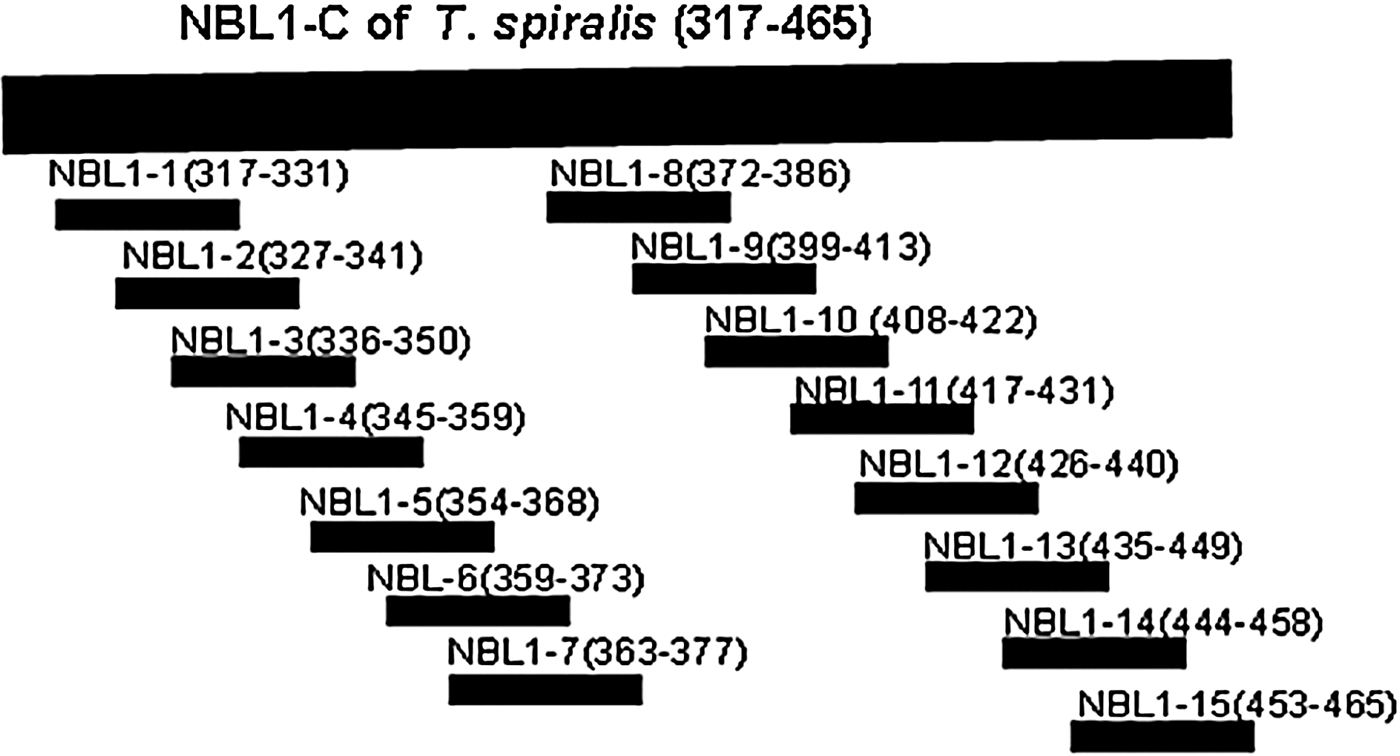
To identify NBL1-C epitopes, recognized precisely by mAbs, a series of 15 partially overlapping short peptides (NBL1-1 to NBL1-15) covering the whole C-terminal part of NBL1 (GenBank: AAK16520.1) were designed as shown in Fig. 1. Each peptide contained 15 amino acids (AA) in length (except the peptide NBL1-15 that contained 13 AA) and overlapped the adjacent peptide by 6 or 10 AA. For each overlapping peptide, a pair of complementary oligonucleotide strands encoding the short peptide was synthesized (Takara Biotechnology, Dalian, China). The two oligonucleotide strands were annealed at 66 °C for 10 min to synthesize the double-stranded DNA. The resultant double-stranded DNA contained a BamHI and a NotI cohesive terminus at the 5′ and 3′ ends, respectively. The annealed fragment was ligated into pGEX-4T-1 using T4 DNA ligase (Takara Biotechnology), which includes an in-frame GSTsj tag, to generate recombinant plasmid. The inserts in the recombinant plasmids were sequenced, and the confirmed recombinant plasmids were transformed into E. coli BL21 cells and induced with IPTG at a final concentration of 1 mm for 4 h at 37 °C. The soluble recombinant proteins were purified by Glutathione Sepharose affinity chromatography according to the manufacturer's instructions (GE Healthcare). The purity of the recombinant proteins was assessed after migration on a 12% SDS–PAGE (Laemmli, Reference Laemmli1970) and stained with Coomassie Brilliant Blue R. The protein concentrations of the recombinant NBL1-1 to NBL1-15 were determined using the Pierce BCA Protein Assay Kit (Thermo Fisher Scientific). Reactivity of mAbs against the 15 GST Sj -fused polypeptides was analysed by Western blot as described above.
Schematic diagram showing the position of overlapping peptides used in this study relative to NBL1-C. Numbers into brackets indicate the location of the first and the last amino acids of each peptide.

RESULTS
Production and characterization of mAbs isotypes
The fusion was allowed obtaining 310 hybridomas, of which 5 were finally selected by ELISA for their specificity to recognize rNBL1-C. These 5 hybridoma cell lines that produce mAbs with a high ELISA titre were identified and named 6C33E114F82D3, 5D43A43C1, 3E83G91D5, 5H125E91D6 and 2B112E5, respectively. The selected clones were expanded into cell culture flasks for large-scale production. An IgG concentration ranking from 6·3 to 10·9 μg mL−1 was currently obtained. The 5 hybridomas expressed mAbs from the same isotype, IgG1 class and Kappa light-chain.
Specificity of mAbs against rNBL1-C and native NBL1
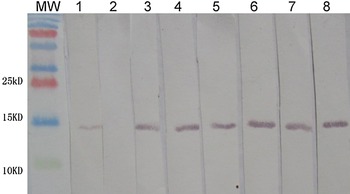
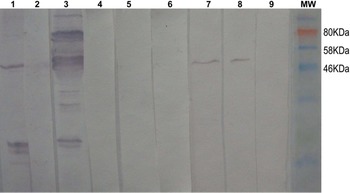
Specific immunoreactivity of these mAbs with rNBL1-C was analysed by Western blot. Results showed that all mAbs recognized rNBL1-C with a unique band at a molecular mass of 15 kDa (Fig. 2, lanes 4 – 8), while the myeloma cell culture supernatant used as negative control did not (Fig. 2, lane 2). In addition, the specificity of selected mAbs was further characterized by Western blot using somatic extract antigens from either a mix of AD5 and NBL, or NBL or ML. The clone 6C33E114F82D3 reacted with a single band at 50 kDa in somatic extract antigens of AD5-NBL and NBL that could correspond to native NBL1 (Fig. 3). As expected, selected mAb failed to recognize any protein in somatic extract antigens from the ML stage. These results indicated that the selected mAbs can recognize the recombinant and native NBL1 specifically.
Western blot screening of selected mAbs against rNBL1-C. Lane Mr: protein molecular mass marker relative mobility, lane 1: positive serum from mouse immunized with rNBL1-C, lane 2: myeloma cell culture supernatant, lane 3: hybridomas culture supernatant, lane 4: 6C33E114F82D3 clone supernatant, lane 5: 5D43A43C1 clone supernatant, lane 6: 3E83G91D5 clone supernatant, lane 7: 5H125E91D6 clone supernatant, lane 8: 2B112E5 clone supernatant.

Western blot screening of selected mAb (6C33E114F82D3) against the native protein NBL1. Lanes 1–3: the positive serum from mice infected with 300 ML T. spiralis and collected at 35 dpi reacted with the somatic extract antigens of AD5+NBL (lane 1), NBL (lane 2) and ML (lane 3). Lanes 4–6: the myeloma cell culture supernatant reacted with somatic extract antigens of AD5+NBL (lane 4), NBL (lane 5) and ML (lane 6). Lanes 7–9: 6C33E114F82D3 clone supernatant reacted with somatic extract antigens of AD5+NBL (lane 7), NBL (lane 8) and ML (lane 9). Lane Mr: protein molecular mass marker relative mobility.

In situ localization of NBL1 within T. spiralis NBL
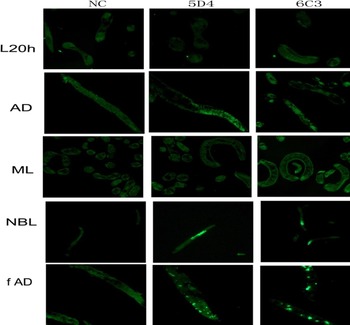
In order to assess the specificity of selected mAbs and to locate expression of NBL1, indirect immunofluorescence assays were performed on frozen sections from different stages of T. spiralis. A high-intensity fluorescence was observed within NBL (Fig. 4). In addition, both 5D43A43C1 and 6C33E114F82D3 clones also stained the gravid females. Interestingly, the location of NBL1 in the female adult is only restricted in the developing embryos and the larvae before birth. Moreover, no staining was observed in 20 h-old larvae and ML. Myeloma culture supernatant used as negative control never gave a positive staining in any T. spiralis tissues.
Immunofluorescence staining of frozen sections of different stages of T. spiralis using selected mAbs (5D43A43C1 and 6C33E114F82D3). NC: negative control, myeloma cell culture supernatant reacted with 20 hpi larvae (L20h), the 5-day adult worm (AD), muscle larvae (ML), newborn larvae (NBL), the 5-day female worm (fAD); 5D4: 5D43A43C1 clone supernatant reacted with L20h, AD, ML, NBL and fAD; 6C3: 6C33E114F82D3 clone supernatant reacted with L20h, AD, ML, NBL and fAD.

Determination of peptide sequences recognized by mAbs
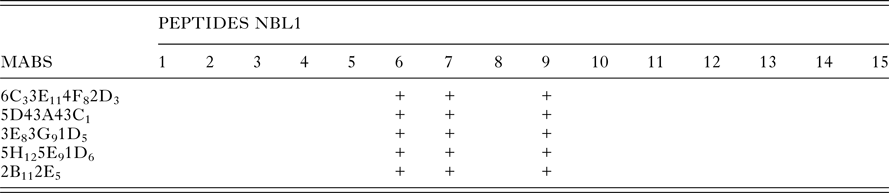
The sequences encoding overlapping peptides were cloned into pGEX-4T-1 expression plasmids for expression of soluble polypeptides fused with the 26 kDa GSTsj. GSTsj-fused polypeptides showed a molecular mass of approximately 26·6 kDa as expected (online Fig. S2). Almost no contaminants were visible on SDS–PAGE stained with Coomassie Brilliant Blue. Identification of peptide sequences recognized by each mAb was assessed using 15 overlapping fragments of 15 AA long (NBL1-1 to NBL-15). The 5 mAbs recognized 3 of the 15 fragments by Western blot; these overlapping sequences shared a common motif of 10 AA (PSSGSRPTYP) (Table 1).
Identification of linear epitopes of NBL1-Cterm recognized by mAbs

+: recognition of overlapping peptide by mAbs in Western blot.
DISCUSSION
In the present study, 5 specific mAbs against NBL1, a serine proteinase from NBL stage of T. spiralis were produced successfully. In order to confirm the specificity of selected mAbs, we examined their reactivity with recombinant protein of NBL1-C and somatic extracts of different T. spiralis stages. The mAbs recognized rNBL1-C, native NBL1, crude NBL antigens, mix antigens of AD5+NBL, but failed to react with antigens from other parasitic stages such as L20h, AD and ML. These results confirmed thus the stage specificity of NBL1 expression as an NBL protein as described by Liu et al. (Reference Liu, Wang, Fu, Li, Wu, Le Rhun, Chen and Boireau2007). In addition, antigens used in Western blot were reduced forms, indicating that the antigenic epitope recognized by mAbs is linear. Indeed, the 5 produced mAbs reacted with the same 10 AA sequence (PSSGSRPTYP). This underlines the high antigenicity of the 10 AA motif repeated 4 times in the C-terminal part of NBL1. Other serine proteinases of T. spiralis have been cloned and characterized, such as the serine proteinase TsSerP and TspSP-1.2 (Trap et al. Reference Trap, Fu, Le Guerhier, Liu, Le Rhun, Romand, Perret, Blaga and Boireau2006; Wang et al. Reference Wang, Wang, Jin, Ren, Liu and Cui2013), and the ML stage-specific serine proteinase Ts23-2 (Nagano et al. Reference Nagano, Wu, Nakada, Boonmars and Takahashi2003). The expression profile of TsSerP and TspSP-1.2 demonstrated that they were expressed at all parasitic stages, whereas Ts23-2 expression was restricted to the ML stage. NBL1 is the first described serine proteinase of T. spiralis expressed specifically at NBL stage.
Immunolocalization of NBL1 evidenced a specific expression in NBL, embryos and larvae before birth within the gravid females. The belonging to an antigenic group as described by Boireau et al. (Reference Boireau, Vayssier, Fabien, Perret, Calamel and Soule1997) was not clear-cut. However, the specific distribution of NBL1 to embryos and NBL indicated that this serine proteinase could be involved in invasion stage of Trichinella for migration of NBL within tissues, thus facilitating the passage from intestinal mucosa to blood stream and penetrating muscle cells. Proteinases expressed at different stages and with specific roles in establishment of parasitism have been reported in previous studies. Indeed, immunolocalization experiments showed that serine proteinases TsSerP and Ts23-2 were present in the peripheral regions and the oesophagus as well as the stichocytes of ML, respectively (Nagano et al. Reference Nagano, Wu, Nakada, Boonmars and Takahashi2003; Trap et al. Reference Trap, Fu, Le Guerhier, Liu, Le Rhun, Romand, Perret, Blaga and Boireau2006). Authors suggested that those serine proteinases play a potential role in parasite nutrition and participating in intestinal invasion. Serine and metalloproteinase activities involved in host tissue penetration were identified in ES products of Onchocerca volvulus microfilariae and male, but these activities were not detected in ES products of female. Interestingly, during establishment of infection, infective microfilariae and males migrate through host tissue, whereas females reside only in nodules. Thus, the specific expression of proteinases was thought to be associated with different behaviour of worms (Haffner et al. Reference Haffner, Guilavogui, Tischendorf and Brattig1998). Subtilisin-like serine proteinase 3 of Plasmodium falciparum was specifically expressed at the late asexual blood stages (Alam et al. Reference Alam, Bhatnagar and Chauhan2012). Proteolysis analysis suggested that it could play an important role in the processes of motility, virulence and immune evasion (Alam et al. Reference Alam, Bhatnagar, Relan, Mukherjee and Chauhan2013). Studies of proteinases throughout the life of T. spiralis evidenced that ES antigens and crude extracts of ML present a great activity against structural proteins (collagen), while NBL and adult worm degrade principally haematic proteins (haemoglobin, fibrinogen and IgG; Ros-Moreno et al. Reference Ros-Moreno, Vázquez-López, Giménez-Pardo, de Armas-Serra and Rodríguez-Caabeiro2000). The stage-specificity of proteolytic activity is thus related with the parasite life cycle. In our previous study, immunolocalization of NBL1 using the anti-NBL1 serum in situ showed an expression of NBL1 in the nuclei of muscle cells invaded by T. spiralis from 9 dpi (M. Liu et al. personal communication, unpublished data). These results demonstrated that NBL1 is crucial in the invasion and/or installation of the parasite within its host. In this study, the restricted expression of NBL1 during the newborn stage (and embryos) further strengthens our hypothesis that NBL1 may facilitate penetration of the vascular/lymphatic systems and invasion of muscle cells by NBL. A number of serine proteinases from the parasite invasive stage have been shown as key determinants for host tissue invasion, including serine proteinase from infective larvae of Steinernema carpocapsae and T. spiralis, elastase from cercariae of Schistosoma mansoni (Toubarro et al. Reference Toubarro, Lucena-Robles, Nascimento, Santos, Montiel, Veríssimo, Pires, Faro, Coelho and Simões2010; Ingram et al. Reference Ingram, Rafi, Eroy-Reveles, Ray, Lambeth, Hsieh, Ruelas, Lim, Sakanari and Craik2012; Wang et al. Reference Wang, Wang, Jin, Ren, Liu and Cui2013). The proteolytic activity in degradation of several components of cellular and extracellular matrix or the role in invasion of intestinal epithelial cells in vitro was indeed demonstrated. In addition, according to the expression of NBL1 in developing embryos and in larvae before birth, it could be hypothesized that NBL1 is also involved in embryogenesis and newborn development through proteolytic function. In Caenorhabditis elegans, serine proteinases have been shown to play a vital role in early development of the nematodes (Peters et al. Reference Peters, McDowall and Rose1991; Thacker et al. Reference Thacker, Peters, Srayko and Rose1995). Study on an O. volvulus serine proteinase inhibitor evidenced that it is located to the eggshells surrounding the developing embryos within the uterus of female worms. The localization data indicate that the serine proteinase inhibitor play a role in embryogenesis and microfilarial development by controlling the activity of endogenous serine proteinases (Ford et al. Reference Ford, Guiliano, Oksov, Debnath, Liu, Williams, Blaxter and Lustigman2005).
The epitope PSSGSRPTYP can be considered as highly immunogenic as the 5 selected clones recognized this motif, which is repeated 4 times in the C-terminal part of NBL1. The antigenic potential of NBL1 have indeed been evaluated by preliminary ELISA based on rNBL1-C and suggests that it could be a useful protein for improving serological tools dedicated for an early detection of Trichinella infection in pigs (Boireau et al. Reference Boireau, Liu, Fu, Le Rhun, Bahuon, Vallee, Le Guerhier, Hernandez Bello and Wu2007). The mAbs produced in this study will thus be useful to design new serological tests based on NBL1. Moreover, such mAbs will also find applications in the understanding of NBL1 function in embryogenesis of Trichinella or in its interactions with the host at the early steps of invasion.
SUPPLEMENTARY MATERIAL
To view supplementary material for this article, please visit http://dx.doi.org/S0031182014001851.
ACKNOWLEDGEMENTS
The authors are grateful to Pauline Macé, Aurélie Heckmann, Baldissera Giovani and Virginie Jazedé for their technical assistance and/or advice.
FINANCIAL SUPPORT
This work was supported by Med-Vet-Net EU contract (WP 27 TrichiMED), ANR TrichiVac contract and China scholarship council.