INTRODUCTION
Mussels inhabiting the natural environment are subjected to the changes in food availability (Wong & Cheung, Reference Wong and Cheung2001) which eventually effect their growth and health condition (Menge et al., Reference Menge, Daley, Sanford, Dahlhoff and Lubchenco2007). In South-east Asia, the green-lipped mussel, Perna viridis (Linnaeus, 1758), plays an important role in molluscan culture by serving as an abundant and cheap protein source in this region (Menzel, Reference Menzel1988; Chou & Lee, Reference Chou and Lee1997; Rajagopal et al., Reference Rajagopal, Venugopalan, Nair, van der Velde, Jenner and den Hartog1998; Wong & Cheung, Reference Wong and Cheung2001). Regular growth and health assessment would be necessary for quality assurance in the mussel farming industry. Although physiological responses, such as change in biomass and condition index, have been used for assessing growth and health condition in bivalves (Widdows, Reference Widdows1978), the responses usually required a longer exposure duration to reveal measurable effects. Recently, the nucleic acid ratio between RNA content and DNA content in tissues (i.e. RNA/DNA ratio) has been proposed as an efficient index for evaluation of the general health condition of marine organisms when exposed to rapidly changing natural and anthropogenic stressors (Dahlhoff & Menge, Reference Dahlhoff and Menge1996; Wo et al., Reference Wo, Lam and Wu1999; Yang et al., Reference Yang, Wu and Kong2002; Dahlhoff, Reference Dahlhoff2004). The RNA/DNA ratio has demonstrated its versatile utility in assessing growth rate and condition of fish (Buckley, Reference Buckley1979) and subsequently other marine organisms such as bivalves (Menge et al., Reference Menge, Daley, Sanford, Dahlhoff and Lubchenco2007), copepods (Wagner et al., Reference Wagner, Durbin and Buckley1998) and crustaceans (Moss, Reference Moss1994).
Previous studies have reported that the RNA/DNA ratio is a sensitive biomarker to food availability in different species (Parslow-Williams et al., Reference Parslow-Williams, Atkinson and Taylor2001; Okumura et al., Reference Okumura, Nagasawa, Hayashi and Sato2002; Speekmann et al., Reference Speekmann, Hyatt and Buskey2006). However, the intrinsic biological variations, such as size and tissue types, could mask the response in the RNA/DNA due to food availability (Mayrand et al., Reference Mayrand, Pellerin-Massicotte and Vincent1994; Norkko & Thrush, Reference Norkko and Thrush2006). Therefore, the present study involved both field and laboratory aspects to examine the effects of endogenous factors (animal size and tissue types) and food availability on the RNA/DNA ratio of P. viridis. The results would provide a sound basis for more accurate interpretation of the RNA/DNA ratio when it is adopted as a rapid growth biomarker in P. viridis cultured in the mussel farming industry or used in a biomonitoring programme for marine pollution.
MATERIALS AND METHODS
Field study
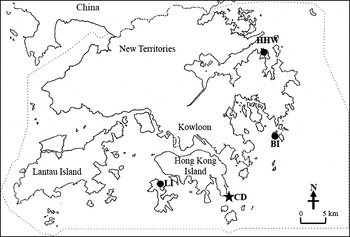
Various sizes of the green-lipped mussel Perna viridis were collected from three sites in Hong Kong, namely Hoi Ha Wan (HHW), Bluff Island (BI) and Lamma Island (LI), between September and October 2008 (Table 1; Figure 1); LI is located within a mariculture zone. Mussels at HHW and BI were found attaching to the submerged chain of floating buoys near a coral protection area, while those collected from LI were attached to the raft of an open-sea-cage fish farm where nutritional fish feed in the form of pellet or trash fish were commonly applied. To verify if RNA/DNA ratios of mussels collected from these three different sites (i.e. HHW, BI and LI) were influenced by the degree of nutrient enrichment, secondary water quality monitoring data on the nutrient enrichment related parameters including turbidity, volatile suspended solids, total inorganic nitrogen, chlorophyll-a and total suspended solids were extracted from the Marine Water Quality Database (2004–2007) of the Environmental Protection Department (EPD) of the Hong Kong Special Administrative Region Government (HKEPD, 2008). As there were three, two and two marine water sampling stations for LI, BI and HHW, respectively, all available data for each of the three sites were pooled for statistical comparison.
Map of Hong Kong showing the sampling sites where the mussels Perna viridis were collected at Hoi Ha Wan (HHW), Bluff Island (BI) and Lamma Island (LI), respectively. A filled star indicates the location of the Cape D'Aguilar Marine Reserve (CD) where natural seawater was taken, filtered and used for the laboratory study.

General hydrographical and geographical information of the three study sites.

No significant difference in salinity, temperature and dissolved oxygen levels was found among the study sites during the sampling period. All collected mussels were transported to the laboratory in a cool box with ambient seawater. Upon arrival at the laboratory, any epibiotic organisms on the mussel shells were removed. To investigate the effect of animal size on the RNA/DNA ratio, mussels were divided into three size-classes, 30–40 mm (small), 40–50 mm (medium) and >50 mm (large), according to the shell length measured with calipers (accuracy: ±0.5mm). For each size-class, 15 mussels were randomly selected from each sampling location. Adductor muscle (AD), foot, gill and hepatopancreas (HP) were excised and weighed from each mussel and snap frozen in liquid nitrogen in an autoclaved microcentrifuge tube. Frozen samples were stored at –80°C until nucleic acid analysis.
Laboratory study
To investigate the effect of nutritional status (i.e. starving versus feeding) on the RNA/DNA ratio, mussels with initial shell length of 30–40 mm were collected from HHW and used for the laboratory experiment. As a previous study has demonstrated that the RNA/DNA ratio in marine mussels can be influenced by size and vary significantly between different sites (Norkko et al., Reference Norkko, Thrush and Wells2006), this study was restricted to Perna viridis with a similar size (i.e. shell length) collected from HHW only. This size-range was chosen based on the results of the above field study and previous literature showing that small immature mussels generally exhibited the highest RNA/DNA ratio in their tissues when compared with the larger mature mussels and provided a more sensitive response in terms of the magnitude of change to the ambient environment (Chícharo & Chícharo, Reference Chícharo and Chícharo2008). Any epibiotic organisms on the mussel shells were removed. The mussels were then acclimated to laboratory conditions (salinity at 33‰ (±2; ±SD), temperature at 25°C (±1)) for 2 weeks before experimentation. During the acclimation period, the level of dissolved oxygen was maintained at >90% saturation with running natural seawater from the Cape D'Aguilar Marine Reserve (CD: 22°11′N 114°13′E; Figure 1); the mussels were initially starved for the first week and then fed with the marine microalgae Tetraselmis spp. in the second week. After the acclimation period, 25 mussels were randomly selected and allocated to each of the two experimental treatments (i.e. starving versus feeding). In the starving treatment, the mussels were placed in an 8 l glass tank filled with membrane filtered seawater (Millipore 0.22 µm membrane, Billerica, MA, USA) collected from Cape D'Aguilar Marine Reserve and were not fed with the marine microalgae for 10 days. In the feeding treatment, mussels were placed in the same condition as the starved mussels except that they were provided with Tetraselmis spp. at a density of 5 × 10⁶ cells/ml on a daily basis. The ration concentration was comparable with the cell density observed during algal bloom in the eastern waters of Hong Kong (Yung et al., Reference Yung, Wong, Broom, Ogden, Chan and Leung1997; Wong & Wong, Reference Wong and Wong2009). The experimental conditions were maintained at 12h:12h light:dark cycle, salinity at 33‰ (±2; ±SD), pH at 8.7 (±1), temperature at 25°C (±1) and dissolved oxygen level >90% saturation through aeration. Water was renewed once every two days. The exposure duration of 10 days was chosen as the endpoint, based on the results of a pilot study where mortality was observed in starved mussels after 10 days. Five mussels were randomly collected from each treatment tank by the end of Day 10 and AD, foot, gill and HP of each selected mussel were dissected and stored at –80°C until the nucleic acid analysis.
Nucleic acid analysis
The fluorometric method was used to measure the concentration of nucleic acids while extraction and quantifying procedures followed those described by Caldarone et al. (Reference Caldarone, Wagner, St Onge-Burns and Buckley2001) with some modifications. In brief, a sample of snap frozen tissues was homogenized by Ultra Turrax homogenizer (IKE Werke, Germany) in 200 µl of 1% STEB (1 g N-sarcosil in 100 ml 1 × TE buffer) in 1.5 ml microcentrifuge tube. The homogenate was then shaken at 4°C for 1 hour. After shaking, 1 ml 1 × TE buffer was added to the homogenate and mixed thoroughly by vortex or mechanical inversion for 40 times. This made up the final concentration of the mixture with 0.2% STEB. The mixture was then centrifuged at 10,000 rpm for 30 minutes. To avoid the re-suspension of tissue particulates, 1 ml of supernatant was transferred to an autoclaved microcentrifuge tube for storage at –80°C before analysis.
Upon analysis, 75 µl of the supernatant was loaded to a well of a 96-well plate and 75 µl of ethidium bromide fluorescence was added to the supernatant. After 30 minutes, fluorescence of total nucleic acid was measured using the spectrofluorometer with a microplate reader (M2e, Molecular Devices Corporation, USA) and the SOFTmax Pro. 5.1. software (Molecular Devices Corporation, USA) at 525 nm excitation wavelength and 590 nm emission wavelength. After the first fluorescence measurements, 7.5 µl RNase of 200 µg/ml was added and 45-minute incubation time was followed to ensure that all the RNA was hydrolysed by the enzyme. The fluorescence was subsequently measured as above for the second reading. In essence, RNA fluorescence values were the difference between the first and second fluorescence readings; and DNA fluorescence values were the second fluorescence reading. RNA and DNA concentrations in the samples were determined from the standard calibration curves which were constructed by running the same analysis with standards of known DNA and RNA contents (Sigma calf thymus DNA, 1.5–15 µg/ml; Sigma calf liver RNA, Type IV, 5–40 µg/ml).
Statistical analyses
Levene's test was used to test for homogeneity of variance of the RNA/DNA ratio among treatment groups and the results indicated that all treatment groups shared an equal variance for the field study but not for the laboratory study. To correct the heterogeneity of variance, datasets from the laboratory study were log-transformed. For the field study, a 3-way analysis of variance (ANOVA) was used to test the variation in the RNA/DNA ratio in field collected mussels among sites (3 levels: BI, HHW and LI), animal sizes (3 levels: small, medium and large) and tissue types (4 levels: AD, foot, gill and HP), while all three factors were treated as fixed factors. For the laboratory study, a 3-way ANOVA was used to compare the log-transformed RNA/DNA ratios among the four tissue types (AD, foot, gill and HP), two time points (Day 0 versus Day 10) and the two feeding treatments (starving versus feeding). For ANOVA, a post-hoc Student–Newman–Keuls (SNK) multiple comparison test was used to identify any significantly different means. A multivariate analysis of variance (MANOVA) was used to verify if there was site difference in the nutrient enrichment related parameters measured by Hong Kong Environmental Protection Department (HKEPD, 2008) with a post-hoc SNK test to identify any significantly different means. Spearman's correlation analyses were performed on the mean values of environmental parameters and RNA/DNA ratios of different tissues from field collected mussels. All data analyses were performed using SPSS (Version 17.0, Chicago, IL, USA).
RESULTS
Field study
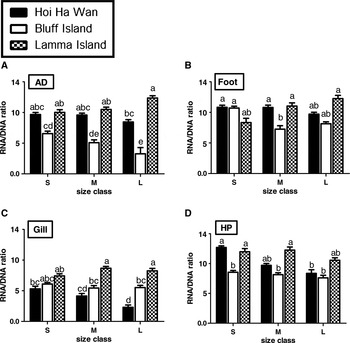
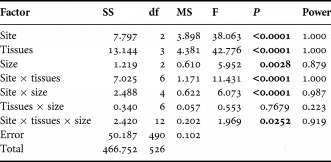
The RNA/DNA ratio of Perna viridis varied significantly between the three sites, four tissue types and three size-classes, and these factors also significantly interacted with each other (Table 2; Figure 2), though the effects of tissue type and site were more apparent than the influence of size as indicated by the F value of each fixed factor (Table 2). In AD, RNA/DNA ratios were similar among all size-groups for each of the three sites while both medium and large mussels collected from BI had a significantly lower RNA/DNA ratio than those from LI and HHW (Figure 2A). The RNA/DNA ratio in foot muscles of the small BI mussels was significantly higher than that in the medium animals (Figure 2B), whereas RNA/DNA ratios in foot muscles of mussels collected from HHW and LI were fairly similar across all size-classes (Figure 2B).
Mean RNA/DNA ratios (+ SEM, N = 13–15) in the four tissue types (A) adductor muscle (AD), (B) foot, (C) gill and (D) hepatopancreas (HP) in three different size-classes (i.e. S, small, 30–40 mm; M, medium, 40–50 mm; and L, large, >50 mm) of Perna viridis collected from three different sampling sites including Hoi Ha Wan, Bluff Island and Lamma Island. Bars labelled with different letters indicate significantly different means at P < 0.05 (Student–Newman–Keuls test).

Results of 3-way analysis of variance of RNA/DNA ratio of four tissues (adductor muscle, foot, gill and hepatopancreas) from three size-classes (small, medium and large) of Perna viridis collected from three sampling sites (Hoi Ha Wan, Bluff Island and Lamma Island). Bold P values indicate factors with significant effect at P < 0.05.

Irrespective of size and site effects, RNA/DNA ratios of the gills of P. viridis were significantly and consistently lower than those measured in other tissues (Figure 2). There was a significant and consistent site effect on the RNA/DNA ratio in the gills across all size-classes with LI mussels having the highest ratio, BI mussels being the intermediate and followed by those from HHW (Figure 2C). Nonetheless, effect of size on RNA/DNA ratios in the gills was insignificant (Figure 2C). Variation of RNA/DNA ratios of HP was site specific; size effect was statistically significant in HHW mussels only in which the RNA/DNA ratio decreased with increasing size (Figure 2D; Table 2). In general, mussels of all size-classes from BI consistently showed the lowest RNA/DNA ratio in all tissue types except the gills when compared with that of the other two sites (Figure 2D).
Spatial variation in nutrient-related parameters
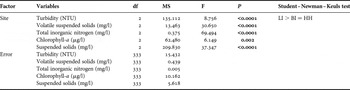
Based on the HKEPD data (Table 3), waters nearby LI consistently showed significantly higher values for all of the nutrient enrichment related parameters when compared with those measured nearby BI and HHW (Table 4). These results suggested that there was considerably higher nutrient levels and greater food availability (as reflected by chlorophyll-a) to filter feeding Perna viridis in LI than in the other two sites.
Environmental data from sampling sites in this study (mean ± SEM). Data were collected from the Marine Water Quality Database (2004–2007) of the Environmental Protection Department (EPD) of Hong Kong Special Administrative Region Government (HKEPD, 2008).

*Notes: according to the marine water quality report from Hong Kong Environmental Protection Department (HKEPD, 2008), ‘middle water’ is defined as the water column between 1 m below sea surface and 1 m above seabed.
Results of multivariate analyses of variance on nutrient-related environmental variables of three sampling sites (Lamma Island (LI); Bluff Island (BI); Hoi Ha Wan (HHW)) from HKEPD data between 2004 and 2007 (HKEPD, 2008). Factors with significant effect at P < 0.05 are indicated by bold P values.

NTU, nephelometric turbidity units.
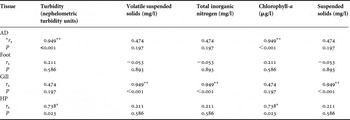
Spearman's correlation analyses, however, revealed significant positive correlations between the mean RNA/DNA ratios of AD, gill and HP tissues, and the averages of nutrient-related environmental parameters (Table 5). Specifically, the mean RNA/DNA ratios in both AD and HP were positively correlated with turbidity and chlorophyll-a concentration, respectively; whereas the mean RNA/DNA ratios of gill were positively correlated with volatile suspended solid, total inorganic nitrogen and suspended solids, respectively. Surprisingly, none of the environmental parameters showed a significant correlation with the mean RNA/DNA ratios in gill tissues (Table 5).
Results of Spearman's correlation analyses on the relationships between RNA/DNA ratios of different tissues (i.e. AD, adductor muscle; foot; gill; HP, hepatopancreas) in field collected Perna viridis and nutrient-related environmental parameters (N = 9).

*r s, Spearman's correlation coefficient. *P < 0.05; **P < 0.001.
Laboratory feeding experiment
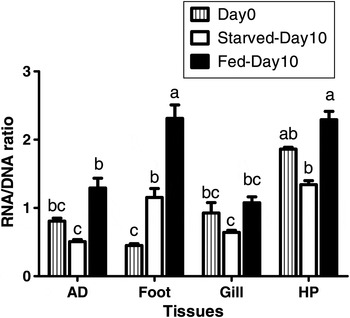
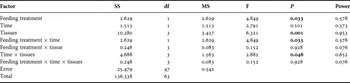
No mortality of P. viridis was observed throughout the experiment. This experiment primarily tested the hypothesis that differences in food availability (i.e. starved versus fed mussels) could influence the RNA/DNA ratio in their tissues. In general, RNA/DNA ratios of starved mussels were significantly lower than those in fed mussels at the end of experimentation after ten days (Figure 3 & Table 6; ANOVA: F1,47 = 4.849, P = 0.033), but the magnitude of change in the ratio greatly varied among different tissue types (ANOVA: F3,47 = 6.321, P = 0.001).
Mean RNA/DNA ratios (mean + SEM, N = 5) in different tissues, adductor muscle (AD), foot, gill and hepatopancreas (HP), between fed and starved Perna viridis after the 10-day experimental period. Black bars represent fed mussels, whereas white bars represent starved mussels. Bars with vertical line represent reference mussels on Day 0. Bars labelled with different letters indicate significantly different means at P < 0.05 (Student–Newman–Keuls test).

Results of 3-way analysis of variance on RNA/DNA ratios in four different tissues of fed and starved Perna viridis (i.e. 2 feeding treatments) over the 10-day experiment experimental period (i.e. 2 time points: Day 0 versus Day 10). Factors with significant effects at P < 0.05 are indicated by bold P values.

RNA/DNA ratios of AD between starved and Day 0 mussels were quite consistent, while the difference between starved and fed mussels on Day 10 was significant (Figure 3; Table 6; SNK test: P < 0.05). The coefficients of variation (CV) in the ratios of AD were found to be 26% and < 40% for starved and fed mussels, respectively. Foot muscle exhibited the most significant difference between starved and fed mussels in which the mean ratios of fed mussels were significantly higher than those in starved mussels (Figure 3; Table 6; SNK test; P < 0.05). However, a high variability in RNA/DNA ratios of foot muscle was noted as reflected by the CV (>67% for fed mussels and >80% for starved ones). In gills, RNA/DNA ratios of fed and starved mussels were fairly stable (CV < 35% for both starved and fed mussels) during the experimental period (Figure 3; Table 6; SNK test: P > 0.05).
Irrespective of food availability, RNA/DNA ratios of the gills were generally lower among all tissue types (Figure 3). This observation was consistent with those observed in the field experiment. Similar to the foot muscle, RNA/DNA ratios of HP in fed mussels (CV = 45%) were significantly higher than those in starved mussels (CV = 51%) and slightly higher than the ratio initially measured on Day 0 (Figure 3; Table 6; SNK test: P < 0.05).
DISCUSSION
It has been widely suggested that the RNA/DNA ratio in sessile marine organisms may be a useful biomarker in coastal habitats that are constantly fluctuating in food dynamic, and changes in magnitude of the RNA/DNA ratio are often representative of the ambient condition (Chícharo et al., Reference Chícharo, Chícharo, Alves, Amaral, Pereira and Regala2001; Dahlhoff et al., Reference Dahlhoff, Stillman and Menge2002; Dahlhoff, Reference Dahlhoff2004; Norkko et al., Reference Norkko, Pilditch, Thrush and Wells2005). Before making proper use of this biomarker, the background of natural variability in their responses needs to be better understood. The current results demonstrated that the RNA/DNA ratio varied significantly among sites with different levels of nutrient enrichment, among tissue types and to a lesser extent among different size-classes. Our observations have provided useful background information on the use of the RNA/DNA ratio as a growth (or stress) biomarker in the mussel farming industry or a biomonitoring programme for marine pollution.
Food availability and RNA/DNA ratio
It is a well-known fact that there is a strong link between coastal food availability and mussel physiology (Dahlhoff & Menge, Reference Dahlhoff and Menge1996). The results from the present field and laboratory studies supported this postulation and confirmed that the level of the RNA/DNA ratio in the mussel is tissue-specific and can reflect nutritional status (well-fed versus starvation), which is directly related to food availability. Mussels collected from BI always had significantly lower RNA/DNA ratios in HP, adductor and foot muscles than mussels collected from LI and HHW, while there was a consistent spatial variation of the ratio in the gills (i.e. LI > BI > HHW). Such observed spatial variations in the RNA/DNA ratio could be partially attributed to the difference in nutrient-related hydrographical condition among sites. For instance, BI is located in the south-eastern waters of Hong Kong subjected to inputs from the oligotrophic South China Sea (Wu et al., Reference Wu, Chung, Wen, Liu, Chen, Chen and Karl2003) with relatively limited freshwater and nutrient input (e.g. nitrogen and silicon) from terrestrial runoff (Miao et al., Reference Miao, Hutchins, Yin, Fu, Harrison and Wang2006; HKEPD, 2008). Under such a low nutrient condition, mussels at BI would have comparatively lower food availability, slower growth rate and hence a lower RNA/DNA ratio in contrast to those living in the eutrophic LI site.
On the contrary, high RNA/DNA ratios were frequently registered in LI mussels, especially in the gills, where there appears to be the most ‘eutrophic’ environment among the three study sites because there were significantly higher concentrations of nutrient-related parameters in the water column (HKEPD, 2008). Mussels from LI were, in fact, situated at an open-sea-cage fish farm where fish meals (in the form of pellets) and minced trash fish with high protein content are commonly applied as fish feed (Rumsey Reference Rumsey1993). Any unconsumed fish food and fish faecal egestion can accumulate as organic matter on the seabed which can be re-suspended in the water column to serve as additional nutrient supply for filter feeding mussels to promote their growth (Hylland et al., Reference Hylland, Skold, Gunnarsson and Skei1996; Leung et al., Reference Leung, Chu and Wu1999) and result in elevated RNA/DNA ratios in the mussels (Norkko et al., Reference Norkko, Thrush and Wells2006). Conceivably, the RNA/DNA ratio in mussels could be used as a sensitive biomarker to differentiate sites with different levels of nutrient enrichment.
The present laboratory experiment was designed to test the hypothesis that the RNA/DNA ratio decreases with starvation in the mussel. This is an important consideration for inferring mussel's metabolic activity in the field while the results would be useful to evaluate the sensitivity of different tissues towards poor nutritional status in terms of the RNA/DNA ratio. After starving for ten days, Perna viridis showed a significant decrease in RNA/DNA ratios in AD, HP and gill tissues when compared with the fed individuals. On the contrary, the RNA/DNA ratio of foot muscles was still elevated in the mussels even under starvation. Such an increase in the amount of RNA abundance may be associated with the continuous synthesis of proteinaceous byssus threads required for settlement on substrate, irrespective of food availability or energy supply (Shin et al., Reference Shin, Yau, Chow, Tai and Cheung2002; Wang et al., Reference Wang, Hu, Shin and Cheung2010). By comparing between starved and well-fed mussels, RNA/DNA ratios in foot muscle, HP and AD were very sensitive to a short-term change in food availability (i.e. 10 days) and such results reinforce the findings obtained in the field study (as discussed above). Like P. viridis, previous studies also reported that starvation can result in reduced RNA/DNA ratios in bivalves (Wright & Hetzel, Reference Wright and Hetzel1985; Dahlhoff et al., Reference Dahlhoff, Stillman and Menge2002), gastropods (Okumura et al., Reference Okumura, Nagasawa, Hayashi and Sato2002) and fish (Ferron & Legett, Reference Ferron and Leggett1994). The decrease in the RNA/DNA ratio is related to the reduction or inhibition of protein synthesis and thus the ratio can be used as an indication of hindered growth and metabolism (Dahlhoff, Reference Dahlhoff2004; Chícharo & Chícharo, Reference Chícharo and Chícharo2008). Thereby, the lower RNA/DNA ratio may signify the slow growth rate (or poor health, i.e. stress condition) in the mussels that are perhaps under deprived food availability coupled with other physical–chemical stresses.
Size effect on RNA/DNA ratio
It is a general physiological rule that juvenile animals usually have a higher metabolic rate and faster growth (Chícharo & Chícharo, Reference Chícharo and Chícharo2008). As such, one would predict that small mussels should present a higher RNA/DNA ratio reflecting a high rate of protein synthesis for somatic growth (Hawkins, Reference Hawkins1991). This study, however, did not show and support the hypothesized size-dependent trend that the RNA/DNA ratio increases with decreasing size in Perna viridis. Instead, the current results showed that the size effect on the RNA/DNA ratio in P. viridis is highly tissue-specific and site-specific. Thus, it is not possible to make tangible generalizations on the size effect. The size effect was only significant in AD and foot muscle of BI mussels and in gill and HP of HHW mussels, in which small mussels exhibited a higher RNA/DNA ratio than in medium and large mussels (Figure 2). Referring to the HKEPD data, BI and HHW are relatively ‘oligotrophic’. The decline of RNA/DNA ratios with increasing size observed in BI and HHW mussels could be the combined consequence due to the limited exogenous food available and the allocation of endogenous energy reserves from somatic growth to reproduction (Roddick et al., Reference Roddick, Kenchington, Grant and Smith1999; Mouneyrac et al., Reference Mouneyrac, Linot, Amiard, Amiard-Triquet, Métais, Durou, Minier and Pellerin2008). Also, it should be noted that a decrease in the RNA/DNA ratio with increasing age most likely reflects a decrease in growth rate but may not necessarily indicate a decrease in condition (Chícharo & Chícharo, Reference Chícharo and Chícharo2008).
The discrepancy of the size effect between sites is probably associated with the better nutritional status in LI mussels contrasting with BI and HHW mussels. The elevated food availability associated with fish farming activities might have promoted fast growth and thus overridden the size effect on RNA/DNA ratios in LI mussels. Norkko et al. (Reference Norkko, Thrush and Wells2006) also reported a similar observation that the effect of enhanced food availability could override the negative effect of hypoxia on the RNA concentration in marine benthic bivalves.
Moreover, it has been reported that there were significant differences in nucleic acid concentration between males and females of marine organisms during the spawning season (Chícharo & Chícharo, Reference Chícharo and Chícharo2008). The current study did not take gender effect into account, as it was not possible to identify the sex of Perna viridis solely based on the colour of the gonad without in-depth histological studies (Lee, Reference Lee1988). Based on the field study conducted by Cheung (Reference Cheung1991), P. viridis in Hong Kong exhibited year-round spawning and thus gender effect might influence the interpretation of the RNA/DNA ratio to a certain extent. However, several studies also elucidated that food availability is the primary controlling factor for growth and gonad development in mussels (Sreenivasan et al., Reference Sreenivasan, Thangavelu and Poovannan1989; Rajagopal et al., Reference Rajagopal, Venugopalan, van der Velde and Jenner2006). Hence, gender and size could be comparatively minor factors influencing the result and interpretation of the RNA/DNA ratio in the mussels under eutrophic condition. A further study on the gender effect on the ratio in P. viridis is still needed to verify this postulation.
Nonetheless, the current results did show that small mussels in two sites (BI and HHW) exhibited the highest RNA/DNA ratio in most cases. Therefore, selecting small fast-growing individuals for measurement of the RNA/DNA ratio is still preferable as it may provide a more sensitive response (in terms of the magnitude) to the change of ambient levels of nutrients and toxicants.
Sensitivity of RNA/DNA ratio in different tissues due to food availability
In the present field study, the correlation analyses demonstrated that the level of the RNA/DNA ratio, particularly in HP, AD and gill tissues of the mussels, is strongly associated with nutrient levels in the marine environment. In our laboratory study, RNA/DNA ratios of HP, AD and gill tissues of the mussels considerably reduced after starvation for ten days, while feeding could promote the elevation of the ratio in all tissues, in particular more pronounced increases were observed in foot muscle and HP tissues. RNA/DNA ratios of HP and foot are comparatively more sensitive to nutritional status because they are characterized by dynamic protein-based activities, but in different aspects.
Hepatopancreas serves as an energy storage organ to allocate energy utilization among tissues (Mayrand et al., Reference Mayrand, Pellerin-Massicotte and Vincent1994; Segnini de Bravo, Reference Segnini de Bravo2003). The increase in the RNA/DNA ratio of HP is more directly related to energy acquisition and facilitated growth. HP consists of digestive glands which produce digestive enzymes and also act as a buffer organ to store and distribute metabolites to other parts of the organism (Pease, Reference Pease1976; Mayrand et al., Reference Mayrand, Pellerin-Massicotte and Vincent1994). Since HP is actively involved in the metabolic and enzymatic activities, a higher rate of protein turnover is expected (Bayne et al., Reference Bayne, Widdows, Thompson and Bayne1976) and this is reflected in our results that HP tissues have a significantly higher RNA/DNA ratio over other tissue types in most of the cases.
As mentioned above, a high RNA/DNA ratio in foot muscles of P. viridis is probably related to the secretion of proteinaceous byssal threads (Coan et al., Reference Coan, Scott and Bernard2000). Under a desirable environmental condition, mussels are more likely to attach on the substratum by pressing foot muscles firmly on the surface and secreting adhesive protein for byssus production (Nishida et al., Reference Nishida, Ohkawa, Ueda and Yamamoto2003) and lead to elevated RNA/DNA ratio. Given that there was high variation (shown by the coefficient of variation) in the RNA/DNA ratios in foot muscle and no significant correlation between the ratio in this tissue and all of the nutrient-related environmental parameters, the RNA/DNA ratio of foot muscle may be less directly related to the energy acquisition or nutritional associated factors. Wang et al. (Reference Wang, Hu, Shin and Cheung2010) proposed that byssus thread production has to compete with other physiological processes for energy which may reduce the tolerance of the mussels to stress, and consequently inhibit the chance of their survival. However, the present laboratory study was a short-term experiment in which survival was not threatened by energy depletion. It would be worthwhile and interesting to further investigate the potential energetic trade-off between byssus production and survival under prolonged starvation when growth becomes negative.
CONCLUSION
To summarize, the RNA/DNA ratio in the mussel Perna viridis, particularly in HP tissues, is sensitive to nutritional-related stresses. Spatial or temporal comparison of the ratio between different groups of P. viridis should be carried out by selecting the appropriate types of tissues and to a lesser extent a confined size-class for analysis. Although RNA/DNA ratios of AD and gill tissues were relatively less sensitive to short-term changes in food availability in the laboratory experiment, their ratios in field collected mussels displayed a clear spatial variation pattern corroborated by the difference in nutrient-related hydrographical condition in a more long-term time scale. Given that considerable differences in the RNA/DNA ratio were found between tissue types, conversion factors could also be estimated and adopted to facilitate the comparison between studies using different tissues of the same species for nucleic acid analysis (Olivar et al., Reference Olivar, Diaz and Chicaro2009). By choosing suitable tissues at a confined size of the same population of P. viridis (e.g. 30–40 mm in shell length) with optimum sample size, the RNA/DNA ratio could be a useful biomarker for indicating the cellular growth of the mussels and indirectly reflecting the propensity of primary productivity in the marine ecosystem.
ACKNOWLEDGEMENTS
This work is partially supported by the Area of Excellence Scheme under the University Grants Committee of the Hong Kong SAR Government (project no. AoE/P-04/2004). We thank Dr Vivien Bao for proofreading an early draft of this paper. Jamius Yeung thanks the Swire Institute of Marine Science and the University of Hong Kong for providing her with a postgraduate studentship.