Introduction
Social work is considered to be an essential part of the interprofessional Palliative Care teams (Cummings, Reference Cummings, Doyle, Hanks and Macdonald1999; Johanson and Johanson, Reference Johanson, Johanson, Sheehan and Forman1996; Radbruch and Zech, Reference Radbruch, Zech, Aulbert and Zech2000; Commissioning Guidance for Specialist Palliative Care: Helping to Deliver Commissioning Objectives, 2012; Österreichisches Bundesinstitut für Gesundheitswesen, 2014). Yet little has been known so far about the situation of Hospice and Palliative Care Social Work (PCSW) in Europe. In 2014 and 2015, two White papers of the European Association for Palliative Care (EAPC) Task Force on social work in palliative care were published on core competencies for PCSW in Europe (Hughes et al., Reference Hughes, Firth and Oliviere2014, Reference Hughes, Firth and Oliviere2015). EAPC Task Forces are formed by interested EAPC members from a range of disciplines and different countries who work together to deliver on focused, time-limited projects. The Social Work Task Force was established in 2009 with the aim to offer leadership to social workers (SWs) in the End of Life and Palliative Care across Europe. The next step was to generate data on the prevalence of PCSW in Europe and on the job situation of Palliative Care Social Workers. Creating a fundamental data basis on PCSW in Europe is a precondition to develop the profession, where the differences — due to structural or professional reasons — could be the starting point to learn from each other. Developing PCSW requires us to get to know the status quo on a European level, to acknowledge differences, and to develop a common understanding and European professional standards.
Methods
Since there were no data available on PCSW in Europe, the challenge was to generate very basic level data from as many European countries as possible. The EAPC has collective members in most European countries. The EAPC was asked to contact the collective members asking them to fill in an online questionnaire (from October 2015 to March 2016). In order to generate sufficient data, two reminders followed.
The questionnaire for the collective members contained questions concerning the estimated figures of SW in their countries, their presence on the national board, social work standards, standardized job descriptions, and asked for the Hospice and Palliative Care settings where SWs are to be found. Given the lack of consensus around definitions in end-of-life care and palliative care (Bern-Klug et al., Reference Bern-Klug, Kramer and Linder2005) and the variability in the use of these related terms in the literature, in our survey, we used the wording from the EAPC White Paper on Standards and Norms for Hospice and Palliative Care (Radbruch et al., Reference Radbruch, Payne, Bercovitch, Caraceni, de Vlieger, Firth, Hegedus, Nabal, Rhebergen, Schmidlin, Sjøgren, Thishelman and Wood2009, Reference Radbruch, Payne, Bercovitch, Caraceni, de Vlieger, Firth, Hegedus, Nabal, Rhebergen, Schmidlin, Sjøgren, Thishelman and Wood2010).
The collective members were also asked to name a person who would be willing to distribute the second questionnaire in his country in order to reach as many individual PC SWs as possible to gain some insights from the SWs themselves.
In a second approach, we contacted these people in April 2016, sending them the link to the SWs questionnaire. We asked them to distribute the link to the PC SWs in their country. Two reminders were sent. This online questionnaire was closed in March 2017. Since one of the main obstacles of such an international survey is that it must be understood by participants with native languages other than English, we offered to translate the questionnaires into some native languages. In the end, there were English and German version onlines. This questionnaire contained questions about the professional situation of the participating SWs including the interprofessional team they work in as well as their qualification. The main items were the tasks and roles they performed including a potential role overlap. A starting point for the creation of the questionnaire was the EAPC White Paper on core competencies for PCSW in Europe (Hughes et al., Reference Hughes, Firth and Oliviere2014, Reference Hughes, Firth and Oliviere2015). In a first draft, the EAPC Task Force set up a list of known tasks and roles of PCSW. This draft of the tasks and roles was sent out to the members of the Task Force all over Europe. Then the list was redefined, and the items were grouped around four main themes: tasks concerning patient and family, tasks concerning the team, tasks concerning the management of volunteers, and tasks concerning other activities.
For the analysis of the data, the Statistical Package for the Social Sciences (SPSS 24 for Microsoft Windows) was used. Since the data did not follow a normal distribution, nonparametric tests were applied. To compare the results of different countries and different settings, the t-test for independent samples was used.
Results
Participants
Thirty-two collective members from 25 European countries (Albania, Austria, Belgium, Czech Republic, Denmark, Finland, France, Germany, Greece, Hungary, Ireland, Italy, Lithunia, Luxembourg, Netherlands, Norway, Poland, Portugal, Romania, Russia, Slovakia, Spain, Sweden, Switzerland, and UK) participated. From five countries, more than one collective member took part (Belgium, Greece, Norway, Russia, and UK). The EAPC members represent 32 countries, so the survey covered 78% of the countries represented by the members of the EAPC.
360 SWs from 19 countries (including Serbia, which is not an EAPC member) responded. Most responses from SWs came from Germany (32% of the questionnaires), the UK (19%), and Austria (12%) (Table 1).
Number of questionnaires from Palliative Care Social Workers by the country

Ninety-one percent of the respondents were female, between 22 and 70 years of age (on average 46 years), and 90% had a degree in social work (28% Bachelor, 21% Master, and 41% Diploma). 51% had undergone a specialized training in Palliative Care. Almost all of those with a specialized training (89%) had been in interprofessional training. Forty-four percent had a certificate of attendance in such a training, 40% a diploma in Palliative Care, and 10% a post-graduate certification. The time frame of this training varies from <9 h (5%) to >120 h (37%). Most of this training took between 41 and 120 h (42%). Some of the respondents were new to PCSW, and some had up to 39 years of experience (on average 9 years). Eighty-two percent of the participants work with adult palliative care patients, namely in home palliative care services (27%), inpatient hospices (24%), palliative care units (21%), hospital palliative care support teams (18%), volunteer hospice services (Radbruch et al., Reference Radbruch, Payne, Bercovitch, Caraceni, de Vlieger, Firth, Hegedus, Nabal, Rhebergen, Schmidlin, Sjøgren, Thishelman and Wood2009: 30; 16%), and day hospices (13%). Multiple answers were allowed.
Prevalence of Palliative Care Social Workers (SWs) in Europe
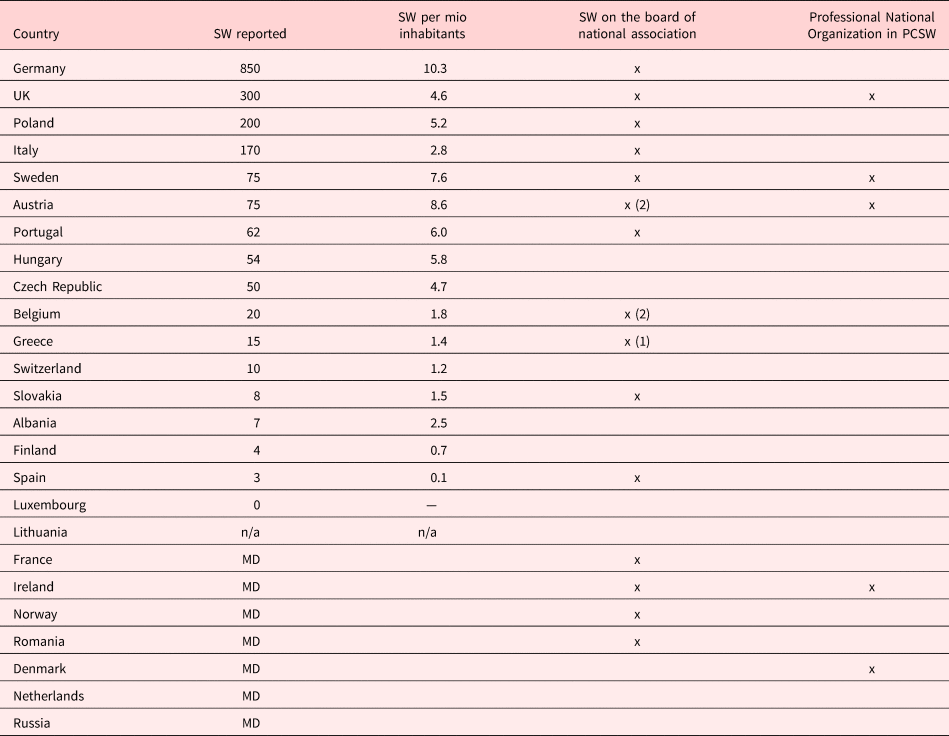
The survey generated data on the number of SWs in 18 European countries. There were no data available about the number of SWs in Denmark, France, Ireland, Lithuania, Netherlands, Norway, Romania, and Russia.
Palliative Care Social Workers are based in different settings: inpatient hospices (55%), hospital palliative care units (50%), home palliative care services (46%), and hospital palliative care support teams (46%) — according to the estimates of the national Hospice and Palliative Care associations. They are rarely represented in volunteer hospice services: 21% “rarely” and 21% “not at all”.
According to the responses from member associations of the EAPC, the large majority of SWs can be found in Germany, the UK, Poland, and Italy. In relation to the population, most SWs can be found in Germany, Austria, and Sweden. Whereas there are 10.3 SW per million inhabitants in Germany, there are 4.6 in the UK and 1.2 in Switzerland. In 60% of the responding countries (n = 25), there are SWs on board of at least one of the national hospice or palliative care associations, and in five countries, SWs had their own national association (Table 2).
Palliative Care Social Workers in Europe

Social work standards and specialized training in Hospice and Palliative Care
In 80% of the responding countries, there were no national guidelines for social work in Hospice and Palliative Care settings. However, there are certain documents/standards for social work in palliative care in 12 countries (48%). An example for this is a quality concept for PCSW in Germany (Leutbecher et al., Reference Leutbecher, Rohlfing, Schneider, Fülbier, Kn, Witteler, Ellermann, Müllender, Schlütz and Goldmann2006) or the paper on standards, competences, and the job profile of PCSW in Austria (OPG, 2018). In about half of the responding countries (48%), there exist professional profiles or standardized job descriptions for PCSW.
Only five countries (20%) reported the existence of a specialized qualification in PCSW (Table 3).
Specialized qualifications in PCSW

Working conditions
Fifty percent of the responding SWs had a full-time job in PCSW. Forty-eight percent worked part time and 2% were self-employed (3–43 h per week, on average 30 h). Almost half of the respondents are the only SWs in their team (46%). 72% of the responding SWs were employed by a hospice or palliative care service, 90% were regular team members of the interprofessional PC or hospice team. Their jobs were funded mainly by the public (60%). 40% of the jobs were funded by private donations.
Three out of four SWs had a job description available. But only 50% stated that their colleagues knew this job description. The participants were asked to what extent the job description consisted of PC tasks. Fourteen percent of the responding SW reported that their job did not include any PC tasks. Eighteen percent said that their job descriptions included at least to some extent PC tasks, and 26% reported that their job consisted exclusively of PC tasks. On a scale from 0 (not congruent) to 5 (completely congruent), the mean figure for congruency of job description and real job was 3.8 (range: 0–5).
The national organizations were asked as well as the individual SWs to rate the working conditions for SWs in their countries. The national organizations rated the working conditions worse than the responding SWs. Eighty-one percent rate their working conditions to be very good or good, but only 17% of the national organizations do so (Table 4).
Working conditions

1 = very good to 4 = insufficient.
Countries with less than 4 SW questionnaires are not included.
Tasks
The participating SWs were asked to rate each item they performed and whether they carried out this task exclusively/often, sometimes/rarely or never.
Ninety-four percent of the predefined tasks concerning patient and family and 93% of the tasks concerning the team have been confirmed by the respondents to be part of their professional duty as SWs.
The core tasks of PCSW are: providing emotional support for the family of the patient, mediating clients and family's information needs and counseling family members, as well as participating in the interprofessional team and promoting the social perspective within the team (80% or more SWs rated these tasks as exclusively or often their task). Alongside, they take over many other tasks like counseling on financial issues, counseling patients, psychosocial assessment of the family, psychosocial assessment of the patient, and providing emotional support for patients.
Managing volunteers is only carried out by one in five SWs. Even fewer SWs are board members, researchers, or fundraisers.
PCSW seems to be focusing on the family and the social perspective: 28% of the participants stated that they spend most of their working time on patients, 24% on family, and 19% on patient and family to equal parts. However, 82% of SWs are also involved in promoting the work of their organization and 95% are obliged to carry out administrative activities. Twenty-one percent of the SWs spend most of their time with administrative activities.
The set of tasks performed differs between the settings. In hospital palliative care units, SWs have a strong focus on the psychosocial assessment of patients and their families. The main focus in all other settings is emotional support for family and counseling family members. However, in every setting, there is a strong focus on participation in care planning and delivery. Compared to the other settings, palliative care units and palliative care teams are less engaged with emotional support for clients, advising on legislation, advocating on behalf of clients, and fostering communication within the family (Table 5).
Tasks of Palliative Care Social Workers

Roles and role overlaps
The study design involved the identification of roles performed by SWs (e.g. case manager and mediator). The SWs participating in the survey were asked to state which role they performed most often, which ones sometimes, rarely, or never. Being a team member is the primary role for Palliative Care Social Workers (99%). The second task most often performed is the role of the counselor and thirdly the task of advocator (Table 6).
Role overlaps of Palliative Care Social Workers

The responding SWs reported working in interprofessional teams with nurses (75%), physicians (73%), psychologists (52%), chaplains (55%), physiotherapists (52%), art therapists (15%), music therapists (16%), and others (22%). This means working with role overlaps on a daily basis for SW. The respondents were asked to report role overlaps with other members of the interprofessional team. According to the respondents, there is an 80% role overlap with nurses (19% “strong” and 61% “some”), closely followed by psychologists and psychotherapists with 79% (18% “strong” and 61% “some”). There is also a considerable role overlap with chaplains (73%; 14% “strong” and 59% “some”). The least overlap but still significant is the role overlap with physicians reported by 52% of the respondents (44% “strong” and 48% “some”).
Comparison between Austria, Germany, and the UK
Since Austria, the UK, and Germany had the highest response rates, data between these countries were compared. Most of the responding SWs were female (the UK 83%, Austria 88%, and Germany 90%). The medium age of the SW was 41 in Austria (22–59), 46 in Germany (26–62), and 52 in the UK (34–70). Whereas in Austria two-third of the respondents (67%) had undergone a specialized PC training, only 43% of the respondents from the UK and 55% from Germany reported such a training. However, only 17% of the SWs from Austria and 37% from Germany were employed full time, whereas half of the SWs from the UK (49%) worked full time as a Palliative Care Social Worker. Looking at the tasks performed, Austrian SWs have a focus on working with the family (38% work exclusively or often with families), and the UK SWs have their focus on patient and family (25%). German SWs reported a strong focus on administrative activities (27% as compared to 7% in the UK and 2% in Austria). The job satisfaction is very good in the UK (1.60 on a scale from 1 to 5) and in Austria (1.74) and good in Germany (2.08).
Discussion
Obviously, this study had to deal with many challenges and restrictions. First and probably most important was to find the right persons to deliver the necessary data. The two-step approach proved to be the right decision, but still has some methodological shortcomings. Using the widespread network of the EAPC was very helpful, but even so some of the national organizations did not respond. A response rate of 56% that covered 78% of the member states of the EAPC is quite considerable and provided significant data for the survey. The more delicate part was to generate a representative sample of SW active in the field. The decision to use the path of the national organizations to identify key persons for the distribution of invitations to participate in the online survey makes sense even in the hindsight. The downside of this choice is that there was little influence on the actual sample of participating SW. On the other hand, this secured neutrality in getting the sample.
Although the reported numbers from the national organizations must be treated cautiously since they are only estimations, they do show a huge gap between the different countries which is a big surprise. Data are still missing from big countries like France. So, it is not known how many SW there are active in countries like France, Ireland, or the Netherlands. According to the data, most SWs in relation to the population can be found in Germany, Austria, and Sweden. However, only 17% of the Austrian SWs and 37% of the German SWs are working full time. This might be a crucial factor, why the percentage of SWs is so high in Austria.
A closer look at the EAPC Atlas 2019 (Arias-Casais et al., Reference Arias-Casais, Garralda, Rhee, de Lima, Pons, Clark, Hasselaar, Ling, Mosoiu and Centeno2019) shows that the correlation between the number of SWs in Europe and the number of PC services is rather weak. According to the Atlas, Germany has 1.1 PC services for adults per 100.000 inhabitants, Sweden 1.6, and Austria 2.2. According to the feedback from the National Hospice and PC Associations, Germany has 1.03 SW per 100.000 inhabitants, Sweden 0.76, and Austria 0.86.
Four national organizations could not give us data on the numbers of SWs in their country. So, this could be interpreted that even with SWs on board of a national organization, there is no guarantee that they are in touch with the SWs in their country.
It seems that SWs in Palliative Care are quite content with their jobs. This result can be due to a bias, assuming that more SWs content with their working conditions participated in this study. Seen from the distance of a national organization, there is a lot of room for developing the structures and conditions of PCSW. Given the fact, there are still many PC teams without SWs; obviously, there are still some obstacles to overcome to be satisfied about a situation in which social work is not represented given the importance of the role. Reith and Payne (Reference Reith and Payne2009) provide an example of the power of the role when they argue that SWs in the end-of-life care by enabling family members and informal care givers to care for a dying person strengthen the family in the long term.
This survey proves that SWs perform a wide range of different tasks and roles and is thus in line with the results of Brandsen (Reference Brandsen2005).This can be partly explained by the fact that the environment impacts on the social work role, e.g. working within a interprofessional team on a palliative care unit in a hospital, is quite different from the work in a volunteer hospice service (Lawson, Reference Lawson2007).
The focus of PCSW is on the family and on the social perspective in contrast to the focus of the other professions in the field. This is not a surprise, given the fact that many SWs use the family-centered model of care. This model offers a framework for understanding the value of family in the end-of-life care. Therefore, it fits well with the social work perspective that perceives individuals within the context of their family system and their greater environment (Kovacs et al., Reference Kovacs, Bellin and Fauri2006).
A significant role overlap with other professions was found. This might be due to the wide range of tasks which SWs perform or may be caused by missing job descriptions or standards which lead to ambiguities about competencies and tasks. Too much ambiguity, however, may be irritating and time-consuming (Speck, Reference Speck2006) and should be avoided.
Only five countries reported the existence of specialized qualification training in PCSW. From other research projects, it is known that SWs often feel unprepared for this work and that they need additional training and knowledge (Csikai and Raymer, Reference Csikai and Raymer2005; Christ and Sormanti, Reference Christ and Sormanti1999). In the Quality of Death Index (The Economist Intelligence Unit, 2015), several characteristics have been identified that countries with a high quality of death share. In addition to a strong and effectively implemented national palliative care policy framework and other factors like an extensive palliative care training, resources for general and specialized medical workers are mentioned explicitly. Perhaps, it would be helpful to develop a European curriculum for PCSW including teaching aids, literature, and so on, which could be used as a basis for the development of national curricula.
Conclusion
Our goal was to generate basic data on PCSWs in Europe. This study shows very clearly, on one hand, the diversity of PCSWs in Europe, but on the other hand also the key elements of PCSWs that are shared across national borders and despite of varying framework conditions.
The diversity is visible in the vastly differing numbers of Palliative Care Social Workers across the countries, in the awareness of PCSW or lack thereof on the boards of national organizations, in the uneven spread of SWs within the different Hospice and Palliative Care services, and the absence of specialized training for PCSWs, profiles, or national guidelines. A closer comparison of tasks and roles between the different countries will most likely reveal more of the diversity that exists in the field.
But the study also confirmed some key elements of PCSWs in Europe: PCSWs are essentially team players who maintain the social perspective in the care process and stands at the side of patients and their families. Counseling patients and even more their families, providing emotional support and keeping communication fluid, seem to be key roles of PCSWs.
SWs are used to working with other professions and are quite content with their working conditions — even despite of the considerable role overlaps. It is a characteristic and strength of social work to be in a close contact with many professions and thus being in touch with a diversity of professional roles, but examining the role overlaps in their teams and clarifying the task and roles of the team members where necessary will positively contribute to the team atmosphere and a better output.
Developing PCSWs in Europe is a worthwhile challenge. The frameworks for SWs are not good enough, and the prevalence of SWs in different settings and different countries is still poor. SWs are not yet an integral part in all Hospice and Palliative Care teams as stated in various publications. The EAPC Task Force Social Work should address these issues. Firstly, guidelines and standards would be helpful in order to clarify the competencies and tasks of Palliative Care Social Workers. In addition, it is recommended to develop a European curriculum for PCSWs to provide additional knowledge and skills for SWs in this field. Lastly, more research is needed on social work in palliative care.
Acknowledgments
The authors thank the EAPC for the support undertaking the survey, and the national organizations and social workers for their participation. They also thank the members of the Task Force Social Work for their contributions!
Conflict of interest
None of the contributing authors has any conflict of interest.