Background
Insomnia is defined as ‘a repeated difficulty with sleep initiation, duration, consolidation, or quality that occurs despite adequate time and opportunity for sleep and results in some form of daytime impairment’.1 The daytime impairments associated with insomnia can include fatigue or malaise; attention, concentration, or memory impairment; social or vocational dysfunction or poor school performance; mood disturbances or irritability; daytime sleepiness; motivation, energy or initiative reduction; proneness for errors or accidents at work or while driving; tension, headaches or gastrointestinal symptoms in response to sleep loss; and concerns or worries about sleep.1 These impairments, of course, can be quite costly, affecting normal daytime functioning as well as increasing the likelihood for falls and accidents, depression, cognitive impairments and stress to partners.Reference Tinetti, Speechley and Ginter2–Reference Goktas and Ozkan8 The severity of insomnia is variable and is dependent on frequency, intensity and duration of sleep difficulties, as well as their impact on daytime functioning, mood and quality of life.9, 10
The International Classification of Sleep Disorders (2nd edition), which lists over 80 sleep disorders, defines 11 of these conditions as subtypes of insomnia.1 The technology to precisely diagnose each subtype of insomnia is still lacking in day-to-day practice, but in terms of appropriate understanding and treatment, it is important to consider type of insomnia. The main types include psychophysiological insomnia (with psychosomatic arousal, excessive concern about sleep adequacy, and somatised tension), inadequate sleep hygiene (where the sleep problem appears to be caused or maintained by dysfunctional practices around sleep), and sleep-state misperception (where the insomnia diagnosis is not supported by objective findings). Insomnia can further be classified by its duration: transient (less than 2 weeks), acute or short-term (2–4 weeks), or chronic (more than 4 weeks).Reference Buysse, Szuba, Kloss and Dinger11
Prevalence
The prevalence of sleep problems in adulthood has been shown to increase with age.Reference Tinetti, Speechley and Ginter2, Reference Ford and Kamerow12–Reference Reid, Martinovich, Finkel, Statsinger, Golden, Harter and Zee16 By survey, half of older individuals report some extent of sleep difficulties, including trouble initiating sleep, poorer sleep efficiency, increased time in bed, more night time awakenings, earlier wake up times, and more daytime naps.Reference Stepnowsky and Ancoli-Israel17 Of these sleep complaints, insomnia is the most prevalent in older adult populations.
The reported pervasiveness of insomnia in older adults is perhaps not surprising as insomnia is generally the most common and prevalent of sleep disorders in adults. However, as demonstrated by empirical evidence, the incidence and prevalence of insomnia increase with age, making it a much more significant occurrence in older populations. Where insomnia is reported to affect approximately 35% of the adult population every year, with between 9 and 12% suffering chronically,Reference Ford and Kamerow12, 18, Reference Mellinger, Balter and Uhlenhuth19 according to epidemiological surveys up to 40–50% of individuals over 60 years indicate that they are dissatisfied with their sleep or have trouble sleeping, with between 12 and 25% complaining of chronic insomnia.Reference Ford and Kamerow12, Reference Brabbins, Dewey and Copeland13, Reference Foley, Monjan, Brown, Simonsick, Wallace and Blazer15, Reference Mellinger, Balter and Uhlenhuth19, Reference Hohagen, Kappler, Schramm, Rink, Weyerer, Riemann and Berger20 Indeed, it appears that insomnia is a more prevalent complaint amongst older people with an annual incidence rate in those over 65 years reported as 5%.Reference Foley, Monjan, Simonsick, Wallace and Blazer21
It has been suggested that certain characteristics may moderate insomnia as it appears to be more prevalent in women, older adults, shift workers, and patients with health problems, medication, psychiatric disorders, low life satisfaction, and inadequate sleep hygiene.Reference Hidalgo, Gras, Garcia, Lapeira, Del Campo and Verdejo22, Reference Boix Gras, Lopez-Torres Hidalgo, David Garcia, Tellez Lapeira, Villena Ferrer and Parraga Martinez23 Of the factors most relevant to older people, Foley and colleaguesReference Foley, Monjan, Simonsick, Wallace and Blazer21 report that only 7% of the incident cases of insomnia in older people occur without a co-morbid condition. As such, prevalence rates of insomnia are higher when co-existing medical or psychiatric illness (including depression and anxiety disorders) are taken into account.Reference Ford and Kamerow12, Reference Mellinger, Balter and Uhlenhuth19, Reference Foley, Ancoli-Israel, Britz and Walsh24 Lifestyle changes related to retirement and ageing, institutionalization, the increased incidence of health problems (e.g. arthritis, cancer, RLS, Parkinson's disease, congestive heart failure, asthma, gastro-oesophageal reflux, urinary incontinence, nocturia, and benign hyperplasia), and the use of medication (e.g. CNS stimulants, β-blockers, corticosteroids, bronchodilators, calcium channel blockers, and thyroid hormones) also all appear to place older people at increased risk of disrupted sleep;Reference Morgan, Dallosso, Ebrahim, Arie and Fentem25, Reference Dopheide, Stimmel, Koda-Kimble, Young and Kradjan26 and finally, sleep disturbances may also be co-morbid with (but not necessarily causative of) dementia, while Alzheimer-related deterioration of suprachiasmatic nucleus neurons could cause still further disturbance in sleep–wake cycle disorders.Reference Kripke27
The co-morbidity of insomnia with other medical and psychiatric conditions can make its diagnosis and treatment less concise. However, even with the covariance of other age factors considered (e.g. health problems, neurobiological changes associated with age, desynchronization of circadian rhythms), insomnia remains a significant concern for many older people.Reference Morin and Gramling3, Reference Bliwise, King, Harris and Haskell28 The adverse effects of poor sleep in older populations have been associated with reduced memory, impaired concentration, inhibited functional performance, decreased quality of life, chronic fatigue, and increased risk of cognitive decline, malaise, accidents, falls and mortality.Reference Brassington, King and Bliwise6, Reference Foley, Monjan, Brown, Simonsick, Wallace and Blazer15, Reference Manabe, Matsui, Yamaya, Sato-Nakagawa, Okamura, Arai and Sasaki29–Reference Schubert, Cruickshanks, Dalton, Klein, Klein and Nondahl32 The appropriate assessment and treatment of sleep disorders, particularly in older populations, has increasingly received the attention of researchers and practitioners. While the research base is still expanding, some empirical evidence indicates assessment and treatment options for insomnia in older people.
Objective
The primary objective of this paper is to review the empirical evidence regarding the occurrence of insomnia in older people and the extent of both pharmacological and non-pharmacological treatment options available. It is hoped that the summation of available evidence will later serve in the development of treatment guidelines for insomnia in older populations.
Search methods
EMBASE, Medline and PsychInfo electronic databases were searched through 2 February 2010 using the following search string:
1 Sleep disorders
2 Insomnia
3 Wakefulness
4 1 or 2 or 3
5 Geriatric or geriatrics
6 Elderly
7 Old
8 Aged
9 Senior
10 5 or 6 or 7 or 8 or 9
11 4 and 10
The search retrieved 1006 articles. The resulting titles and abstracts were searched to identify reviews of sleep, particularly insomnia, in older people.
Basic issues concerning sleep in older people
As previously addressed, a variety of factors may give rise to the sleep problems reported (and often under-reported) by older people including medical illnesses, both chronic and acute; the effects of medication; psychiatric problems; primary sleep disorders; social changes; and behaviour patterns that are not conducive to good sleep.Reference Bliwise4, Reference Neubauer33 These problems may be exacerbated by poor handling of these problems by the patient, his or her family, medics, and other health-care workers. Furthermore, determining the clinical significance of insomnia in older people and the extent to which it deserves treatment can be difficult. Several changes in sleep patterns are known to be part of the normal ageing process.
Normal sleep consists of five stages of active and co-ordinated brain processes. Stages I to IV are made up of non-rapid eye movement (NREM) sleep and stage V by rapid eye movement (REM) sleep. NREM sleep dominates the first half of a normal night, with each subsequent stage of sleep increasing in depth. Stage I occurs at sleep onset or following arousal from another stage of sleep. The EEG is low voltage with mixed frequencies and reduced α-activity compared with the awake state. It makes up about 5% of the total sleep time. Stage II contains more slow-wave activity, and sleep spindles and K complexes are seen. It makes up around 50% of overnight sleep. Stage III, also about 5% of sleep time, is yet more slow-wave EEG activity and Stage 4 is the slowest activity and makes up about 15% of sleep. Together, Stages III and IV are known as slow-wave sleep. These are the deepest forms of sleep from which awakening is especially difficult. Arousal disorders such as sleep-walking and confusional arousals arise in slow-wave sleep.
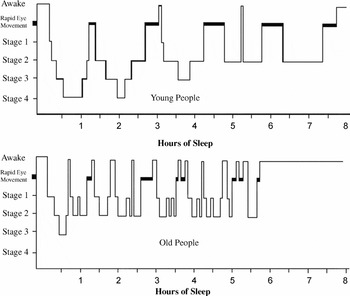
REM sleep, occurring in stage V, is generally associated with dreaming as well as lability of heart rate, blood pressure, and respiration. Brain metabolism is highest in this stage of sleep, with a low voltage, mixed frequency non-α electroencephalogram (EEG). Spontaneous rapid eye movements are seen and skeletal muscle tone is virtually absent. REM sleep makes up approximately 25% of total sleep time in adults and it is when most dreaming occurs. REM-sleep episodes occur at approximately 90 minute cycles, with each episode increasing in duration as the night progresses. It is sometimes known as paradoxical sleep since the EEG is most like wakefulness and yet there is very little physical activity. These sleep stages are summarized in Figure 1, which shows a summative hypnogram, or sleep histogram, for a 25-year-old adult and an otherwise healthy 80-year-old person for comparison.
Sleep hypnogram for a young adult and an 80-year-old. Horizontal axis = time, vertical axis = sleep stage. These subjects fall from wakefulness into slow-wave non-REM sleep in stages 1 to 4 before their first REM phase where most dreaming occurs. The first half of the night is dominated by slow-wave sleep and the second half by REM sleep. A patient who is limiting their sleep is more likely to be deficient in REM sleep, and thus more likely to have cognitive difficulties. Note the shorter, more fragmented sleep in the elderly compared with the young adult.

The most striking differences are that the younger person sleeps for a longer time, with fewer wakes during the night. The older person sleeps less, and this sleep is highly fragmented with many arousals, some of which are for a considerable time. The older person also has very much less deep NREM sleep. Whether the older person needs less sleep at night or simply cannot get it is not currently known, but it may go some way in explaining why high levels of daytime sleepiness in older people is so common.Reference Bliwise4 Overall, it can be seen that sleep efficiency (the ratio of time asleep to time in bed) has fallen. The reduction in deep sleep and its replacement with lighter Stage II sleep is of clinical significance as it is reflected in perception of sleep quality.Reference Riedel and Lichstein34
As seen, some changes in sleep patterns are known to be part of the normal, healthy ageing process. The likeness that these normal ageing processes sustain with symptoms of insomnia may, in part, explain the increased prevalence of sleep complaints in older populations. However, sleep problems in older populations should not be mistakenly considered a normal part of the ageing process. The assessment and treatment of insomnia in older populations needs to be addressed carefully.
Assessment
As sleep can be influenced by medical conditions, chronic diseases, psychiatric disorders and medications, as well as a host of other conditions, the first step in treating sleep disturbances in older people is to identify or assess the underlying problem.Reference Ancoli-Israel35 As such, it is suggested that subjective enquiries about the sleep of older patients should be done routinely as they are at special risk of sleep disorders, which they tend to under-report and see as normal and untreatable. Three areas should be explored in mapping a patient's sleep patterns, namely quality, duration and timing.
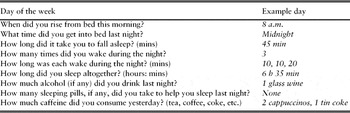
For the evaluation and treatment of insomnia is it recommended that clinicians compile a good sleep history, augmented by a sleep diary and a physical examination. Sleep diaries can be helpful in understanding the times a patient goes to bed, gets to sleep, wakes in the night, wakes in the morning, and gets up (for examples, see http://science.education.nih.gov/supplements/nih3/sleep/guide/nih_sleep_masters.pdf or Table 1).
Sleep diary

Using sleep diaries, estimates can be made of sleep latency and efficiency (times between getting to bed and getting to sleep, and ratio of time asleep to time in bed, respectively). From the physical examination, attention should be paid to any primary systemic illness, including cardiorespiratory disease or neurological disorder such as Parkinson's disease or stroke, as well as any psychiatric problems, particularly depression and anxiety, which may disturb sleep. To supplement patient and spouse report, actigraphy, a small wrist-watch-sized motion detector that distinguishes wake and sleep, can also be a useful objective measurement of insomnia in older people.Reference Sadeh, Hauri, Kripke and Lavie36 Kamel and GammackReference Kamel and Gammack37 also recommend the employment of ‘a detailed mental state and psychiatric examination, laboratory investigations including thyroid function, serum chemistry panel, cardiopulmonary studies if indicated, and assessment of the sleep environment.’
Upon compilation of the sleep history, medical and psychiatric problems should receive attention and, if the insomnia remains, identification of an underlying cause should be attempted before direct treatment for insomnia is initiated.
Dementia
Dementia presents additional challenges to physicians because many of the sleep changes seen in the normal ageing population are amplified. Compared with controls, older people with dementia have a longer sleep latency (time between going to bed and getting to sleep), wake up in the night more frequently and for longer periods, and are more likely to fall asleep during the day.Reference Prinz, Vitaliano, Vitiello, Bokan, Raskind, Peskind and Gerber38–Reference Vitiello40 While there is some evidence of a possible link between sleep problems and dementia,Reference Prinz, Vitaliano, Vitiello, Bokan, Raskind, Peskind and Gerber38 individual differences are great and do not discriminate between dementia and non-dementia patients effectively. The possible causal mechanism is thought to include a degeneration of the neurons in the suprachiasmatic nuclei. Whatever the organic origin, it is likely that behavioural factors will influence sleep problems. There is good evidence that a regular day–night pattern of activity with minimal naps and optimal daytime stimulation is helpful. Sleep disorders in older people with dementia should be treated according to the specific disorder and symptom.Reference Stepnowsky and Ancoli-Israel17
Institutionalization
The link between institutionalized living and sleep disturbance is perhaps best demonstrated by the high levels of hypnotic drug consumption that have been found in hospitals and nursing homes.Reference Alessi, Schnelle, MacRae, Ouslander, al-Samarrai, Simmons and Traub41 Within these institutions, sleep disturbance may be related to the act of admission itself. A period of adjustment may be required (3–4 days), as is common in many other settings where people do not sleep normally when their usual night time environment changes. Hypnotics should not be prescribed for people who cannot sleep in a new institution unless they have other problems as well. Moving to an institution is likely to be contemporaneous with a life event such as the death of a partner, discomfort, or pain, any of which may have a negative effect on sleep. Noise has been shown to be a significant factor in the sleep of institutionalized older people and, often, noise levels in such homes are excessive. Institutions that fail to stimulate residents during the day and that have routines that are not conducive to sleep may be more likely to have sleep-disordered residents.
Treatment
Treatment of insomnia is recommended having generally improved sleep-onset, sleep maintenance, and patient satisfaction. Furthermore, it has also been shown to reverse or lessen some co-morbidities related to insomnia, including depression, medical conditions, and poor quality of life.Reference Roth, Hajak and Ustun42 Treatment has also been asserted to restore patient cognition and co-ordination.Reference Roth, Hajak and Ustun42
Non-pharmacological treatments such as sleep hygiene and education integrated into a cognitive behavioural framework, have been shown to be effective in the treatment of insomniaReference Morin, Hauri, Espie, Spielman, Buysse and Bootzin43 and have been designated the preferred, primary treatment of chronic insomnia.44 This recommendation is partially in acknowledgement of the other drugs commonly taken by older people and seeks to reduce polypharmacy.Reference Montgomery and Dennis45 Yet, as demonstrated by the substantial employment of medicinal sleep aids by older people, pharmacotherapy is the most widely recommended and utilized treatment by primary care physicians.Reference Morin, Hauri, Espie, Spielman, Buysse and Bootzin43 In 1985 it was estimated that some 7.4% of the adult population, with 14% of those in the 65- to 79-year-old range, used either over-the-counter sleeping aids or a prescription hypnotic in the course of a year.Reference Mellinger, Balter and Uhlenhuth19 Furthermore, it was shown that people aged 60 years and above were prescribed sedative-hypnotic drugs at more than twice the rate of people aged 40–59 years,Reference Baum, Kennedy, Knapp and Faich46 with most long-term users (>1 year) of hypnotic medications being older.Reference Mellinger, Balter and Uhlenhuth19 Non-pharmacological methods have, at least in the past, been largely under-utilized in clinical practice despite substantial evidence in favour of their efficacy. Of course, some evidence supports the use of pharmacology in the treatment of selected sleep disorders, but most studies are limited by small, mixed samples and short trial periods of a few days,Reference Bain7 whereas a substantial body of empirical evidence supports the use of non-pharmacological treatments for sleep problems in older people. The extent of treatment options available to older people with insomnia will be considered here in greater detail, both non-pharmacological and pharmacological.
Non-pharmacological treatments
Behavioural and conditioning factors have been shown to have a mediating effect on insomnia as they seek to alter dysfunctional beliefs and practices that perpetuate complaints of insomnia.Reference Morin, Hauri, Espie, Spielman, Buysse and Bootzin43 In general, current evidence indicates that non-pharmacological treatments, such as cognitive-behavioural therapy (CBT) or sleep education, are more effective in the treatment of sleep disturbances in older people.Reference Bain7, Reference Montgomery and Dennis45, Reference Harrington and Avidan47 Indeed, ‘outcome data from more than a dozen treatment studies conducted with community-dwelling older adults indicate that behavioural approaches produce reliable and durable therapeutic benefits, as evidenced by improved sleep efficiency and continuity and enhanced satisfaction with sleep patterns’.Reference Morin, Mimeault and Gagne48 Non-pharmacological treatments for insomnia in older people have been shown to reduce hypnotic use, improve sleep satisfaction, maintain most effects at follow-up, and decrease psychological distress about sleep. Upon review of 48 treatment studies, Morin et al.Reference Morin, Hauri, Espie, Spielman, Buysse and Bootzin43 conclude that several non-pharmacological interventions ‘produce reliable and durable changes in the sleep of patients with chronic and primary insomnia,’ with several studies demonstrating the validity of the same treatments in older populations.
Sleep hygiene or sleep education
Sleep hygiene or sleep education address the lifestyle and environmental factors that affect sleep and aim to establish: regular sleep and wake times; avoidance of excessive time in bed awake (sleep restriction); stimulus control in the form of a clear routine leading up to sleep; daily activity and exercise; appropriate use of caffeine (avoidance after 4 pm); limited alcohol and nicotine use; elimination of loud noise, excessive light, and uncomfortable room temperature. Essentially, sleep hygiene seeks to challenge and correct dysfunctional or inaccurate beliefs and practices about sleep. In this population the education component should include basic information about age-related changes to sleep patterns.
According to Lichstein and Riedel,Reference Lichstein and Riedel49 sleep hygiene or sleep education offer a helpful start to the treatment of insomnia. Poor sleep hygiene is rarely the root cause of insomniaReference Buysse, Reynolds and Thorpy50 and when tried alone, has proven ineffective in the treatment of chronic and severe insomnia in older adults.Reference Engle-Friedman, Bootzin, Hazlewood and Tsao51 However, it is suggested that appropriate sleep hygiene may sustain a mediating role within other multi-faceted interventions.Reference Edinger, Hoelscher, Marsh, Lipper and Ionescu-Pioggia52, Reference Morin, Kowatch, Barry and Walton53 According to a review of 10 studies combining sleep hygiene with other interventions and three studies evaluating the intervention alone,Reference Morin, Hauri, Espie, Spielman, Buysse and Bootzin43 the best employment of sleep hygiene education is for very mild sleep complaints of insomnia or in conjunction with other evidence-based treatments.
Cognitive behavioural therapies
Cognitive behavioural therapy (CBT) includes stimulus control, relaxation therapy, and sleep restriction. It is recommended that the treatment option be chosen carefully to match the ailment and the patient. CBT and stimulus control are primarily for patients with dysfunctional cognitions and practices regarding sleep. Relaxation therapies seek to reduce somatic arousal and are particularly applicable to patients with tension and anxiety. Sleep restriction is relevant when excessive time is spent in bed awake. The therapies and their evidence-base are successively explored.
CBT seeks to address dysfunctional beliefs and attitudes about sleep by targeting unrealistic sleep expectations, misconceptions of the cause of insomnia, emotional distress, catastrophizing of the consequences of inadequate sleep, and performance anxiety. The treatment follows the general protocol of CBT by identifying patients’ incorrect cognitions regarding sleep, challenging their validity, and replacing them with appropriate cognitions and behaviours. Essentially, this treatment identifies cognition as a mediator in sleep behaviour. CBT, in the treatment of insomnia, has been shown to be approximately equal in effectiveness to pharmacology with better long-term outcomesReference Morin, Hauri, Espie, Spielman, Buysse and Bootzin43, Reference Morin, Bastien, Brink and Brown54, Reference Gauriau, Raffray, Choudat, Corman and Leger55 and also to improve pharmacological outcomes.Reference De Vanna, Rubiera, Onor and Aguglia56 A review of eight efficacy trials (6 studies reviewing cognitive therapy alone and 2 as part of a multi-faceted intervention), reported only positive outcomes;Reference Morin, Hauri, Espie, Spielman, Buysse and Bootzin43 more recent trials, reviews, and meta-analyses reflect similar positive outcomes.Reference Baum, Kennedy, Knapp and Faich46, Reference Gauriau, Raffray, Choudat, Corman and Leger55 With this evidence-base, CBT has been deemed the most effective treatment for insomnia.44 As stronger dysfunctional beliefs and attitudes about sleep have been substantially demonstrated in older adults,Reference Morin, Kowatch, Barry and Walton53 CBT represents a convincing treatment option. CBT is generally applicable to all older patients, except in the case of pre-existing cognitive decline.
Cognitive behavioural intervention for insomnia also includes stimulus control, which aims to set up conditions conducive to sleep for the patient. According to Morin et al.,Reference Morin, Hauri, Espie, Spielman, Buysse and Bootzin43 ‘the main objective of stimulus control therapy is to train the insomnia patient to re-associate the bed and bedroom with rapid sleep onset by curtailing sleep-incompatible activities (overt and covert) that serve as cues for staying awake and by enforcing a consistent sleep–wake schedule.’ The treatment typically involves removing any sleep-incompatible stimuli from the bedroom, and having the patient get up if not asleep within 20 minutes of getting into bed. It is essentially a conditioning treatment that develops strong associations between the bedroom and sleep, while extinguishing associations between sleep and any other place. As older adults tend to engage in sleep-incompatible behaviours in the bedroom because of limited physical abilities, this treatment option can be particularly relevant. According to a review of efficacy studies, 12 studies examining stimulus control therapy alone found improved sleep compared with controls or other interventions.Reference Morin, Hauri, Espie, Spielman, Buysse and Bootzin43 Furthermore, meta-analyses combining the data from multiple studies have shown stimulus control therapy to significantly reduce the average self-reported sleep onset latency and improve sleep maintenance, or the time between waking.Reference Morin, Hauri, Espie, Spielman, Buysse and Bootzin43 Stimulus control therapy is recommended as one of the most effective treatments available for insomnia in older people,Reference Morin, Hauri, Espie, Spielman, Buysse and Bootzin43, Reference Morin, Mimeault and Gagne48 as indicated by a few comparative studies.Reference Lacks, Bertelson, Gans and Kunkel57–Reference Friedman, Bliwise, Yesavage and Salom61 It is also one of the few treatments for insomnia that meets the American Psychological Association (APA) criteria for empirically supported psychological treatment.Reference Morin, Hauri, Espie, Spielman, Buysse and Bootzin43
Other cognitive behavioural techniques currently with less (although increasing) research evidence to support them include imagery and relaxation (e.g. progressive muscle relaxation and biofeedback), paradoxical intention, and thought suppression. Standard progressive muscle relaxation (PMR) probably has the most substantial evidence-base of all of the relaxation techniques; and while PMR has been shown to sustain superior effects over comparison groups in 16 of 17 efficacy trials, some studies have shown PMR less effective with older adultsReference Edinger, Hoelscher, Marsh, Lipper and Ionescu-Pioggia52, Reference Friedman, Bliwise, Yesavage and Salom61 and less effective than sleep restriction and stimulus control therapies.Reference Morin, Hauri, Espie, Spielman, Buysse and Bootzin43 The limited information available regarding the efficacy of imagery training, biofeedback, paradoxical intention, and thought suppression is available in the review of non-pharmacological treatments for chronic insomnia by Morin and colleagues.Reference Morin, Hauri, Espie, Spielman, Buysse and Bootzin43
Sleep restriction limits the amount of time in bed to the length of time that the person is likely to sleep. It aims to improve sleep efficiency (ratio of time asleep to time in bed) by either increasing time asleep or reducing time in bed. Most patients want to increase their time in bed, even though this may not be physiologically necessary. By asking patients to use a sleep diary carefully, sleep efficiency can be calculated and sleep compressed and, if necessary, expanded later as long as efficiency is maintained. It can be difficult to persuade older patients to accept this treatment as it is based on a key time when they must get up, however little sleep they may have had. However, in this way, their increasing tiredness will increase the drive for sleep. Two studies have evaluated the singular impact of sleep restriction on sleep in older adultsReference Friedman, Bliwise, Yesavage and Salom61, Reference Anderson, Zendell, Rosa, Rubinstein, Herrera, Simons, Caruso and Spielman62 with positive outcomes for sleep latency and maintenance. Still other studies have combined the treatment with other therapies in multi-faceted interventions,Reference Edinger, Hoelscher, Marsh, Lipper and Ionescu-Pioggia52, Reference Morin, Kowatch, Barry and Walton53, Reference Hoelscher and Edinger63 reportedly producing some of the best outcomes.Reference Morin, Mimeault and Gagne48 Despite these findings, an additional consideration is needed for the application of this treatment option in older populations: it has been suggested that because it may be unpleasant or unsafe (medical conditions and risk of accident) to leave bed in the middle of the night, older people may not adhere to some of the instructions.Reference Morin, Mimeault and Gagne48 In this case, it may be better to seek alternative treatment options. However, sleep restriction therapy is recommended as one of the most effective treatments available for insomnia in older people,Reference Morin, Hauri, Espie, Spielman, Buysse and Bootzin43, Reference Morin, Mimeault and Gagne48 as indicated by a few comparative studies.Reference Lacks, Bertelson, Gans and Kunkel57–Reference Friedman, Bliwise, Yesavage and Salom61
Bright light therapy
Bright light therapy is meant to affect the timing of the sleep phase or cycle of circadian rhythms.Reference Chesson, Anderson, Littner, Davila, Hartse, Johnson, Wise and Rafecas64 The treatment involves participants sitting in front of a ‘light box’ that emits very high (typically 10,000 lux) fluorescent light for periods of around two hours daily. The timing of the light treatment is variable depending on the irregular timing of the participant's sleep pattern, e.g. those needing to advance their sleep phase participate early in the day. The few existing intervention trials indicate that bright light therapy may improve sleep outcomes in older people, particularly in patients with dementia or depression.Reference Montgomery and Dennis65 At present, however, there is no evidence-base for the treatment of sleep problems in ‘normal’ older adults.
Additional non-pharmacological options
Studies with general populations have shown that the concurrent treatment of co-morbid conditions (i.e. depression and insomnia) can lead to better overall response.Reference Fava, McCall, Krystal, Wessel, Rubens, Caron, Amato and Roth66 Furthermore, there is some evidence from general populations that written information can be an effective way of delivering some sleep hygiene and cognitive treatments, although no good trials have been conducted with older populations.Reference Montgomery, Bjornstad and Dennis67 Finally, daily exercise is also thought to be important in promoting good sleep, although firm evidence for it is again somewhat limited.Reference Montgomery and Dennis68
Multi-faceted interventions
While several studies have examined the efficacy of multi-faceted interventions, more research is needed towards identifying best combinations of individual treatments. Morin et al.Reference Morin, Hauri, Espie, Spielman, Buysse and Bootzin43 concluded that while nine studies of multi-faceted interventions indicated a combined approach as significantly more effective than no treatment, multi-faceted interventions are not always better than single treatment therapies. Furthermore, the state of the research evaluating the combination of pharmacological and non-pharmacological treatments in the same intervention is much the same. Morin et al.Reference Morin, Hauri, Espie, Spielman, Buysse and Bootzin43 again concluded that while the combined treatment fared significantly better than no treatment in four studies, no statistically significant differences emerged across the active treatment conditions. Ultimately, multi-faceted interventions show promise for the effective treatment of insomnia in older populations, but require further exploration and empirical support. BainReference Bain7 simply comments that despite the possibility of curtailing drug dependencies or improving duration of effects, behavioural therapies should not be combined with the use of sedative-hypnotics, as further research is needed.
Pharmacological treatments
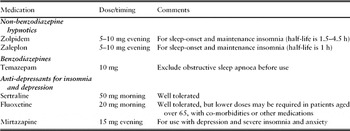
Some patients may benefit from short-term use of sleep-promoting medications.Reference Nowell, Mazumdar, Buysse, Dew, Reynolds and Kupfer69 It should be stressed that among a physician's first set of treatment goals should be the improvement of sleep hygiene in the patient, moving on to drug treatment only if necessary. Before prescribing a sedative-hypnotic, especially to an older patient, a risk-benefit analysis should be conducted.Reference Mathews70 The type and duration of the insomnia as well as the patient's age, pre-existing medical conditions, concurrent medications, and previous treatment should be taken into account. Furthermore, the choice of sedative-hypnotic agent for insomnia should be based on issues of efficacy including whether it consolidates fragmented sleep, whether it can be administered at different times in the night, and the effect on next-day functioning. Preferably, a short half-life with few withdrawal symptoms and minimal adverse events with no tolerance should be key considerations. Furthermore, Kupger and ReynoldsReference Kupfer and Reynolds71 suggest five principles to guide the use of pharmacotherapy for insomnia: use of the lowest effective dose, employment of intermittent dosing (2 to 4 times weekly), limitation to short-term prescription (regular use for no more than 3–4 weeks), gradual discontinuation of the medicine (reducing rebound insomnia), and prescription of medications with shorter elimination half-lives (minimize daytime sedation). Some common options are listed in Table 2.
Common pharmacological options

ZolpidemReference Scharf, Mayleben, Kaffeman, Krall and Ochs72–Reference Walsh, Soubrane and Roth75 and zaleplon,Reference Ancoli-Israel, Walsh, Mangano and Fujimori76, Reference Ancoli-Israel, Richardson and Mangano77 short-acting type-1 GABA benzodiazepine receptor agonists (BzRAs), have been shown to be effective in older adults with a lower propensity for causing withdrawal, dependence, tolerance, or clinical residual effect. The primary effects of these drugs involve decreasing sleep onset time and/or increasing total sleep time. The long-term use of any of these drugs, however, is strongly discouraged as their continued employment is generally ineffective and likely to have adverse effects and/or dependency.Reference Morin, Mimeault and Gagne48 While two types of hypnotic sedative agents exist, namely benzodiazepines and non-benzodiazepines, a meta-analysis of 24 randomized controlled trials in patients aged ≥ 60 years employing pharmacological treatment of insomnia for ≥ 5 consecutive nights has indicated no significant difference in sleep quality between benzodiazepines and the non-benzodiazepines zolpidem, zaleplon and zopiclone (mean effect size, 0.04; 95% CI, −1.11 to 1.19) and no significant difference in the adverse effects of benzodiazepine and non-benozodiazepine sedative-hypnotics (OR, 1.11; 95% CI, 0.59–2.07).Reference Glass, Lanctot, Herrmann, Sproule and Gusto78
Benzodiazepines
Benzodiazepines (BZDs) are appropriate for the treatment of insomnia as they increase stage II sleep, reduce REM sleep, decrease sleep latency, and reduce nocturnal awakenings.Reference Woodward79 Among the hypnotics, the treatment of choice is a short-acting benzodiazepine receptor agonist. Short-term use and low doses are recommended.Reference Petrovic, Mariman, Warie, Afschrift and Pevernagie80 Occasional use reduces the possibility of withdrawal effects. The option to use such a drug may reduce anxiety about sleep in the patient and therefore be beneficial. If selected for treatment, it is important to choose a benzodiazepine that meets the patient's needs. According to Grunstein,Reference Grunstein81 BZDs can give rise to hangover effects, result in rebound insomnia within 1–2 weeks of use, and impair psychomotor performance and memory. In cases of excessive daytime sleepiness, referral to a sleep specialist is indicated, as this symptom can be dangerous.
Triazolam has a rapid onset (within 30 minutes) and can help with the initiation of sleep.Reference Bain7 Though the occurrence of morning hangover is less likely than with other sedative hypnotics, triazolam is more likely to induce rebound insomnia, psychological dependence, and anxiety.Reference Mathews70 Temazepam and estazolam are longer-acting benzodiazepines and can help maintain sleep throughout the night and early morning.Reference Bain7 Temazepam has a slower onset, taking around 1 hour for effect. As its active duration is between 6 and 10 hours, it impacts sleep maintenance without inducing hangover effects. Estazolam, flurazepam and quazepam have an onset time of 1 to 2 hours after ingestion. Flurazepam and quazepam can also help maintain nocturnal sleep and prevent early morning awakenings. However, while these sedative hypnotics sustain less risk of rebound insomnia, flurazepam and quazepam have been associated with next-day sedation and cognitive impairment.Reference Bain7
Non-benzodiazepines
According to Bain,Reference Bain7 the non-benzodiazepine sedative-hypnotics appear ‘to offer few, if any, significant clinical advantages in efficacy or tolerability’ in older people than benzodiazepines. Still, the specific characteristics particular to each drug may prove more appropriate to certain patients or complaints.
Zolpidem can be used in the treatment of insomnia for issues with sleep-onset and has been shown to be well tolerated in older populations. Only potentially mild side-effects such as nausea, dizziness and drowsiness have been reportedReference Kummer, Guendel, Linden, Eich, Attali, Coquelin and Kyrein82–Reference Shochat, Loredo and Ancoli-Israel84 and some cases of rebound insomnia.Reference Grunstein81 Zolpidem has a rapid onset (within 30 minutes) and a short, variable duration (3–8 hours).
Zaleplon can be used in the treatment of insomnia for issues with sleep-onset as well. It has a fast onset (within 30 minutes) and a short duration (2–4 hours). Due to these properties, zaleplon can be used as needed so long as four or more hours of sleep time remain. No major adverse effects, tolerance, or rebound insomnia have been reported.Reference Shochat, Loredo and Ancoli-Israel84 The most frequently reported adverse effects are mild, including headaches, dizziness, nausea and somnolence.Reference Bain7 The use of zaleplon in the treatment of older people has been demonstrated efficacious.Reference Ancoli-Israel, Walsh, Mangano and Fujimori76, Reference Ancoli-Israel, Richardson and Mangano77, Reference Hedner, Yaeche, Emilien, Farr and Salinas85, Reference Barbera and Shapiro86
Non-prescription medications
Many older people with insomnia self-medicate with over-the-counter drugs and products. A 1999 study of the use of non-prescription sleep products in 176 adults over the age of 60 years found that 13% used alcohol, 36% used antihistamines, and 11% used dietary supplements as sleep aids.Reference Sproule, Busto, Buckle, Herrmann and Bowles87 Melatonin is widely used in many countries where it is available over the counter and in others where it may be prescribed. Endogenous secretion of melatonin, known to promote sleep, is reduced in older adults.Reference Stepnowsky and Ancoli-Israel17 Some studies suggest that melatonin replacement therapy may improve sleep efficiency in this population.Reference Garfinkel, Laudon, Nof and Zisapel88, Reference Haimov and Lavie89 However, there is little consensus on the recommended dose or timing of administration. The NIH Conference concluded that there is little evidence for the efficacy of melatonin in the treatment of insomnia. More recently, some emerging evidence regarding the safety and efficacy of melatonin has suggested some promise for the treatment of sleep problems in older populations.Reference Bain7, Reference Luthringer, Muzet, Zisapel and Staner90
The use of over-the-counter drugs and products is highly discouraged. Sproule et al.Reference Sproule, Busto, Buckle, Herrmann and Bowles87 warn that such practices can involve adverse effects, lead to drug interactions, and worsen insomnia. Over-the-counter antihistamines are particularly cautioned because of their long duration of action and their anticholinergic effects in older populations; these may cause confusion, constipation and urinary retention.Reference Agostini, Leo-Summers and Inouye91 Furthermore, the NIH 2005 conference concluded that due to the lack of systematic evidence and the potential risk of adverse effects, the use of antihistamines is not recommended, particularly for older adults.44
Conclusion
Insomnia is a prevalent sleep complaint amongst older people, affecting physical and mental health as well as many aspects of life quality and well-being. The appropriate assessment and treatment of insomnia are subsequently of particular importance. Clinicians need to be more aware of their patients’ sleep and conduct formal assessments as appropriate. Furthermore, despite past practice trends, non-pharmacological treatments should be considered first for chronic insomnia as a means to reduce dependency, adverse effects, and polypharmacy. Morin et al.Reference Morin, Hauri, Espie, Spielman, Buysse and Bootzin43 and Morin, Mimeault and GagneReference Morin, Mimeault and Gagne48 suggest that behavioural treatment methods such as stimulus control and sleep restriction are especially beneficial for older insomniacs as they target maladaptive sleep habits. It is well evidenced that cognitive and educational interventions can also be pivotal in altering dysfunctional beliefs and attitudes about sleep, though integrated behavioural and pharmacological treatments require further empirical attention.Reference Morin, Mimeault and Gagne48 Pharmacological treatment should be employed only if insomnia persists, involving the careful patient-specific consideration of the lowest effective dose, best intermittence of dosing, shortest effective duration, best gradual discontinuation scheme, and most effective elimination half-life. For the lack of explicit guidelines for the assessment and treatment of insomnia in older people, this summary of available information represents the best evidence to inform current practice.