Background
Accurate information on the epidemiology of first-episode psychosis is crucial for early psychosis intervention (EPI) services (Kirkbride et al., Reference Kirkbride, Hameed, Ankireddypalli, Ioannidis, Crane, Nasir, Kabacs, Metastasio, Jenkins, Espandian, Spyridi, Ralevic, Siddabattuni, Walden, Adeoye, Perez and Jones2017), both for programmatic and resource planning and to evaluate the proportion of potential cases who are detected and managed within a catchment area. There is a wide range in published incidence estimates (van der Werf et al., Reference van der Werf, Hanssen, Köhler, Verkaaik, Verhey, van Winkel, van Os and Allardyce2014) that vary due to factors such as the age groups and diagnoses that are included (Castillejos et al., Reference Castillejos, Martín-Pérez and Moreno-Küstner2018), the sampling frame for case identification (Hogerzeil et al., Reference Hogerzeil, van Hemert, Rosendaal, Susser and Hoek2014), and the inclusion of a range of inpatient and outpatient service providers in case finding strategies (Jörgensen et al., Reference Jörgensen, Ahlbom, Allebeck and Dalman2010; Simon et al., Reference Simon, Coleman, Yarborough, Operskalski, Stewart, Hunkeler, Lynch, Carrell and Beck2017). Furthermore, recent reports have found up to a 10-fold variation in the incidence of psychotic disorder across countries (Jongsma et al., Reference Jongsma, Gayer-Anderson, Lasalvia, Quattrone, Mulè, Szöke, Selten, Turner, Arango, Tarricone, Berardi, Tortelli, Llorca, de Haan, Bobes, Bernardo, Sanjuán, Santos, Arrojo, Del-Ben, Menezes, Velthorst, Murray, Rutten, Jones, van Os, Morgan and Kirkbride2018), highlighting the need for local estimates to inform the planning and evaluation of EPI services.
The province of Ontario, Canada's largest province with a population of over 13.5 million people, has nearly 60 hospital- and community-based EPI programs. These programs estimate that the treated incidence of first-episode psychosis is in the range of 12–13 per 100 000 per year (Durbin et al., Reference Durbin, Selick, Hierlihy, Moss and Cheng2016), which correspond to frequently cited estimates of the incidence of schizophrenia (McGrath et al., Reference McGrath, Saha, Chant and Welham2008). However, the most recent incidence estimates from Ontario for schizophrenia spectrum psychoses suggest a population-based rate of 55.6 per 100 000 person-years among people between the ages of 14 and 40 (Anderson et al., Reference Anderson, Cheng, Susser, McKenzie and Kurdyak2015). This discrepancy between broader population-based estimates of the incidence of psychotic disorder and the treated incidence reported by EPI programs suggests that there may be additional cases receiving services elsewhere in the health care system, or not receiving treatment at all.
Conversely, not all incident cases of psychotic disorder detected by population-based case ascertainment strategies will meet the case definition for first-episode psychosis as defined by EPI programs (Anderson et al., Reference Anderson, Fuhrer, Abrahamowicz and Malla2012). Many programs restrict admissions to first treatment contact, or by factors such as duration of psychotic symptoms or length of prior antipsychotic treatment (Breitborde et al., Reference Breitborde, Srihari and Woods2009). Furthermore, people with intellectual and developmental disabilities, those with substantial contact with the criminal justice system, and those with complex medical or substance-related comorbidities are often excluded from these programs, and many programs have an upper age limit of 35–40 years (Greenfield et al., Reference Greenfield, Joshi, Christian, Lekkos, Gregorowicz, Fisher and Johnson2018).
Few prior studies on the incidence of psychotic disorders have been conducted from the perspective of early intervention services (Cheng et al., Reference Cheng, Kirkbride, Lennox, Perez, Masson, Lawrence, Hill, Feeley, Painter, Murray, Gallagher, Bullmore and Jones2011), and those that have been done have typically limited case ascertainment to psychiatric services (Cheng et al., Reference Cheng, Kirkbride, Lennox, Perez, Masson, Lawrence, Hill, Feeley, Painter, Murray, Gallagher, Bullmore and Jones2011; Kirkbride et al., Reference Kirkbride, Hameed, Ankireddypalli, Ioannidis, Crane, Nasir, Kabacs, Metastasio, Jenkins, Espandian, Spyridi, Ralevic, Siddabattuni, Walden, Adeoye, Perez and Jones2017). The objectives of the current study were: (1) to use population-based health administrative data to estimate the cumulative incidence of non-affective psychosis in the catchment area of an EPI program; (2) to compare this estimate to the EPI-treated incidence of psychotic disorder; and (3) to use the proportion of referred cases confirmed by the EPI program to estimate the incidence of first-episode non-affective psychosis. The data used to estimate incidence were obtained from a larger project aimed at evaluating access to an EPI program (Anderson et al., Reference Anderson, Norman, MacDougall, Edwards, Palaniyappan, Lau and Kurdyak2018b), and the effectiveness of EPI relative to treatment as usual (Anderson et al., Reference Anderson, Norman, MacDougall, Edwards, Palaniyappan, Lau and Kurdyak2018a), using population-based health administrative data from a defined catchment area.
Methods
Study setting
The Prevention and Early Intervention Program for Psychoses (PEPP) in London, Ontario is the only EPI program serving a well-defined catchment area of nearly 425 000 people, 50% of whom fall within the age range for the program (approximately 213 000 people). The catchment area includes a mix of both urban and rural communities, and 10% of the population is living below the low-income cut-off. Migrant groups comprise 20% of the population, and approximately 12% self-identify as a visible minority (Statistics Canada, 2007). The program accepts clients who met the following criteria: (i) primary diagnosis of a first-episode non-affective psychotic disorder, defined as <30 days of prior antipsychotic treatment; (ii) aged 16–50 years; (iii) absence of a developmental disability or organic psychosis; and (iv) no outstanding major criminal charges. Eligibility for the program is based on a clinical assessment by a program psychiatrist, and the program has been described in detail elsewhere (Norman and Manchanda, Reference Norman and Manchanda2016).
Cohort creation
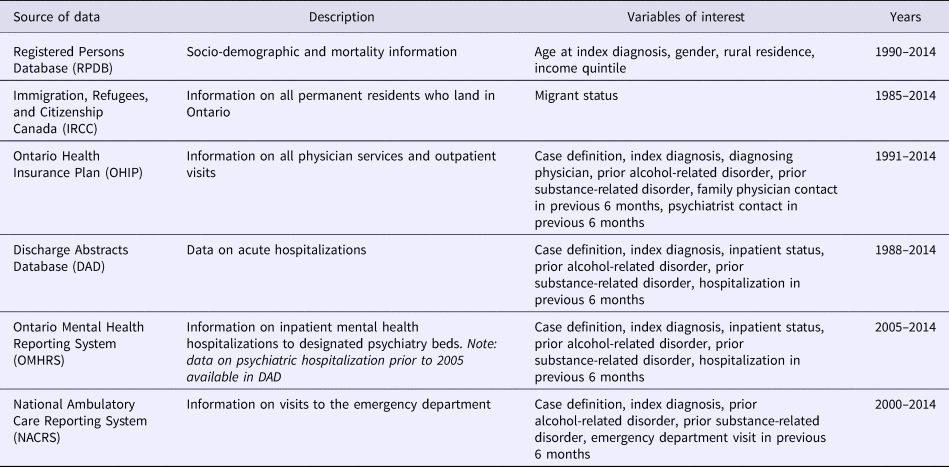
We constructed a retrospective cohort of incident cases of non-affective psychotic disorder in the EPI catchment area over a 17-year period (1997–2013, inclusive), defined based on six-digit postal codes. The cohort was constructed using linked population-based health administrative data arising from the Ontario Health Insurance Plan (OHIP), which is the publicly funded universal health system that covers medically necessary services for nearly the entire population (>96%) (OHIP for All: Healthier Together, 2018). These data are held by the Institute for Clinical Evaluative Sciences (ICES) and include information on physician billings, hospitalizations, emergency department (ED) visits, and basic demographic data, as well as linkages to other databases, such as immigration data (Table 1).
Description of the linked health administrative databases used to construct the cohort of incident cases of non-affective psychotic disorder

We identified cases aged 16–50 years in the health administrative data by the presence of at least one of the following:
• an inpatient hospitalization with a primary discharge diagnosis of a non-affective psychotic disorder from a general hospital bed [International Classification of Diseases (ICD), 9th Revision code 295.X, 297.X, 298.X; ICD-10 code F20 or F25]; or
• an Axis 1 diagnosis of non-affective psychotic disorder from a designated psychiatric hospital bed [Diagnostic and Statistical Manual of Mental Disorders, 4th Edition (DSM-IV) code 295.X, 297.X, 298.X]; or
• at least two outpatient billing claims or ED visits within a 12-month period with a diagnostic code for non-affective psychotic disorder (ICD-9 code 295.X, 297.X, 298.X; ICD-10 code F20 or F25).
This algorithm has been previously validated in ICES data against medical charts and found to have moderate positive predictive value (proportion of true positives among all people meeting case definition = 62%) and high negative predictive value (proportion of true negatives among all people who do not meet the case definition = 90%) for a diagnosis of non-affective psychotic disorder (Kurdyak et al., Reference Kurdyak, Lin, Green and Vigod2015). Cases were excluded as prevalent if there was evidence of contact with mental health services for non-affective psychosis prior to the study window – this exclusion period ranged from 9 to 25 years depending on the database and year of diagnosis. People with a prior history of diagnosis for affective psychotic disorder were not excluded, and were counted as an incident case at the point where the diagnosis changed to non-affective psychosis. We did not apply any additional exclusions to the study cohort on factors such as duration of prior antipsychotic use or presence of a substance use disorder. For all people included in the cohort, we extracted available sociodemographic information, including age at index date, gender, neighborhood-level income quintile, migrant status, and rurality of residence.
We obtained data on all clients admitted to the EPI program since its inception, and we linked this to the study cohort using unique identifiers, which allowed us to identify EPI clients within the health administrative data. We also linked the physician registration number and dates of tenure for all PEPP program psychiatrists, which allowed us to identify people who may have had contact with an EPI-psychiatrist for screening but were ultimately found to be ineligible for the program. Cohort members were divided into the following groups:
(i) Confirmed cases – people admitted to the EPI program;
(ii) Confirmed non-cases – people screened by an EPI psychiatrist but not admitted to the program; and
(iii) Suspected cases – people not in the EPI database who had never seen an EPI psychiatrist.
The Research Ethics Board at the University of Western Ontario and Sunnybrook Health Sciences Centre granted approval for the linkage of the primary data to the ICES data holdings. Patient-level data were linked using coded identifiers, and the de-identified datasets were analyzed on site at ICES. We followed the RECORD guidelines for observational studies using routinely collected data (online Supplementary Table S1), and a description of all codes and algorithms used to create study variables is presented in online Supplementary Table S2.
Estimation of incidence
We estimated the annual cumulative incidence proportion of non-affective psychoses for the total sample meeting our case definition (total incidence) and the sample admitted to EPI services (EPI-treated incidence). We also attempted to estimate the incidence of first-episode psychosis – specifically, new cases of non-affective psychosis who would meet the case definition for an EPI program – using the following approach. Firstly, we estimated the proportion of confirmed cases among all cases referred to the program [confirmed cases/(confirmed cases + confirmed non-cases)] for each age and gender strata. Assuming our sample of suspected cases would be comprised of a similar mix of true cases and false positives, we applied these proportions to the sample of suspected cases to estimate the number of people with first-episode psychosis potentially missed by the EPI program. Finally, we added this number to the number of confirmed cases to correct our treated incidence estimate, yielding an estimated incidence of first-episode non-affective psychosis for the EPI program catchment area.
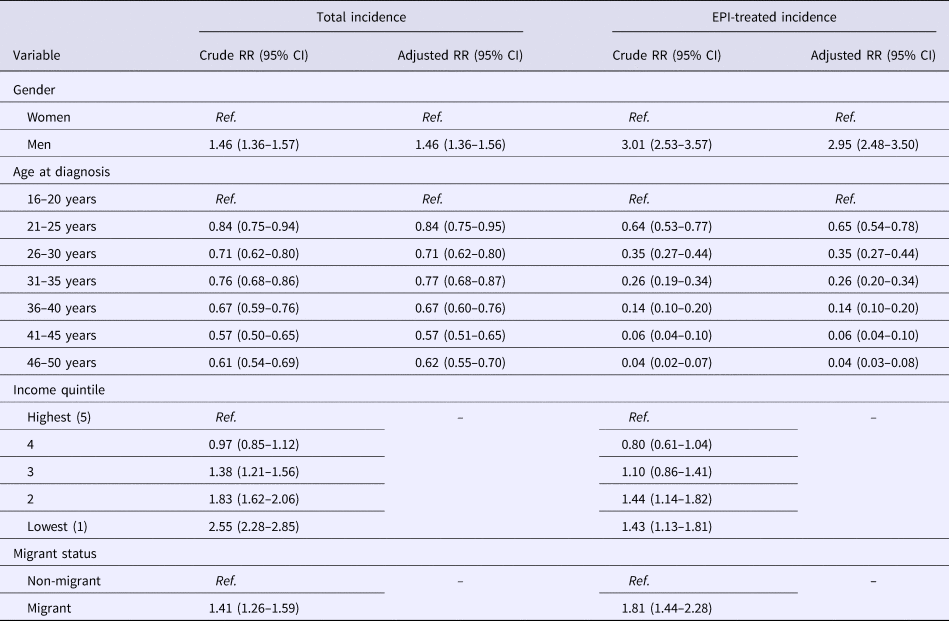
Age- and gender-stratified denominator data were obtained from the 2006 census for the county of Middlesex-London (Statistics Canada, 2007), which represents the mid-point of our study period. Incidence estimates were adjusted for age and gender using direct standardization to the 2011 Canadian population, which is the standard population used by Statistics Canada. We computed crude and adjusted risk ratios (RRs) using Poisson regression to adjust for age and gender; however, detailed denominator data were not available for migrant status or income quintile so we computed crude RRs only. The crude and adjusted estimates, where available, were highly similar; therefore, we discuss the crude RRs throughout the manuscript for consistency, although both estimates are available in the summary table.
All analyses were conducted in Stata Version 15, and results are reported as cumulative incidence proportions or RRs with corresponding 95% confidence intervals (CI).
Results
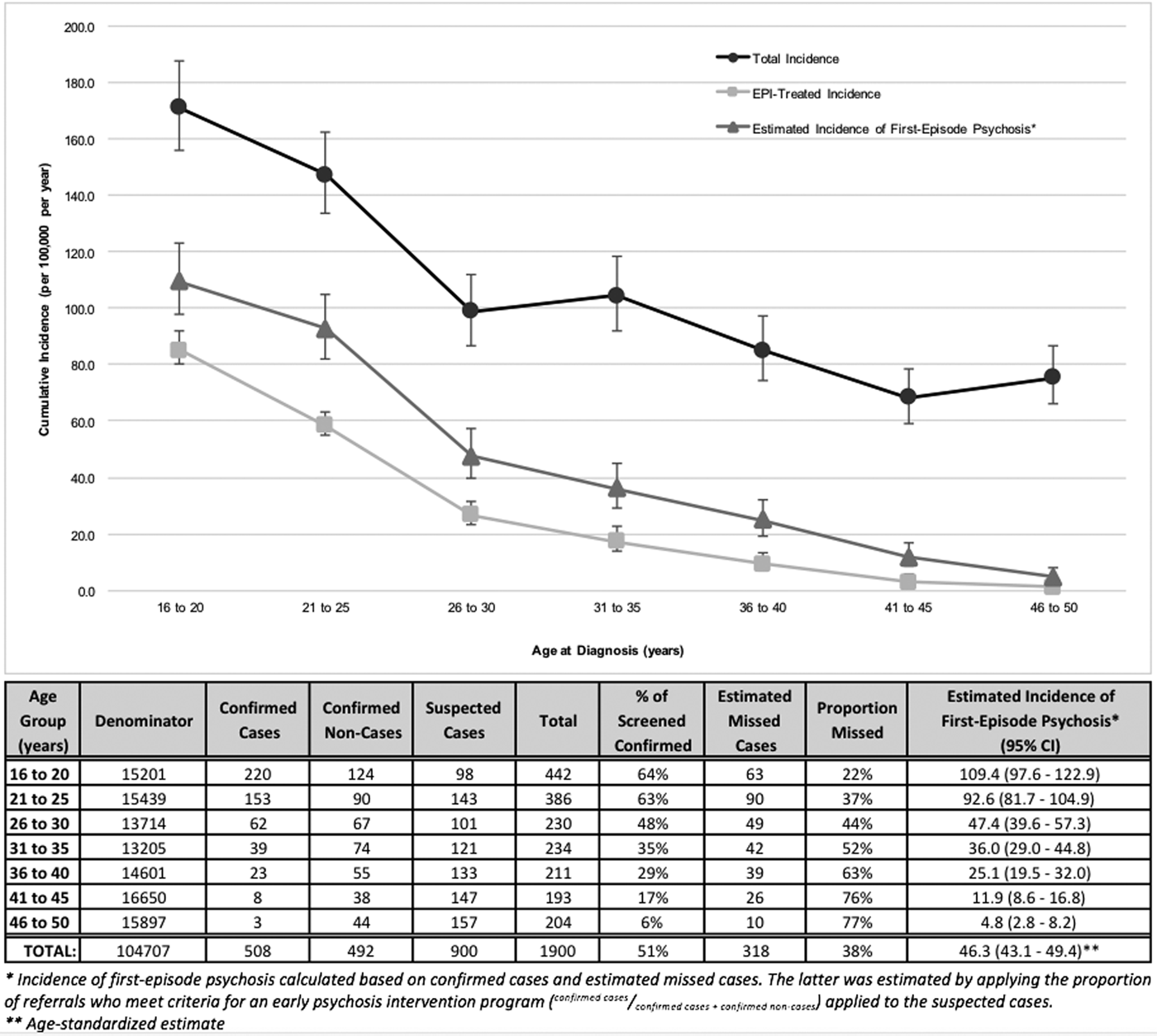
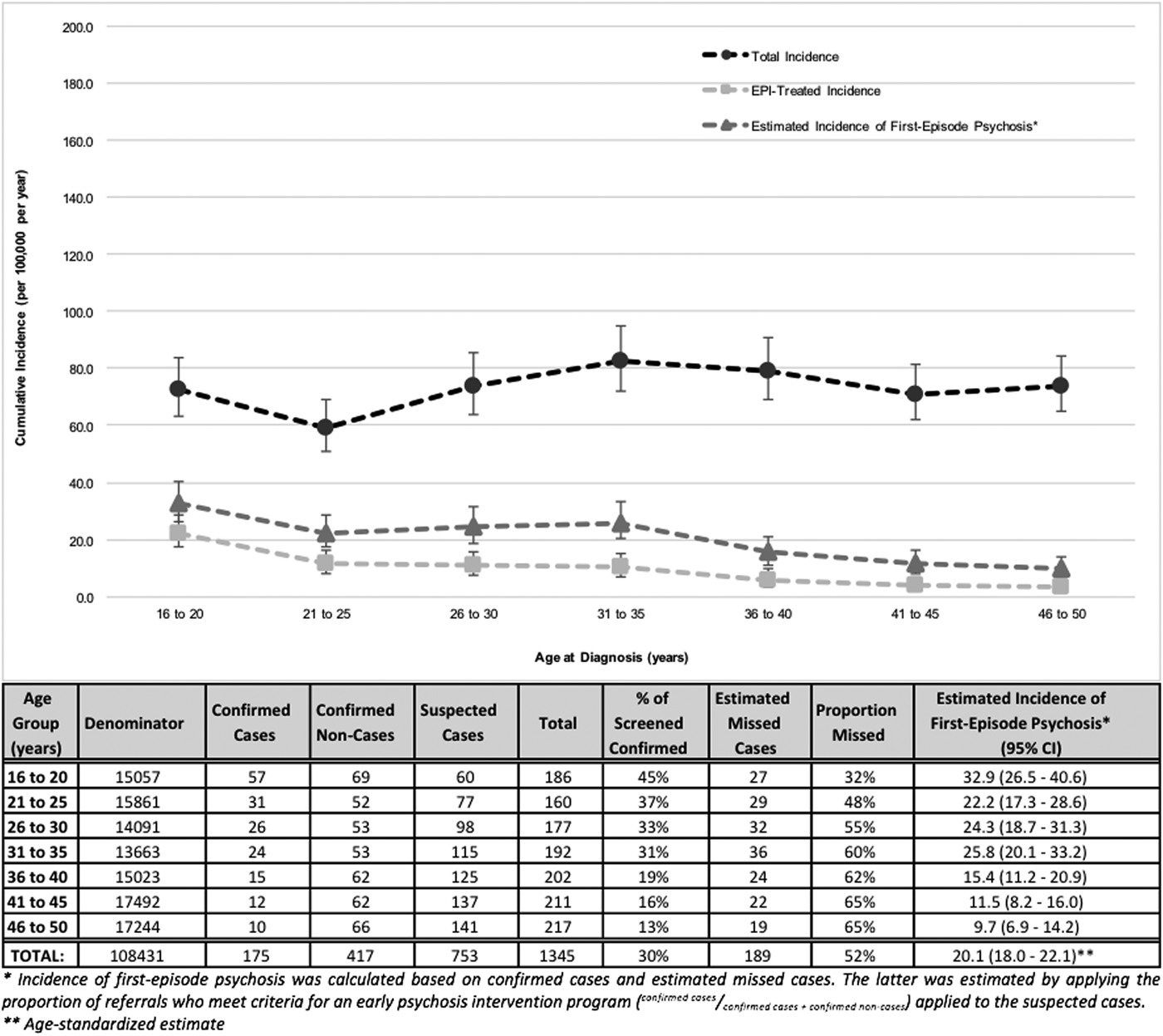
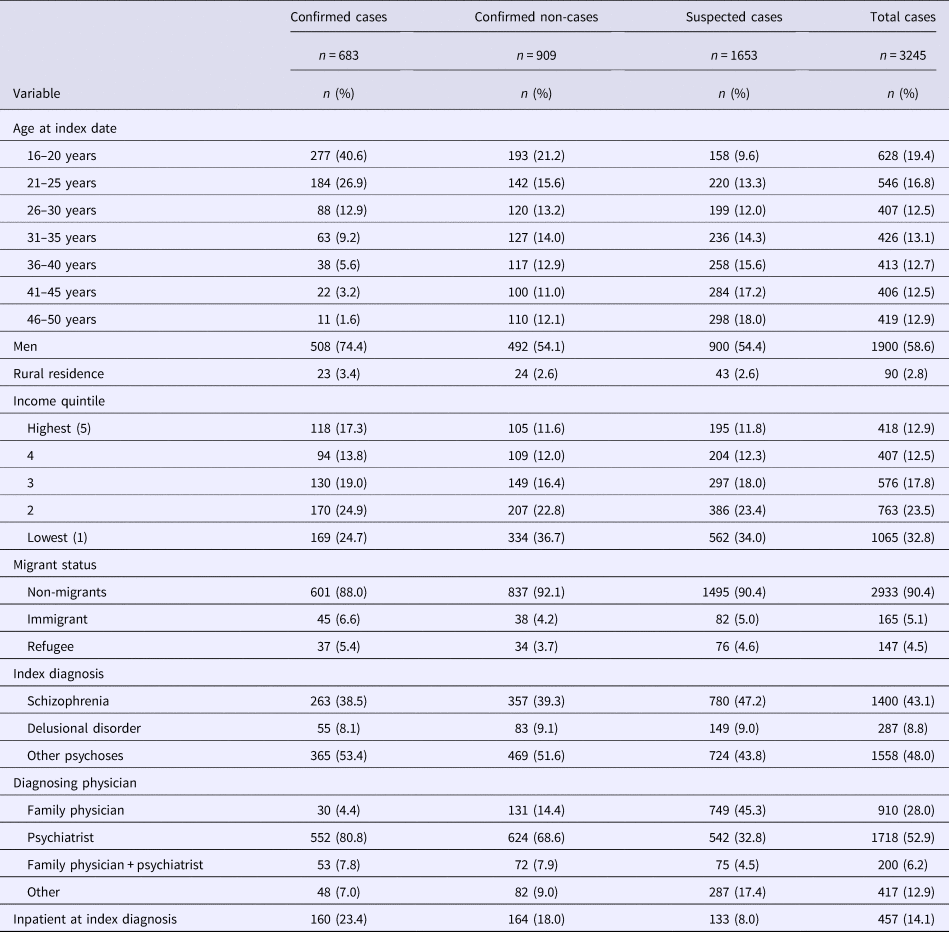
Our algorithm identified 3245 cases of incident non-affective psychotic disorder presenting to services in the EPI catchment area over the 17-year period, of whom 21% were confirmed cases, 28% were confirmed non-cases, and 51% were suspected cases (Table 2). This yields an age- and gender-standardized total cumulative incidence of 90.0 per 100 000 per year (95% CI 87.0–93.1). Men had a higher incidence than women (RR = 1.46, 95% CI 1.36–1.57), and there was a decline in incidence across age groups (age 46–50 v. 16–20 years: RR = 0.61, 95% CI 0.54–0.69). The incidence of non-affective psychosis peaked among men aged 16–20 years, and declined steeply thereafter (Fig. 1), whereas women showed a steadier trajectory across the age groups (Fig. 2). Incidence estimates were higher in the low-income areas of the catchment area (lowest v. highest: RR = 2.55, 95% CI 2.28–2.85) and among migrant groups (RR = 1.41, 95% CI 1.26–1.59) (Table 3).
Age-stratified estimates of the average annual cumulative incidence of non-affective psychotic disorder among men in the catchment area. Incidence estimates reflect the total incidence in the health administrative data, the early psychosis intervention (EPI)-treated incidence, and our adjusted estimates of the incidence of first-episode psychosis.

Age-stratified estimates of the average annual cumulative incidence of non-affective psychotic disorder among women in the catchment area. Incidence estimates reflect the total incidence in the health administrative data, the early psychosis intervention (EPI)-treated incidence, and our adjusted estimates of the incidence of first-episode psychosis.

Sociodemographic and clinical characteristics of confirmed cases, confirmed non-cases, and suspected cases of incident non-affective psychotic disorder

Crude and adjusted risk ratios for the early psychosis intervention (EPI)-treated incidence and the total incidence of non-affective psychotic disorder in the program catchment area

EPI, early psychosis intervention; RR, risk ratio; CI, confidence interval; Ref., reference category.
Over this same period, 683 people were admitted to the EPI program, yielding an age- and gender-standardized EPI-treated incidence of 18.8 per 100 000 per year (95% CI 17.4–20.3). The trends in effect estimates across subgroups were similar to those found for the total incidence (Table 2), but showed a greater magnitude of effect for gender, age and migrant status (men v. women: RR = 3.01, 95% CI 2.53–3.57; age 46–50 v. 16–20 years: RR = 0.04, 95% CI 0.02–0.07; migrants v. non-migrants: RR = 1.81, 95% CI 1.44–2.28), and were attenuated for neighborhood income quintile (lowest v. highest income: RR = 1.43, 95% CI 1.13–1.81) (Table 3).
Among people referred to the program for screening (n = 1592), 43% were admitted (men = 51%; women = 30%), with substantial variation by age and gender in the proportion admitted: among men, the admission proportion ranged from 6% for men aged 46–50 years, to 64% for men aged 16–20 years; among women, the admission proportions ranged from 13% for women aged 46–50 years, to 45% for women aged 16–20 years (Figs 1 and 2). If we assume that similar age- and gender-stratified proportions of suspected cases would have been admitted to the EPI program, had they presented for screening, we estimate that the standardized cumulative incidence of first-episode non-affective psychosis in the program catchment area is 33.3 per 100 000 per year (95% CI 31.4–35.1), with a cumulative incidence of 46.3 per 100 000 per year (95% CI 43.1–49.4) for men (Fig. 1), and a cumulative incidence of 20.1 per 100 000 per year (95% CI 18.0–22.1) for women (Fig. 2). Based on these data, we estimate that 38% of men with first-episode psychosis, and 52% of women, are not captured by the EPI sample.
Discussion
Our corrected estimates of the incidence of first-episode non-affective psychotic disorder in the EPI catchment area suggest that the true incidence may be nearly twice as high as the EPI-treated incidence, leading to a substantial number of missed cases of first-episode psychosis each year. Our various incidence estimates are in line with other reports – ranging from high incidence estimates obtained from population-based health administrative data (69–126 per 100 000 per year/person-years) (Jörgensen et al., Reference Jörgensen, Ahlbom, Allebeck and Dalman2010; Anderson et al., Reference Anderson, Fuhrer, Abrahamowicz and Malla2012; Vanasse et al., Reference Vanasse, Courteau, Fleury, Grégoire, Lesage and Moisan2012; Hogerzeil et al., Reference Hogerzeil, van Hemert, Rosendaal, Susser and Hoek2014; Kühl et al., Reference Kühl, Laursen, Thorup and Nordentoft2016; Simon et al., Reference Simon, Coleman, Yarborough, Operskalski, Stewart, Hunkeler, Lynch, Carrell and Beck2017), to the lower estimates of treated incidence obtained in the context of EPI services (21–28 per 100 000 person-years) (Hogerzeil et al., Reference Hogerzeil, van Hemert, Rosendaal, Susser and Hoek2014; Kirkbride et al., Reference Kirkbride, Hameed, Ankireddypalli, Ioannidis, Crane, Nasir, Kabacs, Metastasio, Jenkins, Espandian, Spyridi, Ralevic, Siddabattuni, Walden, Adeoye, Perez and Jones2017). However, it is difficult to compare absolute numbers to those obtained in other jurisdictions given that recent evidence suggests up to a 10-fold difference in estimates across countries (Jongsma et al., Reference Jongsma, Gayer-Anderson, Lasalvia, Quattrone, Mulè, Szöke, Selten, Turner, Arango, Tarricone, Berardi, Tortelli, Llorca, de Haan, Bobes, Bernardo, Sanjuán, Santos, Arrojo, Del-Ben, Menezes, Velthorst, Murray, Rutten, Jones, van Os, Morgan and Kirkbride2018). Over half of all cases identified by our algorithm had their first presentation to services after age 30, which is similar to previous reports (Simon et al., Reference Simon, Coleman, Yarborough, Operskalski, Stewart, Hunkeler, Lynch, Carrell and Beck2017) and has important implications for the delivery of EPI services, which typically have an upper age limit of 30–35 years (Lappin et al., Reference Lappin, Heslin, Jones, Doody, Reininghaus, Demjaha, Croudace, Jamieson-Craig, Donoghue, Lomas, Fearon, Murray, Dazzan and Morgan2016; Anderson et al., Reference Anderson, Norman, MacDougall, Edwards, Palaniyappan, Lau and Kurdyak2018b).
There are several potential explanations for the large discrepancy that we observed between incidence estimates obtained from health administrative data and the treated incidence within EPI services. First, not all incident cases of psychotic disorder would meet the case definition for first-episode psychosis as defined by EPI programs, with the latter using a more restrictive criterion for inclusion (Anderson et al., Reference Anderson, Fuhrer, Abrahamowicz and Malla2012). The operational definition of first-episode psychosis may exclude potential clients based on the duration of psychotic symptoms, duration of antipsychotic medication, or prior help-seeking contacts (Breitborde et al., Reference Breitborde, Srihari and Woods2009), and in the case of the EPI program in the current study, exclusions are also made if there is an affective presentation at first onset. Our findings suggest that only 40% of people identified by our case-finding algorithm who were screened by the EPI program were ultimately admitted, which is in line with reported estimates from some programs (O'Donoghue et al., Reference O'Donoghue, Lyne, Renwick, Madigan, Kinsella, Clarke, Turner and O'Callaghan2012; Clay et al., Reference Clay, Allan, Lai, Laverty, Jagger, Treise and Perez2018), but much lower than others (Kirkbride et al., Reference Kirkbride, Hameed, Ankireddypalli, Ioannidis, Crane, Nasir, Kabacs, Metastasio, Jenkins, Espandian, Spyridi, Ralevic, Siddabattuni, Walden, Adeoye, Perez and Jones2017). A recent study used electronic medical records to ‘confirm’ whether cases identified in health administrative data would meet the case definition for first-episode psychosis. These findings suggest that the proportion of confirmed cases varies by age and care setting of initial presentation, ranging from 19–47% for cases identified in non-mental health outpatient settings, to 66–84% for cases diagnosed in an inpatient setting (Simon et al., Reference Simon, Coleman, Yarborough, Operskalski, Stewart, Hunkeler, Lynch, Carrell and Beck2017). This same study also found that the most frequent reasons for not meeting the case definition for first-episode psychosis were a lack of criterion A symptoms required for diagnosis and prior treatment for psychotic disorder, particularly among the older age groups (Simon et al., Reference Simon, Coleman, Yarborough, Operskalski, Stewart, Hunkeler, Lynch, Carrell and Beck2017). We applied the confirmation proportions from this study to our suspected cases group – when combined with the confirmed cases group, this approach yields numbers consistent with our incidence estimates for first-episode non-affective psychosis (38.4 per 100 000 per year – data available on request).
Differences in methodology have also been highlighted as an explanation for discrepant incidence estimates across studies (van der Werf et al., Reference van der Werf, Hanssen, Köhler, Verkaaik, Verhey, van Winkel, van Os and Allardyce2014; Moreno-Küstner et al., Reference Moreno-Küstner, Martín and Pastor2018), and could explain the differences in estimates in the current study. Our estimate of the EPI-treated incidence loosely resembles a first contact incidence study, which has been considered to date as the ‘gold standard’ methodology for estimating incidence and used in many large-scale international epidemiological studies (Hogerzeil and Susser, Reference Hogerzeil and Susser2017). This approach relies on the monitoring of ‘entry points’ to psychiatric services for case ascertainment, and cases who initially present with other mental disorders are screened out and censored for the remaining follow-up period. Conversely, our estimate of the total incidence obtained from health administrative data more closely resembles a longitudinal sampling frame (Hogerzeil and Susser, Reference Hogerzeil and Susser2017), which allows for the presence of other psychiatric symptoms in the evolution of psychotic disorder. Analyses that use a longitudinal sampling frame to estimate the incidence of psychotic disorder find rates that are three times higher than estimates based on a first contact sampling frame (Hogerzeil et al., Reference Hogerzeil, van Hemert, Rosendaal, Susser and Hoek2014), largely due to changes in the clinical presentation over time.
Similar to our findings, known risk factors for psychotic disorder, such as gender and ethnic minority status, are attenuated when using a longitudinal v. a first contact sampling frame (Hogerzeil et al., Reference Hogerzeil, van Hemert, Rosendaal, Susser and Hoek2014, Reference Hogerzeil, van Hemert, Veling and Hoek2017), although our findings suggest greater disparities by neighborhood income quintile for a longitudinal sampling frame, which has not been reported previously. This raises the question of the extent to which the evidence on these well-established risk factors for psychotic disorder may have been conflated with factors that impact on access to specialized psychiatric services. Given that most prior studies on risk factors for psychosis were based on a first contact sampling frame, which may have missed over half of incident cases, this prior knowledge on the etiology of psychotic disorders may have consequently been impacted by selection bias (Hogerzeil et al., Reference Hogerzeil, van Hemert, Rosendaal, Susser and Hoek2014). To address these issues, Hogerzeil and Susser (Reference Hogerzeil and Susser2017) have recently proposed a new ‘hybrid design’, which would combine the validity of a first contact sampling frame (e.g. standardized diagnoses) with the comprehensiveness of a longitudinal sampling frame as the new gold standard for incidence estimation (Hogerzeil and Susser, Reference Hogerzeil and Susser2017).
Prior studies also vary widely in the type of data that are included, ranging from data from specialized services only (e.g. inpatient unit, EPI program) to data from all types of service providers. Estimates of the incidence and prevalence of psychotic disorder can vary widely depending on whether outpatient data are included in the case-finding algorithm (Jörgensen et al., Reference Jörgensen, Ahlbom, Allebeck and Dalman2010; Vanasse et al., Reference Vanasse, Courteau, Fleury, Grégoire, Lesage and Moisan2012), and may also lead to a narrowing of the gender differential in incidence rates if men are more likely to be treated in an inpatient setting (Anderson, Reference Anderson2013). Commonly accepted estimates of the incidence of psychotic disorder obtained from meta-analyses are almost entirely based on first contact samples (van der Werf et al., Reference van der Werf, Hanssen, Köhler, Verkaaik, Verhey, van Winkel, van Os and Allardyce2014), and only a third of included studies include primary care in case ascertainment (Castillejos et al., Reference Castillejos, Martín-Pérez and Moreno-Küstner2018). As such, the use of these estimates for the planning and evaluation of EPI services may underestimate the program case load.
Another explanation for the discrepancy in incidence estimates could arise from the validity of the algorithm used to identify cases in health administrative data. In the current study, we used a slightly more conservative algorithm than one validated previously, which has a moderate positive predictive value (62%) and a high negative predictive value (90%), and was validated for chronic psychotic illness rather than first-episode cases (Kurdyak et al., Reference Kurdyak, Lin, Green and Vigod2015). These numbers suggest that we have likely captured some false positives in our study sample, with relatively few missed cases. There is likely some degree of overascertainment across all studies using health administrative data, where diagnostic codes are assigned based on clinical records rather than a standardized diagnostic interview. However, prior reports suggest that physicians are typically cautious when assigning diagnoses of psychotic disorder (Goldner et al., Reference Goldner, Jones and Waraich2003), and sensitivity analyses of estimates obtained from health administrative data do not find evidence of overdiagnosis (Hogerzeil et al., Reference Hogerzeil, van Hemert, Rosendaal, Susser and Hoek2014). The case-finding algorithms also do not typically account for changes in diagnostic trajectories over time, such as from non-affective to affective psychosis (Fusar-Poli et al., Reference Fusar-Poli, Cappucciati, Rutigliano, Heslin, Stahl, Brittenden, Caverzasi, McGuire and Carpenter2016b), or may have detected transient or self-limiting cases of psychosis that could resolve without intervention from an EPI program (Fusar-Poli et al., Reference Fusar-Poli, Cappucciati, Bonoldi, Hui, Rutigliano, Stahl, Borgwardt, Politi, Mishara, Lawrie, Carpenter and McGuire2016a).
Finally, it is highly likely that EPI services are missing a substantial number of cases of first-episode psychosis – our estimates suggest that as many as half of all cases are being missed, with increasing proportions in older age groups, which we have discussed in detail in other reports (Anderson et al., Reference Anderson, Norman, MacDougall, Edwards, Palaniyappan, Lau and Kurdyak2018b). This is consistent with a recent multi-site first contact incidence project, where a leakage study found that up to half of cases at one site (Brazil) were missed by psychiatric services, with considerable variation (10–50%) across sites (Jongsma et al., Reference Jongsma, Gayer-Anderson, Lasalvia, Quattrone, Mulè, Szöke, Selten, Turner, Arango, Tarricone, Berardi, Tortelli, Llorca, de Haan, Bobes, Bernardo, Sanjuán, Santos, Arrojo, Del-Ben, Menezes, Velthorst, Murray, Rutten, Jones, van Os, Morgan and Kirkbride2018). The extent of missed cases will likely vary across jurisdictions due to differences in the health system context and local availability of resources. Even if only a small fraction of our non-users group were true cases of first-episode psychosis, the EPI program would be missing a substantial number of people, thus highlighting the need to consider cases receiving care outside of the specialized mental health sector when computing incidence estimates. Furthermore, these findings also highlight the need to re-evaluate the inclusion criterion for EPI programs to ensure that people with newly diagnosed psychotic disorder who may not meet the operational definition of first-episode psychosis will still have the opportunity to benefit from early intervention.
Limitations
We do not know how many people in our suspected cases group would be eligible for EPI services. We have attempted to estimate this using available data on the proportion of referrals admitted; however, the suspected cases group might be expected to have a lower acceptance rate. Additionally, we do not have information on the reasons behind non-admission of the ‘confirmed non-case’ group – some of these people did not meet the diagnostic criteria for non-affective psychosis, whereas others would be a ‘non-case’ for reasons such as duration of prior antipsychotic use, involvement of the criminal justice system, or an unwillingness to engage with the program. The former group should be excluded from incidence estimates, and the latter included; however, the health administrative data did not contain sufficient information to allow us to make this distinction. Our estimates of the incidence of first-episode psychosis could have been further refined through the inclusion of data on prior antipsychotic medication use, which is an exclusion for many EPI programs, but the lack of a universal pharmacare program in Ontario precluded this. Our denominator data were obtained from the Canadian census, and we used the midpoint of the 17-year study period for the estimation of cumulative incidence – however, the size of population in the program catchment area increased by 13% over this period (Statistics Canada, 2007), and this change in denominator would impact our estimates. The incidence estimates that we computed reflect diagnosed incidence, and not the incidence in the community, and may therefore be underestimated. Prevalence estimates obtained using a general population sampling frame are higher than those using a health services sampling frame (Moreno-Küstner et al., Reference Moreno-Küstner, Martín and Pastor2018), suggesting that we may have missed some cases who do not present to health services. Our case-finding algorithm excluded people who had only one outpatient visit for non-affective psychotic disorder, as inclusion of these people would have further increased the number of false-positive cases in our sample (positive predictive value = 57%). However, if some of these visits represented true cases of non-affective psychotic disorder, then this exclusion would underestimate the incidence to an even greater extent than we report. Further research is warranted to better understand this ‘single visit’ group and the implications for epidemiologic estimates and service delivery. Finally, our case definition was limited to non-affective psychotic disorders in keeping with the inclusion criteria for the EPI program, and our estimates do not include people with affective psychotic disorders or substance-induced psychosis, although the latter may have been coded as psychosis NOS and captured by our estimates.
Conclusions
Our findings suggest that incidence estimates limited to specialized psychiatric services may substantially underestimate the incidence of first-episode non-affective psychotic disorders, relative to population-based estimates. Conversely, not all incident cases of psychotic disorder would meet the case definition for first-episode psychosis. We need accurate information on the epidemiology of first-episode psychosis to allow service planners and administrators to more effectively resource EPI services and evaluate their coverage.
Supplementary material
The supplementary material for this article can be found at https://doi.org/10.1017/S0033291718002933.
Data
The dataset from this study is held securely in coded form at ICES and the ICES analyst (CL) had full access to study data. While data sharing agreements prohibit ICES from making the dataset publicly available, access can be granted to those who meet pre-specified criteria for confidential access, available at http://www.ices.on.ca/DAS. The full dataset creation plan is available from the authors upon request.
Acknowledgements
This study was supported by a New Investigator Fellowship from the Ontario Mental Health Foundation (KKA). This study was conducted at the Institute for Clinical Evaluative Sciences (ICES), which is funded by an annual grant from the Ontario Ministry of Health and Long-Term Care (MOHLTC). The opinions, results, and conclusions reported in this paper are those of the authors and are independent from the funding sources. No endorsement by ICES or the Ontario MOHLTC is intended or should be inferred. Parts of this material are based on data and information compiled and provided by CIHI. However, the analyses, conclusions, opinions, and statements expressed herein are those of the author, and not necessarily those of CIHI.
Author contributions
Several authors were involved in the preparation of this manuscript. Ross Norman, Arlene MacDougall, Jordan Edwards, Lena Palaniyappan, and Paul Kurdyak were involved in the conception and design of the study, in the interpretation of data, and in the critical revision of the article for intellectual content. Cindy Lau was involved in the analysis and interpretation of data and in the critical revision of the article for intellectual content. Kelly Anderson was involved in the conception and design of the study, in the analysis and interpretation of data, and in writing the first and subsequent drafts of the paper. All authors have approved the final version of the manuscript.