1. Introduction
Civil engineers present a dismal picture of the current global infrastructure, claiming that countries around the world need to raise 15 trillion US dollars between 2016 and 2040 to meet the global investment need (Global Infrastructure Hub, 2017). Closely connected to the infrastructural crisis is the rapid decline in the use of public transport. In recent years, the use of public transport has plummeted in countries such as the United States (Gordon, Reference Gordon2018; Hu, Reference Hu2018). Public transport, however, is crucial for its ability to move people around. It is not a matter of preference but of necessity, particularly for the urban poor who do not own cars but still need to grocery shop and commute to jobs and schools (White, Reference White2015; Florida, Reference Florida2017). Thus, public transport is key to reducing inequality and enhancing residents’ opportunities for upward mobility (Conn, Reference Conn2014; Florida, Reference Florida2017; Kanter, Reference Kanter2015). Prominent economists have also highlighted the need for investing in infrastructure, such as public transport, that can spark innovations and the economy by conglomerating people and knowledge (Florida, Reference Florida2017). Despite the critical need for the maintenance and augmentation of public transport, as well as its significant implications for a sustainable environment, discussions around the topic in countries including the United States have often become ideological battles between liberals and conservatives, with conservatives displaying hostility towards public transport (Conn, Reference Conn2014).
This article points to ‘political trust’ as a mechanism for enhancing public transport. While earlier studies focused on the determinants of political trust (Citrin, Reference Citrin1974; Miller, Reference Miller1974), scholars in recent years have paid particular attention to the dynamic role of political trust in reshaping the public’s attitude towards policy (Hetherington, Reference Hetherington1998; Hetherington and Ruldolph, Reference Hetherington and Rudolph2008). Scholars have investigated dynamic relationships between ideology and political trust and found that political trust helps individuals to support public policies that make them feel ideologically at risk. For instance, when moderated by political trust, liberals are more likely to support conservative causes, such as tax cuts or the privatisation of social security, and conservatives are more likely to support redistributive spending programmes (Hetherington, Reference Hetherington2005; Popp and Rudolph, Reference Popp and Rudolph2011; Rudolph and Evans, Reference Rudolph and Evans2005; Rudolph and Popp, Reference Rudolph and Popp2009).
Using the pooled data of the 2010 and 2014 General Social Surveys, this article explores whether political trust moderates the relationship between conservatives and public transport spending. As public transport proposals are often subject to referendums in countries such as the United States, public opinion plays a vital role in shaping support for such proposals. Exploring an issue neglected in contemporary politics and social policy, this study contributes to the growing literature on the relationship between political trust and policy attitudes.
The study proceeds as follows. We offer an overview of the state of public transport and its evolution as a contentious issue in the United States and other countries. Next, we discuss the literature on political trust, ideology and self-sacrifices (risks) and develop research hypotheses. We then test the hypotheses empirically and discuss the results and their implications.
2. Conservative aversion to public transport
Since the nineteenth century, public transport has been a vital part of US cities. Ferry services, horse railways, electric street cars and railroads formed part of the urban landscape in the early twentieth century (Young, Reference Young2015). Due to the revolution in mass production and growing suburbanisation, the emergence of automobiles began to erode the popularity of public transport in favour of expressways (Caro, Reference Caro1974; Jackson, Reference Jackson1985). In the 1960s, ‘Great Society’ programmes were launched alongside funding to try to reverse the decline in the use of public transport. This initiative converged with growing environmental awareness, energy crises and a hostility to freeways and car culture, leading to a resurgence in the use of public transport (Young, Reference Young2015). In the 1970s, rapid transport systems made headway in cities such as San Francisco and Atlanta (Young, Reference Young2015).
These efforts to revive public transport, however, were short-lived, and the decline has continued. For instance, in 2017, public transit ridership decreased in 31 of 35 major metropolitan areas (Siddiqui, Reference Siddiqui2018). To resuscitate public transport, some cities, including Salt Lake City and Phoenix, have embraced public transport (Bliss, Reference Bliss2019; Fitzgerald, Reference Fitzgerald2018; Jaffe, Reference Jaffe2013). However, these efforts have often reached an impasse in other cities due to an ideological divide between liberals and conservatives regarding public transport.
An aversion to public transport runs deep in US history. According to urban historian Steven Conn (Reference Conn2014), anti-urbanism may date back as far as the early twentieth century. For many social and political elites, urban centres stood for unsanitary conditions exacerbated by a flurry of incoming immigrants from eastern and southern Europe along with the African Americans and Hispanic Americans already in the cities (Conn, Reference Conn2014). Looking for ideal worlds in which the ‘pristine’ qualities of humanity could be preserved, these elites saw rural areas as alternatives to urban squalor. Technological changes also paved the way for the purity–squalor dichotomy. The expansion of electricity, automobiles and highways enabled people who abhorred cities to move to the newly created suburbs (Conn, Reference Conn2014). These changes were further accelerated by heightened racial tensions from the 1950s to 1970s when racial protests broke out across major cities and liberal courts ruled in favour of desegregated public education and bussing (Conn, Reference Conn2014; Jackson, Reference Jackson1985; Kruse, Reference Kruse2007; Lassiter, Reference Lassiter2006). Consequently, many whites fled from cities, leaving minorities trapped there.
Suburbanisation and white flight also benefitted from federal policies that offered tax subsidies to homebuyers and to construct highways. The zoning codes in suburbs did not allow multi-unit housing to be built, warding off an inflow of minorities (Conn, Reference Conn2014; Jackson, Reference Jackson1985). Presidents Richard Nixon and Ronald Reagan saw opportunities to strengthen the Republican Party base across suburbs, uniting the party with suburbanites. What historians call the New Right, the political alignment of modern conservatism that emerged in the 1960s and 1970s, was, thus, forged in American suburbs (Lassiter, Reference Lassiter2006; McGirr, Reference McGirr2002; Shermer, Reference Shermer2015). It was no irony that the Tea Party, a conservative populist movement prominent during the presidency of Barack Obama, also emerged in the suburbs. The rural–urban divide helped exert its influence and catapulted Donald Trump into the presidency in 2016 (Badger, Reference Badger2019). Progressives who champion public transport have become increasingly identified as cosmopolitan elites who look down upon freedom-loving, car-based conservatives (Craver, Reference Craver2018).
Such anti-urbanism is not an American exception. Scholars have observed ideological polarisations between cities and suburban fringes in Canada (Walks, Reference Walks2004, Reference Walks2005a), Britain (Atkinson and Flint, Reference Atkinson and Flint2004; Walks, Reference Walks2005b), Belgium (De Maesschalck, Reference De Maesschalck2009, Reference De Maesschalck2011), the Netherlands (Passchier and van der Wusten, Reference Passchier, van der Wusten, Johnston, Shelley and Taylor1990) and Poland (Marcinkiewicz, Reference Marcinkiewicz2018). In the contexts of all these studies, conservative parties have gained more traction in suburbs, whereas progressive parties have garnered stronger support in cities, a divide that is especially pronounced in Belgium. Cities have been considered a hotbed of moral degeneration, while suburbs have symbolised places whose purity should be cordoned off from welfare-consuming metropolitan lifestyles and urban plights (De Maesschalck, Reference De Maesschalck2009, Reference De Maesschalck2011).
While the rural–urban ideological divide occurs in other countries, none exhibits a crystallised ideological divide like that in the United States. Conservatives highly populate suburbs and rural areas, whereas liberals find home in cities. In fact, Democratic platforms are premised on increasing federal spending and subsidies for roads, rails and public transport (Zanova, Reference Zanova2016). Republican platforms, conversely, call for the elimination of federal programmes other than those dedicated to strengthening car ownership and highways (Zanova, Reference Zanova2016). Because there is a substantial geographical imbalance between conservatives who live in suburbs, exurbs and rural areas and rarely use public transport and racial minorities who are the predominant beneficiaries of public transport (Pew Research Center, 2014), conservatives’ attitudes towards public transport are akin to their animus towards social welfare provisions (Stromberg, Reference Stromberg2015). As with all social welfare programmes, conservatives are loath to support those they consider to be underserving, most of whom are minorities. What abets this notion is that public transport services in the United States are often mandated not to increase fares and must operate without being able to generate sufficient profits to be self-sustainable, leading to a vicious cycle of shrinking ridership and service quality (Siddiqui, Reference Siddiqui2018). Moreover, some homeless people use public transport as a shelter, furthering the notion that public transport is part of the social welfare system (Nichols and Cázares, Reference Nichols and Cázares2011).
Recently, across the United States, conservatives, in particular, have mobilised forces to defeat public transport proposals in locations such as Nashville, Tennessee and Phoenix, Arizona (Tabuchi, Reference Tabuchi2018). Aversion to public transport is seemingly taking on an increasingly prominent dimension in contemporary political life in the United States. A pertinent question to ask, then, is whether there is a mechanism to help conservatives reverse their ideological dislike of public transport.
3. Public transport, ideological risks and political trust
As stated, public transport represents an ideological risk to conservatives because they consider it to be a social welfare problem and support service for those who cannot afford a car. Synonymous to welfare, public transport has become a politically charged issue that provokes a visceral reaction from conservatives (Stromberg, Reference Stromberg2015).Footnote 1
Scholars have pointed to political trust as a mechanism for moderating the relationship between ideology and policy attitudes (Hetherington, Reference Hetherington2005; Rudolph and Evans, Reference Rudolph and Evans2005; Rudolph and Popp, Reference Rudolph and Popp2009). Therefore, could it be used to encourage conservatives to move beyond their ideological positions and support spending on public transport? Political trust can be defined as “a basic evaluative orientation towards the government founded on how well the government is operating according to people’s normative expectations” (Hetherington, Reference Hetherington1998: 791). This definition is similar to those in earlier and later studies (Citrin, Reference Citrin1974; Miller, Reference Miller1974; Rudolph and Popp, Reference Rudolph and Popp2009). Witnessing a plummeting level of political trust, earlier studies mainly focused on its determinants (Citrin, Reference Citrin1974; Hibbing and Theiss-Morse, Reference Hibbing and Theiss-Morse2001; Miller, Reference Miller1974). However, as the literature on political trust matured, scholars turned their attention to the relationship between political trust and policy attitudes (Chanley et al., Reference Chanley, Rudolph and Rahn2000; Hetherington, Reference Hetherington1998, Reference Hetherington2005; Hetherington and Globetti, Reference Hetherington and Globetti2002; Hetherington and Husser, Reference Hetherington and Husser2012; Hetherington and Rudolph, Reference Hetherington and Rudolph2008; Popp and Rudolph, Reference Popp and Rudolph2011; Rudolph and Evans, Reference Rudolph and Evans2005; Rudolph, Reference Rudolph2009; Rudolph and Popp, Reference Rudolph and Popp2009). They argued that political trust reflects the individual’s willingness to trust what the government does regarding a given policy area in terms of both performance and process (Rudolph and Popp, Reference Rudolph and Popp2009). Citizens who distrust the government are less likely to support government programmes, let alone their expansion.
Scholars have also noted that when individuals confront issues that pose an ideological risk to them, political trust serves as a decision mechanism by which they may choose to support the issues (Hetherington, Reference Hetherington2005; Rudolph and Evans, Reference Rudolph and Evans2005). Political trust, however, influences some individuals more than others. Its effect falls more heavily on individuals who have greater ideological and material interests at stake than those who are indifferent to them (Hetherington, Reference Hetherington2005; Popp and Rudolph, Reference Popp and Rudolph2011; Rudolph and Evans, Reference Rudolph and Evans2005; Rudolph and Popp, Reference Rudolph and Popp2009). Scholars have also cautioned that while distrust is conceptually similar to political conservatism, the concepts are distinct (Hetherington, Reference Hetherington2005). Even individuals who distrust government and want to see its reach diminished in certain areas may tolerate and even embrace a government they trust.
Hetherington (Reference Hetherington2005) found that the influence of political trust depends on the perceived ‘risk’ or ‘sacrifice’ of given policies and has a greater impact when an individual has to sacrifice his or her ideological preferences to support the policies. According to Hetherington (Reference Hetherington2005), political trust affects citizens’ support for redistributive spending or spending targeted at black people but not for distributive spending programmes involving the environment and national defence. Rudolph and Evans (Reference Rudolph and Evans2005) extended Hetherington’s findings and argued that the influence of political trust becomes more prominent when conservatives are forced to sacrifice their ideological preferences for redistributive policies; likewise, it becomes more pronounced when liberals have to sacrifice their ideological preferences for policies such as tax cuts and the privatisation of social security (Rudolph and Popp, Reference Rudolph and Popp2009).
Public transport is increasingly perceived as a risky policy area. Because the burden of supporting public transport falls more heavily on conservatives than on liberals, conservatives feel they must sacrifice their preferences to support it. However, supporting public transport does not require self-sacrifice from liberals, as they already support public infrastructure and transport. Thus, political trust serves as a decision heuristic by moderating the relationship between personal ideology and attitudes to public transport spending.Footnote 2 For these reasons, we propose the following hypotheses for empirical testing:
Hypothesis 1: Conservatives will be negatively associated with supporting spending on public transport.
Hypothesis 2: Conservatives are more likely to support spending on public transport when moderated by political trust.
4. Measurement
4.1. Data
This study relies on the pooled data of the 2010 and 2014 General Social Surveys. The General Social Survey, implemented by the National Opinion Research Center (NORC), employs multi-stage, stratified sampling. It was administered every year between 1972 and 1994 (except for 1979, 1981 and 1992), and since 1994, it has been administered every other year. So far, 31 surveys have been carried out (NORC, 2017). We rely on the 2010 and 2014 surveys because only those two contain all the variables included in our model.
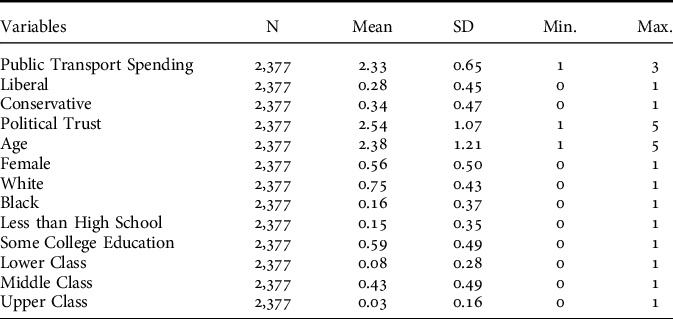
Overall, the study’s empirical model includes 2,377 observations: 1,270 from the 2010 survey and 1,107 from the 2014 survey. For the pooled data, 2,377 respondents were recorded as answering a question about public transport spending. Of these, 670 respondents identified themselves as liberal (28.19%); 350 liberals considered public transport spending “too little” (52.24%), whereas 269 liberals deemed it “about right” (40.15%) and 51 thought it “too much” (7.6%). Among the 804 self-identified conservatives (33.82%), 305 considered public transport spending “too little” (37.94%), whereas 392 deemed it “about right” (48.76%) and 107 thought it “too much” (13.31%). Therefore, in terms of perceptions about public transport spending, liberals and conservatives differ mainly in their attitude towards the need for additional funding (52.24% versus 37.94%).
4.2. Variables
The dependent variable is an attitudinal measure of spending on public transport. Respondents were asked whether the level of spending on public transport was “too little”, “about right” or “too much”. It was reversely coded so that a value of three indicates “too little” (interpreted as more spending needed) and a value of one indicates “too much” (interpreted as less spending needed).
The main independent variables are political trust and ideology. Political trust is a single measure. Respondents were asked, “Most of the time we can trust people in government to do what is right”. The variable ranges from one to five, and higher values indicate greater political trust. Ideology measures the respondents’ self-placement on a seven-point ideology scale with respect to their political views (from extremely liberal to extremely conservative). For this, three indicator variables (liberal, conservative and moderate) were created, with moderate serving as the reference variable. Using the measures of political trust and ideology, this study tests whether political trust moderates the relationship between conservatives and attitudes towards spending on public transport. It hypothesises that conservatives are more likely to support spending on public transport when moderated by political trust.
The model also accounts for a set of control variables, such as education, class and wealth, that may explain individuals’ spending preferences for public transport. People with a better education are more likely to be aware of the current state of environmental sustainability and to support spending on public transport (Meyer, Reference Meyer2016). Self-identification of class also indicates perceived personal wealth, which studies have shown is positively associated with car ownership (Dargay and Gately, Reference Dargay and Gately1999) and negatively associated with public transport. Working class serves as the reference variable for the three class variables. Also, the urban poor are especially likely to be African Americans, whose choice to live in cities is partly explained by the availability of public transport (Glaeser et al., Reference Glaeser, Kahn and Rappaport2008). Demographic variables such as age (level) and female (indicator variable) are also accounted for.
5. Results
Ordered probit was relied on to test the moderation of political trust on the relationship between conservatives and attitudes towards spending on public transport because the dependent variable is categorical and ranges from one to three (Long, Reference Long1997). While it can be turned into a variable for a binary probit, scholars argue that collapsing ordered categories into binary ones may cause “the loss of a significant amount of information” as well as ignoring the “conceptual and empirical differences” regarding different attitudes to government spending (Fullerton and Dixon, Reference Fullerton and Dixon2010: 650). Another benefit of using an ordered probit model is that even though the proportionality assumption is violated, the model’s efficiency is not compromised (Williams, Reference Williams2016). Finally, robust standard errors are also employed.
This study expects that political trust will moderate the relationship between conservatives and their spending preferences for public transport. Because conservatives are more exposed to ideological risks posed by public transport than liberals are, political trust is expected to serve as a decision mechanism to help conservatives support spending on public transport. Implicit in this assumption is that political trust is not an influencing factor for liberals because they support public transport regardless of the levels of political trust.
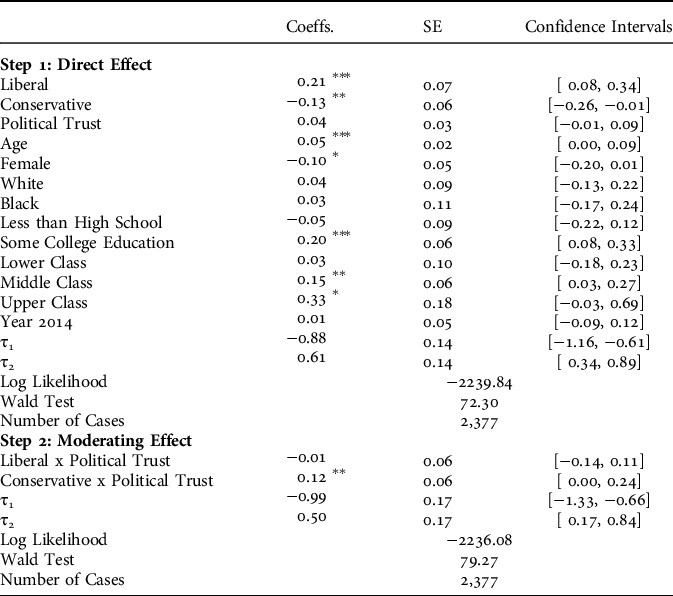
The results of the model are presented in Table 2, which follows a hierarchical regression analysis. Step 1 shows the direct effects of the explanatory and control variables, while Step 2 focuses on the joint effects of ideology and political trust. The results confirm the first hypothesis that conservatives are negatively associated with spending on public transport. Political trust also moderates the relationship between conservatives and their spending preferences; conservatives are more likely to support public transport if moderated by political trust. Being liberal is significantly and positively associated with the dependent variable. As theorised, liberals are not affected by their level of political trust. In this model, political trust itself is not in a meaningful relationship with the dependent variable. Although political trust may not be directly associated with individuals’ public transport spending preferences, it plays a crucial role in shaping how conservatives perceive such preferences. The results confirm the expectation that public transport presents an ideological risk to conservatives and political trust serves as a heuristic by which conservatives can reorient their attitudes towards spending on public transport.
Descriptive Statistics

Ideology, Political Trust and Attitudes to Spending on Public Transport

* p < 0.10, ** p < 0.05, *** p < 0.01
With respect to the control variables, “some college education” is significant and positively signed. This indicates that individuals with a higher level of education may be more likely to understand the nation’s public transport needs and show greater support for improving the deteriorating public transport system than those with only a high school education. Additionally, compared to those identified with the working class, individuals who perceive themselves as middle or upper class show more support for spending on public transport. Since both middle and upper class individuals are likely to be better educated than those of the working class, they may be more conscious of contemporary public transport needs. At least in these data, women show less preference for public transport spending than men do, perhaps because they consider public transport in the United States to be an unsafe mode of transportation; however, at the 10% level, the significance is somewhat weak. Seniors may desire more accessibility to public transport that enables them to maintain their lifestyle even if they cannot drive by themselves (Shrestha et al., Reference Shrestha, Millonig, Hounsell and McDonald2017).
It is also worth noting that race exerts no influence on spending preferences. Minority populations are dominant in US inner cities, but in this model black people do not necessarily support more spending on public transport than those of other racial backgrounds; nor does being white indicate a preference for less spending on public transport. Perhaps this result accords with the tendency of most US citizens to rely on their own vehicles for commuting (The Economist, 2018), reflecting the stigmatisation of public transport in contemporary US life (Shrikant, Reference Shrikant2018).
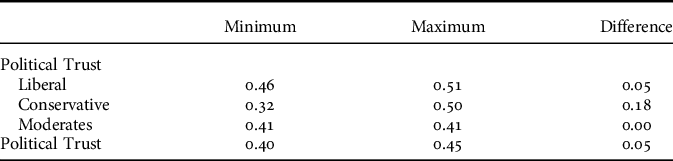
To further identify the impact of political trust, the predicted probabilities of supporting spending on public transport are illustrated in Table 3. Each covariate is set at its minimum and maximum value, with all other variables set at the average. If the difference between the minimum and maximum value can be perceived as a one-unit shock, the results in Table 3 show that, among conservatives, political trust increases the support for public transport by approximately 18%. As such, political trust substantially alters conservatives’ policy attitudes.
Predicted Probabilities of Supporting Spending on Public Transport

As theorised, the impact of political trust is negligent among liberals in the predicted probabilities of the latter supporting spending on public support, with one-unit shock of political trust resulting in a 5% change. Liberals believe in fostering public transport, and such a belief is not dramatically altered by a high level of political trust. Similarly, the impact of political trust on moderates is relatively inconsequential. Moderates may face ideological sacrifices with respect to supporting public transport spending, but the impact of political trust on them is logically much smaller than on conservatives (Rudolph and Popp, Reference Rudolph and Popp2009). In this study’s data, political trust has almost no impact on how moderates perceive public transport spending.
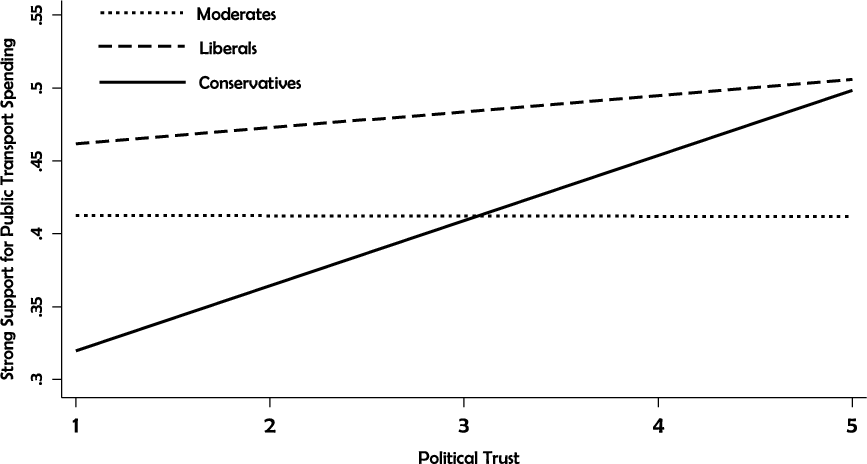
Figure 1 visualises the interaction between political trust and ideology for supporting spending on public transport. The solid line (conservatives) shows a steep, positive slope when the level of political trust increases. On the contrary, the dashed line (liberals) and the short-dashed line (moderates) are hardly affected by the degree of political trust. In this model, public transport spending only poses ideological risks to conservatives, who support it only with political trust.
The Interaction between Political Trust and Ideology for Supporting Spending on Public Transport

6. Conclusion and discussion
In recent years, public transport has attracted the attention of media outlets; antiquated facilities, lengthy delays and accidents have made frequent newspaper headlines in, for example, New York, Los Angeles and Chicago (Hu, Reference Hu2018). Can anything be done to alleviate and improve the current state of US public transport?
The article points to political trust as a mechanism to overcome ideological barriers to government programmes. The results indicate that conservatives are negatively associated with supporting spending on public transport, but they are more likely to support it if moderated by political trust. Political trust serves as a heuristic—a mental shortcut shaping their worldview and conservatives with high levels of trust are more likely to develop more favourable views of spending on public transport.
Thus, political trust has critical implications for a wide spectrum of national-, state-, and city-level policies associated with public transport. In terms of environment, Taniguchi and Marshall (Reference Taniguchi and Marshall2018) have demonstrated that citizens with a greater level of institutional trust in government are more likely to make sacrifices for the environment. A similar finding is also backed by several studies that note positive relationships between political trust and support for environmental protection and its policies (Fairbrother, Reference Fairbrother2016; Harring, Reference Harring2013, Reference Harring2018). Political trust further helps people to take ameliorative action in response to climate change and fosters individuals’ willingness to pay for actions to fight climate change (Smith and Mayer, Reference Smith and Mayer2018). Additionally, political trust predicts public support for municipal services, such as public transport (Herian, Reference Herian2014). In the case of urban planning, political trust is positively associated with the public’s support for zoning; with high trust, citizens are willing to lend power to local administrators in enacting zoning policies (Cooper et al., Reference Cooper, Knotts and Brennan2008). Weiner and Greenberg (Reference Weiner and Greenberg2018) have shown that the public’s support is crucial for acquiring funding for the Hudson Tunnel Project, which aims to build the Northeast Corridor’s Hudson River rail crossing between New York and New Jersey.
The importance of political trust can also be manifested in international cases. Congestion charging, a public transport initiative, has generated contentious discourses in recent decades. A comparison of two cities in a similar cultural and legal context reveals how political trust can encourage public acceptability of congestion pricing. In Sweden, Stockholm and Gothenburg introduced congestion charging in 2007 (after a trial) and in 2013, respectively. While Stockholm’s congestion charging served as the model for Gothenburg’s, public acceptability for the two cases proceeded differently. While congestion charging continues to be implemented in both cities, it gained political legitimacy through a popular referendum (enforceable) in Stockholm in 2007 but lost political legitimacy when a popular referendum (non-enforceable and only for consultancy purposes) in Gothenburg in 2014 resoundingly rejected the system with 57% voters against it (Hysing and Isaksson, Reference Hysing and Isaksson2015; Hansla et al., Reference Hansla, Hysing, Nilsson and Martinsson2017). The main reason for the difference was the local government’s top-down, pro-forma approach to involving the public in the decision-making process for implementing the system in Gothenburg (Hysing, Reference Hysing2015). The lack of public participation, caused by decision-makers’ paternalistic views, led to a decline in public trust of local political actors and a low public acceptability of the congestion charging (Hysing, Reference Hysing2015). An empirical analysis by Hansla et al. (Reference Hansla, Hysing, Nilsson and Martinsson2017) also found positive associations between citizens’ who voted for keeping congestion charging in Gothenburg and their trust in politicians, local institutions and procedural fairness.
A more dramatic case of the effects of political trust on public transport discourses can be found in Nashville, Tennessee, where Mayor Megan Barry launched an ambitious $5.4 billion initiative in 2017 that aimed to reshape the city’s public transport with new transit centres, bus service expansion, new tram lines and bike as well as sidewalk infrastructure. However, when it was put to a ballot in 2018, 64% rejected the measure. The failure stemmed from self-inflicted political bungling, including failure to garner support from the public and members of the city council, Barry’s love affair with her bodyguard and involvement in stealing city money, and poor communication with those living outside the city as to why metropolitan public transport was necessary (Capps, Reference Capps2018; Fitzgerald, Reference Fitzgerald2018).
It should also be noted that not all cities experience ideological struggles when pushing for public transport. Some cities have tried to persuade people of various political ideologies to support public transport based on its potential for economic growth. In particular, economic growth is used as a selling point to attract support from conservative political leaders and business interests; conservatives may buy into public transport more readily when it is presented as means to facilitate economic growth rather than to support the underprivileged (Weyrich and Lind, Reference Weyrich and Lind2009). Highlighting economic growth is a sustainable strategy backed by a review study that assessed empirical studies examining positive relationships between public investment in transport and its economic benefits (Bhatta and Drennan, Reference Bhatta and Drennan2003).
In the United States, some cities have been successful in promoting public transport for its economic benefits. For instance, Salt Lake City, Utah has reinvented itself through public transport. Despite being surrounded by conservative governors and senators, the city has achieved a remarkable degree of public transport development since the 1990s. Political and business leaders are in consensus about the construction and expansion of public transport to enhance the city’s economy. Despite a ballot initiative failing to muster a pass in 1992, the city was able to build its first light rail line in 1999. The non-profit organisation Envision Utah also worked with city officials and the public to develop a denser, planned city and neighbourhoods. Consequently, a second light rail line was built in 2001 along with an 89-mile commuter rail created in 2008 and expanded in 2011. Similarly, a 70-mile rail project connecting suburbs to the city core and the airport was built along with a streetcar line. With strong support from top to bottom and financial support from the state and the city (local sales tax), the city is one of the few success stories in which the public was convinced of the importance of public transport to economic growth (Fitzgerald, Reference Fitzgerald2018; Jaffe, Reference Jaffe2013).
Phoenix is another example of a city in which arguments for economic benefits have trumped ideological opposition to public transport. Phoenix, a Sun Belt city long associated with being business-friendly and with the rise of modern conservatism, has been actively pushing for expansion in public transport in recent years. The city started building a 20-mile rail system in 2005 and finally introduced a light rail called the Valley Metro Rail in 2008. The 20-mile rail has enjoyed strong ridership and spurred economic development in downtown areas. Today, the system has 38 stations on its 28-mile tracks and connects an international airport and Arizona State University (Davis-Young, Reference Davis-Young2019). Encouraged by positive results, the city is embarking on a 66-mile rail expansion to be completed by 2034 (Sisson, Reference Sisson2017). As expansion efforts mounted, the estimated costs also rose, spurring criticism from some residents and small business owners who saw the expansion threating their livelihoods (Davis-Young, Reference Davis-Young2019). Voters, however, resoundingly rejected Proposition 105, which would have ended the new rail construction that was ongoing in south Phoenix as well as future expansions (Hsieh, Reference Hsieh2019). The result defeated ferocious anti-transit efforts waged by the Americans for Prosperity lobby, sponsored by billionaires Charles and David Koch. The residents of Phoenix believed that the city’s economic future lay in dense urban development rather than the urban sprawl for which the city has long been known (Bliss, Reference Bliss2019; Trumm, Reference Trumm2019).
In other countries, public transport has also gained broad popularity from residents for its economic benefits. For instance, the conservative Mayor Myung-bak Lee of the Seoul Metropolitan Government in South Korea pushed for and completed dramatic public transport initiatives in 2004. Those initiatives included an integrated, automatic fare and ticketing system across transport modes and routes, exclusive bus-only lanes for efficient operation and transfers among modes with fares adjusted for the distance taken (Allen, Reference Allen2013; Pucher et al., Reference Pucher, Park, Kim and Song2005). In Sweden, a survey of general policy documents revealed that local governments predominantly rely on economic growth to rationalise public transport developments (Stjernborg and Mattisson, Reference Stjernborg and Mattisson2016). For economic stimulation, some cities have even experimented with free city-wide public transport. For example, Tallinn, Estonia began implementing fare-free travel in 2013 (Hess, Reference Hess2017). Dunkirk, France is also experimenting with how free buses, started in 2018, can transform the city (Willsher, Reference Willsher2018). Indeed, public transport is free across the whole country of Luxembourg despite its small size (Lo, Reference Lo2020). Discourses surrounding the implications of these fare-free systems have been remarkably devoid of the partisan invective commonly observed in US city cases such as Nashville, Tennessee. Thus, investment in public transport is not necessarily captive to ideological contentions and can secure support from those with various political ideologies if it is promoted as bringing economic benefits to all.
This study is not without some methodological and substantive limitations. First, it did not examine whether political trust enhances actual policy outcomes. It also failed to demonstrate under which conditions political trust activates the shift from ideological preferences to support of a policy. Additionally, the study relied on pooled data that are cross-sectional in nature; as such, a causal relationship in the model should be accepted with caution. Finally, the study primarily focuses on the situation in the United States, where there is strong ideological polarisation regarding many political issues, including public transport. While the study’s findings may not be directly relevant for countries where public transport is not a polarised issue, they may be useful in relation to other ideologically polarising issues facing countries around the world.
ACKNOWLEDGEMENTS
This work was supported by Inha University Research Grant (2021).