Orthographic knowledge most likely does not deteriorate with aging (e.g., MacKay, Abrams, & Pedroza, Reference MacKay, Abrams and Pedroza1999; Shafto, Reference Stuart-Hamilton and Rabbitt2010), yet there are many reasons to expect changes in spelling abilities in old age. Difficulties in spelling could reflect a decline in working memory (Stuart-Hamilton & Rabbitt, Reference Tun, McCoy and Wingfield1997) that limits the capacity to maintain an active list of phonemes or graphemes in preparation for writing, or a decrease in the ability to activate phonological or orthographic representations, similar to the presumed effects on spoken word retrieval (MacKay & Abrams, Reference MacKay and Abrams1998). However, writing experience and vocabulary knowledge accumulate over one’s lifetime, possibly offsetting difficulties in retrieval of spoken words (e.g., Bowles & Salthouse, Reference Bowles and Salthouse2008; Kavé & Mashal, Reference Kavé and Mashal2012; Kavé & Yafé, Reference Kavé and Yafé2014; Kemper & Sumner, Reference Kemper and Sumner2001; Verhaeghen, Reference White, Abrams, Palm and Protasi2003), as well as in orthographic retrieval. The current study examines these explanations by focusing on the effect of word and letter frequency on spelling abilities in younger and older Hebrew speakers.
Most studies of spelling in old age have been conducted within the theoretical framework of the transmission deficit hypothesis (TDH; MacKay & Burke, Reference MacKay, Burke and Hess1990). This hypothesis was initially put forth to explain difficulties in spoken word production, stating that aging, as well as the lack of recent or frequent activation, weakens connections between semantic and phonological representations. A weak connection transmits too little excitation, and thus a given representation cannot reach the threshold necessary for activation, resulting in a production failure. MacKay and Abrams (Reference MacKay and Abrams1998) adapted the TDH to spelling, arguing that weak connections between a word’s representation levels are responsible for spelling difficulties in older individuals, and are most prominent in words that are spelled irregularly. These words are activated by only one source within the network, unlike words with regular spelling whose retrieval is aided by other words that share similar spelling. Thus, the TDH predicts that older adults will have more spelling errors relative to younger adults, and that these errors will reflect difficulties in retrieval of full orthographic representations. The TDH further predicts that errors will be more prevalent in low-frequency words as well as in words with low-frequency or irregular spelling. In addition, age will interact with frequency, so that older adults will find it especially difficult to spell low-frequency words and words with low-frequency spelling.
Previous research has yielded conflicting findings that provide only partial confirmation of these predictions. Support for the TDH comes from a study by Stuart-Hamilton and Rabbit (Reference Tun, McCoy and Wingfield1997) in which 159 English speakers in three age groups (mean ages 55.9, 65.1, and 74.0) spelled 20 words, and the number of words that were spelled correctly decreased with age. Similarly, MacKay and Abrams (Reference MacKay and Abrams1998) dictated 40 words to young (mean age 19.00), older (mean age 67.20), and oldest adults (mean age 77.04), and found that the two older groups made more spelling errors than did the youngest group. In contrast, Abrams and Stanley (Reference Abrams and Stanley2004) found no age differences when participants were asked to spell words that they heard and saw before, with significant age differences appearing only when experimental cues mismatched the presented stimuli (e.g., hearing base but seeing bare). Furthermore, Abrams and White (Reference Abrams, White and Fabini2010) asked 60 younger adults (mean age 19.25) and 60 older adults (mean age 72.42) to spell 90 single words, and found that older adults outperformed younger adults in spelling, rather than vice versa. Likewise, in a study in which participants were asked to spell homophone words (e.g., blew–blue) in sentence context, younger adults made significantly more errors than did older adults (White, Abrams, Palm, & Protasi, Reference White, Abrams and Zoller2012). Thus, in some contexts older adults make more spelling errors than do younger adults, but in other cases no such age differences emerge.
According to the TDH, spelling not only should be worse in older relative to younger adults but it should also be differentially worse for low-frequency words. Stuart-Hamilton and Rabbitt (Reference Tun, McCoy and Wingfield1997) examined frequency effects by dictating 10 low-frequency words (e.g., lanthanum) and 10 high-frequency words (e.g., knowledge). As expected, age interacted with word frequency, and the oldest group made more errors on the low-frequency words, with a ceiling effect for the high-frequency words. In another study, Shafto (Reference Stuart-Hamilton and Rabbitt2010) presented to 36 younger adults (mean age 20.61) as well as to 36 older adults (mean age 72.86) words in which an incorrect letter was marked in red. Participants were asked to name the letter that should replace the underlined letter in order to correct the spelling. Half of the words were of low frequency and half were of high frequency. The results showed a significant interaction, with older adults producing more correction errors than younger adults for the low-frequency words but not for the high-frequency words. These studies support the assumption that older adults find it especially difficult to spell low-frequency words. However, Stuart-Hamilton and Rabbitt (Reference Tun, McCoy and Wingfield1997) did not match their conditions in terms of word length, and thus the low-frequency words were longer (10.6 letters on average) than were the high-frequency words (7.8 letters on average). Shafto (Reference Stuart-Hamilton and Rabbitt2010) used an oral spelling correction task that might be more taxing to working memory than a writing spelling task, because participants must compare the presented letter string with the stored string. It is thus possible that at least some of the effects that were documented in these studies were due to an overload of orthographic information in working memory, which decreased performance more severely in older adults and in rare words.
Unlike the studies that found more difficulties in spelling low-frequency words in older adults, several studies showed that older adults spell low-frequency words better than do younger adults. For instance, Abrams and White (Reference Abrams, White and Fabini2010) reported that while low-frequency words (e.g., unforeseeable) led to overall more spelling errors than did high-frequency words (e.g., marriage), the negative impact of low-frequency words was more deleterious for younger adults than it was for older adults. Similarly, MacKay and Abrams (Reference MacKay and Abrams1998) documented an interaction between age and frequency, with no age differences for the low-frequency words (e.g., inoculate), alongside significant differences for the high-frequency words (e.g., committee). In this study, all participants spelled low-frequency words at the same level, but younger adults spelled high-frequency words better than did the oldest adults. The authors attributed the effect to the fact that younger adults had not yet acquired the spelling of some of the low-frequency words. In addition, younger adults spelled some of the low-frequency words by sound and thus made more regularization errors on the low-frequency words than did older adults. These findings were interpreted as an indication of limited word knowledge in younger adults, but they also show that the accumulation of knowledge affects the selection of spelling processing strategies.
An alternative account of spelling abilities in old age is presented by dual-route and parallel distributed processing models. According to these models, spelling relies on sublexical phoneme-to-grapheme conversion, as well as on lexical retrieval of whole-word representations (Cortese, Balota, Sergent-Marshall, & Buckner, Reference Cortese, Balota, Sergent-Marshall and Buckner2003). The relative reliance on each type of processing depends on more general orthographic characteristics of the language, as well as on characteristics of specific words within each language and the strength of the weights of their representations. Skilled spelling most likely relies on the interaction of both types of processing, but there are cases in which stronger reliance on one type of representation or processing might be more efficient. Hence, spelling of nonwords or new words must be carried out through sublexical processes because no lexical representation is available for them. In regular words with completely consistent spelling, spelling can be done either through the conversion of each phoneme into its corresponding grapheme or through full lexical retrieval. Yet, when spelling low-frequency words, whose lexical representation is either unfamiliar or less accessible, sublexical processing might assume prominence. In contrast, in irregular words, which cannot be predicted by phoneme-to-grapheme conversion rules, correct spelling is more highly dependent on full lexical retrieval. Aging could affect the relative reliance on either sublexical or lexical processing. Thus, if older adults have difficulty in activating orthographic representations, they might gradually resort to using sublexical processes. In contrast, the accumulation of vocabulary and the expansion of orthographic knowledge could lead to greater reliance on full lexical retrieval with increased age.
Research on reading of single words suggests that compared to younger adults, older adults rely more heavily on lexical as opposed to sublexical processes. For example, Chapleau et al. (Reference Chapleau, Wilson, Potvin, Harvey-Langton, Montembeault and Brambati2017) found that younger French-speaking adults made more regularization errors when reading aloud irregular low-frequency words than did older adults. They interpreted these results as evidence that the younger adults used sublexical reading strategies that were not used by the older adults. In a study of English readers, Cohen-Shikora and Balota (Reference Cohen-Shikora and Balota2016) reported that when asked to read irregular words as regular, older adults had greater difficulty in suppressing lexical representations than did younger adults. These studies suggest that aging or reading experience lead to strengthening of lexical over sublexical processing in reading. Examining spelling abilities, Cortese et al. (Reference Cortese, Balota, Sergent-Marshall and Buckner2003) found that older adults were more likely than were younger adults to spell homophones according to their dominant semantic usage, thus relying more heavily on lexical access. Moreover, older adults were less likely than were younger adults to pay attention to phonological information, choosing the most dominant spelling based on sound-to-spelling principles less often than did younger adults.
In the current study, we look at the effects of age and frequency on spelling in Hebrew. Several properties are particularly important concerning Hebrew spelling. First, most Hebrew words are spelled with consonants alone, without vowels at all or with minimal vowel notation. Hebrew uses diacritics to specify pronunciation, but this system appears primarily in children’s books or poetry. Adults do not use diacritics in spelling. Second, if vowels appear, they are represented primarily by two letters. Third, because there are very few vowel letters, words are relatively short. Fourth, while most Hebrew phonemes map unequivocally onto unique graphemes, there are some polygraphic sounds that can be spelled with two different letters (Berent & Frost, Reference Berent, Frost, Perfetti, Rieben and Fayol1997). Hence, many Hebrew words, or segments within words, can be spelled by using phoneme-to-grapheme conversion rules, yet spelling of polygraphic sounds must rely on lexical knowledge. Spelling errors in Hebrew often involve selection of the wrong letter to match a polygraphic sound, although they could also involve letter transposition, deletion, or addition, as in other languages. Errors of vowel selection, inappropriate letter doubling, or lack of doubling, as well as omission of silent letters, are rather rare. Consequently, it is much easier to anticipate the errors that participants will make and to equate low-frequency and high-frequency words with regard to the type of expected misspelling.
Another characteristic of Hebrew spelling involves letter frequency (Ravid, Reference Shafto2002). Some of the polygraphic sounds are spelled with letters that differ in frequency, one appearing both in base forms and in grammatical forms (e.g., ת, א), while the other appears in base forms only (e.g., ט, ע). For example, the sound /t/ can be represented by both the letter ת and the letter ט. The letter ת appears in third-person feminine future forms (e.g., תשב teshev “she will sit”), in second person masculine future forms (e.g., תלמד tilmad “you-masculine will study”), as well as in feminine plural forms (e.g., בנות banot “girls”, גדולות gdolot “large, feminine”). In contrast, the letter ט has no grammatical function and hence is less frequent in the language. In the current study, we focus on base forms in which target letters have no grammatical functions.
We examine two theoretical accounts of spelling abilities in older age. If the predictions of the TDH are correct, we expect older adults to make more spelling errors in general, and to find it especially difficult to spell low-frequency words and low-frequency letters. To test this hypothesis, we selected words that were familiar to all participants, thus avoiding spelling errors that reflect lack of knowledge, and investigating the weakening of connections only for existing representations. According to the TDH, in familiar words vocabulary knowledge should not affect spelling, and older adults should have more difficulties in full orthographic retrieval relative to younger adults. Alternatively, if orthographic knowledge is intact in older age, and if older adults rely more heavily on lexical processing than do younger adults due to greater language experience, then older adults should have fewer difficulties in retrieving the correct spelling from their orthographic lexicon. Furthermore, the TDH predicts that older adults would have more difficulty in producing low-frequency letters that appear in fewer words, because these letters are activated less often. Yet, if older adults rely more heavily on lexical processing, letter frequency should have smaller effects on their spelling abilities.
Method
Participants
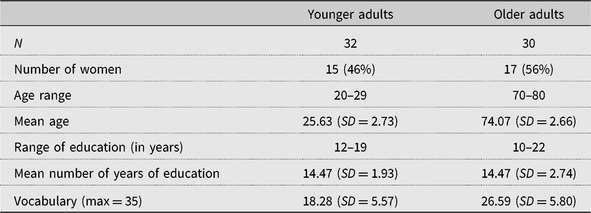
A convenience sample of 62 community-dwelling volunteers was recruited, with 32 younger adults (aged 20–29) and 30 older adults (aged 70 or above). Table 1 presents full demographic details for both groups. All participants were born in Israel and were native Hebrew speakers. They reported having no history of learning disorders, psychiatric disturbances, neurological disease, or head trauma. The mean number of years of education was matched across groups. Scores on a 35-item multiple-choice Hebrew vocabulary test (Kavé & Yafé, Reference Kavé and Yafé2014) were significantly higher for the older relative to the younger participants, t (59) = −5.703, p < .01. Older individuals reported no subjective decline in cognitive abilities and scored within the normal range on the Mini-Mental State Examination (Folstein, Folstein, & McHugh, Reference Folstein, Folstein and McHugh1975), with a mean score of 28.47 (range 27–30, SD = 1.04). The study received the approval of the ethics committee at the Open University.
Sample characteristics, by age group
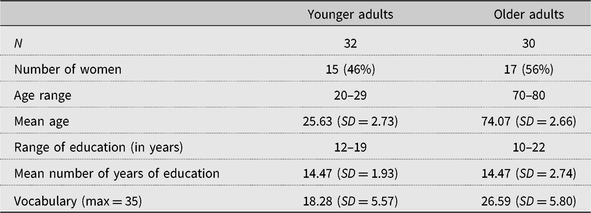
Note: Groups differed significantly in vocabulary scores, p < .01.
Stimuli
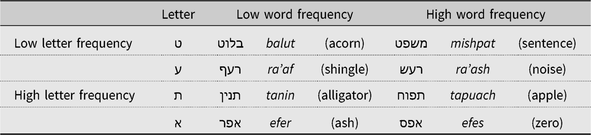
We selected 120 Hebrew nouns, each having 3–6 letters, consisting of one of four target letters that corresponded to two polygraphic phonemes (ת-ט and א-ע). Two of these letters (א and ת) may have grammatical functions, but in the current study we made sure to select no verbs (thus no future forms with these letters) and no plural nouns (thus no feminine plural with ת). Stimuli fit two factors: word frequency (low vs. high) and letter frequency (low vs. high), with 30 words in each cell (see Table 2 for examples).
Examples of stimuli, by word and letter frequency
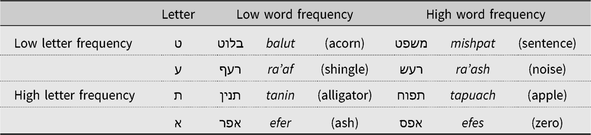
Note: Hebrew transliterations appear in italics. English translations appear in parentheses.
Word frequency
The low-frequency word condition included 60 words whose frequency did not exceed 6 occurrences per million in the Linzen (Reference Linzen2009) online database (M = 1.20, SD = 1.71). The high-frequency word condition included 60 words whose frequency was at least 19 occurrences per million (M = 54.27, SD = 44.30). In each condition there were 15 words with one of the four target letters. Low-frequency words were on average 4.08 letter long (SD = 0.87), and high-frequency words were on average 4.03 letter long (SD = 0.88), with no significant difference between conditions. Target letters appeared at the beginning of the word in 29% of the stimuli, in the middle of the word in 46% of the stimuli, and at the end of the word in 25% of the stimuli, and the two word frequency conditions were matched in terms of letter position.
Letter frequency
The same 120 words also fit two letter frequency conditions, so that half of the low-frequency words and half of the high-frequency words included a low-frequency letter, and the other half included a high-frequency letter. Of the 60 words with a letter of low frequency, 30 included the letter ט and 30 included the letter ע. Of the 60 words with a letter of high frequency, 30 included the letter ת and 30 included the letter א. Differences in letter frequency within each pair of graphemes were corroborated through the online MILA-Knowledge Center for Processing Hebrew database (http://www.mila.cs.technion.ac.il/). Words with low-frequency letters had a mean word frequency of 30.95 (SD = 46.51), as determined by the Linzen (Reference Linzen2009) online database, and words with high-frequency letters had a mean word frequency of 24.52 (SD = 34.83), with no significant difference between the two conditions. Word length as well as target letter position were matched across letter frequency conditions.
Procedure
Words were recorded by a male native Hebrew speaker, and arranged in a semirandom order that was identical for all participants. Each trial consisted of the target word, a beep of 110 ms, and a 1.5-s delay. Participants were asked to write down each word as quickly and as accurately as possible on a sheet of paper. The complete list of words included 45 additional words of similar length that were part of another study. These words did not fit the selection criteria of the present study in terms of word and letter frequency or in terms of letter position, and did not enter the analyses. Words were presented through headphones in 11 separate lists of 15 words each, with a short break after each 15-item list. Prior to the experimental trials, participants heard 5 words, and were asked to make sure that they could hear them well through the headphones. They could listen to these words as many times as they wanted. Once volume levels were individually adjusted, a 15-item practice trial was presented. The experiment began when the participant indicated that the task was clear.
Following the dictation phase, participants were asked to read the list of all nouns aloud, and their responses were recorded. Reading was examined to make sure that all participants had encountered the words before and that misspellings were not due to lack of word familiarity. As most Hebrew words are spelled with no vowels, in principle any string of consonants can be read in several different ways. Even when the word consists of a vowel letter, as in בוטן, that letter can be pronounced as either /o/ or /u/, and readers must be familiar with the word in order to read it correctly as boten (peanut). Thus, correct reading aloud indicates prior orthographic familiarity.
Error coding
Misspellings were coded as either relevant or irrelevant. Relevant misspellings involved phonological substitution (i.e., selection of the incorrect competing letter instead of the designated target letter). Irrelevant errors included substitution of the target letter with a letter that corresponded to a different phoneme, substitution of a nontarget letter, letter transposition, letter omission, or letter insertion, whether involving the target letter or any other letter in the word. As each word could have only one relevant error, coding of irrelevant errors referred to the word level. That is, even if two irrelevant errors occurred in the same word, we counted the word once. Completely different words were coded as irrelevant errors. Correct responses were words that included neither relevant nor irrelevant errors and were spelled appropriately. We note that irrelevant errors and word omissions could reflect slip of the pen, mishearing, or difficulty keeping up with the pace of dictation. They could therefore affect the number of correct responses even though they do not reflect difficulty in retrieving the correct spelling. Hence, we analyze the percentage of correct responses relative to all correct responses together with relevant errors, regardless of irrelevant errors or word omissions.
Results
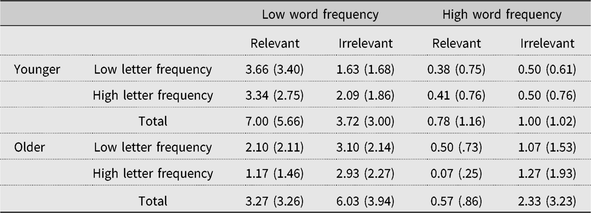
There was a ceiling effect of reading accuracy (M younger = 97.25% correct, SD = 2.13; M older = 97.70% correct, SD = 2.22), with no significant difference between the groups, t (60) = –0.816, ns. To examine the effects of frequency and age on spelling, we ran three analyses of variance with a within-subjects comparison of word and letter frequency and a between-subjects comparison of age groups (see raw scores in Tables 3 and 4). These analyses were performed for relevant errors, irrelevant errors, and percentage of correct responses. Following each analysis by subjects (F 1), we also report an item analysis (F 2).
Means (and SD) of spelling errors, by frequency and age group
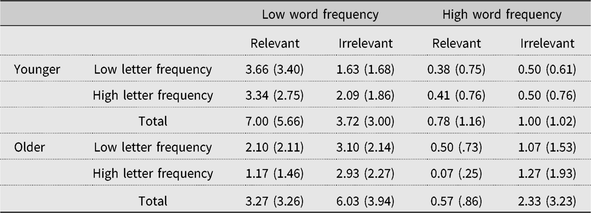
Note: Relevant represents the number of words in which the incorrect competing letter substituted the designated target letter. Irrelevant represents the number of words that were spelled incorrectly in which the error did not involve substitution of the target letter with its competing letter.
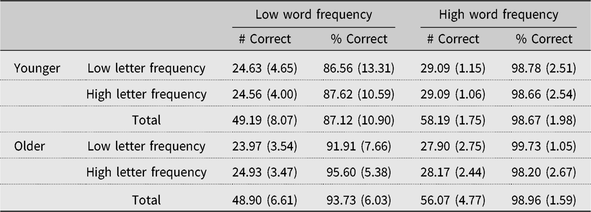
Means (and SD) of correct spelling performance, by frequency and age group
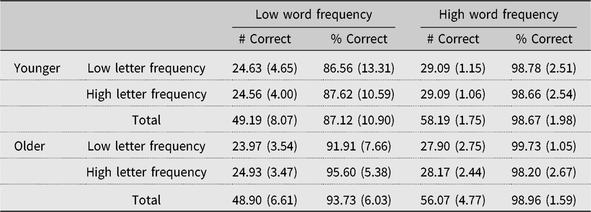
Note: Percentage correct was calculated as the number of correct responses divided by the number of correct responses as well as the number of relevant errors, excluding irrelevant errors and word omissions.
Relevant errors
An analysis of the number of relevant errors showed a main effect of word frequency, with more errors made on low-frequency words relative to high-frequency words, F 1 (1, 60) = 74.064, p < .05, ŋ2 = .552, F 2 (1, 116) = 33.054, p < .05, ŋ2 = .222. There was also a main effect of letter frequency in the subject analysis, with more errors made on words with low-frequency letters than on words with high-frequency letters, F 1 (1, 60) = 6.073, p < .05, ŋ2 = .092, but this effect was not significant in the item analysis, F 2 (1, 116) = 1.128, ns, ŋ2 = .010. The main effect of age was significant, with more relevant errors made by younger adults than by older adults, F 1 (1, 60) = 8.381, p < .05, ŋ2 = .123, F 2 (1, 116) = 23.224, p < .05, ŋ2 = .167. The two-way interaction between word frequency and age was significant, F 1 (1, 60) = 11.529, p < .05, ŋ2 = .161, F 2 (1, 116) = 18.449, p < .05, ŋ2 = .137, as the younger adults made more relevant errors on the low-frequency words than did the older adults, with no age difference for the high-frequency words. There was no significant interaction between letter frequency and age, F 1 (1, 60) = 2.635, ns, ŋ2 = .042, F 2 (1, 116) = 1.755, ns, ŋ2 = .015, or between word frequency and letter frequency, F 1 (1, 60) = 3.139, ns, ŋ2 = .050, F 2 (1, 116) = 0.296, ns, ŋ2 = .003. The three-way interaction between word frequency, letter frequency, and age was not significant as well, F 1 (1, 60) = 0.108, ns, ŋ2 = .002, F 2 (1, 116) = 0.036, ns, ŋ2 = .000.
Irrelevant errors
An analysis of irrelevant errors yielded a significant main effect of word frequency, F 1 (1, 60) = 61.859, p < .05, ŋ2 = .508, F 2 (1, 116) = 33.272, p < .05, ŋ2 = .223, with more errors made on low-frequency words than on high-frequency words. There was no main effect of letter frequency, F 1 (1, 60) = 0.877, ns, ŋ2 = .014, F 2 (1, 116) = 0.021, ns, ŋ2 = .000. The main effect of age was significant in the subject analysis, F 1 (1, 60) = 8.190, p < .05, ŋ2 = .120, with older adults making more irrelevant errors relative to younger adults, but it was not significant in the item analysis, F 2 (1, 116) = 0.202, ns, ŋ2 = .002. There were no significant interactions between word frequency and age, F 1 (1, 60) = 1.446, ns, ŋ2 = .024, F 2 (1, 116) = 3.747, ns, ŋ2 = .031, between letter frequency and age, F 1 (1, 60) = 0.660, ns, ŋ2 = .011, F 2 (1, 116) = 0.058, ns, ŋ2 = .001, between word frequency and letter frequency, F 1 (1, 60) = 0.029, ns, ŋ2 = .000, F 2 (1, 116) = 0.171, ns, ŋ2 = .001, or between word frequency, letter frequency, and age, F1 (1, 60) = 1.936, ns, ŋ2 = .031, F 2 (1, 116) = 0.000, ns, ŋ2 = .000.
Percentage of correct responses
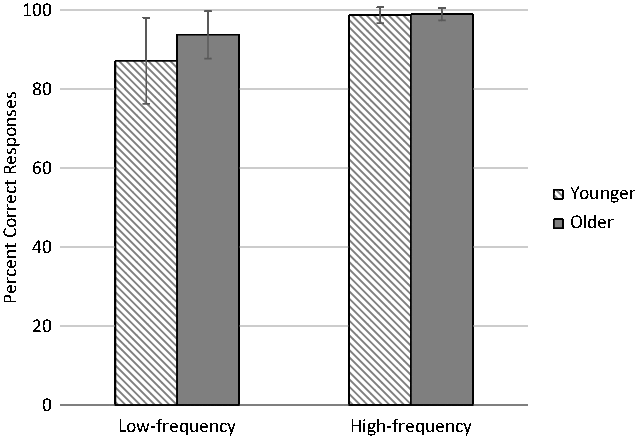
An analysis of the percentage of correct responses showed a main effect of word frequency, F 1 (1, 60) = 70.287, p < .05, ŋ2 = .539, F 2 (1, 116) = 31.696, p < .05, ŋ2 = .215, with a higher percentage of correct responses for the high-frequency words (see Table 4 and Figure 1). The main effect of letter frequency was significant in the subject analysis, F 1 (1, 60) = 6.327, p < .05, ŋ2 = .095, with a higher percentage of correct responses for words with high-frequency letters, but it was not significant in the item analysis, F 2 (1, 116) = 0.384, ns, ŋ2 = .003. There was a main effect of age in both the subject analysis, F 1 (1, 60) = 7.188, p < .05, ŋ2 = .107, and the item analysis, F 2 (1, 116) = 19.564, p < .05, ŋ2 = .144, with a higher percentage of correct responses in the older group than in the younger group. The interaction between word frequency and age was significant in both analyses, F 1 (1, 60) = 10.178, p < .05, ŋ2 = .145, F 2 (1, 116) = 15.961, p < .05, ŋ2 = .121, reflecting the fact that younger adults had more difficulties than did older adults in spelling low-frequency but not high-frequency words. The interaction between letter frequency and age was not significant, F 1 (1, 60) = 3.003, ns, ŋ2 = .048, F 2 (1, 116) = 1.589, ns, ŋ2 = .014. The interaction between word frequency and letter frequency was not significant, F 1 (1, 60) = 3.530, ns, ŋ2 = .055, F 2 (1, 116) = .034, ns, ŋ2 = .000, and the same was true for the three-way interaction between word frequency, letter frequency, and age, F 1 (1, 60) = 0.349, ns, ŋ2 = .006, F 2 (1, 116) = 0.014, ns, ŋ2 = .000.
Percentage of correct responses on low-frequency and high-frequency words, by age groups.

To examine the effect of vocabulary knowledge on age differences in spelling abilities, we ran the subject analyses again, using vocabulary scores as a covariate. Note that one older participant did not complete the vocabulary test, as reflected in the degrees of freedom. In the analysis of relevant errors, entering vocabulary as a covariate eliminated the effect of age as well as the interaction between word frequency and age group. In the analysis of irrelevant errors, the main effect of age remained significant after entering vocabulary as a covariate, F (1, 58) = 25.205, p < .05, ŋ2 = .303, with more irrelevant errors in the older group. The interaction between word frequency and age group emerged as significant, F (1, 58) = 10.047, p < .05, ŋ2 = .148, with older adults making more irrelevant errors especially on the low-frequency words. Entering vocabulary scores to the analysis of the percentage of correct responses eliminated the main effect of age, as well as the interaction between word frequency and age. The interaction between letter frequency and age emerged as significant, F (1, 58) = 4.184, p < .05, ŋ2 = .067, reflecting the fact that the age difference was greater for the high-frequency letters than it was for the low-frequency letters.
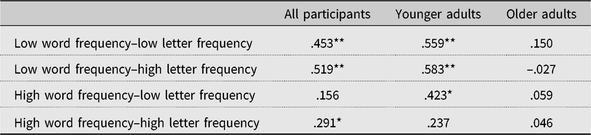
Finally, we looked at the correlations between vocabulary scores and the percentage of correct responses, for all participants together and then separately for each age group. As can be seen in Table 5, vocabulary scores were significantly correlated with three of the four measures when all participants were entered into the analysis together, as well as within the younger group. There were no equivalent correlations within the older group.
Correlations between vocabulary scores and percentage of correct responses, by condition and age group
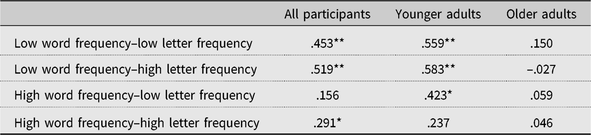
* p < .05.
** p < .01.
Discussion
Our results show that word frequency and letter frequency affect word spelling in Hebrew-speaking younger and older adults. All participants made more errors on low-frequency words as well as on words that included low-frequency letters. In addition, and unlike the prediction of the TDH (MacKay & Burke, Reference MacKay, Burke and Hess1990), younger adults made more relevant misspelling errors than did older adults, and there was no interaction between the two frequency effects. Although younger adults made more errors on the low-frequency words, these results cannot be attributed to younger adults’ lack of familiarity with the stimuli, as both age groups recognized all words in a reading task. Once vocabulary scores were entered into the analyses, most age effects were eliminated.
Our findings are in line with some of the previous studies in which no age-related decline in spelling performance emerged (e.g., White et al., Reference White, Abrams and Zoller2012; White, Abrams, & Zoller, Reference White, Abrams and Zoller2013), but they stand in contrast to other studies that demonstrated more spelling difficulties in older individuals (e.g., MacKay & Abrams, Reference MacKay and Abrams1998). Furthermore, our results regarding the impact of frequency on spelling resemble some previous findings but not others (e.g., MacKay & Abrams, Reference MacKay and Abrams1998; Shafto, Reference Stuart-Hamilton and Rabbitt2010; Stuart-Hamilton & Rabbitt, Reference Tun, McCoy and Wingfield1997). It might be argued that our results conflict with other findings in the literature because the current study was conducted in Hebrew, whereas earlier research on spelling in old age was conducted in English. The type of spelling errors in both languages is different, and speakers of Hebrew might have fewer errors overall than speakers of English because Hebrew phoneme-to-grapheme conversion rules are more transparent. Specifically, the words in the current study were familiar and short, and we focused on errors in only one target letter. Thus, Hebrew speakers might not show the decline in spelling abilities predicted by the TDH (MacKay & Abrams, Reference MacKay and Abrams1998) because they have to retrieve fewer spelling components from their orthographic lexicon. Furthermore, Hebrew morphology might make it easier to memorize spelling, as the letter that corresponds to the polygraphic sound is often repeated in other words that share the same morphology. These aspects of Hebrew spelling might help individuals improve their spelling knowledge over the years. As aging-related changes are expected to be universal, it is important to conduct research on spelling in old age in languages with diverse orthographies.
Nonetheless, our results cannot be seen as unique to Hebrew, as previous studies in English have also reported findings that contrast with the TDH. These studies varied greatly in many critical empirical aspects, such as participant ages, stimuli selection, type of spelling task, dependent variables (e.g., number or percentage of correct responses or errors), and control of vocabulary knowledge. It is difficult to pinpoint only one particular variable that differed across designs, but we believe that the fact that earlier research has not controlled for the type of potential errors as strictly as we did might be the source of contradictions in the literature. Evidence from individuals with brain damage suggests that some spelling errors are especially susceptible to graphemic buffer or working memory limitations but are less susceptible to lexical effects, such as word frequency (e.g., Cipolotti, Bird, Glasspool, & Shallice, Reference Cipolotti, Bird, Glasspool and Shallice2004). As Hebrew speakers make relatively few errors, a detailed analysis of irrelevant errors was deemed less appropriate for the current data. Future research with English speakers could compare different error types made by older adults to assess the reasons for difficulties. Such research could include measures of working memory as well, to investigate the possibility that specific types of errors reflect the inability to hold the necessary orthographic information within the graphemic buffer. We note also that recent studies of English spelling suggest that certain words are more error prone than others (Rahmanian & Kuperman, Reference Ravid2019), and that there could be a reciprocal relationship between the quality of orthographic representations and spelling errors. These findings show that in addition to word frequency or the type of error, the probability of misspelling of specific words must also be investigated.
According to MacKay and Abrams (Reference MacKay and Abrams1998), spelling difficulties in old age do not reflect working memory limitations but rather difficulties in orthographic selection, and older adults should find it especially difficult to retrieve irregular or low-frequency spelling. This account predicts an interaction between word and letter frequency that would reflect difficulties in transmission of excitation to the least frequent representation. The current study does not corroborate these predictions. Specifically, older adults produced fewer relevant errors than did younger adults, with no indication of a decrease in full orthographic activation. Relevant errors reflect greater reliance on phoneme-to-grapheme sublexical processing over lexical retrieval of full orthographic representations. Younger adults made more such errors, likely due to difficulty in retrieving complete lexical representations. In contrast, older adults appear to rely on intact activation of complete orthographic knowledge. This interpretation fits well with predictions of dual-route models, showing that older adults spell through lexical processing more often than do younger adults. We note that although we framed our discussion on dual-route models, our results also support predictions of parallel distributed processing models, as did the results reported by Cortese et al. (Reference Cortese, Balota, Sergent-Marshall and Buckner2003). Thus, the findings may suggest that aging leads to strengthening of lexical over sublexical weights in the model.
Interpretation of previous research on spelling in old age through the dual-route perspective shows that older adults demonstrate increased reliance on lexical processing relative to younger spellers. For example, while MacKay and Abrams (Reference MacKay and Abrams1998) found more spelling errors in older individuals, in line with the TDH, they also showed that younger adults made more regularization errors for low-frequency words than did older adults. They argued that this type of error was an indication that the younger adults were not familiar with the dictated words, but this error also indicates that younger adults used phoneme-to-grapheme sublexical spelling processing for these stimuli. Likewise, Abrams and Stanley (Reference Abrams and Stanley2004) found better spelling in younger than in older adults, as predicted by the TDH. However, when asked to write nonwords, the oldest participants in this study wrote real words instead of nonwords more often than did the younger participants, presumably because the oldest participants relied on lexical rather than on sublexical processing. In addition, the oldest participants spelled phonologically similar nonwords (bace after hearing base) at the same level as they spelled phonologically dissimilar nonwords (bame after hearing base), unlike younger participants who differentiated between these two types of stimuli. It is thus likely that the younger (but not the older) participants used sublexical conversion rules. In the same vein, Shafto’s (Reference Stuart-Hamilton and Rabbitt2010) finding that relative to younger adults, older adults corrected fewer words in which one segment was marked could mean that older adults spelled more poorly. Yet, as the task forced participants to focus on word segments rather than on the spelling pattern of the entire word, the age difference could also mean that older adults had more difficulty applying sublexical rules to these stimuli. Abrams and White (Reference Abrams, White and Fabini2010) reported that older adults’ retrieval of whole-word spelling was better than their completion of missing letters, whereas younger adults performed similarly on all tasks. Note further that Crowley, Mayer, and Stuart-Hamilton (Reference Crowley, Mayer and Stuart-Hamilton2009) found that performance on tasks of phonological awareness predicted spelling abilities in younger but not in older participants. This finding might reflect the fact that phonological skills matter primarily when applying conversion rules, but are less critical when using whole-word lexical retrieval, and are thus more important for spelling by younger adults.
Why do older adults resort to reliance on full lexical representations in spelling? Our analysis of vocabulary performance suggests that vocabulary knowledge eliminates age effects for relevant errors and for the percentage of correct responses. It has been shown that vocabulary scores increase with age (Bowles & Salthouse, Reference Bowles and Salthouse2008; Kavé & Yafé, Reference Kavé and Yafé2014; Verhaeghen, Reference White, Abrams, Palm and Protasi2003), and this increase is attributed to the time that it takes to accumulate knowledge. Concurrent with the accumulation of vocabulary knowledge, repeated exposure to print might strengthen orthographic representations, making lexical processing more efficient. The increase in vocabulary could contribute to the increase in reliance on lexical processing in spelling. It is also possible that the increase in both vocabulary and in reliance on lexical spelling occur in parallel as a result of an increase in language experience that comes with age. Our correlation analysis suggests that individual differences in vocabulary are associated with spelling within the younger but not the older group. Hence, the older group might have already reached a plateau in vocabulary knowledge, in the strength of orthographic representation, or in the adoption of lexical spelling strategies. That is, older adults’ reliance on full orthographic retrieval in the current study was most likely not a function of each person’s individual vocabulary level or of the strength of orthographic representation of each word, but rather a reflection of the extra 50 years of orthographic processing that has changed the selection of spelling strategies (Cohen-Shikora & Balota, Reference Cohen-Shikora and Balota2016). We point out that in contrast to our finding that vocabulary scores correlated with spelling in the younger group alone, MacKay and Abrams (Reference MacKay and Abrams1998) found such correlations only for their older participants. This discrepancy is difficult to explain, possibly reflecting differences in the vocabulary and spelling measures that were used in each study.
Of note, while younger adults made more relevant errors than did older adults, the reverse picture was seen when irrelevant errors were examined. Due to our classification method, irrelevant errors included predominantly mishearing, which is expected to be more common in older relative to younger adults. This effect is in line with previous studies that show that sensory effort affects cognitive performance in aging (Tun, McCoy, & Wingfield, Reference Verhaeghen2009). In addition, irrelevant errors involved letter deletions, insertion, or transposition. These errors might result from working memory limitations. Stuart-Hamilton and Rabbitt (Reference Tun, McCoy and Wingfield1997) reported that spelling difficulties in older adults were related to fluid rather than to crystallized abilities. The prevalence of irrelevant errors might also explain why older adults report having more difficulty in spelling (MacKay & Abrams, Reference MacKay and Abrams1998), as well as why they make more errors overall when producing written texts (Kalman, Kavé, & Umanski, Reference Kalman, Kavé and Umanski2015). In principle, spelling of single words should not overload working memory, yet older adults have been found to have more irrelevant errors nonetheless. Such errors do not necessarily represent difficulty in full orthographic retrieval. Moreover, it is possible that older adults complain about a decrease in spelling abilities that affects spelling from semantic representations rather than spelling from dictation, because when spelling from semantic representations alone, they might have more errors. As a dictation task activates the phonological representation of the word, it might make the orthographic representation more accessible. Hence, spontaneous writing, in which orthographic retrieval depends on semantic activation, might be more affected by age than writing to dictation. In order to examine this possibility, future research could compare spelling of words that the writer generates spontaneously to spelling of words from dictation.
In summary, our findings provide support for Cortese et al.’s (Reference Cortese, Balota, Sergent-Marshall and Buckner2003) suggestion that the division of labor between lexical and sublexical processing shifts as people age. This shift most likely reflects a lifetime of reading and spelling experience that increases familiarity with orthographic forms (Chapleau et al., Reference Chapleau, Wilson, Potvin, Harvey-Langton, Montembeault and Brambati2017). Thus, older adults might rely more heavily on full lexical retrieval in spelling, and might have no major difficulties in activating orthographic representations, unlike the predictions of the transmission deficit hypothesis.
Acknowledgments
We thank Alon Tavor Ben Melech, Yaron Cohen, Limor Levy, and Alex Manevich for their help in stimuli preparation and data collection. There was no conflict of interests in the conduct and reporting of this research.