A fundamental question of women's studies is how women's numerical presence in politics has an impact on the substantive representation of women's interests. This question might get a special flavor in a context in which women's descriptive representation is notoriously low and remains static over an extended period of time and in which fundamental democratic norms are being threatened. Our case selection, Hungary, is a prime example in both regards, and thus Hungary is a least likely case to show the enforcement of women's interests. Still, throughout this article, we argue that these particularities add to existing knowledge on the representation of women: first by demonstrating that a low level of descriptive representation can provide opportunities for substantive representation, and second by showing that low descriptive representation levels can produce different patterns of substantive representation.
To provide context regarding the low level of female political presence, it should be noted that women's descriptive representation remained below 10% in Hungary from the country's democratic turn in 1990 until 2018 throughout eight parliamentary elections. Therefore, Hungary remains the only country among new Central and Eastern European democracies where female descriptive representation has been stagnant at this low level. In all other postcommunist countries, a spectacular increase has occurred: on average, by 2018, the share of women's parliamentary representation had increased to 21.6% in the European Union (EU) postcommunist member states.Footnote 1
Research on Hungary has demonstrated the causal complexity behind this low level of female political presence (Ilonszki Reference Ilonszki and Tremblay2008; Magyar Reference Magyar2010; Montgomery and Ilonszki Reference Montgomery, Ilonszki, Matland and Montgomery2003; Várnagy Reference Várnagy2013), confirming the findings of recent academic literature that has noted the varied and complex causes of the prevalence of gendered regimes (Krook Reference Krook2010). Still, as a priority cause, parties have been found to be the main constraints on women's representation in Hungary (Montgomery and Ilonszki Reference Montgomery and Ilonszki2016). A strongly bipolar party political scene with male dominance in leadership positions cemented the gendered regime, irrespective of whether left-leaning coalitions or conservative coalitions were in governing positions. In the first two post-transition decades (1990–2010), the early freezing of the party system made the Hungarian polity different from other postcommunist countries, where more varied and more flexible partisan frameworks offered more opportunities for women.
A further aspect adds to the context, namely, the democratic backlash after 2010. Democratic institutions and mechanisms of checks and balances became undermined (Uitz Reference Uitz2015), and media freedom was curtailed (Bajomi-Lázár Reference Bajomi-Lázár2013). Although the 2010 partisan transformation ended the frozen partisan scene, the opportunity structures for women did not improve. The conservative parties became dominant while the left lost much of its influence, and the newly formed parties either represented the extreme right or had limited representation capacity.Footnote 2 Although problems of democracy were identified early on (Lengyel and Ilonszki Reference Lengyel and Ilonszki2012), more recent comparative research frames the Hungarian case as a democratic regression, whereby the quality of a democracy is clearly degraded (Tomini and Wagemann Reference Tomini and Wagemann2017). In some other new Central and Eastern European democracies, democratic backlash can also be observed, and male dominance remains the ruling pattern (Chiva Reference Chiva2018).Footnote 3 Still, Hungary is exceptional because of the combination of low descriptive representation and the extent of democratic decline.
To unfold the research question about the changing patterns of substantive representation under the same low descriptive presence, first we put our case in the relevant theoretical frame and define the methodology applied. In the second section, we examine who spoke in the interest of women during two concrete episodes at two distinct points in time and how and where this occurred. The third section aims to explain the differences in substantive representation patterns, while the conclusion briefly summarizes how the aspects of representation are connected and qualify the regime.
THEORETICAL FRAME AND THE METHODOLOGY APPLIED
Political representation is a building block of modern democracy, and its complexity remains a focus of research interest in the broadest sense: the quality of representation relates to the quality of democracy. In Pitkin's (Reference Pitkin1967) classic work, four components of representation are identified, namely, the formal, descriptive, symbolic, and substantive, with a causal connection between them. The analysis of the complex connections between these aspects has had a fertilizing impact on understanding women's representation. Schwindt-Bayer and Mishler (Reference Schwindt-Bayer and Mishler2005, 422–23) demonstrate how descriptive representation “mediates” all the other representation aspects and acts as a “glue” in women's representation. Similarly, Lombardo and Meier (Reference Lombardo and Meier2016, 148) find that the formal-legal frame provides opportunities for the “normative setting,” with implications for women's symbolic as well as numerical presence. These aspects clearly appear to be integrated, while substantive representation enjoys a somewhat elevated role. In harmony with Pitkin's approach, substantive representation appears as political representation per se, as substantive representation embodies a real and concrete “acting for” the interests of those who are represented.
It is not surprising that women's studies often focus on how numerical descriptive presence as a “glue” can lead to women's political relevance—that is, their substantive representation. As a result of the long-lasting historical disadvantage that women suffered in terms of political liberties, the connection between women's descriptive presence and their real political representation was and remains an important issue with compelling findings, often with implications for policy consequences as well (Celis Reference Celis2006; Swers Reference Swers2002). It remains debated, however, how far sheer numbers can go (Beckwith and Cowell-Meyers Reference Beckwith and Cowell-Meyers2007) and particularly whether there is some critical threshold (Dahlerup Reference Dahlerup1988) in this process. (For a summary, see Childs and Krook Reference Childs and Krook2006, Reference Childs and Krook2009; Dahlerup Reference Dahlerup2006.)
From the perspective of our research, these questions are instructive but should be raised somewhat differently: What if the numbers do not increase and are far from any critical threshold? And is it only the policy output (or policy change) that qualifies representation in a knowingly gendered regime? (Mackay Reference Mackay2008). Two strands of the literature provide supportive guidance in these regards. First, it has been found that we cannot look for actors only among women (Celis et al. Reference Celis, Childs, Kantola and Krook2008) in identifying the influential agents of representation, particularly when they are in token positions in a gendered regime. Under such conditions, critical actors have to be found in an “open ground” and “beyond the usual suspects” (Celis and Erzeel Reference Celis and Erzeel2015), as (the few) women cannot and will not necessarily raise their voices in the interest of women. Beyond the female-male divide, this approach can build up a multi-actor representation process whereby a wide range of actors appear on the scene, not only those who “officially” represent the people in representative institutions. To put it bluntly, critical actors are not necessarily those who officially represent.
Second, representative claim theory—that is, “a conception of representation which stresses its dynamic, claim-based character and its performative aspects” (Saward Reference Saward2006, 299)—is fruitful from the perspective of our research question because it helps distinguish between the policy outcome and the representation process. Under conditions of low descriptive representation level and gendered institutions, it is unfounded to expect that pathbreaking policy will benefit women's interests; thus, the features of the process will be telling about representation. The discussion about claims qualifies representation (Celis and Childs Reference Celis and Childs2012; Celis et al. Reference Celis, Childs, Kantola and Krook2014; Childs and Lovenduski Reference Childs, Lovenduski, Waylan, Celis, Kantola and Weldon2013; Saward Reference Saward2006) and illuminates the nature of the entire gendered context. If the process involves a broad spread of actors and arguments, if the representative issue is widely discussed and brings forward varied aspects, and if information and visibility of the issue are widespread, it can be argued that the representative process is “better” even if the final policy decision does not meet all expectations. In contrast, if the representative issue is neglected, representation has substantial caveats.
A further value of the representation claim conception is that it incorporates the object of the claims—that is, women. Do they feel really represented by the representative claim? A representative claim can be regarded as true and real representative momentum only if the intended constituency accepts it as a claim serving the constituency's interests (Saward Reference Saward2010). Thus, it does not suffice if the “official” claim maker argues that she serves some constituency interest if the constituency thinks otherwise. This is a particularly important aspect, as research in Hungary has demonstrated that only a minority of women say that parties (or any party) represent women's interests. Surprisingly, this attitude prevails irrespective of the respondents’ party sympathy or voting intention (Tátrai Reference Tátrai2010).
Serving a constituency does not necessarily happen in the official representative site (parliament), however; the relevant actors might be equally present in the extraparliamentary arena—a division that we expect to be relevant from the perspective of representing women's interests in a gendered regime. The two sites obviously interact, and they might reinforce each other, but they might also be in contrast.
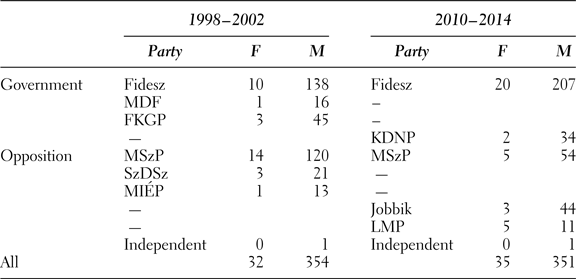
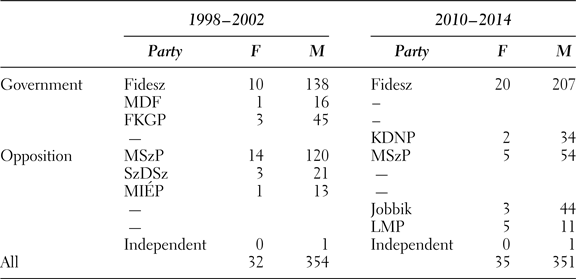
On these grounds, our goal is to identify who speaks for women's interests and where this takes place. Is there a female-male divide, is there a partisan divide, is there a parliamentary versus extraparliamentary divide in these respects? For the purposes of our research questions, we have selected two policy episodes that relate to a clear and obvious women's issue, abortion, following Lovenduski's argument that women's issues are “those that mainly affect women, either for biological reasons (such as breast cancer screening or reproductive rights) or for social reasons (sex equality or child care policy)” (Reference Lovenduski2001, 745). This issue emerged at two points in time, in 2000 and 2011; thus, the regime's effect on the dynamics of substantive representation can be observed. For the sake of easier understanding the context, Table 1 summarizes the government/partisan/gender context that prevailed during the two policy episodes, the first occurring during the 1998–2002 parliamentary term and the second during the 2010–14 parliamentary term. In both periods, conservative coalitions were in power, with the conservative Fidesz being the senior partisan actor. In the second case, the government enjoyed a two-thirds constitutional majority. A right-wing turn occurred as the opposition left—comprising the Hungarian Socialist Party (MSzP) and the Alliance of Free Democrats–Hungarian Liberal Party (SzDSz) in the first term and the MSzP and the Politics Can Be Different party (LMP) in the second term—was stronger in the first term; moreover, a small radical-right party, the Hungarian Justice and Life Party (MIÉP), in the first term was replaced by a larger extreme right, the Movement for a Better Hungary (Jobbik), in the second term. As the numbers show, a female presence was equally low in both terms.
Composition of parliament government/opposition, by party, by gender
Source: Hungarian National Assembly, http://www.parlament.hu.
ANALYSIS AND FINDINGS
The first selected policy episode was the amendment of the abortion bill. The first government after the democratic transition had legislated on abortion in 1992 (Act LXXIX of 1992 on the Protection of Fetal Life), and although the law was controversial, it was “touted as a moderate compromise” (Gal Reference Gal1994, 258). The law allowed abortion in four instances: if justified by the health condition of the mother or of the fetus, if the pregnancy was in connection with a criminal act, or if the pregnant woman was in a “serious crisis situation.” In 2000, an amendment to the law followed from an obligation (i.e., a decision of the Constitutional Court of Hungary) to clarify the law's ambiguities, particularly to define a “serious crisis situation.”
The second policy episode occurred in 2011, when a democratic backlash became apparent in a number of aspects. One of them was the creation of a new constitution, the Fundamental Law of Hungary, that included controversial institutional changes. In addition, Article II of the new constitution declares that a fetus shall be protected from the moment of conception. Thus, there was a potential threat to reopen the abortion issue, which indeed happened: an amendment of the abortion law was submitted during the constitutional debate. Both episodes refer to the protection of women's self-determination rights from external pressures and constraints at a crucial moment of their life.
The Parliamentary Scene
Regarding the parliamentary context, we examined the committee stages and the plenary stages of the debates. To begin with, bills regularly go through the committee, then a plenary debate (called a first reading), followed again by committee and plenary debates (second reading), where the amendments are decided upon. Finally, the voting procedure takes place at the plenary level. In the case of the abortion law amendment in 2000, three committees participated in the process: the Committee of Health and Social Affairs, the Committee of Human Rights, and the Committee of Constitutional Affairs. Expectedly, the 2011 constitutionalization would imply a more complex procedure, but political motivations overthrew this rationale, as we shall see later. To illustrate the paradox: while the debate over the abortion law amendment lasted for four months, the entire constitutionalization process lasted for only one month.
In fact, the 2000 debate had already started in 1999. After the decision of the Constitutional Court, three members of parliament (MPs) (a woman and two men) from the opposition liberal party (SzDSz) submitted three proposals to put the abortion issue on the agenda. Although these proposals were not put on the parliamentary order book, they opened the debate for the public, as the media followed their initiatives. Before the government eventually submitted its own amendment bill (proposing the creation of a consultancy service and obliging women to take part in two consultations before having an abortion), a survey was carried out on behalf of the Prime Minister's Office at the beginning of 2000 (Gábos Reference Gábos2000). This implies that the government was concerned about the opposition's preparatory steps and about the public mood. According to the survey, the respondents held strong views about abortion, with 82% of the respondents saying that the decision of the mother should not be restricted by society or the state. In all, 87% of the respondents did not agree with the possible prohibition of abortion as a measure to increase the number of births. As we shall see later, public opinion was important in formulating the government's position, particularly the senior party Fidesz's pragmatic approach and eventual decision about the amendment of the abortion law.
In the parliamentary general debates, the main question referred not to the solution (the pragmatic aspects of consultancy and contraception), but to whether abortion is morally acceptable and when the legal subjectivity of a person begins. There were three main positions formed, with a divide between the two left parties (MSzP and SzDSz) and the conservatives, the Independent Smallholders’ Party (FKGP) and the Hungarian Democratic Forum (MDF) together with the right-wing radicals (MIÉP), while the large governing conservative Fidesz was divided on the issue: one part of it rejected abortion but did not consider prohibition as a viable solution, and another part emphasized the development of prevention in the first place (Kelemen Reference Kelemen2008). We analyzed all the speeches in the first reading stage (93 altogether, 73 male versus 20 female among them) according to their potential representative claim content and in the second reading, where the number of speeches and the number of female MPs’ speeches decreased (33 versus 6) (see Table 2). The committee debates were also analyzed, but we decided not to establish numerical evidence on this ground because the committee discussion periods were relatively short, the three committees’ involvement was unbalanced (e.g., in the Committee on Constitutional Affairs, only two comments were made), and the more open speech (i.e., discussion format)—being repetitive—would have put the numerical results on unsolid ground. From our perspective, it is important to note that these committee discussions (where they existed) were largely confrontational, and the antifeminist stances in amending initiatives became explicit. Nevertheless, these amendment motions remained inconsequential, as they were voted down, mainly because of the pragmatic approach of the conservative Fidesz. In the end, the bill was adopted (217 MPs voted for the bill, 75 MPs voted against, and 31 MPs did not vote). Fidesz and the MSzP supported the bill; the FKGP, MDF, and MIÉP refused it; and the majority of the MPs from the SzDSz did not vote.
Types of claims in the two episodes, by gender, in the general and in the detailed debate

In 2011, the second case, the enactment of a new constitution for Hungary, especially its Article II, provides a more depressing picture. In the autumn of 2010, an ad hoc committee dealing with the preparation of the new constitution was set up with seven working groups; one of them (no. 2) was in charge of Article II within the framework chapter “Freedoms and Responsibilities.” The majority of the members of this working group from the right-wing parties emphasized the protection of the fetus and the state's obligations in this regard. In contrast, the Socialist MSzP claimed that although the state should provide protection for an unborn human being, the fetus does not have a legal subjective identity. Very soon, however, the two left-wing parties (MSzP and LMP) realized that the government did not aim to discuss alternatives in this matter (or indeed concerning any other parts of the new constitution) and decided not to take part in committee sittings. Eventually, on November 16, 2010, the committee accepted the draft version unanimously with Fidesz, the Christian Democratic People's Party (KDNP), and Jobbik present—without the participation of the two protesting left-wing parties.
Finally, the draft of the Fundamental Law that was submitted to the parliament on March 14, 2011, contained a controversial sentence: “Everyone shall have the right to life and human dignity; the life of the fetus shall be protected from the moment of conception.”Footnote 4 As the two left-wing parties did not take part at this stage of the constitutionalization process, in the general debate, six MPs, all male, presented the three right-wing parliamentary party groups’ standpoints (Fidesz, KDNP, and Jobbik). Four speeches among them mentioned the protection of the fetus's life as a new element of the constitution. But in the general debate, this issue did not get much attention: only 20 out of 248 speeches were related to Article II, four of the speakers being female MPs who particularly emphasized the protection of the fetus's life. Generally, in most cases, the MPs only mentioned and welcomed that the new constitution contained the protection of fetal life in their speeches, but some (from Jobbik and the KDNP) made it explicit that a total ban on abortion would be the only acceptable solution for their party. Clearly, the two governing parties were divided on this matter: Fidesz, similarly to its behavior in the abortion debate a decade earlier, took a pragmatic approach in the face of public opinion, while the KDNP occupied a strict anti-abortion position. In the second reading, none of the speeches touched on the protection of the fetus's life because no amending proposal was submitted to this article. Finally, the Fundamental Law of Hungary was accepted on April 18, 2011 (262 MPs voted for the law, 44 MPs voted against it, one MP did not vote, and the two left-wing parties did not take part in voting) after only a six-day-long parliamentary debate.
The new article of the constitution explicitly implies that the abortion debate can open any time as illustrated by a motion. Three MPs from the extreme-right Jobbik (one woman among them) submitted a proposal to amend the abortion law before the draft of the new constitution was actually voted on. The proposal, arguing for the principle of the protection of human life from the moment of conception, aimed to prohibit abortion even in case of a “serious crisis situation.” In fact, the proposal aimed to delete this paragraph. The opposition motion was discussed by two standing committees, and both of them were rejected. This time, the pragmatic approach of the Fidesz majority won again.
Reading through the debates, we classified the speeches of the participants into four categories, identifying them as feminist claims, gender-conscious claims, gender-neutral claims, and antifeminist claims. We distinguished between feminist and gender-conscious claims on the grounds that gender-conscious claims are aware of the importance of the given issues for women and the difficulties women have to face, but they do not demand or put forward immediate solution or action, as feminist claims do. Feminist claims and gender-conscious claims qualify for the substantive representation of women as they recognize women's special interests in this issue. This is in agreement with research showing that feminist perspectives are only one part of the story of women's substantive representation, as nonfeminist representative claims might also contribute to the substantive representation of women if and when the claims are constructed as being important for women, presented as only affecting women, discussed in terms of gender difference, spoken of in terms of gendered effects, or framed in terms of equality between women and men (Celis and Childs Reference Celis and Childs2012, 219). These fall into the category of gender-conscious claims. For example, a leading MSzP female MP expressed a clear feminist standpoint by saying, “I think that the autonomy of a woman, who calls on consultancy has to be clarified and nobody can put psychological pressure on her,” and a conservative Fidesz female MP (among others) expressed the gender-conscious opinion, “Men and women ought to share the burden of decision in this question,” when identifying common responsibilities.
In contrast, gender-neutral claims do not refer at all to the gender aspects of the issue, as a Fidesz male politician said in general terms: “It is not only about clinical situations or health issues but about situations and life.” Antifeminist claims openly reject that abortion is considered from the perspective of women and women's interests—for example, they regard abortion in relation to demographic issues and population growth. “The life of the fetus cannot be the matter of anyone else's self-determination,” an influential KDNP politician formulated. Occasionally, the speeches and the wordings were harsh and even cruel: “We should stop this anti-life position and death machine but you talk about women's rights to self-determination,” according to a radical-right MIÉP male MP. Clearly, antifeminist and gender-neutral claims cannot be regarded as ones that aim for the representation of women. A numerical summary of the types of claims in the different activities is presented in Table 2.
On the basis of the theoretical framework, we expected changing patterns in substantive representation between the two points in time—that is, between the two policy episodes. Somewhat in contrast to the theoretical frame and on the basis of the authors’ former experiences, we were more cautious about expecting to find critical actors who speak for women among conservative parties and men.
As to the first point, the expectation is fully confirmed. Despite the same low descriptive representation levels, the evolving picture of substantive representation is not static. Indeed, we found substantial differences in how the process of interest representation occurred during the two time periods. The declining number of claims is an important observation in itself. It relates to the smaller number of potentially interested actors (as the left parties withdrew from the debate) and to the general decline of interest in this issue at the same time. Overall, a decline in substantive representative claims (either feminist or gender-conscious ones) at the same time as an increase in openly antifeminist approaches can be observed between the two time periods. In the first period, we witnessed more parliamentary activity than in the second; in the former, male and non-left partisan actors also appeared to be representing women's interests. Clearly, in a still full-blown democratic representation context, a large proportion of men expressed gender-conscious claims both in the general and in the detailed debate, so our cautious expectation about the role of men proved false. In addition, the conservative (Fidesz) MPs appeared among them. Still, it is worth noting that feminist claims were exclusively used by women, while antifeminist claims were exclusively used by men, even in this still-competitive framework. The former were embodied exclusively by the left parties and the latter mainly by the radical right and some Fidesz MPs, reflecting the internal divide of that party between modest conservative and radical-right views.
A strong argument in the feminist literature concerns the female-male policy divide (Lovenduski and Norris Reference Lovenduski and Norris2003), namely, that women politicians and male politicians tend to behave and sometimes even vote differently, particularly on issues that are sensitive for women's interests. This divide was obvious—as specified earlier—between the feminist and antifeminist claim makers in 2000. By the second policy episode, however, the differences between women and men in formulating representative claims had declined—which is indeed a shocking finding given the case selection. Even if we acknowledge that not all women want to act and can be expected to act for women (Childs and Krook Reference Childs and Krook2006, 522), the abortion issue should have triggered more interest from women. But the differences in female activity were spectacular between the two periods. In the first case, several women were active participants in presenting feminist and gender-conscious claims. In the second, a female perspective could not be heard at all: women either did not participate in the “official” parliamentary context or were advocates of the conservative party line. In an increasingly gendered context, the same proportion of women will bring about different representation phenomena. The female versus male policy divide shrank between the two periods—that is, women's behavior became more similar to the majority male behavior—although antifeminist claims were exclusively put forward by men even at that time. Presence theory (Phillips Reference Phillips1995; Young Reference Young2000)—that women's special experiences are important in formulating women's interest because these experiences are different from male experiences—proved to have less explanatory force on women's behavior than the impact of extremely gendered institutions. In the second period, women's voices could hardly be heard. In parliament, women's interests lost representation in 2011.
The Extraparliamentary Scene
In the first episode, the parliamentary developments were not much influenced by the extraparliamentary context. The government did not feel obliged to consult about the abortion bill in advance with civil organizations representing women or dealing with women's rights. The Ministry of Health did involve some of the recognized religions in advance.Footnote 5 The churches and Christian organizations protested against abortion and asked the legislature to enact a bill that would protect the “right to life.” For example, the Catholic Episcopal Conference published an encyclical letter, in which it summarized the Catholic principles concerning the protection of fetal life and demanded that abortion be stopped. The Pacem in Utero and Alliance of Christian Intellectuals submitted a statement with 7,781 signatures to the Prime Minister's Office, in which they asked politicians to prepare a law defending human life from the moment of conception. Several civil organizations (several dozen people) with the support of the Catholic Church demonstrated on June 10, 2000, in order to call attention to the protection of fetal life.
On the other side, several civil organizations defending human rights and/or women's rights expressed their opinion about the prospective aggravation of regulating abortion. For example, TASZ (the Association for Civil Rights) claimed that the bill prescribed an unacceptable intervention into women's private lives, forcing them to participate in two consultations if they wish to seek an abortion. On April 30, 2000, four civil organizations planned a demonstration with the participation of around 120 people.Footnote 6 The women's working group Young Left (the youth organization of the Socialist Party) prepared a petition stating that the organization opposed the amendment of the abortion law, as it would violate women's right to self-determination. Organizations from the supporting and opposing sides expressed their views about the new regulations and had—even if small—demonstrations. In the end, because of their relative insignificance, these civil activities did not enjoy attention among parliamentary actors.
In contrast, in the media, the issue was widely introduced: the bill itself, the different standpoints and arguments, and detailed statistical and comparative information about abortion were published. This was partly due to the mobilizing potential of the left-wing parties rooted in their media connections and the extended time frame of the debate. As mentioned earlier, the government felt obliged to acquire (survey) information in the preparatory stage, which also triggered media attention.
The nonparliamentary environment of the second episode was largely different. The debate was relocated from the parliament to extraparliamentary activities both by civil women's organizations and even by “parliamentary politicians.” Although the left-wing parties did not take part in the parliamentary debate, the Socialist MSzP's women's organization published a statement arguing that the new constitution was against women's right to self-determination and that the appropriate way to reduce the number of abortions was not prohibition but prevention. The other left-wing party (LMP) refused the tightening of abortion regulation and emphasized the importance of prevention as well. Interestingly, the governing parties also took the extraparliamentary floor, openly campaigning for the new article in an attempt to reassure the public. They emphasized that the protection of fetal life would have no consequences on abortion regulation, as Article II about the protection of fetal life had merely a symbolic meaning with no practical (legal) effect. This campaign was necessary as opinion poll surveys (this time not government-initiated but public ones) showed similarly permissive results compared with a decade before.
Nongovernmental organizations became active and expressed their concern about Article II, arguing that its phrasing could imply an absolute ban of abortion. Among others, TASZ and Amnesty International claimed that the new constitution would open up the possibility of either tightening the regulation or prohibiting abortion altogether. The protection of the fetus's life cannot undermine women's rights, they argued. Furthermore, the abortion question was not removed from the agenda after the enactment of the Fundamental Law. In May 2011, SzDSz (at this point not a parliamentary party any longer) and SZEMA (Free People for Hungary, a civil organization) tried to initiate a national referendum with four questions, one of them concerning Article II of the enacted constitution.Footnote 7 The initiative failed as the National Election Commission, which is entitled to verify the supporting signature collection forms, rejected the question.
Parallel to this, the government started an anti-abortion campaign. Posters and billboards appeared on the streets and on public transport vehicles recommending adoption instead of abortion. On the billboards, a fetus could be seen with the following sentence: “I understand that you are not yet ready for me, so give me up to the adoption agency, LET ME LIVE!” Nongovernmental organizations and left-wing parties (MSzP and LMP) protested against the campaign immediately. Moreover, this guilt campaign was financed by resources from the EU's employment and social solidarity program, PROGRESS. Viviane Reding, the EU's fundamental rights commissioner, warned the Hungarian government that the anti-abortion campaign did not comply with the rules of the PROGRESS program and demanded the withdrawal of the posters, which eventually happened by June.
The Fundamental Law raised other international concerns as well. Among others, the statement of the Venice Commission noted that it is problematic if the constitution contains the protection of the fetus's life, as the mother loses her self-determination and the right to health as a result. The commission emphasized that this article could lead to the prohibition of abortion, which is contrary to EU norms and agreements.Footnote 8 The government's opinion was stuck by pincers (van der Vleuten Reference van der Vleuten2005) between EU norms and national civic demand. The comparison of the two cases clearly shows the increased strength of the extraparliamentary site—that is, the civic arena—in the second period compared with the first. The parallel decline of women's substantive representation in parliament also implies that women's interests were taken up by nonelected representatives.
DIFFERENT REPRESENTATION PATTERNS—DECLINE AND CHANGE
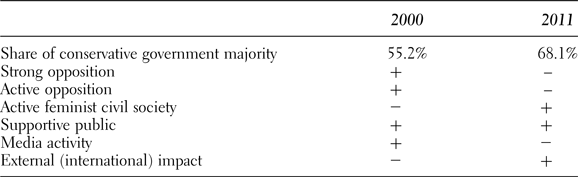
In the two policy episodes, we found different representation patterns—that is, different connections between women's descriptive presence and their substantive representation. In the context of a highly gendered regime and democratic decline, the acclaimed place of representation and accountability (i.e., parliament) had hollowed out by the second period. In contrast, a more lively representation scene formed with various actors outside parliament. Several institutional, partisan, normative, and procedural aspects explain this transformation. Table 3 shows some of these aspects.
Supports and constraints on women's substantive representation

As mentioned before, in both periods, conservative government coalitions were in power, a potential disadvantage for women's representation. Nevertheless, the governing status and the political status of the senior governing party (Fidesz) changed between the two periods. In the second period, the government enjoyed an oversized two-thirds majority, which made any legislation even with constitutional force possible without opposition impact.Footnote 9 This is what we could observe in the process of constitutionalization, which “normally” should be an extended process of adjustments between different political and social forces to achieve the broadest possible agreement. Even more important, the Fidesz party changed, moving toward the right in terms of the cultural divide—that is, toward traditional-conservative-nationalist values (as opposed to green-alternative-liberal cultural values). According to more recent research results (Erzeel and Celis Reference Erzeel and Celis2016), these cultural positions have strong explanatory force in how parties handle women's interests, and they are more telling indicators than the economic left-right divide. In the second period, this turn by Fidesz is clearly visible. As the large conservative government party moved toward the right, political polarization increased (Angelusz and Tardos Reference Angelusz, Tardos, Tardos, Enyedi and Szabó2011; Körösényi Reference Körösényi2013).
At the same time, the opposition also was transformed. The Socialist Party was substantially weakened, and in 2010, the left-liberal SzDSz fell out of parliament. Although the left parties were responsible for creating and cementing the gendered regime, at least there were some active and gender-conscious women politicians in their ranks who could voice women's interests at important moments. This is what happened with the amendment of the abortion law in 2000, when they were able to put the issue on the parliamentary agenda early on and managed to maintain it on the media agenda. In contrast, the weakened and paralyzed left in 2011 could not see any other option but to drop out of the constitutionalization process in protest. This proved to be detrimental to the representative process—and had broader significance from the perspective of the regime's democratic credentials.
In addition to these institutional, partisan, and procedural aspects, the deterioration of norms and behavior also explains how political representation can be abused. Parliament became an increasingly gendered environment after 2010. Dahlerup (Reference Dahlerup2006, 512) argues that the “politics as workplace” perspective has to be considered in understanding women's representation opportunities. Accordingly, while a negative workplace effect would appear for nongender issues and thus would harm the entire democratic process, it clearly affects the representation of women's interests. Informal institutions such as gendered behavioral norms, confrontational speaking styles, sexist vocabulary, and anti-women remarks are decisive in constraining women's opportunities in parliament. These phenomena can be observed in excess in the post-2010 Hungarian parliament, with negative effects.Footnote 10
The civic sphere proves to be generally weak in postcommunist countries, although more recently, a reconsideration of this view has taken place (Foa and Ekiert Reference Foa and Ekiert2017). Concerning Hungary, the spread and visibility of civic organizations had increased by the end of the second decade of democracy (Nagy and Sebestény Reference Nagy and Sebestény2008). Indeed, in our second observed momentum, civic organizations were more active. It should be noted, however, that gender-related civic groups were not resourceful, had low membership figures, and rarely appeared in the mainstream media (Fábián Reference Fábián2009). While the support of the public regarding permissive abortion legislation or women's self-determination was present, this did not trigger huge support or protest movements.
CONCLUSIONS
Women's interests appeared on the political agenda to a limited degree in both observed policy episodes, but despite the same level of descriptive representation, there was a clear decline in substantive representation in the official parliamentary site. In the first case, women's interests were still visible in the parliamentary framework, while in the second, it was only in the extraparliamentary scene that women's interests were formulated. In the first case, women's interests were at least recognized, but in neither case did they have policy impact.
From the perspective of the theory of representation, our analysis confirms previous studies in two respects. First, we can conclude that low numbers together with gendered institutions negatively influence women's substantive representation. Under these conditions, descriptive representation and substantive representation are connected in a vicious circle. Substantive representation is constrained by sheer numbers that originate in gendered institutions, while gendered institutions themselves constrain the representative opportunities of all actors involved. Descriptive representation and substantive representation are closely linked. Clearly, “feminists should not give up on presence” (Lovenduski and Guadagnini Reference Lovenduski, Guadagnini, McBride and Mazur2010, 164). It is not the low level of descriptive representation that is directly responsible for the failure of substantive representation but low descriptive presence; particularly when it is a lasting feature of a regime, this is an obvious distress signal that substantive representation is under threat.
Second, in identifying the causes of the decline and eventual failure of women's substantive representation, the relevance of context—that is regime-level explanation—is obvious. In harmony with Pitkin's analytic framework which posits that substantive representation correlates directly to political representation, our analysis proves that the “normative primacy of substantive representation is compelling” and the “quality of women's representation is universal” (Schwindt-Bayer and Mishler Reference Schwindt-Bayer and Mishler2005, 425). Thus, democratic decline is a cause of concern not only from a gender perspective. Women's substantive interests are closely related to general interest representation problems and democracy problems. Our gender-related test case contributes to the understanding of how democratic decline is actually taking place. The government's anti-civic campaign and legislation in 2017–18 will further impact the extraparliamentary site, where substantive representation was livelier than in the official site. As democratic institutions and democratic context deteriorate, women's interests are also under threat.