Experiment
Spine gourd (Momordica dioica Roxb., Cucurbitaceae) is a perennial species propagated by tubers. M. dioica (diploid, called spine gourd) and Momordica subangulata subsp. renigera (tetraploid, called teasle gourd) were found in eastern and north-eastern India, respectively. The latter species has been misidentified as tetraploid M. dioica and is cultivated in West Bengal and Orissa states. Cultivation of spine gourd is less demanding and ideal for homestead gardens. The nutritional value of spine gourd fruits is superior with respect to protein, vitamin A and ascorbic acid (Naik et al., Reference Naik, Shah and Pandya1951; Sastri, Reference Sastri1962). Apart from its nutritive value, spine gourd root contains aliphatic compounds (Ali and Srivastava, Reference Ali and Srivastava1998) and the plant parts are used in traditional medicines. Extensive use of its tubers in various ethno-medicinal formulations by different tribal communities of Kerala has been reported (Joseph and Antony, Reference Joseph and Antony2008). In addition, the seed kernel oil of spine gourd is used as such or as a source of drying oil in the paint and varnish industry (Chakrabarty et al., Reference Chakrabarty, Bhattacharya, Desai and Patel1956).
The objective of the present study is to characterize and evaluate the yield and other horticultural traits of a set of accessions of Momordica spp. maintained at the Central Horticultural Experiment Station, Bhubaneswar, Orissa.
All 40 accessions were planted at a spacing of 2 × 1 m in a randomized block design with three replications. The plant population in the experimental field had female and male plants at the ratio of 10:1 to ensure effective pollination. The accessions were evaluated for 12 quantitative, 10 qualitative and a phenological character. Mean, ANOVA, coefficient of variation (CV) and cluster analysis were performed using INDOSTAT statistical package.
Discussion
The accessions showed a considerable level of variability (supplementary Fig. S1, available online only at http://journals.cambridge.org) for qualitative traits such as leaf lobing (entire to deeply lobed), leaf colour (light green to dark green), blossom-end rostration of fruit (faint to appreciable length), fruit shape (globular to elliptic), fruit colour at edible maturity (whitish green to dark green) and ripe fruit colour (yellow to red). The diversity found in fruit colour and shape would be helpful for the selection of genotypes with desired quality. In addition, the accessions displaying contrast characters can be used to study the genetics of trait expression. Among the accessions studied, the earliest flowering was observed in CHSG 104 (31 d), which is a favourable trait to take advantage of early harvest and profitable market avenue owing to its high demand.
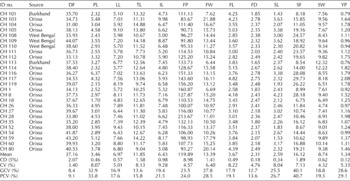
A wide range of variation (Table 1) was observed for petiole length (1.7–6.4 cm), leaf length (4.8–9.4 cm), internode length (4.7–9.9 cm), tendril length (7.7–14.2 cm), number of fruits per plant (83.7–213.7) and fruit weight (6.4–21.9 g). Accession CHSG 117 recorded the highest yield (2.1 kg/plant) followed by CHSG 28 (1.9 kg/plant), while other accessions exhibited a yield range of 0.8–1.8 kg/plant. The high CV observed for vegetative characters like internode length (9.3%), tendril length (8.1%), petiole length (8.1%), fruit length (8.2%), fruit stalk length (8%) and number of seeds per fruit (7.1%) could be due to heterogeneity existing among the accessions. The estimates of genotypic coefficient of variation and phenotypic coefficient of variation for all the characters correspond closely, which indicate that the variability existing in them was mainly due to their genetic makeup, and thus selection on the basis of phenotype alone should be effective. The high level of phenotypic diversity observed among the accessions in this study is in agreement with the earlier findings (Ram et al., Reference Ram, Banerjee, Pandey and Srivastava2001; Bharathi et al., Reference Bharathi, Naik and Dora2006; Panchbhai et al., Reference Panchbhai, , Deshmukh and Kale2006) for different characters in other sets of germplasm.
Momordica dioica accessions from India used for morphological classification and their quantitative characteristics

DF, days to flowering; PL, petiole length (cm); LL, leaf length (cm); TL, tendril length (cm); IL, internode length (cm); FP, number of fruits/plant; FW, fruit weight (g); FL, fruit length (cm); FD, fruit diameter (cm); SL, fruit stalk length (cm); SF, number of seeds/fruit; SW, 100-seed weight (g); YP, yield/plant (g); CD, critical difference; CV, coefficient of variation; GCV, genotypic coefficient of variation; PCV, phenotypic coefficient of variation.
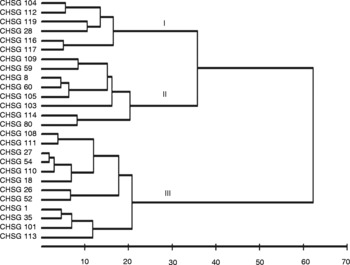
Following Ward's clustering technique, the accessions were grouped into three main clusters (I, II, III) comprising 6, 8 and 12 accessions, respectively (Fig. 1). The maximum intercluster distance 5.5 was observed between clusters I and III. Cluster I could be characterized with genotypes early in flowering (except CHSG 119), more number of fruits per plant (>100), number of seeds per fruit (>10) and greater yield per plant (>1.8 kg/plant). Cluster II comprised the accessions having high individual fruit weight and 100-seed weight. The accessions grouped in cluster III recorded lower values for most of the traits studied.
Ward's minimum variance dendrogram of 26 accessions of spine gourd.

This prized vegetable presently restricted to the areas of its natural distribution has the scope for extended cultivation in the context of climatic change, physiographic diversity and adaptation. Its commercial cultivation is meagre due to a lack of availability of improved varieties, seed dormancy, low multiplication rate of tubers, dormancy of tubers and unpredictable sex ratio in seedling progeny (Ali et al., Reference Ali, Okubo, Fujii and Fujiedan1991). The results presented here on the nature and magnitude of genetic variability and diversity existing in this species will provide the foundation for designing an efficient spine gourd breeding programme. The present study also highlights the importance of spine gourd germplasm from eastern India for maintaining a considerable range of diversity for most of the important traits studied. As spine gourd is distributed widely almost throughout India, further collections from Peninsular and Western India are required for maximum diversity sampling.