Introduction
Major depressive disorder (MDD) is currently the leading cause of disability worldwide and is associated with increased risk for serious diseases, including diabetes, stroke, dementia, and cardiovascular disease (Luppino et al., Reference Luppino, de Wit, Bouvy, Stijnen, Cuijpers, Penninx and Zitman2010; Vancampfort et al., Reference Vancampfort, Correll, Wampers, Sienaert, Mitchell, De Herdt and De Hert2014), and increased mortality rates (Walker, McGee, & Druss, Reference Walker, McGee and Druss2015). Though MDD treatment outcomes are poorer when medical comorbidities are present (McMahon, Reference McMahon2014), relatively little is known about why this association exists, mechanisms of effective treatment, or predictors of treatment response.
Growing evidence indicates that MDD should not simply be considered in terms of mental illness or brain dysfunction but as a ‘whole body illness’ in which certain pathological processes are present throughout the body (Wolkowitz, Reus, & Mellon, Reference Wolkowitz, Reus and Mellon2011). Psychobiological responses to chronic stress play a major role in the etiology and pathophysiology of MDD and its somatic concomitants. The cumulative physical effect of such responses has been conceptualized as ‘allostatic load’ (AL), a measure of ‘wear and tear’ on neuroendocrine systems caused by repeated adaptive processes (i.e. allostasis) in response to stress (McEwen, Reference McEwen2003; Seeman, McEwen, Rowe, & Singer, Reference Seeman, McEwen, Rowe and Singer2001). Relatedly, metabolic disturbances [including metabolic syndrome (MetSyn) and its contributing factors (i.e. metabolic dysregulation; MetD)] have been bidirectionally associated with MDD, with studies suggesting that certain metabolic hormones act on the brain and affect mood (Biessels & Reagan, Reference Biessels and Reagan2015; McGregor, Malekizadeh, & Harvey, Reference McGregor, Malekizadeh and Harvey2015; Van Doorn, Macht, Grillo, & Reagan, Reference Van Doorn, Macht, Grillo and Reagan2017), and with evidence that MDD confers risk for MetD and vice versa (Pan et al., Reference Pan, Keum, Okereke, Sun, Kivimaki, Rubin and Hu2012). Increased AL or MetD indicate perturbations in pathways related to endocrine, metabolic, inflammatory, and neural systems that can induce a cascade of adverse physiological outcomes, including comorbid medical diseases, abdominal obesity, neural atrophy, reduced neurogenesis, and dendritic remodeling. All of which may ultimately contribute to the psychological and/or physical aspects of MDD (Furtado & Katzman, Reference Furtado and Katzman2015; McEwen, Reference McEwen2003; Raison, Capuron, & Miller, Reference Raison, Capuron and Miller2006; Seeman et al., Reference Seeman, McEwen, Rowe and Singer2001; Soczynska et al., Reference Soczynska, Kennedy, Woldeyohannes, Liauw, Alsuwaidan, Yim and McIntyre2011).
Though the relationship between increased AL and MetD with MDD has been established (Liu, Carvalho, & McIntyre, Reference Liu, Carvalho and McIntyre2014; McEwen, Reference McEwen2003; Pan et al., Reference Pan, Keum, Okereke, Sun, Kivimaki, Rubin and Hu2012), their relationship with antidepressant response is less well studied. To the best of our knowledge, no prior study has prospectively examined the relationship between AL and subsequent antidepressant response in MDD, and only one has prospectively examined a metabolic profile similar to MetD in relation to antidepressant outcomes. Mulvahill et al. (Reference Mulvahill, Nicol, Dixon, Lenze, Karp, Reynolds and Mulsant2017) reported that pre-treatment MetSyn was associated with a decreased likelihood of reaching remission in late-life depression, though not all subjects were medication-free prior to beginning antidepressant treatment. In the present study, we sought to determine whether physiological dysregulation itself – prior to the onset of associated medical illnesses – is associated with altered antidepressant response. Accordingly, we tested whether pre-treatment AL and MetD each predict subsequent clinical response to selective serotonin reuptake inhibitor (SSRI) treatment in MDD individuals rigorously screened for the absence of medical illnesses or confounding medications. As AL and MetD reflect dysregulation of important neural, hormonal, energetic, and homeostatic mechanisms implicated in MDD and its successful treatment, we hypothesized that increased pre-treatment AL and MetD would predict poorer antidepressant outcomes, even in individuals without significant medical illnesses.
Methods
Ethical standards
All procedures contributing to this work comply with the ethical standards of the relevant national and institutional committees on human experimentation and with the Helsinki Declaration of 1975, as revised in 2008. All study participants gave written informed consent to participate and were compensated; MDD subjects additionally received free clinically appropriate antidepressant treatment. Subjects were recruited by flyers, online postings, newspaper ads, and (in the case of MDD subjects) clinical referrals.
Subjects
A total of 37 unmedicated adults (aged 19–65) with current MDD completed an 8-week, open-label study of SSRI-treatment as part of a larger study of MDD (‘Cell Aging in Major Depression;’ R01MH083784). All MDD subjects enrolled prior to March 2015 and for whom SSRIs were clinically indicated, received SSRI-treatment in the larger study and are included here, in addition to all healthy control (HC) subjects (n = 76; ages 21–69 years; 47 females, 29 males) enrolled during the same period (Table 1). Serum dehydroepiandrosterone-sulfate (DHEAS) and cortisol data from these MDD subjects were previously reported in relation to SSRI-remission (Hough et al., Reference Hough, Lindqvist, Epel, Denis, Reus, Bersani and Wolkowitz2017) but the remaining components of AL and MetD have not been reported.
Demographics and clinical characteristics of the sample

a Data was not available for one MDD Responder.
b Data was transformed using its natural logarithm (LN) for group comparisons; raw data is presented for means and standard deviations.
c Lifetime Depression Chronicity is presented in months, adjusted for subject age, and was not associated with allostatic load (r = 0.160, p = 0.397) or metabolic dysregulation (r = 0.054, p = 0.765).
d Medication dosages increased over the course of treatment as tolerated and as warranted by clinical response. Sertraline dosing began with 25 mg/day and increased to ⩽200 mg/day; fluoxetine and citalopram began with 10 mg/day and increased to ⩽40 mg/day; escitalopram began with 10 mg/day and increased to ⩽20 mg/day. Dose escalation was determined by the study psychiatrist, using standard algorithms based on drug tolerability and efficacy. Final SSRI Dose is based on dose-equivalency of sertraline (Preskorn, Reference Preskorn2009). Data were not available for one MDD Responder and one MDD Non-responder.
* Significant at the p < 0.05 level.
** Significant at the p < 0.01 level.
Depressed subjects were diagnosed with MDD without psychotic features using the Structured Clinical Interview for DSM-IV-TR Axis-I Disorders (SCID) (First, Reference First1997), with a current 17-item Hamilton Depression Rating Scale (HDRS) (Hamilton, Reference Hamilton1960) rating of ⩾17. All diagnoses were confirmed by a separate clinical interview with a board-certified psychiatrist. Depressed subjects were excluded for any of the following: bipolar disorder, psychotic symptoms during their current major depressive episode (MDE), history of psychosis outside of an MDE, acute suicidality, an eating disorder or post-traumatic stress disorder (PTSD) within 1 month of study entry, and substance/alcohol abuse or within 6 months of study entry. Co-morbid anxiety disorders (except PTSD) were allowed if MDD was the primary diagnosis. Control subjects had no lifetime history of any DSM-IV-TR Axis-I disorder, also confirmed by SCID.
Study participants were rigorously screened for medical illnesses and had no acute illnesses or infections, chronic or acute inflammatory disorders, neurological disorders, or any other major medical conditions considered to be potentially confounding, as assessed by history, physical examination, and clinical laboratory blood screening. For at least 6-weeks prior to enrollment, subjects had not had any vaccinations and were free of psychotropic medications (including antidepressants), hormone supplements, steroid-containing birth control, and any other potentially interfering medications, and none were taking vitamin supplements above the US recommended daily allowances. Short-acting sedative-hypnotics were allowed as-needed for sleep in MDD subjects, to a maximum of three times per week, but none within 1 week of participation. Prior to each study visit, all subjects passed a urine toxicology screen for drugs of abuse and a urine test for pregnancy in women of child-bearing potential. During their participation, no subjects began new psychotherapy interventions; those who were engaged in ongoing psychotherapy at the time of enrollment continued the same regimen.
Procedures
Subjects were admitted as outpatients to the UCSF Clinical and Translational Science Institute between the hours of 0800 and 1100, having fasted (except water) since 2200 h the night before. Subjects were instructed to sit quietly and relax for 25–45 min before vital signs, blood samples, and body measurements [height, weight, waist circumference (narrowest point for women, umbilicus for men), and hip circumference (widest point)] were obtained. Depressive symptom severity was then rated in MDD subjects using the 17-item HDRS (Hamilton, Reference Hamilton1960). Each HDRS was conducted with two raters who scored within one point of each other; if this was not achieved, a consensus rating was determined.
Following this, 37 MDD subjects completed 8-weeks of standard open-label outpatient SSRI treatment. The first 28 subjects were treated with sertraline (initially the only SSRI to be studied); the remaining nine subjects followed an otherwise identical protocol that allowed treatment with any SSRI determined to be clinically appropriate by the study psychiatrist (sertraline n = 2, fluoxetine n = 2, citalopram n = 2, and escitalopram n = 3). Outpatient medication compliance, as well as clinical evaluations and assessments of drug tolerability, were assessed by telephone after 1-week and in-person after 4- and 8-weeks of treatment, when pill counts were performed. All but three subjects (due to insufficient blood volume) had post-treatment plasma antidepressant concentrations assessed. Antidepressant concentrations were in the expected clinical range in all but one subject [a ‘Responder’ whose final sertraline dose was low (25 mg) due to intolerance of side effects at higher doses], suggesting excellent outpatient compliance. At the end of 8-weeks of SSRI-treatment, MDD subjects had blood re-drawn and were again rated using the HDRS. Subjects with ⩾50% improvement in HDRS ratings were classified as ‘Responders’ (n = 22), while those with <50% improvement were classified as ‘Non-responders’ (n = 15); remission was additionally assessed using classifications of ‘Remitters’ (post-treatment HDRS ratings ⩽7; n = 13) and ‘Non-remitters’ (post-treatment HDRS >7; n = 24) (Lecrubier, Reference Lecrubier2002). All HDRS ratings were performed blind to biochemical assessments.
Biological assessments
Serum was collected into serum separator tubes for assessment of cortisol, DHEAS, glucose, and cholesterol (total, HDL, and triglycerides). Plasma was collected into lavender-top EDTA tubes for assessment of glycosylated hemoglobin (HgbA1c). Serum for cortisol and DHEAS was frozen at −80° C prior to being assayed by RIA and ELISA; assay methodology for these samples is described in Hough et al. (Reference Hough, Lindqvist, Epel, Denis, Reus, Bersani and Wolkowitz2017). Plasma for HgbA1c, and serum for glucose and cholesterol [total, high-density lipoprotein (HDL), and triglycerides] were determined by Quest Diagnostics, of San Jose, CA. Blood samples were transported at room temperature to Quest Diagnostics on the same day they were collected. Serum was separated prior to transport to ensure that there would not be prolonged exposure to red blood cells.
Calculating AL and MetD
All subjects (n = 37 MDD; n = 76 HC) provided data that was included in analyses examining individual contributing factors of AL and MetD. Three MDD and eight HC subjects were missing data for at least one variable needed for calculating both MetD and AL; one additional HC was missing data for at least one variable needed for calculating MetD but had all AL data; three MDD and four HC subjects were missing data for at least one variable needed for calculating AL but had all MetD data. This left 31 MDD (n = 19 Responders, 12 Non-responders; n = 11 Remitters, 20 Non-remitters) and 64 HC subjects to be included in final AL analyses, and 34 MDD (n = 20 Responders, 14 Non-responders; n = 12 Remitters, 22 Non-remitters) and 67 HC subjects to be included in final MetD analyses.
AL was calculated using methodology from the MacArthur Studies of Successful Aging (Seeman et al., Reference Seeman, McEwen, Rowe and Singer2001), with the exception of 12-h urinary catecholamine levels, as urine was not analyzed in the present study. HC tertiles of the eight AL components were determined (Table 2): systolic blood pressure, diastolic blood pressure, waist-hip-ratio, total cholesterol, HDL cholesterol, HgbA1c, serum cortisol, and serum DHEAS. Because serum DHEAS and cortisol were assayed in two batches (described in Hough et al. (Reference Hough, Lindqvist, Epel, Denis, Reus, Bersani and Wolkowitz2017)), tertiles for these variables were determined separately between the two assay batches. Similarly, tertiles for waist-hip-ratio was determined separately between men and women, due to differences in waist measurement site and normative standards between men and women. All subjects received one point for each AL factor at or above the upper tertile of the HC distribution, with the exception of HDL cholesterol and DHEAS, which received one point for being at or below the lowest tertile. These contributing factors were then summed to create a total AL score ranging from 0 to 8 for each subject.
Criteria for allostatic load and metabolic dysregulation contributing factors (Panel, Reference Panel2002)b

a Criteria for individual contributing factors of allostatic load were determined by tertiles of healthy control subjects.
b Criteria for hypertension was met if either systolic or diastolic blood pressure were beyond their respective defining levels.
Metabolic dysregulation was determined using risk factors for MetSyn, as outlined by the National Cholesterol Education Program's Adult Treatment Panel-III (ATP-III) (Grundy, Brewer, Cleeman, Smith, & Lenfant, Reference Grundy, Brewer, Cleeman, Smith and Lenfant2004; Panel, Reference Panel2002) (Table 2). For a diagnosis of MetSyn to be made, ATP-III guidelines require the presence of three or more of the following risk factors: (i) abdominal obesity (waist circumference >102 cm for men and >88 cm for women), (ii) triglycerides ⩾150 mg/dL, (iii) HDL cholesterol <40 mg/dL for men and <50 mg/dL for women, (iv) fasting glucose ⩾110 mg/dL, and (v) hypertension (systolic blood pressure ⩾130 mmHg or diastolic blood pressure ⩾85 mmHg). As a result of this study's medical exclusion criteria, MetSyn risk factors could be present in both MDD and HC subjects but very few subjects met full MetSyn criteria (n = 3 MDD, n = 3 HC). As such, subjects were instead assigned one point for each metabolic risk factor present, which were then summed to create a total MetD score ranging from 0 to 5 for each subject.
Statistical analyses
All analyses were 2-tailed with α = 0.05. Between-group comparisons were performed using t tests or ANOVA when data met the assumption of normality in both groups; when data did not meet necessary test assumptions and could not be normalized using their natural logarithm or square root, non-parametric tests were performed (Mann–Whitney U, Kruskall–Wallis and χ2 tests, as applicable).
Primary analyses examining whether pre-treatment AL and MetD could serve as predictors of SSRI-response were conducted using separate linear regressions wherein pre-treatment AL or MetD independently predict a subsequent absolute change in depression severity ratings (post-treatment HDRS total score minus pre-treatment HDRS total score). Additionally, logistic regressions were used to determine whether pre-treatment AL and MetD could predict post-treatment classification as a treatment Responder or Non-responder and classification as a treatment Remitter or Non-remitter. To determine that pre-treatment AL and MetD could predict subsequent SSRI-response over and above the effects of age and sex (identified a priori as potential confounds), both linear and logistic regressions included sensitivity analyses with age and sex as additional predictors of response. Similarly, additional sensitivity analyses tested the interaction of sex and the primary predictor variable (AL or MetD) to determine whether regression results differed between men and women (i.e. whether sex moderated the relationships).
Results
Participant characteristics
Responders and Non-responders did not differ in pre-treatment HDRS scores, age, sex, years of education, race, current tobacco use, current MDD episode duration, or final SSRI dose (Table 1). Compared to Responders, Non-responders had greater lifetime MDD chronicity [t(34) = 2.243, p = 0.032]; this difference was near statistically significant after correcting for age [F(1,33) = 4.085, p = 0.051] but MDD chronicity was not associated with AL (r = 0.160, p = 0.397) or MetD (r = 0.054, p = 0.765). Control subjects were well-matched to both Responders and Non-responders in regards to age, sex, years of education, and race. Compared to HC, Responders were more likely to be current smokers (p = 0.004), while Non-responders did not differ from HC.
Increased AL and MetD predict poorer treatment response
Higher pre-treatment AL significantly predicted less absolute decreases in HDRS depression severity ratings after 8-weeks of treatment (post- minus pre-treatment scores) [R 2 = 0.179, F(1,29) = 7.548, p = 0.010], as did pre-treatment MetD [R 2 = 0.148, F(1,32) = 6.751, p = 0.014]. Based on these results, we may estimate that, for every additional point of AL, HDRS improvement is lessened by 1.5 points over the course of treatment (β 0 = −14.094, β 1 = 1.499, p = 0.012) and, for every additional MetD risk factor present, HDRS improvement is lessened by 2 points over the course of treatment (β 0 = −11.901, β 1 = 1.991, p = 0.014). When including age and sex in the model, AL and MetD remained significant predictors of absolute change in HDRS, over and above the effects of age and sex (AL: p = 0.020; MetD: p = 0.027), which were not significant predictors (all p ⩾ 0.317). Further, sex did not moderate the relationship between absolute change in HDRS and AL (p = 0.661) or MetD (p = 0.483). This indicates that the observed relationships between AL and MetD with an absolute change in HDRS depression severity ratings were likely not attributable to influences of age or sex.
Pre-treatment AL significantly predicted post-treatment status as a Responder or Non-responder (R 2C&S = 0.156, χ2 = 5.251, odds ratio = 0.585, p = 0.022), as did pre-treatment MetD (R 2C&S = 0.117, χ2 = 4.231, odds ratio = 0.529, p = 0.040), such that greater pre-treatment AL or MetD were associated with poorer SSRI-response. When including age and sex in the model, AL and MetD remained significant predictors of response status, over and above the effects of age and sex (AL: p = 0.031; MetD: p = 0.047), which were not significant predictors (all p⩾0.116). Further, sex did not moderate the relationship between treatment-response and AL (p = 0.205) or MetD (p = 0.765). These results indicate that the observed relationships between AL and MetD with treatment-response were likely not attributable to influences of age or sex. Pre-treatment AL and MetD did not predict status as a Remitter or Non-remitter (AL: R 2C&S = 0.039, χ2 = 0.020, odds ratio = 0.969, p = 0.888; MetD: R 2C&S = 0.039, χ2 = 1.353, odds ratio = 0.689, p = 0.245) and these results were not significantly affected when including age and sex in the model (AL: p = 0.924; MetD: p = 0.205).
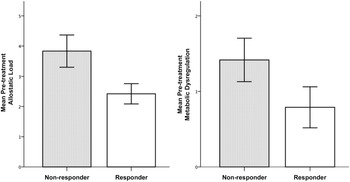
Secondary analyses directly comparing treatment Responders and Non-responders revealed that Non-responders had significantly higher AL (t = 2.36, p = 0.025) and MetD (U = 79.50, p = 0.033) scores (Table 3, Fig. 1). Notably, there were no significant differences between Responders and Non-responders in any individual contributing factors of AL and MetD (all p ⩾ 0.064; Table 3), though most were in the hypothesized direction.
Pre-treatment allostatic load and metabolic dysregulation in Responders and Non-responders. Compared to Responders, SSRI-treatment Non-responders have greater pre-treatment allostatic load [left; Responder M = 2.42 (s.d. = 1.46), Non-Responder M = 3.83 (s.d. = 1.85)] and metabolic dysregulation [right; Responder M = 0.80 (s.d. = 1.15), Non-Responder M = 1.64 (s.d. = 1.15)]. Error bars represent ± 1 Standard Error.

Between-group comparisons of pre-treatment allostatic load, metabolic dysregulation, and their individual factors

Post-hoc analyses indicate that Non-responders had significantly greater MetD compared to both Responders (p = 0.026) and Controls (p = 0.001); Controls did not differ from Responders (p = 0.748). Responders had significantly lower systolic blood pressure than both Controls (p = 0.021) and Non-responders (p = 0.027); Controls did not differ from Non-responders (p = 0.528).
a These analyses have been performed using standardized z-values according to assay batch.
b These analyses have been performed using standardized z-values according to sex.
* Significant at the p < 0.05 level.
** Significant at the p < 0.01 level.
Between-Group comparisons with healthy controls
Compared to HC, MDD subjects (Responders and Non-responders combined) had significantly higher pre-treatment MetD (U = 875.5, p = 0.039) but not AL (t = −0.709, p = 0.480). When separately comparing Responders and Non-responders to HC subjects, pre-treatment AL and MetD of Non-responders were significantly higher than those of HC (AL: t = 2.10, p = 0.039; MetD: U = 234.0, p = 0.001), whereas AL and MetD scores of Responders did not significantly differ from HC (AL: t = −0.658, p = 0.512; MetD: U = 641.5, p = 0.748) (Table 3). Compared to HC, Responders did not significantly differ in any individual factors of AL or MetD, whereas Non-responders had significantly higher waist circumference (U = 241.0, p < 0.001) and systolic blood pressure (t = 2.345, p = 0.021), and a trend toward higher diastolic blood pressure (t = 1.987, p = 0.050), and waist/hip ratio (U = 376.5, p = 0.058) (Table 3). See online Supplementary Material for associations between AL, MetD, and other clinical risk factors, including high-sensitivity c-reactive protein (hs-CRP) and body mass index (BMI).
Discussion
We examined AL and MetD in physically healthy, unmedicated individuals with MDD prior to beginning 8-weeks of open-label SSRI-treatment. Though this study should be considered preliminary due to limitations in the sample size and the open-label nature of antidepressant treatment (discussed further below), results indicate that higher AL or MetD before beginning SSRI-treatment is predictive of poorer clinical response. Further, MDD subjects who did not respond to treatment (i.e. Non-responders) had higher pre-treatment AL and MetD compared to both MDD subjects who were responsive to treatment (i.e. Responders) and HC, whereas Responders did not differ from HC. Importantly, Responders and Non-responders generally did not differ on clinical or demographic variables, including initial HDRS ratings, before beginning treatment. Further, sex was not a significant moderator of these findings and the results remained significant when including age and sex in the model, though age and sex were not significant predictors themselves. This indicates that, in our sample, the observed relationships between AL and MetD with treatment response were not attributable to influences of age or sex, however, this study was not adequately powered to test gender-specific effects, therefore, it is possible that such p > 0.05 are false negative due to the lack of statistical power.
While AL and MetD predicted absolute decreases in depression severity and post-treatment Responder v. Non-Responder status, it did not predict Remitter v. Non-Remitter status. Prior studies have found that poor physical health predicts non-remission in MDD (Mojtabai, Reference Mojtabai2017). Possible explanations for our failure to find this include: (i) our subjects had risk factors for medical illness but were specifically screened to have no current or chronic illnesses; (ii) remission may take longer to occur than response, as it is recommended that treatment trials should be at least 12-weeks when remission is the primary outcome (Rush et al., Reference Rush, Kraemer, Sackeim, Fava, Trivedi, Frank and Kupfer2006); and (iii) ‘remission’ is a more difficult target to achieve (Trivedi et al., Reference Trivedi, Rush, Wisniewski, Nierenberg, Warden, Ritz and Team2006), requiring meeting pre-defined targets and the near-absence of symptoms, whereas ‘response’ simply implies a clinically meaningful degree of depressive symptom improvement.
Though prior studies have shown that worse metabolic health at baseline is associated with poorer naturalistic longitudinal clinical outcomes in MDD (Marijnissen et al., Reference Marijnissen, Vogelzangs, Mulder, Van Den Brink, Comijs and Voshaar2017; Virtanen et al., Reference Virtanen, Ferrie, Akbaraly, Tabak, Jokela, Ebmeier and Kivimäki2017; Vogelzangs et al., Reference Vogelzangs, Beekman, van Reedt Dortland, Schoevers, Giltay, De Jonge and Penninx2014), and that pre-treatment BMI can have a role in predicting the response to different types of antidepressants (Green et al., Reference Green, Goldstein-Piekarski, Schatzberg, Rush, Ma and Williams2017; Jha et al., Reference Jha, Wakhlu, Dronamraju, Minhajuddin, Greer and Trivedi2018), only one previous study has prospectively examined MetSyn prior to antidepressant administration (Mulvahill et al., Reference Mulvahill, Nicol, Dixon, Lenze, Karp, Reynolds and Mulsant2017), and none have prospectively examined AL prior to antidepressant administration. Similar to our results, Mulvahill et al. (Reference Mulvahill, Nicol, Dixon, Lenze, Karp, Reynolds and Mulsant2017) reported that pre-treatment MetSyn was associated with a decreased likelihood of venlafaxine-associated remission in late-life depression. The present study builds upon these findings by extending beyond older adults and late-life depression, and demonstrating this association in subjects who were entirely medication-free at baseline. Further, these results indicate that cumulative risk for MetSyn (i.e. MetD rather than full MetSyn) may be sufficient in predicting subsequent antidepressant response, which may improve the potential clinical utility of these results. Importantly, as subjects in the present study were thoroughly screened for medical-health and the absence of potentially interfering medications, these results indicate that risk factors for future medical disease (i.e. AL and MetD) can predict antidepressant treatment outcomes even before the emergence of physical disease, suggesting that the observed non-response to SSRI treatment is not simply the result of ‘sickness behavior’ or a psychological effect of such medical illnesses.
Previous reports regarding the use of individual components of AL and MetD in predicting antidepressant treatment outcomes have been mixed. For example, higher pre-treatment serum DHEA and DHEAS may be associated with treatment remission but no response (Hough et al., Reference Hough, Lindqvist, Epel, Denis, Reus, Bersani and Wolkowitz2017), and hypercortisolism has often been reported as a predictor of poorer outcomes, though meta-analytic results indicate that cortisol may not significantly predict treatment response (Fischer, Macare, Cleare, & Reviews, Reference Fischer, Macare, Cleare and Reviews2017). Further, Woo et al. (Reference Woo, McIntyre, Kim, Lee, Kim, Yim and Jun2016) reported that obesity, but not hypercholesterolemia, predicted poorer antidepressant response, while others have reported that hypercholesterolemia predicted poorer antidepressant outcomes (Papakostas et al., Reference Papakostas, Petersen, Sonawalla, Merens, Iosifescu, Alpert and Nierenberg2003; Sonawalla et al., Reference Sonawalla, Papakostas, Petersen, Yeung, Smith, Sickinger and Fava2002). In the present study, we decided a priori to analyze AL and MetD rather than evaluating their individual factors, as such summary scores may more closely reflect the systemic biology underlying these conditions (McEwen, Reference McEwen2003; Seeman et al., Reference Seeman, McEwen, Rowe and Singer2001). The fact that there were no significant differences in any individual factor of AL or MetD between Responders and Non-responders in our study may be a result of the limited sample size; however, as the cumulative profiles of these factors were predictive of response, it is likely that summary scores of AL and MetD may serve as more robust treatment-predictors than their individual factors.
Though the direct causes and mechanisms by which AL and MetD occur in MDD are not fully understood, we can postulate on their association with SSRI-response. Sustained increase of glucocorticoids can influence the metabolic and neuroendocrine dysregulation reflected in AL and MetD, and contribute to decreases in neuroprotective factors, thereby inhibiting neurogenesis and promoting atrophy – particularly in key regions associated with affective disorders, including the hippocampus, amygdala, and medial prefrontal cortex (Belleau, Treadway, & Pizzagalli, Reference Belleau, Treadway and Pizzagalli2019; Makki, Froguel, & Wolowczuk, Reference Makki, Froguel and Wolowczuk2013; McEwen, Reference McEwen2000, Reference McEwen2001, Reference McEwen2003; Sheline, Liston, & McEwen, Reference Sheline, Liston and McEwen2019). As hippocampal neurogenesis may be considered a marker and a mediator of successful antidepressant response (Dranovsky & Hen, Reference Dranovsky and Hen2006; Schmidt & Duman, Reference Schmidt and Duman2007), it is possible that inhibition of hippocampal neurogenesis secondary to AL or MetD may decrease the likelihood of response. As MetD and AL are associated with processes (e.g. increased fat and inflammation) that can stimulate the hypothalamic-pituitary-adrenal (HPA)-axis and inhibit negative feedback regulation (Bose, Oliván, & Laferrère, Reference Bose, Oliván and Laferrère2009), this may help maintain impaired glucocorticoid signalling and lessen the likelihood of clinical improvement. Further, as the hippocampus is a target of metabolic hormones such as insulin, leptin and ghrelin (Biessels & Reagan, Reference Biessels and Reagan2015; Van Doorn et al., Reference Van Doorn, Macht, Grillo and Reagan2017), it is also possible that sustained increases of such hormones can lead to a state of resistance with consequences for depression and antidepressant response. Lastly, the physiological dysregulation indexed by AL and MetD may directly impact the monoamine system, reducing monoamine biosynthesis and increasing the activity of monoamine transporters, thus interfering with SSRI's mechanism of action (Vogelzangs et al., Reference Vogelzangs, Beekman, van Reedt Dortland, Schoevers, Giltay, De Jonge and Penninx2014).
An intriguing possibility arising from the present findings is that biologically distinct subgroups of MDD may respond differently to different interventions. Whereas individuals with increased AL or MetD may respond relatively poorly to SSRIs, they may respond preferentially well to interventions that target the underlying metabolic or HPA-axis perturbations. For example, exogenous administration of DHEA has shown antidepressant efficacy (Bloch, Schmidt, Danaceau, Adams, & Rubinow, Reference Bloch, Schmidt, Danaceau, Adams and Rubinow1999; Maninger, Wolkowitz, Reus, Epel, & Mellon, Reference Maninger, Wolkowitz, Reus, Epel and Mellon2009; Peixoto, Devicari Cheda, Nardi, Veras, & Cardoso, Reference Peixoto, Devicari Cheda, Nardi, Veras and Cardoso2014; Rabkin, McElhiney, Rabkin, McGrath, & Ferrando, Reference Rabkin, McElhiney, Rabkin, McGrath and Ferrando2006; Schmidt et al., Reference Schmidt, Daly, Bloch, Smith, Danaceau, St Clair and Rubinow2005; Wolkowitz et al., Reference Wolkowitz, Reus, Roberts, Manfredi, Chan, Raum and Weingartner1997; Reference Wolkowitz, Reus, Keebler, Nelson, Friedland, Brizendine and Roberts1999) and pioglitazone and other insulin-sensitizing medications (alone or in conjunction with antidepressants) successfully treat depression in individuals with MDD accompanied by MetD or obesity, even in those who had not previously responded to traditional antidepressants alone (Colle et al., Reference Colle, De Larminat, Rotenberg, Hozer, Hardy, Verstuyft and Corruble2017; Fitzsimons et al., Reference Fitzsimons, van Hooijdonk, Morrow, Peeters, Hamilton, Craighead and Vreugdenhil2009).
Limitations of the present study include (i) a relatively small sample, especially for the Non-responder group; (ii) the use of multiple different SSRIs, though this may increase generalizability in clinical populations; (iii) the use of only SSRI antidepressants, thus limiting extrapolation to other classes of antidepressants; (iv) the open-label nature of the antidepressant therapy, which can confound drug response with placebo response (although this more closely resembles clinical settings); (v) the use of single time-point and single time-of-day (fasting morning collections) evaluation of variables, which fails to account for diurnal and day-to-day fluctuations, and (vi) the length of treatment was 8-weeks, whereas 12-weeks is recommended for studies assessing remission (Rush, 2006 #526). Given these limitations, these results should be considered preliminary, pending further investigation through a larger study, ideally one within a randomized controlled trial (RCT). As prior studies have reported that profiles of metabolic functioning may predict naturalistic clinical trajectories in MDD (Marijnissen et al., Reference Marijnissen, Vogelzangs, Mulder, Van Den Brink, Comijs and Voshaar2017; Virtanen et al., Reference Virtanen, Ferrie, Akbaraly, Tabak, Jokela, Ebmeier and Kivimäki2017; Vogelzangs et al., Reference Vogelzangs, Beekman, van Reedt Dortland, Schoevers, Giltay, De Jonge and Penninx2014), future research should include the use of a placebo group to determine that these findings are specific to SSRI-treatment rather than more general trends toward depressive symptom improvements over time. Strengths of the present study include (i) our use of well-characterized, rigorously diagnosed, physically healthy, unmedicated MDD subjects; (ii) a minimum 6-week medication-free period before participation; (iii) an 8-week period of antidepressant treatment that was verified by pill counts in all subjects and plasma antidepressant assays in the majority; and (iv) the use of a single class of antidepressant medication to increase sample homogeneity and mechanistic considerations. Further, the present study extends beyond previous supporting literature as the first to prospectively examine the use of pre-treatment AL or MetD in predicting antidepressant treatment response in MDD and by examining these parameters in subjects screened for the absence of frank physical illness or confounding medications.
Though preliminary, these findings highlight the potential importance of neuroendocrine and metabolic dysregulation in responsivity to SSRI medication. The present investigation indicates a need and sets the stage for future research in this topic through larger studies, ideally including investigation within an RCT. Such findings may become relevant in treatment selection, as most clinicians readily have access to the variables involved in calculating MetD. These findings also raise the possibility that MDD individuals with greater AL or MetD may represent a pathophysiological subtype of depression that may respond better to alternative treatments that specifically target AL/MetD or their mediating factors (Vogelzangs et al., Reference Vogelzangs, Beekman, Boelhouwer, Bandinelli, Milaneschi, Ferrucci and Penninx2011), although this hypothesis was not tested in this study. Further, these findings may provide insight into the role of metabolic and HPA-axis markers in relation to mechanisms of SSRI treatment.
Supplementary material
The supplementary material for this article can be found at https://doi.org/10.1017/S0033291720000896.
Acknowledgements
The authors gratefully acknowledge the assistance of Kevin Delucchi, PhD, Phuong Hoang, and Alanie Lazaro of UCSF, the Mendoza Lab of UC Davis, and the UCSF CTSI Clinical Research Center staff. This study was funded by the National Institute of Mental Health (NIMH) (Grant R01-MH083784), O'Shaughnessy Foundation, Tinberg family, UCSF Academic Senate, and UCSF Research Evaluation and Allocation Committee (REAC), and supported by National Institutes of Health/National Center for Research Resources (NIH/NCRR) and NIH National Center for Advancing Translational Sciences (UCSF-CTSI Grant UL1 RR024131). C.M.H. is supported by funding provided by UCLA Graduate Division and the National Science Foundation Graduate Research Fellowship Program (NSF Grant DGE-1650604). D.L. is supported by the Swedish Research Council (registration number 2015-00387), Marie Sklodowska Curie Actions, Cofund (Project INCA 600398), Swedish Society of Medicine, Söderström-Königska Foundation, Sjöbring Foundation, OM Persson Foundation and the province of Scania (Sweden) state grants (ALF). No granting or funding agency had a role in the study design and conduct; data collection, management, analysis and interpretation; or manuscript preparation, review, or approval. All authors had full access to all of the data in the study and take responsibility for the integrity of the data and the accuracy of the data analysis. The contents of this publication are solely the responsibility of the authors and do not necessarily represent the official views of the NIH.
Conflicts of interest
None.