In the wake of defeat after the 2008 presidential election, disgruntled conservatives were energized by the emergence of the Tea Party movement in early 2009. Mostly organized around opposition to President Obama's policies for addressing the fiscal crisis, Tea Party protests in early 2009 centered on demands for limited government and lower taxes. The debate surrounding health-care reform in late 2009 and early 2010 further energized the movement, as grassroots Tea Party organizations turned their ire on politicians who supported Democratic-backed reforms. By late 2010, the loosely organized Tea Party movement endorsed 129 candidates for the US House of Representatives and nine candidates for the US Senate, winning 39 in the House and five in the Senate (see Williamson, Skocpol, and Coggin Reference Williamson, Skocpol and Coggin2011). According to Karpowitz et al. (Reference Karpowitz, Monson, Patterson and Pope2011), Tea Party endorsements and candidates adopting the Tea Party label significantly increased their vote share in Republican primaries although the positive effect did not carry over into the general election beyond setting the terms of political discourse. Since the 2010 election, Tea Party-linked representatives wield a great deal of power in the Republican Caucus and have constrained the ability of House Republican leaders to compromise with Democrats.
Not surprisingly, the Tea Party, has been the subject of a good deal of speculation about who supports it, to what end, and why. A common explanation is that the Tea Party is nothing more than a rebranding of conservative Republicanism (see Williamson, Skocpol, and Coggin Reference Williamson, Skocpol and Coggin2011, 35). Former Speaker of the House Nancy Pelosi, for example, denies that the Tea Party is a genuine grassroots movement, labeling it “Astroturf.” To her, the Tea Party is an appendage of the Republican Party and its well-financed, conservative interest groups opposed to President Obama's policies. Others claim that what makes the Tea Party distinctive is that it is an off-shoot of the religious right while others claim it is a paranoid style of politics (Parker and Barreto Reference Parker and Barretoforthcoming; see also Hofstadter Reference Hofstadter1965) as exemplified by “birthers,” critics of President Obama who claim he is not legally eligible to be president because they contend he was born outside the United States.
Another well-known narrative is that Tea Party supporters are motivated by racial resentment, a hypothesis that has received much scholarly attention (Barreto et al. Reference Barreto, Cooper, Gonzalez, Parker and Towler2011; Parker and Barreto Reference Parker and Barretoforthcoming; Williamson, Skocpol, and Coggin Reference Williamson, Skocpol and Coggin2011). Williamson, Skocpol, and Coggin (Reference Williamson, Skocpol and Coggin2011, 34) see racial stereotypes underlying the dichotomy between “freeloader” and “hardworking taxpayer” used by many Tea Party supporters with whom they spoke. They conclude that “[r]acial resentment stokes Tea Party fears about generational societal change, and fuels the Tea Party's strong opposition to President Obama” (Williamson, Skocpol, and Coggin Reference Williamson, Skocpol and Coggin2011, 34). Barreto and colleagues (Reference Barreto, Cooper, Gonzalez, Parker and Towler2011) found that Tea Party supporters exhibited strong out-group resentment toward blacks: “beyond ideology, ethnocentrism, or authoritarianism, supporting the Tea Party leads Whites to increase animosity towards Blacks” (Barreto et al. Reference Barreto, Cooper, Gonzalez, Parker and Towler2011, 126). The focus on racial resentment suggests that the Tea Party is little more than a current day incarnation of the strand of conservative populism that has defined a core component of conservatism since the 1970s. An emerging consensus in the subfield of American political development characterizes conservative populism as an outgrowth of a tactical decision by conservative political elites in the late 1960s. These conservatives use racial resentments among working- and middle-class whites to stoke anxiety about the security of their place in an increasingly fluid economy. They cultivate the belief that racial minorities get a free ride from generous means-tested government programs, while working whites struggle, undermining white support for these programs (Edsall and Edsall Reference Edsall and Edsall1991; Glenn and Teles Reference Glenn and Teles2009; Schwartz Reference Schwartz2009).
Although the definition of “racial resentment” has been somewhat vague in the literature devoted to conservative populism, the operating model appears to be consistent with the symbolic racism framework. In a nutshell, this framework characterizes the etiology of racial resentment among whites as rising out of implicit acceptance of negative racial stereotypes, which encompass a belief that minorities, particularly blacks, continue to lag economically behind whites not because of racism but because they refuse to work hard enough to overcome poverty (Kinder and Sanders Reference Kinder and Sanders1996; Sears and Henry Reference Sears and Henry2005). Because of the pervasive perceptions that minorities violate the Protestant ethic of hard work engrained in American political culture,Footnote 1 they are deemed undeserving of government assistance (Gilens Reference Gilens2000). This belief extends to anxieties about nonwhite immigration (Brader, Valentino, and Suhay Reference Brader, Valentino and Suhay2008). This form of racial resentment need not be a reflection of knee-jerk racism. “Symbolic racists” are willing to help minorities who follow the Protestant work ethic (Kuklinski et al. Reference Kuklinski, Sniderman, Knight, Piazza, Tetlock, Lawrence and Mellers1997; Sniderman and Carmines Reference Sniderman and Carmines1997).
In contrast, some political observers highlight heterogeneity among the racial attitudes of Tea Party supporters. In his description of the Tea Party Convention held in February 2010, in Nashville, Tennessee, Jonathan Raban (Reference Raban2010, 2) notes that although many attendees seemed motivated by racial animus, many in the crowd were repulsed by it. Calls in speeches for literacy tests and claims that President Obama was born outside the United States were met with both cheers and “unresponsive faces.” Although some attendees openly talked about Obama's race in negative terms, others behaved in ways antithetical to racial prejudice, like the white couple in their 60s who had adopted two special needs black children. He relates a story about one attendee's reaction to the overt displays of religiosity and race baiting in which she confides to him, “You know, I phoned my husband last night. I told him that being here has made me realize that I am a liberal conservative” (Raban Reference Raban2010, 2, emphasis in the original).
We investigate the contours of Tea Party support during the 2010 midterm elections with the help of a nationally representative web-based survey. Using these data we offer systematically derived answers to the following questions: Who supports the Tea Party? What do Tea Party supporters want, and are its supporters marked by the sort of heterogeneity that Raban describes? Although we examine attitudes on a variety of political issues, we especially focus on whether racial resentment motivates Tea Party opposition to government programs. Addressing this last question is difficult, because racial resentment is not easily captured in surveys. Opposition to means-tested programs, for instance, may be evidence of racial prejudice (Kinder and Sanders Reference Kinder and Sanders1996) or it may be a principled stand against government interference in the economy (Kuklinski et al. Reference Kuklinski, Sniderman, Knight, Piazza, Tetlock, Lawrence and Mellers1997). Consequently, we gauge the effects of racial cues with an embedded survey experiment that randomly manipulated the skin complexion of potential government-aid beneficiaries.
Our study offers some support for the emerging narrative surrounding the Tea Party. Supporters of the movement are predominately white, male, Republican, and conservative. We find little evidence that Tea Party supporters are predominantly the working poor. Instead, Tea Party supporters have higher income levels than the general population. Consistent with the conservative label, Tea Party supporters are committed to the libertarian themes emphasized by the movement's leaders, such as limiting the size of government and lowering taxes. Yet, Tea Party supporters are also very conservative on abortion and gay marriage, lending support for the notion that the Tea Party is, at least in terms of political attitudes, more similar to conservatism (and Republicanism) than libertarianism.
Our findings also depart, albeit slightly, from previous accounts. Although we find some evidence that racial resentment colors the majority of Tea Party supporters' definition of who is deserving of government aid, it does not appear to be the driving force behind opposition to social programs. We also uncover some evidence of heterogeneity within the movement, with a small minority of Tea Party supporters voicing less-extreme political attitudes and evincing a rejection of negative racial stereotypes. Together, these results contradict important elements of the conventional characterization of the Tea Party on issues of race and government spending.
THE DATA
We draw on the Cooperative Congressional Election Study (CCES) conducted by YouGov/Polimetrix during the 2010 midterm elections. The CCES is a web-based survey drawn from a matched random sample of a list of all consumers in the United States, which covers 95% of the adult population, and a list of PollingPoint panelists who agreed to take Polimetrix surveys.Footnote 2 Although the CCES is an opt-in panel, the 2010 CCES produced estimates of social and political indicators that are as accurate as a telephone survey (Ansolabehere and Schaffner Reference Ansolabehere and Schaffner2011). The CCES is composed of many modules developed by research teams. Our module consists of 2,000 respondents. In addition to the data collected on the modules, researchers also have access to survey questions asked of respondents in all of the modules (i.e., the “common content”). The data for this project come from survey questions and an embedded survey experiment included on the module that we fielded as part of the CCES as well as survey questions from the common content that respondents in our module answered.
WHO ARE TEA PARTY SUPPORTERS?
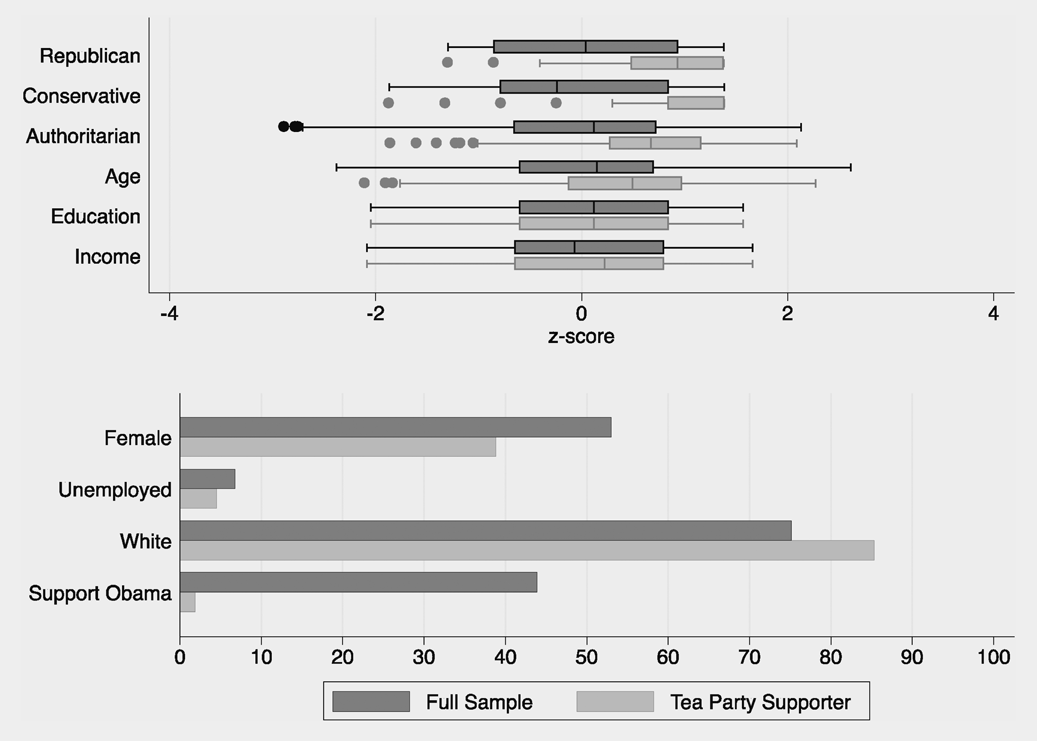
Our first order of business is to document who supports the Tea Party movement. We asked survey respondents, “What is your view of the Tea Party movement: Would you say it is very positive, somewhat positive, neutral, somewhat negative, or very negative, or don't you know enough about the Tea Party movement to say?” Respondents who answered “very positive” are coded as strong Tea Party supporters (n = 583 or 29.2% of the sample). In figure 1, we compared Tea Party supporters to the full sample on a host of demographic and attitudinal characteristics. The top panel of figure 1 displays box plots for characteristics that were measured using ordinal scales (the question wording for these measures is in the Appendix). Because each of these characteristics is measured using different scales, we facilitate comparisons by converting each measure into standardized units called a z-score. We take the difference between the individual's response to the survey item and the mean score for the survey item and then divide this difference by the standard deviation. Consequently, each box plot shows the distribution of characteristics on a common scale in which the mean for each measure is fixed at zero. The values on the x-axis represent the number of standard deviations above and below each measure's mean. The bottom panel of figure 1 displays the percentage of respondents who categorized themselves as female, unemployed, white, and expressed support for President Obama.
Differences between Tea Party Supporters and the Full Sample on Demographic and Attitudinal Characteristics

Figure 1 shows striking differences between Tea Party supporters and the full sample. Respondents who hold a very positive view of the Tea Party movement are much more likely than the full sample to identify as Republican. Yet, whether the Tea Party can be considered GOP “Astroturf” depends on how we define Republican. If we cast a wide net, including “strong” and “weak” Republican identifiers as well as Independents who “lean” Republican, Republicans have a strong affinity for the Tea Party. Using this approach, nearly 89% of Tea Party supporters identify as (or lean) Republican. Among the different categories of Republican, the modal response category is among respondents who identify as “strong” Republicans (48% of Tea Party supporters). Somewhat unexpectedly, Independent GOP leaners are more likely to be Tea Party supporters (30%) than “weak” Republican identifiers (12%). In contrast, using the same classification strategy for Democrats, we find that less than 4% of Tea Party supporters identify as Democrats and 7% among “pure” Independents (nonleaners).
Tea Party supporters also tend to score higher than the full sample on conservatism and authoritarianism, which is a common measure that reflects a preference for obedience to authority and traditional morality (see appendix for details). Tea Party supporters are also older, more affluent, predominately white males, and are less likely to be unemployed. However, we do not find any differences between Tea Party supporters and the full sample in education. Yet, we find one thing on which Tea Party supporters agree: deep disapproval of President Obama. In our full sample, roughly 44% said they approved of President Obama's performance. In contrast, only 2% of Tea Party supporters said they approved.
In some respects, these findings are not surprising. Despite early descriptions of the Tea Party as a broad-based movement, Nancy Pelosi's description of the Tea Party as an offshoot of the Republican Party, at least with respect to the mass public, appears to be correct (also see Williamson, Skocpol, and Coggin Reference Williamson, Skocpol and Coggin2011). Yet we observe some intriguing differences. Despite that Tea Party supporters tend to be more affluent than the full sample, they are not more educated. Furthermore, in spite of appeals to freedom and liberty common in Tea Party rhetoric, many authoritarians surprisingly exist in the Tea Party ranks (but see Farber Reference Farber2010).
WHAT DO TEA PARTY SUPPORTERS WANT?
Although conservatives constitute the center of gravity among Tea Party supporters, the box plots in figure 1 evince some degree of heterogeneity. Not all Tea Party supporters identify as conservative. Specifically, approximately 18% of Tea Party supporters hold moderate or liberal views on policy issues. To explore possible differences between the conservative majority and the smaller nonconservative faction of Tea Party supporters, we compared the attitudes of conservatives and nonconservatives inside and outside the Tea Party on fiscal, social, and racial policies.
With respect to fiscal policy, CCES respondents were asked how they would prefer Congress to reduce the federal government's budget deficit: cut defense spending, cut spending on domestic programs, or raise taxes. Table 1 displays responses to both questions by Tea Party support and self-identified ideology. Two interesting findings emerge. First, irrespective of ideology, Tea Party supporters are much more likely to prefer cutting domestic spending than everyone else (i.e., those who have only a somewhat positive view of the Tea Party, a neutral view, or a negative view) (χ2[6] = 792.4, p < 0.001). On average, 85.3% of Tea Party supporters want Congress to reduce the budget deficit through cuts in domestic programs, while only 24% of people who do not identify as strong Tea Party supporters (i.e., “everyone else”) want to cut domestic spending. Nevertheless, among Tea Party supporters we see some evidence of heterogeneity with nonconservatives more than twice as likely as conservatives to support cutting defense spending and raising taxes (χ2[2] = 12.83, p = 0.002).
Preferences over Methods to Balance the Budget among Conservatives and Nonconservatives by Tea Party Support

Column percentages in cells and number of observations in parentheses.
The picture that emerges from table 1 is largely consistent with the public face of the Tea Party movement, which is often touted as promoting a limited government, antitax ideology. These data make it clear that Tea Party supporters, especially among the self-described conservative faction of the Tea Party, prefer cutting domestic programs rather than cutting defense spending, one of the largest areas of the federal budget.
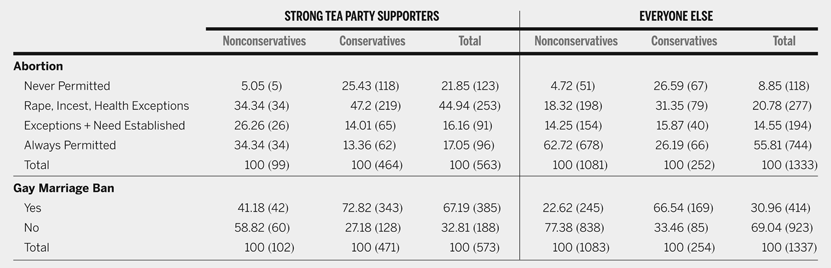
Although economic issues have defined a good deal of Tea Party rhetoric, Tea Party supporters' attitudes toward social issues suggest that supporters are conservative, not libertarian. Table 2 displays attitudes toward the social issues of abortion and gay marriage. Respondents expressed their attitude toward abortion by selecting one of four policy options: (1) never permit the practice; (2) only permit it in cases where the pregnancy is a result of rape, incest, or threatens the health of the mother; (3) permit abortion in cases beyond rape, incest, or the health of the mother but only after a need has been clearly established; and (4) women should be allowed to obtain an abortion as a personal choice. The data presented in the upper portion of table 2 shows that Tea Party supporters are, on average, more conservative on the abortion issue than everyone else (χ2[3] = 279.25, p < 0.001). Fully, 21.9% of Tea Party supporters would never permit abortion, while only 8.9% of those with a less positive view of the movement would do so. Likewise, 55.8% of those who lack strong support for the Tea Party would leave abortion as a personal choice, while only 17.1% of Tea Party supporters would. Nevertheless, we again observe heterogeneity within the Tea Party ranks, with nonconservative Tea Party supporters taking a more moderate stance on abortion than their conservative compatriots (χ2[3] = 47.16, p < 0.001). Among conservatives in the movement, 72.6% would either never permit abortion to take place or only within narrow exceptions, while only 39.4% of nonconservative Tea Party supporters take this strong position.
Abortion and Gay Marriage Attitudes among Conservatives and Nonconservatives by Tea Party Support

Column percentages in cells and number of observations in parentheses.
The bottom portion of table 2 shows that Tea Party supporters are, on average, also more conservative on gay marriage than everyone else. Tea Party supporters are much more supportive of a constitutional amendment banning gay marriage: 67% of Tea Party supporters endorse a ban whereas 69% of nonsupporters are opposed to the ban (χ2[3] = 231.31, p < 0.001). Again, we observe heterogeneity within the Tea Party ranks, with nonconservative Tea Party supporters taking a more moderate stance on gay marriage than conservative identifiers. Among Tea Party conservatives, 72.8% support a gay marriage ban, while only 41.2% of nonconservative Tea Party supporters take a strong position (χ2[3] = 38.09, p < 0.001).
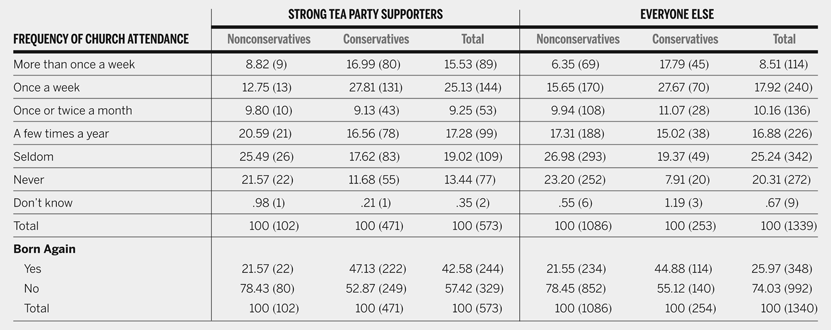
Religiosity also distinguishes Tea Party supporters from the general public. Supporters appear to be more religious than the general public insofar as attending church more often (t 1997 = 6.81, p < 0.001 two-tailed) and identifying as born again Christian (z = −6.97, p < 0.001 two-tailed). The top portion of table 3 shows that nearly 41% of Tea Party supporters attend church at least once a week whereas only 26% do so in the general public. In addition, 42% of Tea Party supporters claim to be born again Christians, while only 26% of the general public claims to be. However, Tea Party supporters continue to be a heterogeneous group. Conservative Tea Party supporters are twice as likely to attend church at least once a week (t 571 = 4.58, p < 0.001 two-tailed) and identify as born again Christians (z = −4.73, p < 0.001 two-tailed) as compared to nonconservative Tea Party supporters. Specifically, 45% of Tea Party conservatives versus 22% of nonconservative Tea Party supporters indicate they attend church at least once a week and 47% of Tea Party conservatives versus 22% of nonconservative Tea Party supporters identify as born again. In sum, much like the GOP, Tea Party supporters are socially conservative.
Church Attendance and Born Again Identification among Conservatives and Nonconservatives by Tea Party Support

Column percentages in cells and number of observations in parentheses.
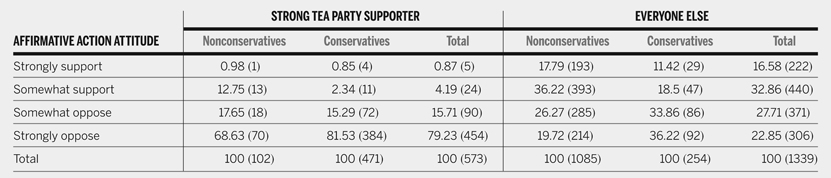
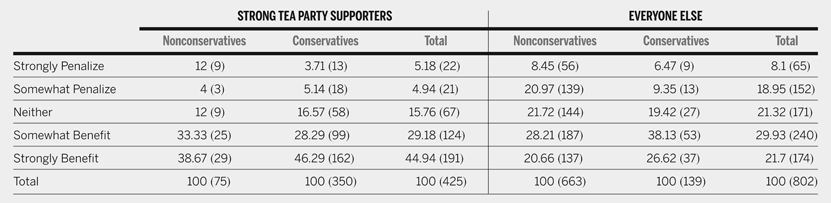
Finally, we consider the positions of Tea Party supporters on racial policies. We confine ourselves to two major areas of concern that often arise out of Tea Party rhetoric (cf. Williamson, Skocpol, and Coggin Reference Williamson, Skocpol and Coggin2011): the perceived (un)fairness of affirmative action programs and overly hospitable policies toward immigrants. Perhaps unsurprisingly, relative to everyone else, Tea Party supporters overwhelmingly oppose affirmative action (see table 4, χ2[3] = 670.83, p < 0.001) and think their state's immigration policies benefits immigrants (see table 5, χ2[3] = 101.72, p < 0.001). Yet a familiar pattern emerges from the data: while Tea Party supporters who do not identify as conservative take more conservative positions than everyone else, these individuals also take less-extreme and somewhat more moderate positions on racial issues. Compared to Tea Party conservatives, nonconservative Tea Party supporters are less likely to strongly oppose affirmative action, and a small minority express some support for the policy (see table 3, χ2[3] = 23.77, p < 0.001). They are also less likely than Tea Party conservatives to say that their state's policies “strongly benefit” immigrants (see table 5, χ2[3] = 10.51, p = 0.033). Moreover, the differences between nonconservative and conservative Tea Party supporters do not appear to be an artifact of minorities identifying as nonconservative Tea Party supporters. Both factions of Tea Party supporters are overwhelmingly white (86.4% for conservatives and 81.4% for nonconservatives, t 571 = −1.31, p = .095 one-tailed), and the same pattern of results emerges if we restrict the sample to whites.
Attitudes toward Affirmative Action among Conservatives and Nonconservatives by Tea Party Support

Column percentages in cells and number of observations in parentheses.
The Perceived Effect of Immigration Laws in Respondents' State among Conservatives and Nonconservatives by Tea Party Support

Column percentages in cells and number of observations in parentheses.
On the whole, these results demonstrate that Tea Party supporters are much more to the right than other Americans on a broad range of issues that encompass fiscal, social, and racial policies. Contrary to claims by some individuals in the Tea Party that its members are only united on a desire for limited government, most Tea Party supporters want the government to regulate social issues such as abortion. With respect to racial policies, it appears that Tea Party supporters are animated by a concern that minorities are unfairly receiving government benefits. Whether this is an extension of a color-blind impulse to treat everyone fairly or racial resentment is addressed next.
IS TEA PARTY OPINION MOTIVATED BY RACIAL RESENTMENT?
Both recent scholarship (Barreto et al. Reference Barreto, Cooper, Gonzalez, Parker and Towler2011; Parker Reference Parker2010; Williamson, Skocpol, and Coggin Reference Williamson, Skocpol and Coggin2011) and popular accounts (Lakoff Reference Lakoff2009) have advanced the claim that Tea Party opposition to domestic government programs, especially those designed to benefit the poor, stem from racial resentment and an acceptance of racial stereotypes that paint nonwhites as lazy and undeserving of help. Yet it is difficult to assess the veracity of this claim from a lack of support for government programs. After all, principled conservatives may oppose any government program on the grounds that it violates the principle of limited government (Kuklinski et al. Reference Kuklinski, Sniderman, Knight, Piazza, Tetlock, Lawrence and Mellers1997). Furthermore, it is important to assess the source of the racial resentment if it does underlie Tea Party opposition to government programs. If symbolic racism is at the root of Tea Party opposition to government programs, then the movement's supporters should be wary of requests for government aid by racial minorities who do not obviously conform to norms entailed in the Protestant work ethic (e.g., hard work). Conversely, if old-fashioned racism is the root cause, Tea Party supporters would oppose any government aid to racial minorities, irrespective of whether they conform to accepted norms.
We tackle this question with the help of an embedded survey experiment. Respondents on our module were asked to read statements attributed to “everyday people” and “indicate how much they agree with each of the statements” using a slider that placed answers on a 100-point scale. Each statement was paired with a picture of a face of the person expressing it. Because our concern is whether support for government programs stem from racial resentment, each of the “everyday people” making the statement differed by race and ethnicity. Although it is simple to include pictures of people of different races and ethnicities, doing so introduces potential confounds including differences in trait features (e.g., attractiveness) or facial expressions (e.g., anger). Todorov and colleagues (Reference Todorov, Said, Egnell and Oosterhof2008), for example, found that different trait features affected judgments of trustworthiness and dominance. To work around such problems, we created images using the FaceGen Modeller program (Blanz and Vetter Reference Blanz and Vetter1999; Singular Inversions 2006). Based on a database of actual faces, FaceGen renders three-dimensional faces that can be manipulated on multiple dimensions. For our purposes, a major advantage of FaceGen is that it can render faces to vary by a single characteristic while holding constant potential confounds. Holding constant all other facial dimensions, we varied the complexion of the face's skin, creating a white face, a brown face, and a black face. By randomly assigning respondents to these face-statement pairs, we ensure that predispositions toward government programs and latent racial attitudes are held constant across the conditions. Consequently, we can identify the independent effect that race or ethnicity has on support for government programs designed to help the poor.
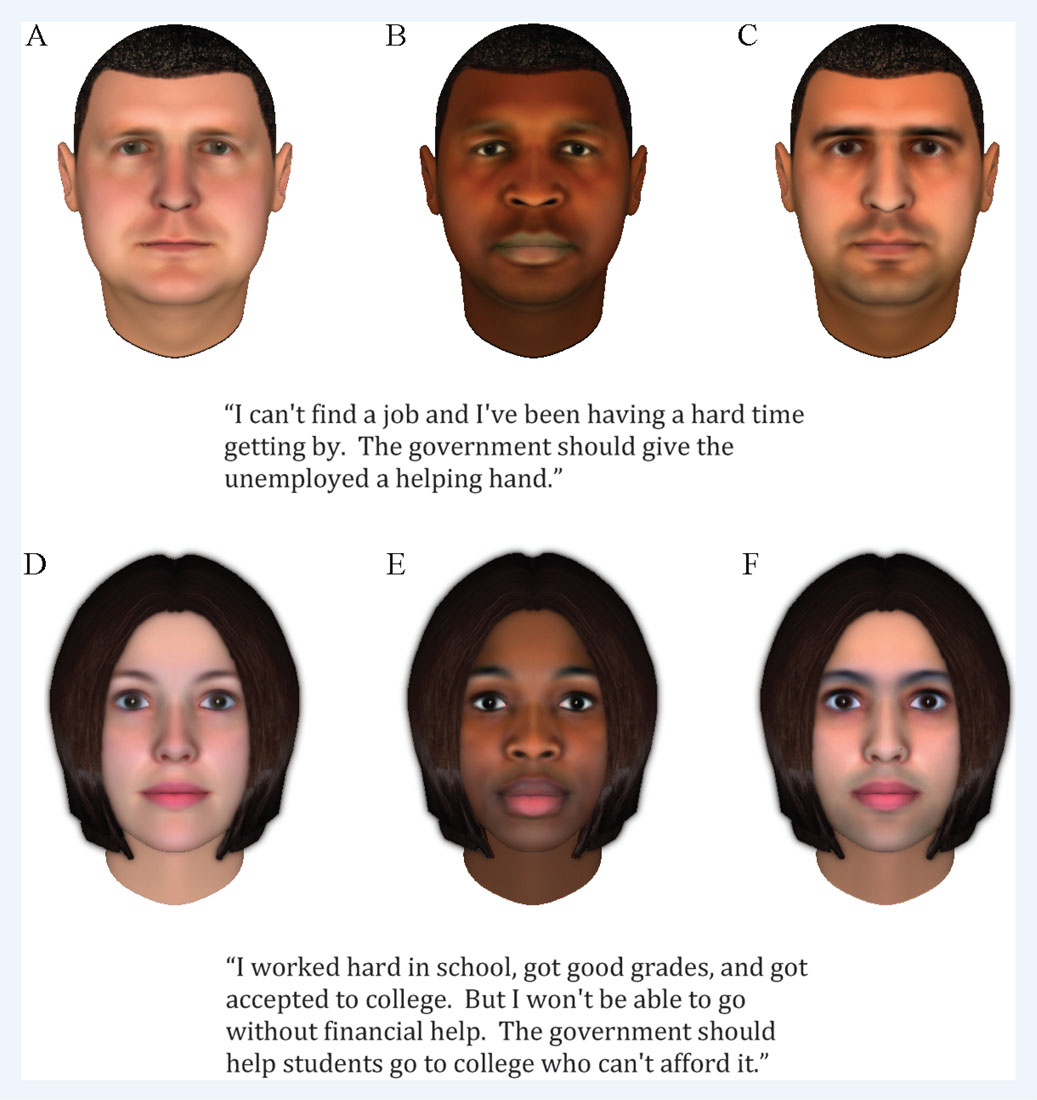
The faces and statements are shown in figure 2. We use two statements. The first is designed to test whether stereotypes that characterize minorities as having less of a commitment to the Protestant work ethic than whites underlies Tea Party opposition to government programs. As seen in the top row of figure 2, the statement begins with a complaint that the person has had difficulty finding a job and concludes with the argument that the government should “give the unemployed a helping hand.” The deservingness of this individual is a matter of interpretation. On the one hand, if one assumes that the person is committed to the Protestant work ethic, then the initial statement about the difficulty finding a job implies that this individual is trying hard to find work but failing because of a weak job market in the midst of a struggling economy. In this instance, a “helping hand” is deserved. On the other hand, if one assumes (perhaps implicitly) that minorities lack a commitment to hard work, then these individuals may be deemed less worthy of government's help (see also Petersen et al. Reference Petersen, Slothuus, Stubager and Togeby2010). To examine whether support for government assistance turns on the race or ethnicity of the recipient, respondents are given one of three possible faces. Figures 2A, 2B, and 2C depict the white, black, and brown male faces behind this statement, respectively.
Faces and Statements in the “Everyday People” Experiment
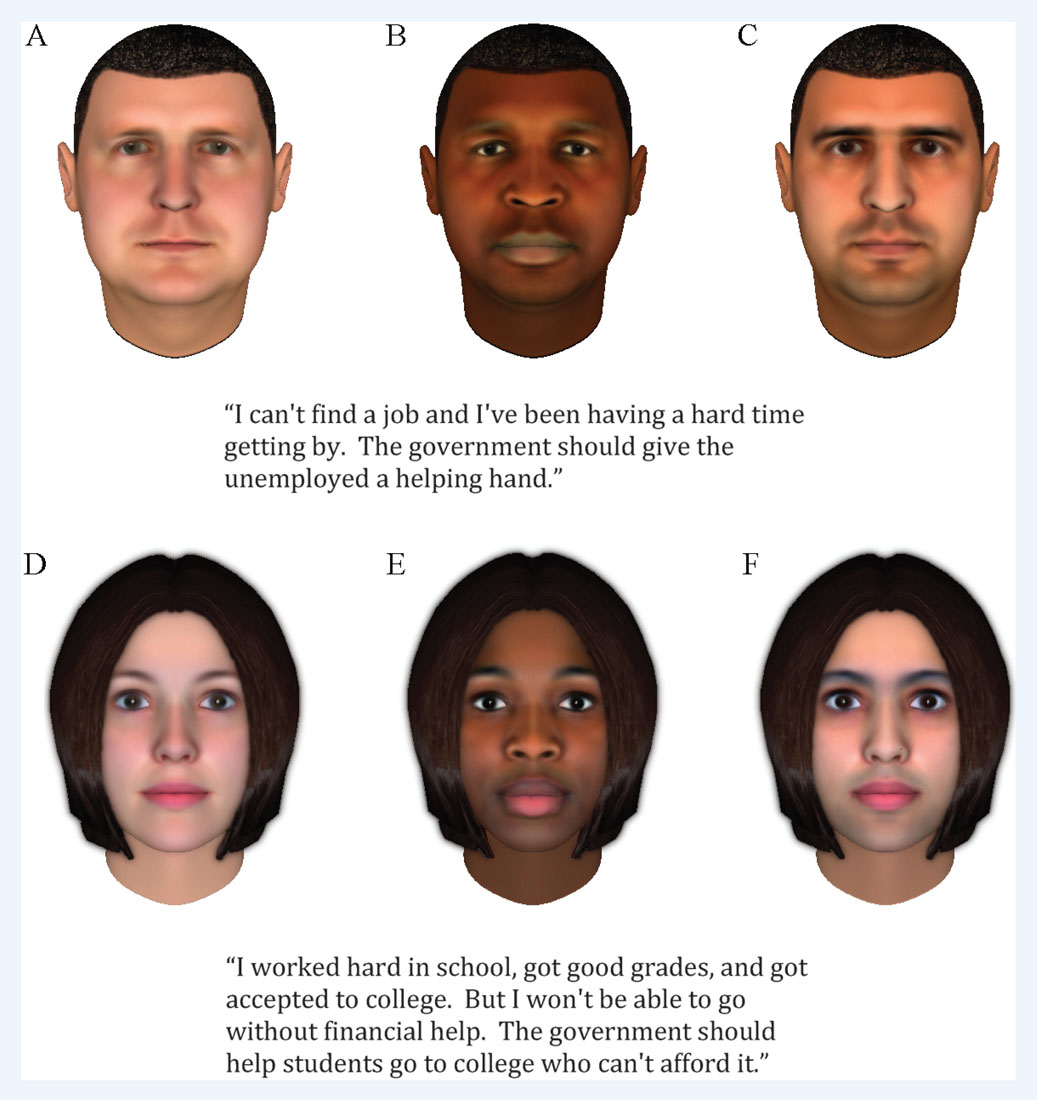
The second statement was designed to bolster the perception that the person is indeed committed to the Protestant work ethic. As seen in the bottom row of figure 2, in this statement the person prefaces her plea for government assistance by noting that she has worked hard in school, earned good grades, and has been accepted to college, but cannot afford to go. Moreover, she wants government aid to further her education, which implies that she wants to better her position through hard work. If symbolic racism, as opposed to old-fashioned racism, motivates opposition to government programs, then we would not expect the skin complexion of the individual to affect how respondents rate the statement. Again, to evaluate whether opinion about government assistance depends on the race of the recipient, respondents are presented with one of three faces. Figures 2D, 2E, and 2F depict the white, black, and brown female faces behind the statement, respectively.
Because we observed some heterogeneity in preferences of self-identified conservatives and nonconservatives among the Tea Party supporters, we investigated whether different motivations underlie their opinions by segmenting the analysis by ideology and Tea Party support. We also restrict our analysis to whites, because we are interested in investigating the presence of racial resentment toward minorities. Few minorities view the Tea Party positively, and the results are similar if racial and ethnic minorities are included.
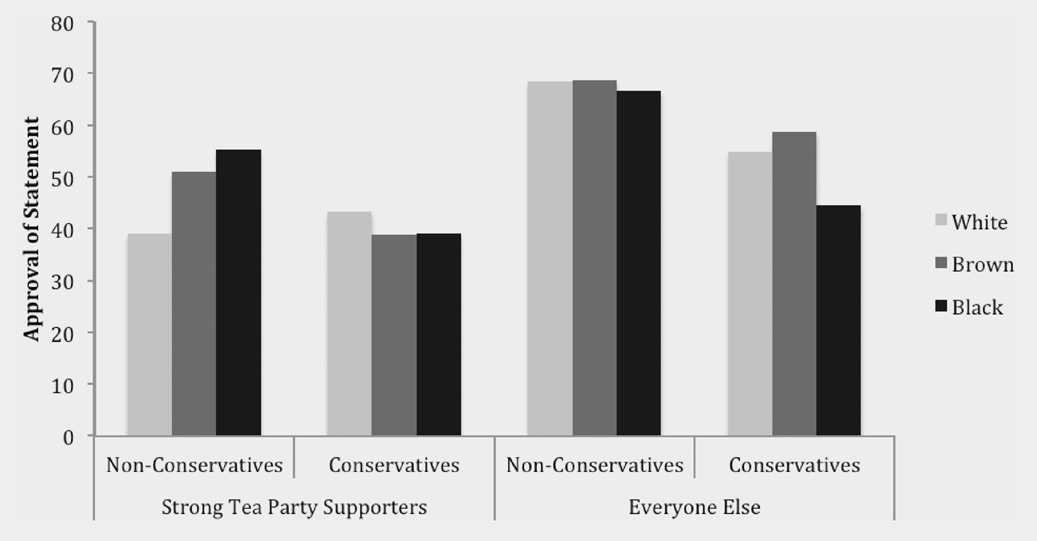
The results for the unemployment aid statement are shown in figure 3. The bars in these charts represent the average approval rating by ideology and Tea Party support. Consistent with what we have seen before, Tea Party supporters are, on average, less approving of the argument that the government should assist the unemployed. Irrespective of ideology, Tea Party supporters rated the statement at 41.9 on the 100-point scale, while everyone else rated the statement at 64.9, on average. Yet after we segment the ratings by the skin complexion of the person making the statement, an intriguing pattern emerges: conservative Tea Party supporters rated the statement attributed to the white face more than 4 points higher than when the statement was attributed to the nonwhite faces (p < 0.07).Footnote 3 This difference registers a fifth of a standard deviation, reflecting a real but substantively modest effect of the racial cue on support for government aid to the unemployed. Moreover, when we compare these results to conservatives who are less supportive of the Tea Party movement, there is a similar drop in support for unemployment aid, but only when attributed to the black face (p < 0.05).Footnote 4 Together, these results suggest that opposition to government aid is not solely a function of racial resentment. Rather, some degree of racial resentment underlies conservative opposition to support for unemployment aid, and this resentment appears to run deeper among Tea Party conservatives.
Response to Unemployment Aid Statement by Ideology and Tea Party Support

Nonconservative Tea Party supporters exhibit the opposite reaction. It appears that their support for the statement actually increases with the darkness of the statement-maker's skin complexion (p < 0.05). In contrast, the rating of the statement by nonconservatives who are less supportive of the Tea Party is high and unaffected by the statement-maker's skin complexion (p > 0.15). These results suggest that nonconservative supporters of the Tea Party are driven by a different motive in their opposition to government programs, and they may even be sympathetic to the plight of minorities.
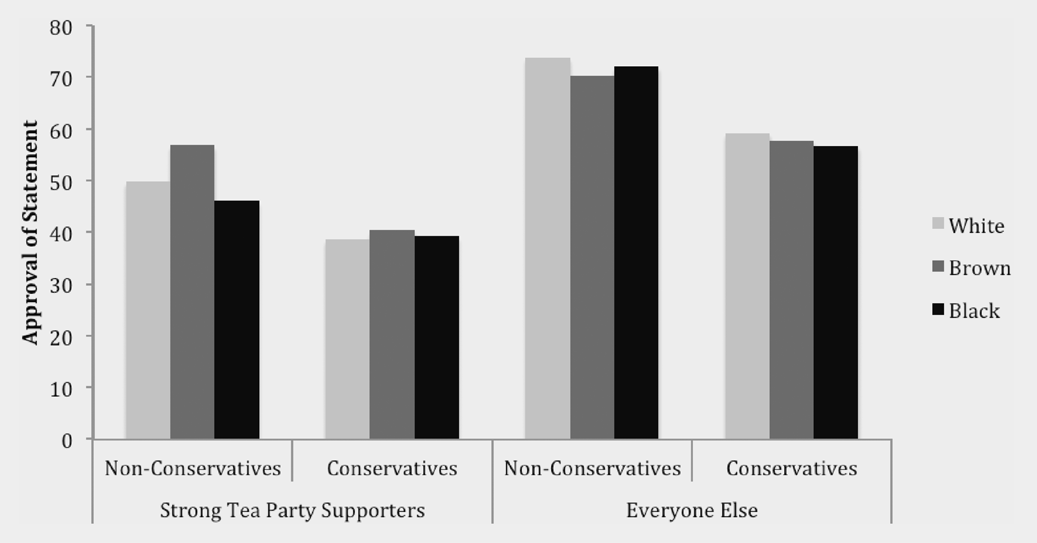
Finally, we observe no statistically significant differences in the rating of the college-aid statement across the treatment conditions (see figure 4). Although Tea Party supporters were less likely to support the statement (M = 41.5) than everyone else (M = 69.3), the skin complexion of the statement maker did not appear to influence their reaction to the statement. Together, the results of our face experiments suggest that conservative Tea Party supporters are more likely to oppose government aid to racial minorities when they are perceived to violate norms surrounding the Protestant work ethic rather than out of a general hostility toward minorities.
Response to College Aid Statement by Ideology and Tea Party Support

CONCLUSION
Our study helps clarify the composition, aims, and motivations underlying the Tea Party movement. The picture that emerges from the survey data we collected during the 2010 midterm elections both overlaps and contrasts the view of the movement that has grown out of popular commentary and recent scholarship. Our analysis confirms the sense that the Tea Party movement is fundamentally white, male, and conservative in character. Although the evidence also comports with the suggestion that conservative populism may arise, in part, out of economic insecurities of upper-middle class whites, we do not find much evidence for the thesis popularized by Thomas Frank's (Reference Frank2004) book What's the Matter with Kansas? that grassroots conservative movements, like the Tea Party, consist primarily of working poor whites mobilizing against their class interests. Indeed, Tea Party supporters tend to be wealthier than the general population.
Although the higher incomes of Tea Party supporters run contrary to Frank's thesis that the working class are the foot soldiers of conservative grassroots movements, our data cannot speak to his argument about the role of right-wing pundits and politicians who stoke conservative resentment by casting liberals as sanctimonious, snobbish elitists fixed on imposing their values on everyone else. Nonetheless, our data provide suggestive evidence for the argument that cultural grievances matter to Tea Party supporters. In addition to Tea Party supporters being more conservative on these issues than the general public, we found Tea Party conservatives to be more supportive of a ban on gay marriage, more opposed to abortion rights, and more religious than conservatives outside the Tea Party.
Consistent with the espoused libertarian bent of the Tea Party, the vast majority of Tea Party supporters are opposed to cutting defense spending and raising taxes. Tea Party supporters appear to prefer a smaller government even if it means cuts to Social Security and Medicare. In contrast to the rhetoric articulated by Tea Party activists, the conservative impulse underlying the movement extends beyond fiscal matters and into social and racial policies as well.
Yet in our investigation of the motives that underlie Tea Party supporters' opposition to government programs, we only find modest evidence that it emanates from racial resentment. Irrespective of the racial identity of the prospective beneficiary, Tea Party supporters tend to oppose government aid for the unemployed or poor college students. Nonetheless, opposition to these programs intensifies among conservatives when racial stereotypes are not countered by the beneficiary's personal narrative. We find this to be the case for conservatives who strongly support the Tea Party and those who are less supportive, but the racial resentments of Tea Party conservatives appear to be broader and deeper than conservatives outside of the Tea Party movement. So, although it does appear that racial resentment plays some role in opposition to government programs among conservative Tea Partiers, these data do not support the notion that racial resentment is the primary factor.
Moreover, nonconservatives who support the Tea Party appear to behave in the opposite fashion, suggesting that their opposition to government programs for the poor may not be motivated by racial resentment. In fact, the evidence here suggests that nonconservatives in the Tea Party movement may even use nonwhite racial features as a positive cue. These findings comport with both popular (Raban Reference Raban2010) and scholarly (Williamson, Skocpol, and Coggin Reference Williamson, Skocpol and Coggin2011) accounts that highlight differences among Tea Party supporters' racial attitudes. More generally, we find that Tea Party supporters who do not identify as conservatives tend to take less extreme, although relatively conservative, positions. Whereas these individuals make up less than 20% of Tea Party supporters, our analysis indicates that support for the Tea Party is not uniform, and future research should be directed at understanding the heterogeneity among supporters.
Because our results contradict some important elements of the emerging narrative surrounding the Tea Party, we need to ask why. One potential explanation is that popular perceptions of the Tea Party are driven by media coverage of its “elites,” those politicians who have been elected to public office with the Tea Party's endorsement, and its activists, those individuals who attend Tea Party marches, meetings, and rallies. Although our sample surely included some Tea Party activists, the vast majority of the respondents in our study had probably never participated in a Tea Party event. Indeed, Williamson, Skocpol and Coggin (Reference Williamson, Skocpol and Coggin2011, 27) report that only 20% of those who support the Tea Party have attended a meeting or made a donation. Because many people over-report political participation this percentage is likely to be inflated. Future research should bridge the gap between the attitudes and behavior of mass-level supporters of the movement and its activists and leaders.
ACKNOWLEDGMENTS
We would like to thank Yarrow Dunham and Chris Parker for helpful comments and suggestions. We also thank Sylvia Manzano and Francisco Pedraza for allowing us to use their question on immigration and Richard Gale for his research assistance.
APPENDIX: Survey Question Wording for Political Questions
View of the Tea Party
-
1. What is your view of the Tea Party movement; would you say it is very positive, somewhat positive, neutral, somewhat negative, or very negative, or don't you know enough about the Tea Party movement to say?
Response Options: Very positive, Somewhat positive, Neutral, Somewhat negative, Very negative, Don't know enough to say, No opinion
Affirmative Action
-
2. Affirmative action programs give preference to racial minorities in employment and college admissions in order to correct for past discrimination. Do you support or oppose affirmative action?
Response Options: Strongly support, Somewhat support, Somewhat oppose, Strongly oppose
Budgetary Preferences
-
3. What would you most prefer that Congress do—cut domestic spending, cut defense spending, or raise taxes?
Response Options: Cut Defense Spending, Cut Domestic Spending, Raise Taxes
Authoritarianism
-
4. Although there are a number of qualities that people feel that children should have, every person thinks that some are more important than others. Below are pairs of traits parents try to instill in their children. For each pair, please select which one you think is more important for a child to have.
Response Options on a 100-point scale:
-
• (0) Independence ——————— Respect for Elders (100)
-
• (0) Obedience ——————— Self-Reliance (100)
-
• (0) Curiosity ——————— Good Manners (100)
-
• (0) Being Considerate ——————— Well Behaved (100)
Abortion
-
5. Which one of the opinions on this page best agrees with your view on abortion?
Response Options:
-
• By law, abortion should never be permitted
-
• The law should permit abortion only in case of rape, incest, or when the woman's life is in danger
-
• The law should permit abortion for reasons other than rape, incest, or danger to the woman's life, but only after the need for the abortion has been clearly established
-
• By law, a woman should always be able to obtain an abortion as a matter of personal choice
Gay Marriage
-
6. Do you support a Constitutional Amendment banning Gay Marriage?
-
• Yes
-
• No
Church Attendance
-
7. Aside from weddings and funerals, how often do you attend religious services?
-
• More than once a week
-
• Once a week
-
• Once or twice a month
-
• A few times a year
-
• Seldom
-
• Never
-
• Don't know
Born Again
-
8. Would you describe yourself as a “born-again” or evangelical Christian, or not?
-
• Yes
-
• No
Immigration
-
9. Do you think [respondent's state] immigration laws and policies generally:
-
• Strongly benefit immigrants currently living in [respondent's state]
-
• Somewhat benefit immigrants currently living in [respondent's state]
-
• Somewhat penalize immigrants currently living in [respondent's state]
-
• Strongly penalize immigrants currently living in [respondent's state]
-
• Neither
-
• Not Sure
Ideology
-
10. How would you rate each of the following individuals and groups?
-
• Yourself
Response Options: Very Liberal, Liberal, Somewhat Liberal, Middle of the Road, Somewhat Conservative, Conservative, Very Conservative, Not Sure
Party Identification
-
11. Generally speaking, do you think of yourself as a … ?
Response Options: Democrat, Republican, Independent, Other