




No CrossRef data available.
Article contents
Toxicity of cadmium and zinc to the decaudised cercarial life-span of Diplostomum spathaceum (Trematoda: Diplostomidae)
Published online by Cambridge University Press: 17 October 2003
Abstract
The toxicity of cadmium and zinc at concentrations ranging from 0·1 to 10 000 μg/l to the life-span of decaudised cercarial bodies (cercariae that have shed their tails) of Diplostomum spathaceum was investigated. The effects of metal exposure at 3 temperatures (12, 20, and 25 °C) and 3 levels of water hardness (distilled water, soft water and hard water) were studied. In general, under most experimental conditions increasing metal concentrations reduced the life-span of decaudised cercariae. Increasing water hardness and decreasing water temperature caused an increase in the life-span of both control and metal exposed decaudised cercariae. However, at certain isolated metal concentrations, associated with a specific level of water hardness and temperature, increased survival above controls occurred. Differences in the relative toxicity of cadmium and zinc were dependent on the environmental conditions of exposure. The decaudised cercarial life-span under metal exposure was found to be generally independent of the overall cercarial survival and tail loss in most experimental conditions. Prolonged exposure to cadmium and zinc caused changes in the decaudised cercarial life-span when compared to individuals decaudised during the initial 24 h exposure period to those which were decaudised during the final 24 h period of cercarial survival. The validity of studying the decaudised cercarial life-span as an indicator of ‘fitness’ of larvae to migrate through the tissues of the target fish host, in terms of glycogen utilization, was assessed for those cercariae decaudised during the initial 24 h exposure period only. A limited reduction in the decaudised cercarial life-span during this period compared to controls was recorded, which may possibly indicate a reduced penetration ‘fitness’ of cercariae exposed to cadmium and zinc. The importance and relevance of these findings to parasite migration and establishment in the fish host are discussed.
Keywords
Information
- Type
- Research Article
- Information
- Copyright
- 2003 Cambridge University Press
INTRODUCTION
The impact of pollutants on the transmission of digeneans has, for a number of years, focused on the vulnerable free-living stages, especially cercariae. Historically most studies have concentrated on survival as the main indicator of toxicant effects (e.g. Abd Allah, Wanas & Thompson, 1996; Soucek & Noblet, 1998; Pietrock et al. 2001). However, recent studies by Morley and co-workers have attempted to expand the number of survival parameters investigated to assess metal toxicity to Diplostomum spathaceum cercariae by examining tail loss as well as survival (Morley, Crane & Lewis, 2001, 2002 a).
Under most conditions of metal exposure changes in cercarial survival and tail loss of the experimental population were found to be interlinked with a decrease in survival preceded by an increase in tail loss (Morley et al. 2002 a). However, at certain metal concentrations changes in this parallel relationship occurred, leading to either stimulation or inhibition of tail loss compared to the survival rate which, as suggested, may be associated with changes in the life-span of decaudised cercariae i.e. cercariae which have shed their tails (Morley et al. 2002 a). It is possible that continual metal exposure of the gradually ageing cercarial population may affect the life-span of decaudised cercarial bodies when compared with those decaudised during the first few hours post-exposure. Consequently, an examination of the life-span of decaudised cercariae under metal exposure will contribute to our understanding of toxicity to cercarial functional biology.
In addition such studies may also be a useful gauge of the relative ‘fitness’ of decaudised cercariae to migrate through the skin of their target host. Pechenik & Fried (1995) have demonstrated that the absolute and functional life-span of a cercarial population and their infectivity are interlinked and controlled to the same degree by energy expenditure. Cercariae such as Schistosoma mansoni use their muscular tails, in conjunction with cercarial secretions, to drive the cercarial body into the outer skin layers of the target host. The tail is then shed and the body migrates through the skin and into the host using its stored glycogen reserves for metabolism. However, D. spathaceum, upon successful attachment to the host, sheds its tail prior to penetration (Hoglund, 1991) and the decaudised cercariae are therefore totally reliant only on the body glycogen reserves for the entire process of penetration and migration.
Previous studies by Rai & Clegg (1968), Para, Lewert & Ozcel (1970), and Lawson & Wilson (1983) have established that decaudised cercarial bodies use between 24 and 35% of their glycogen reserves in crossing the host skin membrane. Lawson & Wilson (1983) concluded that inadequate energy reserves may be a factor in both lower infection rates and a more rapid loss of infectivity. Earlier studies by Lawson & Wilson (1980 a) established the link between survival of cercariae and their glycogen content. More recent work has associated metal toxicity to cercarial survival with the impaired utilization of glycogen (Siddall & des Clers, 1994; Morley et al. 2001, 2002 b). Heavy metals, in particular cadmium, are known to be potent inhibitors of the enzymes involved in carbohydrate metabolism in both parasitic helminths (Murthy & Tayal, 1978; Parshad & Guraya, 1978; Goil, 1978; Goil & Harpur, 1979; Gupta & Trivedi, 1986) and other invertebrates (Ortel, 1996). It is therefore apparent from the published literature that there are direct links between cercarial glycogen utilization, survival and infectivity. Consequently, an investigation on the effects of metal exposure on the decaudised cercarial life-span of D. spathaceum could provide valuable information for interpreting potential cercarial infectivity, in terms of glycogen utilization, in metal-polluted environments over a range of water hardness and temperature condition.
To date there have been few studies on the functional biology of decaudised cercariae. All previous investigations have focused on mechanically decaudised cercariae and include infectivity studies (Portnoy, Higashi & Kamal, 1983; Braham, Riley & Uglem, 1996), survival studies (Mitchell, Mason & Whalley, 1980), and physiological studies (e.g. Ramalho-Pinto et al. 1974; Howells et al. 1975; Samuelson & Stein, 1989).
Nevertheless, the influence of environmental parameters such as water temperature and hardness and the additional burden of metal toxicity to the decaudised cercarial life-span are not known. In the present study the toxicity of cadmium and zinc to decaudised D. spathaceum cercariae was investigated. Diplostomum spathaceum is a ubiquitous parasite of a range of fish species within the UK and occurs in many different climate zones (Chubb, 1979). Temperatures of 10 °C or lower appear to impede or prevent emergence of cercariae from the lymnaeid snail host (Lyholt & Buchmann, 1996). It has also been demonstrated experimentally that 10 °C is the minimum temperature for active transmission of D. spathaceum to the fish host (Stables & Chappell, 1986).
The aims of the present study were to determine how exposure to cadmium and zinc influences the decaudised cercarial life-span of D. spathaceum at 3 temperatures (12, 20, and 25 °C) and 3 types of water hardness (distilled, soft and hard water), to establish the validity of studying the decaudised cercarial life-span data as a survival parameter for providing additional information on pollutant toxicity to cercariae, and to assess the benefits of using such data as an indicator of penetration ‘fitness’ i.e. the ability of cercariae to successfully migrate into the host using only their own stored glycogen reserves. Cadmium and zinc are related heavy metals, which almost always occur together during pollution events. They are widely used in industry and are released into the environment as a by-product of ore smelting (Hellawell, 1986). Concentrations of these metals, which chronically pollute the aquatic environment within the UK have been recorded at concentrations as high as 160 μg/l for cadmium and 8800 μg/l for zinc (Vivian & Massie, 1977).
MATERIALS AND METHODS
Test solutions
Stock solutions of 100 mg/l cadmium and zinc were prepared by dissolving either cadmium chloride (CdCl2.5/2H2O, minimum 98%) or zinc chloride (ZnCl2, minimum 98%) (Sigma Chemicals) in distilled water to give the correct concentration of metal ions. Test solutions were obtained by diluting stock solutions in distilled water and were added to the test vessels at concentrations which gave final cercarial exposures of 0·1 μg/l, 10 μg/l, 100 μg/l and 10000 μg/l. Synthetic soft (25 mg/l CaCO3, pH 7·85) and hard (250 mg/l CaCO3, pH 8·00) waters were prepared using procedures described by HMSO (1969).
Water analysis
Samples of test solutions were analysed for metal loss from soft water incubated at either 25 °C, 20 °C, or 12 °C in the metal concentration range of 10 μg/l to 10000 μg/l (0·1 μg/l was below the limit of detection) after 0·5 h, 5 h and 24 h. Solutions were analysed on a Perkin Elmer Optima 3300 Inductively Coupled Plasma-Atomic Emission Spectrometer which was calibrated with a 1% nitric acid blank and a standard which consisted of 1000 μg/l of cadmium and zinc in 1% nitric acid. The accuracy of the data was assessed by analysing a certified reference material (NIST SRM 1643d) along with the samples and was calculated to have a relative error of 0·00037% for cadmium and 0·00065% for zinc.
Source and identification of parasites
Specimens of Lymnaea stagnalis naturally infected with D. spathaceum were collected from Dinton Pastures, Reading, UK (National Grid Reference SU779724), maintained in aerated 8 l Perspex tanks and fed on a diet of lettuce leaves. Recently emerged cercariae of D. spathaceum were identified according to morphological criteria as described by Niewiadomska (1986). Infected snails and solutions were acclimatized to each experimental temperature in a 12 h light/dark incubator for 24 h prior to the beginning of each experiment as required.
Decaudised cercarial toxicity test
Toxic effects were investigated by pipetting 36 cercariae (maximum age 25 min) individually into wells of flat-bottomed 96-well microtitre plates (Life Sciences International) using a wide-bore pipette tip to prevent cercarial damage. Each well contained a final solution volume of 300 μl of either distilled water, soft water, or hard water with sufficient test solution having been added, or a control addition of distilled water, to give the appropriate concentration exposure. Cercariae were maintained in a 12 h light/dark incubator set at either 25 °C, 20 °C, or 12 °C, and all experiments were set up at the same time of day. Three replicates of each treatment were set up and observations of cercariae were undertaken at intervals of 0·5–3 h, depending on the concentration of the test solution used. Once the cercariae had shed their tails they were observed at the same time-intervals until death occurred. Tail loss occurred at regular intervals as the cercarial population aged (Morley et al. 2002 a). Death was pronounced when decaudised cercariae failed to respond to mechanical stimulation with a fine needle. Results were analysed using a Lee-Desu Comparison test for contrasting differences between the entire decaudised cercarial population. This test calculates survival function directly from the continuous survival times and the resulting estimates do not depend on the grouping of data into a certain number of time-intervals. In addition, we investigated whether prolonged metal exposure of aged cercariae affected the subsequent life-span of decaudised cercariae at low concentrations (0·1–100 μg/l), where survival over time of the cercarial population exceeded 24 h. This was done by comparing those individuals which decaudised during the initial 24 h exposure period with those that decaudised during the final 24 h survival period in each test solution using the Lee-Desu comparison test. To investigate the relative ‘fitness’ of decaudised cercariae to migrate through the skin membrane of their target host, the life-span of individuals which had decaudised only during the initial 24 h post-emergence period was compared with controls using the Lee-Desu comparison test (glycogen utilization by cercariae has been determined during this period to primarily occur from the tail reserves rather than the body reserves as described by Ginetsinskaya (1960) and Fried, Eyster & Pechenik (1998)). Statistical analysis was performed using UNISTAT 4.5 (Unistat Ltd, 1996).
RESULTS
Water analysis
Analysis of the water samples over time revealed that loss of dissolved metals generally occurred within 0·5 h in most test solutions, and concentrations generally continued to decline up to 24 h. The greatest initial loss rate was from the highest metal concentration (10000 μg/l). Nevertheless, over the 24 h period there was no more than a 15% concentration loss from any of the test solutions. Over the 3 experimental temperatures there were no major differences in metal loss.
Metal toxicity to decaudised cercarial life-span
The life-span of decaudised cercarial of D. spathaceum was found to show a rapid decline in survival in the first few hours after tail loss with a minority surviving for an extended period of time. Under control conditions decaudised cercariae demonstrated a general trend of increasing life-span with decreasing temperature and increasing water hardness (Figs 1–3). Exposure to cadmium and zinc resulted in a change in the duration of the life-span which was dependent on metal concentration, water temperature and water hardness. Increasing water temperature and decreasing water hardness increased the toxicity of the two metals at most concentrations (Figs 1–3). Statistical analysis of metal toxicity at different temperatures showed that, with a few exceptions, there was a significant difference (Lee-Desu P[les ]0·0415) between controls and each treatment at each concentration for both cadmium and zinc.

Fig. 1. The decaudised cercarial life-span of Diplostomum spathaceum at 25 °C exposed to cadmium and zinc in (A) distilled water, (B) soft water, (C) hard water. Error bars are standard errors. ([bull ]) Control; ([utrif ]) 0·1 μg/l; (○) 10 μg/l; (□) 100 μg/l; ([squf ]) 10000 μg/l.

Fig. 2. The decaudised cercarial life-span of Diplostomum spathaceum at 20 °C exposed to cadmium and zinc in (A) distilled water, (B) soft water, (C) hard water. Error bars are standard errors. ([bull ]) Control; ([utrif ]) 0·1 μg/l; (○) 10 μg/l; (□) 100 μg/l; ([squf ]) 10000 μg/l.

Fig. 3. The decaudised cercarial life-span of Diplostomum spathaceum at 12 °C exposed to cadmium and zinc in (A) distilled water, (B) soft water, (C) hard water. Error bars are standard errors. ([bull ]) Control; ([utrif ]) 0·1 μg/l; (○) 10 μg/l; (□) 100 μg/l; ([squf ]) 10000 μg/l.
Water hardness was less effective than temperature in altering the effects of metal toxicity. In general, significant differences occurred between distilled water and the harder waters (Lee-Desu P[les ]0·0292), especially for zinc, which became more prominent at lower temperatures. At 12 °C differences between the 3 water media were significant at all concentrations (Lee-Desu P[les ]0·0079) whilst at 25 °C differences were only significant for cadmium and zinc at 10000 μg/l and 10 μg/l (Lee-Desu P[les ]0·0169) and for zinc at 0·1 μg/l (Lee-Desu P=0·0165).
The life-span of decaudised cercariae under the different experimental conditions (Figs 1–3) was generally reduced with increasing metal concentrations. A reduced life-span occurred in all experimental exposures at 10000 μg/l (Lee-Desu P<0·0001). The life-span was also reduced at 25 °C for all 100 μg/l exposures, all 0·1 μg/l exposures in soft and hard water, and the 10 μg/l exposures in soft water for cadmium and in hard water for zinc (Lee-Desu P[les ]0·0403); at 20 °C in distilled water for 10 and 0·1 μg/l Zn and 100 μg/l Cd, in soft water for 100 μg/l Zn, and in hard water for both metals at 100 μg/l (Lee-Desu P[les ]0·0183); and at 12 °C for 100 μg/l Cd in soft water (Lee-Desu P<0·0001).
However, under some experimental conditions the decaudised cercarial life-span was increased for metal exposed individuals above control levels. This occurs at 25 °C for 10 μg/l cadmium and zinc in distilled water, at 20 °C for 10 μg/l Cd and 100 μg/l Zn in distilled water, and at 12 °C for 100 μg/l Cd in distilled water and in soft water for 0·1–100 μg/l Zn (Lee-Desu P[les ]0·0184).
Comparisons of the relative toxicity of cadmium and zinc showed that environmental conditions had only an inconsistent influence on inducing a significant difference between the two metals. At 25 °C only 10000 μg/l and 0·1 μg/l exposures in distilled water and 10 μg/l exposures in hard water were significantly different (Lee-Desu P[les ]0·0001), whilst at 20 °C only 100 and 10 μg/l exposures in distilled water, 100 μg/l exposures in soft water and 10000 and 10 μg/l exposures in hard water were significantly different (Lee-Desu P[les ]0·0027). However, at 12 °C there was significantly different toxicity between the two metals at all exposures apart from 10 μg/l in distilled and hard water (Lee-Desu P[les ]0·0347).
Metal-induced changes in the decaudised cercarial life-span as the population aged
An examination of the life-span of decaudised cercariae between those decaudised in the initial 24 h exposure period compared to those in the final 24 h period of survival of the experimental population demonstrated a significant difference at several low metal concentrations. At both 25 and 20 °C, although there was no difference in control exposures, a reduced life-span occurred during the final 24 h period at 25 °C for 100 μg/l Zn exposures in hard water, and at 20 °C for 0·1 μg/l Cd exposures in distilled and hard water and for zinc in soft water at 0·1–100 μg/l exposures and hard water at 0·1 μg/l (Lee-Desu P[les ]0·0184). At 12 °C a significant decrease in the life-span during this final period of decaudation was more extensive and included all control exposures as well as all metal exposures (Lee-Desu P[les ]0·0158), except for exposure to 10 μg/l Cd in distilled and soft water, 100 μg/l Cd in distilled and hard water, 100 μg/l Zn in soft water, and 100 and 10 μg/l Zn in hard water.
Assessment of the decaudised cercarial life-span indicative of penetration ‘fitness’
Changes in the decaudised cercarial life-span which may indicate their relative ‘fitness’ to infect and migrate through their target host was assessed in those that were decaudised during the initial 24 h exposure period. The life-span of metal-exposed decaudised cercariae when compared to controls was reduced at 25 °C in 100 and 10000 μg/l exposures in distilled water, 100 and 10000 μg/l Cd in soft water, and for all cadmium and zinc exposures apart from 10 μg/l Cd in hard water (Lee-Desu P[les ]0·0443). At 20 °C a reduced life-span occurred only for 10000 μg/l exposures at all water hardness and temperatures and in 100 μg/l Zn exposures in soft water and 100 μg/l Cd and Zn exposures in hard water (Lee-Desu P[les ]0·0263). However, at 12 °C only 10000 μg/l Cd and Zn exposures and 10 μg/l Cd in soft water caused a reduced life-span (Lee-Desu P[les ]0·0279). In addition, an increased life-span was recorded in distilled water at 25 °C for 10 μg/l Cd and Zn exposures and at 20 °C for 10 μg/l Cd and 100 μg/l Zn (Lee-Desu P[les ]0·0027) compared with controls.
DISCUSSION
The aims of the present study were to establish the toxicity of cadmium and zinc to the decaudised cercarial life-span and to assess the validity of using this data as an indicator of penetration ‘fitness’. The majority of cercariae under most control and metal exposures become decaudised before they die (Morley et al. 2002 a). This study has shown that the life-span of decaudised cercariae can be affected by both ambient environmental conditions (water temperature and hardness) and heavy metal exposure. Decreasing water temperature and increasing water hardness resulted in an increase in the life-span of decaudised D. spathaceum. These changes are in accordance with other studies on heavy metal toxicity to aquatic invertebrates and have previously been discussed by Morley et al. (2001). Previous studies by Morley et al. (2002 a) have established that changes in cercarial survival and tail loss under most conditions of metal exposure are interlinked. However, it would appear that the decaudised cercarial life-span operates with some degree of independence from cercarial survival and tail loss (Morley et al. 2001, 2002 a) as increases and decreases in the life-span, influenced by environmental or toxic conditions, are not always replicated with similar changes for survival and tail loss. Indeed Morley et al. (2002 a) reported a number of changes in the cercarial survival/tail loss relationship which they suggested may be induced by fluctuations in the life-span of decaudised cercariae following metal exposure. These changes in the life-span are possibly related to prolonged contact with toxic metals because of changes in the length of the life-span which occurred in a number of metal exposures over time reported in the present study. However, the relationship that exists between cercarial survival, tail loss, and decaudised cercarial life-span appears to be highly complex and any generalizations must be treated with some caution. Indeed, for example, decaudised cercariae appear to be more susceptible to the effects of water hardness on metal toxicity at low temperatures than that demonstrated by the overall pattern of cercarial survival which is, in contrast, more susceptible to water hardness at high temperatures.
The extended life-span of metal-exposed decaudised cercariae under certain concentrations compared to controls is likely to be due to mechanisms that have induced similar results in D. spathaceum cercarial survival and tail loss (Morley et al. 2001, 2002 a). It has been suggested that this is a product of inhibition of the enzymes involved in glycogen utilization (Morley et al. 2001) possibly associated with a general reduction in cercarial activity (Morley, Crane & Lewis, 2003).
In addition, tail loss has been reported to induce an increase in permeability of cercariae (Howells et al. 1975) which may lead to an increased absorption of toxicants. Hence, cadmium and zinc exposure could result in more widespread metabolic effects within the decaudised cercarial body than those demonstrated in entire cercariae. These effects, dependent on various environmental parameters, may cause either increased or decreased death rates possibly via metabolic inhibition.
Although the increased permeability of decaudised cercariae to toxicants seems to occur, water permeability does not appear to increase to any great extent in the present study. Decaudised cercariae showed no increased sensitivity to water i.e. swelling of the body, suggesting that the stimulation of tail loss was not related to stimulation of penetration behaviour and subsequent loss of the protective glycocalyx coat. Indeed, Mills (1979) considered that tail loss appeared to play little part in the development of water sensitivity, which was more likely to be associated with physiological changes that occurred on contact with the host.
The validity of examining the life-span of decaudised cercariae to assess the penetration and initial migration of larvae may be established from studying the available literature. Previous studies by Ratanarat-Brockelman (1974) and Lawson & Wilson (1980 a,b, 1983) have concluded that cercarial bodies have enough glycogen to last 24 h but the high active phase of penetration uses between 24 and 35% of the available glycogen so that the practical reserves will last a lot less than 24 h. Ginetsinskaya (1960) and Fried et al. (1998) suggested that glycogen reserves are depleted almost exclusively from the tail reserves for at least the first 24 h post-emergence indicating that, as far as glycogen utilization is concerned, the cercarial bodies remain infective during this period. However, in D. spathaceum, maximum cercarial infectivity only occurs up to 5 h post-emergence before declining to zero by 23 h (Whyte, Secombes & Chappell, 1991). This impairment of infectivity may be due to a decline in glycogen reserves in the tail rather than in the body due to the pivotal role the tail plays in the initial stages of host location and attachment. Indeed, Portnoy et al. (1983) found that mechanically decaudised S. mansoni cercariae were only half as infective as entire cercariae, highlighting the fundamental importance of the tail for successful transmission. Apart from glycogen utilization other unrelated factors such as some deficiency in a post-penetration physiological event (Pechenik & Fried, 1995) or a consequence of host immune response (Chappell, Hardie & Secombes, 1994) may also reduce cercarial infectivity. During exposure to heavy metals Morley et al. (2002 a) considered that under most conditions cadmium and zinc did not induce cercariae to utilize glycogen from their body reserves in preference to those in the tail, indicating that glycogen utilization might only occur from the body during prolonged exposure to metal concentrations following the initial 24 h post-emergence period.
The in vitro effects of metal exposure on glycogen utilization and the activity of decaudised cercariae are likely to have wide-ranging implications in vivo for the migrating larvae (diplostomules), as the absorbed metal ions will have a prolonged toxicity to the functional biology of the migrating diplostomules even though the parasite is no longer directly exposed to the metal-contaminated water. Lawson & Wilson (1983) concluded that inadequate energy reserves may be a factor in both lower infection rates and more rapid loss of infectivity of S. mansoni cercariae. Inadequate energy reserves, or the ability to fully utilize them, may be of greater significance for D. spathaceum as, unlike S. mansoni, there is no evidence to suggest that diplostomules can acquire nutrients during their migration to the target site, the eye lens, of the fish host (Ratanarat-Brockelman, 1974) and may therefore be totally dependent on their glycogen reserves during this period. Indeed, after initial penetration, D. spathaceum is restricted to a 24 h ‘window’ to achieve entry into the eye lens after which any larvae remaining outside the lens become moribund and are eventually phagocytosed (Ratanarat-Brockelman, 1974; Whyte et al. 1991). In addition, any metal effects on activity may also be influential. Ratanarat-Brockelman (1974) estimated that diplostomules migrate at a rate of 5·5 mm/h over a maximum distance of 10 cm, with sufficient glycogen reserves to sustain migratory activity for approximately 20 h. Subsequent work by Hoglund (1995) found that fish size was important for successful parasite establishment, more metacercariae being found in the eyes of smaller fish, possibly due to a reduced ability to penetrate or migrate in large fish. Indeed Clegg & Smithers (1968) demonstrated that differences in S. mansoni establishment was possibly related to differences in host species skin morphology. These factors could be crucial for parasite establishment in polluted environments. On the assumption that diplostomules continue to be influenced in a similar way to decaudised cercariae, then a reduction in activity and inhibition of glycogen utilization could lead to reduced prevalences in large fish where an increase in body size and skin density may make successful migration to the eye more difficult for metal-exposed D. spathaceum. Indeed differing susceptibilities of various fish host species (Wootten, 1974) may lead to a complete loss of D. spathaceum from some fish species in metal-polluted environments whilst prevalence in other fish species remain relatively unaffected.
It is therefore apparent that in vivo studies of parasite establishment in polluted conditions are fraught with difficulties. Consequently in vitro examinations of decaudised cercariae may possibly be a good preliminary indicator of specific penetration ‘fitness’, in regards to glycogen utilization. However, the validity of studying decaudised cercariae for assessing general penetration ‘fitness’ can only be determined, in the first instance, by undertaking an initial direct comparison with experimental infections of fish. Indeed, although it would appear that the glycogen reserves are the main controlling factor for initial host penetration and migration, a range of factors may be involved in the ultimate successful host establishment. Therefore, to assess pollutant toxicity to infectivity, in vitro studies of decaudised cercariae would benefit from additional physiological procedures.
In addition, any consideration of the effects of metal toxicity on the ability of migrating diplostomules to infect their target host must also take into account exposure of the target fish host to xenobiotics. Although D. spathaceum may infect anywhere on the body surface, the cercariae preferentially penetrate the head region and in particular the gill area, of the host (Hoglund, 1991). Gills of fish are particularly sensitive to toxicants in the water, as these can induce a range of pathological symptoms such as hyperplasia and hypertrophia (Karlsson-Norrgren et al. 1985; Kirk & Lewis, 1993). Any gross morphological changes to the gill structure may either increase or decrease the difficulty of D. spathaceum to penetrate and migrate through the affected tissues. Such morphological changes to the fish host might influence successful parasite establishment especially in combination with any potential metal-induced inhibition of cercarial and diplostomule activities, and further investigations are needed to verify this.
The present study has therefore demonstrated the validity of isolating and examining data on decaudised cercarial life-span from those of cercarial survival and tail loss. This not only provides valuable information on the mechanisms of metal toxicity to cercariae, but may also be a possible indicator of the relative ‘fitness’ of decaudised cercariae, with respect at least to glycogen utilization, to migrate into the target host. Future studies on pollutant toxicity to cercariae should examine the life-span of decaudised cercariae in conjunction with cercarial survival and tail loss to provide a wide-ranging assessment of toxicant effects on the survival parameters of these important free-living stages of digeneans.
References
REFERENCES
ABD ALLAH, A. T.,
WANAS, M. Q. &
THOMPSON, S. N.
(
1996).
The effects of lead, cadmium, and mercury on the mortality and infectivity of Schistosoma mansoni cercariae.
Journal of Parasitology 82,
1024–1026.CrossRefGoogle Scholar
BRAHAM, G. L.,
RILEY, M. W. &
UGLEM, G. L.
(
1996).
Infectivity and the cercarial tail chamber in Proterometra macrostoma.
Journal of Helminthology 70,
169–170.CrossRefGoogle Scholar
CHAPPELL, L. H.,
HARDIE, L. J. &
SECOMBES, C. J.
(
1994).
Diplostomiasis: the disease and host-parasite interactions. In
Parasitic diseases of fish (ed. Pike, A. W. &
Lewis, J. W.), pp.
59–86.
Samara Publishing Ltd, UK.
CHUBB, J. C.
(
1979).
Seasonal occurrence of helminths in freshwater fish. II. Trematodes.
Advances in Parasitology 17,
141–313.Google Scholar
CLEGG, J. A. &
SMITHERS, S. R.
(
1968).
Death of schistosome cercariae during penetration of the skin. II. Penetration of mammalian skin by Schistosoma mansoni.
Parasitology 58,
111–128.CrossRefGoogle Scholar
FRIED, B.,
EYSTER, L. S. &
PECHENIK, J. A.
(
1998).
Histochemical glycogen and neutral lipid in Echinostoma trivolvis cercariae and effects of exogenous glucose on cercarial longevity.
Journal of Helminthology 72,
83–85.CrossRefGoogle Scholar
GINETSINSKAYA, T. A.
(
1960).
The relationship between the distribution of glycogen in the bodies of different cercariae and their biological peculiarities.
Doklady Biological Sciences 135,
949–951.Google Scholar
GOIL, M. M.
(
1978).
Effect of some –SH and other reagents on aspartate aminotransferase and L-alanine aminotransferase of Paramphistomum explanatum Fischoeder, 1901.
Zeitschrift für Parasitenkunde 55,
59–62.CrossRefGoogle Scholar
GOIL, M. M. &
HARPUR, R. P.
(
1979).
A comparison of the non-specific acid phosphomonoesterase activity in the larva of Phocanema decipiens (Nematoda) with that of the muscle of its host the codfish (Gadus morhua).
Zeitschrift für Parasitenkunde 60,
177–183.CrossRefGoogle Scholar
GUPTA, S. P. &
TRIVEDI, K. K.
(
1986).
Effect of various chemical substances on the activity of trehalase in nematodes, Bunostomum trigonocephalum and Haemonchus contortus of veterinary importance.
Indian Journal of Helminthology 38,
19–30.Google Scholar
HELLAWELL, R. M.
(
1986).
Biological Indicators of Freshwater Pollution and Environmental Management. Elsevier Applied Sciences, London.CrossRef
HMSO (1969).
Fish toxicity tests.
Her Majesty's Stationary Office Leaflet, No. Dd. 139779 K36 12/69.
HOGLUND, J.
(
1991).
Ultrastructural observations and radiometric assay on cercarial penetration and migration of the digenean Diplostomum spathaceum in rainbow trout (Oncorhynchus mykiss).
Parasitology Research 77,
283–289.CrossRefGoogle Scholar
HOGLUND, J.
(
1995).
Experiments on second intermediate fish host related cercarial transmission of the eyefluke Diplostomum spathaceum into rainbow trout (Oncorhynchus mykiss).
Folia Parasitologica 42,
49–53.Google Scholar
HOWELLS, R. E.,
GERKEN, S. E.,
RAMALHO-PINTO, F. J.,
KAWAZOE, U.,
GAZZINELLI, G. &
PELLEGRINO, J.
(
1975).
Schistosoma mansoni: tail loss in relation to permeability changes during cercaria-schistosomulum transformation.
Parasitology 71,
9–18.CrossRefGoogle Scholar
KARLSSON-NORRGREN, L.,
RUNN, P.,
HAUX, C. &
FORLIN, L.
(
1985).
Cadmium-induced changes in gill morphology of zebrafish, Brachydanio rerio (Hamilton-Buchanan), and rainbow trout, Salmo gairdneri Richardson.
Journal of Fish Biology 27,
81–95.CrossRefGoogle Scholar
KIRK, R. S. &
LEWIS, J. W.
(
1993).
An evaluation of pollutant induced changes in the gills of rainbow trout using scanning electron microscopy.
Environmental Technology 14,
577–585.CrossRefGoogle Scholar
LAWSON, J. R. &
WILSON, R. A.
(
1980 a).
The survival of the cercariae of Schistosoma mansoni in relation to water temperature and glycogen utilization.
Parasitology 81,
337–348.Google Scholar
LAWSON, J. R. &
WILSON, R. A.
(
1980 b).
Metabolic changes associated with migration of the schistosomulum of Schistosoma mansoni in the mammalian host.
Parasitology 81,
325–336.Google Scholar
LAWSON, J. R. &
WILSON, R. A.
(
1983).
The relationship between the age of Schistosoma mansoni cercariae and their ability to penetrate and infect the mammalian host.
Parasitology 87,
481–492.CrossRefGoogle Scholar
LYHOLT, H. C. K. &
BUCHMANN, K.
(
1996).
Diplostomum spathaceum: effects of temperature and light on cercarial shedding and infection of rainbow trout.
Diseases of Aquatic Organisms 25,
169–173.CrossRefGoogle Scholar
MILLS, C. A.
(
1979).
The influence of differing ionic environments on the cercarial, post-cercarial and adult stages of the ectoparasitic digenean Transversotrema patialense.
International Journal for Parasitology 9,
603–608.CrossRefGoogle Scholar
MITCHELL, J. B.,
MASON, A. R. &
WHALLEY, A. J. S.
(
1980).
The anterior tail chamber and survival of Gorgoderina vitelliloba.
International Journal for Parasitology 10,
181–182.CrossRefGoogle Scholar
MORLEY, N. J.,
CRANE, M. &
LEWIS, J. W.
(
2001).
Toxicity of cadmium and zinc to Diplostomum spathaceum (Trematoda: Diplostomidae) cercarial survival.
International Journal for Parasitology 31,
1211–1217.CrossRefGoogle Scholar
MORLEY, N. J.,
CRANE, M. &
LEWIS, J. W.
(
2002 a).
Toxicity of cadmium and zinc to cercarial tail loss in Diplostomum spathaceum (Trematoda: Diplostomidae).
Parasitology 125,
293–301.Google Scholar
MORLEY, N. J.,
CRANE, M. &
LEWIS, J. W.
(
2002 b).
Toxicity of cadmium and zinc mixtures to Diplostomum spathaceum (Trematoda: Diplostomidae) cercarial survival.
Archives of Environmental Contamination and Toxicology 43,
28–33.Google Scholar
MORLEY, N. J.,
CRANE, M. &
LEWIS, J. W.
(
2003).
Toxicity of cadmium and zinc to the cercarial activity of Diplostomum spathaceum (Trematoda: Diplostomidae).
Folia Parasitologica 50,
57–60.CrossRefGoogle Scholar
MURTHY, R. C. &
TAYAL, S.
(
1978).
Trehalase activity in Stilesia globipunctata (Cestoda).
Zeitschrift für Parasitenkunde 56,
63–68.CrossRefGoogle Scholar
NIEWIADOMSKA, K.
(
1986).
Verification of the life-cycles of Diplostomum spathaceum (Rudolphi, 1819) and D. pseudospathaceum Niewiadomska, 1984 (Trematoda, Diplostomidae).
Systematic Parasitology 7,
23–31.Google Scholar
ORTEL, J.
(
1996).
Metal-supplemented diets alter carbohydrate levels in tissue and hemolymph of Gypsy moth larvae (Lymantria dispar, Lymantriidae, Lepidoptera).
Environmental Toxicology and Chemistry 17,
1171–1176.CrossRefGoogle Scholar
PARA, J.,
LEWERT, R. M. &
OZCEL, M. A.
(
1970).
Schistosoma mansoni: distribution of 14C in isotopically labelled cercariae and its loss during early infection.
Experimental Parasitology 27,
273–280.CrossRefGoogle Scholar
PARSHAD, V. R. &
GURAYA, S. S.
(
1978).
Phosphatases in helminths: effects of pH and various chemicals and anthelmintics on the enzyme activities.
Veterinary Parasitology 4,
111–120.CrossRefGoogle Scholar
PECHENIK, J. A. &
FRIED, B.
(
1995).
Effect of temperature on survival and infectivity of Echinostoma trivolvis cercariae: a test of the energy limitation hypothesis.
Parasitology 111,
373–378.CrossRefGoogle Scholar
PIETROCK, M.,
MEINELT, T.,
MARCOGLIESE, D. J. &
STEINBERG, C. E. W.
(
2001).
Influence of aqueous sediment extracts from the Oder River (Germany/Poland) on survival of Diplostomum sp. (Trematoda: Diplostomidae) cercariae.
Archives of Environmental Contamination and Toxicology 40,
327–332.Google Scholar
PORTNOY, M.,
HIGASHI, G. I. &
KAMAL, K. A.
(
1983).
Percutaneous infection by Schistosoma mansoni ‘tailless’ cercariae.
Journal of Parasitology 69,
1162–1164.CrossRefGoogle Scholar
RAI, S. L. &
CLEGG, J. A.
(
1968).
Death of schistosome cercariae during penetration of the skin. I. Penetration of bird skin by Austrobilharzia terrigalensis.
Parasitology 58,
199–214.CrossRefGoogle Scholar
RAMALHO-PINTO, F. J.,
GAZZINELLI, G.,
HOWELLS, R. E.,
MOTA-SANTOS, T. A.,
FIGUEIREDO, E. A. &
PELLEGRINO, J.
(
1974).
Schistosoma mansoni: Defined system for stepwise transformation of cercariae to Schistosomule in vitro.
Experimental Parasitology 36,
360–372.CrossRefGoogle Scholar
RATANARAT-BROCKELMAN, C.
(
1974).
Migration of Diplostomum spathaceum (Trematoda) in the fish intermediate host.
Zeitschrift für Parasitenkunde 43,
123–134.CrossRefGoogle Scholar
SAMUELSON, J. C. &
STEIN, L. D.
(
1989).
Schistosoma mansoni: Increasing saline concentration signals cercariae to transform to schistosomula.
Experimental Parasitology 69,
23–29.CrossRefGoogle Scholar
SIDDALL, R. &
DES CLERS, S.
(
1994).
Effects of sewage sludge on the miracidium and cercariae of Zoogonoides viviparus (Trematoda: Digenea).
Helminthologia 31,
143–153.Google Scholar
STABLES, J. N. &
CHAPPELL, L. H.
(
1986).
Diplostomum spathaceum (Rud. 1819): effects of physical factors on the infection of rainbow trout, Salmo gairdneri, to Diplostomum spathaceum infections.
Parasitology 93,
71–79.Google Scholar
SOUCEK, D. J. &
NOBLET, G. P.
(
1998).
Copper toxicity to the endoparasitic trematode (Posthodiplostomum minimum) relative to physid snail and bluegill sunfish intermediate hosts.
Environmental Toxicology and Chemistry 17,
2512–2516.CrossRefGoogle Scholar
VIVIAN, C. M. G. &
MASSIE, K. S.
(
1977).
Trace metals in waters and sediments of the River Tawe, South Wales, in relation to local sources.
Environmental Pollution 14,
47–61.CrossRefGoogle Scholar
WHYTE, S. K.,
SECOMBES, C. J. &
CHAPPELL, L. H.
(
1991).
Studies on the infectivity of Diplostomum spathaceum in rainbow trout (Oncorhynchus mykiss).
Journal of Helminthology 65,
169–178.CrossRefGoogle Scholar
WOOTTEN, R.
(
1974).
Observations on strigeid metacercariae in the eyes of fish from Hanningfield Resevoir, Essex, England.
Journal of Helminthology 48,
73–83.CrossRefGoogle Scholar
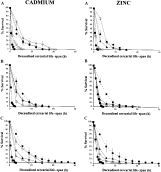
Fig. 1. The decaudised cercarial life-span of Diplostomum spathaceum at 25 °C exposed to cadmium and zinc in (A) distilled water, (B) soft water, (C) hard water. Error bars are standard errors. ([bull ]) Control; ([utrif ]) 0·1 μg/l; (○) 10 μg/l; (□) 100 μg/l; ([squf ]) 10000 μg/l.
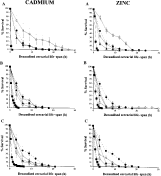
Fig. 2. The decaudised cercarial life-span of Diplostomum spathaceum at 20 °C exposed to cadmium and zinc in (A) distilled water, (B) soft water, (C) hard water. Error bars are standard errors. ([bull ]) Control; ([utrif ]) 0·1 μg/l; (○) 10 μg/l; (□) 100 μg/l; ([squf ]) 10000 μg/l.
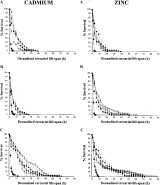
Fig. 3. The decaudised cercarial life-span of Diplostomum spathaceum at 12 °C exposed to cadmium and zinc in (A) distilled water, (B) soft water, (C) hard water. Error bars are standard errors. ([bull ]) Control; ([utrif ]) 0·1 μg/l; (○) 10 μg/l; (□) 100 μg/l; ([squf ]) 10000 μg/l.
 You have
Access
- 8
- Cited by