The effects of childhood trauma on memory have been much debated (e.g., Goodman, Quas, & Ogle, Reference Goodman, Quas and Ogle2010; Howe, Cicchetti, & Toth, Reference Howe, Cicchetti and Toth2006; Loftus, Garry, & Feldman, 1994; Pezdek & Banks, Reference Pezdek and Banks1996). Recently this debate has concentrated on false memory as indexed by the Deese–Roediger–McDermott (DRM) task (Gallo, Reference Gallo2010; Pezdek & Lam, Reference Pezdek and Lam2007). Traditionally, the DRM paradigm involves presenting participants with positive and neutral as well as some vaguely negative word lists, with each list semantically related to a “critical lure” (CL), that is, a word that was not actually presented. On subsequent memory tests, participants often falsely remember the CLs as having been presented amidst the associated words. For instance, in a well-known study by Roediger and McDermott (Reference Roediger and McDermott1995), participants were first presented with a word list including bed, rest, awake, tired, dream, wake, snooze, blanket, doze, and slumber. When later asked to remember the words, participants often spontaneously—and falsely—reported the CL, sleep, as having been presented in the original list. Confidence ratings on such tasks have further demonstrated that adults are surprisingly confident that the CLs were actually presented (Roediger & McDermott, Reference Roediger and McDermott1995). Backward associative strength (BAS), along with familiarity and meaningfulness, are particularly robust predictors of the DRM effect (Brainerd, Yang, Reyna, Howe, & Mills, Reference Brainerd, Yang, Howe, Reyna and Mills2008; Roediger, Watson, McDermott, & Gallo, Reference Roediger, Watson, McDermott and Gallo2001). Roediger and McDermott's 1995 article quickly became a classic, generating a deluge of research (e.g., Brainerd, Reyna, & Ceci, Reference Brainerd, Reyna and Ceci2008; Gallo, Reference Gallo2006, Reference Gallo2010; Ghetti, Qin, & Goodman, Reference Ghetti, Qin and Goodman2002; Howe, Cicchetti, Toth, & Cerrito, Reference Howe, Cicchetti, Toth and Cerrito2004).
These studies are important to a scientific understanding of false memories for semantically associated word lists. The findings support the possibility that the human mind reconstructs reality, sometimes producing false memories and beliefs, even when simply processing lists of words. Because robust false-memory effects (in both recall and recognition) can be reliably obtained under conditions of precise experimental control, researchers have relied on the DRM task to address important questions about false memories in adults and children (Brainerd, Reyna, et al., Reference Brainerd, Reyna and Ceci2008; Gallo, Reference Gallo2006; Howe, Reference Howe2007).
However, we know of no developmental studies that have examined DRM false memory for trauma-related lists in child sexual abuse (CSA) victims. Because of heated debates about memory for trauma-related information and about the applicability of DRM findings to legal cases, especially concerning victims of CSA, it was of interest to determine if such victims would show reduced or exaggerated DRM false memory effects. Thus, the purpose of the present research was to examine DRM false memory for trauma-related and nontrauma-related lists in adolescents and adults with and without documented CSA histories. Individual differences in psychopathology and attachment were also explored.
Developmental Differences in DRM Performance
DRM performance has been investigated developmentally in several studies (e.g., Brainerd, Reyna, & Forrest, Reference Brainerd, Reyna and Forrest2002; Ghetti et al., Reference Ghetti, Qin and Goodman2002; Howe, Reference Howe2007; for a review, see Brainerd, Reyna, et al., Reference Brainerd, Reyna and Ceci2008). Although contradictory findings exist regarding whether children are more or less susceptible than adults to false memories on the DRM task, the majority of published studies report that adults are more prone than children to DRM false memory effects. Children's false memories, like those of adults, involve activation of associative relations (Howe, Wimmer, & Blease, Reference Howe, Wimmer and Blease2009). The extent to which the developmental trend is explained by simple associative relations versus deficits in gist memory for children is currently under debate (Brainerd, Reyna, et al., Reference Brainerd, Reyna and Ceci2008; Howe, Wimmer, Gagnon, & Plumpton, Reference Howe, Wimmer, Gagnon and Plumpton2009). Although adolescents would be expected to have gist memory functioning largely equivalent to that of adults, which could equalize the occurrence of DRM false memory across age, adolescents may not have the same extent of associative strength as adults for trauma-related lists, resulting in greater false memory for adults than adolescents when presented with such lists. One possible exception could be that CSA experience may provide adolescent victims with relatively tight semantic relations for trauma-related material (Foa & Kozak, Reference Foa and Kozak1986). Alternatively, lack of sufficient memory monitoring has been identified as a key component of the DRM false memory effect (Gallo, Reference Gallo2006). If adolescents' memory monitoring skills (e.g., source monitoring abilities) are still developing, they may exhibit greater DRM false memory than adults (Ghetti et al., Reference Ghetti, Qin and Goodman2002).
In any case, there is currently a paucity of developmental DRM research that compares the performance of traumatized children and adults. In one particularly relevant study, Howe et al. (Reference Howe, Cicchetti, Toth and Cerrito2004) tested 5- to 12-year-old maltreated children and nonmaltreated controls on the DRM task using standard DRM lists. There were no significant differences in DRM false memory as a function of maltreatment status. The authors commented that future research should include trauma-related DRM lists to determine if maltreatment or developmental differences would then emerge. The present study addressed that suggestion.
DRM, Emotional Lists, and Development
Several recent studies have examined DRM performance when adults and/or children are exposed to emotional lists (e.g., Howe & Derbish, Reference Howe and Derbish2010). It has been hypothesized that DRM false memory might be less apparent for lists that activate negative than positive emotional themes because people pay particularly close attention to negative information and thus engage in more “item-specific” processing of negative lists; item-specific processing reduces DRM false memory effects (e.g., Palmer & Dodson, Reference Palmer and Dodson2009). According to this view, developmental differences in false memory might be attenuated or nonexistent for negative lists due to greater item-specific processing regardless of age. However, others have contended that negative valence activates “gist” or meaning processing to a greater extent than does positive or neutral information, making it more difficult to differentiate negative target and distractor words at test. In effect, the claim is that negative valence is an especially salient gist. To the extent that, with age, gist processing tendencies increase, it follows that adults should show a stronger false memory effect than children especially for negative lists compared to, for example, positive lists (Brainerd, Holliday, Reyna, Yang, & Toglia, Reference Brainerd, Holliday, Reyna, Yang and Toglia2010).
However, empirically, findings vary as to whether more false memory occurs for negative versus neutral or positive lists, whether age and emotional list type interact, or whether effects simply reflect changes in response bias. To wit, several studies find that false memory is more likely for negative than neutral and/or positive DRM lists. For example, Howe, Candel, Otgaar, Malone, and Wimmer (Reference Howe, Candel, Otgaar, Malone and Wimmer2010) examined the role of valence in children's (5- to 11-year-olds) and adults' true and false memories using the DRM paradigm. Children's and adults' true recall and recognition were best for neutral compared to negative items. Concerning false memory, although false recall was higher for neutral compared to negative items, false recognition was higher for negative compared to neutral items. Although the findings were thus rather mixed, they were partly consistent with the idea that negative emotional information is semantically denser than neutral information, resulting in greater false memory at least on recognition tests (see also Howe, Reference Howe2007).
Brainerd, Stein, Silveira, Rohenkohl, and Reyna (Reference Brainerd, Stein, Silveira, Rohenkohl and Reyna2008) and Brainerd et al. (Reference Brainerd, Holliday, Reyna, Yang and Toglia2010) also report greater likelihood of false memory for negative than nonnegative lists. They examined DRM false memory on recognition tasks in adults and children, respectively, who were presented with negative and positive lists (with arousal held constant). False memory was highest for negative lists, especially with age. The authors concluded, based largely on Brainerd and Reyna's (1998) fuzzy trace theory, that for lists of negative valence, false memory increases because the perceived meaning overlap between false and true items increases and that this problem is exacerbated for adults compared to children because adults are better at abstracting gist. In addition, for negative lists, it was inferred that participants were less able to use verbatim memories of true items to suppress errors.
In contrast to these findings, Palmer and Dodson (Reference Palmer and Dodson2009) reported less false memory for emotional than neutral DRM lists. Adult participants viewed negative, positive, and neutral lists of semantic associates matched on BAS. Neutral lists resulted in the highest false and true recall rates. The results suggest that emotional words decrease false memories by encouraging item-specific processing, which impairs the acquisition of relational information and/or the spread of activation to the critical lure (see also Pesta, Murphy, & Sanders, Reference Pesta, Murphy and Sanders2001). Moreover, emotional lures are likely more distinctive than nonemotional lures; adults and children are less likely to false alarm to distinctive items (e.g., Ghetti et al., Reference Ghetti, Qin and Goodman2002).
Finally, response bias is an important consideration in the DRM false memory effect generally, including for emotional lists. Budson et al. (Reference Budson, Todman, Chong, Adams, Kensinger and Krangel2006) examined DRM true and false memory for negative versus neutral lists in younger and older adults. (Of interest here are the older adults in their sample who did not suffer from dementia.) Critical lures for the negative lists included such words as rape, sick, hungry, hell, and danger; critical lures for the neutral lists included, for example, slow, sleep, fruit, foot, and sweet. A significant effect of emotion for true memory but not false memory emerged. For true recognition, younger and older adults were more likely to correctly recognize studied emotional versus nonemotional words. For false recognition, a significant effect of emotion failed to emerge. However, response bias best explained the findings; adults were more liberal in their responses to emotional compared with nonemotional items regardless of whether they were studied or nonstudied, and if nonstudied, regardless of whether they were related to the studied items or not. These results suggest that studying emotionally charged items may shift participants' response bias to a more liberal one for all emotional items at test—not just the ones related to the study lists. Although one possible explanation for this effect is that gist representations of emotional word lists are more robust and/or broader than those of nonemotional word lists, the data are alternatively compatible with Windmann and Krueger's (1998; see also Windmann & Kutas, Reference Windmann and Kutas2001) proposal that emotion biases recognition memory at an unconscious and automatic stage to facilitate processing of potentially threatening stimuli relative to neutral ones. This facilitation in processing may lead to enhanced fluency and a sense of familiarity, thereby increasing the likelihood of an incorrect “old” response.
Thus, results from DRM studies are mixed, with some researchers finding more false memory for negative lists and others finding more false memory for nonnegative lists. Moreover, there are hints in the literature that findings may vary for recall versus recognition when emotional DRM lists are employed (Howe & Malone, Reference Howe and Malone2010). Further research is clearly warranted to disentangle the effects of different emotions on true and false memory in the DRM paradigm.
DRM, CSA History, and Trauma-Related Psychopathology
Previous investigations of DRM performance in adults who report histories of CSA indicate that adults with CSA histories typically make more errors than nonabused controls, especially if the victims reach diagnosis for posttraumatic stress disorder (PTSD; Bremner, Shobe, & Kihlstrom, Reference Bremner, Shobe and Kihlstrom2000; Zoellner, Foa, Brigidi, & Przeworski, Reference Zoellner, Foa, Brigidi and Przeworski2000; see also Brennen, Dybdahl, & Kapidžić, Reference Brennen, Dybdahl and Kapidzic2007). Individuals with trauma histories may have memory monitoring problems that make them more susceptible to false memory errors. However, another body of research indicates that adults and teenagers with maltreatment histories, especially if they have symptoms of PTSD, actually have better memories for trauma-related information than do matched nonabused controls and better memory for trauma-related information than for nontrauma-related information (Alexander et al., Reference Alexander, Quas, Goodman, Ghetti, Edelstein and Redlich2005; McNally, Metzger, Lasko, Clancy, & Pitman, Reference McNally, Metzger, Lasko, Clancy and Pitman1998; Vrana, Roodman, & Beckham, Reference Vrana, Roodman and Beckham1995). Thus, although CSA victims might be prone to memory errors regarding positive and neutral information, their trauma history could potentially enhance memory (or promote resistance to false memory) for trauma-related stimuli. To test this hypothesis, we examined DRM false memory performance in individuals with known histories of CSA compared to a non-CSA control sample, using new trauma-related and nontrauma-related DRM lists.
PTSD is comorbid with several other types of emotional problems, such as dissociation and depression. Moreover, these emotional problems are associated with memory errors on a variety of tasks (e.g., Eisen, Goodman, Qin, Davis, & Clayton, Reference Eisen, Goodman, Qin, Davis and Crayton2007; Hertel, Reference Hertel2000). Dissociative symptoms have been specifically associated with DRM-task memory errors. For example, individuals with greater dissociative tendencies are more prone to DRM memory monitoring errors, such as intrusion errors for nonpresented, non-CL words (e.g., Clancy, Schacter, McNally, & Pitman, Reference Clancy, Schacter, McNally and Pitman2000; Wilkinson & Hyman, Reference Wilkinson and Hyman1998; Winograd, Peluso, & Glover, Reference Winograd, Peluso and Glover1998). However, other studies have found no such relations (e.g., Bremner et al., Reference Bremner, Shobe and Kihlstrom2000; Geraerts, Smeets, Jelicic, van Heerden, & Merckelbach, Reference Geraerts, Smeets, Jelicic, van Heerden and Merckelbach2005; Jelinek, Hottenrott, Randjbar, Peters, & Moritz, Reference Jelinek, Hottenrott, Randjbar, Peters and Moritz2009; for review, see Gallo, Reference Gallo2006). Given that indices of psychopathology are often intercorrelated, it is important to take general psychopathology into account when examining CSA and DRM false memory.
Adult Attachment and DRM False Memory
Possible associations between adult attachment styles and DRM false memory are also of interest. Adult attachment styles have been related to memories of early childhood and intimate partner events, suggesting that the encoding or retrieval of such memories may activate the attachment system (e.g., Simpson, Roles, & Winterheld, Reference Simpson, Rholes and Winterheld2010). For example, it is more difficult for adults with avoidant attachment tendencies to access negative emotional experiences from childhood, whereas adults with ambivalent attachment proclivities access these kinds of experiences easily (Edelstein, Reference Edelstein2006; Mikulincer & Orbach, Reference Mikulincer and Orbach1995). Consistent with attachment theory (Bowlby, Reference Bowlby1969), adults and adolescents with avoidant attachment styles, like their child counterparts, may attempt to suppress physiological and emotional reactions to avoid activation of the attachment system (e.g., Fraley, Garner, & Shaver, Reference Fraley, Garner and Shaver2000).
Qin, Ogle, and Goodman (Reference Qin, Ogle and Goodman2008) examined the relation between adult attachment and DRM performance. Adult attachment orientation predicted DRM false memory when the original Roediger and McDermott lists were employed (e.g., higher security predicted greater DRM false memory for gist information, whereas higher fearful avoidance scores predicted less false memory for gist information). Perhaps more secure individuals embody positive mood (Mikulincer & Shaver, Reference Mikulincer and Shaver2007), and a more positive mood contributes to gist processing (Storbeck & Clore, Reference Storbeck and Clore2005). This may result in greater spontaneous false memory as elicited on the DRM task. However, Qin et al. (Reference Qin, Ogle and Goodman2008) also found that avoidant attachment (both fearful and dismissing), at least in parents, was associated with indices related to greater DRM false memory in adult offspring. The latter findings are consistent with research indicating greater memory error in adults with insecure attachment (Chae, Ogle, & Goodman, Reference Chae, Ogle, Goodman, Quas and Fivush2009). Given that CSA lists may activate attachment issues, it was of interest to examine relations between attachment and DRM false memory for CSA lists as well as for other list types.
The Present Experiment
The main goal of the current research was to administer trauma-related and nontrauma-related DRM word lists as well as cognitive and mental health measures to adolescents and adults with and without documented CSA histories. First, it was predicted that, with BAS controlled, participants would exhibit less false memory for CSA lists than other list types. The basis of this prediction was that CSA lists are distinctive, because they are high in arousal and negative in valence, and distinctiveness reduces DRM false memory through item-specific processing (Ghetti et al., Reference Ghetti, Qin and Goodman2002; Kensinger, Reference Kensinger2009; Schacter, Israel, & Racine, Reference Schacter, Israel and Racine1999). However, it was also possible that CSA lists, like other negative lists, would produce stronger false memory effects due to tighter associative connections or stronger thematic or gist activation (Brainard et al., 2010; Brainard, Stein, et al., 2008; Howe, Wimmer, Blease, et al., Reference Howe, Wimmer and Blease2009; Howe, Wimmer, Gagnon, et al., Reference Howe, Wimmer, Gagnon and Plumpton2009; Howe et al., Reference Howe, Candel, Otgaar, Malone and Wimmer2010). Second, overall, adolescents might be expected to produce fewer false memories than adults on the DRM task (e.g., Howe, Wimmer, Gagnon, et al., Reference Howe, Wimmer, Gagnon and Plumpton2009). Although basic gist processing should be largely in place by adolescence, associative relations for CSA content might increase with age due to familiarity with the sexualized content. It was considered alternatively quite possible, however, that memory monitoring deficits in adolescents relative to adults would result in less DRM false memory with age. Third, overall, participants with a history of CSA were expected to perform better (i.e., display fewer false memories) than participants with no known CSA histories on trauma-related DRM lists but worse on nontrauma-related DRM lists (and thus worse overall). The basis for this prediction was that CSA victims might overfocus on trauma-related information, bolstering use of item-specific processing, whereas problems in memory monitoring might be more apparent on nontrauma-related lists. This would result in a significant CSA Status × List Type interaction. Moreover, such effects might be particularly apparent for individuals with symptoms of PTSD, that is, individuals with greater traumatization (McNally et al., Reference McNally, Metzger, Lasko, Clancy and Pitman1998) and with younger age. Fourth, greater PTSD symptomology and younger age were predicted to be associated with recall and/or recognition of additional words that were not presented and that were not the CL, reflecting deficits in memory monitoring. Fifth and finally, insecure attachment orientations were predicted to be linked to greater DRM memory error.
Method
Participants
Participants (N = 93, 81 female) included 49 14- to 17-year-olds (M = 15.12 years, SD = 0.95) and 44 18- to 37-year-olds (M = 21.43 years, SD = 4.77). The sample contained 58.1% Caucasians, 21.5% African Americans, 8.6% Hispanics, 2.2% Asian Americans, and 9.7% other. Twenty-five adolescents and 22 adults had histories of CSA.
Participants with CSA histories were primarily recruited from a child maltreatment diagnostic/treatment center and district attorneys offices, although a few (n = 3) were recruited from university Introductory Psychology classes. Control participants were recruited from many sources (e.g., newspaper ads, internet ads, medical clinics, Introductory Psychology classes; for the latter, n = 5). Controls were screened for CSA histories. In soliciting nonabused controls, CSA was defined (e.g., fondling of genitals, penetration), and adults and caregivers were asked not to participate or have their children participate, respectively, if CSA had been experienced by the children. Although it is often impossible to know for certain if a child has or has not experienced CSA, misclassification provides a conservative test of the main hypotheses. Caregivers and children were required to have lived together for 6 months or more, so that the caregivers could provide valid information (e.g., on the mental health measures). None of the participants were in nonkinship foster care or group homes.
The youngest children included were 14 years old due to the sexual nature of the stimuli and the standardization of psychopathology measures. All participants were English speaking and free of such disorders as mental retardation, schizophrenia, and autism.
Materials and measures
Demographic questionnaire
The demographic questionnaire included questions about age, gender, race/ethnicity, socioeconomic status, and education. Information was also collected about foster placements and therapy experiences (e.g., years in therapy).
Traumatic Events Screening Inventory for Children (TESI-C) and Trauma Assessment for Adults (TAA)
The TESI-C (Ford & Rogers, Reference Ford and Rogers1997) is an 18-item measure that assesses exposure to potentially traumatic experiences (e.g., severe accidents, child abuse). The TESI-C is standardized for use with children as young as 7 years, but it is also appropriate for adults reporting about childhood experiences. Caretakers completed the TESI-C in relation to their adolescent children in the present study. The TAA (Resnick, Best, Kilpatrick, Freedy, & Falsetti, Reference Resnick, Best, Kilpatrick, Freedy and Falsetti1993) is a similar measure for adults and includes questions about potential traumas in adulthood. The TAA was administered to adults in the present study. Both measures have high convergent validity values (i.e., 0.42 to 0.91). Test–retest reliability correlations for TESI-C range from 0.81 to 0.85. Test–retest reliability values for the TAA are also high (e.g., 0.80).
Wechsler Adult Intelligence Scale and Wechsler Intelligence Scale for Children: Memory span and vocabulary subtests
The memory span subtest of the Wechsler Adult Intelligence Scale (Wechsler, Reference Wechsler1997) and Wechsler Intelligence Scale for Children (Wechsler, Reference Wechsler1991) requires participants to repeat several series of numbers (of varying list length) both forward and backward. The vocabulary section involves defining words. Reliabilities for these IQ subscales are high, and the tests are well normed.
Dissociative Experiences Scale (DES) and the Adolescent Dissociative Experiences Scale (ADES)
The DES (Bernstein & Putnam, Reference Bernstein and Putnam1986) is a widely used self-report measure that includes 28 questions designed to assess normal to pathological dissociative experiences. The adolescent version, the ADES (Armstrong, Carlson, Putnam, Libero, & Smith, Reference Armstrong, Putnam, Carlson, Libero and Smith1997), measures psychological constructs such as dissociation, amnesia, and depersonalization using age-appropriate item content. Adolescents indicate how frequently they experience each of 30 items using an 11-point scale (0 = never, 10 = always). Test–retest reliabilities for both measures range from 0.77 to 0.93, and both have been used effectively to distinguish among abused, nonabused, and dissociative-disordered children and adults.
Trauma symptom checklists
The Trauma Symptom Checklist (TSC-33; Briere & Runtz, Reference Briere and Runtz1989) was administered to both adults and caretakers; it includes subscales for anxiety, depression, dissociation, sexual abuse trauma index, sexual problems, and sleep disturbance, as well as a total score. The TSC for Children (TSC-C; Briere, Reference Briere1996) is the downward extension and is appropriate for 8- to 15-year-olds. Subscales for this measure include anxiety, depression, posttraumatic stress, sexual concerns, dissociation, and anger. Both measures are frequently used in research and have good psychometric properties.
Posttraumatic Stress Disorder Scale (PDS) and the Child Posttraumatic Stress Disorder Symptom Scale (CPSS)
The PDS (Foa, Reference Foa1995) is a self-report questionnaire that provides a categorical PTSD diagnosis as well as a continuous measure of PTSD severity and number of PTSD criteria met. The measure has been validated with clinical interviews and other self-report trauma measures among individuals with a wide range of trauma experiences (e.g., victims of natural disasters, assaults, war). The CPSS (Foa, Johnson, Feeny, & Treadwell, Reference Foa, Johnson, Feeny and Treadwell2001) is the child version of this scale and is appropriate for children 8 to 18 years of age. Both the PDS and CPSS have high internal consistency, good test–retest reliability, and demonstrated validity.
Child Behavior Checklist (CBCL) and Young Adult Self-Report (YASR)
The CBCL (Achenbach, Reference Achenbach1991) is a parent-report questionnaire that assesses maladaptive emotional and behavioral problems in children ages 4 to 18. The YASR (Achenbach, Reference Achenbach1997) is the adult self-report version of this questionnaire and was administered to adult participants. Scores for internalizing (i.e., anxious, depressive, and overcontrolled) and externalizing (i.e., aggression, hyperactive, noncompliant, and undercontrolled) symptoms and behavior from the CBCL and the YASR were analyzed. The psychometric properties of the CBCL and YASR are exemplary for measures of this type.
State–Trait Anxiety Inventory (STAI) and STAI for Children (STAIC)
The STAI (Spielberger, Gorschuch, & Lushene, Reference Spielberger, Gorschuch and Lushene1970) is a self-report measure of anxiety for adults, and includes separate measures of state (S) and trait (T) anxiety. The STAIC (Spielberger, Edwards, Montuori, Lushene, & Platzek, Reference Spielberger, Edwards, Lushene, Montouri and Platzek1973) has been successfully used with adolescents. These measures have good psychometric properties. High scores indicate greater trait or state anxiety.
Experiences in Close Relationships Questionnaire (ECR)
The ECR (Brennan, Clark, & Shaver, Reference Brennan, Clark, Shaver, Simpson and Rholes1998) is a standardized 36-item self-report measure of attachment. Participants respond to items using 7-point Likert (agree–disagree) scales that yield measures of attachment-related anxiety and avoidance. The ECR is appropriate for use with adults and adolescents. The reliability and construct validity of these scales have been demonstrated extensively (Mikulincer & Shaver, Reference Mikulincer and Shaver2007; Sibley, Fischer, & Liu, Reference Sibley, Fischer and Liu2005).
Children's Trauma Questionnaire (CTQ)
The CTQ (Bernstein, Ahluvalia, Pogge, & Handelsman, Reference Bernstein, Ahluvalia, Pogge and Handelsman1994) is a standardized screening measure that identifies maltreatment histories. Adults respond to 28 items using 5-point Likert scales. In the present study, caretakers of adolescent participants completed a modified version of the CTQ in which questions referred to the adolescents' childhood experiences. The CTQ yields four main factors: physical neglect, emotional neglect, emotional abuse, sexual abuse, and a minimization score. The scale's reliability and validity have been demonstrated in adult populations.
DRM lists
Forty DRM lists were included (10 each for CSA, positive, negative, and neutral lists). Examples of CLs per category are: sex, rape, fondle (CSA); rich, loving, happy (positive); ugly, kill, crash (negative), and foot, girl, window (neutral). Eleven of the original DRM lists (Roediger et al., Reference Roediger, Watson, McDermott and Gallo2001) were used in the neutral (n = 10) and negative (n = 1) categories, reducing the number of lists to be newly developed. For the lists we developed, 166 18- to 31-year-old undergraduates (105 females, M = 19.68 years, SD = 1.75) provided free associations to potential items. The 10 best associates for each CL were selected based on the sum of the BAS ratings and frequency, age of acquisition, concreteness, and familiarity ratings (MRC Psycholinguistic Database, 1987) to ensure the words were age appropriate and highly similar across these dimensions for lists within and across list type. Traditionally, mean BAS has been considered the strongest predictor of a word list eliciting false memory of a CL (Roediger et al., Reference Roediger, Watson, McDermott and Gallo2001; but see Brainerd, Reyna, et al., 2008). The CSA lists had significantly lower BAS ratings (M = 0.06, SD = 0.04) than the other lists (p < .05), whereas the BAS ratings for the positive and negative lists (M = 0.14, SD = 0.06 and M = 0.13, SD = 0.05, respectively) were quite comparable to those of neutral DRM lists developed by Roediger and McDermott (Reference Roediger and McDermott1995), although BAS varies considerably even among the standard neutral lists (e.g., from 0.06 to 0.20).
We also obtained ratings of valence and arousal for each list. Specifically, 30 undergraduates (15 females) rated the lists in terms of valence (1 = very negative; 5 = very positive), and a separate group of 30 undergraduates (15 females) rated the lists in terms of arousal (1 = not at all arousing, exciting, stimulating, and interesting; 5 = very arousing, exciting, stimulating, and interesting), consistent with Bradley and Lang's (Reference Bradley and Lang1994) rating system. All raters indicated English as their first language. For each type of rating, participants were presented with one of two random orders of the lists. Separate one-way within-subject analyses of variance (ANOVAs) were conducted on the ratings to determine list type differences. For valence, the main effect of list type was significant, F (3, 87) = 484.37, p < .001, ηp2 = 0.94. The valence means were as follows: neutral, M = 3.27, SD = 0.23; positive, M = 4.48, SD = 0.28; negative, M = 1.72, SD = 0.32; CSA, M = 2.50, SD = 0.30. Pairwise comparisons revealed that all means significantly differed, ps < .001. As would be expected, the negative and CSA lists were rated as particularly negative, and the positive lists were rated as particularly positive. The CSA lists were likely not viewed as the most negative because some of the words, such as kiss, have positive connotations in many contexts. For arousal, the main effect of list type was also significant, F (3, 87) = 125.65, p < .001, ηp2 = 0.81. The arousal means were as follows: neutral, M = 1.74, SD = 0.41; positive, M = 2.93, SD = 0.67; negative, M = 3.54, SD = 0.62; CSA, M = 3.78, SD = 0.57. Pairwise comparisons indicated that all means significantly differed, ps < .01. Thus, the CSA lists were rated as the most arousing, and the neutral lists were rated as the least arousing. Despite statistical significance, the absolute mean difference in arousal ratings between the CSA and negative lists was small.
To form the stimuli, associates for each CL were listed in order from strongest to weakest associate. The 40 word lists were ordered using a random numbers table such that each word list category (e.g., negative lists) did not appear more than twice in a row (for details of list development, see Block, Reference Block2008).
Recognition test
The first and fifth associate from each list was selected to be included in the recognition task. A distractor (a nonpresented word not including the CL) was selected for each associate and CL. The criteria for choosing distractors were as follows: first, distractors were matched with their paired target words in terms of frequency, concreteness, familiarity, and age of acquisition. Second, distractors were selected and matched by category (i.e., CSA, positive, negative, or neutral) according to valence when possible.
Associates, CLs, and distractors (N = 240) were randomized using a random numbers table, with several restrictions. First, associates and CLs could not be within 10 places of each other, and words from each category (e.g., CSA, positive) could not repeat more than twice consecutively. Second, each distractor from a given list had to be five places or more away from other distractors for that list.
Procedure
The study was approved by the university's Institutional Review Board. For participants who met study criteria based on a telephone interview (e.g., age, absence of developmental disability), a more thorough screening occurred at the experimental session. Participants (adolescents and adults) were tested individually. Informed consent was obtained. Parents approved all lists before they were presented to adolescents. Participants first completed a standard demographic questionnaire followed by the ECR and IQ subscale tests. For the DRM task, participants heard the 40 DRM word lists. Two random orders of the DRM word lists were created for purposes of presentation, with the stipulation that no more than 2 lists in any one category could occur sequentially. Because of its length, the DRM task was divided into two segments (each involving presentation of 20 lists, 5 from each of the 4 list categories, and free recall and recognition for those 20 lists). Participants performed free recall for 12 lists that differed across the two versions and for 8 lists that were the same across the two versions. The two segments were separated by a short break. Researchers who administered these tests were blind to CSA status.
Within each segment, participants engaged in free recall after approximately half of the word lists (9 to 11 of the 20 lists); within each of the two random orders of presentation, random assignment was used to determine which lists the participants free recalled. In this way, participants did not know whether, after each presentation of a list, they would be asked to freely recall it or simply to wait during the delay until the next list was presented.
Before the recognition test, participants completed the STAI or STAIC (in Segment 1, participants completed the state scales; in Segment 2, participants completed the trait scales). Per segment, two recognition test orders were counterbalanced across participants within each age group. Participants indicated “Yes” or “No” as to whether they believed the word had been presented.
After the DRM task was completed, the following questionnaires were administered to participants in two random orders: BDI/CDI, DES/ADES, CTQ, PDS/CPSS, YASR (for adult participants), and the TSC-40/TSC-C. The TAA (adult participants only) and the Negative Experiences Questionnaire were then administered. Caretakers completed the demographic questionnaire, CBCL, CDC, CTQ, TESI-C, and Negative Experiences Questionnaire in that order. All participants were then debriefed.Footnote 1–Footnote 3
Results
Preliminary analyses
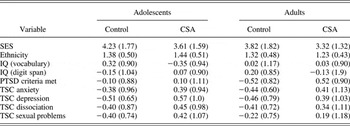
For the analyses, when measures differed across ages (e.g., for depression, PTSD), mean z scores were created. Matching success was determined through a series of 2 (Age) × 2 (CSA Status) ANOVAs (Table 1). There were no significant main effects or interactions for socioeconomic status, ethnicity (majority vs. minority), digit span (z scored), or vocabulary (z scored), Fs (1, 85–89) ≤ 2.76. However, CSA (M = 0.30, SD = 1.03) and control (M = −0.30, SD = 0.87) participants differed significantly in the number of PTSD criteria met (z scores), F (1, 89) = 10.15, p < .01, η2s = 0.10, and the Age × CSA interaction was significant as well, F (1, 89) = 4.21, p < .05, η2s = 0.05. Simple effects analyses revealed that CSA adolescents (M = 0.10, SD = 1.11) and control adolescents (M = −0.10, SD = 0.89) did not significantly differ, whereas as CSA adults (M = 0.52, SD = 0.90) met a significantly greater number of PTSD criteria than did control adults (M = −0.52, SD = 0.82), F (1, 42) = 14.04, p < .001. There were no other significant simple effects.
Means (standard deviations) for matching variables

Note: CSA, child sexual abuse; SES, socioeconomic status (annual income): 1 = under $15,000, 2 = $15,000–$25,000, 3 = $25,000–$40,000, 4 = $40,000–$60,000, 5 = $60,000–$90,000, 6 = over $90,000; ethnicity: 1 = Caucasian, 0 = other; IQ (vocabulary) is the vocabulary subscore from the Wechsler Intelligence Test (z scored), and IQ (digit span) is the digit span subscore from the Wechsler Intelligence Test (z scored); PTSD, posttraumatic stress disorder; TSC, Trauma Symptom Checklist.
On the TSC (z scores), CSA participants (M = 0.31, SD = 1.11) reported more sexual problems than did controls (M = −0.32, SD = 0.74), F (1, 85) = 9.16, p < .01, η2s = 0.10; greater dissociation (CSA, M = 0.40, SD = 1.03; control, M = −0.41, SD = 0.79), F (1, 89) = 17.19, p < .001, η2s = 0.16; greater depression (CSA, M = 0.49, SD = 1.00; control, M = −0.49, SD = 0.71), F (1, 89) = 26.95, p < .001, η2s = 0.24; and more anxiety (CSA, M = 0.40, SD = 1.02; control, M = −0.41, SD = 0.80), F (1, 86) = 17.79, p < .001, η2s = 0.17. Analyses of CBCL/YASR scores revealed significant main effects for CSA status both for internalizing (CSA, M = 0.56, SD = 9.97; control, M = 47.23, SD = 10.15) and externalizing behaviors (CSA, M = 56.38, SD = 9.73; control, M = 49.07, SD = 9.96), Fs (1, 84) ≥ 11.30, ps < 0.001, η2s = 0.12. In addition, for internalizing problems, there was a significant age main effect (adolescents, M = 54.48, SD = 9.47; adults, M = 48.71, SD = 11.72), F (1, 84) = 6.10, p < .05, η2s = 0.07. Moreover, a one-way ANOVA confirmed that there were no significant differences in age for the CSA and control participants, F (1, 92) = 0.03.
Because a relatively large number of psychopathology measures was administered, the number of variables was reduced through factor analysis using principal axis factoring with oblique rotation (OBLIMIN with Kaiser normalization). PTSD was not included in the factor analysis because of its special status in relation to the hypotheses and PTSD's past importance in predicting memory in maltreated samples. The factor analysis yielded two factors with eigenvalues greater or equal to one. Using 0.40 as a cutoff for factor loadings, the first factor included sexual concerns, dissociation, depression, and anxiety as measured by the TSC/TSC-C; dissociation as measured by the DES/ADES; and trait anxiety as measured by the STAI/STAIC. It yielded an α value of 0.88. For each participant, a mean z score for this Psychopathology Scale was created (M = −0.01, SD = 0.81). CBCL/YASR internalizing and externalizing scores loaded on the second factor, but the factor did not yield adequate reliability; thus, the CBCL/YASR scores were considered separately. State anxiety as measured by the STAI/STAIC did not load adequately on either factor and was treated as a separate variable.
Main analyses
Hypotheses were tested through a series of ANOVAs and regression analyses. For free recall and recognition, a series of 2 (Age: 14- to 18-year-old adolescents vs. adults) × 2 (CSA Status: CSA vs. control) × 2 (PTSD: low vs. high criteria met) × 4 (List Type: CSA, negative, positive, neutral) mixed ANOVAs was conducted with list type as the only within-subject factor. For recognition, a series of comparable ANOVAs was conducted on false alarms to CLs, d′, and β scores. High versus low PTSD criteria was determined by a mean split resulting in 48 participants in the high PTSD and 45 participants in the low PTSD groups. The smallest cells in the ANOVAs contained at least 5 participants. For each dependent measure regarding DRM memory (e.g., free recall of the CL, d′ score), BAS adjusted scores were created by subtracting the mean BAS value for each list type from the participants' mean score for each list type. All analyses reported in the main text were based on such scores.
Free recall
Free recall CL proportion scores (false recall of CLs) were created by dividing CLs that were falsely recalled for a given list type by the total number of word lists presented for a given list type. The main effect of list type was significant, F (3, 83) = 6.35, p < .001, ηp2 = 0.19. The CSA and negative list CLs (Ms = 0.15 and 0.16, SDs = 0.20 and 0.21) were significantly more likely to be recalled than positive list CLs (M = 0.06, SD = 0.19), ps < .001. Recall of neutral list CLs (M = 0.11, SD = 0.23) did not significantly differ compared to that for the other list types. Thus, in free recall, there was more false memory for CSA and negative lists than for positive lists.
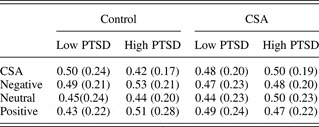
There was also a significant Age × CSA Status × PTSD interaction, Fs (1, 85) = 4.54, ps < .05, ηp2s = 0.05. Means are presented in Table 2. Simple effect analyses revealed a significant CSA Status × PTSD interaction for adolescents, Fs (1, 45) = 4.78, p < .05, ηp2 = 0.10. Simple effects analyses showed that, for participants with a higher number of PTSD criteria met, adolescents with CSA histories falsely recalled the critical lure more often than did control adolescents with high PTSD symptoms, F (1, 24) = 3.76, p < .05 (one-tailed test). There were no other significant simple effects.
Means (standard deviations) for free recall of critical lures

Note: CSA, child sexual abuse; PTSD, posttraumatic stress disorder criteria met.
Proportion scores were calculated for number of correct associates recalled divided by the number of correct associates potentially recallable for each list type. The main effect of list type was significant, F (3, 83) = 54.52, p < .001, ηp2 = 0.66: Recall for all lists types was significantly different from one another with significantly higher recall for CSA list associates compared to all other list types, and significantly lower recall for positive associates compared to all other list types (CSA, M = 0.50, SD = 0.14; negative, M = 0.43, SD = 0.12; neutral, M = 0.46, SD = 0.14; positive, M = 0.35, SD = 0.12; ps < .01). A significant main effect of age emerged, F (1, 85) = 8.84, p < .01, ηp2 = 0.09: adolescents (M = 0.41, SD = 0.08) recalled fewer associates than did adults (M = 0.47, SD = 0.13). The number of additional words recalled was also analyzed. There were no significant effects (CSA list, M = 2.10, SD = 2.45; negative list, M = 2.42, SD = 2.77; neutral list, M = 2.71, SD = 2.79; positive list, M = 2.52, SD = 2.59). Thus, in free recall, CSA associates were the most likely to be recalled, a traditional developmental difference in memory for associates emerged, and no significant differences were found for recall of additional words.
Recognition
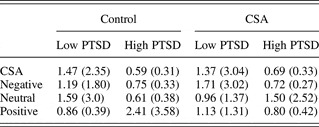
For the ANOVA for proportion of false alarms to CLs on the recognition test, list type was not significant, F (3, 83) = 1.57 (CSA, M = 0.48, SD = 0.20; negative, M = 0.49, SD = 0.21; neutral, M = 0.46, SD = 0.23; positive, M = 0.47, SD = 0.23). A significant CSA Status × PTSD × Age interaction also emerged, F (1, 85) = 4.84, p < .05, ηp2 = 0.05 (Table 3). Simple effect analyses revealed that the PTSD × Age interaction was significant for CSA participants, F (1, 43) = 6.57, p < .05, ηp2 = 0.13. CSA adolescents with high PTSD scores false alarmed more often to the critical lure than CSA adolescents with low PTSD scores, F (1, 23) = 4.71, p < .05, ηp2 = 0.17. No other simple effect analyses were significant. Although the List Type × CSA Status × PTSD interaction was significant, F (3, 83) = 3.41, p < .05, ηp2 = 0.11 (Table 4), all simple effect analyses were nonsignificant.
Means (standard deviations) for false alarms to the critical lures on the Recognition Test

Note: CSA, child sexual abuse; PTSD, posttraumatic stress disorder.
Means (standard deviations) for false alarms to critical lures on the Recognition Test

Note: CSA, child sexual abuse; PTSD, posttraumatic stress disorder.
Next, d′ and β scores were calculated according to Wixted and Lee (n.d.). For calculating d′, scores of zero and 1 were adjusted by 1/(2N) as suggested by Wixted (http://psy2.ucsd.edu/~kang/sdt/sdt.htm). To create the d′ scores, hits to studied list items and false alarms to CLs per list were compared. Preliminary analyses confirmed that overall mean d′ scores differed significantly from zero, F (1, 91) = 59.44, p < .001, with zero indicating chance performance, and that this was also true for the CSA lists, F (1, 91) = 48.39, p < .001; negative lists, F (1, 91) = 19.21, p < .001; neutral lists, F (1, 91) = 29.52, p < .001; and positive lists, F (1, 91) = 15.06, p < .001.
When d′ scores for each participant were entered into the ANOVA, there was a significant main effect of list type, F (3, 83) = 15.19, p < .001, ηp2 = 0.15 (CSA, M = 0.66, SD = 0.84; negative, M = 0.18, SD = 0.68; neutral, M = 0.35, SD = 0.86; positive, M = 0.15, SD = 0.71). CSA lists enjoyed a higher d′ than did the other list types, ps < .05. Neutral lists had significantly higher d′ scores than did negative and positive lists, ps < .05. Negative and positive list d′ scores did not significantly differ (pairwise comparisons). A significant List Type × CSA Status × PTSD interaction also emerged, F (3, 83) = 4.08, p < .01, ηp2 = 0.05 (Table 5). Simple effects analyses revealed a significant List Type × CSA Status interaction for participants with high PTSD scores, F (3, 41) = 2.80, p = .05, ηp2 = 0.17, but not for those with low PTSD scores, F (3, 44) = 0.44. The main effect of list type among control participants with high PTSD scores was significant, F (3, 14) = 7.55, p < 0.05, ηp2 = 0.62. The pattern was very similar across groups, however, with CSA having the highest d′ scores. Per group, there was a significant main effect of list type for CSA participants, F (3, 43) = 4.28, p < .01, ηp2 = 0.23, control participants, F (3, 42) = 10.36, p < .001, ηp2 = 0.43, participants with low PTSD scores, F (3, 44) = 5.12, p < .01, ηp2 = 0.26, and participants with high PTSD scores, F (3, 41) = 8.81, p < .001, ηp2 = 0.39.
Means (standard deviations) for d′ scores

Note: CSA, child sexual abuse; PTSD, posttraumatic stress disorder. Mean values that do not share subscript letters per column are significantly different.
Beta scores were calculated as a ratio, such that scores above 1.0 indicate a tendency to say “no” (a conservative response criterion), scores below 1 indicate a tendency to say “yes” (a liberal response criterion), and scores of 1.0 indicate no bias on the recognition test. There was a significant CSA Status × PTSD × List Type interaction, F (3, 83) = 3.12, p < .05, ηp2 = 0.10 (Table 6). Simple effect analyses revealed a significant List Type × PTSD interaction for control participants, F (3, 132) = 3.72, p < .05, as well as a significant List Type × CSA Status interaction for participants with high PTSD scores, F (3, 129) = 5.15, p < .05. Of interest, response bias was particularly low on CSA lists for participants with high PTSD scores. However, further analyses of these interactions yielded no significant effects.
Means (standard deviations) for β false alarms

Note: CSA, child sexual abuse; PTSD, posttraumatic stress disorder.
Correlations and regressions
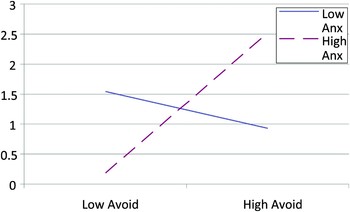
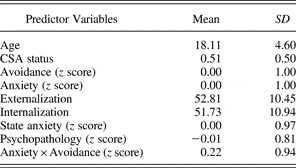
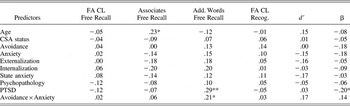
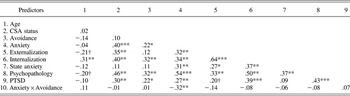
Means for individual difference variables and main dependent measures are presented in Table 7. Correlations of individual-difference variables with the main dependent measures for CSA lists are presented in Table 8. Correlations among individual-difference variables are presented in Table 9. Hierarchical regression analyses were conducted to examine the unique contribution of individual difference variables in predicting the various DRM dependent measures for CSA lists. The following variables were entered: Step 1, age (as a continuous variable), CSA status, CBCL externalizing T scores, attachment anxiety dimension, attachment avoidance dimension, and PTSD criteria met; Step 2, attachment Anxiety × Avoidance interaction. Multicollinearity prevented inclusion of other mental health variables (e.g., dissociation, psychopathology, CBCL internalizing T scores). There was only one significant model, which was for additional words recalled from the CSA lists. The overall model for the first step was not significant, F (6, 81) = 1.76, R 2 = .12, but the overall model for the second step reached significance, F (7, 80) = 2.53, p < .05, ΔR 2 = .07. PTSD was a significant predictor (β = 0.15, p < .05) as was the interaction of attachment anxiety score and attachment avoidance score (β = 0.28, p < .05). Compared to individuals with fewer PTSD criteria met, individuals with a greater number of PTSD criteria met recalled more additional words on the CSA lists. The significant interaction is shown in Figure 1. As can be seen, higher scores on both the avoidance and anxiety dimensions of attachment (comparable to fearful avoidants in adult attachment research) were associated with a higher level of free recall of additional words. Thus, individuals with greater PTSD symptomology and those with stronger tendencies toward fearful avoidance exhibited less proficient memory monitoring. The findings were unchanged when interactions among the attachment variables and CSA status were added to the regressions.
The Avoidance × Anxiety interaction for free recall of additional words for child sexual abuse lists. Avoid, avoidance dimension; Anx, anxiety dimension.

Means and standard deviations for predictor variables in regression

Note: CSA, child sexual abuse.
Correlations among predictors and Deese–Roediger–McDermott dependent variables for CSA word lists (N = 88–93)

Note: CSA, child sexual abuse; FA, false alarms; CL, critical lure. Add., additional; Recog., recognition test; PTSD, number of criteria met for posttraumatic stress disorder.
*p < .05. **p < .01.
Intercorrelations among predictors (N = 88–93)

Note: CSA, child sexual abuse; PTSD, posttraumatic stress disorder.
†p < .06. *p < .05. **p ≤ .01. ***p < .001.
It was also of interest to determine if arousal or valence were better predictors of DRM performance than BAS. As mentioned earlier, we had obtained ratings of valence and arousal for the lists from groups of undergraduate students. The correlations of the valence and arousal ratings, including with BAS, were nonsignificant: valence and arousal, r = −.28; BAS and valence, r = −.08; and BAS and arousal, r = .09. In separate hierarchical list-level analyses, the DRM memory measures (e.g., free recall of the CL, recall of additional words, d′ scores) were each regressed on BAS (M = 0.17, SD = 0.13), valence (M = 3.06, SD = 1.25), and arousal (M = 2.96, SD = 0.94) ratings on Step 1, with the Valence × Arousal interaction entered on Step 2. Only the model for free recall of the CL was significant: Step 1, F (3, 29) = 3.47, p < .05, R 2 = .29; Step 2, F (4, 29) = 3.13, p < .05, ΔR 2 = .05. BAS was the only significant predictor (β = 0.46, p < .05).
Discussion
Our main goal was to examine DRM false memory for trauma-related and nontrauma-related DRM lists in adolescents and adults with and without CSA histories. In this regard, many studies based on the DRM paradigm are limited because the original DRM word lists create false memories primarily for neutral words (e.g., flag). The few studies that have examined DRM false memory for emotional lists have generally not focused on CSA victims (but see Howe, Toth, & Cicchetti, in press). Although the DRM paradigm has been used to examine false memory in individuals with maltreatment histories (e.g., Howe et al., Reference Howe, Cicchetti, Toth and Cerrito2004), it is important to investigate memory for trauma-related information in such populations.
Several recent studies investigated DRM false memory for valenced word lists (e.g., Brainerd, Stein, et al., Reference Brainerd, Yang, Howe, Reyna and Mills2008; Brainerd et al., Reference Brainerd, Holliday, Reyna, Yang and Toglia2010; Howe, Reference Howe2007; Howe et al., Reference Howe, Candel, Otgaar, Malone and Wimmer2010). Howe (Reference Howe2007) proposed that, compared to neutral word lists, negative word lists might induce more item-specific processing and consequently less false memory, or alternatively, that the rich semantic interrelations of negative words might lead to increased false memory. Brainerd, Stein, et al. (Reference Brainerd, Stein, Silveira, Rohenkohl and Reyna2008) and Brainerd et al. (Reference Brainerd, Holliday, Reyna, Yang and Toglia2010) contended that negative compared to neutral and positive DRM lists are more likely to activate gist processing, leading to more false memory for the former than the latter. These theoretical predictions were examined in the present study by exploring DRM false memory for trauma-related, negative, positive, and neutral lists. Given that significant differences in BAS ratings per list type were uncovered, it was important to control for BAS in free recall and recognition performance.
We found that participants falsely recalled the CL significantly more often for CSA and negative lists than for positive lists. Participants also recalled significantly more CSA list associates than associates of all other list types. These findings suggest greater thematic processing of CSA lists compared to positive and neutral lists on our free recall task. The findings are consistent with those of Howe (Reference Howe2007), Brainerd, Stein, et al. (Reference Brainerd, Stein, Silveira, Rohenkohl and Reyna2008), and Brainerd et al. (Reference Brainerd, Holliday, Reyna, Yang and Toglia2010) in suggesting that negative emotional DRM lists have denser semantic relations or result in greater gist processing compared to positive lists, but our results add that CSA lists were also particularly prone to false memory in free recall both for our CSA and non-CSA groups. (Unfortunately, many of the CSA words we included have not been normed in such a way as to permit calculation of semantic density. Moreover, our CSA lists were rated as higher in arousal than the other lists, which may have also affected the pattern of results.)
For recognition, signal detection analyses presented a strikingly different picture. CSA lists enjoyed the highest d′ scores, indicating they produced the least false memory compared to other list types. Previous research indicates that positive affect can increase gist processing (Gasper & Clore, Reference Gasper and Clore2002; Storbeck & Clore, Reference Storbeck and Clore2005), which in the case of the DRM task, may lead to lower d′ scores. It is also possible that the nature of the CSA words (e.g., rape, molest, hump), being rather startling and/or taboo to the average person and trauma-related for the CSA victims, led to greater item-specific processing than did the other lists, including the negative lists. The words were likely surprising for our participants to hear in a scientific study, perhaps leading to greater item-specific processing and thus better memory on the recognition test.
We are not the first to report divergent findings for DRM-task recall and recognition of emotional lists. Howe (Reference Howe2007) also obtained opposite results for recall and recognition involving emotional DRM lists. However, in his study, children were least likely to report true and false negative information in free recall. In contrast, A′ scores in the Howe (Reference Howe2007) study indicated that it was more difficult to discriminate negative than neutral information in recognition. It is possible that the CSA lists we constructed resulted in greater relational processing for free recall, but also motivated more item-specific processing for recognition, especially to the extent that DRM false memory errors are generated at test. Inverse findings for recall and recognition are not uncommon in memory studies generally, with free recall often based more on semantic knowledge, and recognition based more on item-specific processing (e.g., see Goodman, Reference Goodman1980).
Response bias is also of interest in DRM false memory research, perhaps especially when traumatized individuals exposed to trauma-related information are included. According to Windmann and Krueger (Reference Windmann and Krueger1998), trauma victims should have a tendency to respond “old” to trauma-related information (a lax response criterion). These researchers argue that everyone is evolutionarily primed to give special attention to trauma-related information via amygdala activation because such responses promote survival, but that traumatized individuals overinterpret many nontrauma-related stimuli as trauma related. In contrast to this proposal, in the present study, no significant differences in response bias emerged. It is possible, however, that although the stimuli we employed did not elicit a lax response bias in CSA victims, other stimuli might do so. Moreover, although the effect was not significant, participants with higher PTSD scores had particularly lax response biases for CSA lists.
It was also hypothesized that participants with CSA histories, particularly if they showed symptoms of PTSD, would perform better (i.e., display fewer false memories) than non-CSA controls on trauma-related DRM lists, but worse on nontrauma-related DRM lists. This expectation was based on previous research indicating that trauma victims have a memory bias that supports accurate memory for trauma-related information but creates a memory deficit for positive and neutral information (e.g., McNally et al., Reference McNally, Metzger, Lasko, Clancy and Pitman1998; Vrana et al., Reference Vrana, Roodman and Beckham1995). However, the predicted pattern was not found. Significant differences may have failed to emerge because the trauma-related lists were related to sex, and were therefore attention grabbing, distinctive, and relevant to all of the participants. Another possibility is that CSA per se or greater traumatization do not necessarily lead to the development of fear networks (Foa & Kozak, Reference Foa and Kozak1986) or trauma-related expertise (Castel, McCabe, Roediger, & Heitman, Reference Castel, McCabe, Roediger and Heitman2007; Chi, Reference Chi and Siegler1978) sufficient to affect DRM false memory for the trauma-related word lists we constructed. Note that maltreatment victims' basic memory processes, including on DRM tests, often do not significantly differ from those of nonmaltreated controls (Howe et al., Reference Howe, Cicchetti and Toth2006).
Regarding developmental differences, adolescents would be expected to evince less false memory than adults to the extent that they might be less familiar with some of the words we presented. Alternatively, adolescents were anticipated to exhibit more false memories than adults on our DRM task given possible deficits in memory monitoring. However, the main effect of age was not significant in this regard. Overall, adolescents' false memory performance did not differ significantly from that of adults. The lack of a straightforward developmental difference may be understandable given the study did not include young children. That is, failure to find significant age differences may be related to the age range of participants included in this research. From the perspective of fuzzy trace theory, adolescents should already have the ability to abstract gist and might therefore be just as likely to report false memory as adults (Brainerd & Reyna, Reference Brainerd and Reyna1998). Moreover, adolescents' associative networks for the words used in the present research were likely to be relatively similar to those of adults. Although, arguably, adolescents on average may know less about sexuality than adults do, the adolescents' associative structure for the words on our lists may have been sufficiently similar to those of adults to eliminate age effects overall. Memory monitoring skills are also likely to be fairly well developed by adolescence, at least absent vulnerabilities that might delay such development. However, a developmental difference that was apparent in our data concerned memory for associates: adolescents recalled fewer associates than did adults. Thus, a developmental difference in true memory for presented words emerged, consistent with typical developmental trends of better memory performance with age.
In relation to emotional lists specifically, Howe (Reference Howe2007) predicted that children would form false memories for emotional material earlier than for neutral material. This prediction was based on the notion that the necessary associative structures required to form false memories are available earlier for emotional information (Pollack & Kistler, Reference Pollak and Kisteler2002). It is likely that by age 14 associative structures necessary for false memory for both emotional and neutral information are already formed. Developmental differences as a function of list type might have emerged in the present research if younger children had been tested, but the sexually explicit nature of the stimuli prevented inclusion of young children.
We were particularly interested in possible interactive effects of age, CSA status, and PTSD on DRM false memory, especially given past findings of greater error on DRM tasks for adults with PTSD who report histories of CSA (Bremner et al., Reference Bremner, Shobe and Kihlstrom2000; Zoellner et al., Reference Zoellner, Foa, Brigidi and Przeworski2000). A significant interaction emerged among age, CSA status, and PTSD in our study, such that for youth who exhibited more PTSD symptoms, those with CSA histories evinced more false memory in free recall than same-age controls. CSA-group adolescents with high PTSD symptomology also false alarmed on the recognition test to critical lures more than did CSA-group adolescents with fewer PTSD symptoms. These findings are consistent with previous research suggesting that PTSD subsequent to childhood trauma is associated with memory monitoring deficits (Golier et al., Reference Golier, Yehuda, Lupien, Harvey, Grossman and Elkin2002; McNally et al., Reference McNally, Metzger, Lasko, Clancy and Pitman1998). In the current study, PTSD was also related to less adequate memory monitoring regarding free recall of additional, nonpresented (non-CL) words for CSA lists. However, specifically for false memory of CLs, the deficits associated with CSA and PTSD were restricted to adolescents, who generally may have deficits in memory monitoring skills compared to adults. One might expect gist processing and associative strength to be, if anything, higher for adults than adolescents (leading to more false memory with age), but that memory monitoring skills might still be developing, which could lead to greater false memory for adolescents than adults, particularly if childhood trauma is associated with delays in development. Especially if CSA history, PTSD, and younger age each are associated with potential deficits in memory monitoring, their combination may lead to greater error on the DRM task—a developmental delay that was no longer apparent for our adult participants with CSA histories and PTSD symptoms. This interpretation seems to offer the most parsimonious explanation of our findings.
Finally, it was of interest to examine attachment style, which has been empirically linked to DRM false memory. Fearful avoidance was associated with less effective memory monitoring, regardless of CSA history. Specifically, individuals who exhibited stronger tendencies toward fearful avoidance recalled more nonpresented non-CL words for CSA lists. This finding is consistent with previous research in which individuals with more secure attachments demonstrated superior cognitive functioning (e.g., Fraley et al., Reference Fraley, Garner and Shaver2000; Ogle, Reference Ogle2010). It is also consistent with the findings that attachment avoidance is associated with greater memory error for stressful information in particular (Chae et al., Reference Chae, Ogle, Goodman, Quas and Fivush2009)—in the present case, words associated with CSA.
Future Directions: Methodological Concerns and New Translational Research
We have a number of suggestions for future research on CSA and the DRM task. First, regarding methodology, future research should include a larger sample size than was encompassed in our study; the relatively small number of participants we tested may have resulted in an inability to detect certain predicted interactions. It will be important to determine if our findings replicate with a larger sample. Furthermore, researchers should consider presenting the word lists by category rather than in a random order, the latter of which might disrupt trauma-related processing. Moreover, future DRM studies with CSA lists should include the more typical DRM procedure for counterbalancing of targets and distractors on the recognition test. This was not possible in the present experiment because of the need for a sufficient number of word lists to be presented in each category. Valence and arousal ratings could vary for CSA and non-CSA groups, and thus future researchers should obtain ratings from CSA groups as well as non-CSA groups.
Second, continued translational research on trauma and memory generally, including DRM performance specifically, is needed. Considerable debate centers on whether DRM false memory findings are generalizable to legal cases or justify application of specific memory development theories to the legal context (Brainerd, Reyna, & Zember, in press; Freyd & Gleaves, Reference Freyd and Gleaves1996; Gallo, Reference Gallo2010; Pezdek & Lam, Reference Pezdek and Lam2007). In our view, new translational research should determine quite directly if DRM findings for CSA victims are applicable to forensic situations. One next step would be to test CSA victims on DRM lists and on false memory paradigms that are arguably more ecologically valid regarding forensic cases, at least, more ecologically valid than are DRM lists. Loftus and Pickrell's (Reference Loftus and Pickrell1995) “lost in the mall” paradigm, which taps implanted false memory for childhood autobiographical events, would be one such false memory task of considerable interest. Qin et al. (Reference Qin, Ogle and Goodman2008) examined DRM performance and false implanted memory in college students and laypersons, finding a significant relation between the two tasks. Specifically, intrusion of unrelated words in free recall on the DRM task and a more liberal response criterion in DRM recognition were associated with false childhood autobiographical memory, suggesting a common underlying mechanism of lax memory monitoring. This was found even though the nonemotional DRM lists were used, whereas false childhood memories dealt with more emotional material. Being younger and being a child of a fearful avoidant parent also predicted implanted false memory scores, and participants' own attachment styles (greater avoidance) predicted their performance on the DRM task (regarding a more liberal response bias).
Conducting a similar study to that of Qin et al. (Reference Qin, Ogle and Goodman2008) with CSA victims would be on point. Bremner et al. (Reference Bremner, Shobe and Kihlstrom2000) previously found that women with CSA histories and PTSD diagnoses (vs. women with CSA histories but without PTSD diagnoses) showed increased DRM memory error regarding recognition memory for additional (new) words. However, their study did not include an ecologically valid false memory measure to test the generalizability of their findings to forensically relevant false memory tasks. Of note, spontaneous false memory for critical lures, as tapped by the DRM task, is not what has generally predicted implanted false memory performance in laboratory tasks. Rather, to date, memory monitoring regarding additional, nonpresented words seems to be the more robust predictor (but see Clancy et al., Reference Clancy, Schacter, McNally and Pitman2000; Clancy, McNally, Schacter, Lensenweger, & Pitman, Reference Clancy, McNally, Schacter, Lezenweger and Pitman2002; for a review, see Gallo, Reference Gallo2010).
In addition to examining the relations between DRM performance and implanted false memory, it is also of interest to investigate relations between DRM performance and accurate autobiographical memory in CSA victims. In a preliminary examination of this issue, Ogle et al. (Reference Ogle, Block, Harris, Augusti, Pineda and Urquiza2007) explored whether DRM performance on emotional lists predicted autobiographical memory accuracy in adolescents with and without child maltreatment histories. No significant relations were found for DRM false memory, but free recall of DRM list associates significantly predicted more accurate autobiographical memory. It is possible that both tasks tapped, to a certain extent, a general characteristic of greater versus poorer memory accuracy.
However, even when significant relations exist, they are often not sufficiently strong to provide much guidance to the legal system. Typically, the variance explained is relatively meager. For example, in the Ogle et al. (Reference Ogle, Block, Harris, Augusti, Pineda and Urquiza2007) study just mentioned, a correlation of 0.40 was found between DRM accurate recall of associates and accurate autobiographical memory. This means that the proportion of variance accounted for was only 0.16, leaving 0.84 unexplained. If legal professionals or jurors were to base decisions on such correlations, they would inaccurately credit (or discredit) witnesses in many if not most cases. For example, many CSA victims would likely be inaccurately judged as not credible witnesses when their memory was quite correct. In some other studies, the differences in performance between groups were quite weak and significant only with one-tailed statistical tests (justified by predictions). Overall, in our view, it is premature to assume that results such as ours would generalize to false memory for autobiographical events in CSA victims and premature to use such findings as a basis for decisions or expert testimony in actual legal cases. Moreover, the pattern of findings differs depending on the type of test (free recall vs. recognition). Such differences need to be understood before implications of the findings can be firmly drawn. We agree, however, with Brainerd et al.'s (in press) suggestion that DRM findings (as well as findings from a subset of misleading questioning studies) indicate that children are not always more prone to false memories than adults—a conclusion with legal relevance—and that the DRM paradigm and variants thereof might eventually prove useful for identifying instructions and mental processes that help children guard against false memory formation during forensic interviews (but see Gallo, Reference Gallo2010).
Finally, in conclusion, research on memory for trauma-related information in maltreated children and adults is timely given heated theoretical debates about the effects of trauma on memory development. Moreover, translational research in this area is crucial to inform practice. The present study provides valuable information to inform debate and application.