


Introduction
There is substantial evidence that, despite its effectiveness, cognitive behavioural therapy (CBT) is used less often than would be expected (e.g. Tobin et al., Reference Tobin, Banker, Weisberg and Bowers2007). Even when they plan to use CBT, clinicians either avoid or under-utilize key techniques (Becker et al., Reference Becker, Zayfert and Anderson2004; Finley et al., Reference Finley, Garcia, Ketchum, McGeary, McGeary, Stirman and Peterson2015; Stobie et al., Reference Stobie, Taylor, Quigley, Ewing and Salkovskis2007). Several emotional and behavioural factors have been shown to account for this deviation from empirically supported treatments (EST), including clinician lack of knowledge, clinician anxiety, and poor use of manuals (e.g. Becker et al., Reference Becker, Zayfert and Anderson2004; Deacon et al., Reference Deacon, Farrell, Kemp, Dixon, Sy, Zhang and McGrath2013). However, it will also be important to understand how clinicians’ attitudes to CBT interact with those emotional and behavioural factors.
There is clear evidence that many clinicians hold negative attitudes towards specific elements of EST, and that such attitudes are associated with poorer use of those elements. For example, negative attitudes to exposure therapy (Olatunji et al., Reference Olantunji, Deacon and Abramowitz2009) and negative attitudes towards therapy manuals in general (Addis et al., Reference Addis, Wade and Hatgis1999) are each associated with a lower likelihood of using the necessary tools. There are well-validated measures of these attitudes to specific elements of EST, such as the Therapist Beliefs about Exposure Scale (TBES; Deacon et al., Reference Deacon, Farrell, Kemp, Dixon, Sy, Zhang and McGrath2013) and Addis and Krasnow's (Reference Addis and Krasnow2000) measure of clinicians’ negative and positive attitudes to manuals. These measures confirm that negative attitudes are associated with clinicians’ failure to use elements of EST that are commonly employed in CBT (Addis and Krasnow, Reference Addis and Krasnow2000; Deacon et al., Reference Deacon, Farrell, Kemp, Dixon, Sy, Zhang and McGrath2013). However, such measures are limited by their focus on specific CBT tools.
Given humans’ internal drive for consistency of attitudes (Festinger, Reference Festinger1957), it is possible that such beliefs about specific techniques reflect a more general pattern of attitudes towards CBT, and that it might be important and potentially simpler to measure negative attitudes to CBT as a whole, rather than individual elements or techniques. Given the under-utilization of CBT outlined above, a more general measure of attitudes towards CBT has the potential to improve the quality of services offered by clinicians. It could allow the training of clinicians to be tailored to address any inappropriately negative beliefs about CBT. Similarly, it could guide supervision, providing the supervisor with an awareness of where a supervisee needs support.
Any such measure of attitudes to CBT needs to be understood in the context of other factors that influence such clinical practice. Previous research has indicated the role of clinician anxiety and low self-esteem as factors that are associated with the under-delivery of techniques such as exposure (Feeny et al., Reference Feeny, Hembree and Zoellner2003; Koch et al., Reference Koch, Gloster, Waller, Richard and Lauterbach2007; Levita et al., Reference Levita, Salas Duhne, Girling and Waller2016; Simpson-Southward Reference Simpson-Southward2015). It is important to determine the levels to which attitudes and emotional factors might each explain the under-utilization of CBT techniques. Obviously, CBT itself has developed as the result of a process of critical analysis of what does and what does not work in therapies. That process of critical analysis is an important one for the continued development of therapies, including CBT. Therefore, any measure of such attitudes should be seen as helping to advance the use of CBT through understanding why individual clinicians do or do not use it appropriately, rather than accepting CBT protocols as being prescriptive lists of what should be done. That approach allows for the possibility that clinician attitudes should be considered as indicating ways in which the evidence might be developed, in order to determine whether recommended practice should be amended in the future.
This study reports the development and validation of a measure to assess negative attitudes towards CBT – the Negative Attitudes towards CBT Scale (NACS). Its utility was tested among clinicians treating anxiety disorders. Psychometric properties (factor structure; internal consistency) were tested. A two-factor structure was hypothesized – impact on the patient experience, and impact on the therapist experience. The clinical validity of the measure was tested against several self-reported variables – first, relative to clinicians’ characteristics (e.g. age, gender, anxiety, self-esteem); second, relative to clinicians’ reported use of specific treatment techniques (e.g. behavioural techniques). Given previous literature (e.g. Levita et al., Reference Levita, Salas Duhne, Girling and Waller2016), it was hypothesized that clinicians reporting higher anxiety and lower self-esteem would be less likely to use behavioural techniques. However, it is unclear if mood would affect the use of other methods. It was hypothesized that clinicians’ higher levels of anxiety and poorer self-esteem would be associated with negative attitudes. However, it was also hypothesized that the effects of attitudes towards CBT on the implementation of behavioural techniques would be above and beyond those of anxiety.
Method
Ethics
This study received ethical approval from the University of Sheffield, Department of Psychology Research Ethics Committee. The authors of this paper abided by the Ethical Principles of Psychologists and Code of Conduct set out by the American Psychological Association.
Design
This was a cross-sectional study of mental healthcare providers working with anxious clients. The study was conducted using a survey and self-report inventories. Data were analysed using correlational and comparative methods.
Participants
The sample consisted of 204 clinicians who reported that they were working with patients with anxiety disorders. A total of 1965 clinicians were approached directly to participate in this study, via two online databases and four workshops. Five hundred and thirty-seven clinicians from the British Association for Behavioural and Cognitive Psychotherapies and 1286 clinicians from the British Psychological Society were approached by email to take part in the online version. Of these, 280 clinicians started the study. Following removal of those who failed to complete the measure, 123 were included for analysis.
A further 142 clinicians were approached via teaching workshops across the UK. Of those clinicians, 82 started a paper version of the measure, and 77 were eligible for analysis. Four additional responses were collected via snowball sampling methods. All four completed the survey online and were included in analysis. Thus a total of 366 responses (from both online and workshops) were collected. Of these, 204 were useable.
The mean age of the 204 participants was 45.92 years (SD = 10.9), and 68.1% were female. Sixty-four (31.4%) reported being clinical psychologists, 28 (13.7%) were counselling psychologists, two (1%) were psychiatrists, 30 (14.7%) were psychiatric nurses, four (2%) were clinical social workers, nine (4.4%) were licensed counsellors, 63 (30.9%) belonged to some other mental healthcare profession, and four (2%) did not report a core profession. Regarding primary theoretical orientation, 161 clinicians (78.9%) reported using CBT, six (2.9%) reported using psychodynamic/psychoanalytic approaches, two (1%) reported using a humanistic approach, five (2.5%) reported using an existential approach, and 30 (14.7%) reported using other approaches. The group's mean time qualified was 11.94 years (SD = 10.19). Clinicians worked on average 30.53 hours (SD = 12.44) per week. Regarding clinical time spent with clients, clinicians reported an average of 12.47 hours (SD = 6.78) per week. Clinicians reported a mean of 13 sessions (SD = 10.91; range = 1–100) with each anxious client before treatment was complete. Regarding supervision, clinicians reported receiving 2.61 hours (SD = 1.92) of supervision per month, and reported supervising others for an average of 5.03 hours (SD = 9.80) per month. Regarding session length, the most common response (n = 195) was that sessions were between 45 and 90 minutes long. Nine clinicians reported session lengths under 45 minutes, and none reported sessions of over 90 minutes.
Measures and procedure
Each participant completed self-report measures of demographic details, attitudes to CBT, therapy methods used, anxiety, and self-esteem. Responses were included for analysis if participants completed the Negative Attitudes towards CBT Scale (NACS). Considering the unusable responses, most were excluded because the participant did not complete any part of the survey after the demographics section. A few participants skipped the therapy methods questionnaire (TMQ; see below) but still completed the NACS. Any answers given as a range were averaged (e.g. ‘2–3’ was treated as ‘2.5’). If a written response was unreadable, the item was treated as a missing value. No substitution for missing data points was carried out.
Demographics
All participants were asked to report demographic information. This included details of age, gender, ethnicity, core profession, theoretical orientation, professional accreditation, hours worked per week, hours spent with clients per week, hours spent in supervision (given or receiving), and average session length (i.e. ‘under 45 minutes’, ‘45–90 minutes’, or ‘90 minutes or longer’).
Negative Attitudes towards CBT Scale
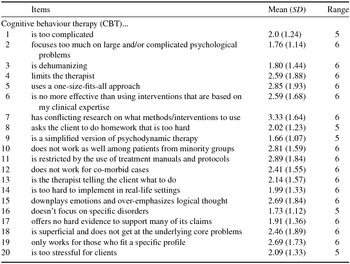
The NACS was developed for this study. The participants completed 20 items that reflect attitudes to CBT (see items in Table 1). Those items were identified from the literature and from clinician and patient online discussion forums (e.g. patient.info, socialanxietysupport.com, anxietyuk.org.uk, etc.). Items were generated based on the theme of concerns and complaints, to avoid excessive overlap between the items. Therefore, some of the items originated from complaints that did not coincide with other complaints or misbeliefs regarding CBT (e.g. ‘CBT does not focus on specific disorders’). Each item is rated on a 1–7 scale, with higher scores reflecting more negative attitudes to CBT (1 = strongly disagree; 4 = neither agree or disagree; 7 = strongly agree). The NACS's preliminary psychometric properties are addressed in this paper.
Means (SD) and ranges of scores on the Negative Attitudes towards CBT Scale (n = 204)

Therapy Methods Questionnaire
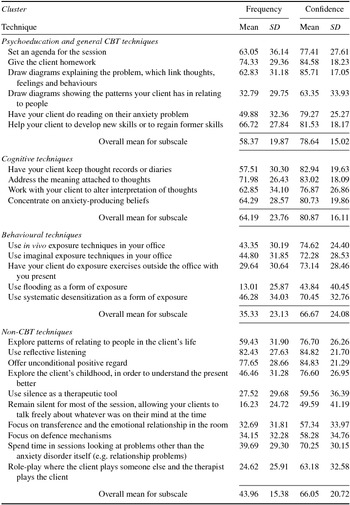
This scale was designed for a series of studies on clinicians’ behaviours in the treatment of anxiety disorders. The TMQ addressed 26 therapy techniques, which clinicians rated (on a 0–100% scale) for how often they used them in clinical work with anxiety disorders (0% = never used, 50% = used in half of such sessions, 100% = used in every session). They were then asked to report (on a 0–100% scale) on how confident they were in using that skill with this group of patients. The 26 items were selected from the current literature and from treatment manuals (Abramowitz et al., Reference Abramowitz, Taylor, McKay and Steketee2012; Clark, Reference Clark2007; Clark and Beck, Reference Clark and Beck2010; Craske and Barlow, Reference Craske, Barlow and Barlow2008; Franklin and Foa, Reference Franklin, Foa and Barlow2008; Kearney, Reference Kearney2005; Martin, Reference Martin2013; Resick et al., Reference Resick, Monson, Rizvi and Barlow2008; Stobie et al., Reference Stobie, Taylor, Quigley, Ewing and Salkovskis2007; Turk et al., Reference Turk, Heimberg, Magee and Barlow2008; Whittal and Robichaud, Reference Whittal, Robichaud and Steketee2012). Table 2 shows how the techniques were grouped into scales (e.g. behavioural techniques, cognitive techniques, etc.), and the means and standard deviations for the frequency of use and confidence using those techniques. Each scale had an internal consistency that was in the acceptable range (Cronbach's alpha = .71 to .87) with the exception of the ‘confidence in using psychoeducation and general CBT techniques’ scale (alpha = .59), suggesting that any results related to this scale should be interpreted with caution.
Mean levels of use of and confidence in using each therapy technique (grouped by subscale)

This measure was included to assess how often techniques were used and the confidence clinicians had using those techniques, and to test the predictive validity of the NACS. The scope of this paper was not to validate this measure, and the study had too few participants to run a valid factor analysis on a measure with this many items. Nor would it be appropriate to validate two measures at once, as the validity of each would be dependent on the other. This measure was not used to measure competency with individual techniques. In addition to this, the TMQ is retrospective in nature. Therefore, the clinicians’ ratings might not reflect what actually occurs in therapy.
Intolerance of Uncertainty Scale – Short form
The Intolerance of Uncertainty Scale (IUS-12) (Carleton et al., Reference Carleton, Norton and Asmundson2007) is a 12-item self-report measure of intolerance of uncertainty – a core cognitive component of anxiety. It uses five-point Likert scales. It has strong psychometric properties (Carleton et al. Reference Carleton, Norton and Asmundson2007; Khawaja and Lai, Reference Khawaja and Lai2010), and higher scores on the two subscales indicate greater levels of prospective and inhibitory anxiety. Prospective anxiety is uncertainty about future outcomes, while inhibitory anxiety reflects inaction when faced with uncertainty.
Rosenberg Self-Esteem Scale
The Rosenberg Self-Esteem Scale (RSES; Rosenberg, Reference Rosenberg1965) is a 10-item self-report measure of global self-worth. It uses four-point Likert scales, and higher scores indicate greater self-esteem. The RSES is widely used and has strong psychometric properties (Schmitt and Allik, Reference Schmitt and Allik2005; Sinclair et al., Reference Sinclair, Blais, Gansler, Sandberg, Bistis and LoCicero2010).
Data analysis
SPSS version 22 was used for all analyses. Cronbach's alpha was used to determine the internal consistency of the a priori subsets of items that were extracted from the TMQ (see above). Exploratory factor analysis was used to determine the factor structure of the NACS. Principal Axis Factoring was used as the extraction method. No Rotation, Direct Oblimin and Varimax rotations were also carried out to determine whether more meaningful factors emerged.Footnote 1 Items were accepted as part of a scale if they had an item loading of ≥.5 and if the item loading was at least .2 above the loading on any other scale (Comrey and Lee, Reference Comrey and Lee1992; Tabaschnick and Fidell, Reference Tabaschnick and Fidell2007). In order to determine whether any rotation improved factor structure, that rotation would have to result in a more meaningful loading of items onto the resulting factors. However, as none of the above rotations changed which items loaded onto the scales (see below), the original unrotated solution was used. The resulting scales were tested for internal consistency, using Cronbach's alpha.
Pearson's correlations (r) and t-tests were used to determine whether clinicians’ dimensional and categorical characteristics (e.g. age, gender) were associated with NACS scores. Pearson's r correlations (one-tailed, where applicable) were used to determine the association between clinicians’ internal factors (e.g. self-esteem and anxiety) and the NACS. Multiple linear regressions were used to determine which internal states (anxiety, attitudes, self-esteem) were better predictors of technique use and confidence. Finally, multiple linear regressions were used to determine the associations of internal states and theoretical orientation with technique use and confidence.
Results
Factor structure of the Negative Attitudes towards CBT Scale
Extraction
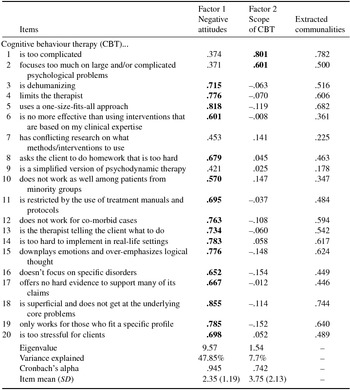
Table 3 shows results of the factor analysis of the NACS items among the 204 clinicians who completed the measure. Principal Axis Factor Analysis is reported, although it should be noted there was no substantive difference in eigenvalues between extraction methods. Based on recommendations from the literature (eigenvalue > 1 and scree analysis; Kaiser, Reference Kaiser1960; Tabaschnick et al., Reference Tabaschnick and Fidell2007; Yong and Pearce, Reference Yong and Pearce2013), two factors emerged. The Kaiser–Meyer–Olkin measure of sampling adequacy was conducted and yielded a result of .934, indicating that the sampling was more than adequate for this testing. Additionally, a Bartlett's test of sphericity was conducted (χ2 (190) = 2376.06, p < .001), indicating that this sample was adequate for factor analysis.
Principal Axis Factoring Analysis of the Negative Attitudes towards CBT Scale (n = 204), with item mean score and internal consistency (Cronbach's alpha) of resulting scale

Bold values indicate successful loading (>.5) onto the factor.
Rotation
In addition to no rotation, varimax and direct oblimin rotations were used to determine the best possible factorial structure. Neither rotation improved upon the factor structure found with no rotation, in terms of factors and eigenvalues. Nor did any rotation change the loadings of individual items onto the factors. Given that there is a single valid unitary factor (see below), remaining rotations did not improve upon the factor structure.
Completed scale
While two factors emerged, the second factor consisted of only two items, and was therefore judged to be too small to be meaningful (Tabaschnick et al., Reference Tabaschnick and Fidell2007; Yong and Pearce, Reference Yong and Pearce2013). Consequently, those two items were omitted. In addition, two other items were omitted due to not fitting either factor adequately (item loadings < .5). The remaining 16 items were used to form a single scale, which had a high level of internal consistency (Cronbach's alpha = .95). The NACS score was the mean score on those 16 items (range = 1–7), where higher scores indicated more negative attitudes to CBT. The final measure and scoring system are given in the Appendix.
For the purpose of establishing whether the scale would still be valid if items were missed by respondents, multiple reliability tests were run with items missing. These analyses established that any one or two items can be omitted without impacting the internal consistency of the resulting scales (Cronbach's alpha > .90 in all cases). Therefore, the scoring system (see Appendix) allows up to two items to be omitted by the respondent, if the item mean is adjusted accordingly (total score/number of items completed).
Association of Negative Attitudes towards CBT with clinician characteristics
Demographics
Pearson's correlations and t-tests were used to determine whether negative attitudes to CBT (NACS scores) were associated with demographic characteristics (age, years qualified, hours worked, clinical contact hours, average number of sessions with a client, and hours spent giving or receiving supervision). Whatever the therapy offered by the individual clinician, negative attitudes to CBT were associated with the clinician spending fewer hours per week with clients (r[204] = –.218, p = .002) and with the clinician spending more sessions with each client before treatment was completed (r[191] = .153, p = .035). There were no significant correlations with any other demographic characteristic (p > .15 in all cases). Nor was there any association of therapist gender with negative attitudes to CBT (t-test; t = 1.06, p = .786).
Theoretical orientation
The therapists were divided into those who described their work as CBT-based (n = 161) and all others (n = 43). The CBT therapists had a mean NACS score of 1.97 (SD = .87), while the non-CBT therapists had a mean score of 3.90 (SD = 1.1). An independent-samples t-test showed that the non-CBT clinicians held more negative attitudes towards CBT than the CBT clinicians (t[202] = 11.6, p < .001).
Clinicians’ internal states
Pearson's correlations were used to determine whether negative attitudes to CBT (NACS scores) were associated with the clinicians’ levels of anxiety (IUS scores; prospective anxiety mean = 12.83, SD = 4.11; inhibitory anxiety mean = 8.18, SD = 3.01) and self-esteem (RSES scores; mean = 32.55, SD = 4.90). Prospective anxiety was positively associated with NACS scores (r = .128, n = 202, one-tailed p = .034). However, neither inhibitory anxiety nor RSES scores correlated significantly with NACS scores (IUS inhibitory anxiety: r = .045, p = .52; RSES: r = –.081, p = .25).
Associations between internal states and techniques
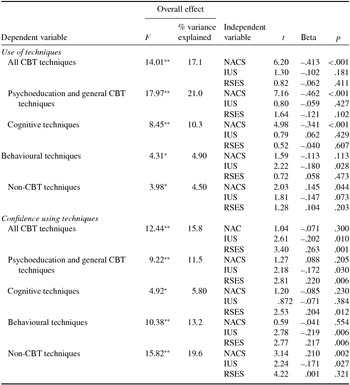
Multiple linear regressions were used to determine whether attitudes (NACS scores) or other internal traits (i.e. anxiety and self-esteem) predicted technique use. Table 4 shows the associations between clinician internal traits and each cluster of technique types.
Associations between clinicians’ internal states (anxiety, attitudes, self-esteem) and techniques (use and confidence)

IUS, total scores on the Intolerance to Uncertainty scale; NACs, scores on the Negative Attitudes towards CBT scale; RSES, scores on the Rosenberg Self-Esteem Scale; *p < .01 (two-tailed); **p < .001 (two-tailed).
Considering the clinicians’ reported use of the different types of technique, there were two patterns of association. First, more negative attitudes towards CBT (i.e. higher scores on the NACS) predicted less frequent use of psychoeducation and cognitive techniques. In contrast, higher levels of clinician anxiety predicted lower use of behavioural techniques.
The pattern of findings relating to confidence in using CBT methods was different. Table 3 shows that both high self-esteem and low anxiety were associated with clinicians having greater confidence in using all techniques (CBT or non-CBT). Negative attitudes towards CBT (NACS score) were predictive only of greater confidence in using non-CBT techniques.
Associations between clinician characteristics and techniques used
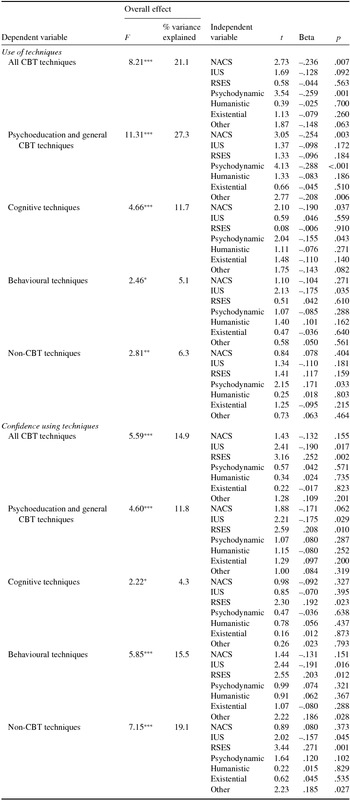
In order to determine whether clinicians’ theoretical orientation added to these effects of emotions and attitudes, further multiple linear regressions were conducted, as shown in Table 5 (‘CBT’ as an orientation was omitted, to reduce the risk of multicollinearity). The existing effects of NACS scores and mood were essentially unchanged. However, it is noteworthy that clinicians who described their orientation as ‘psychodynamic’ were less likely to use a range of CBT techniques, though there was no impact of this orientation on confidence in use of the different techniques.
Associations between clinicians’ characteristics (attitudes, emotions and theoretical orientation) and techniques (use and confidence)

IUS, total scores on the Intolerance to Uncertainty scale; NACs, scores on the Negative Attitudes towards CBT scale; RSES, scores on the Rosenberg Self-Esteem Scale; *p < .05 (two-tailed); **p < .01 (two-tailed); ***p < .001 (two-tailed).
Discussion
This study has developed a measure to assess clinicians’ attitudes towards CBT – the Negative Attitudes towards CBT Scale (NACS). Clinicians treating anxiety disorders were asked to complete the NACS and to report on the therapy techniques that they used. The NACS had a single factor, with strong internal consistency. Validation included testing associations with clinicians’ characteristics and with their reported use of CBT and non-CBT techniques. Clinicians who reported CBT as their primary theoretical orientation reported less negative attitudes towards CBT than clinicians who reported using other approaches, while clinicians’ prospective anxiety was associated with negative attitudes to CBT. More time spent with patients overall and fewer sessions offered to patients were also correlated with less negative attitudes to CBT.
Attitudes to CBT and emotional factors appeared to play different roles in clinicians’ implementation of CBT and non-CBT techniques. Negative attitudes to CBT were associated with less frequent use of general/psychoeducational and cognitive methods, while anxiety (intolerance of uncertainty) was associated with lower use of behavioural methods. In contrast, confidence in using CBT methods was more consistently associated with low anxiety and positive self-esteem. Confidence using non-CBT methods was associated with negative attitudes to CBT, low anxiety, and positive self-esteem.
Overall, these findings support and extend the conclusion (e.g. Deacon et al., Reference Deacon, Farrell, Kemp, Dixon, Sy, Zhang and McGrath2013) that negative attitudes to CBT affect how clinicians deliver this empirically supported therapy, taking it away from protocol. This relationship could be bidirectional in nature. For example, negative attitudes could cause a decreased use of CBT techniques, while an increased use of techniques could cause a decrease in negative attitudes. However, such attitudes need to be considered alongside other factors. A particular concern is the association of a higher level of clinician anxiety with a reduced use of behavioural CBT methods for the treatment of anxiety disorders, as has been shown elsewhere for anxiety and other disorders (e.g. Meyer et al., Reference Meyer, Farrell, Kemp, Blakey and Deacon2014; Turner et al., Reference Turner, Tatham, Lant, Mountford and Waller2014; Waller et al., Reference Waller, Stringer and Meyer2012). Given research into the role anxiety plays in the use of exposure techniques (e.g. Feeny et al., Reference Feeny, Hembree and Zoellner2003; Koch et al., Reference Koch, Gloster, Waller, Richard and Lauterbach2007; Levita et al., Reference Levita, Salas Duhne, Girling and Waller2016), it is not surprising that clinician anxiety (and not negative attitudes) is strongly associated with the less frequent delivery of behavioural techniques. Therefore, the utility of the NACS as a means of understanding the general attitudes that underpin clinicians’ delivery of therapy is likely to be enhanced by combining it with measures of their emotional status (e.g. anxiety). The clinical utility of NACS might also be enhanced by combining it with measures of more technique-specific attitudes (e.g. Addis and Krasnow, Reference Addis and Krasnow2000; Deacon et al., Reference Deacon, Farrell, Kemp, Dixon, Sy, Zhang and McGrath2013).
Clinically, the NACS has the potential to be used in a number of ways to enhance the delivery of CBT. In supervision and training in the delivery of CBT, the NACS and IUS in combination give clinicians and teachers a means of identifying likely issues with adherence to different elements of empirically supported treatment. Therefore, this tool could be used to enhance the learning and delivery of CBT. Such attitudes and emotional factors could be addressed through appropriate adjustments to training programmes, including didactic methods (e.g. Deacon et al., Reference Deacon, Farrell, Kemp, Dixon, Sy, Zhang and McGrath2013) or more complex packages of educational and experiential methods (e.g. Farrell et al., Reference Farrell, Deacon, Dixon and Lickel2013). This tool can also be used as pre/post measure for CBT educators and supervisors to identify the impact of their teaching and supervision. Similarly, a focus on such attitudinal and emotional measures might help clinicians to terminate therapy at an appropriate point rather than continuing seeing patients for longer (e.g. Turner et al., Reference Turner, Tatham, Lant, Mountford and Waller2014). Finally, the NACS and IUS might be used as a means of determining whether particular individuals are a good or bad fit for CBT-specific training programmes.
Despite the potential of NACS for clinical use, as outlined above, it is important to consider the developing nature of CBT and the need to accept the case for change when it is justified. The NACS reflects best practice as it is currently understood in CBT for anxiety disorders, but should not be seen as prescriptive. Many clinical developments result from the work of clinicians who evaluate their own outcomes and demonstrate new approaches that can improve those outcomes more widely. Thus negative attitudes to existing practice cannot be seen as wrong in themselves. However, if they result in therapist drift without such justification, then they are potentially problematic. Supervision and training should encourage clinicians to support their negative attitudes with empirical evidence, rather than simply accepting or rejecting those attitudes.
These findings need to be replicated and extended. It will be important to determine whether the NACS is useful when applied to understanding how clinicians work with other disorders (e.g. depression, psychosis), and to determine whether the utility of NACS generalizes across professional groups (and potentially even theoretical orientations). Such studies would be augmented by the use of real-world longitudinal methods and experimental vignette designs, each of which would give clearer evidence of the validity of the conclusion that clinicians’ attitudes and emotional states have a causal impact on their use of CBT techniques. It is also important to consider how well the NACS predicts the actual use of techniques before using it in training or supervision. As this study only details what clinicians reported using, it will be necessary to validate the NACS in tandem with observation of actual practice. Given the relatively few non-CBT therapists involved in this study, future studies would need to address the generalizability of these findings by ensuring the inclusion of other orientations not represented here. The impact of training of clinicians might be assessed using the NACS before and after teaching sessions, to determine whether changes in attitudes to CBT result in more effective delivery of evidence-based CBT methods.
Acknowledgements
We have no further acknowledgments.
Financial support: None.
Conflicts of interest: The authors have no conflict of interest with respect to this publication.
Appendix A Negative Attitudes towards CBT Scale
We are interested in your views on CBT. Please rate how accurate you find the following statements that clinicians have made elsewhere:
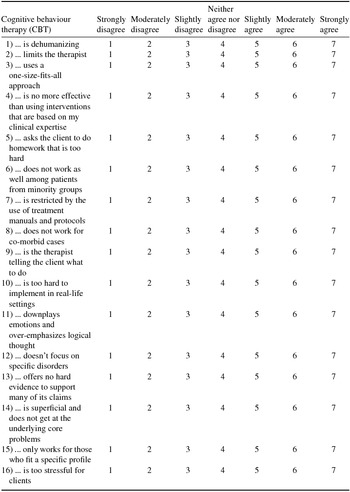
NACS scoring key:
-
• All items are positively scored 1–7.
-
• The Negative Attitudes towards CBT scale only has one factor.
-
• The overall score is the mean of all 16 items (total the 16 items and divide by 16).
-
• Up to two items can be missed from this scale, and the 25 scale mean can be adjusted accordingly. However, if more are missing, then the scores are invalid.



Comments
No Comments have been published for this article.