Material & Etymology
Amber has been known since antiquity in Europe, made into pendants, and used for perfume containers in large quantities since the first millennium bce. It is a naturally occurring fossilized tree (a certain kind of northern pine) resin, composed primarily of carbon-hydrogen-oxygen (C10H16O). It is rather soft (Mohs hardness 2.0–2.5), hence easy to carve, and possesses a resinous luster when polished. Its colours range from transparent to translucent deep orange-red to brown and sometimes a more opaque yellow. Solid amber has no smell, but when powdered it gives off an agreeable aroma. When warmed or burned it has a characteristic pinewood fragrance. It softens at about 150°C and, if heated above 200°C, it will break down to give an “oil of amber” and a black residue. In his Historia naturalis (XXXVII), Pliny the Elder considers its scent when heated to be the most reliable proof of real amber.
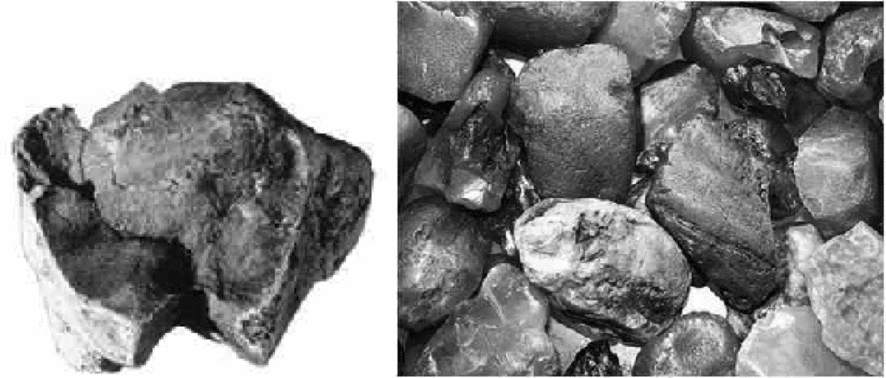
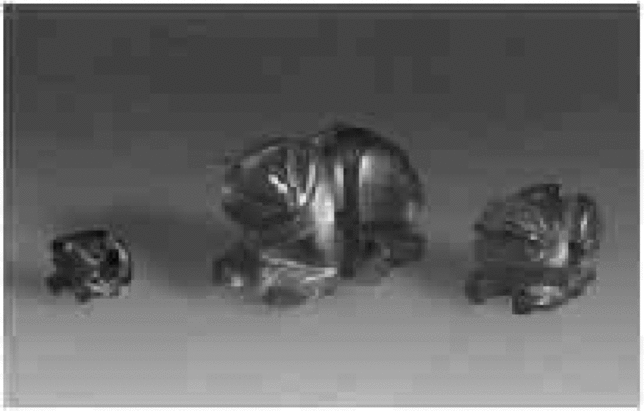
Although amber is found in a wide variety of places, its primary source since antiquity has been the Baltic region, where nuggets have been washed ashore along the Baltic coast. It is identified by different names according to where it came to be used: “electron” (Greece) for its electrostatic properties; “glaesum, sucinum” (Rome) for its glass-like luster; “sea-resin” (Baltic-Lithuanian); “Bernstein” (Germany) because it burns; “hupo” or “tiger's soul” (China) according to local myths about amber being formed from the essence of a dead tiger. The name “amber/ambar/ambra” is in fact of Indo-European-Arabic origin. First used in reference to “ambergris” (Chinese longyanxiang 龍涎香), it is the fragrant fatty product of the sperm whale's digestive system that has been known to have been regurgitated and washed ashore off the Sea of Arabia since Egyptian times. The nomenclature transfer (or confusion) from the animal substance ambergris to the plant resin amber may have occurred because of similarities in the manner in which both were collected (washed ashore by the ocean), their appearance, and their fragrant scent (Fig. 1).
Samples of raw ambergris and Baltic amber

Amber as Medicine and Aromatic
Since Classical antiquity, amber has been highly prized for its medicinal, evil-averting, and other natural properties, not to mention for its fragrance.Footnote 1 Powdered amber (obtained by drilling) was drunk dissolved in liquid (perhaps alcohol?); amber was worn around the neck for protection against throat diseases, or applied as an antiseptic for wounds. It was also believed to have magical or religious powers, such as the embodiment of captured solar-energy. Amber was also used in wine, as a preservative when embalming the dead and finally, as a luxury import item for personal ornaments in close association with perfume and perfume containers – especially in Greek and Roman contexts – intended for use by the elite.
In Chinese contexts, amber should (as a plant resin), belong in the same category as other fragrant tree resins such as suhexiang 蘇合香 (liquid ambar), ruxiang 乳香 (frankincense), anxixiang 安息香 (styrax), longnaoxiang 龍腦香 (camphor), many of which have been known since the sixth century. Amber however has never been included among these fragrances in traditional studies of aromatics and incense in China.Footnote 2 Traditional Chinese texts list amber as “medicine”; Schafer discusses it under “jewelry”.Footnote 3 The closest connection of amber to fragrance appeared in Berthold Laufer's early study of amber in Asia, where he noted that in Tibet, the local name for amber is “perfumed crystal”.Footnote 4 The Chinese had known about amber (hupo or “tiger's soul”) since the early centuries of the Christian era at the latest. But the material never gained a significant foothold in China until the tenth to twelfth century, when Baltic amber arrived in large quantities as a tribute to the Chinese court, and more recently, since the seventeenth century.Footnote 5
Aromatics and Incense in China
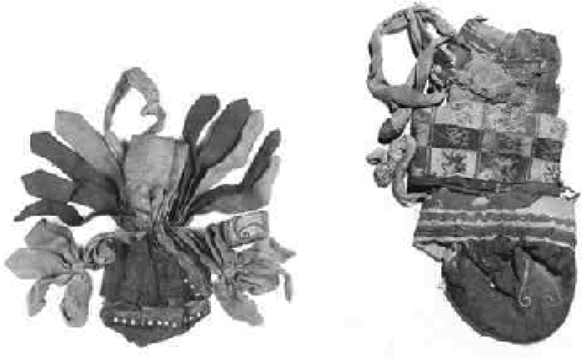
However, incense and aromatics did figure prominently in Chinese life and society since at least the late first millennium bce, as evidenced by the variety of incense burners and paraphernalia produced since that period.Footnote 6 The sources for aromatics – both plant and animal – were both native and imported, the best reaching China no later than early centuries ce. Some came via land from West and Central Asia into north China, evidenced by brocade and textile sachets recovered in burials at Yingpan, Xinjiang province (Fig. 2). More came via sea from Arabia-India-Southeast Asia to Guangzhou and east China seaports.Footnote 7 Interest in and written records about aromatics grew rapidly during the tenth to thirteenth centuries.Footnote 8 The tenth-century text Taiping Yulan 太平御覽 (Imperial Survey in Times of Peace) lists forty-two fragrances; the twelfth-century text Xiangpu 香譜 (Book of Incense) by Hong Zou 洪芻 records twenty-two formulae for aromatic blends using frankincense, camphor, and musk (but there is no mention of amber).
Embroidered aromatic pouch from Yingpan cemetery, Xinjiang province. 1st–3rd century After Xinjiang et al. 1999, nos. 515, 522.

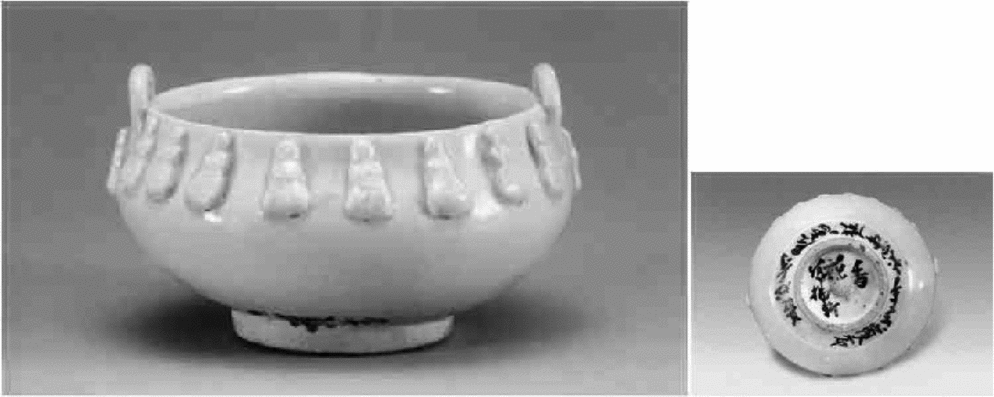
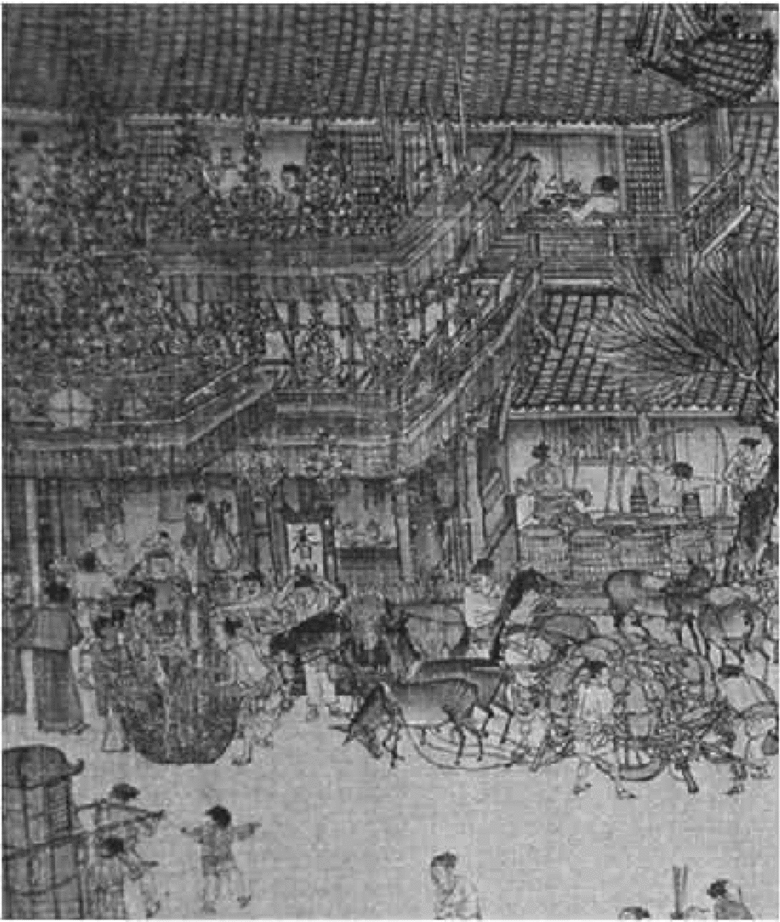
This led to a proliferation of paraphernalia, the majority of which are incense burners in ceramic and metalwork, used mainly in religious and secular contexts.Footnote 9 These included censers made of luxury materials of the highest artistic quality such as the gilt silver spherical gimbal-designed censers recovered from the crypt at the Buddhist temple outside Xi'an Famensi (dedicated 873);Footnote 10 or Ding ware incense burners from the Buddhist crypt of Jingzhisi 靜誌寺 in Dingzhou 定州, Hebei province (sealed 977), one of which carried an ink inscription indicating that floral aromatics were used (Fig. 3).Footnote 11 The widespread use of incense among even ordinary citizens of the Northern Song capital at Kaifeng is vividly captured in Zhang Zeduan's 張擇端 eleventh-century masterpiece “Travelling Upstream During the Qingming Festival 清明上河 ”. The painting shows market shops displaying banners advertising aromatics (Fig. 4). A rare glimpse of the extent of the aromatics trade during this period is provided by the discovery of a Southern Song ship's cargo at Quanzhou 泉州, which yielded over 4, 700 jin 斤 aromatics & medicinal herbs (i.e. 2,800 kilograms, 1 jin approximating 600 grams), such as ambergris, frankincense, and a variety of aromatic woods.Footnote 12
Ding ware incense burner with ink inscription on bottom from Jingzhisi, Hebei province. Before 977. After Hebei 2003, no. 55.

Detail of market scene, Travelling Upstream during the Qingming Festival, Zhang Zeduan, 11th century. Collection Palace Museum, Beijing.

By comparison, for the same tenth to twelfth-century period in north China, then occupied by the Qidan (Liao dynasty) and subsequently Jurchen (Jin dynasty) tribes, signs of this obsession with incense and incense paraphernalia were much less evident. Instead, we see an abundance of amber in similar religious, burial and elite social contexts, most spectacularly demonstrated by the 1983 discovery of the undisturbed burials of the Qidan Princess Chen and her consort in Inner Mongolia.Footnote 13 The scarcity of written records by these semi-nomadic peoples may have been one reason for our relative lack of information regarding amber in Qidan life; inaccessibility to aromatic imports – which mostly came via sea routes to southern Chinese port cities – may be another; but were there other reasons? What does the overwhelming presence of amber in the Qidan cultural sphere imply for the study of trade and traffic in aromatics between the western and eastern edges of the Eurasian continent? Why were the Han-Chinese and the Qidans attitudes toward amber so different? Was amber perceived by Qidans only as medicine (as it was by the Chinese), or did they also regard it as a fragrance? In other words, did the shared Baltic origin of European and Qidan amber bring with it shared appreciation of its non-medicinal properties? How important were geographical and ethnic considerations for the Qidans special appreciation of amber? This paper explores the validity of amber as an aromatic substance in China (as it was in the West) in northern Qidan contexts.
Amber in North China
Archaeological records reveal that from the early centuries ce, amber usually appeared in the form of small, animal-shaped amulets or beads, mostly in South Chinese contexts (Fig. 5), where the material might have come from Yunnan or Burmese sources.Footnote 14 At the time, it was already valued for its medicinal properties. A Six Dynasties record noted that the Song emperor accepted a gift of an amber pillow only because he could reduce it to fragments and distribute them among his army to use against boils and other skin diseases in their campaigns.Footnote 15 Amber was occasionally recovered from northern contexts as well, in close association with border tribes, such as the tomb of Xianbei 鮮卑 elite Kudi Huiluo 庫狄迴洛 (died 562) in Shouyang 壽陽, Shanxi province.Footnote 16
Amber feline pendant from Jiangsu Yangzhou, 2nd–1st century bce. After Xü Liangyu 2003, p. 114.

Amber appeared in north China in significant quantities only from the tenth century, after the Qidans had become a powerful presence there (see Appendix). It arrived in the form of tributes to the Emperor, most frequently during the tenth and eleventh centuries to the Later Zhou and Northern Song courts, sometimes in substantial quantities of as much as 300 kilograms (“500 jin”). Few of these gifts were recorded as having gone directly to the Qidan court, although raw amber has been found in Qidan sites.Footnote 17 On the other hand, archaeological excavations reveal that finished amber products were almost exclusively recovered from Qidans (or other northern, non-Chinese) elite burial and religious contexts. There, amber appears in the form of wearable amulets (perhaps to ward-off evil spirits or as medical cures for diseases), religious (both Daoist and Buddhist) ceremonial accoutrements and as personal ornaments and fragrance-related accessories.
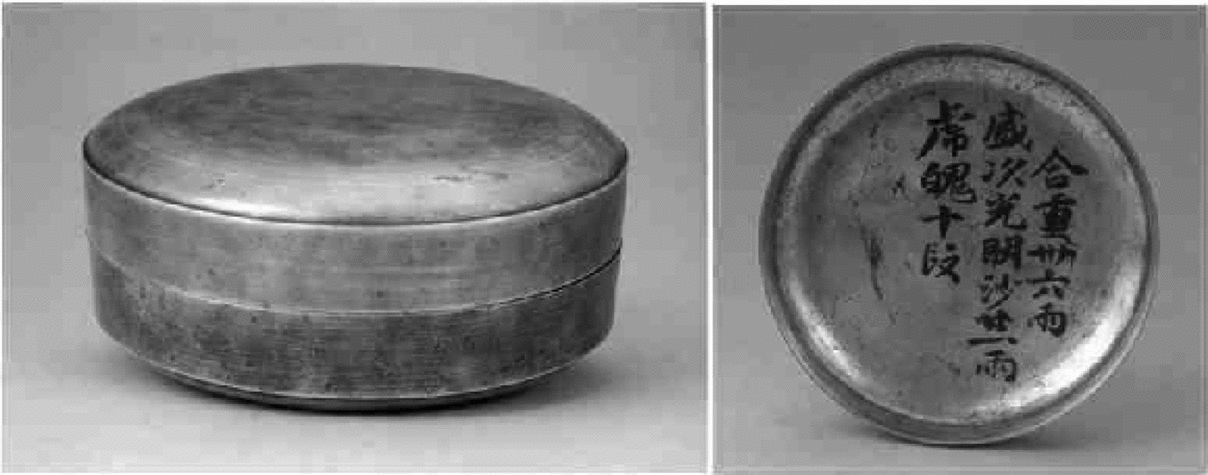
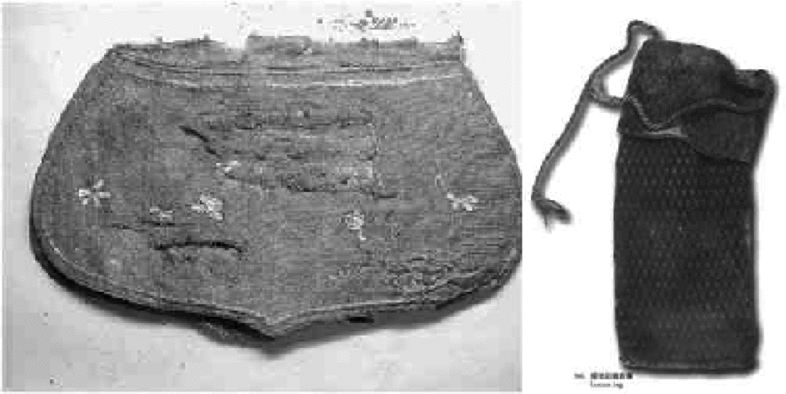
During the Tang dynasty, the medicinal uses of amber are evidenced by its inclusion among the Hejiacun 何家村 hoard in Xi'an 西安 (datable before the end of eighth century). An inscription inside the lid of one of the silver boxes indicates that it contained 10 strings (“ 段 ”) amber (~211 grams) and 21 liang 两 (~444 grams) cinnabar (“ 丹砂 ” mercuric sulfide), both used to cure blood and circulatory problems (Fig. 6).Footnote 18 It has been noted that during the Tang period, the boundaries between aromatics, perfumes, incense, medicine, and spices were vague or virtually non-existent.Footnote 19 Thus, in Tang medical texts we can find instructions for the use of aromatics as medical treatment: “first grind them (aromatics) into powder, then wrap the powder in wax paper, place it in a red textile sachet, and wear at the chest to expel sickness and evil forces”.Footnote 20 It is therefore significant that a Qidan gauze sachet with gold foil decoration in the Hangzhou Silk Museum has survived with fragments of silk tabby and paper in divided slots, as if it once contained the powdered aromatics described in the Tang text above (Fig. 7a). More importantly, another brocade sachet with remains of fragrance, recovered from the Qidan White Pagoda (Baita 白塔) at Qingzhou 慶州 (dedicated 1049), indicates that Tang medicinal practice was also adopted in Qidan religious contexts (Fig. 7b).Footnote 21
Silver box with ink inscription inside cover from Hejiacun, Xi'an. 8th century. After Qi Dongfang & Shen Qinyan 2003, no. 39.

Embroidered gauze pouch with paper and silk inside. Gift of Mengdiexuan, Hangzhou Silk Museum. Tenth and eleventh century. After So (ed.) 2004, V: p. 20.
Fig. 7b. Damask pouch from Qingzhou Baita, Inner Mongolia. Before 1049. After Zhao Feng Reference Feng2004, p. 244.

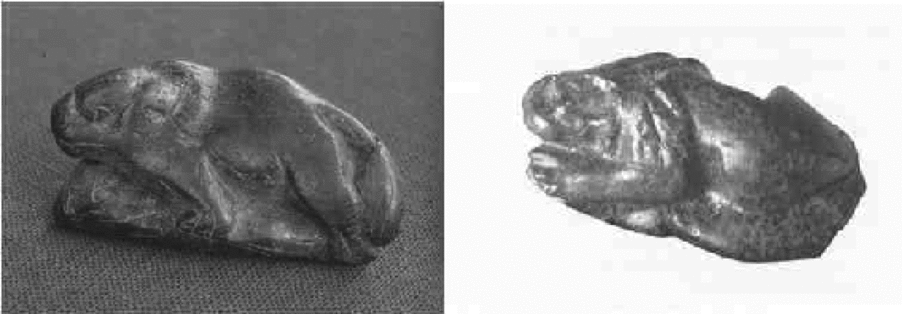
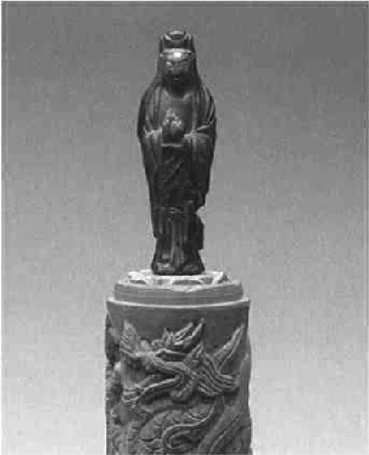
The employment of amber in religious contexts also appears to have begun during the Tang period. Amber beads, like those kept at the Shōsō-in Treasury, would have made ideal prayer beads, because they emit a subtle fragrance when warmed in the hand.Footnote 22 Of greater artistic and art historical significance are two carved amber feline sculptures recovered with other Buddhist treasures from the crypt at Famensi 法門寺 (Fig. 8a).Footnote 23 In both form and modelling, they differ greatly from the small, blocky, geometric amulets from earlier Chinese contexts (see Fig. 5), but the size and style with the smoothly modelled amber lions – also on flat bases – are far more reminiscent of the amber carvings from the late Roman (first to second centuries) necropolis at Budva, Bulgaria (Fig. 8b).Footnote 24 This close stylistic connection and their virtually unique presence in Tang contexts suggest that the Famensi amber felines were exotica brought into China as gifts to the Tang court. They were evidently so highly prized as ‘magical’ objects (of course, the lion also symbolises the Buddha) that the Tang Emperor Yizong 懿宗 considered them to be appropriate for dedication in the crypt at Famensi in 874. Amber continued to be used in religious contexts under Qidan rule. An amber recumbent lion, also carved with low base, was recovered from the tomb of the Qidan noble Yelu Zhongjiao 耶律宗教 (died 1053) in Liaoning Beizhen 遼寧北鎮.Footnote 25 Amber was also used to carve a Bodhisattva statuette on the lid of a wooden sutra container, as well as a lotus-bud shaped reliquary recovered from the White Pagoda at Qingzhou (Fig. 9).Footnote 26
Amber feline from Famensi, Xi'an. Before 874. Famensi 1989, p. 86.
Fig. 8b. Amber feline from Budva, Bulgaria. 1st–2nd century. After Palavestra & Krstié Reference Aleksander and Vera2006, no. 601.

Amber bodhisattva from Qingzhou Baita, Inner Mongolia. Before 1049. After Shen 2006, no. 77.

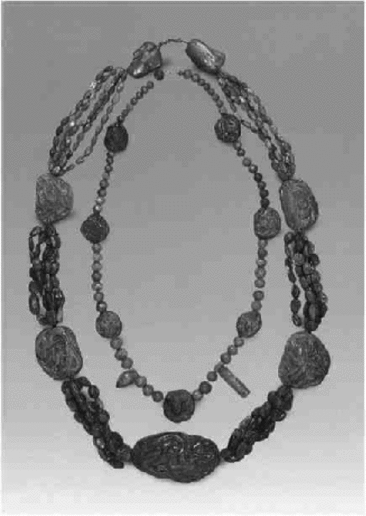
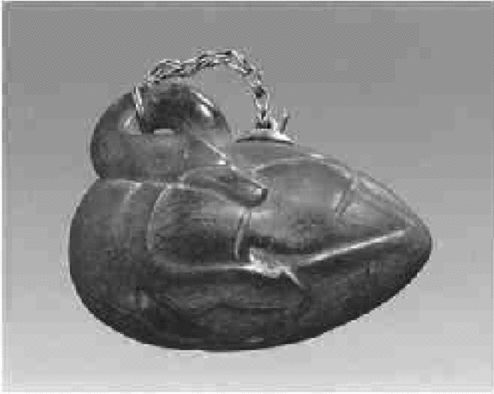
The most outstanding illustration of Qidans unabashed preference for amber as a material for personal ornament is the joint burial of the Qidan Princess Chen (died 1018) and her consort excavated in Inner Mongolia. Each wore two amber necklaces, the longer strung with multiple beaded strands interspersed with large amber pendants in irregular shapes, decorated with writhing dragon motifs in low relief. The shorter necklace consists of a single row of beads, also interspersed with similar large amber pendants (Fig. 10). A distinctive component added to the shorter necklace is a set of two amber ornaments – one pointed teardrop shape and one cylindrical – which reappears consistently as a set in Qidan necklaces.Footnote 27 The Princess and her husband each hold large irregular pieces of amber in their hands (woshou 握手), also carved beautifully with dragon, phoenix, or auspicious mandarin duck motifs in low relief, secured to their palms with gold chains. She also wore an amber-and-pearl headdress, earrings, and several containers (for fragrance) suspended from her gold-ornament belt (Fig. 11a–b) while he wore a silver hunting awl with an amber handle (which would have left a subtle pine scent in his palms when used), and also amber containers suspended from his belt. More amber ornaments were scattered about the grave.Footnote 28 A shallow foliate amber dish in the Mengdiexuan 夢蝶軒 Collection, Hong Kong, might also have served in incense preparations, as the heat required in the burning of aromatics would also cause the amber to emit its distinctive pine-like scent.Footnote 29
Double amber necklaces from tomb of Qidan Princess Chen, Inner Mongolia. Before 1018. After Shen 2006, no. 37.

Amber wild goose-shaped container from tomb of Qidan Princess Chen, Inner Mongolia. Before 1018. After Shen 2006, no. 36.

Most importantly, these amber containers provide the earliest evidence that amber might have been closely associated with fragrance (plant and oils) worn and carried close to the person for both medicinal and aromatic purposes. These small but exquisitely carved containers in a wide variety of shapes, sizes, and designs example the unique artistic achievement of the Qidan, not shared by their Han-Chinese or other neighbours.Footnote 30 Among these, a round box with tightly fitted cover – an essential requirement for an aromatic container to minimise leakage of fragranceFootnote 31 – represents the most common shapes created for this purpose. It is pierced down the centre like a doughnut, so that a chord can pass through to allow it to be tied to an article of clothing (Fig. 12a). Exactly how these pierced circular boxes might have been used is illustrated by the recovery of two such amber examples from the twelfth-century burial of the Jurchen 女真 noble Wan'yan An 完顏晏 at A'cheng 城, Heilongjiang 黑龍江 province.Footnote 32 In both cases these boxes belonged to the Jurchen nobleman, and are strung with additional jade ornaments; one is suspended from a silk sash as one of several belt accessories, like those worn by Princess Chen and her consort; the other is tied to a corner of a yellow silk kerchief (Fig. 12b). By Ming times, this type of pierced circular box was to become closely associated with personal fragrance and cosmetic functions.Footnote 33 Furthermore, examples of this type (see Fig. 12a) actually contained remnants of what appears to be an organic substance.Footnote 34
Amber container with organic remains. Mengdiexuan Collection, Hong Kong. 11th–12th century. After So (ed.) 2004, V: p. 33.
Fig. 12b. Amber container tied to silk kerchief from tomb of Wangyan An, A'cheng, Heilongjiang province 12th century. After So ed. 2004, V: pp. 33–31.

Amber as Aromatic in North China?
The foregoing discussion of historical records, and more importantly, evidence from artifacts of amber in north China revealed intriguing parallels between the use of amber in classical antiquity and medieval Qidan/Liao contexts on the eastern edge of Eurasia. From its first appearance in both west and east Asia, amber was regarded as an exotic luxury material for the social and ruling elite. The medicinal healing properties of amber were recognised in both contexts. Since the first millennium bce (Etruscan, Greek, Roman, Italic periods) small amber carvings were believed to possess magical powers, and were often worn as necklaces, pendants or amulets to repel diseases and evil spirits. Ancient Mediterranean practice drilled amber to produce powder which was consumed as medicine. Amber carvings from the Roman period in the British Museum in London and the Levy Collection in New York show evidence of such drillings, some plugged with a different material.Footnote 35 A similar belief in amber's healing properties was apparent in China from at least the first centuries ce, although its deployment was mostly confined to the southern regions, sourced mostly from southwest China or Burma. During the Six Dynasties and Tang periods, amber began to appear in the north as well, arriving with Central Asian peoples who took turns occupying the territory. There is as yet no concrete evidence in China of drilling amber for powder, but the natural substance was clearly ground up for medical uses.Footnote 36
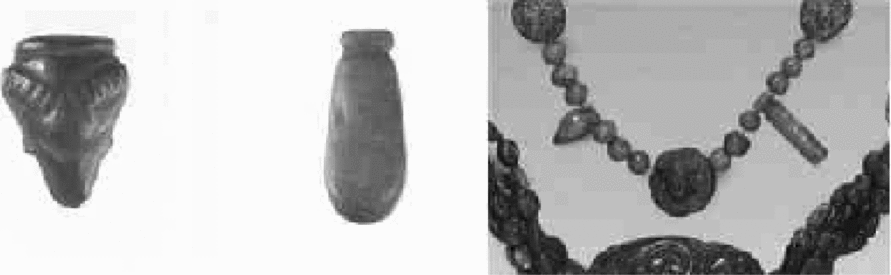
Most striking is the close resemblance between two amber pendants (“ram's head” and “wineskin”) from the sixth to fifth century bce excavations at Novi Pazar, Serbia (Fig. 13), and two distinct and always paired shapes in Qidan contexts (see Fig. 10).Footnote 37 These appear consistently on Qidan ornaments, in a wide range of substances, and are rightly regarded as a signature set in Qidan ornaments. However, they are separated by over 1,500 years in time, and by the vast Eurasian steppes in space. Although we cannot yet map this connection, their striking visual resemblance presents signs of long-distance migrations of peoples and customs that have been lost.
Amber “ram's head” and “wineskin” pendants from Novi Pazar, Serbia. 6th–5th century bce. After Palavestra & Krstié Reference Aleksander and Vera2006, nos. 102, 263.
Fig. 13b. Detail of amber necklace in Fig. 10.

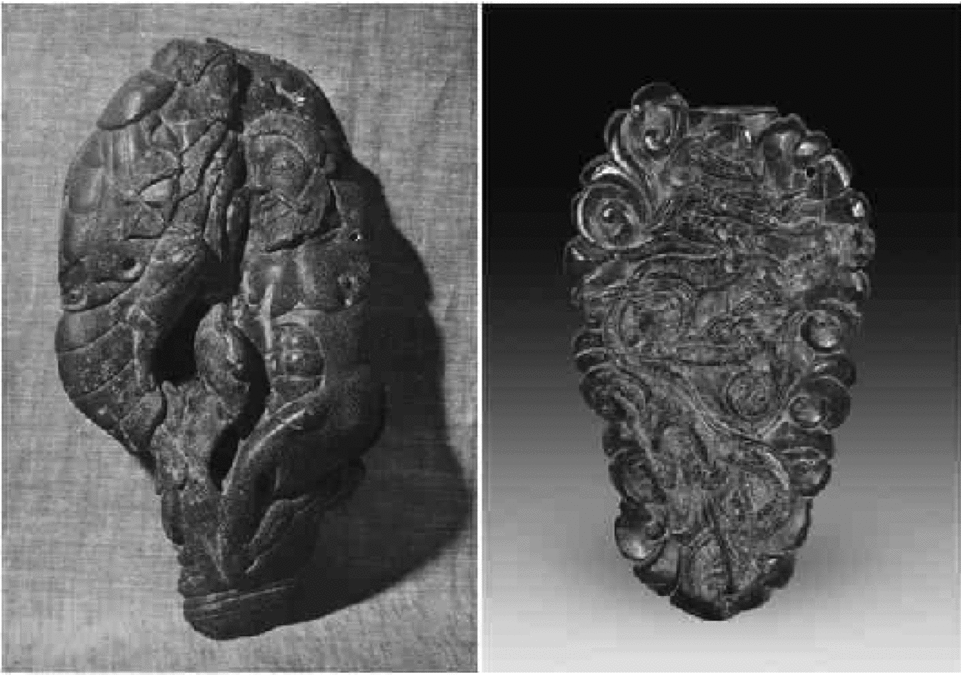
In Roman Italy, women held pieces of amber in their hands during the summer for its coolness and the fragrance when warmed by the palm.Footnote 38 In Qidan burials, they were found held in the hand as woshou; in everday objects, amber was used in situations where it would have been in close contact with the human touch (e.g. handles for tools, prayer beads). The Roman elite also prized amber as raw material for intricately designed sculptures, often of mythological subjects (Fig. 14a–b);Footnote 39 the Qidan used amber to carve Buddhist images (see Fig. 9). In Rome as in north China, the same complex designs were applied to amber bottles and containers for fragrant oils (see Figs. 11, 13).Footnote 40 Both are similarly varied and artistically creative, exploiting the resin's relative softness to compose complex, multi-layered designs of naturalistic motifs.
Amber sculpture and container. British Museum Collection. Italy, 6th–5th century bce. After Strong Reference Strong1966, no. 35.
Fig. 14b. Amber dragon container. Meadow Springs Collection, Hong Kong. 11th century. After So (ed.) 2004, no. V: p. 23.

Amber Traffic
Amber's appearance in Qidan north China represents its easternmost penetration and many of the Mediterranean customs associated with it.Footnote 41 Current archaeological finds of amber in Europe and western Eurasia seem to support the general south and eastward direction for amber's use and spread from the Baltic north in the Neolithic period (ca. fourth millennium bce) to Britain; in the Bronze Age (first millennium, esp. seventh to fifth centuries bce) to Southern Europe; in the Iron Age (fourth century bce to second/third centuries ce) to classical Greek and Roman territories. From ca. 200 ce, the use of amber declined drastically in the Roman world, perhaps due to arrival of Goths who blocked traffic from north to south. Subsequently, during the Medieval period (third to eleventh centuries), amber travelled east to Eastern Europe, Bohemia, and Central Asia, eventually reaching Tang and Qidan China by the ninth and tenth centuries. Almost as abruptly as it had appeared in north China, amber disappeared with the departure of the Qidans in the twelfth century, only to be revived in Prussia the following century where it remained popular well into the nineteenth century.Footnote 42
In north China, amber's close connection with Qidan elite society is puzzling.Footnote 43 Was it simply because large quantities of Baltic amber were readily available to them via the northern land routes at the time? Or was it because amber was under-valued, under-appreciated by the Han-Chinese, the uninterested recipients who promptly passed them on to the Qidans? Or might the Qidans have seen a close approximation of their imperial colour “ 紫” (often inaccurately translated as “purple”) in amber's dark brownish-red colour as a distinctive foil nephrite to the unctuous, pure white nephrite so prized by their Chinese neighbours?Footnote 44 Possibly the Qidan first appreciated amber for its medicinal properties, (knowledge of which was likely to have arrived with the Central Asian traders), or possibly they then discover its aromatic properties? The scent of amber obtained by simply rubbing or burning would have been an easily accessible fragrance well suited to their mobile lifestyle, while its pine-like fragrance might have triggered memories of their homes among the northern forests. Or was it all of the above?
As a fragrant substance, amber illustrates an important aspect in the study of global trade in aromatics – that the trails left by scents and aromatics often echo the movement of peoples who used, traded, and valued them, regardless of quantity, function, and duration. In the case of amber, its sudden appearance and disappearance in north China reflected the ethnic roots, movements, and the ultimate fate of the Qidans, who were its primary consumers during the tenth to twelfth centuries. It signals an unique and unrecorded aspect of the artistic achievement of the Qidans that has escaped us until now.
Appendix
Texts on amber imports (references of amber and its bearers highlighted):Footnote 45
(唐代宗) 大曆六年 (771) 九月, 波斯國遣使獻真珠琥珀等。
(後周) 太祖廣順元年 (951) 西州回鶻遣都督來朝, 貢玉大小六團, 一團碧。 琥珀九斤。. . .. . .回鶻遣使摩尼貢玉團七十七. . .. . .大琥珀二十顆。
(後周) 廣順二年 (952) . . .. . .回鶻遣使. . .. . .貢玉團三, 珊瑚樹二十, 琥珀五十斤。
(北宋) 回鶻可汗景瓊建隆二年 (961) 十二月壬辰遣使貢物。 自是甘州回鶻貢良馬、 美玉、 珊瑚、 琥珀之類不絕。
宋太祖乾德2年(964): 回鶻“遣使貢玉百團, 琥珀四十斤. . .”。
宋太祖乾德3年(965): 于闐國王遣使來朝, 進馬千匹. . .琥珀五百斤。
(北宋) 太平興國二年 (977). . .. . .沙州回鶻. . .. . .以. . .. . .名馬、 珊瑚、 琥珀來獻。
宋太宗太平興國五年(980) 甘州回鶻. . .. . .以. . .、 珊瑚、 琥珀來獻。
宋真宗大中祥符3年(1010): 龜玆國王遣使“來進香藥、 . . .琥珀. . .等。
(北宋) 大中祥符四年 (1011) 大食. . .. . .進象牙、 琥珀、 無名異、 繡絲. . .. . .。
(北宋) 熙寧(1068 – 1077) 以來, 遠不逾一二歲, 近則歲再至。 (于闐)所貢珠玉、 珊瑚、 翡翠、 象牙、 乳香、 木春、 琥珀、 花蕊布. . .. . .。
《契丹國志》 高昌國、 龜茲國、 于闐國、 大食國、 小食國、 甘州、 沙州、 涼州, 以上諸國三年一次遣使, 約四百餘人, 至契丹貢獻玉、 珠、 犀、 乳香、 琥珀、 瑪瑙。
Notes:
-
1 Uighurs 回鶻 were one of the primary intermediaries of amber offerings into China, coming from as far as Persia and Syria, via territories inside modern Xinjiang.
-
2 Amber often arrived together with jade and sometimes frankincense.
-
3 The largest amounts of amber seem to have arrived during the third quarter of the tenth century, brought to the Northern Song court. As confirmed by archeological discoveries,Footnote 46 this occurred at the same time as the boom in amber consumption among the Qidan during the late tenth to early eleventh century.
-
4 Compared to Chinese records, references to tributes entering the Liao/Qidan court in Qidan guozhi 契丹國志 are perfunctory, since they simply record offerings of a variety of products once every three years.