
I. INTRODUCTION
Hypereutectic Al–Si alloys have been widely used in aerospace, automobile, and general engineering industries due to their excellent mechanical properties such as light weight, favorable corrosion resistance, high wear resistance, excellent thermal conductivity, and low thermal expansion coefficient. Reference Mohamed, Samuel, Samuel and Doty1–Reference Sha, Wu, Wang, Wan and An5 Nowadays, more attention has been paid to hypereutectic Al–Si alloys, as they can improve fuel efficiency and reduce emission when served as engine block and piston alloy in automobile industry. Reference Chen and Alpas6,Reference Hekmat-Ardakan, Liu, Ajersch and Chen7 With the increasing of Si content, better friction resistance, lower density, and lower heat expansion coefficient can be achieved in hypereutectic Al–Si alloy. More fuel saving and less automobile exhaust emission will be attained if more low-density hypereutectic Al–Si alloy is used to make automobile power system components. Moreover, high Si content hypereutectic Al–Si alloy is favorable to casting processing owning to its good fluidity, which is primarily due to the high latent heat of the crystallization of Si. Therefore, increasing Si content has become an imperative and feasible research direction to develop next generation hypereutectic Al–Si alloy.
Even though primary and eutectic Si can enhance the wear resistance of Al–Si alloys, the polygonal primary Si block and acicular eutectic Si will segregate the matrix severely and thus undermines the mechanical properties of the alloy. To make it worse, the modification effect of Si will be impaired when Si content is higher than 26 wt%. In addition, large primary Si lump forms easily in conventional cast process. On the other hand, with the addition of Si, it is increasingly difficult to shape automobile power system components with complex shape by conventional cast process. To shape complex automobile components with refining and dispersing primary Si, a multitude of novel methods were developed to process high Si content hypereutectic Al–Si alloys. Reference Ward, Atkinson, Anderson, Elias, Garcia, Kahlen and Rodriguez-Ibabe8–Reference Birol12 Unfortunately, these novel processing methods are extraordinarily expensive for commercial production. Thus, Si contents in many commercial hypereutectic Al–Si alloys are in a suitable range, such as British LM29 (Si: 22.0–25.0, Cu: 0.8–1.3, Mg: 0.8–1.3, Ni: 0.8–1.3, Mn < 0.6, Cr < 0.6, Fe < 0.7, Ti < 0.2) and Japanese AC9A (Si: 22–24, Cu: 0.5–1.5, Mg: 0.5–1.5, Ni: 0.5–1.5, Mn < 0.5, Zn < 0.2, Fe < 0.8, Ti < 0.2). Since LM29 and AC9A were designed for conventional gravity casting, primary Si cannot be refined and dispersed effectively. Naturally, a processing method which can lower production cost and refine Si has been pursued by scientists till now. By comparison, high pressure die casting is a practical way to process hypereutectic Al–Si alloy for its promising effect in refining primary Si and eutectic Si with high cooling rate. Moreover, it is also a relatively economic way for industrial production. But at present, there is no hypereutectic Al–Si alloy with high Si content (>20 wt%) developed for high pressure die casting. On the basis of our experimental researches, an Al–22Si alloy was designed for high pressure die casting in this study, which is the purpose of this paper. The Al–Si–Cu alloy system is chosen in this study as it is the most important and widely used alloy for piston. While magnesium can improve the tensile strength of the Al–Si–Cu alloys by solid solution strengthening, its content should be limited to no more than 1 wt% to avoid the undesirable brittleness of the alloy. Therefore, 0.4 wt% Mg was added into the alloy in this study. Reference Ye13 Cu is the vital alloying element in the alloy which can boost the mechanical properties at both ambient and elevated temperatures (especially for high temperature ultimate tensile strength), enhance hardness, elasticity modulus, and creep resistance of the alloy. Reference Ye13 However, the addition of Cu lowers the corrosion resistance and leads to intergranular corrosion of the alloy, which is caused by grain boundary Cu agglomeration. Furthermore, adding Cu can promote the viscosity and hot tearing susceptibility of the alloy, which seriously degrade the casting properties. Consequently, suitable Cu content is paramount for the development of die casting hypereutectic Al–22Si–0.4Mg alloy. Usually, the amount of Cu in hypereutectic Al–Si–Cu alloy is between 1 wt% and 5 wt%. But the die casting hypereutectic Al–22Si alloy cannot be reinforced by heat treatment due to the presence of pores in the casting. So, to ensure the comprehensive mechanical properties and casting formability, the Cu content for die casting hypereutectic Al–22Si–0.4Mg alloy should be optimized accurately.
In this article, a hypereutectic Al–22Si–xCu–0.4Mg alloy for die casting was studied. To get an outstanding performance of both mechanical properties and casting formability, the influence of Cu content on the microstructure, mechanical property and hot tearing susceptibility of die casting hypereutectic Al–22Si–0.4Mg alloy were investigated. The results were valuable for the development of die casting hypereutectic Al–Si alloys with high Si content.
II. EXPERIMENTAL PROCEDURES
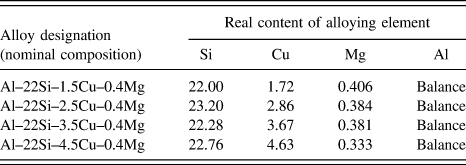
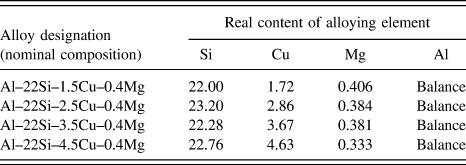
Alloys were melted in a steel crucible coated with shielded dope in an electrical resistance furnace. Industrial pure Al, Si, Mg, and master alloy Al–50 wt% Cu were used to fabricate the alloy required. For the modification, master alloy Al–5 wt% P (the content of phosphorus was 0.04 wt% of the whole melt) was added to the melt at 830 °C, and the melt was stirred and held for 15–20 min to achieve a uniform distribution of the phosphorus element. The compositions of the alloys were shown in Table I.
Alloys designation and real composition (wt%).
A TOYO BD 350V5 horizontal die casting machine (Oriental Machinery Metal Co. Ltd., Ming Stone, Japan) was taken to perform high pressure die casting. All the die casting operations were manipulated under the same set of parameters (fast injection speed was 1.5 m/s and slow injection speed was 0.25 m/s). Die casting mold temperature was kept between 200 and 220 °C before every die casting operation.
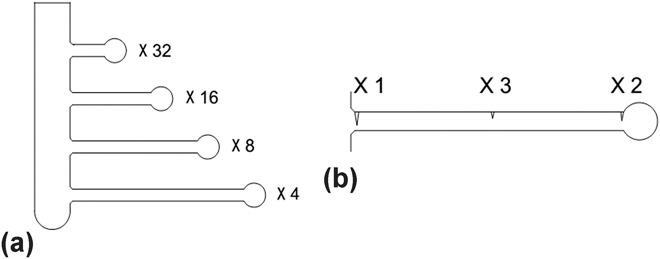
Constrained rod casting (CRC) hot tearing susceptibility test was performed. The hot tearing susceptibility of the alloy can be calculated according to the rod length, shape, and position of the crack under the uniform equation shown in Eq. (1) and Fig. 1. Reference KamguoKamga, Larouche, Bournane and Rahem14,Reference Cao and Kou15 To reduce the experimental uncertainties, the CRC mold was heated to 200 °C and coated with liquid graphite to avoid melt cross-contamination every time before being used. Mold cavities were cleaned before each experiment. Solidification curve was measured with a hypersensitive Φ0.5 K-type thermocouple, a temperature testing system and a recording software.
Schematic diagram of the impact factor of the hot tearing rod: (a) schematic diagram of the impact of the length of the rod; (b) schematic diagram of the impact of the location of the crack.

Ambient temperature tensile test was implemented on electronic all-purpose material testing machine Zwick I Roell Z100 (Zwick, Ulm, Germany). Tensile test was carried out at a constant cross-head speed of 1 mm/s. The diameter of rod tensile test sample was 5 mm and the gage length was 25 mm.
Optical microscopy (OM) analysis was executed in the same cross section. Metallographic pictures were photographed by Zeiss Axio observer metallographic microscope (Carl Zeiss AG, Jena, Germany). Metallographic sample was etched by the Keller reagent (2.5 mL HNO3, 1.5 mL HCl, 1.0 mL HF, 95 mL H2O) for 20 s after being grinded and polished by standard procedures. X-ray diffraction (XRD) scanning analysis was also carried out on Ultima IV equipment (Rigaku Corporation, Tokyo, Japan). Scanning electron microscopy (SEM) and energy dispersive spectroscopy (EDS) were done with Sirion 200, a high definition field emission scanning electron microscope (FEI Company, Hillsboro, Oregon).
 $${\rm{HCS}} = \sum {\left( {{f_{{\rm{length}}}} \times {f_{{\rm{location}}}} \times {w_{{\rm{crack}}}}} \right)} \quad .$$
In Eq. (1), every impact factor is defined by the following rules. The HCS value of one alloy composition equaled the total HCS value of all the rods. As for f length, when crack is found in the longest rod, f length is 4. In the same way, when crack is found in the second longest, third longest, and shortest rod, f length is 8, 16, and 32 respectively, as shown in Fig. 1(a). As for f location, when crack is found at the junction with the upright spure, the middle point of the rod or the junction with the top ball, f location is 1, 3, 2 respectively, as shown in Fig. 1(b). As for w crack, when the crack is complete tear, half complete tear, hairline tear, and half hairline tear, w crack is 4, 3, 2, 1 respectively.
III. RESULTS AND DISCUSSIONS
A. As-cast microstructure
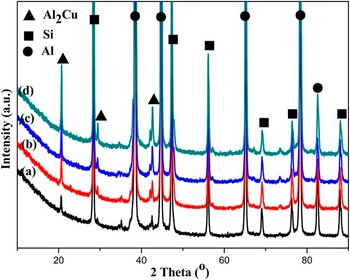
Figure 2 shows XRD patterns of Al–22Si–xCu–0.4Mg alloys. Peaks of α-Al, Si (primary Si and eutectic Si cannot be separated by XRD) and Al2Cu phase are observed in the XRD pattern. Every peak of different composition is in the same position, which is indicative of that the phase species existed in different composition are uniform. It is apparent that the first peak of Al2Cu around 20° becomes higher with the increasing of Cu content. As for the second peak of Al2Cu around 29° which is shorter than the first peak of Al2Cu, it also turns more obvious with Cu increased. As for the third peak of Al2Cu beside 43°, it is clear that the intensity of Al2Cu phase enhances with the rising of Cu content. It is suggestive that the amount of Al2Cu augments with Cu content increased. The heights and locations of peaks of α-Al and Si do not alter with the climbing of Cu content.
XRD photographs of Al–22Si–xCu–0.4Mg alloy: (a) 1.5 wt% Cu, (b) 2.5 wt% Cu, (c) 3.5 wt% Cu, and (d) 4.5 wt% Cu.

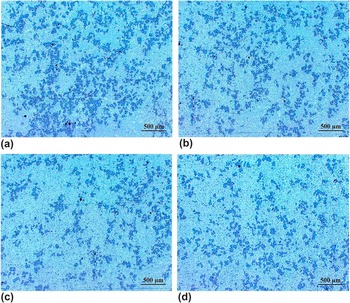
Figure 3 reveals the metallographic pictures of Al–22Si–xCu–0.4Mg alloys. It can be seen that the irregular polygonal primary silicon blocks are embedded in the as-cast matrix. The average size of primary Si is measured using Image-pro plus software. The mean diameter of primary Si of Al–22Si–xCu–0.4Mg alloy is about 30 μm. The matrix of Al–22Si–xCu–0.4Mg alloy is composed of (Al + Si) eutectic and α-Al. The white matrix is α-Al. The morphology of eutectic Si in (Al + Si) eutectic is in long rod shape.
Optical microstructures of die casting Al–22Si–xCu–0.4Mg alloy: (a) 1.5 wt% Cu, (b) 2.5 wt% Cu, (c) 3.5 wt% Cu, and (d) 4.5 wt% Cu.

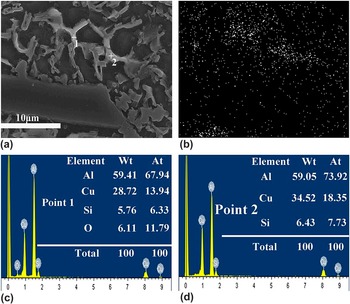
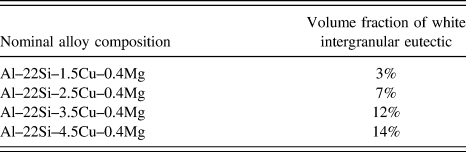
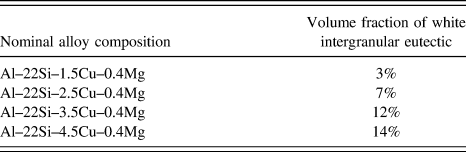
Figure 4 illustrates the SEM micrographs of Al–22Si–xCu–0.4Mg alloys. Figure 5 demonstrates the map-scanning and point-scanning results of Al–22Si–4.5Cu–0.4Mg sample. Combining XRD patterns, map-scanning result and point-scanning result, it is concluded that the white intergranular phase is not pure Al2Cu phase and Al2Cu phase is included in the white intergranular body. Judging from the point-scanning result and full composition equilibrium Al–Si–Cu liquidus projection, the white intergranular body is eutectic (Al + Si + Al2Cu). It is self-evident that Al2Cu, which precipitates beside the ternary eutectic Si or α-Al from SEM micrographs, forms in the eutectic (Al + Si + Al2Cu). It is also apparent that the eutectic (Al + Si + Al2Cu) forms beside the eutectic (Al + Si) judging from SEM micrographs. From the SEM micrograph, it can be seen that the large lump is primary Si, the long rod or long stick is binary eutectic Si, the short rod or small particle is ternary eutectic Si. In addition, it is obvious that white intergranular eutectic (Al + Si + Al2Cu) is near long rod binary eutectic Si or α-Al, and is not close to primary Si. From XRD patterns, it is also clear that the amount of Al2Cu rises with Cu content increased, which is consistent with the phenomenon that the amount of white intergranular eutectic (Al + Si + Al2Cu) increases with the increasing of Cu content. The amount and morphology of white intergranular eutectic (Al + Si + Al2Cu) change with the going up of Cu content. The total volume fraction of white intergranular eutectic (Al + Al2Cu + Si) in Fig. 4 is presented in Table II. The total volume fraction of white intergranular eutectic (Al + Si + Al2Cu) ascends when more Cu is added. However, when nominal Cu content jumps from 2.5 wt% to 3.5 wt%, the volume fraction of eutectic (Al + Si + Al2Cu) increases most, which is from 7% to 12%. It is in accord with the morphology transformation of eutectic (Al + Si + Al2Cu). When nominal Cu content is over 2.5 wt%, white intergranular eutectic (Al + Si + Al2Cu) is inclined to spread out to encircle α-Al grain. When nominal Cu content is more than 3.5 wt%, white intergranular eutectic (Al + Si + Al2Cu) is apt to form continuous intergranular net. By comparing the four compositions, it is apparent that the intergranular eutectic (Al + Cu + Al2Cu) tends to spread out over the grain boundary of α-Al and become thicker with high Cu content, especially when nominal Cu content is over 2.5 wt%. In conclusion, as for as-cast microstructure, Al2Cu and eutectic (Al + Si + Al2Cu) increase with the increasing of Cu content.
SEM photographs of the microstructure Al–22.5Si–xCu–0.45Mg alloy: (a) 1.5 wt% Cu, (b) 2.5 wt% Cu, (c) 3.5 wt% Cu, and (d) 4.5 wt% Cu.

EDS analysis results of alloy with 4.5 wt% Cu: (a) an area of sample; (b) Cu map distribution of (a); (c) the point-scanning result of point 1; (d) the point-scanning result of point 2.

Total volume fraction of white intergranular eutectic of Al–22Si–xCu–0.4Mg alloy.
B. Tensile properties
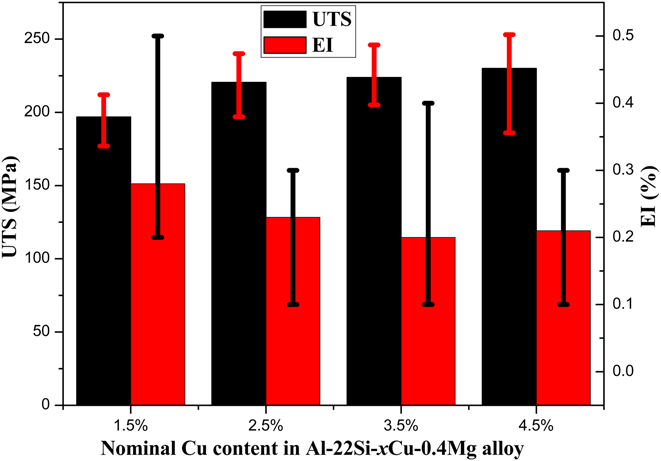
Figure 6 depicts the ambient temperature mechanical properties of as-cast Al–22Si–xCu–0.4Mg alloys. It is clear that the UTS improves with Cu content increased, which is mainly caused by the solid solution strengthening effect of Cu element and disperse strengthening effect of intergranular Al2Cu. When nominal Cu content climbs from 1.5 wt% to 2.5 wt%, 3.5 wt%, and 4.5 wt%, the average UTS ascends from 196.9 MPa to 220.5 MPa, 223.8 MPa, and 230 MPa respectively. When Cu content is over 2.5 wt%, the increasing trend of UTS becomes flat drastically. The strengthening effect of Cu is most significant from 1.5 wt% to 2.5 wt% and least significant from 2.5 wt% to 3.5 wt%. The reasons are as follows: when Cu is mainly solutionized in α-Al or existed as particle Al2Cu in particle eutectic (Al + Si + Al2Cu) (for instance, nominal Cu content rises from 1.5 wt% to 2.5 wt%), the UTS improves substantially. However, when the discontinuous intergranular eutectic (Al + Si + Al2Cu) containing Al2Cu tends to form continuous intergranular net with high Cu content (as an example, nominal Cu content increases from 2.5 wt% to 3.5 wt%), it considerably reduces the strength and ductility of the alloy. The sample of alloys with Cu content more than 2.5 wt% will break before it reaches the highest intensity. Consequently, UTS enhances least. That is why the increasing trend of UTS becomes flat noticeably when the Cu content is over 2.5 wt%. The elongations of Al–22Si–xCu–0.4Mg alloy with high Si content are all less than 1%. With the increasing of Cu, the average elongation decreased slightly (from 0.28% to 0.23%, 0.20%, and 0.21% respectively), which almost has no effect on the elongation of the alloy. It demonstrates that the conventional high pressure die casting Al–22Si–xCu–0.4Mg alloy almost has no plasticity or ductility.
Room temperature mechanical property of Al–22Si–xCu–0.4Mg alloy.
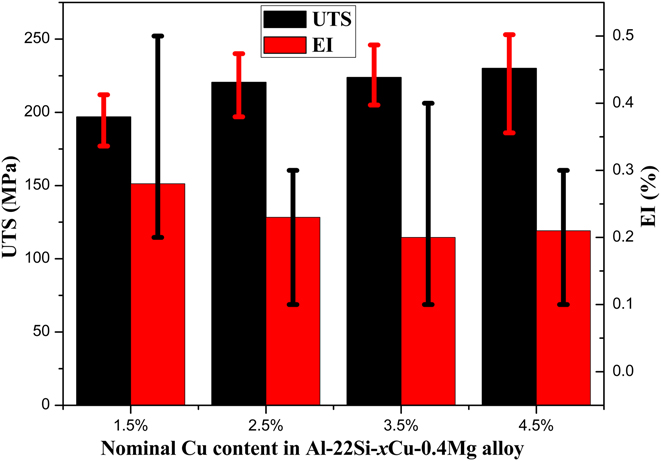
Figure 7 describes the SEM micrographs of the ambient temperature tensile fracture surfaces of Al–22Si–xCu–0.4Mg alloys. It is evident that the crack is prone to originate from the junction of primary Si and the matrix. It is also obvious that the crack tends to propagate along the boundary of primary Si. The fracture morphology reveals that the fracture mode of high pressure die casting Al–22Si–xCu–0.4Mg alloy is completely brittle fracture. It is universally acknowledged that the crack always tends to occur in the weakest location in the tensile test sample. The weakest location is always the location which has the highest stress concentration during tensile test. The interface of primary Si and the matrix is the complete incoherent interface. The primary Si is hard and brittle phase and the matrix is softer and more ductile. As a result, the junction of primary Si and the matrix is not so strong. During tensile test, the junction of primary Si and the matrix tends to become highest stress concentration point first and serve as crack nucleation point. That is why crack tends to originate from the junction of primary Si and the matrix and propagate along the boundary of primary Si. As a result, the addition of Cu content almost has little effect on the ductility of Al–22Si–xCu–0.4Mg alloy.
SEM photographs of the room temperature tensile fracture surface of Al–22Si–xCu–0.4Mg alloy: (a) 1.5 wt% Cu, (b) 2.5 wt% Cu, (c) 3.5 wt% Cu, (d) 4.5 wt% Cu.

C. Hot tearing susceptibility
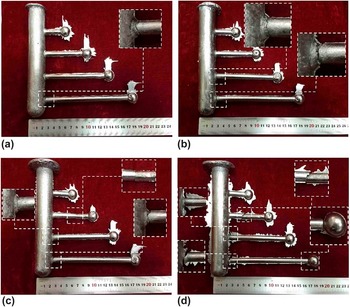
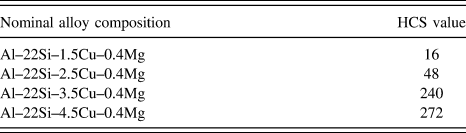
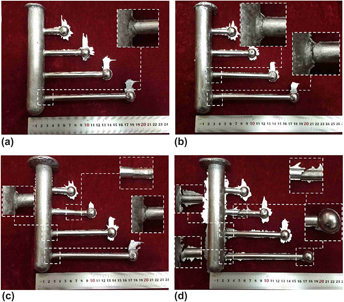
Figure 8 illustrates the hot tearing susceptibility test results of Al–22Si–xCu–0.4Mg alloys. Based on Eq. (1), the HCS (Hot Cracking Susceptibility) value of Al–22Si–xCu–0.4Mg alloy was calculated in Table III. It is indicative that HCS value climbs with Cu content increased (from 16 to 48, 240, and 272 respectively). When nominal Cu content goes up from 2.5 wt% to 3.5 wt%, HCS value jumps most, which is suggestive that the hot tearing susceptibility strikingly increases. Over the same Cu content limit (nominal Cu content: 2.5 wt%), the total volume fraction of intergranular eutectic (Al + Si + Al2Cu) and hot tearing susceptibility rises most simultaneously. Also over the same Cu content limit, the UTS improves least. These phenomena are coherent since the mechanical properties are up to the microstructure. The hot tearing susceptibility is mainly determined by the solidification process and solidified microstructure.
Hot tearing susceptibility test results of Al–22.5Si–xCu–0.45Mg alloy: (a) 1.5 wt% Cu, (b) 2.5 wt% Cu, (c) 3.5 wt% Cu, and (d) 4.5 wt% Cu.

HCS value of Al–22Si–xCu–0.4Mg alloy.
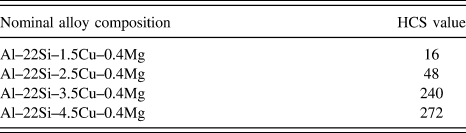
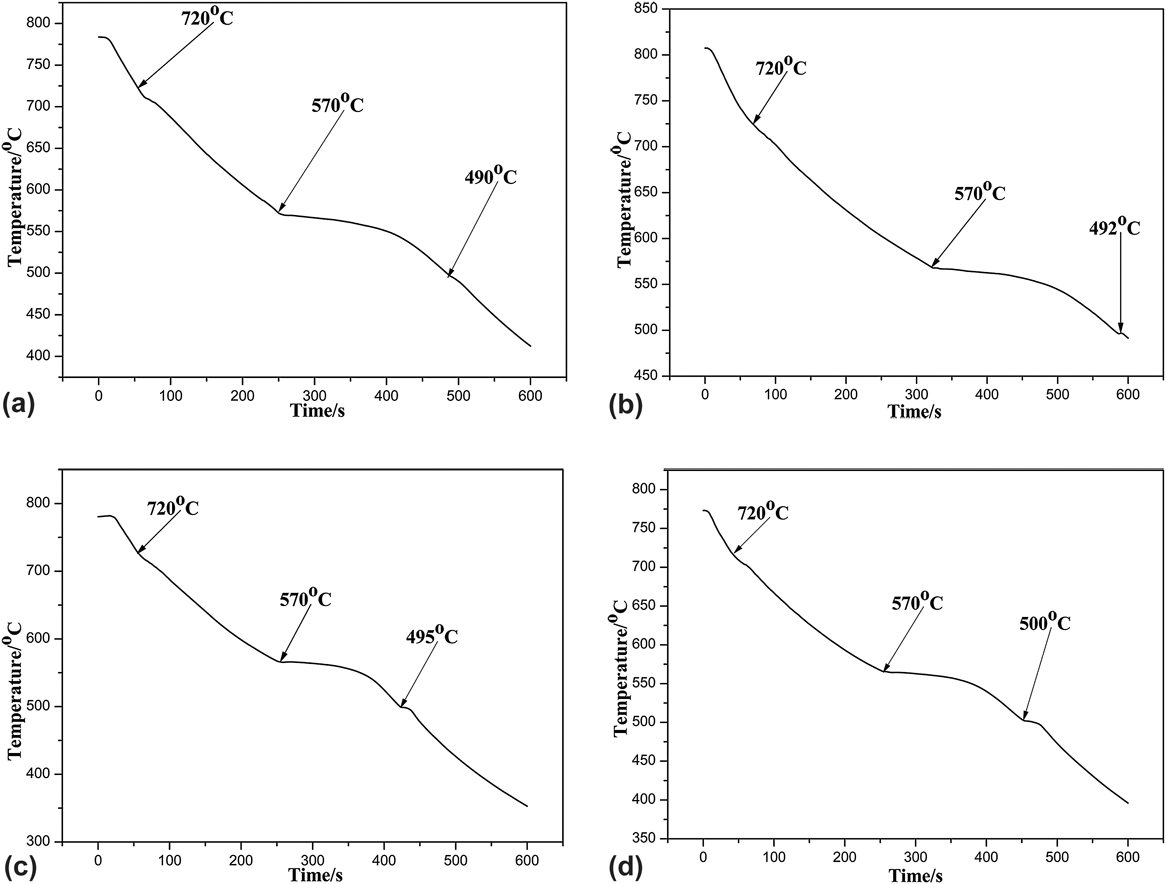
Figure 9 demonstrates the solidification curves of Al–22Si–xCu–0.4Mg alloys. From solidification curve, three temperature plateaus can be found, which are primary silicon precipitation (L → Si) plateau, ternary eutectic reaction (L → Si + α-Al) plateau, and quaternary eutectic reaction (L → Al2Cu + Si + α-Al) plateau respectively. The solidification sequence of Al–22Si–xCu–0.4Mg alloy is in consistence with the SEM micrographs in Fig. 4. Irregular polygonal primary Si precipitates are formed first from the melt, then, the eutectic (Al + Si) forms from the melt. When eutectic (Al + Si) completely solidified from the melt, the solid skeleton formed. When solid skeleton was established, intergranular eutectic (Al + Si + Al2Cu) liquid is left in the intervals of the eutectic (Al + Si). That is why white intergranular eutectic (Al + Si + Al2Cu) is near long rod binary eutectic Si or α-Al, not near primary Si. The primary silicon precipitation temperature of Al–22Si–xCu–0.4Mg is around 720 °C. For Al–22Si–xCu–0.4Mg alloy, ternary eutectic reaction temperature remains around 570 °C. Reference Zeren, Karakulak and Gümüş16 It is well-known that when the solid skeleton established and little liquid film left in the intervals of solid skeleton, hot tearing phenomenon has the highest probability to happen. Reference Birol12 For cast Al–Si–Cu–Mg alloy, higher Cu content elevates the quaternary eutectic reaction (L → α-Al + Si + Al2Cu) temperature. Reference Zeren, Karakulak and Gümüş16,Reference Wang, Bian, Wang and Zhang17 Quaternary eutectic reaction (L → α-Al + Si + Al2Cu) temperature of Al–22Si–xCu–0.4Mg alloy with 1.5 wt%, 2.5 wt%, 3.5 wt%, 4.5 wt% nominal Cu content is 490 °C, 492 °C, 495 °C, 500 °C respectively. In the first place, it is apparent that the quaternary eutectic reaction plateau becomes longer when Cu content goes up, which demonstrates that the quaternary eutectic reaction time prolongs. For Al–22Si–xCu–0.4Mg alloy, the quaternary eutectic reaction (L → α-Al + Si + Al2Cu) period is the vulnerable period in which thin liquid films exists between eutectic (Al + Si) dendrites. A large freezing range alloy promotes hot tearing since such an alloy spends a longer time in the vulnerable state in which thin liquid films exists between the dendrites. Taking into account that the highest strain accumulated in the liquid film, Dodd, Metz, and Flemings explained the increase of hot tearing caused by the segregation of a low-melting component from the viewpoint that this addition increases the time of the liquid film existence. Reference Birol12 In Fig. 9, it is evident that compared with (b) or (d), the quaternary eutectic reaction plateau growth of (c) is most. Consequently, the HCS value jumps most from (b) to (c). Also in Fig. 9, the quaternary eutectic reaction plateau of (d) is longest, as a result, the HCS value of (d) is highest. From this point of view, longer quaternary eutectic reaction time promotes the hot tearing susceptibility significantly, which is the primary factor. There is another point, the liquid film distribution is determined by the dihedral angle θ. With a low dihedral angle, the liquid tends to spread out over the grain boundary surface, which strongly reduces the dendrite coherence. From the microstructure analysis above (in Fig. 4), for Al–22Si–xCu–0.4Mg alloy, the liquid films tends to spread out over α-Al grain boundary surface when high Cu content is added (especially when Cu content is over 2.5 wt%, the liquid films spread out most apparently). Therefore, for Al–22Si–xCu–0.4Mg alloy, the HCS value increases most when nominal Cu content is increased from 2.5 wt% to 3.5 wt%. From this point of perspective, intergranular continuous liquid net spread out over α-Al grain boundary promotes hot tearing markedly. This is the secondary important factor. The last one but not the least, it is apparent in Fig. 9 that the quaternary eutectic reaction temperature goes up with the addition of Cu. The higher the quaternary eutectic reaction temperature is, the lower the rupture strength of the semisolid matrix becomes. Fracture or hot tearing occurs if the shrinkage stress exceeds the rupture stress. If the rupture strength of the semisolid matrix is lower enough, hot crack forms more easily because the rupture strength can be exceeded by the accumulated stress more easily. Therefore, higher quaternary eutectic reaction temperature promotes hot tearing. The above are the three reasons why hot tearing susceptibility rises with the addition of Cu. To improve mechanical property and reduce hot tearing susceptibility at the same time, Al–22Si–0.4Mg alloy with 2.5 wt% Cu addition is the most suitable choice for high pressure die casting.
Solidification curves of Al–22Si–xCu–0.4Mg alloy: (a) 1.5 wt% Cu, (b) 2.5 wt% Cu, (c) 3.5 wt% Cu, and (d) 4.5 wt% Cu.

IV. CONCLUSIONS
In Al–22Si–xCu–0.4Mg alloy, the amount and average size of Al2Cu phase increases with Cu content increased. The UTS improves with the addition of Cu. And the hot tearing susceptibility also goes up sharply when more Cu is added, which is caused by longer quaternary eutectic reaction time, larger amount of residual intergranular Cu-rich liquid film spreading out over α-Al grain boundary, and higher quaternary eutectic reaction temperature. Considering both the mechanical property and hot tearing susceptibility, optimal Cu content for die casting Al–22Si–0.4Mg alloy found in this paper is 2.5 wt%.
ACKNOWLEDGMENTS
This project is sponsored by National Natural Science Foundation of China (No. 51404153) and Shanghai Yang-fan Program (No. 14YF1402000). The authors would like to thank Dr. Chaoying Xie for her kind help in revising the manuscript.