Introduction
The elderly population size is growing worldwide due increased life expectancy of older adults (Oeppen and Vaupel, Reference Oeppen and Vaupel2002). This is also affecting the number of “oldest” old people (80+ years) (Jeune and Skytthe, Reference Jeune and Skytthe2001; Shah, Reference Shah2007a), and is expected to lead to an increase in the number of centenarians worldwide. Over recent decades, there has been a steady increase in centenarians, and in some countries the number of centenarians has almost exponentially increased (Drefal et al., Reference Drefal, Lundstrom, Modig and Ahlbom2012). Moreover, there is no indication that this will change in the foreseeable future (Oeppen and Vaupel, Reference Oeppen and Vaupel2002; Christensen et al, Reference Christensen, Doblhammer, Rau and Vaupel2009).
Suicide rates generally increase with ageing in many countries (Shah, Reference Shah2007b; Bertolote and De Leo, Reference Bertolote and De Leo2012). A higher suicide risk has been reported among very old men, but this phenomenon has not been found consistently for women (Coren and Hewitt, Reference Coren and Hewitt1999; De Leo, Reference De Leo1999). A Danish study reported that suicide rates in the oldest old (80+ years) remained stable over the period 1972–1998, whereas those in the 50–64 and 65–79 years age groups declined (Erlangsen et al., Reference Erlangsen, Bille Brahe and Jeune2003). Similar observations were evident in England and Wales for the decade ending 1995 in the very old (Shah et al., Reference Shah, Elanchenny and Collinge2001). In the Danish study, compared to the two other younger groups, suicide rates in males were the highest in the oldest old, but in females they were the lowest (Erlangsen et al., Reference Erlangsen, Bille Brahe and Jeune2003), with the sex ratio in the oldest old being 1:3 compared to 1:2 in the younger age groups (Erlangsen et al., Reference Erlangsen, Bille Brahe and Jeune2003). In New Zealand, one forensic study of 319 deaths amongst centenarians and near centenarians, reported only 3 suicides. (John and Koelmeyer, Reference John and Koelmeyer2001). An American study of death certificates reported no suicides amongst 449 centenarians (Gessert et al., Reference Gessert, Elliot and Haller2002). A Swedish cohort study of 97+ year olds reported the following in the past month: life not worth living, 8%; death wishes, 10.5%; thoughts of taking life, 3.8%; and no suicide attempts (Mellqvist Fassberg et al., Reference Mellqvist Fassberg, Ostling, Borjesson-Hanson, Skoog and Waern2013). The oldest age groups for which data on suicide rates are available is from Germany where the suicide rate in those over the age of 90 years was 90.1 per 100,000 for men and 20.9 per 100,000 for women (Schmidtke and Weinacker, Reference Schmidtke and Weinacker1991). In general, the oldest age groups studied so far have represented the amalgamation of all individuals aged over 75 years (Shah et al., Reference Shah, Bhat, MacKenzie and Koen2007) and over 80 years (Erlangsen et al., Reference Erlangsen, Bille Brahe and Jeune2003). Nevertheless, little is known specifically about suicide rates amongst centenarians and the current knowledge is based on case-reports.
An Australian study of centenarians reported low rates of psychological distress and high rates of satisfaction with life (Sachdev et al., Reference Sachdev2013). Another Australian study of centenarians reported lower levels of depression (Richmond et al., Reference Richmond, Law and KayLamkin2011; Reference Richmond2012) and higher levels of quality of life (Richmond et al., Reference Richmond, Law and KayLamkin2011) than in the general population. A study of Hong Kong centenarians reported low levels of depression and suicidal ideation (Cheung et al., Reference Cheung2012). An Italian study reported that centenarians had lower scores for anxiety and depression compared to younger age groups (Dello Buono et al., Reference Dello Buono, Urciuoli and De Leo1998). An American study of veteran centenarians, comparative to younger age groups, reported low levels of “mental health issues” (Selim et al., Reference Selim2005). A qualitative study of 16 centenarians in the United Kingdom revealed that they presented a positive picture of the ageing process counteracting the negative stereotypes about ageing (Koch, Reference Koch2010). A Danish qualitative study of 30 women aged 85+ years reported that majority had a positive view of life (Hedberg et al., Reference Hedberg, Brulin and Alex2009). Among 25 centenarians in Barbados, high levels of religiosity were positively linked to successful adaptation and coping and high levels of life satisfaction (Archer et al., Reference Archer2005). Given that presence of depressive illness and poor quality of life are important risk factor for suicide in old age (Shah and De, Reference Shah and De1998; De Leo et al., Reference De Leo, Draper, Snowdon and Kolves2013), the above observations tend to suggest the possibility of lower suicide rates in centenarians compared to younger age groups. Furthermore, experience of adversity earlier in life has been recognised as a protective factor against suicide in old age (McIntosh, Reference McIntosh1984; Seiden, Reference Seiden1981; Shah and Bhat, Reference Shah and Bhat2009). Centenarians would have had the longest potential period of exposure to adversity in life, and it could be speculated that this may have the potential to reduce suicide rates in this age group.
The vast majority of centenarians suffer from chronic diseases; cardiovascular diseases, osteoarthiritis and hypertension are the commonest (Anderson-Ranberg, Reference Andersen-Ranberg, Schroll and Jeune2001). Moreover, about half of the centenarians may have dementia (Anderson-Ranberg, Reference Andersen-Ranberg, Schroll and Jeune2001); although, there is evidence that the prevalence of dementia in the oldest old currently may be lower than in previous decades (Christensen et al., Reference Christensen, Doblhammer, Rau and Vaupel2009). Nevertheless, about 20% of centenarians may be able to live a relatively autonomous and independent life (Motta et al., Reference Motta, Bennati, Ferlito, Malaguarnera and Motta2004; Christensen et al, Reference Christensen, McGue, Petersen, Jeune and Vaupel2008). Oldest old are considerably frailer than the “young” old (Jeune, Reference Jeune2002). An American study of 90+ year olds reported that the prevalence of functional disability increased with age and was present in 97% of centenarians (Berlau et al., Reference Berlau, Corrada and Kawas2009). A Danish study of centenarians reported that functional disability was most prevalent in centenarians when compared to other older age groups (Andersen-Ranberg et al., Reference Andersen-Ranberg1999). However, consistent findings suggest that the oldest old currently have better health and functional skills than in previous decades (Christensen et al., Reference Christensen, McGue, Petersen, Jeune and Vaupel2008; Reference Christensen, Doblhammer, Rau and Vaupel2009). Given that functional disability and loss of independence are important risk factors for suicide in older people (Shah and De, Reference Shah and De1998; De Leo and Spathonis, Reference De Leo and Spathonis2003), these observations would suggest their potential to increase suicide rates in centenarians. However, a Swedish cohort study of 97+ year olds did not observe any association between suicidal ideation and poor perceived health or disability (Mellqvist Fassberg et al., Reference Mellqvist Fassberg, Ostling, Borjesson-Hanson, Skoog and Waern2013). In addition, a Swedish study of centenarians reported that they were less likely to use antidepressants than nonagenarians and octagenerians (Wastesson et al., Reference Wastesson2012); again, this would potentially increase suicide rates in centenarians, if depressive illness is not adequately treated.
It is, therefore, difficult to make sensible predictions of the potential suicide rates in centenarians because of the simultaneous presence of factors that could theoretically drive suicide rates in either direction. With this in mind, and in the absence of any studies of suicide amongst centenarians, a cross-national study examing suicide rates in centenarians of both gender was undertaken.
Methods
Data on the number of suicides
Data on the number of suicides (ICD-10 codes X60–84) amongst those aged 100 years and over were ascertained for each country listed with the United Nations Statistics Division (http://unstats.un.org/unsd/methods/inter-natlinks/sd_natstat.asp) using three approaches. First, either members of the International Research Group on Suicide in Older Adults or other colleagues in individual countries were approached through e-mail. Second, for countries where there was no contact person or where the contact person was unable to provide this type of data, the national statistics office website was searched for the above data. The website details for the national statistics offices were ascertained from the United Nations Statistics Division website (http://unstats.un.org/unsd/methods/inter-natlinks/sd_natstat.asp). Third, where data were not available on the national statistics website, the national statistics office was contacted by e-mail. Up to three reminder e-mails were sent. The ICD-10 codes X60–84 cover 25 different methods of suicide, and is the main international classification of suicide. Unfortunately, data were not available for the individual methods of suicide, and these, therefore, will not be considered further.
The International Classification of Diseases (ICD-10) (World Health Organisation, 2007) was used to record deaths, where deaths due to suicide are coded X60–84. Data were ascertained for as many years as possible from 2000 onwards for men and women. Countries were included in the analysis if data were available for a minimum of five years. The reason for doing this was that the number of centenarians is comparatively low and the number of suicides in this age group is also comparatively small. This approach would overcome any year on year random variation.
Data on population size for centenarians in individual countries
Data on the corresponding population at risk (i.e. the number of centenarians in the countries from which the suicide figures were obtained) were obtained for the same period from the United Nations website (http://esa.un.org/unpd/wpp/unpp/panel_indicators.htm). This data source provided population figures for the years 2000, 2005 and 2010. The number of centenarians for each calendar year was estimated from these figures assuming an exponential growth rate as suggested by Preston et al. (Reference Preston, Heuveline and Guillot2000). For countries where there was information on erroneous recording of centenarians (Fortes Gomes and Turra, Reference Fortes Gomes and Turra2009), corrected population estimates from the United States Census Bureau were used (http://www.census.gov/population/international/data/idb/informationGateway.php); this data source was only used for Brazil (Fortes Gomes and Turra, Reference Fortes Gomes and Turra2009).
Data analysis
The numbers of suicide (X60–84) amongst centenarians was summarised across countries and calendar years to produce a global composite figure for the period 2000–2012. The numbers of centenarians, for all the study years (same years as those for suicides and undetermined deaths) in each country, were added together. The numbers of centenarians calculated for each country were added together to produce a global composite figure. All figures were calculated separately for men and women.
Global rate for suicides (X60–84) was calculated by dividing the total number of suicides calculated using the above methodology with the corresponding number of centenarians. The 95% confidence interval was also estimated. These analyses were conducted for men and women.
Suicide rates were also estimated for individual countries. Where the number of suicides in individual countries was small, data from these countries was amalgmated because of concern over identification and privacy (some national statistics offices had expressed concern over this).
Results
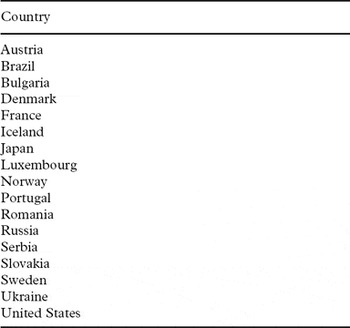
Data for the number of suicides (X60–84) were available for 17 countries. A list of countries is provided in Appendix 1. The following were the sources of data: colleagues in the countries, N = 8; national statistics office website, N = 1; and, direct email contact with national statistics office, N = 8. Data were available for the years 2000–2012. The median number of years for which data were available was 11.5 (range 6–12).
Table 1 illustrates the number of suicides, the total population size for centenarians, the suicide rate per person year, the 95% confidence intervals and the total number of years for the whole data set. The total number of suicides (X60–84) was 90 in men and 64 in women. The suicide rate was 57 (95% confidence interval 45–69) per 100, 000 person years in men and 6.8 (95% confidence interval 5.1–8.5) per 100,000 person years in women.
Estimates of suicide rates for centenarians

There were no suicides amongst male centenarians in Denmark, Iceland, Luxembourg, Romania, Slovakia and Sweden. Suicide rates in male centenarians from Austria, Brazil, Bulgaria, France, Norway, Portugal, Russia, Serbia and Ukraine was small (total of 24 suicides) and the amalgamated rate was 128 per 100,000 person years (95% confidence interval 80–177). The male centenarian suicide rate in Japan (N = 37) was 30 per 100,000 person years (95% confidence interval 19–42) and in the United States was 93 per 100,000 person years (95% confidence interval 63–122). There were no suicides amongst female centenarians in Austria, Bulgaria, Iceland, Luxembourg, Norway, Romania, Serbia, Slovakia and Ukraine. Suicide rates in female centenarians from Brazil, Denmark, Russia, Sweden and the United States was small (total of 14 suicides) and the amalgamated rate was 2.2 per 100,000 person years (95% confidence interval 1.1–3.4). The female centenarian suicide rate in Japan (N = 28) was 11 per 100,000 person years (95% confidence interval 7–15) and in France was 22 per 100,000 person years (95% confidence interval 13–31).
Discussion
This is the first study to estimate a global suicide rate in centenarians. However, some methodological issues need careful consideration before discussing the findings. Data on suicide rates in cross-national studies should be viewed with caution for the following reasons: data are not available from all countries (Moscicki, Reference Moscicki1995; Wasserman et al., Reference Wasserman, Cheng and Jiang2005; De Leo et al., Reference De Leo, Milner and Wang2009) and data for suicides among centenarians were available for only 17 countries; the validity of these data is unclear (Diekstra, Reference Diekstra1989; Wasserman et al., Reference Wasserman, Cheng and Jiang2005); the legal criteria for the proof of suicide vary between countries and different regions within a country (Shah and Ganesvaran, Reference Shah, Ganesvaran, Chiu and Ames1994; Wasserman et al., Reference Wasserman, Cheng and Jiang2005; De Leo et al., Reference De Leo, Dudley, Aebersold, Mendoza, Barnes, Harrison and Ranson2010; Kapusta et al., Reference Kapusta2011); some countries have poor death registration facilities (Shah and Ganesvaran, Reference Shah, Ganesvaran, Chiu and Ames1994); and, cultural and religious factors and stigma attached to suicide may lead to under-reporting of suicides (Abrahams et al., Reference Abrahams, Abrahams and Jacob2005; Wasserman et al., Reference Wasserman, Cheng and Jiang2005). Surprisingly, many developed countries (e.g. Canada, Germany, New Zealand and the United Kingdom) were unable to provide data on the number of suicides in centenarians because their recording systems amalgamated data for 85+, 90+ or 95+). Furthermore, some countries have poor birth registration facilities and this could potentially lead to errors in population estimate of centenarians.
It is possible that the findings are an artefact of the above methodological difficulties. However, the data were ascertained from the best available sources. The suicide rate of 57 per 100,000 person years in men compares reasonably well the rate of 19.6 (range 0–93) in men aged 65–74 and 29.3 (range 0–161) in men aged 75+ years in a cross-national study (Shah et al., Reference Shah, Bhat, MacKenzie and Koen2007; Shah, Reference Shah2011). The suicide rate of 6.8 per 100,000 person years in women compares reasonably well with the rate of 4.0 (range 0–32) in women aged 65–74 and 5.1 (range 0–71) in women aged 75+ years in a cross-national study (Shah et al., Reference Shah, Bhat, MacKenzie and Koen2007; Shah, Reference Shah2011). If the 95% confidence intervals are considered then the observed suicide rates are also comparable with the range of suicide rates observed in 65–74 and 75+ year olds across different countries in the earlier studies. The observed figures are also comparable to those in 90+ year olds from Germany: 90.1 per 100,000 in men and 20.9 per 100,000 in women (Schmidtke and Weinacker, Reference Schmidtke and Weinacker1991). Moreover, both suicide rates were higher in men than in women centenarians and these gender differences are similar to those reported for 65–74 and 75+ year olds in a cross-national study (Shah et al., Reference Shah, Bhat, MacKenzie and Koen2007; Shah, Reference Shah2011) and for 50–64 and 65–79 year olds in Denmark (Erlangsen et al., Reference Erlangsen, Bille Brahe and Jeune2003). These comparative observations suggest that the current findings may have some validity despite the methodological issues. Moreover, the observed suicide rates in centenarians are likely to be an under-estimate because some suicides are mis-classified as undetermined deaths (O’Donnell and Farmer, Reference O’Donnell and Farmer1995; De Leo and Carollo, Reference De Leo and Carollo1996; Dennis et al., Reference Dennis2001).
Caution should be exercised in generalising the findings as data were only available from 17 countries. Furthermore, at present it is not possible to state if the suicide rate amongst centenarians is higher or lower than the comparable rates from younger age groups in narrow five-year age-bands. Such comparative data are not currently available in the literature, but work is in progress to provide such data in the near future. Nevertheless, suicide rates are sufficiently large amongst centenarians for there to constitute a public health concern given the anticipated rise in the centenarian population and the paucity of data on risk and protective factors for suicide in this age group. There is clearly a need to continue to ascertain data on suicides in this age from more countries and to identify the risk and protective factors which may be able to inform national suicide prevention strategies.
Conflict of interest
None.
Description of authors’ roles
AE and DDL conceived the idea. AS, SZ, RB and AE conducted literature searches. AS coordinated the study. Data collection and analyses were conducted by AS, SZ, AE and RB. AS wrote the first draft. All authors amended the draft leading to the final version. DDL gave expert advise on strategie issues.
Acknowledgments
We would like to thank colleagues who helped us secure the data: Dr Ildri Kjolseth (Norway), Prof Lars Mehlum (Norway), Dr France Mesle (France); Dr Margda Waern and Dr Guo-Xin (Sweden), Professor Nestor Kapusta (Austria), Professor Hirofumi Oyama (Japan), Dr Richardo Gusmao (Portugal) and Professor John McIntosh (USA). We are also grateful to the national statistics offices of several countries for providing us with the data.
Countries included in the study