Interest in the impact of institutionalization has seen a resurgence due to the increased number of children adopted from institutions and the percentage of postinstitutionalized children exhibiting difficulties (Fisher, Ames, Chisholm, & Savioe, Reference Fisher, Ames, Chisholm and Savioe1997; Rutter & the English and Romanian Adoptees [ERA] Study Team, Reference Rutter1998). These children also provide an opportunity to study the effects of a circumscribed period of deprivation and the potential for recovery following a dramatic change in context. In the current study, atypical behavior characterized by an eagerness to interact with unfamiliar adults was investigated in postinstitutionalized children several years postadoption. Because this behavior is believed to result from the absence of a consistent, responsive caregiver (Chisholm, Carter, Ames, & Morison, Reference Chisholm, Carter, Ames and Morison1995; O'Connor, Bredenkamp, Rutter, & the ERA Study Team, Reference O'Connor, Bredenkamp and Rutter1999), children who received more individualized care because of placement in foster care prior to adoption were included as a comparison group. Behavioral correlates speculated to underlie this behavior, including attachment-related behaviors, basic emotion abilities, and inhibitory control abilities, were also explored.
International Adoption: Incidence, Preadoption Experiences, and Outcomes
More than 226,000 children were internationally adopted into the United States between 1990 and 2005 (US Department of State, n.d.). During this same period, adoption trends changed drastically. In 1990, 37% of internationally adopted children were born in South Korea, and 3% of the children were born in Eastern Europe or China. By 2000, only 10% of the children were born in South Korea, and 65% of the children were born in Eastern Europe or China.
This shift was significant, as South Korea markedly differs from Eastern Europe and China in terms of the three levels of care that summarize children's preadoption experiences (i.e., adequate medical care and nutrition, sufficient motor and cognitive stimulation, and consistent, responsive caregiving; Gunnar, Bruce, & Grotevant, Reference Gunnar, Bruce and Grotevant2000). In South Korea, children are raised in stable foster care placements and receive excellent medical care, nutrition, and individualized care from trained parents (Kim, Reference Kim1995). Research, though limited, has suggested that these children experience few cognitive or socioemotional difficulties at adoption (Kim, Reference Kim1995). In Eastern Europe and China, children are raised in deprived institutional settings that do not provide adequate general stimulation or individualized care (Johnson, Reference Johnson and Nelson2000; Muhamedrahimov, Palmov, Nikiforova, Groark, & McCall, Reference Muhamedrahimov, Palmov, Nikiforova, Groark and McCall2004). At adoption, these children demonstrate poor medical health (Hostetter et al., Reference Hostetter, Iverson, Thomas, McKenzie, Dole and Johnson1991; Johnson et al., Reference Johnson, Miller, Iverson, Thomas, Franshino and Dole1992), stunted physical growth (Albers, Johnson, Hostetter, Iverson, & Miller, Reference Albers, Johnson, Hostetter, Iverson and Miller1997; Rutter & the ERA Study Team, 1998), cognitive delays (Benoit, Jocelyn, Moddemann, & Embree, Reference Benoit, Jocelyn, Moddemann and Embree1996; Morison, Ames, & Chisholm, Reference Morison, Ames and Chisholm1995), and socioemotional difficulties (Verhulst, Althaus, & Versluis-Den Bieman, Reference Verhulst, Althaus and Versluis-Den Bieman1990a; Vorria, Rutter, Pickles, Wolkind, & Hobsbaum, Reference Vorria, Rutter, Pickles, Wolkind and Hobsbaum1998). Interestingly, the socioemotional difficulties diverge from the other delays with regard to etiology and recovery. That is, socioemotional difficulties are associated with a lack of individualized care from a consistent caregiver rather than a lack of adequate nutrition or general stimulation (Hodges & Tizard, Reference Hodges and Tizard1989a, Reference Hodges and Tizard1989b; Vorria et al., Reference Vorria, Rutter, Pickles, Wolkind and Hobsbaum1998), and these difficulties persist or sometimes increase after adoption (Benoit et al., Reference Benoit, Jocelyn, Moddemann and Embree1996; Johnson, Reference Johnson and Nelson2000; Kreppner, O'Connor, Rutter, & the ERA Study Team, 2001; Morison & Ellwood, Reference Morison and Ellwood2000).
Disinhibited Social Behavior in Postinstitutionalized Children
Many postinstitutionalized children also display an extreme lack of social reserve with unfamiliar adults. The children approach, make personal comments to, initiate physical contact with, and willingly leave with unfamiliar adults without hesitation. These interactions tend to be superficial and nonreciprocal. However, the children are not truly indiscriminate, as they demonstrate a preference for familiar adults despite being more likely than other children to approach unfamiliar adults (O'Connor et al., Reference O'Connor, Marvin, Rutter, Olrick and Britner2003). It is believed that this behavior might be a marker for a severe disturbance and might place the children at risk for harm (O'Connor et al., Reference O'Connor and Rutter2000; Rutter et al., Reference Rutter, Colvert, Kreppner, Beckett, Castle and Groothues2007). Despite similar descriptions across studies, this behavior has been labeled variously (e.g., indiscriminate friendliness and disinhibited attachment behavior; Chisholm et al., Reference Chisholm, Carter, Ames and Morison1995; O'Connor et al., Reference O'Connor, Bredenkamp and Rutter1999). For this paper, disinhibited social behavior, a more descriptive label, was used to refer to the children's excessively familiar behavior with unfamiliar adults. (This label was not intended to invoke the concept of behavioral inhibition, a broader characteristic reflecting children's behavior in unfamiliar situations [Kagan, Reference Kagan and Reznick1989].) In the current study, the persistence, etiology, and behavioral correlates of disinhibited social behavior were examined in postinstitutionalized children several years postadoption.
Disinhibited social behavior has been observed in numerous studies. For example, institutionalized children were described as more indiscriminate in their interactions with unfamiliar adults than children raised by their families (Smyke, Dumitrescu, & Zeanah, Reference Smyke, Dumitrescu and Zeanah2002; Vorria et al., Reference Vorria, Rutter, Pickles, Wolkind and Hobsbaum1998). Over 60% of Romanian children were rated by their adoptive parents as very friendly to unfamiliar adults (Chisholm et al., Reference Chisholm, Carter, Ames and Morison1995). Postinstitutionalized children also displayed more disinhibited social behavior than domestically adopted children (O'Connor et al., Reference O'Connor, Bredenkamp and Rutter1999). Furthermore, similar to the other socioemotional difficulties observed in postinstitutionalized children, disinhibited social behavior persists. Four years postadoption, children reared in high-quality institutions were described as more indiscriminately affectionate and were more talkative during an interaction with an unfamiliar adult than children raised by their families (Hodges & Tizard, Reference Hodges and Tizard1989b; Tizard & Hodges, Reference Tizard and Hodges1978). According to their parents, there was no change in the overall level of disinhibited social behavior or the number of children who displayed a marked pattern of this behavior over a 2-year period (Chisholm, Reference Chisholm1998; O'Connor et al., Reference O'Connor and Rutter2000). In the current study, children were assessed at least 3 years postadoption; thus, the results could provide additional evidence for the persistence of this behavior.
Etiology of Disinhibited Social Behavior
Following his observations of young children including young institutionalized children, Bowlby (Reference Bowlby1982) formulated attachment theory, which views the attachment relationship as an adaptive mechanism and describes the effects of caregiving experiences on this relationship and subsequent relationships. Based on this theory, it has been speculated that disinhibited social behavior results from the lack of a consistent, responsive caregiver rather than from inadequate medical care, nutrition, or general stimulation (Chisholm et al., Reference Chisholm, Carter, Ames and Morison1995; O'Connor et al., Reference O'Connor, Bredenkamp and Rutter1999; Smyke et al, Reference Smyke, Dumitrescu and Zeanah2002). Indeed, disinhibited social behavior was not related to parent report or objective indices of general deprivation (Chisholm, Reference Chisholm1998; O'Connor et al., Reference O'Connor, Bredenkamp and Rutter1999). This behavior has also been observed in children adopted from high-quality institutions that provided adequate nutrition and general stimulation but not consistent caregivers (Roy, Rutter, & Pickles, Reference Roy, Rutter and Pickles2004; Tizard & Rees, Reference Tizard and Rees1975; Vorria et al., Reference Vorria, Rutter, Pickles, Wolkind and Hobsbaum1998). Finally, disinhibited social behavior was reduced in an institution designed to increase caregiver consistency (Smyke et al., Reference Smyke, Dumitrescu and Zeanah2002). However, institutionalized children with preferred caregivers still displayed this behavior (Zeanah, Smyke, & Dumitrescu, Reference Zeanah, Smyke and Dumitrescu2002). Thus, additional research is needed to ascertain the etiology of disinhibited social behavior. In the current study, etiological factors were examined through the inclusion of children adopted from foster care. As is noted above, institutional care and foster care differ greatly in terms of individualized care (i.e., highly regimented care from multiple caregivers vs. consistent individualized care from one caregiver). Thus, the children adopted from foster care were expected to display less disinhibited social behavior. These children also experienced less general deprivation. Therefore, to examine the specific role of individualized care, it was important to control for differences in general deprivation.
Behavioral Correlates of Disinhibited Social Behavior
Because of its similarities with symptoms of an attachment disorder, much research exploring the behavioral correlates of disinhibited social behavior has focused on the children's attachment relationship with their adoptive parents. However, disinhibited social behavior was not correlated with measures of attachment security soon after adoption (Chisholm, Reference Chisholm1998). Furthermore, despite an improvement in attachment security 2 years later, there was not a corresponding decrease in disinhibited social behavior (Chisholm et al., Reference Chisholm, Carter, Ames and Morison1995). The authors concluded that disinhibited social behavior reflects an adaptive, but persistent, response to an extremely deprived environment rather than a disturbance in the attachment system.
In contrast, O'Connor and colleagues (Reference O'Connor, Marvin, Rutter, Olrick and Britner2003) argued that disinhibited social behavior signals the lack of a selective attachment relationship, an indicator of an attachment disorder. They also noted that traditional assessment procedures might not be appropriate for postinstitutionalized children, as these procedures assume the presence of a selective relationship. Thus, they modified a coding system for a traditional observational procedure by adding an atypical insecure attachment classification, which involved unusual behaviors such as seeking contact with the unfamiliar adult. Among postinstitutionalized children, atypical attachment was related to disinhibited social behavior (O'Connor et al., Reference O'Connor, Marvin, Rutter, Olrick and Britner2003). Given the equivocal results, the relation between the children's disinhibited social behavior and attachment relationship warrants further attention. In the current study, attachment-related behaviors indicating selective use of the parent as a secure base and a source of comfort were assessed.
It has also been proposed that general socioemotional abilities, as opposed to an attachment disorder, underlie disinhibited social behavior. For example, it has been suggested that this behavior is “akin to inappropriate social approach . . . in the absence of an awareness of interpersonal boundaries” (O'Connor et al., Reference O'Connor, Bredenkamp and Rutter1999, p. 13). That is, disinhibited social behavior might reflect insensitivity to social and emotional cues. Indeed, children from Eastern European institutions demonstrated difficulty with identifying facial expressions of emotion and inferring emotional states from situational cues compared to nonadopted children (Wismer Fries & Pollak, Reference Wismer Fries and Pollak2004). Postinstitutionalized children also performed more poorly on a theory of mind task even after controlling for verbal ability (Tarullo, Bruce, & Gunnar, Reference Tarullo, Bruce and Gunnar2007). To date, the relation between disinhibited social behavior and general socioemotional abilities has not been examined. Thus, basic emotion abilities were assessed in the current study.
Finally, it has been suggested that disinhibited social behavior reflects underlying deficits in attention and behavior regulation as applied specifically to interactions with unfamiliar adults (MacLean, Reference MacLean2003). Research suggests that difficulties with inattentiveness and hyperactivity are particularly pervasive in postinstitutionalized children (Chugani et al., Reference Chugani, Behen, Muzik, Juhasz, Nagy and Chugani2001; Kreppner et al., Reference Kreppner, O'Connor and Rutter2001; Tizard & Rees, Reference Tizard and Rees1974; Vorria et al, Reference Vorria, Rutter, Pickles, Wolkind and Hobsbaum1998). In addition, in several studies with postinstitutionalized children, disinhibited social behavior was associated with reports of attention problems (Chisholm, Reference Chisholm1998; O'Connor et al., Reference O'Connor, Bredenkamp and Rutter1999, Reference O'Connor and Rutter2000; Roy et al., Reference Roy, Rutter and Pickles2004). To expand upon these results, the current study focused on a specific aspect of regulation, inhibitory control, rather than the more global measures of attention problems previously used. Because inhibitory control (i.e., the ability to inhibit a prepotent attentional or behavioral response) has been shown to involve frontostriatal circuits (Casey et al., Reference Casey, Castellanos, Giedd, Marsh, Hamburger and Schubert1997), its inclusion could provide insight into the neural underpinnings of disinhibited social behavior.
Objectives and Hypotheses of the Current Study
The current study examined disinhibited social behavior in postinstitutionalized children several years postadoption and addressed possible etiological factors and behavioral correlates of this behavior. Disinhibited social behavior was assessed in children adopted from institutional care, children adopted from foster care, and children reared in their biological families using an observational measure and a parent interview. Although these measures have not been completed in the same study previously, it was expected that they would be related. Given the lack of consistent individualized care in institutions, it was predicted that children adopted from institutional care would demonstrate more disinhibited social behavior than children adopted from foster care and nonadopted children. It was also predicted that the group difference in disinhibited social behavior would remain significant after controlling for parent report of general deprivation experienced preadoption. To distinguish among competing hypotheses about underlying factors, behavioral correlates of disinhibited social behavior, including attachment-related behaviors, basic emotion abilities, and inhibitory control abilities, were explored.
Method
Participants
The sample included 120 6- to 7-year-old children (age range = 6.02–7.98 years, M age = 6.85 years, SD = 0.56 years). This age range was selected because it was appropriate for all of the measures of interest. The children were equally distributed across the institutional care, foster care, and nonadopted groups. The adopted children had been internationally adopted into the United States after receiving institutional care or foster care for the majority of their lives. The children in the institutional care group had spent at least 70% of their lives in institutional care and no more than 6 months in family-based care prior to adoption, and the children in the foster care group had spent at least 70% of their lives in foster care and no more than 2 months in institutional care prior to adoption. The adopted children were required to have been adopted prior to the age of 36 months to ensure adequate time in their adoptive homes. The children in the nonadopted group were raised by their biological families in the United States.
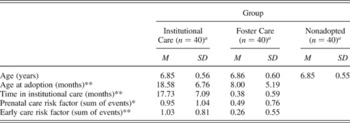
The foster care and nonadopted groups served as comparison groups for the institutional care group and were matched for age and gender. As is seen in Table 1, the groups did not differ in terms of age, F (2, 117) = .002, ns, and there were 30 girls and 10 boys in each group. However, because countries have institutional or foster systems to care for wards of the state, the institutional care and foster care groups differed in terms of country of origin. The institutional care group was primarily from Eastern Europe (45%) and China (43%), whereas the foster care group was primarily from South Korea (80%). In addition, because of difference in adoption policies, the institutional care group was significantly older than the foster care group at adoption, F (1, 78) = 61.61, p < .001.
Descriptive statistics for child characteristics

aEach group contains 30 girls and 10 boys.
*p < .05. **p < .01.
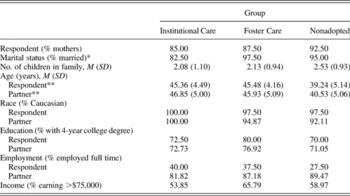
The parents completed a questionnaire about family characteristics, including parent age, education, and employment. As is shown in Table 2, the families of the three groups were similar, differing on only a few characteristics. Although most of the parents were married, the parents in the institutional care group were significantly less likely to be married, Pearson χ2 (2, N = 120) = 6.76, p < .05. In addition, the parents in the nonadopted group were significantly younger than the parents in the adopted groups, respondent's age F (2, 110) = 22.34, p < .001, partner's age F (2, 105) = 16.55, p < .001. Because none of these characteristics were significantly related to disinhibited social behavior, they were not included in additional analyses.
Descriptive statistics for family characteristics

*p < .05. **p < .01.
Procedure
The adopted children were recruited from the Minnesota International Adoption Project Registry, which included over 2,000 internationally adopted children at the time of the study. Children were included on the Registry after their parents returned a postcard expressing a willingness to participate in research. All of the nonadopted children were recruited from a department-maintained participant list, which consisted of children whose parents indicated an interest in research. Following a complete description of the study, families came for a laboratory session that lasted approximately 2.5 hr.
Measures
For the current study, individual scale and multimethod, multiagent composite scores were examined in analyses. Scales and composites were created using the strategy described by Patterson and Bank (Reference Patterson and Bank1986). The authors specified the two criteria for indicators of a scale or composite: (a) acceptable internal consistency (Cronbach α coefficient ≥ .60 and item-total correlations ≥ .20) and (b) convergence with other indicators designed to assess the same scale or composite (factor loadings for a one-factor solution ≥ .30). Indicators that met the specified criteria were used to create scale or composite scores.
Disinhibited social behavior
An observational measure was adapted from previous research with postinstitutionalized children (Tizard & Rees, Reference Tizard and Rees1975) to assess the children's tendency to initiate interactions with unfamiliar adults. At the beginning of each session, the child and parent were led to the testing room. The parent was seated at the back of the room to complete a questionnaire. The child was provided with drawing materials and was told that the parent needed to finish some paperwork. Once the family was situated, an unfamiliar female adult entered the room and introduced herself. The unfamiliar adult then sat quietly at the back of the room for 1 min. During this period, the adult responded briefly to any initiations made by the child but did not act to maintain the interactions. At the end of this time, the unfamiliar adult invited the child to play with some toys. After providing the toys, the unfamiliar adult sat quietly for 5 min. The unfamiliar adult then invited the child to play with her for 5 min, during which she interacted with the child in a more typical fashion. Each interaction was videotaped and coded by a trained coder. Although the coder was not informed of group membership, the child's ethnicity might have provided information about adoption status in some cases. The coder recorded the latency to the child's first verbal initiation and the frequency of verbal initiations to the unfamiliar adult. Two coders reviewed 20% of the videotapes to calculate interrater reliability. For the latency variable, coders were within 3 s of each other 83% of the time. The Cohen κ coefficient for the frequency variable was 0.86. The latency and frequency variables were significantly correlated, r (111) = −.68, p < .001, and thus were standardized and averaged to create an observational measure of disinhibited social behavior.
In addition, a semistructured interview designed to evaluate postinstitutionalized children's behavior with unfamiliar adults was completed (O'Connor et al., Reference O'Connor, Bredenkamp and Rutter1999, Reference O'Connor and Rutter2000). The parent was asked if the child was too eager to approach, made personal comments to, or initiated physical contact with unfamiliar adults. If any of the questions were endorsed, specific examples were requested. Each interview was audiotaped and coded by a trained coder, who was uninformed as to group membership. The questions were scored on a 3-point scale, with the highest score indicating a persistent pattern of disinhibited social behavior. Two coders reviewed 20% of the audiotapes to calculate interrater reliability (κ = 1.00–0.88). The scores to the three questions met the established criteria (α = .65, item-total correlations ≥ .44, and factor loadings ≥ .75). Thus, consistent with previous research, these scores were summed to create a parent report of disinhibited social behavior.
Because the observational measure and parent report of disinhibited social behavior have not been used in the same study, it was important to examine the relation between these measures. The scores from these two measures of disinhibited social behavior were significantly correlated, r (114) = .40, p < .001, and thus were standardized and averaged to create a composite measure of disinhibited social behavior.
General deprivation
To assess the duration and degree of general deprivation encountered prior to adoption, each adoptive parent completed a questionnaire about the child's preadoption experiences. The length of time in institutional care was used to index the duration of the deprivation, and two composite measures were created to index the degree of deprivation. The prenatal care risk factor was created by summing the number of adverse prenatal experiences reported by the parent (i.e., prenatal exposure to alcohol or other substances, prenatal malnourishment, and premature birth). The early care risk factor was created by summing the number of adverse caregiving experiences reported by the parent (i.e., multiple placements, discrimination due to ethnicity, sexual or physical abuse, and physical neglect).
General cognitive ability
To provide an estimate of the children's general cognitive functioning, each child was administered the vocabulary and block design subtests of the Wechsler Intelligence Scale for Children, Third Edition (Wechsler, Reference Wechsler1991). These subtests are considered the best measures of verbal and nonverbal intelligence, respectively, and are highly correlated with the full-scale intelligence quotient (Sattler, Reference Sattler1992). Raw scores on the subtests were converted into age-normed scaled scores. The scaled scores were then summed and transformed into full scale intelligence quotient equivalents.
Attachment-related behaviors
The children's attachment-related behaviors with their parents were assessed using a semistructured interview previously developed for research with postinstitutionalized children (O'Connor et al., Reference O'Connor, Bredenkamp and Rutter1999, Reference O'Connor and Rutter2000). The parent provided information about the child's willingness to confide in and to seek comfort from the parents for physical pain and emotional upset. The parent was asked open-ended questions (e.g., if your child is physically hurt or feeling ill, what does s/he do?) and was instructed to provide specific examples. Each interview was audiotaped and coded by a trained coder. The questions were scored on a three-point scale, with the highest score indicating that the child consistently and selectively relied on the parents for comfort. Two coders reviewed 20% of the audiotapes to calculate interrater reliability (κ = 1.00–0.90). The scores to the three questions met the established criteria (α = .60, item-total correlations ≥ .28, and factor loadings ≥ .58). Thus, consistent with previous research, the scores were summed to create an attachment-related behaviors score.
Basic emotion abilities
Three computerized tasks were used to assess the children's basic emotion abilities (Perlman, Kalish, & Pollak, Reference Perlman, Kalish and Pollak2008; Wismer Fries & Pollak, Reference Wismer Fries and Pollak2004). The first task, which consisted of eight trials, assessed the children's ability to recognize basic emotions. The child was presented with four pictures of the same individual displaying different emotions and was asked to select the picture in which a particular emotion was displayed. The second task, which included 16 trials, assessed the children's ability to infer emotional states from situational cues. During this task, the child heard a short vignette and was asked to select the picture that represented the protagonist's emotional state. The final task, which consisted of 27 trials, assessed the children's understanding of the antecedents of basic emotions. For this task, the child was asked to evaluate the accuracy of a robot's explanation for a protagonist's emotional state. Accuracy was recorded individually for the three tasks. The scores met the established criteria (α = .60, item-total correlations ≥ .34, and factor loadings ≥ .68), and thus were standardized and averaged to create a composite measure of basic emotion abilities.
Inhibitory control
Inhibitory control was assessed using two computerized tasks that neuroimaging studies have shown to activate the orbital prefrontal and anterior cingulate cortex (Casey et al., Reference Casey, Castellanos, Giedd, Marsh, Hamburger and Schubert1997). The first task, the go/no go task, was designed to measure children's ability to inhibit a prepotent behavioral response by selectively responding to the target stimuli while inhibiting responses to equally salient nontarget stimuli. In this task, letters were presented individually for 500 ms, with an interstimulus interval of 1,500 ms. The child was asked to respond as quickly as possible to every letter (targets) except “X” (nontargets). The task included two conditions: a control condition of 42 trials containing 100% targets and an inhibition condition of 42 trials containing 50% targets and 50% nontargets. The second task, the attentional control task, was developed to assess children's ability to process multiple stimulus attributes and inhibit attention to irrelevant attributes. In this task, three stimuli were presented simultaneously and varied in either shape or color. The child was asked to indicate which of the three stimuli differed from the other two. The stimuli were presented until a response was made. This task also contained two conditions: a control condition of 60 trials involving automatic processing and an inhibition condition of 60 trials involving controlled attentional processing. In the control condition, the attribute that was used to determine uniqueness was the same. In the inhibition condition, the attribute that was used to determine uniqueness changed from trial to trial. Percent correct during the inhibition condition was recorded separately for the two tasks.
Inhibitory control was also assessed using two delay of gratification tasks (Kochanska, Murray, & Coy, Reference Kochanska, Murray and Coy1997). For the dinky toys task, the child selected a prize from a box filled with prizes. However, the child was asked to verbally indicate the selection without touching or pointing at the prize. For the gift task, the child was instructed not to peek while a prize was being wrapped. The tasks were videotaped and coded by trained coders. For both tasks, the worst transgression, latency to the first transgression, and frequency of transgressions were coded. To calculate interrater reliability for the worst transgression and frequency variables, two coders reviewed 20% of the videotapes (κ = 0.93–0.81). For the latency variables, coders were within 1 s of each other 94% of the time. The three variables met the established criteria for the dinky toys and gift tasks (α = .62 and .95, item-total correlations ≥ .29 and .87, and factor loadings ≥ .59 and .94, respectively) and thus were standardized and averaged.
Finally, the Children's Behavior Questionnaire (Rothbart, Ahadi, Hershey, & Fisher, Reference Rothbart, Ahadi, Hershey and Fisher2001), a parent-report measure of temperament, was used to assess the children's inhibitory control abilities in daily situations. This 195-item questionnaire provides scores for 15 scales and three higher order dimensions. Two scales from the effortful control dimension, attention focusing (i.e., tendency to maintain attentional focus upon tasks) and inhibitory control (i.e., capacity to suppress inappropriate responses), were selected as most relevant to the construct of interest. These scales demonstrated acceptable internal consistency (α = .84 and .88, item-total correlations ≥ .35 and .41, and factor loadings ≥ .45 and .48, respectively). In addition, these scales were correlated, r (117) = .66, p < .001, and thus were standardized and averaged to create a parent report of inhibitory control.
As was expected, the scores from the go/no go task, attentional control task, dinky toys task, gift task, and parent report of inhibitory control met the established criteria (α = .64, item-total correlations ≥ .27, and factor loadings ≥ .47) and thus were standardized and averaged to create a composite measure of inhibitory control.
Results
Data analysis plan
First, group differences in general deprivation, behavioral correlates, and disinhibited social behavior were explored using one-way analyses of variance (ANOVAs). Post hoc paired comparisons using Fisher's least significant difference test were conducted to follow-up significant group differences. Second, the relations between the children's disinhibited social behavior, general deprivation, and behavioral correlates were examined using Pearson product-moment correlations. Third and finally, a multiple linear regression was conducted to determine variables that uniquely predicted disinhibited social behavior.
Preliminary analyses
General deprivation
Descriptive data for the indices of general deprivation for the two adopted groups are shown in Table 1. A one-way ANOVA indicated that the institutional care group spent significantly more time in institutional care than the foster care group, F (1, 78) = 237.73, p < .001, η2 = .75. In addition, according to parent report, the institutional care group experienced significantly more prenatal and early care risk factors than the foster care group, F (1, 77) = 5.12, p < .05, η2 = .06, and F (1, 76) = 24.09, p < .001, η2 = .24, respectively. Thus, the children in the institutional care group experienced longer and more severe deprivation prior to adoption according to their parents.
Behavioral correlates
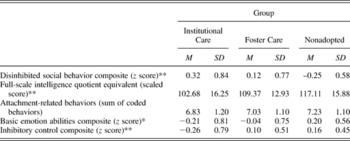
Descriptive data for the behavioral correlates are presented in Table 3. A one-way ANOVA revealed a significant group difference in the full-scale intelligence quotient equivalent, F (2, 116) = 9.13, p < .001, η2 = .14. Post hoc analyses indicated that the institutional care and foster care groups scored significantly lower than the nonadopted group, t (78) = −4.27, p < .001, and t (77) = –2.28, p < .05, respectively. The two groups of adopted children did not differ from each other, t (77) = –1.97, ns. Despite the group difference in general cognitive ability, only one adopted child scored below the average range (i.e., full scale intelligence quotient equivalent < 80) on this measure. The three groups did not differ on attachment-related behaviors, F (2, 117) = 1.25, ns, η2 = .02. However, there were significant group differences in basic emotion abilities and inhibitory control, F (2, 117) = 3.32, p < .05, η2 = .05, and F (2, 117) = 5.64, p < .005, η2 = .09, respectively. The institutional care group scored lower than the nonadopted group on the measure of basic emotion abilities, t (78) = –2.57, p < .05, whereas the foster care group did not significantly differ from the other groups, institutional care group t (78) = 1.06, ns, and nonadopted group t (78) = –1.50, ns. On the measure of inhibitory control, the institutional care group performed more poorly than the foster care and nonadopted groups, t (78) = –2.40, p < .05, and t (78) = –2.91, p < .05, respectively. The foster care group did not differ from the nonadopted group, t (78) = –0.57, ns. (Because of unequal variances among the groups, post hoc paired comparisons using Games–Howell test were conducted to follow-up the significant group difference in inhibitory control.) In summary, the institutional care group performed more poorly on the measures of general cognitive ability, basic emotion abilities, and inhibitory control than the nonadopted group. The foster care group performed worse than the nonadopted group in terms of general cognitive ability and performed better than the institutional care group in terms of inhibitory control.
Descriptive statistics for disinhibited social behavior and behavioral correlates

Note: For the disinhibited social behavior composite, higher numbers indicate more disinhibited social behavior. For each of the behavioral correlate scores, higher numbers indicate better performance.
*p < .05. **p < .01.
Group differences in disinhibited social behavior
Descriptive data for the composite measure of disinhibited social behavior are also presented in Table 3. There were no significant age or gender differences in disinhibited social behavior, r (118) = .07, ns, and F (1, 118) = 0.25, ns, η2 = .01, respectively. Likewise, the observational measure and parent report of disinhibited social behavior were not influenced by age or gender, observational measure r (114) = −.01, ns, and F (1, 114) = 0.29, ns, η2 = .01, respectively, and parent report r (118) = .08, ns, and F (1, 118) = 0.02, ns, η2 = .01, respectively. Although there were significant effects of age on basic emotion abilities and gender on inhibitory control, r (118) = .21, p < .05, and F (1, 118) = 5.44, p < .005, η2 = .04, respectively, age and gender were not considered in analyses because they were not related to disinhibited social behavior. However, a one-way ANOVA revealed a significant group difference in disinhibited social behavior, F (2, 117) = 6.05, p < .005, η2 = .09. Post hoc analyses indicated that the institutional care and foster care groups scored significantly higher than the nonadopted children, t (78) = 3.44, p < .001, and t (78) = 2.19, p < .05, respectively. The two adopted groups did not differ from each other, t (78) = 1.25, ns. Similarly, there were significant group differences for the observational measure and parent report of disinhibited social behavior, F (2, 113) = 5.14, p < .01, η2 = .08, and F (2, 117) = 3.71, p < .05, η2 = .06, respectively. As was expected, the institutional care group displayed higher levels of disinhibited social behavior than the nonadopted group. Surprisingly, the foster care group was also more likely to demonstrate this behavior.
Associations with disinhibited social behavior
General deprivation
To explore possible etiological factors, the relations between disinhibited social behavior and indices of general deprivation were examined for the adopted groups. This behavior was not significantly correlated with the prenatal or early care risk factors, r (77) = .17, ns, and r (76) = .11, ns, respectively. In addition, none of the individual events used to create the prenatal and early care risk factors were significantly associated with disinhibited social behavior. In contrast, disinhibited social behavior and length of time in institutional care were significantly related, r (78) = .29, p < .01. Thus, according to parent report, disinhibited social behavior was related to the duration but not the degree of general deprivation.
Behavioral correlates
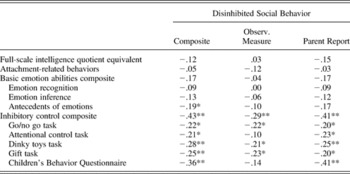
Next, the relations between disinhibited social behavior and the behavioral correlates were examined. Disinhibited social behavior was not significantly correlated with general cognitive ability, attachment-related behaviors, or basic emotion abilities, r (117) = −.12, ns, r (118) = −.05, ns, and r (118) = −.17, ns, respectively. Disinhibited social behavior was negatively associated with inhibitory control, r (118) = −.43, p < .001. As is shown in Table 4, the relation between the disinhibited social behavior and inhibitory control composite scores was generally paralleled by the individual scale scores. In sum, it appears that children with poorer inhibitory control were more likely to display disinhibited social behaviors.
Correlations between disinhibited social behavior and behavioral correlates

*p < .05. **p < .01.
Because disinhibited social behavior and inhibitory control were significantly related to length of time in institutional care, it was important to ensure that the relation between these two variables was not mediated by time in institutional care. Thus, a multiple linear regression was conducted for the adopted children. Length of time in institutional care was entered and then inhibitory control was entered. At the first step, time in institutional care accounted for a significant amount of the variability in disinhibited social behavior, R 2 = .09, F (1, 78) = 7.25, p < .01. At the second step, inhibitory control accounted for a significant amount of variability in disinhibited social behavior even after controlling for time in institutional care, ΔR 2 = .13, F (1, 77) = 12.33, p < .001. Furthermore, when inhibitory control was entered into the regression first, R 2 = .18, F (1, 78) = 17.32, p < .001, time in institutional care no longer accounted for a significant amount of variability in disinhibited social behavior, ΔR 2 = .03, F (1, 77) = 2.90, ns. These results suggest that inhibitory control mediated the relation between disinhibited social behavior and length of time in institutional care.
Discussion
The purpose of the current study was to examine the persistence, etiology, and behavioral correlates of disinhibited social behavior in postinstitutionalized children. As was expected, the children adopted from institutional care displayed more disinhibited social behavior than the nonadopted children. Surprisingly, the children adopted from foster care also demonstrated this behavior. Disinhibited social behavior was not significantly related to parent report of the degree of general deprivation encountered preadoption or to concurrent measures of general cognitive abilities, attachment-related behaviors, or basic emotion abilities. Disinhibited social behavior was associated with length of time in institutional care and with inhibitory control abilities, but the relation between disinhibited social behavior and time in institutional care appears to have been mediated by inhibitory control. The implications of these results are considered below.
Despite similar descriptions, disinhibited social behavior has been labeled variously and has been assessed using different procedures. Thus, there is concern that the different studies were describing related, but distinct, patterns of behavior. Zeanah and colleagues (Reference Zeanah, Smyke and Dumitrescu2002) found convergence of three different interviews assessing disinhibited social behavior. However, the authors emphasized the importance of a multimethod approach, as this convergence could have reflected informant bias rather than a coherent pattern of behavior. In the current study, disinhibited social behavior was assessed using an observational and parent-report measure (O'Connor et al., Reference O'Connor, Bredenkamp and Rutter1999; Tizard & Rees, Reference Tizard and Rees1975). The results from these two procedures were moderately, although significantly, related. Furthermore, the pattern of results (e.g., associations with behavioral correlates) for these procedures was generally comparable. Therefore, these results provide further evidence that the previous studies were describing a similar phenomenon.
The focus of the current study was to examine disinhibited social behavior in children internationally adopted from institutional care compared to children internationally adopted from foster care and nonadopted children. Unexpectedly, both groups of adopted children displayed more disinhibited social behavior than the nonadopted children. It has been speculated that this behavior results from the lack of a consistent, responsive caregiver rather than from general deprivation (Chisholm et al., Reference Chisholm, Carter, Ames and Morison1995; O'Connor et al., Reference O'Connor, Bredenkamp and Rutter1999; Smyke et al., Reference Smyke, Dumitrescu and Zeanah2002). In fact, it was not associated with parent report of the degree of general deprivation. Nonetheless, disinhibited social behavior in the foster care group raises questions about the etiology of the behavior, as it is believed that these children had experienced more consistent, individualized care than the children in the institutional care group. For instance, according to the parents, 75% of the children in the foster care group had been in only one foster care placement, and only 5% of these children experienced some degree of emotional neglect. However, these children experienced at least one disruption in their care because of adoption. Thus, consistent caregiving might still have played a role in the development of disinhibited social behavior.
Disinhibited social behavior in both groups of adopted children might also be explained by an experience common to the international adoption process. For example, all of the adopted children experienced a major transition at adoption (e.g., new language and new routines). In addition, the children encountered the challenge of forming an attachment relationship with their adoptive parents at a later age. Alternatively, there might be two different risk factors that contributed to the development of disinhibited social behavior in the adopted children. Perhaps the absence of a consistent, responsive caregiver led to disinhibited social behavior in the institutional care group, whereas the loss of a significant caregiver during a sensitive period led to disinhibited social behavior in the foster care group. Given the unexpected results, additional research is needed to confirm disinhibited social behavior in children adopted from foster care and to ascertain the factors involved in the development of this behavior.
To understand the underpinnings of disinhibited social behavior, the current study also examined behavioral correlates. Consistent with prior research (O'Connor et al., Reference O'Connor, Bredenkamp and Rutter1999, Reference O'Connor and Rutter2000), general cognitive ability was not associated with this behavior. Furthermore, the cognitive ability of the adopted children was within the average range. Thus, disinhibited social behavior does not appear to be a manifestation of a general developmental delay. As was noted above, it has been argued that disinhibited social behavior signifies the presence of an attachment disorder (O'Connor et al., Reference O'Connor, Marvin, Rutter, Olrick and Britner2003). However, several results do not support this hypothesis. The adopted children did not differ from the nonadopted children in terms of attachment-related behaviors toward their parents. According to their parents, the adopted children sought out their parents in times of distress, suggesting that the children were selectively attached to their parents. In addition, consistent with the research by Chisholm and colleagues (Reference Chisholm, Carter, Ames and Morison1995; Chisholm, Reference Chisholm1998), attachment-related behaviors toward the parents were not related to disinhibited social behavior. These results indicate that adopted children may display disinhibited social behavior despite having preferential relationships with their parents. Notably, in the current study, the attachment-related behaviors were based on parent report. Future research should use multimethod approaches for assessing attachment-related behaviors. Finally, although it has been suggested that disinhibited social behavior might reflect insensitivity to socioemotional cues (O'Connor et al., Reference O'Connor, Bredenkamp and Rutter1999) and the institutional care children in the current study performed more poorly on the basic emotion abilities tasks, disinhibited social behavior was not significantly related to the ability to recognize and understand the emotional state of others.
In contrast, inhibitory control was related to disinhibited social behavior. In fact, inhibitory control mediated the relation between disinhibited social behavior and length of time in institutional care. As was proposed by MacLean (Reference MacLean2003), regulatory abilities may underlie disinhibited social behavior. The children might lack the required inhibitory control abilities to regulate their behavior during interactions with unfamiliar adults despite awareness of the inappropriateness of their behavior. The current study expands upon previous studies that reported a relation between disinhibited social behavior and attention problems, as these studies relied upon parent or teacher reports for both domains (Chisholm, Reference Chisholm1998; O'Connor et al., Reference O'Connor, Bredenkamp and Rutter1999, Reference O'Connor and Rutter2000; Roy et al., Reference Roy, Rutter and Pickles2004). The relation between disinhibited social behavior and inhibitory control is noteworthy, as inhibitory control abilities appear to involve specific frontostriatal circuits (Casey et al., Reference Casey, Castellanos, Giedd, Marsh, Hamburger and Schubert1997). Interestingly, previous research with postinstitutionalized children reported decreased metabolic activity in the same regions of the prefrontal cortex (Chugani et al., Reference Chugani, Behen, Muzik, Juhasz, Nagy and Chugani2001). Overall, these results point toward specific neural systems that may be impacted by early deprivation. Although promising, further research is necessary given that this behavior has not been described in other populations with poor regulation (e.g., children with attention-deficit/hyperactivity disorder).
Limitations of the current study
Several limitations of the current study should be noted. For example, the preadoption information was based on retrospective reports from adoptive parents who may not have had direct knowledge about their children's preadoption care. Their reports may have been informed by general knowledge about the quality of care provided in particular countries or by their children's functioning. In the current study, parent report of the children's preadoption experiences was not related to disinhibited social behavior. Thus, it does not appear that the parents were relying on their children's functioning in this area to inform their estimates. Nonetheless, it would be desirable to collect this information as soon as possible after adoption. In addition, researchers could rely on more objective measures, such as time in institutional care or cognitive measures at adoption. However, with the exception of time in institutional care, disinhibited social behavior has not been related to subjective or objective measures of the quality of preadoption care (Chisholm, Reference Chisholm1998; O'Connor et al., Reference O'Connor, Bredenkamp and Rutter1999, Reference O'Connor and Rutter2000).
Another limitation is that the nonadopted children were advanced in terms of general cognitive ability and might not have been an ideal comparison group. The nonadopted children were raised in families that were socioeconomically comparable to the families of the adopted children. In general, children reared in affluent, enriched environments have advanced cognitive abilities (Dollaghan et al., Reference Dollaghan, Campbell, Paradise, Feldman, Janosky and Pitcairn1999). In fact, the children in the institutional care group were within the average range of cognitive ability despite histories of deprivation. Nevertheless, it is possible that the nonadopted children were advanced in other areas, thus overemphasizing the delays of the adopted children. Because many of the measures of interest did not have established norms, it was critical to include the nonadopted children to determine the appropriateness of the adopted children's performance. Although it is important to include comparison groups in research with adopted children, the most appropriate comparison group might vary depending upon the question of interest because each comparison group poses its own advantages and disadvantages.
Directions for future research
Although the adopted children were more likely than nonadopted children to demonstrate disinhibited social behavior, there was considerable heterogeneity within the groups. For example, 35% of the children adopted from institutional care and 52% of the children adopted from foster care demonstrated no characteristics of this behavior. Heterogeneous outcomes among postinstitutionalized children have been noted across multiple domains (O'Connor et al., Reference O'Connor, Bredenkamp and Rutter1999; Rutter, Kreppner, & O'Connor, Reference Rutter, Kreppner and O'Connor2001; Verhulst, Althaus, & Versluis-Den Bieman, Reference Verhulst, Althaus and Versluis-Den Bieman1990b). That is, postinstitutionalized children are at risk for socioemotional difficulties, but these difficulties are not inevitable. In the current study, inhibitory control predicted a significant amount of the variation in disinhibited social behavior, but the complete picture remains elusive.
Thus, additional research is warranted. It will be crucial to study the development of adopted children longitudinally across multiple domains of functioning using developmentally appropriate measures. It might be helpful to focus on specific abilities with known neural substrates, such as inhibitory control. In addition, it will be important to gain accurate, detailed information regarding the children's prenatal and preadoption care to explore the impact of specific adverse experiences. Aspects of the postadoption environment, such as parenting style and availability of resources, should also be assessed. Researchers would then be able to identify risk and protective factors in both of these environments. It is likely that gaining information about the children's preadoption experiences will remain a challenge. However, accurate information might aid in predicting the relative risk of various groups of adopted children.
More closely related to disinhibited social behavior, it might be helpful to assess the children's social behavior more broadly. For example, several parents volunteered that their children were extremely reticent with unfamiliar, and sometimes even familiar, adults. It might be beneficial to assess the complete range of behavior with unfamiliar and familiar adults, as adopted children might be more likely than nonadopted children to display extreme forms of behavior. In fact, disinhibited social behavior and extreme fear of unfamiliar adults have been described in maltreated children (Albus & Dozier, Reference Albus and Dozier1999). It might also be important to assess the children's peer relationships, as parents in the current study noted difficulties in this area. Thus, there may be consistency in the children's social behavior across contexts and partners.
Finally, given the number of adopted children demonstrating persistent socioemotional difficulties, it will be important to research interventions that might ameliorate these difficulties. A number of adoptive parents expressed concern about their children's safety due to their disinhibited social behavior. Based on the results of the current study, inhibitory control abilities might be an avenue for intervention for disinhibited social behavior. However, over the years, adoptive parents seeking professional assistance for their children's behaviors have often received conflicting or ineffective advice (Gunnar et al., Reference Gunnar, Bruce and Grotevant2000). Thus, it will be critical to systematically research the efficacy of the various interventions recommended for adopted children to determine the most appropriate interventions and the children or behaviors most likely to benefit from those interventions.