Introduction
Insects are capable of exploiting various ranges of the electromagnetic spectrum as foraging cues. Ultraviolet and visible light (∼300–700 nm wavelength) excite photopigments in compound eyes (Schmitz and Bleckmann Reference Schmitz and Bleckmann1997), which aid in locating resources based on their hue and shape (Briscoe and Chittka Reference Briscoe and Chittka2001; Kelber et al. Reference Kelber, Balkenius and Warrant2002). A particular wavelength range may play a singular role during stages of the resource finding process, but it has become apparent that visual cues can be complex and may entail any combination of plant colour, shape, size, pattern, and texture (e.g., Prokopy Reference Prokopy1968; Moericke et al. Reference Moericke, Prokopy, Berlocher and Bush1975; Roitberg Reference Roitberg1985; Owens and Prokopy Reference Owens and Prokopy1986; Kelber Reference Kelber1994; Allard and Papaj Reference Allard and Papaj1996).
Radiant infrared (IR) wavelengths of >700 nm are received in some insects by specialised IR receptors. For example, IR reception aids Australian fire beetles, Melanophila acuminata De Geer (Coleoptera: Buprestidae), in locating mating swarms near burning forest fires, and finding oviposition sites in recently burnt trees (Evans Reference Evans1964; Vondran et al. Reference Vondran, Apel and Schmitz1995; Schmitz and Bleckmann Reference Schmitz and Bleckmann1997; Schmitz et al. Reference Schmitz, Bleckmann and Mürtz1997).
Conophytic insects use a variety of visual cues such as tree silhouette, size, and shape; cone size, shape, and colour; and contrast between foliage and cone colour to facilitate host selection (reviewed in Turgeon et al. Reference Turgeon, Roques and De Groot1994). However, little is known about how conophagous insects perceive and exploit these cues, even though such information could aid in the detection and management of these economically important insects.
Cone colour (or cone-foliage contrast) plays a role in host detection by some Diptera and Coleoptera conophytes (Turgeon et al. Reference Turgeon, Roques and De Groot1994; Roques et al. Reference Roques, Sun, Zhang, Turgeon and Xu1995). The western conifer seed bug, Leptoglossus occidentalis Heidemann (Hemiptera: Coreidae), is attracted to IR radiation from cones (Takács et al. Reference Takács, Bottomley, Andreller, Zahradnik, Schwarz, Bennett, Strong and Gries2009) and visible light (400–750 nm) (Zahradnik Reference Zahradnik2012). Similarly, adult Dioryctria abietivorella (Groté) (Lepidoptera: Pyralidae) are attracted to specific wavelengths of IR radiation and to specific hues of visible light (Zahradnik Reference Zahradnik2012).
Like L. occidentalis and D. abietivorella, the Douglas-fir cone gall midge, Contarinia oregonensis Foote (Diptera: Cecidomyiidae), is a member of the conophagous insect guild. Contarinia oregonensis larvae colonise cone scales of Douglas-fir, Pseudotsuga menziesii (Mirbel) Franco (Pinaceae) (Johnson Reference Johnson1963). In early spring, female C. oregonensis oviposit in female conelets that are open for pollination (Miller Reference Miller1983), placing their eggs singly or in clusters near the base of cone scales. Neonate larvae tunnel into cone scales and induce the formation of galls, within which they develop (Hedlin Reference Hedlin1961). When conelets have assumed a pendant position, they are no longer susceptible to oviposition by female C. oregonensis. This narrows the oviposition timeframe, and necessitates the efficient exploitation of host-finding cues. Cone and foliage colour, as well as IR radiation, may be among these cues.
We hypothesised that cone colour is a foraging cue for female C. oregonensis and predicted we would find differences in larval densities among different coloured cones, and differences in captures of adults on different coloured traps. We further hypothesised that early-season Douglas-fir cones exhibit a thermographic contrast to needles and that female C. oregonensis exploit this contrast to locate cones. We therefore predicted the number of adults captured on traps would differ between cold and warm traps.
Materials and methods
Surveys 1–3: effect of cone colour, cone orientation, and tree components (cone, foliage, branch) on apparent temperatures
In thermographic Surveys 1–3, we compared the temperature of cones with different colour (Survey 1) and orientation (Survey 2), as well as the temperatures of different tree components (Survey 3). Thermographic and corresponding photographic images were taken with a mid-range IR (3–5 μm) AGEMA Thermovision 550 camera (FLIR Systems Ltd., Burlington, Ontario, Canada) and a Kodak EasyShare C613 (Kodak, Rochester, New York, United States of America), respectively, at the Kalamalka Forestry Centre (British Columbia Ministry of Forests and Range, Vernon, British Columbia; 50°14′ N, 119°16′ W) on 22 April 2010 between 11:30 and 13:30 hours, corresponding with the time when female C. oregonensis forage. All thermographic images were analysed post hoc, using ThermaCAM Reporter 2000 Pro software (FLIR Systems Ltd.) to calculate the mean temperature of target objects, taking into account the values of parameters including (i) emissivity of the object (the ratio of the radiation emitted by a surface of interest to the radiation emitted by a black body at the same temperature), (ii) distance from the object, (iii) atmospheric temperature, (iv) reflected ambient temperature (the calculated temperature of incident IR radiation), and (v) relative humidity.
In our study, thermographic images were recorded from the east side of trees at a distance of 5 m from the objects. Reflected ambient temperature was recorded within each image using the mean temperature across the surface of a tinfoil disk placed near the target object to calculate the object's temperature. Standardised post hoc analyses of recorded images set emissivity at 0.95 (the approximate value of the emissivity of vegetated areas [Jiang et al. Reference Jiang, Li and Nerry2006]). Hourly atmospheric temperature and relative humidity data were obtained from Environment Canada Weather. Foliage temperature was determined using the calculated mean temperature of three randomly selected areas of foliage. We refer to apparent temperature of target objects because it was not directly measured. Software calculations were confirmed by some direct temperature measurements with a thermal couple.
Within the orchard, all trees were ascribed to categories of bearing cones of specific colour (green, purple, purple/green) and orientation (upright, horizontal, pendant). In Survey 1, 15 trees of each cone colour category were randomly selected, the apparent temperature of one randomly selected cone per tree was recorded, and the mean temperature of each cone colour (green, purple, purple/green) was calculated. In Survey 2, 15 trees of each cone orientation category were randomly selected, the temperature of one cone per tree was recorded, and the mean temperature of 15 cones with upright, horizontal, or pendant orientation was calculated. In Survey 3, thermographic images of 25 randomly selected trees were recorded. Each image contained cones, branches, and foliage. In each image, the temperature of one cone, one branch (with few or no needles), and three areas of foliage (∼10 × 10 cm each, typically taken on different branches and then averaged) were recorded, and the mean temperature of 25 cones, 25 branches, and 25 foliage areas was calculated.
Survey 4: effect of cone colour on oviposition by female C. oregonensis
Survey 4 measured the effect of cone colour on oviposition by female C. oregonensis. On 24 May 2009, early in the season while cones were in upright and horizontal positions, each cone-bearing tree in a Douglas-fir seed orchard near Saanichton (British Columbia, Canada; 49°27′ N, 123°43′ W) was assigned a code number for its cone colour (1 = purple; 2 = purple with green; 3 = equal purple and green; 4 = green with purple; 5 = green). The colour of immature cones is consistent within trees and between years (Copes Reference Copes1972). In July 2009, three cones on the west side of trees, ∼150 cm from the ground, were removed from 10 randomly selected trees (all different clones) for each of the five colour codes. Cones were cut in half and exposed C. oregonensis larvae were counted. Half-cut counts were averaged across the three harvested cones from each tree.
Trapping Experiments 1–4: effect of trap colour, temperature, and shape on attraction of C. oregonensis
Trapping experiments were conducted at either the Saanichton Seed Orchard or Kalamalka Forestry Centre. Unless noted otherwise, all traps were constructed of sections of polyvinyl chloride (PVC) piping (5.1 cm diameter × 12.7 cm) (IPEX, Toronto, Ontario, Canada) closed with a 5.1-cm PVC cap at the bottom and covered with a lid at the top (NIBCO Elkhart, Indiana, United States of America). Traps were covered with Painter's Mate tape (Shurtape Technologies, Hickory, North Carolina, United States of America), spray-painted with Rust-oleum Painter's Touch Grey spray paint (RPM International Inc., Medina, Ohio, United States of America), and coated with a thin layer of adhesive TangleFoot (Contech Enterprises, Victoria, British Columbia, Canada). Traps were suspended vertically (unless otherwise noted) using galvanised 20-G wire from branches of randomly selected P. menziesii trees bearing at least 50 cones. Pairs of traps were deployed ∼165 cm above ground on the east side of selected trees to allow them to be warmed by the early-morning sun. Spectrometric profiles and thermographic images taken with an HR4000 spectrometer (Ocean Optics, Duneline, Florida, United States of America) and the AGEMA Thermovision camera confirmed that TangleFoot did not significantly alter the spectrometric profile of paint colour or the apparent temperature. The trapping period ran from ∼10:00 hours until shade started to cover traps, at about 17:00 hours. Captured midges were identified on site using a hand-held magnifier. Antennae and wing venation of midges deduced to be C. oregonensis were consistent with those reported in the literature. On one day, traps were checked continuously to be able to carefully inspect midges before they were completely entangled in the adhesive. A sample of specimens, identified as C. oregonensis on site, was removed, preserved in 70% ethanol, and sent to Dr. Bradley J. Sinclair (Canadian Food Inspection Agency, Canadian National Collection of Insects) who confirmed that all specimens were male and female C. oregonensis. All other midges found in traps were about 50% larger and could readily be distinguished from C. oregonensis.
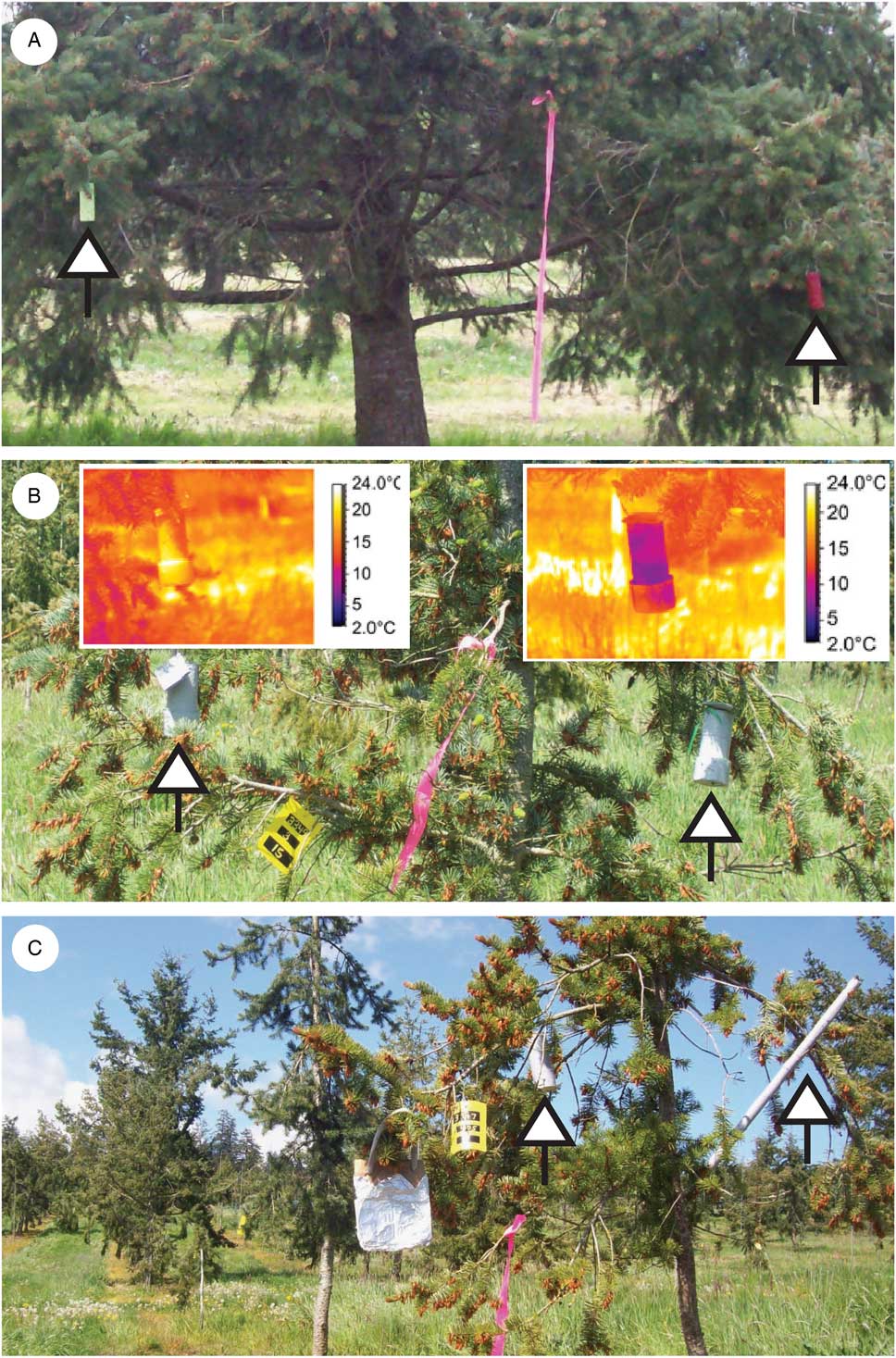
Experiment 1 tested the effect of trap colour on attraction of C. oregonensis and was run at the Kalamalka Forestry Centre between 30 April and 6 May 2010. A pair of traps, spaced ∼120 cm apart, was suspended from each of 25 randomly selected P. menziesii trees, each bearing at least 50 cones. One member of the pair was painted purple (Rust-oleum Satin Claret Wine), the other green (Rust-oleum Satin Green Apple) (Fig. 1A). These paint colours were chosen because they represented the extremes of cone colour variation. Captured midges were recorded every 60 minutes, identified, and removed. The AGEMA camera was used to confirm that the temperature of colour traps was similar.
Photographic and thermographic images of paired traps deployed in Experiments 1–4 that (A) represented the extremes (green or purple) of cone colour variation (Experiment 1), (B) represented temperatures warmer or colder than the background (Experiments 1 and 2), and (C) resembled or not the shape and orientation of tree branches (Experiment 4). Inserts in (B) represent thermographic images of hot and cold traps.

Experiments 2 and 3 tested the effect of IR radiation on attraction of C. oregonensis. They were conducted at the Saanichton Seed Orchard between 23 and 24 May 2009 (Experiment 2) and at the Kalamalka Forestry Centre between 13 and 15 May 2010 (Experiment 3). In each experiment, paired grey-painted traps (see above) were suspended ∼120 cm apart on 21 randomly selected P. menziesii trees, each bearing at least 50 cones. Warm traps were filled with 50 mL of water and allowed to heat up in the sun, whereas cold traps were filled with 150 mL of ice water, which maintained a cold trap surface (Fig. 1B). Every 120–180 minutes, 75 mL of water were withdrawn from the cold trap by syringe and replaced by ice cubes. Lids were kept on both types of traps to maintain a similar relative humidity. Periodically throughout the experiment, the AGEMA camera (see above) was used to confirm that warm and cold traps maintained temperatures that were warmer (with higher-frequency, higher-energy IR emissions) and cooler (with lower-frequency, lower-energy IR emissions) than the background, respectively.
Experiment 4 tested the effect of trap shape on attraction of C. oregonensis and was run at the Kalamalka Forestry Centre between 1 and 7 May 2010. Two trap types with different shapes but similar surface area were compared: long and thin or “branch-like” (2 cm diameter × 43 cm = 270 cm2 surface area) versus wide and short or “can-shaped” (6.5 cm diameter × 13 cm = 265 cm2 surface area), i.e., not resembling branches (Fig. 1C). Both types of traps were painted with Rust-oleum Grey Primer. Paired branch-like or can-shaped traps were suspended ∼60 cm apart from 18 randomly selected P. menziesii trees, each bearing at least 50 cones. Can-shaped traps were suspended vertically and branch-like traps horizontally. Every hour, captured midges were recorded, removed, and identified.
To determine whether shape affected trap temperature, and whether their temperatures differed from that of foliage, we obtained four thermographic images of each trap type and foliage (see Methods for Survey 3) on 26 April 2010 at Timber West in Saanichton British Columbia, Canada (49°27′ N, 123°43′ W).
Statistical analyses
In Surveys 1–3, the apparent temperature of cone colour, cone orientation, and tree component in thermographic images was analysed by one-way ANOVA for randomised complete block design (with trees as blocks) and a post hoc Tukey–Kramer test (Zar Reference Zar1999). In Survey 4, the mean number of C. oregonensis larvae exposed per cone half-cut was compared for the five colour categories by one-way ANOVA and a post hoc Tukey–Kramer test (Zar Reference Zar1999). In Experiments 1–4, total numbers of C. oregonensis adults per trap were tallied and compared between test stimuli by the Wilcoxon signed-rank test (Zar Reference Zar1999).
Results
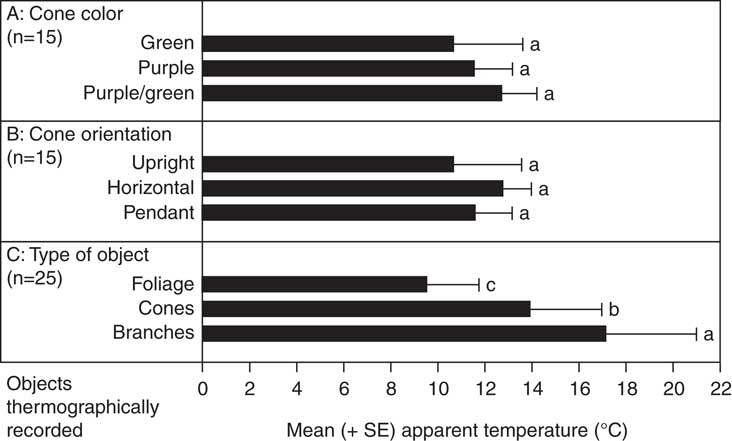
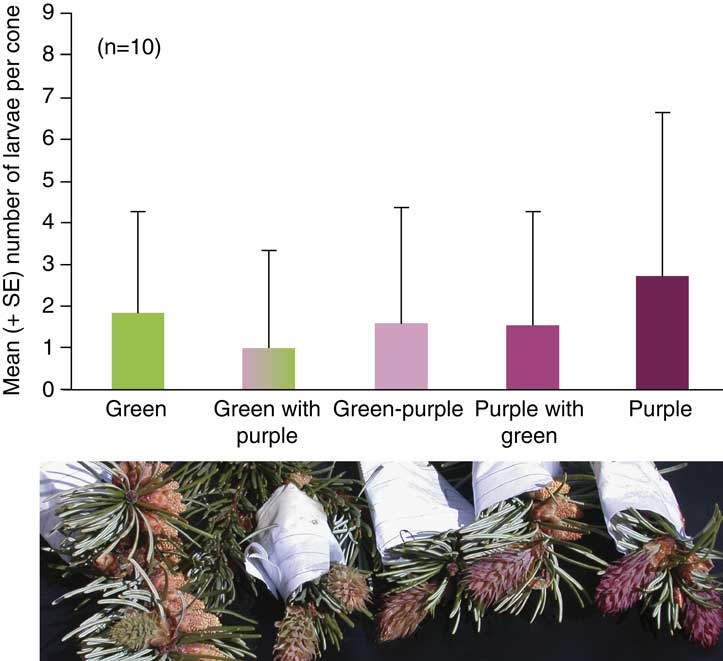
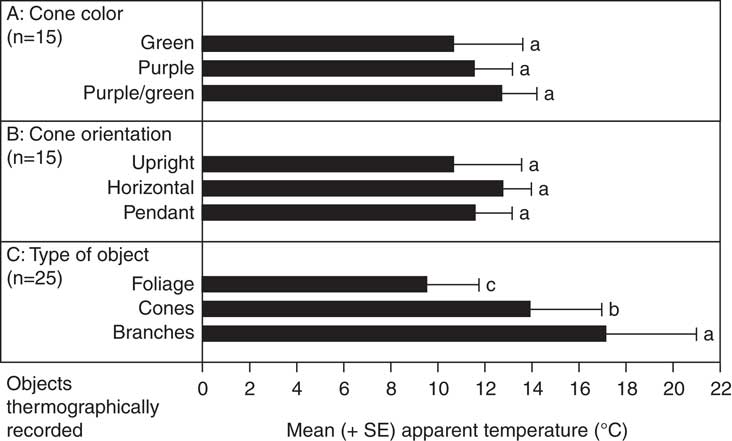
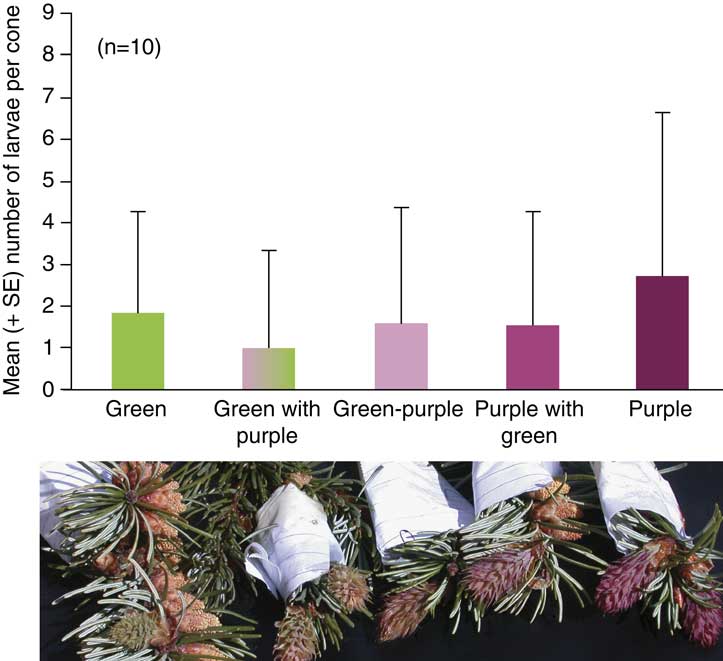
There was no significant difference in apparent temperature between Douglas-fir cones of different colour (F 2,42 = 1.25, P = 0.30; Fig. 2A) or orientation (F 2,42 = 1.87, P = 0.17; Fig. 2B). There were significant temperature differences between foliage, cones, and branches (F 2,24 = 97.5, P < 0.0001; Fig. 2C). Branches were significantly warmer than cones and foliage, and cones were significantly warmer than foliage (Fig. 2C). There was no significant difference in the number of C. oregonensis larvae found in cones of different colour (F 4,71 = 1.2, P = 0.32; Fig. 3).
Mean (+SE) apparent temperature recorded in thermographic surveys of different cone colours (A), cone orientation (B), and tree components (C). Within each survey, means denoted by different letters differed significantly (ANOVA and the Tukey test, P < 0.05).
Mean (+SE) number of Contarinia oregonensis larvae found in Douglas-fir cones halves of various colours in Survey 4. Cone colour had no significant effect on numbers of larvae present in cones (ANOVA, P > 0.05).
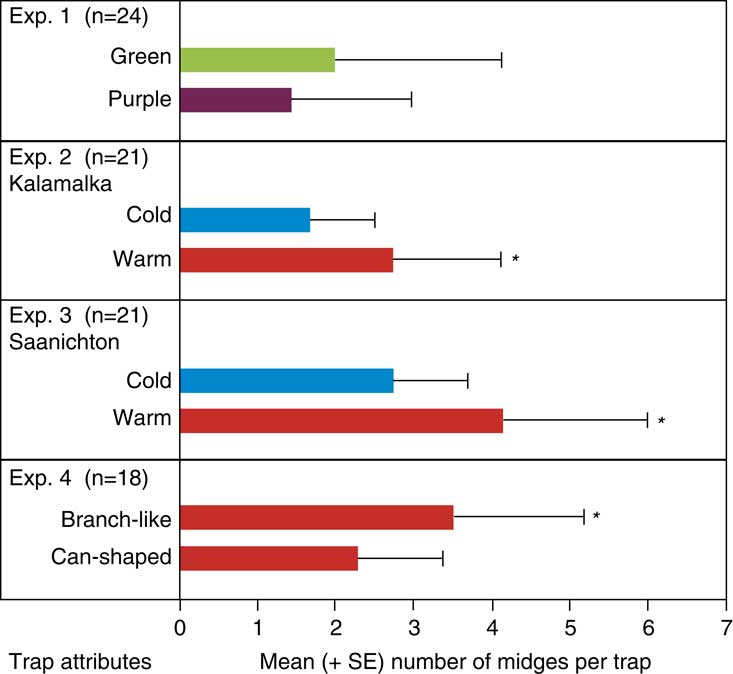
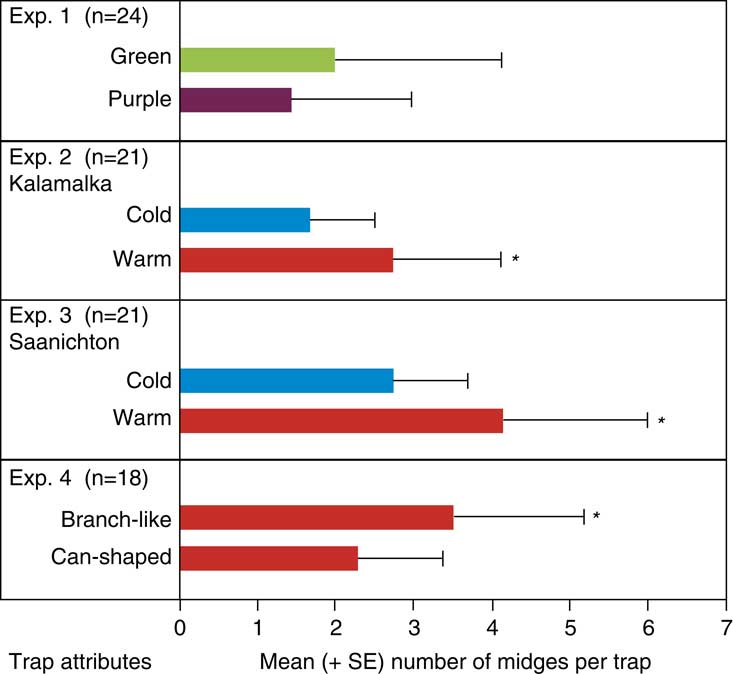
Traps painted green or purple, representing the extremes of cone colour variation, captured similar numbers of adult C. oregonensis (Experiment 1: Z = −1.73, P = 0.082; Fig. 4). Warm traps attracted significantly more adult C. oregonensis than did cold traps in Sechelt (Experiment 2: Z = 2.59, P = 0.0095; Fig. 4) and in Kalamalka (Experiment 3: Z = 3.69, P = 0.0002; Fig. 4). Branch-like traps captured significantly more adult C. oregonensis than did can-shaped traps (Experiment 4: F 2,72 = 50.5, P < 0.0001; Fig. 4). Branch-like and can-shaped traps had mean apparent temperatures of 12.9°C (±0.38°C), and 13.3°C (±0.77°C), respectively, whereas the foliage had a mean temperature of 10.9°C (±0.61°C). The mean temperature of the two trap types did not differ (Tukey–Kramer test: P = 0.88) but significantly exceeded that of foliage (Tukey–Kramer test: branch-like trap, P = 0.011; can-shaped trap, P = 0.03).
Effect of trap colour (Experiment 1), trap apparent temperature (Experiments 2 and 3), and trap shape (Experiment 4) on captures of adult Contarinia oregonensis. In each of Experiments 1–4, bars with an asterisk indicate a significant preference for the test stimulus (Wilcoxon signed-rank test, P < 0.05).
Discussion
Our data indicate that (i) Douglas-fir cones, branches and foliage in early spring differ in temperature, (ii) cone colour and cone orientation do not affect cone temperature, and (iii) female C. oregonensis show no oviposition preference for cones of specific colour, and males and females prefer warm traps to cold traps, but show no preference for green or purple traps.
Cones susceptible to oviposition by female C. oregonensis are in an upright and horizontal orientation. As cone temperature did not change with cone orientation (Fig. 2B), it cannot be used as a cue for female C. oregonensis to gauge cone suitability for oviposition. However, cones were significantly warmer than surrounding foliage (Fig. 2C), suggesting that female C. oregonensis may use this contrast in IR radiation to locate cones. Contrasting IR radiation between the target object and background is used by vertebrates such as the Chinese pit-viper, Gloydius shedaoensis Zhao (Squamata: Viperidae) (Shine and Sun Reference Shine and Sun2002), and invertebrates such as L. occidentalis (Takács et al. Reference Takács, Bottomley, Andreller, Zahradnik, Schwarz, Bennett, Strong and Gries2009) as a foraging cue. When given a choice between warm and cold traps, C. oregonensis preferred the warm traps (Experiment 2; Fig. 4). Because they also preferred branch-like traps over can-shaped traps (Experiment 4; Fig. 4), and branches are the warmest part of early-season Douglas-fir trees (Fig. 2C), female C. oregonensis may exploit the shape and IR cue of branches, not cones, as a foraging cue. Having located the branch of a host tree, they may then use other cues to orient towards cones, or, if it does not bear cones, forage for another branch.
The design of our field experiments did not allow us to separate convective and conductive heat from radiant IR to demonstrate conclusively that C. oregonensis responded to IR radiation from warm, branch-like sources. However, the thermal gradient between a warm object and its external environment is steep (Baierlein Reference Baierlein1999), making conductive heat perceptible over only a very short range. Thus, conductive or convective heat is not a suitable long-range foraging cue to pollinators or herbivores. IR radiation, however, is effective over a long distance (Takács et al. Reference Takács, Bottomley, Andreller, Zahradnik, Schwarz, Bennett, Strong and Gries2009). Two other members of the conophagous insect guild, the Heteroptera species L. occidentalis (Takács et al. Reference Takács, Bottomley, Andreller, Zahradnik, Schwarz, Bennett, Strong and Gries2009) and the nocturnal Lepidoptera species D. abietivorella (Zahradnik Reference Zahradnik2012), have IR receptors and respond to IR radiation. Thus, it seems reasonable to predict that C. oregonensis has functional IR receptors but this remains to be determined.
The adaptive significance of responding to IR radiation from natural resources appears to differ between groups of insects. Adult M. acuminata exploit IR radiation from forest fires as an indirect cue to locate future sites for oviposition and larval development (Evans Reference Evans1966; Schmitz and Bleckmann Reference Schmitz and Bleckmann1997; Schmitz and Trenner Reference Schmitz and Trenner2003). This may also apply to female C. oregonensis, which seems to exploit branch-derived IR radiation as an indirect, or intermediate, cue to locate cones for oviposition and larval development. Adult L. occidentalis, in contrast, feed on the content of seeds (Krugman and Koerber Reference Krugman and Koerber1969; Blatt and Borden Reference Blatt and Borden1999; Strong et al. Reference Strong, Bates and Stoehr2001) and exploit cone-derived IR radiation as a direct cue to locate a food source.
We predicted that cone colour would mediate foraging behaviour of C. oregonensis. Cone colour may provide contrast to surrounding foliage and modulate cone temperature. In white fir, Abies concolor (Gordon & Glendinning) Lindley ex Hildebrand (Pinaceae), the interior of purple cones is warmer than that of green cones (Sturgeon and Mitton Reference Sturgeon and Mitton1980) and thus might be more conducive for the development of conophagous insect larvae. That female C. oregonensis showed no preference for green or purple traps (Experiment 1, Fig. 4), and no oviposition preference for cones of specific colour (Fig. 3), suggest that cones are not distinguished from each other based on colour.
Our findings have implications for monitoring C. oregonensis populations. Pheromone-baited traps attract males and provide only an indirect measure of female population abundance (Gries et al. Reference Gries, Khaskin, Gries, Bennett, King, Morewood, Slessor and Morewood2002; Morewood et al. Reference Morewood, Morewood, Bennett and Gries2002). In our study, traps attracted males and females, offering new possibilities of population assessment. However, the mechanisms of retaining captured specimens must be improved so that their sex can be more readily determined.
Acknowledgements
The authors thank Patti Brown, Cathy Cook, Tim Crowder, and Chris Walsh for access to field sites, Jim Corrigan for input, Bradley Sinclair for identification of trap-captured specimens, and two anonymous reviewers and subject editor Jon Sweeney for constructive comments and editorial suggestions. Funding was provided by the Forestry Genetics Council of British Columbia, British Columbia Ministry of Forests and Range, Canadian Forestry Products, and by a Natural Sciences and Engineering Research Council of Canada (NSERC) – Industrial Research Chair to G.G., with Contech Enterprises Inc. and Global Forest Science as sponsors.