Introduction
Back pain and common mental disorders (CMDs), e.g. depression and anxiety, constitute two of the most critical public health problems today (Alexanderson & Norlund, Reference Alexanderson and Norlund2004; Lim et al. Reference Lim, Vos, Flaxman, Danaei, Shibuya, Adair-Rohani, Amann, Anderson, Andrews, Aryee, Atkinson, Bacchus, Bahalim, Balakrishnan, Balmes, Barker-Collo, Baxter, Bell, Blore, Blyth, Bonner, Borges, Bourne, Boussinesq, Brauer, Brooks, Bruce, Brunekreef, Bryan-Hancock, Bucello, Buchbinder, Bull, Burnett, Byers, Calabria, Carapetis, Carnahan, Chafe, Charlson, Chen, Chen, Cheng, Child, Cohen, Colson, Cowie, Darby, Darling, Davis, Degenhardt, Dentener, Des Jarlais, Devries, Dherani, Ding, Dorsey, Driscoll, Edmond, Ali, Engell, Erwin, Fahimi, Falder, Farzadfar, Ferrari, Finucane, Flaxman, Fowkes, Freedman, Freeman, Gakidou, Ghosh, Giovannucci, Gmel, Graham, Grainger, Grant, Gunnell, Gutierrez, Hall, Hoek, Hogan, Hosgood, Hoy, Hu, Hubbell, Hutchings, Ibeanusi, Jacklyn, Jasrasaria, Jonas, Kan, Kanis, Kassebaum, Kawakami, Khang, Khatibzadeh, Khoo, Kok, Laden, Lalloo, Lan, Lathlean, Leasher, Leigh, Li, Lin, Lipshultz, London, Lozano, Lu, Mak, Malekzadeh, Mallinger, Marcenes, March, Marks, Martin, McGale, McGrath, Mehta, Mensah, Merriman, Micha, Michaud, Mishra, Mohd Hanafiah, Mokdad, Morawska, Mozaffarian, Murphy, Naghavi, Neal, Nelson, Nolla, Norman, Olives, Omer, Orchard, Osborne, Ostro, Page, Pandey, Parry, Passmore, Patra, Pearce, Pelizzari, Petzold, Phillips, Pope, Pope, Powles, Rao, Razavi, Rehfuess, Rehm, Ritz, Rivara, Roberts, Robinson, Rodriguez-Portales, Romieu, Room, Rosenfeld, Roy, Rushton, Salomon, Sampson, Sanchez-Riera, Sanman, Sapkota, Seedat, Shi, Shield, Shivakoti, Singh, Sleet, Smith, Smith, Stapelberg, Steenland, Stockl, Stovner, Straif, Straney, Thurston, Tran, Van Dingenen, van Donkelaar, Veerman, Vijayakumar, Weintraub, Weissman, White, Whiteford, Wiersma, Wilkinson, Williams, Williams, Wilson, Woolf, Yip, Zielinski, Lopez, Murray, Ezzati, AlMazroa and Memish2012; Vos et al. Reference Vos, Flaxman, Naghavi, Lozano, Michaud, Ezzati, Shibuya, Salomon, Abdalla, Aboyans, Abraham, Ackerman, Aggarwal, Ahn, Ali, Alvarado, Anderson, Anderson, Andrews, Atkinson, Baddour, Bahalim, Barker-Collo, Barrero, Bartels, Basanez, Baxter, Bell, Benjamin, Bennett, Bernabe, Bhalla, Bhandari, Bikbov, Bin Abdulhak, Birbeck, Black, Blencowe, Blore, Blyth, Bolliger, Bonaventure, Boufous, Bourne, Boussinesq, Braithwaite, Brayne, Bridgett, Brooker, Brooks, Brugha, Bryan-Hancock, Bucello, Buchbinder, Buckle, Budke, Burch, Burney, Burstein, Calabria, Campbell, Canter, Carabin, Carapetis, Carmona, Cella, Charlson, Chen, Cheng, Chou, Chugh, Coffeng, Colan, Colquhoun, Colson, Condon, Connor, Cooper, Corriere, Cortinovis, de Vaccaro, Couser, Cowie, Criqui, Cross, Dabhadkar, Dahiya, Dahodwala, Damsere-Derry, Danaei, Davis, De Leo, Degenhardt, Dellavalle, Delossantos, Denenberg, Derrett, Des Jarlais, Dharmaratne, Dherani, Diaz-Torne, Dolk, Dorsey, Driscoll, Duber, Ebel, Edmond, Elbaz, Ali, Erskine, Erwin, Espindola, Ewoigbokhan, Farzadfar, Feigin, Felson, Ferrari, Ferri, Fevre, Finucane, Flaxman, Flood, Foreman, Forouzanfar, Fowkes, Franklin, Fransen, Freeman, Gabbe, Gabriel, Gakidou, Ganatra, Garcia, Gaspari, Gillum, Gmel, Gosselin, Grainger, Groeger, Guillemin, Gunnell, Gupta, Haagsma, Hagan, Halasa, Hall, Haring, Haro, Harrison, Havmoeller, Hay, Higashi, Hill, Hoen, Hoffman, Hotez, Hoy, Huang, Ibeanusi, Jacobsen, James, Jarvis, Jasrasaria, Jayaraman, Johns, Jonas, Karthikeyan, Kassebaum, Kawakami, Keren, Khoo, King, Knowlton, Kobusingye, Koranteng, Krishnamurthi, Lalloo, Laslett, Lathlean, Leasher, Lee, Leigh, Lim, Limb, Lin, Lipnick, Lipshultz, Liu, Loane, Ohno, Lyons, Ma, Mabweijano, MacIntyre, Malekzadeh, Mallinger, Manivannan, Marcenes, March, Margolis, Marks, Marks, Matsumori, Matzopoulos, Mayosi, McAnulty, McDermott, McGill, McGrath, Medina-Mora, Meltzer, Mensah, Merriman, Meyer, Miglioli, Miller, Miller, Mitchell, Mocumbi, Moffitt, Mokdad, Monasta, Montico, Moradi-Lakeh, Moran, Morawska, Mori, Murdoch, Mwaniki, Naidoo, Nair, Naldi, Narayan, Nelson, Nelson, Nevitt, Newton, Nolte, Norman, Norman, O'Donnell, O'Hanlon, Olives, Omer, Ortblad, Osborne, Ozgediz, Page, Pahari, Pandian, Rivero, Patten, Pearce, Padilla, Perez-Ruiz, Perico, Pesudovs, Phillips, Phillips, Pierce, Pion, Polanczyk, Polinder, Pope, Popova, Porrini, Pourmalek, Prince, Pullan, Ramaiah, Ranganathan, Razavi, Regan, Rehm, Rein, Remuzzi, Richardson, Rivara, Roberts, Robinson, De Leon, Ronfani, Room, Rosenfeld, Rushton, Sacco, Saha, Sampson, Sanchez-Riera, Sanman, Schwebel, Scott, Segui-Gomez, Shahraz, Shepard, Shin, Shivakoti, Singh, Singh, Singh, Singleton, Sleet, Sliwa, Smith, Smith, Stapelberg, Steer, Steiner, Stolk, Stovner, Sudfeld, Syed, Tamburlini, Tavakkoli, Taylor, Taylor, Taylor, Thomas, Thomson, Thurston, Tleyjeh, Tonelli, Towbin, Truelsen, Tsilimbaris, Ubeda, Undurraga, van der Werf, van Os, Vavilala, Venketasubramanian, Wang, Wang, Watt, Weatherall, Weinstock, Weintraub, Weisskopf, Weissman, White, Whiteford, Wiersma, Wilkinson, Williams, Williams, Witt, Wolfe, Woolf, Wulf, Yeh, Zaidi, Zheng, Zonies, Lopez, Murray, AlMazroa and Memish2012). Both types of disorders have a detrimental impact on occupational function and therefore rank among the most frequent causes of short or permanent marginalization from the labour market (OECD, 2003; Stewart et al. Reference Stewart, Ricci, Chee, Morganstein and Lipton2003; Breivik et al. Reference Breivik, Collett, Ventafridda, Cohen and Gallacher2006).
Back pain and CMDs often interact and the co-morbidity of these conditions is well established (Reichborn-Kjennerud et al. Reference Reichborn-Kjennerud, Stoltenberg, Tambs, Roysamb, Kringlen, Torgersen and Harris2002; Schmitz et al. Reference Schmitz, Wang, Malla and Lesage2007; Borsbo et al. Reference Borsbo, Peolsson and Gerdle2009; Scott et al. Reference Scott, Von Korff, Alonso, Angermeyer, Bromet, Fayyad, de Girolamo, Demyttenaere, Gasquet, Gureje, Haro, He, Kessler, Levinson, Medina Mora, Oakley Browne, Ormel, Posada-Villa, Watanabe and Williams2009; Hilderink et al. Reference Hilderink, Burger, Deeg, Beekman and Oude Voshaar2012; Gerrits et al. Reference Gerrits, van Oppen, van Marwijk, Penninx and van der Horst2014). In Europe, up to one third of subjects with chronic pain (the majority with back pain) have a co-morbid depression or anxiety (Breivik et al. Reference Breivik, Collett, Ventafridda, Cohen and Gallacher2006). Depression has been shown to predict the onset of pain and back pain appears to increase the incidence of depression (Hilderink et al. Reference Hilderink, Burger, Deeg, Beekman and Oude Voshaar2012; Gerrits et al. Reference Gerrits, van Oppen, van Marwijk, Penninx and van der Horst2014). The current knowledge base suggests that the association between depression and pain is multifactorial in its nature, including shared neurobiology and genetics (Reichborn-Kjennerud et al. Reference Reichborn-Kjennerud, Stoltenberg, Tambs, Roysamb, Kringlen, Torgersen and Harris2002; Goesling et al. Reference Goesling, Clauw and Hassett2013).
Besides the importance of research on the underling mechanisms of the pain–depression link, knowledge regarding the consequences of the overlap of these conditions is of particular clinical importance. It has been shown that patients with pain have more limitations of functions (Stamm et al. Reference Stamm, Pieber, Blasche and Dorner2014) and higher healthcare costs in case of a co-morbid depression (Borsbo et al. Reference Borsbo, Peolsson and Gerdle2009; Baumeister et al. Reference Baumeister, Knecht and Hutter2012). In a Canadian study, depression and chronic conditions, including back disorders, were found to have a joint effect on self-reported disability (Schmitz et al. Reference Schmitz, Wang, Malla and Lesage2007). Results from the World Mental Health Surveys show a joint effect of mental and physical conditions on the probability of severe disability (Scott et al. Reference Scott, Von Korff, Alonso, Angermeyer, Bromet, Fayyad, de Girolamo, Demyttenaere, Gasquet, Gureje, Haro, He, Kessler, Levinson, Medina Mora, Oakley Browne, Ormel, Posada-Villa, Watanabe and Williams2009). Despite the known adverse effect of back pain and depression on work capacity, knowledge on a potential synergistic effect of back pain and depression with regard to a subsequent risk of disability pension is lacking to date. A recent study based on Finnish health survey data reported an additive but not synergistic effect of CMDs and musculoskeletal disorders with regard to subsequent granting of disability pension (Kaila-Kangas et al. Reference Kaila-Kangas, Haukka, Miranda, Kivekas, Ahola, Luukkonen, Shiri, Kaaria, Heliovaara and Leino-Arjas2014).
The aim of this study was to investigate the risk of disability pension in case of CMDs on the one hand and back pain on the other, and to analyse a synergic effect of both conditions in relation to the outcome. Due to the known sex differences in CMD (Kessler et al. Reference Kessler, McGonagle, Zhao, Nelson, Hughes, Eshleman, Wittchen and Kendler1994; Rutz, Reference Rutz1999), sickness absence and DP (Alexanderson & Norlund, Reference Alexanderson and Norlund2004; Karlsson et al. Reference Karlsson, Carstensen, Gjesdal and Alexanderson2008; Stein & Dorner, Reference Stein and Dorner2012), it was the aim of the study to stratify the results by sex.
Materials and method
Design
This is a population-based prospective cohort study based on linked nationwide register data. The study base comprised all the 5 750 665 individuals aged 16–64 years and registered as living in Sweden on 31 December 2004. The following exclusion criteria were applied: old-age pension (N = 168 946) or disability pension (DP) (N = 485 596) in 2005, sickness absence starting before 1 January 2005 (N = 199 955), emigration or death during 2005 (N = 67 077), and reaching age 65 years during 2005 (N = 6 022). Thus, the final cohort consisted of 4 823 069 individuals (2 532 600 men, 2 290 469 women).
Register data
We used anonymous data from the five following registers, linked by use of the Personal Identification Number (PIN, a unique ten-digit number assigned to all Swedish residents): (1) Longitudinal Integration Database for Health Insurance and Labour Market Studies (LISA) held by Statistics Sweden: age, sex, country of birth, place of residence, family situation, and education in 2005 and emigration in 2005–2010. This database was also used to identify the cohort. (2) MicroData for Analysis of the Social Insurance database (MiDAS) of the Social Insurance Agency: sickness absence (date, main diagnoses, 2005) and DP (date 2004–2010). (3) National Patient Register: morbidity (date and diagnoses of inpatient and specialized outpatient care, 2000–2005); (4) Causes of Death Register: mortality (date and cause of death, 2005–2010), and (5) the Prescribed Drug Register: type of drug prescribed, purchased medication (July–December 2005). Registers 3, 4, and 5 are kept by the National Board of Health and Welfare. Diagnoses were coded according to the International Classification of Diseases (ICD) version 10. Type of prescribed medication was based on the respective code in the Anatomical Therapeutic Chemical Classification System (ATC code).
All people aged >16 years, living in Sweden, with an income from work or unemployment benefits, who due to disease or injury have a reduced work capacity, are covered by the national sickness insurance and can receive sickness benefits (National Board of Health and Welfare, 2008). After a first qualifying day, the employer pays sick pay for the first 14 days of a sick-leave period, thereafter sickness benefit is paid by the Social Insurance Agency. Self-employed have more qualifying days, and they as well as unemployed get all sickness benefits from the Social Insurance Agency. A physician certificate is required after 7 days of self-certification. In this study, data on sick leave with benefits from the Social Insurance Agency was used. All residents in Sweden aged 19–64 years, whose work capacity is permanently reduced due to disease or injury, are eligible to receive disability pension from the Social Insurance Agency. Since 2003, people aged 19–29 years can be granted temporary disability pension if their work capacity is reduced for at least 1 year and in order to complete upper-secondary education.
Exposure
People with back pain were defined using data for 2005 from the above registers (2) and (3), i.e. having been on sick leave or had inpatient care or hospital-based specialized outpatient care in 2005 due to back pain (ICD-10 code M54). This means that primary healthcare visits, with general practitioners were not included. People with CMDs were defined using data regarding 2005, from the above registers (2), (3), and (5), i.e. having been on sick leave, had inpatient or specialized outpatient care due to these diagnoses (ICD-10 code F30-F39 ‘mood disorders’ or F40-F48 ‘neurotic, stress-related and somatoform disorders’) as a main diagnosis, or prescription of antidepressive medication (ATC code N06a ‘antidepressants’) in 2005.
Measurement of outcome
Being granted DP was measured from January 2006 to the end of December 2010.
Covariates
Baseline socio-demographic characteristics included age, country of birth, type of region of residence, family situation, and level of education at December 2004. These variables were categorized as indicated in Table 1. Additionally, having been on sick leave (2005) on the one hand or treated in inpatient or outpatient care (2001–2005) due to any diagnosis except mental and musculoskeletal diagnoses (all ICD-10 codes but F and M diagnoses) were included as covariates. Moreover, sickness absence and in-/outpatient care due to a musculoskeletal diagnosis on the one hand and mental disorders on the other hand were also adjusted for in separate models.
Statistical analyses
Hazard ratios (HRs) and 95% confidence intervals (CIs) for the exposure variables (back pain and CMDs, respectively) with regard to the outcome variable (all-cause DP) were estimated by Cox proportional hazard regression models. All analyses were stratified by sex and the partial likelihood ratio test was applied to test for interaction. Missing values in any covariate were coded as distinct categories. Each individual contributed with person time (days) from January 2006 until date of DP, becoming 65 years of age, emigration, death, or end of follow-up time at December 2010, whichever came first.
First, we calculated crude HRs. Adjusted HRs were then computed in four different models by adding covariates in the regression models. In model I, we controlled for age, in model II we additionally controlled for family situation, educational level, country of birth, and type of living area, in model III we added previous and ongoing sickness absence, inpatient and outpatient care due to any other somatic diagnoses apart from musculoskeletal diagnoses. Finally, in model IV we added sickness absence and previous or ongoing in-/outpatient care due to a musculoskeletal diagnosis in the models with CMDs as the variable of interest. In the models with back pain as the variable of interest, we adjusted for sickness absence and previous and ongoing in-/outpatient care due to a mental diagnosis in model IV.
Statistical multiplicative interaction between back pain and CMDs was tested with the partial likelihood ratio test. The main focus in this study lies within additive interactions between having had co-occurring back pain and CMDs in 2005 in relation to DP. Those indicate the magnitude of the effect on DP when both conditions are present, beyond the mere addition of the effects from each single condition. Additive interactions are shown with means of synergy indices (S). This was calculated as deviation from an additive model, using a previously suggested equation (Rothman, Reference Rothman1974; Andersson et al. Reference Andersson, Alfredsson, Kallberg, Zdravkovic and Ahlbom2005; Li & Chambless, Reference Li and Chambless2007; Richardson & Kaufman, Reference Richardson and Kaufman2009): S = HR (back pain and CMDs − 1)/[(HR CMDs but no back pain − 1)] + [(HR back pain but no CMDs − 1)]. Thus, the synergy index is the ratio of the observed effect with combined exposure to two risk factors in relation to the effect expected with independently acting causes operating jointly. S would equal 1 for causes acting independently, 0 when two causes completely neutralize each other, and approach infinity when two causes produce no effect independently but a measurable affect together (Rothman, Reference Rothman1974). Besides a crude model, the analyses related to the synergy index were controlled for age, family situation, education, country of birth, and type of region of residence in model II. In model III, additional adjustment was carried out for previous and ongoing somatic diagnoses other than musculoskeletal diagnoses.
Relative excess risk due to interaction (RERI) was computed as a metric of departure from additivity of effects (Li & Chambless, Reference Li and Chambless2007; Richardson & Kaufman, Reference Richardson and Kaufman2009). This was measured using the equation: RERI = HR (back pain and CMDs) − HR (back pain but no CMDs) − HR (CMDs but no back pain) + 1 (Andersson et al. Reference Andersson, Alfredsson, Kallberg, Zdravkovic and Ahlbom2005). The attributable proportions (AP) due to interaction were computed to indicate the proportion of DP that would theoretically be prevented if the interaction of the two exposures could be eliminated. This was done using the equation: AP = RERI/HR (back pain and CMDs) (Andersson et al. Reference Andersson, Alfredsson, Kallberg, Zdravkovic and Ahlbom2005). For calculation of the confidence intervals for S, RERI, and AP, we used the delta method, a straightforward Taylor expansion of the variances and covariances (Hosmer & Lemeshow, Reference Hosmer and Lemeshow1992; Andersson et al. Reference Andersson, Alfredsson, Kallberg, Zdravkovic and Ahlbom2005).
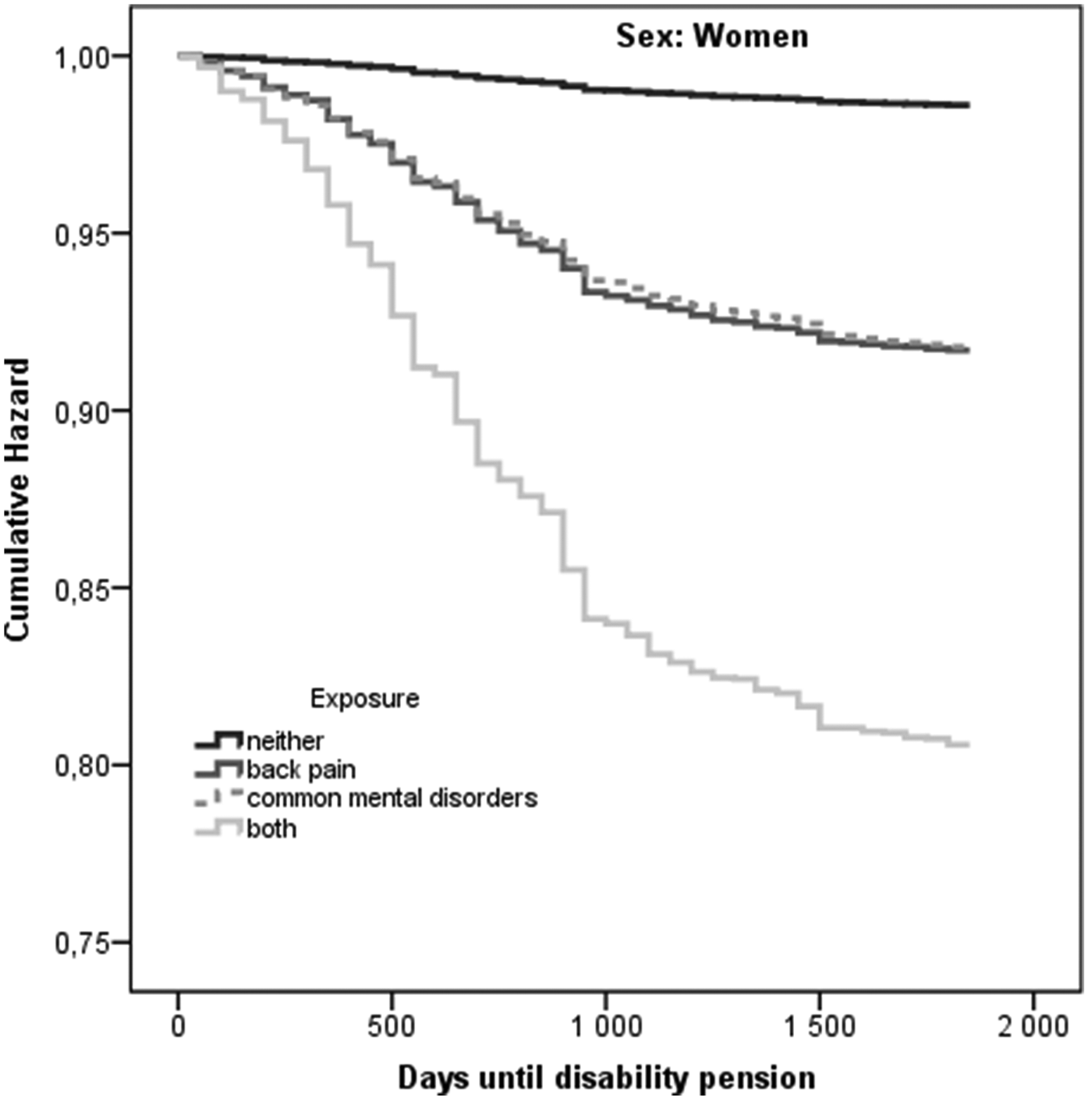
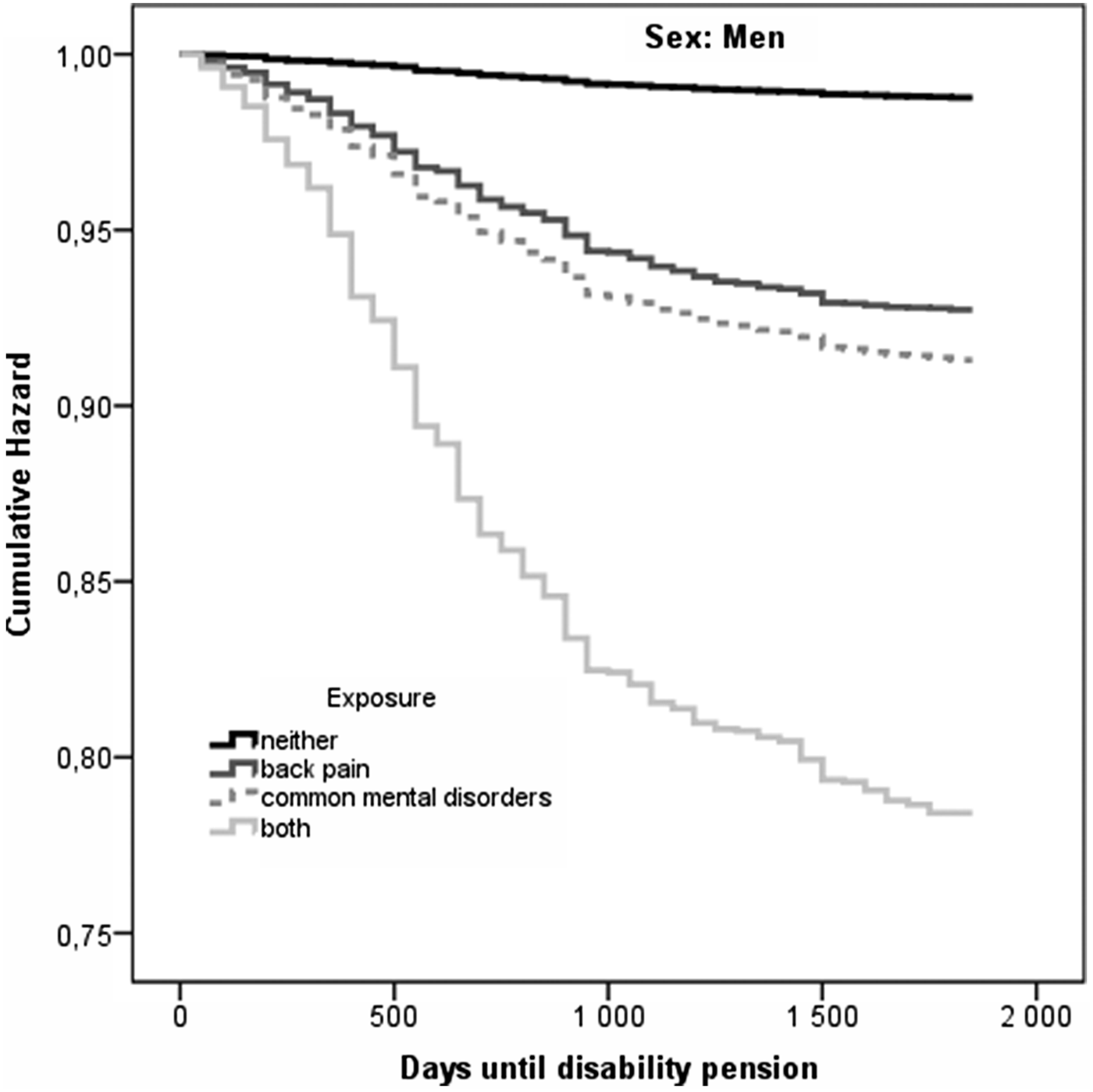
For visualization of the synergistic effect between back pain and CMDs on the risk of DP, cumulative hazards are shown in survival curves for women and men.
Ethical considerations
The project was approved by the Regional Ethical Review Board of Stockholm.
Results
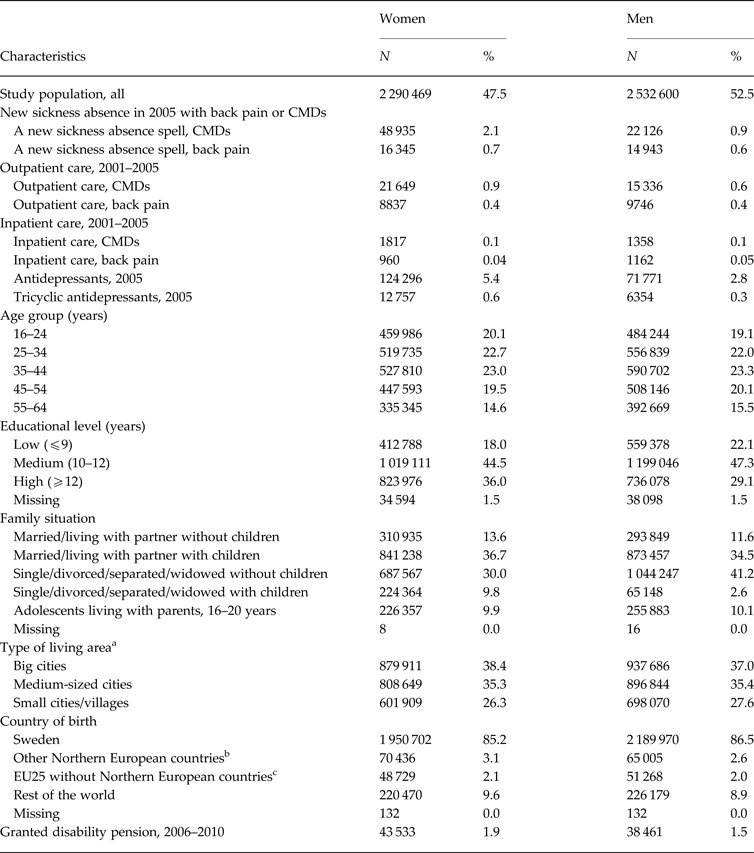
Descriptive information of the cohort comprising 4.8 million individuals is presented in Table 1. The majority of the women and men had at least medium educational level, lived in urban areas, and were born in Sweden. Most immigrants were born in countries outside Europe. There were some sex differences: women were more likely to have a high educational level and to live together with children.
Descriptive statistics of all the 4 823 069 non-retired women and men, aged 16–64 years and living in Sweden 31 December 2004, without ongoing sickness absence at the turn of 2004/2005

CMD, Common mental disorder.
a Type of area of residence, big cities: Stockholm, Gothenburg and Malmö; medium-sized cities: cities with more than 90 000 inhabitants within 30 km distance from the centre of the city; small cities/villages.
b Denmark, Finland, and Norway.
c Member states of the European Union since 2004. Those are (without Northern European countries): Austria, Belgium, Cyprus, Czech Republic, Estonia, France, Germany, Greece, Hungary, Ireland, Italy, Latvia, Lithuania, Luxembourg, Malta, The Netherlands, Poland, Portugal, Slovakia, Slovenia, Spain, Sweden, and United Kingdom.
In 2005, 1.0% of women and 0.9% of men had inpatient care or specialized outpatient care due to back pain or a new sickness absence with back pain, sickness absence being the most common. In total, 7.1% of women and 3.6% of men were identified as having CMDs in 2005 (sickness absence, inpatient care, specialized outpatient care, or prescription of antidepressants), most of them were identified through dispensed antidepressants. During the 5-year follow-up (2006–2010) of the cohort, 1.9% of all the women and 1.5% of all the men were granted DP. This compares to 9.6% and 8.2% of women and men with back pain being granted DP during follow-up and 8.3% and 8.7% of women and men with CMDs, respectively.
HRs for DP in women and men with back pain or CMDs are shown in Table 2. CMDs showed a slightly higher HR for DP compared to back pain. When adjusting for age, socio-demographic, and socio-economic variables, sickness absence, and previous or ongoing care due to somatic diagnoses other than musculoskeletal, and adjusting for mental diagnoses in patients with back pain or adjusting for musculoskeletal diagnoses in patients with CMDs lowered the HRs. Adjusting for other somatic diagnoses than musculoskeletal diseases had very strong effect on HRs (Table 2, model III). The partial likelihood ratio test revealed significant interaction between sex and CMDs in both the crude and the fully adjusted models (p < 0.001). The partial likelihood ratio test for the interaction between back pain and sex was significant in the crude (p = 0.047), but not in the fully adjusted (p = 0.153) models. In men, CMDs were stronger predictors for DP than in women, whereas only marginal sex differences were found regarding back pain. In the multivariate adjusted model, HRs for DP in case of back pain were 4.0 and 3.9 for women and men, respectively. Corresponding HRs for DP related to CMDs were 4.9 for women and 6.1 for men. In both sexes, there was a significant interaction between back pain and CMDs on the HR for DP according to the partial likelihood ratio test (p < 0.001). There was also a significant interaction between sex and CMD (p < 0.001) but not between sex and back pain on the relative risk of DP.
Crude and adjusted HRs for disability pension in 2006–2010, related to back pain or CMDs in 2005, 4 823 069 non-retired women and men, aged 16–64 years and living in Sweden 31 December 2004, without ongoing sickness absence at the turn of 2004/2005

HR, Hazard ratio; CMD, Common mental disorder; DP, disability pension; CI, confidence interval.
Model I: age adjusted.
Model II: adjusted for family situation, educational level, country of birth, type of living area.
Model III: like model II and additionally adjusted for ongoing (2005) sickness absence as well as for previous (2000/2001–2004) or ongoing (2005) in-/outpatient care due to any other somatic diagnoses than musculoskeletal diagnoses.
Model IV: like model III CMDs additionally adjusted for sickness absence due to a musculoskeletal diagnosis as well as previous (2000/2001–2004) and ongoing (2005) in-/outpatient care due to a musculoskeletal diagnosis; back pain additionally adjusted for sickness absence due to a mental diagnosis as well as previous (2000/2001–2004), and ongoing (2005) in/outpatient care due to a mental diagnosis.
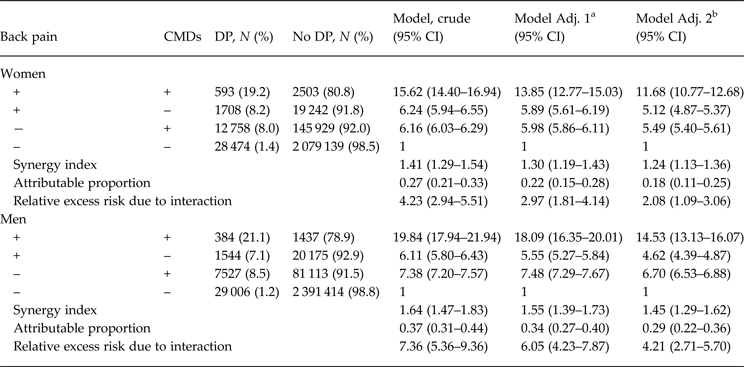
In Table 3, the synergistic effects between back pain and CMDs regarding the hazard for DP are presented. In total, 19.2% of the women and 21.1% of the men with both diagnoses were granted DP during follow-up. HR for DP in those who were affected by both disorders were higher than the sum of HRs of those who were affected with back pain or CMD, only, as shown in Fig. 1 for women, in Fig. 2 for men, and in Table 3. Adjusting for socio-demographic variables and for somatic diagnoses other than musculoskeletal diagnoses lowered the synergistic effects; however, even in the fully adjusted model, the S, AP, and RERI were significant in both sexes (Table 3).
Hazard ratios, by survival curves for being granted disability pension in 2006–2010, among all women aged 16–64 years, and lived in Sweden all of 2005, neither on old-age pension or disability pension in 2005 nor with ongoing sickness absence at the turn of 2004/2005.

Hazard ratios, by survival curves for being granted disability pension in 2006–2010, among all men aged 16–64 years, and lived in Sweden all of 2005, neither on old-age pension or disability pension in 2005 nor with ongoing sickness absence at the turn of 2004/2005.

Synergistic effect of previous back pain and CMDs with regard to the risk of future disability pension, 4 823 069 women and men, aged 16–64 years and living in Sweden, neither on old-age pension or DP in 2005 nor with ongoing sickness absence at the turn of 2004/2005

CMD, Common mental disorder; DP, disability pension; CI, confidence interval; HR, hazard ratio; AP, attributable proportion; RERI, relative excess risk due to interaction.
a Adjusted for socio-demographics (age, education, family situation, type of region of residence, country of birth).
b Additionally adjusted for somatic diagnoses other than musculoskeletal diagnoses 2001–2005.
Synergy index S = HR (back pain and CMDs − 1)/[(HR CMDs but no back pain − 1)] + [(HR back pain but no CMDs − 1)].
Population attributable proportions due to interaction AP = RERI/HR (back pain and CMDs).
Relative excess risk due to interaction RERI = HR (back pain and CMDs) − HR (back pain but no CMDs) − HR (CMDs but no back pain) + 1.
Depression was here defined as either inpatient care or outpatient care or a new sickness absence due to depression or prescribed antidepressants in 2005.
Back pain was here defined as either inpatient care or outpatient care or a new sickness absence due to back pain in 2005.
Discussion
Main findings
In this large, population-based, prospective cohort study including all people of working ages in Sweden at risk for DP, we found a higher risk of future DP in women and men with a diagnosis of back pain defined by specialized inpatient or outpatient care or sickness absence in 2005. These associations remained even after adjustment for various possible confounders and for CMD. Similar results were found for CMD, defined by these markers and additionally by antidepressant prescription. The adjusted HRs were 5-fold and 6-fold higher in women and men, respectively. Back pain and CMD had a strong synergistic effect with regard to the future risk of DP in both women and men.
While the relative risk for DP was considerably higher in case of co-morbid CMDs and back pain, findings indicate higher risk estimates for subsequent DP in case of CMDs compared to back pain, which is in line with a previous study (Alexanderson et al. Reference Alexanderson, Kivimaki, Ferrie, Westerlund, Vahtera, Singh-Manoux, Melchior, Zins, Goldberg and Head2012). Different explanations might underlie these findings. Individuals with CMDs might seek help within the healthcare setting relatively late in the disease trajectory, partly due to the underlying stigma, still associated with mental disorders (Kelly & Jorm, Reference Kelly and Jorm2007). Individuals might then primarily seek help within primary healthcare settings (Kessler et al. Reference Kessler, Demler, Frank, Olfson, Pincus, Walters, Wang, Wells and Zaslavsky2005), where adequate diagnostics and treatment of CMDs is reported to be suboptimal (Duhoux et al. Reference Duhoux, Fournier and Menear2011). In a broad sense, the observed synergistic effect might arise from the effect of CMDs on work capacity on the one hand and the effect of back pain on work capacity on the other. More specifically, CMDs are known to be associated with some degree of cognitive, emotional, social, and physical inhibition (Henderson et al. Reference Henderson, Harvey, Overland, Mykletun and Hotopf2011). In this respect, CMDs and possible associated fatigue might involve functional limitations regarding memory, endurance, capacity to concentrate, or social skills which in turn might affect work capacity. Similar effects of back pain on work ability have been reported. The effects of CMDs on work capacity might be exacerbated by impact of back pain on occupational functioning, and vice versa. In particular, back pain might severely impact on the capacity to comply with physical work demands, as well as with mental and social work demands due to e.g. associated fatigue.
We found a strong synergy effect between back pain and CMD in relation to future risk of DP. To the best of our knowledge, this has not been reported previously. In an earlier study based on Finnish health survey data, an additive but no synergistic effect of CMDs and musculoskeletal disorders with regard to subsequent granting of DP was reported (Kaila-Kangas et al. Reference Kaila-Kangas, Haukka, Miranda, Kivekas, Ahola, Luukkonen, Shiri, Kaaria, Heliovaara and Leino-Arjas2014). The main difference to our study was that in the Finnish study of <4000 individuals, the exposure was based on health examination while our study was based on register data of the health system. The Finnish study found a significantly higher proportion of participants affected by CMD, back pain, or both, than we did. Thus, we can assume, that the patients as indicated by sickness absence or specialized health care for CMD or back pain in our study may represent more severe cases and subsequently, have a higher chance of being granted DP. Furthermore, the sample size in our study was substantially larger compared to the Finnish study (40000 compared to nearly 5 million) and we had no dropouts. Other differences were that they only included people in paid work, that only people aged >30 years were included and that their cohort was followed for more years.
In other studies, a joint effect of mental and various somatic conditions towards disability, as limitations in performing activities of daily living, have been shown (Schmitz et al. Reference Schmitz, Wang, Malla and Lesage2007; Scott et al. Reference Scott, Von Korff, Alonso, Angermeyer, Bromet, Fayyad, de Girolamo, Demyttenaere, Gasquet, Gureje, Haro, He, Kessler, Levinson, Medina Mora, Oakley Browne, Ormel, Posada-Villa, Watanabe and Williams2009), but not on DP. The importance of our findings is additionally strengthened by previous studies suggesting a worsened prognosis of patients with both pain and depression, such as prolonged recovery and reduced response to treatment (Bair et al. Reference Bair, Robinson, Katon and Kroenke2003, Reference Bair, Robinson, Eckert, Stang, Croghan and Kroenke2004). It has been shown in a previous study that patients with chronic pain and co-occurring depression and/or anxiety are suffering from more severe pain, a higher degree of pain-related disability, and have worse outcomes in terms of pain self-efficacy, fear of movement, and coping attitudes than chronic pain patients without CMD (Bair et al. Reference Bair, Wu, Damush, Sutherland and Kroenke2008). Furthermore, it has been shown, that the co-occurrence of painful physical symptoms and depressive episodes leads to lower rates and a delay of help-seeking for emotional reasons, which prolongs the duration of the depressive episode (Demyttenaere et al. Reference Demyttenaere, Bonnewyn, Bruffaerts, Brugha, De Graaf and Alonso2006). Moreover, patients with mental disorders have been reported to risk receiving a lower quality of healthcare and treatment of co-morbid somatic disorders (Bjorkenstam et al. Reference Bjorkenstam, Ljung, Burstrom, Mittendorfer-Rutz, Hallqvist and Weitoft2012). Finally, patients with a CMD like depression are more likely to have an unfavourable lifestyle, e.g. smoking, lack of physical exercise, and unhealthy nutrition (Loprinzi & Mahoney, Reference Loprinzi and Mahoney2014), which can again lead to or deteriorate chronic somatic diseases. These facts might contribute to the underlying mechanisms of how the co-occurrence of back pain and CMD can lead to a higher risk for DP than the individual factors alone. Still, further studies focusing on the clinical aspects as well as on elucidating the underlying mechanisms are warranted to be able to draw firm conclusions with regard to clinical and public health implications.
In general, the HRs for DP associated with back pain were equal for women and men, while risk estimates for DP in relation to CMD were somewhat higher in men than in women. Moreover, a co-morbid CMD when having back pain had a more detrimental effect on the prognosis, in terms of DP, in men then in women. These findings are in line with other studies, in which men have more functional and social impairment when affected by CMD compared to women (Scott, Reference Scott2011). This should, however, be discussed in the light of the known higher prevalence of CMD in women (Kessler et al. Reference Kessler, McGonagle, Zhao, Nelson, Hughes, Eshleman, Wittchen and Kendler1994). In men, depression is more often under- or misdiagnosed and as a result not optimally treated (Rutz, Reference Rutz1999). Men might have different care-seeking behaviours than women and depression in men might be characterized by different clinical manifestation (Rutz, Reference Rutz1999). Therefore, symptoms might be more severe when depression is diagnosed in men which might explain the higher risk for DP in men with depression compared to women.
Strengths and limitations
Among the main strengths of this study were the prospective cohort design, the population-based and very large cohort (>4.8 million) with annual and detailed data for all individuals at risk of DP, the long follow-up (5 years), and no loss to follow-up. The data in the administrative registers is of high quality (Ludvigsson et al. Reference Ludvigsson, Andersson, Ekbom, Feychting, Kim, Reuterwall, Heurgren and Olausson2011; National Board of Health and Welfare, 2013). Another strength is that exposed individuals could be identified by using several different registers, e.g. in terms of sick leave, inpatient and outpatient care, and dispensed medication. Moreover, diagnoses related to the exposure have been set by physicians, i.e. they were not self-reported. Exposure, confounders, and outcome were recorded independently from each other. The whole population of working age in Sweden was included and offered satisfactory statistical power for the sex-stratified analyses, including a wide range of possible confounders as well as for diagnoses at detailed level.
Limitations include that the information on inpatient and outpatient care mainly covers morbidity of more pronounced medical severity, because information on visits to general practitioners in primary healthcare was not available. The register on prescribed medication only holds data from July to December 2005, thus, we had no information regarding previous medication. In Sweden, individuals can purchase prescribed medication for the coming 3-month period, meaning that people on antidepressants should not be able to store up medication for a lengthy period – and be recorded at least once in that register during these 6 months.
In our study we did not distinguish between different CMDs including a variety of different disorders like depression, anxiety, and other neurotic, stress-related and somatoform disorders. The rationale for including all CMDs is mainly based on the clinical knowledge that stress-related mental disorders and, for example, depression are strongly linked and often difficult to differentiate (National Board of Health and Welfare, 2003). This also reflects the growing discussion on the need for changing paradigms in psychiatric diagnostics. More specifically, this discussion is based on conceptualizing depression, anxiety, and stress-related mental disorders rather as a continuum than groups of entities with – often argued – arbitrary boundaries. Apart from this discussion, in occupational health research, CMDs are often collapsed as the effect on work capacity seems to be driven by resembling effects.
We used prescription of antidepressants as one way of defining individuals with CMD. In case of back pain, antidepressants can be prescribed in order to target the symptoms of an underlying depression or anxiety (Chou et al. Reference Chou, Qaseem, Snow, Casey, Cross, Shekelle and Owens2007). Moreover, back pain without clinical symptoms of a CMD can be directly addressed via antidepressants, although the literature is inconclusive in this respect. While the scientific evidence related to the treatment of neuropathic or chronic back pain with tricyclic antidepressants (TCAs) has been assessed as good, the use of modern antidepressants including selective serotonin reuptake inhibitors (SSRIs) has a weak evidence base with regard to alleviation of symptoms of chronic pain (Swedish Council on Health Technology Assessment, 2006; Chou et al. Reference Chou, Qaseem, Snow, Casey, Cross, Shekelle and Owens2007; Dharmshaktu et al. Reference Dharmshaktu, Tayal and Kalra2012). It is likely that in our study, some severe forms of chronic back pain with or without neuropathic pain might have been treated with TCAs, even in the absence of clinical symptoms of a CMD. Still, TCAs may also have been used for more severe forms of a CMD in patients who did not respond to SSRI treatment (Swedish Council on Health Technology Assessment, 2004). Our findings, therefore, have to be interpreted in the light of these limitations. As only 11% of all antidepressant treatment were due to TCAs, and only 2% of patients with back pain in our study received TCAs, it is rather unlikely that the synergetic effect was mainly driven by this type of medication.
We chose not to use prescribed pain medication as one way of identifying people with back pain, as such medication also is prescribed for many other types of pain. Furthermore, many analgesics are sold over the counter and paid out of pocket and, therefore, do not appear in the health insurance registers. This means that, compared to CMD, we probably have an underestimation of number of exposed individuals regarding back pain. Furthermore, knowledge about the validity of the sick-leave diagnoses is limited, although the one study published on this reported an acceptable validity (Ljungdahl & Bjurulf, Reference Ljungdahl and Bjurulf1991). We only had access to the main diagnosis of the sickness absence certificates, therefore some residual confounding due to co-morbidity or unmeasured disease might have occurred. It can be seen as both a strength and a limitation that shorter sickness absences were not included in the study. The majority of the shorter sick-leave spells are not physician-certified, which would decrease the validity of the diagnoses.
Conclusions
Our results indicate that the co-morbidity of back pain and CMD is associated with a higher risk of future DP than the sum of the individual conditions. The synergistic effect was somewhat stronger in men then in women. This is the first study exploring a synergy effect between back pain and CMD and future DP based on a very large population-based cohort. More knowledge and further research is required to evaluate possible implications of these findings for treatment and rehabilitation in case of co-occurring back pain and CMD to prevent further disability and exclusion from the labour market.
Acknowledgements
Financial support for the study was obtained from the Swedish Research Council for Health, Working Life and Welfare – 2007–1762, and the Swedish Research Council – 522–2010–2683.
Declaration of Interest
None.