During the COVID–19 outbreak, people are facing enormous personal and societal challenges, generating a situation in which social psychology has the opportunity to offer answers (see Jetten et al., Reference Jetten, Bentley, Crimston, Selvanathan and Haslam2021; van der Linden, Reference van der Linden2021). In order to respond to present and future global challenges, social psychologists should consider adopting a multilevel perspective, from individual to macrosocial aspects (see Chen et al., Reference Chen, Lam, Liu, Choi, Kashima and Bernardo2021). Our research illustrates the importance of considering this multilevel approach regarding emotions and emotion words.
The concept of emotion encompasses a complex universe of terms that give rise to considerable confusion among both scientists and laypeople. Feeling fear during an assault is a subjective experience very different from the feelings of fear experienced when watching a scary movie or elicited by the negative economic situation associated with the COVID–19 pandemic. However, the same emotional term, fear, is used for all cases. Thus, the word “fear” could describe the experience felt when an individual is attacked and must flee or fight but also when he or she pays to feel fear in the cinema and expects to have a pleasurable time. It could even be that people talk about their fear of the coronavirus without feeling any affect but just to justify actions such as using a face mask. Those are only a few examples of how the concept of emotion and emotion words can be used; there are many more examples, such as interpersonal emotions (Parkinson, Reference Parkinson2011), collective emotions (Garcia & Rimé, Reference Garcia and Rimé2019), group-based emotions (Smith & Mackie, Reference Smith and Mackie2016), future-oriented emotions (Carrera et al. Reference Carrera, Caballero and Muñoz2012), conventional emotions (Fernández-Dols et al., Reference Fernández-Dols, Carrera, Hurtado de Mendoza and Oceja2007), feeling rules (Hochschild, Reference Hochschild1979, Reference Hochschild1983), transcendent emotions (Fiske et al., Reference Fiske, Seibt and Schubert2019), moral emotions (Giner-Sorolla, Reference Giner-Sorolla, Gray and Graham2018), or emotions as appraisals (Briñol et al., Reference Briñol, Petty, Stavraki, Lamprinakos, Wagner and Díaz2018).
Emotion terms are used to categorize a broad class of events, making the study of emotions a minefield for scientists. Two decades ago, James A. Russel pointed out that “the boundaries to the domain of emotion are so blurry that it sometimes seems that everything is an emotion. The experts do not agree on what is an emotion and what is not” (Russell & Feldman-Barrett, Reference Russell and Feldman-Barrett1999, p. 805). Each conceptualization of emotion provides different and relevant information to better understand emotional events. The important point is to clarify what exactly emotional phenomena we are studying under the emotion label. In this vein, the psychological constructionist view proposes that emotion words are a “critical ingredient” in the perception and experience of emotions (Lindquist, Reference Lindquist2017). For constructionism, language is the link among different levels of analysis of emotional events, from individual to interpersonal and macrosocial, but the linguistic terms are not a sufficient criterion to differentiate them. To differentiate what we mean at each level of analysis, it is necessary to study their similarities and differences from a comparative perspective.
In the present research, we explore this comparative approach through three different emotional concepts in the frame of the COVID–19 pandemic in Spain: Inner emotions reported by participants to describe variations in their core affect (i.e., emotions felt); perceptions of others’ feelings (i.e., descriptive feeling rules) and societal uses of emotion words related to the pandemic (i.e., socioemotional conventions). These different concepts imply distinct levels of analysis: inner emotions experienced and reported by participants are the “individual level”; emotions that people perceived in others are considered the “interpersonal level”; and finally, emotions shared in social forums, such as the internet, constitute the “macrosocial level”. Admittedly, these three levels could be analyzed considering other emotional concepts among those we previously mentioned (e.g., future emotions, group-based emotions, or collective emotions). In the following paragraphs, we describe these concepts of emotion in more detail.
The individual level describes emotions subjectively experienced as people face the COVID–19 crisis; they are inner emotions. This level is focused on each person’s feelings (see Gross, Reference Gross2015), that is, on the fluctuation of the valence and activation affective dimensions (Russell, Reference Russell2003). For instance, at the individual level, psychologists noted that feelings of sadness increased significantly in the Spanish adult population during the lockdown (Cecchini et al., Reference Cecchini, Carriedo, Fernández-Río, Méndez-Giménez, González, Sánchez-Martínez and Rodríguez-González2021; Sandín et al., Reference Sandín, Valiente, García-Escalera and Chorot2020); while conflicting emotions were detected in children who worried about being infected but were happy to be with their families (Idoiaga et al., Reference Idoiaga, Berasategi, Eiguren and Picaza2020). In Spain, a large study on the psychological consequences of COVID–19 during the months from March to May 2020 found that when people reported the emotions felt during the lockdown, they included negative emotions such as sadness and resignation but also positive emotions such as hope and calm (see Balluerka Lasa et al., Reference Balluerka Lasa, Gómez Benito, Hidalgo Montesinos, Gorostiaga Manterola, Espada Sánchez, Padilla García and Santed Germán2020).
At a more social level, Hochschild (Reference Hochschild1983, p. 56) pointed out that “feeling rules are what guide emotion work by establishing the sense of entitlement or obligation that governs emotional exchanges”; they are social norms about what, when, where and how to feel. For example, we frequently speak of “having the right” to feel angry to someone who offended us, or we say that they “should feel grateful” to a person who helps them. These expectations are socially construed, and we also find them in how others react when observing us (e.g., “you shouldn’t feel guilty, it was an accident”) or when we observe them and value their emotional reaction as appropriate or not (e.g., “you seem proud of your behavior, but you should be ashamed"). Hochschild noted that sometimes it is possible to experience a certain dissonance between “what we feel, or we want to feel” and “what we should feel” and between “what people truly feel” and “what people communicate” (see Hochschild, Reference Hochschild1979). At this interpersonal level, a similar approach within the norms field is the focus theory of normative conduct (see Cialdini et al., Reference Cialdini, Kallgren, Reno and Berkowitz1991), which distinguishes between injunctive social norms, referring to the perception of what most people approve or disapprove, and descriptive social norms, which include the perception of what most people do. We decided to focus on this interpersonal level by attending to the descriptive feeling rules, that is, the perception of what most people are feeling during the pandemic, or perceptions about others’ emotions. When we observe others in interactions related to COVID–19, we infer their emotional states from their verbal and nonverbal behavior; however, these inferences are not necessarily correct. People can “label” fear where there is only anger. Perceptions about others’ feelings, true or false, are very important because people will react coherently to their inferences labeled with emotion words. Thus, emotion words are integral to emotion perception (see Lindquist, Reference Lindquist2017).
Finally, at the macrosocial level, socioemotional conventions are emotions, not necessarily felt, associated with the coronavirus, conventions that regulate emotional reactions and justify behaviors in society (see Fernández-Dols et al., Reference Fernández-Dols, Carrera, Hurtado de Mendoza and Oceja2007). These socioemotional conventions or emotional climate are specific emotions that are more accessible in a society at different times and circumstances. For instance, Fernández-Dols and colleagues (Reference Fernández-Dols, Carrera, Hurtado de Mendoza and Oceja2007) analyzed sites of the national internet domain in several countries (Australia, Canada, UK, Ireland, Spain, Colombia, and Guatemala), including in a search of three prototypical emotion terms (fear, sadness, and joy). They found that “fear” was not an especially relevant emotion word in countries in hazardous situations, such as Colombia or Guatemala, but it was in wealthier and more stable democracies, such as Spain, Ireland, Australia, the UK, and Canada. Socioemotional conventions inform how a society “talks” about situations and events that affect them. We explored this perspective within the frame of the internet to find the emotional meaning associated with the pandemic at the macrosocial level.
The three abovementioned emotional levels present fuzzy borders and are interconnected, with the emotion words being the vehicles through which influences flow. The interaction among these emotional levels (what people feel, what others are supposed to feel, and the emotions associated with the pandemic itself) allows us to construe the emotional map related to an event, in our case, the COVID–19 outbreak. This emotional chart guides people in construing an emotional episode and labeling it with an emotion word, adapting and coordinating with the emotions perceived in others, and representing the pandemic as a society.
Overview
Previous research has shown the important role played by emotions during the COVID–19 pandemic. In this work, we explore emotions in the frame of the COVID–19 pandemic, distinguishing among the three levels mentioned above: Inner emotions as subjective individual experiences, descriptive feeling rules as interpersonal emotions and socioemotional conventions as macrosocial level.
The main objective of this research is to show the importance of distinguishing among these emotional levels to highlight their similarities and differences through the analysis of emotion words. We expect that people dealing with the same emotional event (COVID–19) will use different emotion words regarding the pandemic at each emotional level. However, because these three levels of analysis are interconnected, we also expect some similarities among them. These results would support the psychological constructivist view of emotion, which underlines the role of language in the study of emotions and the importance of considering a multilevel approach. We note that in the present research, we are not interested in what specific emotion labels are different or similar among emotional levels; we instead seek to identify the degree of overlap among them through language. We are not studying all emotions related to the pandemic; in contrast, we are focusing on a few emotions to study the differences and similarities between the different levels of analysis.
We report two studiesFootnote 1. The first one was carried out during the first wave of the COVID–19 pandemic in Spain and encompasses the state of emergency, lockdown, and post-lockdown (a short period after the end of the lockdown). The second study included the first, second, and third coronavirus waves. Each study was designed separately for independent purposes. For this research, we analyzed some of the measures collected to compare the three levels of emotion concepts mentioned above. By analyzing different kinds of emotion concepts, we can offer a clearer map of the similarities and differences among individual, interpersonal, and macrosocial levels of emotion in the frame of the coronavirus outbreak in Spain. We have clarified that our goal was not to analyze all relevant emotions found in previous research on health and traumatic events, but only some to illustrate the differences and similarities among emotional levels.
Study 1
In Study 1, we evaluated inner emotions and descriptive feeling rules during the first wave of COVID–19 in Spain (March 16th to May 12th, 2020) in three different phases: State of emergency (from March 16th to 29th), lockdown (from March 30th to April 12th), and post lockdown (from April 13th to May 12th).
Considering previous research on emerging infectious diseases for the present analyses, we selected from the whole survey two negative emotions, fear and anger, that have been found in previous health crises (Idoiaga Mondragon et al., Reference Idoiaga Mondragon, Gil de Montes and Valencia2017; Joffe, Reference Joffe2011), and two positive emotions, hope and joy, associated with resilience and personal growth in traumatic events (see Fredrickson, Reference Fredrickson2009; Vázquez & Hervás, Reference Vázquez and Hervás2010). The survey included other emotions (e.g., calm, anguish) and scales (e.g., fatalism, empathic concern, construal level) not related to the purpose of the present study. We selected a sample of emotional terms to illustrate the differences between emotional levels.
Participants
In this study, 1,464 Spanish adults voluntarily participated (1,012 women), and the mean age was 36.88 years (SD = 12.70). There was no stopping rule for data collection because all students enrolled in a social psychology department course were invited to participate. Following the snowball technique, undergraduate students were asked to distribute the survey to acquaintances older than 18 years. The sample size could not be decided a priori because during the semester, students could participate voluntarily to obtain academic credit (each participant could complete the survey only once). The sample recruited by other students voluntarily agreed to participate without receiving any compensation. This procedure led to different sample sizes across the temporal phases.
A sensitivity analysis was conducted in G*Power (Faul et al., Reference Faul, Erdfelder, Buchner and Lang2009) specifying a repeated-measures ANOVA (rpositive inner emotions = .27; rnegative inner emotions = .39; rpositive feeling rules = .24; rnegative feeling rules = .28; p s < .001) and within-between interaction with an alpha significance criterion of .05. The analysis revealed that in this sample, a small effect (f = 0.04) could be detected with 80% power.
Procedure and Measures
The survey was open from March 16th to May 12th 2020, and participants could complete the questionnaire at any time during that period.
First, to measure inner emotions, participants reported how frequently they were feeling anger, fear, hope, and joy in relation to the coronavirus crisis. Second, to evaluate feeling rules, we used the instruction previously used to measure feelings and reactions perceived in others (see Fernández et al., Reference Fernández, Carrera, Sánchez, Páez and Candia2000): In your opinion, how frequently are people (general population) feeling anger [fear, hope, and joy] in relation to the coronavirus? Both questions were answered on a 7-point scale for each emotion term (1 = never; 7 = very frequently). Finally, participants reported their demographic information (i.e., age and gender).
Results
We organized the analyses according to three restriction phases that unfolded during the pandemic: (a) From March 16th to 29th (state of emergency, N = 911), (b) from March 30th to April 12th (lockdown, essential activities only, N = 293), and (c) from April 13th to May 12th (postlockdown, resumption of work activities, N = 260).
Inner Emotions
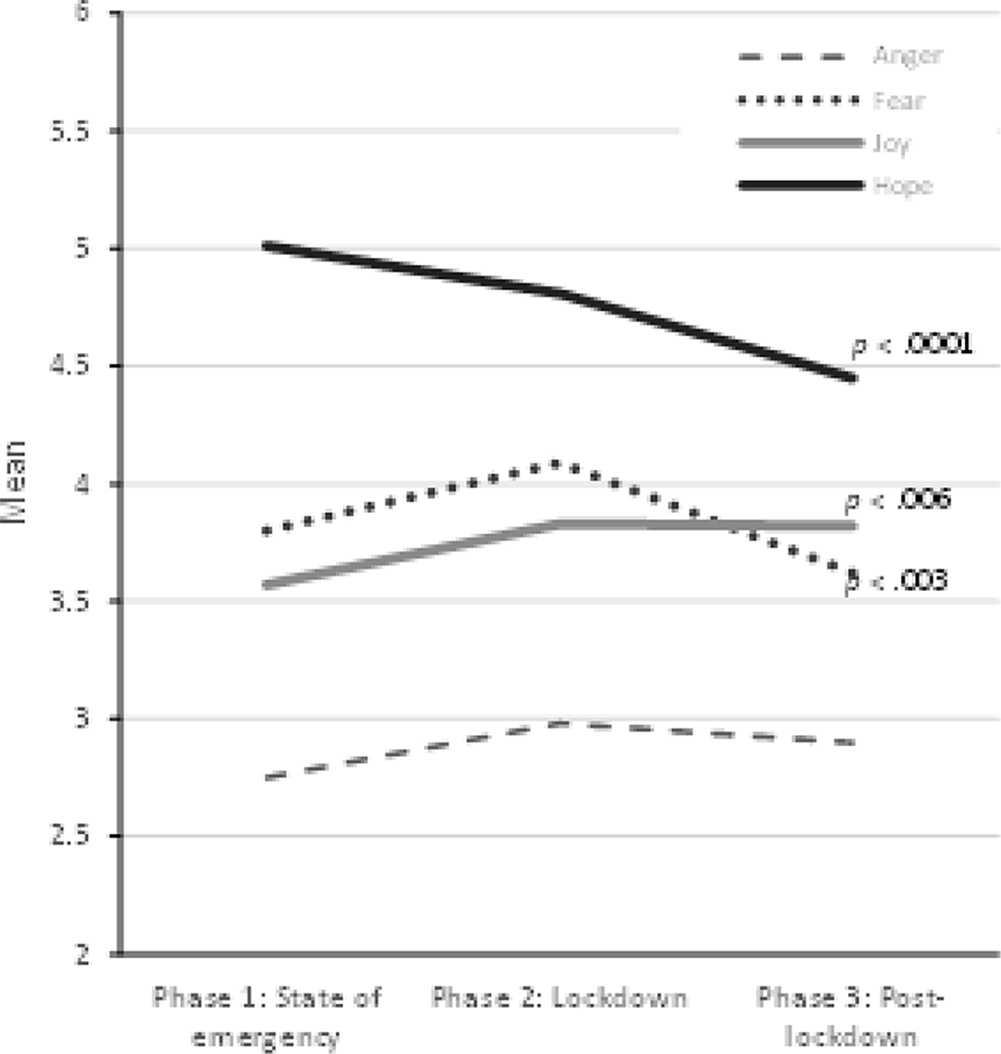
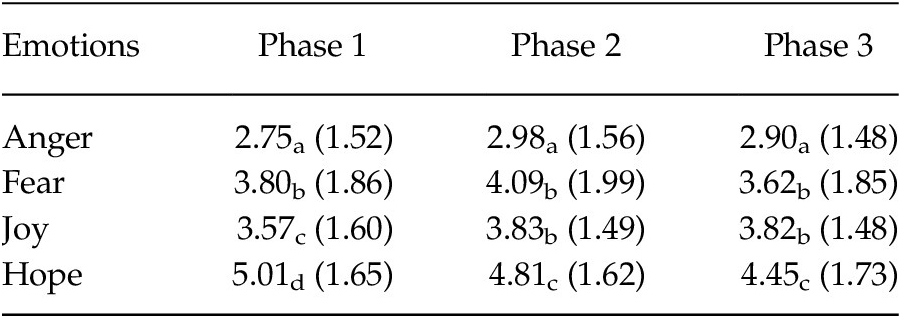
First, we ran a mixed ANOVA with emotional categories as the within-subject factor and temporal phases as the between-subjects factor. The results showed significant main effects of emotions, F(3, 4,383) = 235.78, p < .001, ηp2= .14, and phases, F(2, 1,461) = 5.19, p = .006, ηp2 = .007. These effects were qualified by a significant interaction, F(6, 4,383) = 6.26, p < .001, ηp2 = .008, showing that emotional reactions differed depending on the pandemic phase. Figure 1 and Table 1 show the means and standard deviations of the frequencies of inner emotions self-reported for each temporal phase.
Mean Frequencies for Inner Emotions

Mean Frequency (SDs) for Inner Emotions by Phase

Note. Means in the same column that do not share the same subscripts differ at p < .05.
A within-subject ANOVA on emotions for each phase showed the same pattern, with anger being the least frequent emotion and hope being the most frequent (see Table 1). Post hoc comparisons indicated that during the first phase (state of emergency), all emotions differed from each other. During the lockdown and post-lockdown phases, differences were significant between all pairs of emotions except between fear and joy.
To explore the temporal trends of the emotions, we calculated lineal and quadratic polynomic contrasts for each emotion. Hope decreased (p < .0001) and joy increased (p = .006) linearly across the phases. Fear changed quadratically (p = .003), meaning that the lockdown phase activated this emotion in individuals. Anger remained stable (see Figure 1).
Descriptive Feeling Rules
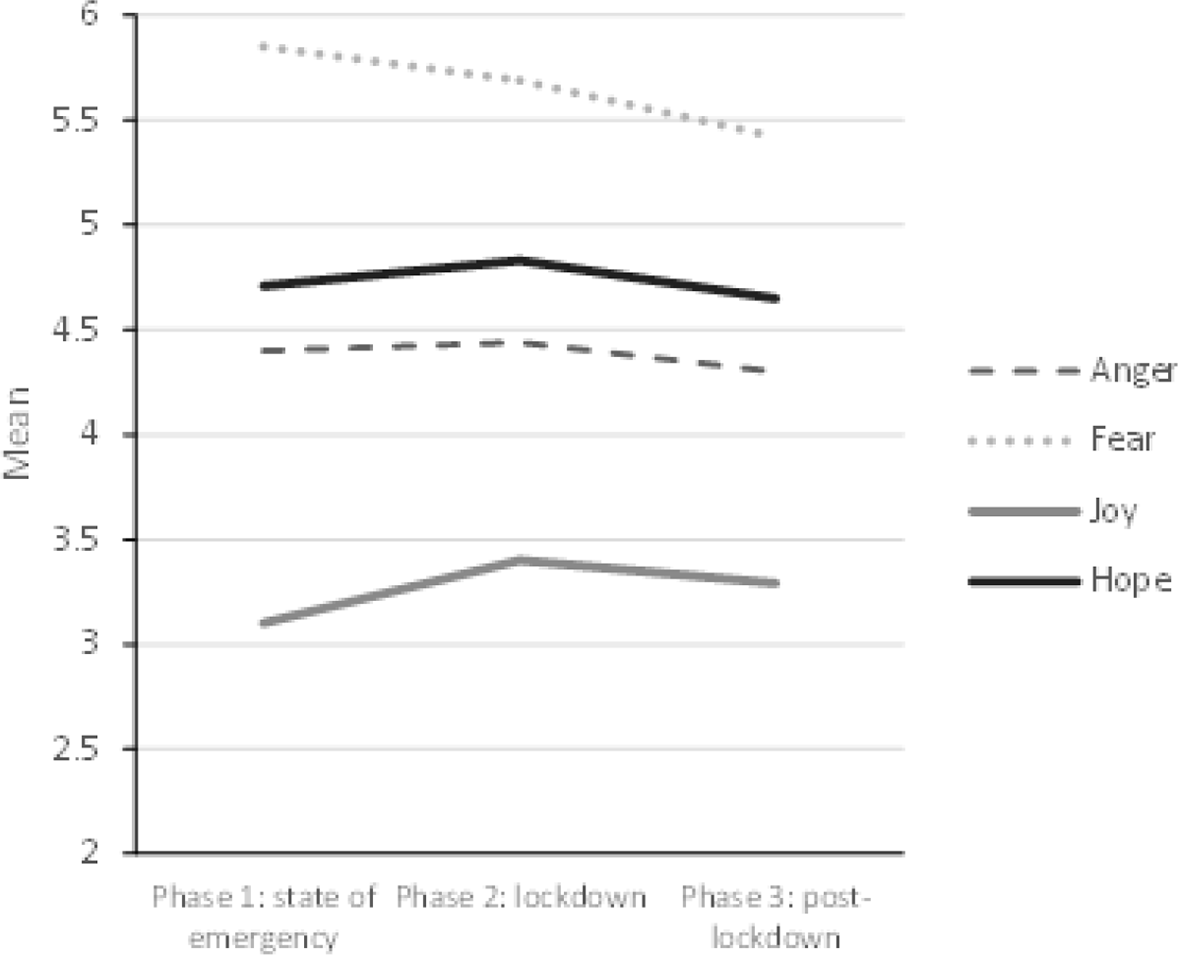
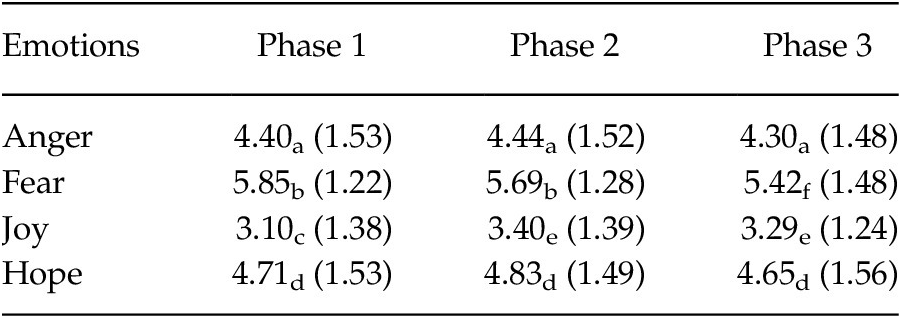
A mixed ANOVA with descriptive feeling rules as the within-subject factor and temporal phase as the between-subjects factor showed that the emotional category, F(3, 4,383) = 856.73, p < .001, ηp2 = .37, and temporal phase, F(2, 1,461) = 3.37, p = .035, ηp2 = .005, were significant. The significant interaction qualified the previous main effects, F(6, 4,383) = 4.63, p < .001, ηp2 = .006. Figure 2 and Table 2 show the results.
Mean Frequencies for the Descriptive Feeling Rules (Emotions Perceived in Others)

Mean (SD) Frequencies for the Descriptive Feeling Rules by Phase

Note. Means in the same column that do not share the same subscripts differ at p < .05.
We repeated the same ANOVA tests conducted with inner emotions. The results showed that in each phase, the frequency of emotions perceived in others differed (p s < .05). The most frequent emotion attributed to other people was fear, and the least frequent was joy. Lineal and quadratic polynomic contrasts were run for each emotion. Anger and hope did not vary across phases, whereas joy and fear did. Joy increased (p = .043) and fear decreased (p < .0001) lineally.
Comparison between Inner Emotions and Descriptive Feeling Rules
We ran a mixed ANOVA (2 emotional levels × 4 emotional categories × 3 temporal phases) with the emotional level (inner emotions vs. descriptive feeling rules) and the emotional category (anger, fear, joy, and hope) as within-subject factors and the temporal phase as the between-subjects factor. The results showed significant main effects of emotional level, F(1, 1,461) = 778.10, p < .001, ηp2 = .35; emotional category, F(3, 4,383) = 329.93, p < .001, ηp2 = .18; and temporal phase, F(2, 1,461) = 5.60, p = .004, ηp2 = .008. The following double interactions were significant: Emotional Category × Temporal Phase, F(6, 4,383) = 5.07, p < .001, ηp2 = .007, and Emotional Level × Emotional Category, F(3, 4,383)= 448.97, p < .001, ηp2 = .23. The Emotional Level × Temporal Phase interaction was not significant, F(2, 1,461) = 0.74, p = .47. The triple interaction was also significant, F(6, 4,383) = 6.62, p < .001, ηp2 = .009.
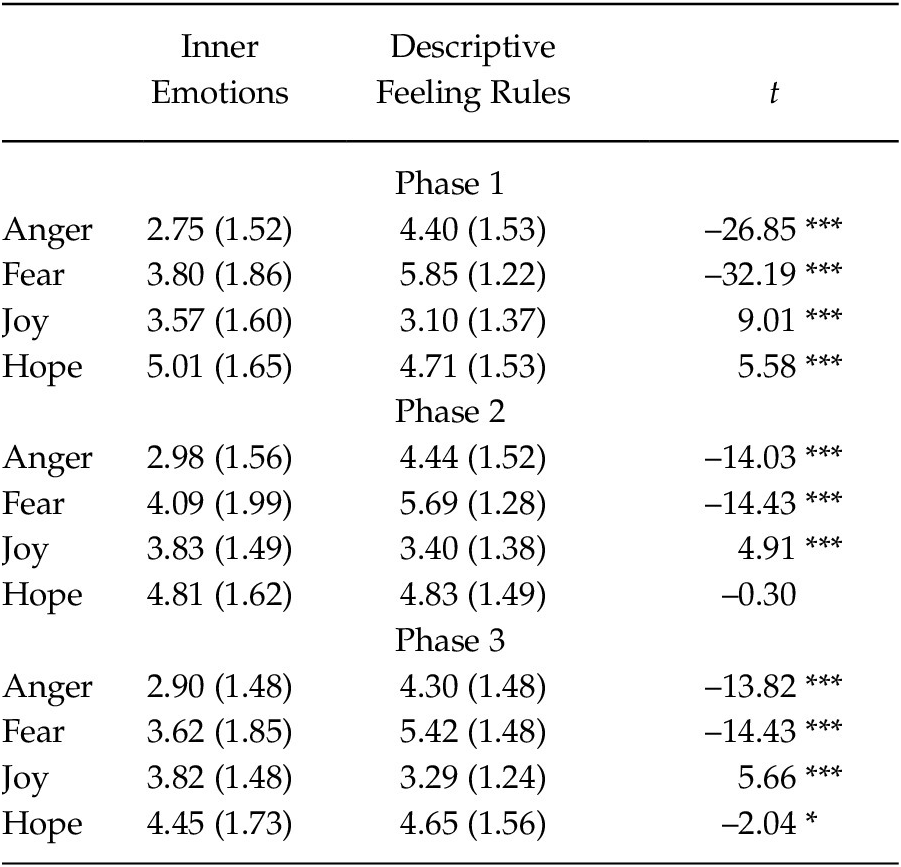
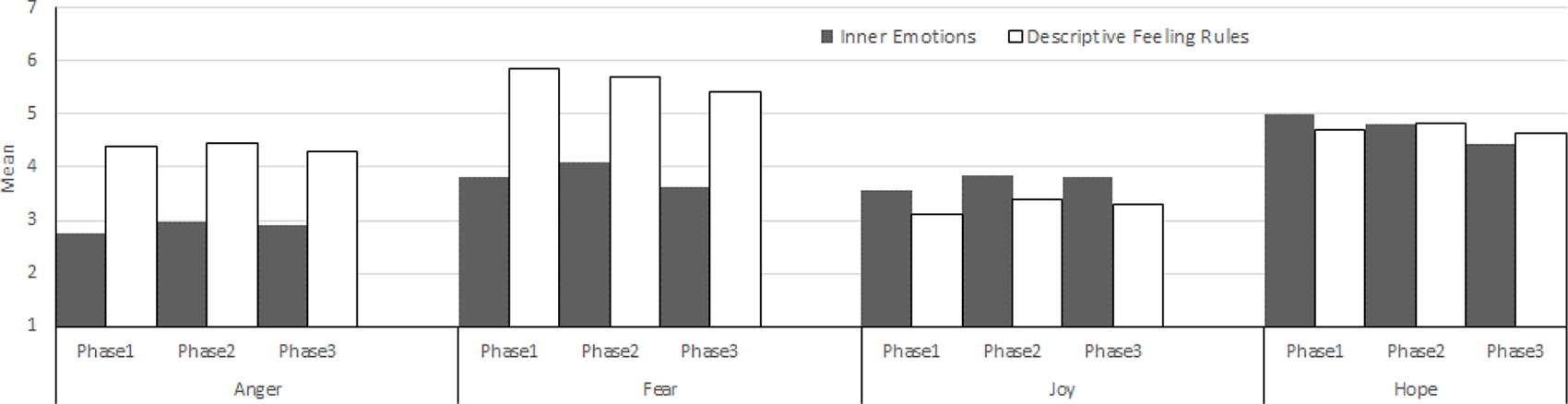
To explore these findings further, for each temporal phase, we conducted paired samples t tests between emotional levels for each emotional category. In all phases, joy was more frequently mentioned as an inner emotion than a descriptive feeling rule. However, anger and fear were more frequently mentioned as descriptive feeling rules than inner emotions. Hope was frequently mentioned in the first phase as an inner emotion. In the third phase, it was slightly more frequently mentioned as a descriptive feeling rule (see Table 3).
Inner Emotions and Descriptive Feeling Rules during the First Wave of the COVID-19 Outbreak in Spain

Note. *p < .05. **p < .01. ***p < .001.
The different patterns found among the individual and interpersonal levels reveal that although emotions are assigned the same verbal category (emotion word), their emotional meaning differs depending on the level of analysis (personal vs. interpersonal).
The emotions personally felt and perceived in other people in relation to the coronavirus pandemic varied across the different temporal moments of the first wave of COVID–19. In general, positive emotions were greater when they were reported as inner emotions than as emotions perceived in others. The opposite was found for negative emotions: People perceived more negative emotions in others than themselves (see Figure 3). Thus, the results support the importance of distinguishing among these emotional levels.
Comparison between Inner Emotions and Descriptive Feeling Rules across the Phases

Study 2
In Study 2, we explored how different emotional categories were associated with the term “coronavirus” in Spain. The term “coronavirus” was the most popular word used to refer to COVID–19 in Spain (Idoiaga Mondragon et al., Reference Idoiaga Mondragon, Berasategi Sancho, Dosil Santamaria and Eiguren Munitis2021). We consider this level to be macrosocial because we do not measure subjective emotions experienced or perceptions of others’ emotions but symbolic associations between coronavirus and emotion words. This approach follows previous research conducted by Fernández-Dols and collaborators (Reference Fernández-Dols, Carrera, Hurtado de Mendoza and Oceja2007), who evaluated emotional climate using the most popular internet search engineFootnote 2 to measure the prevalence of different socioemotional conventions in different countries. The authors reasoned that “differences in the prevalence of emotional categories at different times can provide us with interesting hints about the most typical emotional conventions in a society” (p. 345). Based on this idea, we assume that those emotions more frequently paired with the term “coronavirus” will reflect the socioemotional conventions about this pandemic.
The aim of evaluating millions of associations spread throughout a society is an enormous challenge that the internet can assist with overcoming. The Internet offers access to multiple virtual settings built by one or several individuals in a national domain where some terms are associated with others in a network of relationships.
Participants
Following the procedure used by Fernández-Dols et al. (Reference Fernández-Dols, Carrera, Hurtado de Mendoza and Oceja2007) to evaluate emotional climate, we sampled via an internet search engine (Google) how many sites included the term “coronavirus” combined with different emotion words (Spanish terms: Miedo [fear], enfado [anger], tristeza [sadness], alegría [joy] and esperanza [hope] in the domain of Spain and web sites including this domain (i.e., *.es). This search included other terms not related to the present purpose. In this study, we used each search as individual input. We collected 110 independent measures of each combination (e.g., coronavirus * miedo *.es).
Data were collected daily from March 10th to April 13th in 2020; later, as the pandemic became protracted, we decided to collect data three times a week (Monday, Wednesday, and Friday) from April 14th to June 19th in 2020 and during the second and third waves from October 26th in 2020 to February 12th in 2021.
Google’s access to internet sites is probabilistic, so we tried to conduct the search with the same computer (without logging into a new session) and at the same time (at noon) in the shortest possible period (approximately 30 seconds) using a Python program that implements an automated search using the selenium, bs4, and pandas modules, along with the concurrent futures module for multithreading parallelization developed by Víctor García CarreraFootnote 3. In addition, a script was created to run an automatic service in Linux to periodically execute the search by programming what days and at what times our search engine runs.
Results
We estimated the relative frequencies of each combination (“coronavirus” and an emotional category) by using the number of national sites detected by the engine at the time of the check as the base rate. In all analyses, we followed a comparison logic because this kind of search using Google has some biases that prevent us from considering the data in an absolute way (e.g., Google changes its algorithms periodically). For this reason, the results must be interpreted in a relative way (i.e., from a comparative perspective). We evaluated how the association between coronavirus and a particular emotion term increased, decreased, or remained stable across the three waves. The frequency of each combination was calculated per thousand sample sites.
First, we consider six temporal phases to explore how emotions were differently primed across the coronavirus waves:
Phase 1 (first wave): From March 10th to March 29th. State of emergency in Spain (education centers were closed). Twenty searches were carried out per combination.
Phase 2 (first wave): From March 30th to April 12th. Lockdown in Spain (people must be at home with few exceptions, such as healthcare workers or police). Fourteen searches were carried out per combination.
Phase 3 (first wave): From April 13th to June 19th. First post lockdown period in Spain (people could go to work, but education centers remained closed). Twenty-four searches were carried out per combination.
Phase 4 (second wave): From October 26th to December 15th. The second post lockdown period, when the number of infected and deceased people increased significantly in Spain. Twenty-two searches were carried out per combination.
Phase 5 (second wave, Christmas): From December 16th to January 8th. Christmas time in Spain. During this period, a “happy” emotional climate is usually primed through social conventions such as wishing others a happy new year (see Fernández-Dols et al., Reference Fernández-Dols, Carrera, Hurtado de Mendoza and Oceja2007). Eleven searches were carried out per combination.
Phase 6 (third wave): From January 9th to February 12th. Third post lockdown period, figures indicated a large increase in infections and deaths. Fifteen searches were carried out per combination.
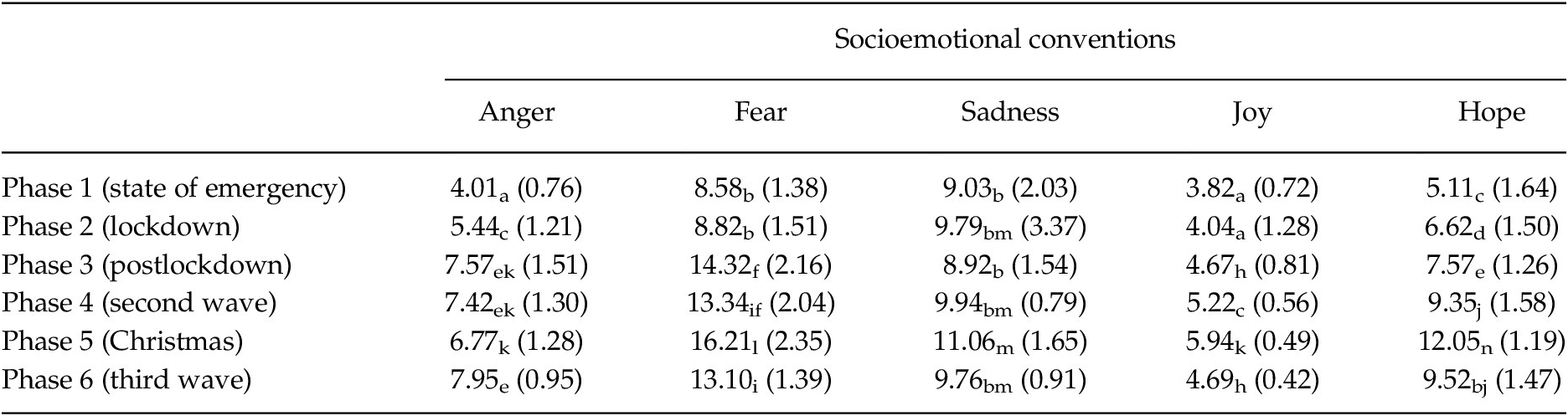
We conducted a mixed ANOVA (5 emotional categories × 6 temporal phases) with emotional category as the within-subject factor and temporal phase as the between-subjects factor. The results revealed significant main effects for phases, F(5, 104) = 35.90, p < .001, ηp2 = .63, and emotional categories, F(4, 416) = 620.42, p < .001, ηp2 = .86. Importantly, the interaction was also significant, F(20, 416) = 20.10, p < .001, ηp2 = .49. Table 4 shows the percentage per thousand (0/00) for each combination (coronavirus * emotion word) across the phases.
Means (SDs) of Searches (0/00) for Each Combination (coronavirus * emotion word) across the Phases

Note. Means in the same row or column that do not share the same subscripts differ at p < .05.
To explore this interaction, six ANOVAs for each temporal phase with emotion words as the within-subject factor showed significant effects in all periods (p s ≤ .004). Post hoc comparisons (see Table 4) indicated that in the first phase, all emotions differed from each other (p s < .001), except in the joy-anger and sadness-fear comparisons. In the second phase, differences among emotions were significant (p s ≤ .006), except between sadness and fear. In the first and second phases, sadness was the most frequent socioemotional convention paired with coronavirus, with joy being the least frequent. In the third phase, the pairs of emotions showed significant differences (p s < .001), except hope-anger. In the fourth phase, all pairs of emotions showed significant differences (p s < .05). At Christmas time, all pairs of emotions differed significantly (p s < .05), except joy-anger. In the last phase, all pairs differed significantly (p s < .05), except sadness-hope. From the third to the sixth phase, fear was the most frequent emotional convention, and joy was the least frequent. In summary, fear and sadness were the most frequently mentioned emotional conventions in the first phases, and from Phases 4 to 6, fear prevailed. For all phases, joy was the least frequently mentioned emotion.
ANOVAs with temporal phase as the between-subjects factor for each emotion word revealed interesting results. Joy increased over time until Christmas, when it presented the highest frequency; after this phase, joy began to decrease, F(5, 104) = 15.27, p < .001, ηp2 = .42. In a pattern similar to that exhibited by joy, the emotion of hope showed significant changes over time, F(5, 104) = 42.82, p < .001, ηp2 = .67. Anger showed different frequencies, F(5, 104)= 29.54, p < .001, ηp2=.58, with the lowest rates appearing during the first and second phases. In the other phases, the level of anger was similar, except at Christmas, when anger increased. Sadness showed differences across the phases, F(5, 104) = 2.80, p = .02, ηp2 = .12, peaking at Christmas. Finally, fear showed significant changes, F(5, 104) = 43.86, p < .001, ηp2 = .68, being lower during the first and second phases and increasing in the following phases.
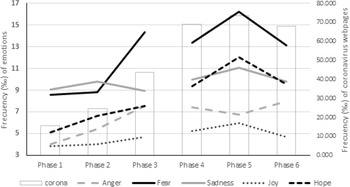
Several polynomic contrasts were run for each emotion. Anger varied across the phases. The linear and quadratic trends were significant (p s < .0001). Figure 4 shows a drop in anger during Phase 5 after increasing from Phase 1.
Evolution of the Association between Emotional Categories and Coronavirus across the Phases

Fear also varied across the phases. The linear, quadratic, and cubic trends were significant (p s < .0001). Figure 4 shows that fear increased during the phases, but two peaks appeared in Phases 3 and 5, especially after the first lockdown and the Christmas period. Sadness increased slightly across the phases (p = .030).
Hope varied across the phases. The linear and quadratic trends were significant (p < .0001). An increase is shown until Phase 5, with a drop in Phase 6. Joy showed the same pattern as hope (p < .0001).
Discussion
In the present research, emotion words have been the vehicle to study differences and similarities among different concepts of emotion. Because laypeople and scientists use the same emotion terms to refer to very different phenomena, it is necessary to clarify what we mean when using these terms. For decades, the same emotional categories have been used to refer to very different concepts; for instance, the word “happiness” is used to describe momentary affect, long-term disposition or affectively charged evaluative reactions (i.e., attitudes). The undefined nature of such terms has made the psychological literature on emotions a nightmare (Russell & Feldman-Barrett, Reference Russell and Feldman-Barrett1999; Russell, Reference Russell2003). To help clarify emotional concepts, we propose distinguishing among individual, interpersonal, and macrosocial levels when studying emotions. Our results supported this multilevel perspective.
The psychological constructionist perspective on emotions points out that emotions are conceptual categories that include numerous instances, sharing some characteristics but differing in others. Experience, perception, generation, and regulation are processes in which individuals play an active role (see Barrett, Reference Barrett2014): people construe their momentary emotional experience and regulate it, and they attribute and share emotions in social contexts. Across two studies, we found similarities and differences among inner emotions experienced, emotions perceived in others and emotions shared on social settings (the Internet), with all these emotional targets focused on the COVID–19 outbreak. The results revealed the suitability of studying emotions at different levels of analysis to capture and detail the diversity of emotion concepts.
Regarding Study 1, individuals reported higher frequencies of positive (hope, joy) than negative inner emotions (anger, fear); this result is consistent with previous research on emotions felt during the pandemic (see Balluerka Lasa et al., Reference Balluerka Lasa, Gómez Benito, Hidalgo Montesinos, Gorostiaga Manterola, Espada Sánchez, Padilla García and Santed Germán2020). In contrast, negative emotions (primarily fear) stood out more than positive emotions among the emotions perceived in other people. In the context of lockdown, where the only input one received from social media was terrible news about people getting sick and dying, it is reasonable to assume that people perceived negative emotions in others even if they were handling the situation perfectly well. In addition, information feeding this negative perception of others’ emotions may come from interactive situations during the pandemic in which individuals shared the most negative aspects of the pandemic on social media (e.g., WhatsApp) and in face-to-face interactions. For example, in Phases 1, 2 and 3, the most frequent interactions, and practically the only ones, were in supermarkets, where many people were concerned about social distancing and the use of face masks, tending to react angrily when those rules were broken. Such reactions could have been considered evidence of the predominance of negative emotions (anger and fear) in others, although it is likely that those people were not feeling those emotions out of/beyond that specific situation. Our data on emotions at the interpersonal level support previous results on social representation (e.g., Idoiaga et al., Reference Idoiaga, Berasategi, Eiguren and Picaza2020), where anger and fear were also the most relevant emotions associated with COVID–19.
This situational explanation may be completed by attending to the functional component of negative emotions. In a context such as the one present during the lockdown, sharing negative emotions could have been useful as a way to connect and sympathize with people who were going through hard times, which is compatible with the idea that intense negative emotions are more likely to be expressed when they are useful according to the present context (Ford & Tamir, Reference Ford and Tamir2012; Porat et al., Reference Porat, Halperin and Tamir2016; Tamir et al., Reference Tamir, Mitchell and Gross2008). In fact, expressing joy in a context where so many people are suffering would have been socially awkward, making it more difficult to perceive positive emotions in others even if they are experiencing them.
Regarding Study 2, the frequency of each search combination (coronavirus-emotion) reveals the link between the disease and a specific emotion in the internet forum. The frequencies of the combinations are indirect indicators of COVID–19’s emotional meaning on the internet, that is, the emotional conventions about the coronavirus. A higher frequency of an emotional combination meant that when people were searching for information about coronavirus on the internet, there was a higher probability of finding one emotion than another related to coronavirus. The association between a specific emotion and the term coronavirus loaded the disease with that emotional meaning, which could explain why the results for the emotions perceived in others are more similar to these results than to those for inner emotions. It is well known that media shapes public perception and opinion (e.g., Aslam et al., Reference Aslam, Awan, Syed, Kashif and Parveen2020; Trnka & Lorencova, Reference Trnka and Lorencova2020), so it is reasonable that the most frequent emotion words linked to coronavirus are those people attribute to others when they form assumptions about how they are feeling.
Emotional terms associated with coronavirus varied widely across the pandemic waves. However, a stable pattern emerged. Whereas coronavirus was mainly associated with fear in all the phases, joy was the most weakly associated term in all phases (in line with the results for feeling rules). Limited to the first 3 phases, sadness (together with fear) was highlighted. The predominance of negative emotions at the macrosocial level supports previous results found in the analysis of mass media during the COVID–19 pandemic (e.g., Idoiaga et al., Reference Idoiaga, Berasategi, Eiguren and Picaza2020; Trnka & Lorencova, Reference Trnka and Lorencova2020).
All emotions increased over time until the last phase (Phase 6), in which they decreased. This decrease may be due to the nature of Phase 5 and its correspondence with Christmas time. Christmas was an even more significant period than usual in Spain because people were finally allowed to get together with family after the lockdown measures, which explains the increase in positive emotions. However, because meeting family created a risk of COVID–19 transmission, many people decided not to see their relatives, so it was also a difficult time. This fact and the many losses could explain the increase in negative emotions such as fear and sadness during Phase 5. In Phase 6, after Christmas, the frequencies were similar to those in Phase 4.
The picture resulting from both studies indicates a similarity between the socioemotional conventions associated with COVID–19 and the descriptive feeling rules, whereas the reported inner emotions were clearly distinct. For example, there is a mismatch between the levels of joy found. Joy was irrelevant at the interpersonal and macrosocial levels but clearly important at the individual level. A mismatch also appeared with fear and hope. While fear was the most predominant emotion word at the interpersonal and macrosocial levels during most of the phases, it was moderately predominant at the individual level. Hope followed the opposite pattern, being the most relevant emotion word at the individual level but being less relevant at the interpersonal and macrosocial levels.
The studies presented have some limitations, as they analyzed a small number of emotional terms, the sample of participants in Study 1 would need to be larger to explore differences in variables relevant to emotional experience (e.g., age, sex, socioeconomic status), and the study on the internet could be completed with a content analysis of the sites. Despite these limitations, we think that our studies show the relevance of considering the different emotional levels in the analysis of emotional reactions.
COVID–19 has turned our world upside down. Due to the unprecedented nature of this event in the last century, it is reasonable to be confused about what is happening and how we should feel. The emotional context during the pandemic in Spain was predominantly negative, as can be concluded from the results of Study 2 and the descriptive feeling rule results in Study 1. However, the context does not necessarily match the individual emotions, and the results from Study 1 about inner emotions are a good example of this. While the media emphasized the connection between COVID–19 and emotions such as fear or anger and many people attributed those emotions to others, the majority of individuals felt joy and hope more intensely than negative emotions.
These results, far from depicting an incoherent emotional landscape, are proof of the different perspectives that can be taken to address the emotional aspects linked to the COVID–19 pandemic. Our studies support the psychological constructionist view on emotion by showing that when people face the same emotional event (COVID–19 pandemic), different emotion words emerge at each level of analysis. These data reveal that language (emotion words) plays a crucial role, as the constructionist approach suggests (see Lindquist, Reference Lindquist2017). People construe emotions differently depending on the level of analysis, using emotion words to acquire, organize, and communicate emotional knowledge. Differences and similarities found at the individual, interpersonal, and macrosocial levels indicate that language and emotion terms have an important role in emotion research.
Emotion words allow people to construe different emotional phenomena depending on the level of analysis: Feelings experienced subjectively that influence their thoughts and behavior, emotions perceived in others that affect social interactions, and emotional meanings that society prescribes and describes regarding COVID–19. Each level might have different consequences: Mixed emotions at the individual level might promote resilience; fear perceived in other people might be motivating protective behaviors; and social sadness shared during Christmas might generate greater empathy.
Finally, we note that professionals interested in emotions need to know the links among the different emotional levels to work effectively with emotional phenomena. For example, they should consider that socially shared emotions do not necessarily translate into personal experiences, a relevant point when designing mass media messages. Emotions felt and communicated could be better understood considering their differences regarding socioemotional conventions. Thus, people might assume that their feelings do not match those imposed by social norms and that they are not unhealthy or inconvenient. These results support the complexity of emotional concepts and the suitability of exploring them at different levels of analysis.