


Hunan produced the largest number and most able leaders for the Chinese Communist Party (CCP). How could this land-locked, sleepy and conservative province produce so many revolutionaries? Roy Hofheinz had this to say about Hunan: ‘Like Prussia she produced great generals and conservative aristocrats, like Hungary great nationalists, like Britain great reformers, and like France great revolutionists’.Footnote 1 Angus McDonald equated the Hunanese with eighteenth-century Virginians who played a role in the American war of national liberation.Footnote 2 This article examines the consequences of three consecutive political theatres and their actors from the 1850s to the 1920s that turned yumi zhi xiang or ‘home of fish and rice’ into a laboratory of reform and land of revolution. It focuses on what three generations of Hunanese did that pushed Hunan into and kept the province in the national spotlight. It tries to tease out the consistencies or the materials that gave them a common colour. The Hunanese, be they Qing loyalists, constitutional reformers, Han nationalists or communists, dominated China's political stage from the 1850s to the late twentieth century. They were patriotic and pragmatic in their patriotism, and they might have made the Communist Revolution more fundamental and bloody. Would the revolution have been so had Champagne liberals or those with no militarist tradition controlled the helm? What, first of all, gave rise and eminence to Hunan for a century and half? With the tide of Hunan gone (apparently not in Taiwan as opposition leaders Ma Yingjiu and Song Chuyu are both Hunanese), we must re-examine this province to see how it had shaped and changed the course of modern China.
A few historians have written about Hunan in the period between the 1890s and 1920s.Footnote 3 Charlton Lewis focused on the transformation of ideas and institution between 1891 and 1907. Hunan's rise, as Roy Hofheinz summarised Lewis's work, stemmed from ‘a proud, self-confident elite, a history of domestic turmoil and repression, the strength born of isolation, and resentment of foreign intrusion’.Footnote 4 Hunan was proud of its role in the suppression of the Taiping and of its resistance against Western encroachment. Joseph Esherick studied reform and revolution between 1897 and 1913. He argued that Hunan was transformed from the ‘center of Chinese conservative and anti-foreignism’ to the ‘home of Mao Zedong and many other modern revolutionaries’.Footnote 5 Agnus McDonald wrote about the early stages of the Communist Revolution in Hunan and believed that the province is not ‘typical’ but that it was a ‘training ground for the leader of the Chinese revolution, where influences from rice paddies and the vast world systems intersected in unique ways’.Footnote 6 The study of Hunan is reviving. Stephen Platt has recently finished a study on the rise of Hunanese nationalism through the revival of Wang Fuzhi during the late Qing dynasty.Footnote 7 Historians are finally getting to the key issue. Hunanese nationalism was the driving force behind Hunan's rise as Platt correctly asserted. I shall add that pragmatism, often manifested in the form of militarism, was another element that gave eminence to the province.
The map of Hunan looks like a human head with its nose in the Hunan-Guizhou border area and its throat in the Hunan-Guangxi border region; the province of Hubei looks almost like a hat on top. Hunan sits in south-central China and the middle Yangzi River Valley with an area of 83,398 square miles. To put this in global perspective, the province is on the same latitude as Egypt and the American state of Florida, and it is nearly the size of England. Surrounded by six other provinces it is also separated from them by the Dongting Lake–Yangzi River in the north, the impenetrable ethnic (Tujia and Miao) region in the west, the Nanling Mountain chain in the south and the Luoxiao Mountains in the east. Hunan has four large rivers—Xiang, Zi, Yuan and Li. The Xiang or Hunan's mother river flows into China's mother river, the Yangzi, and on to Wuhan—the emporium of China, and thereafter the Grand Canal. These waterways were Hunan's ‘commercial arteries and a primary source of livelihood’.Footnote 8 Hunan is linked with the maritime world because it sits on the passageway between Guangdong and northern China. This became more obvious as the Canton-Beijing railway zigzagged its way through the province. The terrain is mountainous but fertile in the lowlands. It experiences the four seasons; but, it is not distinctly cold in the winter, with only occasional snow. This topography and weather allow the Hunanese to cultivate and harvest three times a year. Huguang shu, Tianxia zhu is a saying that translates as ‘when Hu-Guang harvests, all under Heaven has plenty’. Hu-Guang in general refers to the regions of Hunan and Hubei, Guangdong and Guangxi.
Hunan is a rice basket of China. This rich agriculture economy bred a rich land-owning class. It also gave birth to a landless peasantry who were the source of military recruits and the reason of Hunanese militarism. In addition to rice and manpower, Hunan is home to fine teas and the legendary Xiangfei zhu or the mottled bamboo—a much favoured material for opium pipes. European demand for tea and Chinese demand for opium, the availability of Hunan coolies to transport these goods and its passageway geography, made Hunan central in the economic lifeline of China from the eighteenth to the early twentieth centuries. This was not all that Hunan had to offer. She also exported dried fish, tung (paulownia) oil, hides, tobacco, woven cloth and indigo. The province was blessed with China's only coalmines in the south—the Zixin Mine and the Anyuan Mine where the CCP experimented with labour union revolutions early. Hunan is endowed with iron, antimony, gold, silver, copper, zinc, tin and sulphur in addition to one of the largest lead deposits in China. The province would fascinate many Japanese—the Daito (Great Eastern) Steamship Company, the Osaka Shipping Company and the Toa Dobun Kai (East Asia Common Culture Society) among them. The Society opened a language school for Japanese students in Shanghai and sent them to learn more in Hunan. Hunan's minerals attracted not only the Japanese but also the British, the Germans and the Americans. The export of tin, lead and zinc grew rapidly during the First World War, a topic very few historians have researched. Hunan's human and natural resources facilitated trade, contributing to Hunan's economic well-being and urbanisation.Footnote 9
Self-sufficiency made some Hunanese prosperous and others proud. It also bred an intellectual tradition that was inward looking and conservative. Hunan supplied the country with scholar-officials throughout history, but it had not been outstanding. It produced only 726 of the 26,747 jinshi during the Qing dynasty, ranking fifteen out of nineteen provincial units.Footnote 10 Nevertheless, it was home to Qu Yuan, the patriotic scholar-official of the Warring State period, to Yuelu Shuyuan (Changsha) and Shigu Shuyuan (Hengyang), two of the top six classic academies founded in the Song dynasty, and to the seventeenth-century philosopher Wang Fuzhi. A Ming loyalist, Wang was dramatised by the Manchu conquest and resented its rule. His works were banned by the Qing court until the 1870s when Hunanese scholars and officials revived them as Stephen Platt has argued. Anti-Qing intellectuals and activists picked up his patriotic writings, but the revival of an anti-Qing scholar at a time of Qing restoration certainly invites explanation. Wang had laid the foundation for future intellectual trends as the province saw the emergence of pragmatic scholar-officials such as He Changling, Wei Yuan and Tang Peng who would re-define and enrich Wang's statecraft thoughts. Some of them were very anti-foreign, as the province became a last stronghold against missionary penetration. This was manifested in 1891 when a series of anti-foreign riots and killings broke out in the larger south-central region.Footnote 11 Nevertheless, this changed after the Sino-Japanese War in 1895. Hunan's intellectual elite chose the road of reform and learning from the West in general and from Japan in particular. They were not only patriotic but also, and more importantly, pragmatic in their patriotism.
The first political theatre that put Hunan in the national spotlight and kept it there was the Taiping Rebellion (1851–1864). Historians have produced excellent works on the history of the Taiping, and I shall not elaborate here. It broke out in Guangxi province, Hunan's immediate neighbour to its southwest, in January 1851. By June 1852, the Taiping forces were moving towards Hunan and ready to take their first big prize—the capital Changsha. Central and local governments summoned reinforcement troops from both neighbouring and distant provinces with the hope that they could crush the rebellion in its infancy in Hunan. However, this was not successful. On the one hand, the Qing military machine had been in decline; it had neither morale nor resources. On the other hand, thousands of Hunanese joined the rebel forces, making their victory in Hunan possible. The province was a source of military recruits; this was the beginning of Hunanese militarism. The Xianfeng emperor began to look for other ways to fight the advancing Taiping with an empty treasury. The practice of using landlord-/gentry-financed peasant militia was not new; it gained attention during the Opium War when they helped deter British forces in Canton. The idea of using armed peasants to fight the Taiping, even though precarious, was too good to ignore in a time of disaster. The emperor gave this job to Zeng Guofan, then Vice-minister of the Board of Justice, in January 1853. Born and educated in Hunan, Zeng might well have died unknown like many other scholar-officials. His time called for his service and put his talent to test. Zeng's appointment and legacy would change his native Hunan and China forever.
Working with powerful local gentry and his generation of elite scholar-officials, Zeng assembled a Hunan militia called Xiang Jun or the Xiang Army, Xiang being Hunan's mother river; they were also called Xiang Yong, the Hunan Braves. They became an elite military corps under the leadership of Zeng and three of his colleagues—Zuo Zongtang, Hu Linyi and Peng Yilin. Hunan was the second province to introduce lijin (likin) in 1853. This was a tax levied on goods travelling in the interior (once they left port cities in the case of import), and it was at the discretion of local governments. It was introduced precisely to help local governments finance campaigns against the Taiping. The Hunan Braves helped to crush the Taiping in 1864. Historians have written about the Hunan Braves and lijin. My concern here is not how Zeng Guofan managed to suppress the Taiping but the consequences of his rise to national eminence. Zeng and his colleagues saved the dying Qing Empire; they enhanced Hunan's reputation and inflated the value of the Hunanese. They made some believe that they could save the country and instilled in others a deep sense of responsibility and destiny. This conviction would be a constant for a century and a half to come; it was the key to Hunan's rise and eminence. As Zeng, his colleagues and the Hunan Braves distinguished themselves on the national stage, they became the new elite in China but more particularly in Hunan. They put Hunan in the national spotlight, and this had consequences.
The victory over the Taiping rebels earned Zeng the hereditary Marquis title; more importantly, it earned him prestige in the Qing court and political establishment, even though he lost it soon as the Hunan Braves were demobilised after the Taiping. Zeng, a scholar and civil official, had become some sort of warlord that the Qing dynasty could not do without. His colleagues, subordinates and protégés, perhaps as many as 2,000 persons, also received titles or positions. Some followed him around the country to suppress more rebellions, such as the Nian (1851–1868) and the Muslims (1855–1873). Some married into the old establishment; many married their children to each other. Some retired and devoted themselves to teaching in Hunan, while others rose in the ranks of civil and military administrations. The eminence of Hunanese in 1865, first post-Taiping year, can be seen from the positions held by Zeng, his son, colleagues and protégés:

Of the ten governor-general administrative units, six had governor-generals who were Hunanese; of the fifteen governor provincial administrative units, five had governors who were Hunanese.Footnote 12 Zeng and his protégés controlled the capital, the entire east-southeast coast, the entire northwest and southwest regions, grain and salt transportation, the Huai and Yangzi rivers or the Grand Canal and the Ministry of War. That is, they controlled the richest region (this continued to 1903), the border provinces, vital transportation and passage in the interior; they controlled strategic places. Zeng Guochuan, Zeng's younger brother, became Deputy Minister of War. Guo Songtao and Zeng Jize, Zeng's elder son who inherited his Marquis title, became China's first and second ambassadors to Britain and France. Large numbers of Hunanese appeared on the national political stage; this continued in the 1870s and 1880s as their protégés rose to power and they, in turn, promoted more Hunanese. These Hunanese were among the grand secretaries, grand ministers of state, ministers and vice-ministers of the six ministries and various bureaus, academicians of the Grand Secretariat, chief ministers of the nine courts, directors of schools, metropolitan and provincial chief examiners, special envoys, foreign office ministers, ambassadors and many more. Of the 714 national ranking figures of the Qing, 51 were held by Hunanese.Footnote 13 Hunan was second only to Jiangsu (144) and Zhejiang (102) provinces. Many Jiangsu-Zhejiang scholars marvelled at this achievement in their memoirs.Footnote 14 Hunanese filled national and provincial political establishments; they were most visible on the military stage.
The 1885 compiled Hunan Tongzhi listed that Hunan supplied the country with 6,319 military personnel. Of these, 478 were provincial military commanders, 1,077 regional commanders, 1,534 vice commanders, 1,464 lieutenant colonels and 1,766 majors.Footnote 15 Hunan had become the major supplier of soldiers, commanders and generals; this was the ascension of Hunanese militarism. The saying was Wu Xiang Bu Chen Jun—‘No Hunanese, No Army’. The Hunanese helped defend the Qing Empire and they were in practice like warlords. Although Edward McCord dismissed the idea that warlordism can be traced back to the Hunan Braves, I still believe that the example they set had a lot to do with the warlordism that plagued China in the early twentieth century.Footnote 16 Zeng and his legion dominated the national stage; they were, more importantly, the new elite in Hunan. Ties to one's native place are genealogical. Not only did they visit often and flash their prestige but they also came to dominate local agenda: political, educational and economic. Many of them began their career by helping Zeng organise and finance peasant militia; they continued to be active in local defence and tax collection. They were in theory advisers to but in practice superintendents of local governments. This had a most profound impact on Hunan as it emerged to be one of the best guarded and best taxed provinces. Many local scholars and officials serving in Hunan noticed that, as did H. B. Morse:
Even the central provincial administration, alien to the province, dared not oppose the considered opinion of the gentry, strengthened by the support of the Hunanese officials holding office in Peking and in every province, and of the retired officials who had returned with their large fortunes to their Hunan homes. As a result, the administration was more efficient and less corrupt than in any other province in China; the likin collection was more simplified and less burdensome; and the difference between what the people paid and the treasury received did not reach such large dimensions.Footnote 17
This new elite guarded the empire and helped keep local law and order in Hunan. They reinforced in theory and practice the statecraft school political philosophy, that is, institutional change within tradition; and they galvanised learning. While some retired to a comfortable country-scholar life, others devoted themselves to research and education. The old academies, Yuelu, Shigu and Chengnan, became the centre of learning and political debate. Zeng was a graduate of the prestigious Yuelu, as was Guo Songtao, Zeng's close colleague and heir to the Hunan legacy after Zeng died in 1872. Upon his semi-retirement, Guo undertook teaching and research in Changsha. It was here that he redefined and revived Wang Fuzhi as Steven Platt has argued. Moreover, it was through this revival that Guo passed on the Hunan legacy and trained the next generations of Hunanese who would carry it to higher grounds. Zeng and Zuo's generation of elite scholar-officials were educated in these traditional shuyuan. It was only natural that they became the benefactors, masters/deans, resident teachers and frequent guest lecturers of these old classic learning institutions. More patronage and profile meant more learning, more students, and ultimately more literati and scholar-officials. Their own children read in these academies, as would the next generation of Hunanese who would be more zealous about their responsibility and more radical in their approach. Among them was Tang Chaichang (Yuelu), key to radical reform in the late Qing, and Yang Changji (Chengnan), key to the spread of communism in the early Republican era. While ordinary Hunanese took advantage of the learning opportunities in these academies, others would use their native-place connections to climb the ‘ladder of success’.
Zeng Guofan and the Hunan Braves helped create new elite and revive learning in Hunan; it also made many Hunanese even more inward looking and conservative. The province seemed to have settled into a mood of self-congratulation when the self-strengthening movement gathered steam in the port cities in the 1870s and 1880s. But this soon changed. Another national disaster would keep the next generations of Hunanese, many inspired by Zeng Guofan and most educated in these academies, in the national spotlight. How then should we put the consequences of the Taiping theatre in its historical place? Hunanese was not exceptional because Anhuinese also responded to the Taiping with the Anhui Braves. However, Hunan became exceptional when the sense of responsibility was passed on to the next generation and when patriotism took a very different political conviction in the second political theatre. Patriotism and pragmatism, in the form of militarism, were the materials that gave this and the next generation of Hunanese a common colour.
The second political theatre was the Sino-Japanese War. The Hunan Braves helped to suppress not only the Taiping but also the Nian and Muslim rebellions in the late nineteenth century; but their ultimate test came in 1894 during the Sino-Japanese War, a topic that deserves the joint attention of Korean, Japanese and Chinese historians. The Tongzhi and Meiji restorations were launched almost at the same time in the 1860s. However, Japan did a better job than China. She had quickly transformed itself to become the dominant power in Asia and was ready to expand beyond her borders when a peasant rebellion broke out in Korea in 1894. Both China and Japan raced to ‘help’ the Korean king. The Japanese moved faster, seizing the Korean palace and appointing a regent loyal to them in July. A Japanese cruiser then intercepted and sank a Chinese ship that carried 1,200 soldiers. They nearly destroyed the majority of the newly created Northern Navy Fleet stationed in the Shandong Peninsula. Japanese land forces entered China by October and engaged Chinese soldiers in southern Manchuria in early 1895. Within six days, the Japanese captured three key military positions in southern Manchuria—gateway to the capital, while the Japanese Navy sailed freely across the Yellow Sea—the throat of Beijing. The Qing court sued for peace and signed the humiliating Treaty of Shimonoseki in April, which ceded Taiwan and the Liaodong Peninsula to Japan. The Chinese who battled the Japanese during this period were none other than the famous Anhui and Hunan Braves.
Many were surprised at China's defeat; but many more were disappointed with the Hunanese. The invincible Hunan Braves were no match for the swiftly westernised Japanese Navy and Army, and legends of their bravery were shattered. This certainly mattered more to the Hunanese than to others. It disturbed patriotic Hunanese intellectuals and ‘began a period of crisis for the Chinese literati’, as Lewis correctly put it.Footnote 18 An article in Xiang Bao or Hunan Newspaper noted, ‘The defeat of 1894 is really the fault of we Hunanese; we have let the country down and the people have suffered’.Footnote 19 The Hunanese took this defeat and humiliation to heart. Among the most soul-searching was Tan Sitong; he wrote, ‘External threat is deeply entrenched. Our Navy is wiped out; this is extremely frightening . . .. Our people are let down; our country and our race will be finished. Only reform, alas, can save the situation’.Footnote 20 Tan's father was a protégé of Zeng Guofan and governor of Hubei province; he admired Zeng Guofan, Guo Songtao and was a fervent believer of Wang Fuzhi. Not only did he, as well as many others, feel responsible for Qing's failure but he also began to act upon a conviction that they could save the country. This had originated in the Taiping period with his father's generation; it now passed on and inspired his generation. We see what linked the two generations. When patriotism assumed the form of diehard loyalty to the Qing dynasty with the Zeng Guofan generation in the Taiping theatre, it took on the identity of radical reform and soon nationalistic revolution with the Tan Sitong generation in the post–Sino-Japanese War decade.
Defeat at the hands of a smaller Asian country, one that China had traditionally regarded as a vassal state, convinced not just the Hunanese that the ‘self-strengthening’ was not fast or deep enough. More radical reforms were needed to transform China. More reform meant more learning from the West in general and from Japan in particular. The consequences of the post–Sino-Japanese War in Hunan, as I shall argue, gave birth to a generation of radical reformers and soon Han nationalists; and it encouraged the learning of Western knowledge in Japan. This, in essence, was similar to the consequences of the Taiping theatre—the creation of new elite and the galvanising of learning. Tan Sitong met/consulted Kang Youwei and Liang Qichao, Cantonese reformers, and decided that reform should start from his home province. Tan gave up his comfortable job in Nanjing and returned to Hunan. He became the spokesperson and leader of reform in Hunan where many, Xiong Xiling and Tang Chaichang among them, who shared his ideas, had already begun the process. This generation of local elite, like those who organised/financed the Hunan Braves, was again instrumental; more so was this generation of scholar-officials, the new Governor Chen Baoshen and the Education Commissioner Jiang Biao, both Zeng Guofan's protégés. Kang Youwei and Liang Qichao followed Tan to Hunan. Reform-minded intellectuals and scholar-officials converged on Changsha in November 1895, seven months after the Treaty of Shimonoseki. They were ready to put their reformist ideas into practice.
Chen Baoshen advocated the establishment of a mining bureau and the construction of a telegraph line controlled by the government. Hunan's lead gentry took loans to undertake such large projects as introducing electricity, steamship and railroad. They remained pragmatic, as they had been during Zeng's time even though many were not convinced about reform but believed involvement entitled them to control. The enthusiastic Education Commissioner Jiang Biao and his followers turned Changsha into the laboratory of education reform. They organised the Xiang Xue Hui or ‘Hunan Study Association’ and the Xiang Xue Bao or ‘Hunan Study Newspaper’. Xiong Xiling established Shiwu Xuetang or ‘Academy of Current Affairs’ in the summer of 1897, whereas Tan Sitong responded with Liuyang Suanxue She or ‘Liuyang Mathematics Academy’ in his hometown. This was followed by ten other similar academies in other parts of the province. The ‘Academy of Current Affairs’ would become the flagship of reform as Liang Qichao became its dean and resident teacher. The school would train the next generation of Hunanese, some radical reformers and others Han nationalist revolutionaries. Kang Youwei often lectured there, as did other reform-minded scholars such as Huang Zunxian and Tang Chaichang, editor of Hunan's lead newspaper—Xiang Bao or ‘Hunan Newspaper’. It published frequently on subjects such as electricity, railways, steamers and mining. In the winter, Hunan's intellectual elite founded Nanxue Hui or ‘Southern Studies Society’, devoted to educating the local gentry/elite about its role in reform. This was a progressive grassroot socio-political institution and its principal teacher was none other than the zealous Tan Sitong.
By early 1898, Kang Youwei, Liang Qichao, Tan Sitong and Tang Chaichang had caught the attention of the young Guangxu emperor. They were summoned to the court to give advice. The enthusiastic emperor began, on their recommendations, to issue a series of edicts to speed up reform in the summer of 1898. This was the beginning of the so-called ‘hundred-day reform’ that ended in September, 103 days later, when Empress Dowager Cixi returned to power and issued edicts for the arrest of these radical reformers. Kang Youwei escaped to Hong Kong, Liang Qichao to Japan; but the rest were not so lucky. Six were caught and beheaded in public; Tan Sitong was among them and he was only thirty-three years old. Liang Qichao, in his reminiscence of the ‘hundred-day reform’, wrote:
Since the Academy of Current Affairs and the Southern Studies Society, the wisdom and spirit of the Hunanese suddenly opened up. Many private schools were established in the counties and districts. Elementary education was thriving. Everyone could talk about politics; they encourage each other with patriotism and the responsibility of saving the country. Patriotic talents were everywhere; they were in their 20s and 30s. No degrees, no titles, ordinary, they were numerous.Footnote 21
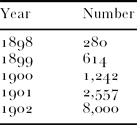
Liang did not mention Zeng Guofan's generation who had set the example and standard for later generations to come. With the chief architects of reform in exile and their main allies executed, the reform movement did not disappear; instead, it gathered new and greater momentum. The schools they founded, the newspapers they published and the young people they inspired would become the next generation of Hunanese reformers. They would indeed turn reform into revolution. They called for the overthrow of the Qing dynasty and the establishment of a republic. Hunanese patriotic intellectuals had found a good place to learn about reform and hammer out their ideas—Japan. In the decade after 1898, a heat wave of Hunanese students, followed by those of other provinces, studied in Japan. Some fled there for fear of persecution, while others went to learn. In 1896, the Qing Government sent thirteen students to study in Japan. The increase can be seen from these preliminary numbersFootnote 22:
While the disaster of the Sino-Japanese War inspired radical reform, the tragedy of the ‘hundred-day reform’ inspired revolution. One of the Hunanese students who went to Japan was Huang Xin. He returned to Changsha in the summer of 1903 and founded the Hua Xin Hui or ‘China Revival Society’ in November. The society, made up of Hunanese students who had participated in reform or studied in Japan, advanced the idea of ‘taking one province in order for other provinces to follow’ and the goal of ‘nationalist revolution to oust the Manchus’. The society planned its first uprising in Changsha in 1904. The news leaked and Huang escaped to Japan where he met Sun Zhongshan (Yat-sen). Sun had founded a similar revolutionary party called Xin Zhong Hui or ‘Revive China Party’ in 1896 and his slogan was also to ‘oust the Manchus, revive China, establish a republic and equalise the right to land’. Hunanese and Cantonese hence led the battle against the Manchus. Separately, they had laboured towards the same goal as Huang and Sun became close comrades. They combined their forces in 1905, creating the Tongmeng Hui or the ‘United League’ and began their final push for the overthrow of the Qing dynasty. The league managed to recruit 963 members in 1905 and 1906; 157 of them were from Huang Xin's native province Hunan and 112 from Sun Zhongshan's home province Guangdong.Footnote 23 Hunanese outnumbered Cantonese in Tongmeng Hui headed by a Cantonese. This would be repeated in the Huangpu Junxiao or ‘Huangpu Military Academy’ located in Guangzhou (Canton).
When Sun travelled around the world to raise money, Huang conducted the operations from Japan. Recent scholarship in China suggested that Huang was also a great militarist. He was the first to advance ‘take Hunan as a base’.Footnote 24 Hunan was familiar territory to Huang. Was he inspired by Zeng Guofan who drew human and financial resources from his home province? Did they somehow inspire Mao Zedong who turned it into a warfare theory to be copied by guerrillas around the world? Zeng, Huang and Mao are the most prominent Hunanese and they were known for their military skills; this reinforces the Hunanese militarism argument. Huang Xin directed six uprisings after their merger. The seventh broke out prematurely in Wuhan, Hubei province on 10 October 1911. It could have been yet another failure until Hunan responded to it with its own uprising in Changsha on October 20. Hunan was the first province to take action and other provinces followed. This made the Nationalist Revolution a reality, if not a success. Years of exposure to reform and the militarism tradition had made this possible. Huang was Sun's most able comrade and became his vice president. There were many more. Song Jiaoren, another Hunanese educated in Japan, was one and Cai E was another. A student from the ‘Academy of Current Affairs’, Cai followed his teachers to Japan and was crucial in the battle against Yuan Shikai who turned the revolutionary clock back and made himself Emperor of China in 1915. Cai was patriotic and unyielding just like Chen Tianhua, a temperamental Hunanese who wrote blood-stained letters to express his patriotism and who drowned himself in Tokyo bay in 1906 in order to wake up his fellow compatriots. Cai and Chen gave their young lives to save China; they would inspire more Hunanese.
Japanese universities and military academies had much to do with twentieth-century politics and militarism in China; the Japan connection only strengthened Hunanese militarism. Indeed, many Nationalist Party revolutionaries studied in Japan. They include Jiang Jieshi (Chiang Kai-shek), the paramount leader after Sun Yat-sen, and his generals, such as Bai Congxi and Tang Enbo, who would battle their Japanese teachers in the Japanese War. The Nihon Rikugun Shikan Gakkou or Japanese Army Officer School alone trained 1,638 Chinese students, many diehard militarists, from 1899 to 1942.Footnote 25 Many warlords, Yan Xisan and Sun Chuanfang, for example, began their career in Japanese military academies. Members of the collaborationist government during the war, Wang Jinwei, for example, studied in Japan; as did the founding fathers of the future Communist Party, Chen Duxiu, Li Dazhao, Li Da and Li Hanjun. The most prominent writers and artists, Lu Xun, his brother Zhou Zuoren, the poet Guo Moruo and the writer Tian Han who wrote the lyrics for the National Anthem, all studied in Japan. Although Joshua Fogel has studied the role of Japan in Liang Qichao's introduction of modern Western civilisation to China, we need to extend the study to Hunan, the province that led the movement of studying in Japan and supplied the largest portion of student intellectuals/activists.Footnote 26 In 1904, there were 2,395 Chinese students studying in Japan, 373 or 15.57% of them were from Hunan.Footnote 27 Hunan even allowed twenty female students to study in Japan.Footnote 28 This was consequential as they inspired later generations of Hunanese female students who would become first-generation communists.
Zeng Guofan's generation of elite invigorated traditional learning in Hunan, whereas the Sino-Japanese War and ‘hundred-day reform’ promoted the learning of Western knowledge in Japan. Continued emphasis on education led to the transformation of old learning institutions and the creation of Western-style schools in Hunan. The old Yuelu was transformed into Hunan University in 1903, and old Chengnan into Hunan Number One Normal School. The Yale-China Association founded the Yale Middle School in 1906 and the XiangYa (Hunan-Yale) College of Medicine several years later. Zhu Jianfan, another Hunanese educated in Japan, founded Zhounan Nuzhong or ‘Zhounan Girls Middle School’. Zhu devoted himself to the education of girls, and Zhounan produced first-generation female communists. Yang Kaihui, who would later marry Mao Zedong, Xiang Jingyu, the first female Central Committee member, Cai Cang, a long-time national leader, and many others were graduates of this legendary school. More schools meant more learning, more books and more ideas. Hunan had forty-seven middle schools by 1909, second only to Sichuan (much larger province).Footnote 29 To encourage learning, Hunan's government allowed half-day school so that many students could work to pay for their tuition and help their families. This unique phenomenon caught the attention of Mr. A. H. Harris, Acting Commissioner of Customs at Changsha, who meticulously calculated the number of schools and students to see whether they evaded taxes. These schools provided rudimentary education to the ordinary and prepared the next generation of Hunanese elite who would carry the Nationalist Revolution to a new height.
The Taiping Rebellion had pushed Hunan into the national spotlight; the Sino-Japanese War had kept Hunan in the spotlight, whereas the ‘hundred-day reform’ had sealed Hunan's fate with reform and revolution. How should we put the consequences of the Sino-Japanese War and the ‘hundred-day reform’ theatre in its historical place? Hunan was not extraordinary because the Anhui Braves also experienced defeat, whereas Guangdong also responded to the failure of the ‘hundred-day reform’ with revolution. However, she became extraordinary when her elite chose to learn from Japan despite the humiliation in order to save China and when her revolutionaries carried a nationalist revolution to a communist height, as we see from the third political theatre. Patriotism, the conviction that they were responsible for China's problem, and pragmatism, that is, whatever political conviction it took and again manifested in militarism, was the key to Hunan's continued rise and eminence.
The third political theatre was the Nationalist Revolution—an uprising that did not save China as Han nationalists had wished. The republic they imaged was quite different from the country they lived in. The gap between empire and republic was too wide, and the idea was too new to the large and scattered illiterate population. This created a vacuum for the politically shrewd as the post-1911 decade saw real disintegration and warlordism. To make things more complicated, the decade saw both the outbreak of the First World War and the Bolshevik Revolution. The momentum of mammoth socio-political change was not limited to China in the early twentieth century. Indeed, the whole world was undergoing a transformation as local or national events triggered global or international responses. The ‘Age of Extremes’ would play out in Hunan and act on this generation of Hunanese.Footnote 30 The aftermath of 1911 gave birth to a new generation of Hunanese, even more radical than the previous generation; and it encouraged the learning of Western knowledge in the West. This, in essence, is similar to the consequences of the previous two political theatres—the emergence of new elite and thinking, and the revitalization of learning. This would see the New Culture Movement and the birth of the CCP. Hunan would go through its own chaos and regression, as it saw nine governors in the nine years after 1911. Nevertheless, Hunan's patriotic intellectuals would build on years of experience and exposure and stay in the forefront of revolution.
The revolution unleashed the energy and imagination of Hunanese intellectuals. They were hungrier for new ideas than ever before, as the 1910s saw the emergence of yet another generation of political thinkers. Some were veterans from the reform era, while others were participants of the 1911 revolution. Prominent among them were Li Jinxi, Yang Changji, Xu Teli and Fang Weixia. When they read, translated foreign language books and compiled them into textbooks, others launched the mouthpiece of Hunanese intellectuals—Da Gong Bao—in September 1915, the same month in which Xin Qingnian or ‘New Youth’ was launched in Beijing. This showcased Hunan's prominence in political thinking. Publishing was key to the spread of new ideas; it now flourished with the help of the vernacular movement where the Chinese language itself was simplified. Many of these Hunanese thinkers taught at the Number One Normal School. They attracted many students, including the country boy Mao Zedong. When Yang Changji returned from a decade of studies in Britain and Japan, he encouraged his students to learn from the real world rather than just from books. Mao and his classmates, Xiao Zisheng and Cai Hesheng among them, organised themselves into a travel-study group in the summer of 1917. They walked to five counties in northeast Hunan to investigate peasant conditions; they also visited factories in Changsha and talked to workers. This was the origin of Mao's grassroots activism. Yang had a most profound impact on Mao as he experimented and would continue to play with Yang's ideas. Mao would marry Yang's daughter Kaihui, a graduate of the progressive Zhounan Girls Middle School and a revolutionary patriot in her own right.
News of the Bolshevik Revolution reached China on 10 October 1917.Footnote 31 This electrified Hunanese thinkers and activists who, along with many others, were deeply disappointed with the Nationalist Revolution. Many, not just those in Hunan, began to study communism and Russia. The appeal was obvious and the degree of relevance high. Like Russia, China had an agrarian economy and a large illiterate peasant population. No socio-political change would come unless their conditions changed. An urban-based bourgeoisie revolution did not and could not change that. A more sweeping revolution was needed and Russia had already shown the way. While some threw caution to the wind, others came to believe that communism could well save China. This generation of Hunanese, like the previous ones, did whatever it took to save the country. Mao Zedong, Cai Hesheng, He Shuheng and ten others founded the Xin Ming Xue Hui or ‘New Citizen's Study Association’ in April 1918. They set goals for themselves, the first being to study in France. Eighty-nine Chinese students left Shanghai for France on 17 March 1919; forty-three of them were Hunanese.Footnote 32 Among them were Mao's best friend Cai Hesheng, Li Lisan, Xiang Jingyu (female) and Cai Chang (female) of the Zhounan Girls Middle School. They also included Zhou Enlai and Deng Xiaoping. The Hunanese led in the tide of studying in Japan in the 1900s and they led again in the wave of studying in France in the 1910s. The formula is obvious by now. They believed they could save China and they were willing to do whatever it took to accomplish that. This was the material that gave two generations of Hunanese a common colour.
The enthusiasm for studying aboard pushed people to Japan after 1895; people enthused about studying in Europe, France, followed by Germany and Britain, and the United States in the post-1911 decade. When France drew revolutionary-minded liberals and radicals, the United States attracted enlightened bourgeois moderates. Among them were the Song sisters and brothers, the flag-bearer of the New Culture Movement Hu Shi, the Renaissance man Lin Yutang and the modern architect Liang Sichen (son of Liang Qichao). The list goes on as the United States returned to China some indemnities from the Boxer Rebellion in the form of scholarships. Just as those who studied in Japan became the pioneers of the Nationalist Revolution, those who studied in the United States became the backbone of the New Culture Movement and the nationalist regime, those who studied in France became the leaders of the Communist Revolution. Japan, the United States and France contributed to China's political transformation from imperial to republic and communist. Their history, politics and culture bore differently on Chinese students, the Hunanese in particular. The dynamics and significance of their encounters deserve systematic study. Yang Changji was invited by the Minister of Education Cai Yuanpei (German educated) to teach at Beijing University in the fall of 1918. Chen Duxiu, a Japan-educated political philosopher, was already there. These two magnets attracted many. Mao was also there working at the library. Mao met Chen and Li Dazhao—soon to be founding fathers of the CCP and returned to Changsha in April 1919. He would, like Tan Sitong and Huang Xi before him, practice his political ideas in his home province hastened by another disaster.
Bad news came from Paris in late April 1919 as China and Hunan's communism-excited intellectuals were debating and, in parts, working for a similar revolution. Victors of the First World War gave Germany's possessions in Shandong province to Japan through the Treaty of Versailles. This was the perfect and best catalyst. More than 3,000 students gathered on Tiananmen Square on the 4th of May and they stormed the residences of the officials involved. The tradition of Tiananmen Square was born. They went on strike the next day and led the whole country into a period of protest and boycott of Japanese goods. Like the defeat in the Sino-Japanese War, this convinced many of the urgency for not just revolution but also radical revolution. As in the aftermath of Shimonoseki, this humiliation seemed to have mattered more to the Hunanese than to anyone else. Deng Zhongxia, Mao Zedong and Peng Huang led demonstrations in Changsha and a province-wide strike and boycott on the 3rd of June. They even managed to oust then Hunan Governor Zhang Jinrao who was brutal to demonstrators. In July, a dozen new periodicals—Xiangjiang Pinglun or ‘The Xiang River Review’ among them, appeared. Mao Zedong, its editor, sang praises of the Russian Revolution as other members of the New Citizen's Study Association echoed him on Da Gong Bao. The Communist Revolution had already begun in Hunan in May 1919. This is probably why communist official history often emphasised the importance of May 4th.
The cold winter of 1919 saw heated debate among patriotic intellectuals, as many who were studying in Japan and in the West returned to China at this critical time. Li Dazhao, Deng Zhongxia and Luo Zhanglong organised a Marxist study group in Beijing in March 1920, whereas Chen Duxiu organised one in Shanghai in May. These Marxist study groups would soon become communist groups, the organisational foundation of the CCP. In August, the first 1,000 copies of Communist Manifesto, translated by Chen Wandao, were published in Shanghai. Chen had just returned from studying in Japan and settled in Shanghai. The city was a paradise not only for gold diggers but also for early communists as it had a working class, a rich ground for mass mobilisation. Like many others, Chen believed that communism could save China and began to translate the Communist Manifesto with the help of Japanese and English versions. In September, another 1,000 copies were distributed. Mao went up to Beijing in the spring of 1920 to consult with Li Dazhao and Deng Zhongxia, and then to Shanghai to meet with Chen Duxiu. He returned to Changsha in the winter and founded the Changsha Communism Group with eight members; this was followed by Wuhan and Guangzhou Communist groups in the same winter and Jinnan in the spring of 1921:

The first congress of the CCP was held in the French Concession of Shanghai in July 1921. In addition to the two representatives from Communist International, thirteen people attended the meeting. See the list on next page:

Four of the delegates, Li Da, Mao Zedong, He Shuheng and Zhou Fuhai, were Hunanese. Four of them, Li Da, Li Hanjun, Dong Biwu and Zhou Fohai, were educated in Japan. There was only one northerner, Wang Jingmei from Shandong. Twelve out of thirteen founding members of the CCP were from Hunan, Hubei, Jiangxi, Guizhou and Guangdong—south-central and southern China.
How can we put the Nationalist Revolution in its historical place even though its consequence is still reverberating today? Hunan was not special because the revolution unleashed the energy and imagination of many intellectuals and other provinces, Hubei, for example, also produced early communists. However, she became special when her patriotic elite carried the nationalistic revolution to a communist apex, and when the revolutionary spirit was passed to a few generations after as Hunanese came to dominate the political and military stages of twentieth-century China. This can be seen from the number of Hunanese enrolled in the famous Huangpu Junxiao or ‘Huangpu Military Academy’, founded by the Nationalist Party in 1924 and headed by Jiang Jieshi. ‘Hunan ranked first overall as a source of cadets. Of the total 4,937 who graduated from the first four classes, Hunan finished more than one quarter: 1,324’.Footnote 33 Guangdong, where the academy is located, ranked second with 682 cadets, whereas Zhejiang, whose native son Jiang Jieshi headed the school, ranked a poor third with 420. Hunan continued to be an important source of military recruits; this had long-term consequences as the academy split along the CCP and Nationalist Party or KMT lines after Sun Zhongshan (Yat-sen) died in 1925. Jiang Jieshi expelled CCP members or killed them; the CCP went underground and staged three uprisings. The Nanchang Uprising took place in Jiangxi province on 1 August 1927. Three hundred ninety-five people participated, 108 of them or 27.34% were Hunanese.Footnote 34 The Qiushou (Autumn harvest) Uprising took place on the Hunan-Jiangxi border in September 1927. One hundred sixty-seven people participated in this revolt, 89 of them or 53.29% were Hunanese.Footnote 35
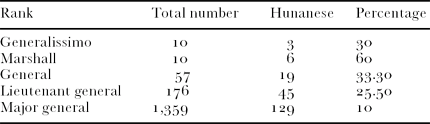
These CCP rebel forces marched toward the Jinggan Mountain area on Hunan-Jiangxi border where they established the First Soviet. The mountain and its protective terrain provided the best refuge for them. It borders Hunan, convenient to draw human and natural resources as more Hunanese came to join the newly founded Red Army. Hunan remained the source of military recruits and this continued into the 1930s and 1940s during the War of Resistance as Hans J. van de Ven has argued. This was more or less the same on the KMT side. Hunanese recruits ranked the third with 1,570,000, next to Sichuan and Henan at 1,898,000, in the KMT standing army.Footnote 36 This meant that they would dominate the CCP and KMT political machines for years to come. Of the twelve members of the CCP's Central Committee in 1945, four were from Hunan, of that in 1954, more than one-quarter was still Hunanese. Seventy-six Hunanese, the largest number from a single province, were included in the body of the most important CCP leaders in 1970.Footnote 37 On the military front, the eminence of Hunanese was even more obvious, as in the chart below. Since the time of Zeng Guofan in the 1850s, the Hunanese had not lost their militarist fortitude:
Three very different political theatres and actors brought Hunan into the national spotlight and kept her in the forefront of reform as well as revolution. Hunanese scholar-officials, intellectual elite and student activists played Qing loyalists, neo-Confucian reformers, Han nationalists and radical communists on the political stage of modern China. This was not a rational progression. What was rational throughout the three theatres was the consistency of patriotism and pragmatism. The formula is that when disasters of a colossal scale confronted China, Hunanese took up the challenge with audacity and originality. They were patriotic, that is, they felt responsible for China, and pragmatic in their patriotism, that is, whatever political conviction it took and they relied on local resources. Patriotism and pragmatism, consistently manifested in militarism, were what made Hunan tick. The bondage of dialect and food ways was certainly important, but more so were their conviction and ambition. What difference did this make to China? Hunanese might have made the Communist Revolution more fundamental or bloody, perhaps even ‘bitter’ for the struggle to come.Footnote 38 Would the revolution have been so had Champagne liberals or those with no militarist tradition controlled the helm? It was a miracle for the proletarian. What regime could bring such upward social mobility in such a short period of time? But it was delivered at a cost beyond calculation. Hunanese led China's revival, reform and revolution from the mid-nineteenth century. China would look different today without the Hunanese. They help us understand the making of modern China. Perhaps, it is better to study local history in our efforts to understand national and or even global history. Hunan is my case in point.
Acknowledgements
I thank the Asia Research Institute, National University of Singapore, for funding my trip to Academia Sinica in 2005 and my colleague Geoff Wade for his constant help. I am very grateful to Professor Zhang Pengyuan of Academia Sinica who took time out of his retirement to bear with my endless questions and guide me in the maze of sources.


